Archive for scientific publishing

Money and Open Access

Posted in Open Access with tags , , , , , , , on November 24, 2025 by telescoper

I was thinking when I did Saturday’s update of the week’s new papers at the Open Journal of Astrophysics that I should convey some idea of the amount of money being saved by using Diamond Open Access.

So far this year we have published 181 articles in the Open Journal of Astrophysics. That’s a very small fraction – a few percent – of the output of the established journals in the area, Astrophysical Journal, Astronomy & Astrophysics and Monthly Notices of the Royal Astronomical Society, MNRAS.

I will take MNRAS as an example for comparison. Last time I looked, the Article Processing Charge (APC) (i.e. publication fee) for a paper submitted there is £2356. Our 181 papers published this year would have cost their authors £426,436 had they had to pay the MNRAS APC. Some – especially in the UK – do not pay directly, but have an equivalent amount taken from their institution(s) via Read-and-Publish agreements. The charge therefore does not come directly from the authors’ funds but from their institution, but that is just splitting hairs. The point about OJAp is that neither authors nor their institutions have to pay.

For comparison, a year’s stipend for a PhD student outside London at UKRI rates is £20,780. That means that the total amount saved by publishing in OJAp rather than MNRAS (£426,436) would be more than the cost of 20 PhD students. It might even be enough (just) to pay your Vice-Chancellor’s salary…

You might well think that is a trivial amount of money compared to the total circulating in science funding, but the real point is that it represents only a tiny fraction of the money being siphoned off from astrophysics research into other activities. Taking all the APCs paid (or page charges or other words that mean “publication fee”) to all the journals, the total figure is probably at least 50 times the £426,436 obtained above. That would be a figure in excess of £20 million. That is not a trivial amount of money. Even for a Vice-Chancellor.

Wouldn’t you and your institution rather keep your grant funds to spend on research than hand it over – directly or indirectly – to publishers? I know I would!

Tuesday at #EAS2025

Posted in Open Access, The Universe and Stuff with tags , , , on June 24, 2025 by telescoper

Today was my first day at EAS 2025 on the nice campus of University College Cork. I managed to register before the first session and found my way around what is clearly a very well organised meeting. They have a very useful app to help attendees navigate both space and time.

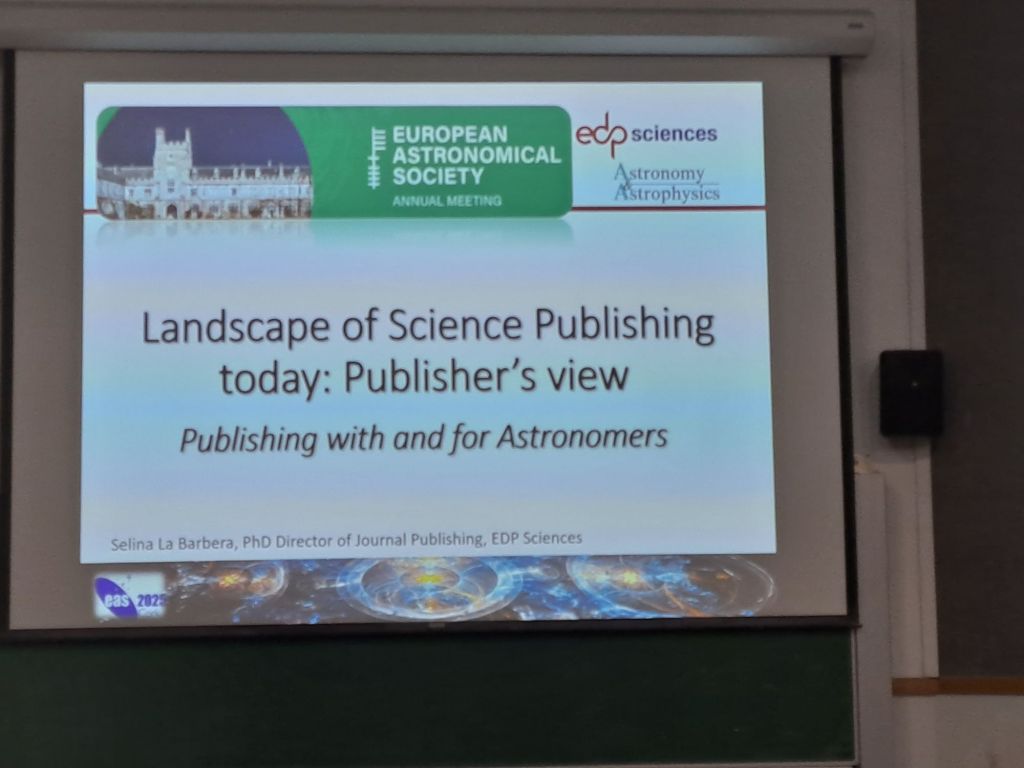
I spent a large part of today at a session about the future of scientific publishing,  which was split in two, either side of the morning’s plenary. The first half started with a talk by Selina La Barbera, a representative of EDP Sciences, the publisher of the journal Astronomy and Astrophysics:

It also featured a talk by João Alves, Letters Editor of Astronomy and Astrophysics, and Uta Grothkopf, librarian of the European Southern Observatory. The last talk was full of insights and information. The Q&A was very lively. I was expecting that I might be the one to inject some controversy into the discussion, but I didn’t need to. Issues about the cost of APCs, etc, were raised by others before I got the chance.

Before the plenary, there was time for a group photograph of staff and students from Maynooth:

The Maynooth Contingent

The highlight of the plenary was seeing Licia Verde collect the Jocelyn Bell Burnell Medal on behalf of arXiv, together with Ralph Wijers. They both gave interesting presentations about arXiv too.

Licia, with the EAS Medal she received today.

Back in the special session about publishing, I participated in a panel discussion, which was very lively. On a Zoom  call last week in preparation for this, we were a bit worried that not many people would take part, but in the event the room was full and many people asked questions, including many about OJAp, and the discussion went on outside after the session was finished.  I think it was a very successful session.

Now that the session I was directly involved in is over, I can relax a bit and be free tomorrow to  attend more science sessions, including a couple about Euclid…

On “Purpose-Led Publishing”

Posted in Open Access with tags , , , , , , , , , , on March 6, 2024 by telescoper

I was flabbergasted by the cheek of an article that recently appeared in Physics World by Michael Brooks announcing that:

I can’t speak about the American Institute of Physics or the American Physical Society but in the context of the Institute of Physics – of which I am a Fellow and in whose house magazine the article appears – I draw your attention to the last sentence of the above excerpt which contains a commitment to “invest funds generated from publishing back into research” (my emphasis).

Really? The IOP invests in research? That’s news to me. How do I apply for a grant? Will they fund my next PhD student?

The IOP invests its funds in many things – many of them worthy – but it does not spend a significant part of the vast income it generates from its publishing house on research. The claim that it does is just dishonest. There’s point in mincing words.

This is an important distinction, particularly so that publishing in most IOP journals now requires the payment of a hefty Article Processing Charge (APC; Artificial Profit Charge would be more apt) which often has to be paid for out of research grants. Previously the revenue of IOP Publishing was appropriated from library budgets through subscriptions, so physicists were less aware of just how much the IOP was raking in. Now that researchers are having to find the funds themselves from research grants it has become more obvious that the IOP is actually a drain on research funds, not a source of them. The APC is a levy on research, designed to generate funds for other things. I think this model is indefensible. What gives the IOP the right to impose charges that far exceed the cost of disseminating scientific results in order to appropriate funds for its other activities?

Moreover, even if the IOP did fund research, what benefit would that be to a researcher in Spain, South Korea or Singapore or indeed anywhere outside the UK and Ireland?

The slogan for the initiative described in the article is “Purpose-led Publishing”. That reminds me of an old saying from systems theory: the Purpose Of a System Is What it Does (POSIWID). What the system does in this case is to raise funds for the IOP. That’s its purpose. Everything else is just marketing spiel.

The claim that IOP Publishing does not make a profit is disingenuous too. It does make a substantial profit. The only difference between it and the likes of Elsevier is where the profits go. A true not-for-profit publisher would charge only at the level to cover the costs of publication. The Purpose that should be leading Publishing in physics is the dissemination of scientific results, not the generation of revenue for sundry other things.

I have avoided publishing in IOP journals for many years because I think the approach of IOP Publishing is unethical. Now I have decided that I no longer wish to be associated with the IOP in any way. I have paid the subscription for 2024 but when that lapses I won’t renew it. Enough is enough.

Why we don’t need scientific papers

Posted in Open Access, Science Politics with tags , , on April 21, 2022 by telescoper

There’s a recent piece by Stuart Ritchie in The Grauniad that argues that the concept of the “scientific paper” has outlived its usefulness and should be scrapped. I think there’s a lot in the arguments presented and the article is well worth reading. Indeed, I have made similar points myself a number of times on this blog relating both to individual papers and to the journals in which they are published.

In this post from a couple of years ago, for example, I asked the question: what are scientific papers for? Here is an extract:

I can think of two main purposes (which aren’t entirely mutually exclusive): one is to disseminate knowledge and ideas; the other is to confer status on the author(s) .

The academic journal began hundreds of years ago with the aim of achieving the former through distribution of articles in print form. Nowadays the distribution of research results is achieved much less expensively largely through online means. Nevertheless, journals still exist (largely, as I see it, to provide editorial input and organize peer review) .

Alongside this there is the practice of using articles as a measure of the ‘quality’ of an author. Papers in certain ‘prestigious’ ‘high impact’ journals are deemed important because they are indicators of status, like epaulettes on a uniform, and bibliometric data, especially citation counts, often seem to be more important than the articles themselves.

By the way, I put up a poll in that piece, which is still open. You can vote here:

The point – also made by Stuart Ritchie – is that the traditional scientific journal is a 17th Century invention and, as such, does not reflect the way modern scientific is performed and disseminated.

In fields like astrophysics and particle physics this anachronistic approach leads to absurdities such as papers with thousands of authors, many of whom won’t have even read, let alone contributed any writing to, the article. Reflecting on the publication of a paper with 5000 authors back in 2015, I wrote this:

It seems quite clear to me that the academic journal is an anachronism. Digital technology enables us to communicate ideas far more rapidly than in the past and allows much greater levels of interaction between researchers. I agree with Daniel Shanahan that the future for many fields will be defined not in terms of “papers” which purport to represent “final” research outcomes, but by living documents continuously updated in response to open scrutiny by the community of researchers. I’ve long argued that the modern academic publishing industry is not facilitating but hindering the communication of research. The arXiv has already made academic journals virtually redundant in many of branches of  physics and astronomy; other disciplines will inevitably follow. The age of the academic journal is drawing to a close. Now to rethink the concept of “the paper”…

This is the closing paragraph of Ritchie’s piece, which says much the same thing:

We’ve made astonishing progress in so many areas of science, and yet we’re still stuck with the old, flawed model of publishing research. Indeed, even the name “paper” harkens back to a bygone age. Some fields of science are already moving in the direction I’ve described here, using online notebooks instead of journals – living documents instead of living fossils. It’s time for the rest of science to follow suit.

It seems to me that the barrier to opening up the processes of scientific publication to these is that the more accurately publications reflect how science is actually done in the digital age, the more difficult it is for the bean counters to assess research quality or productivity. The academic publishing industry has cornered the market on bibliometric indicators so it rather than the scientific community gets to dictate how scientific quality will be measured. The tail is wagging the dog. Until that ends – and it will only end when we fairer ways of evaluating research – we will be saddled with the broken system we have now.

A Modest Proposal – The Open Journal of Astrophysics

Posted in Open Access with tags , , on July 17, 2012 by telescoper

Following on from yesterday’s piece, I thought I’d make a quick suggestion.

Astrophysics has taken the lead for many years in opening up access to scientific publications – all publications of any merit are available for free on the internet via the arXiv and, in my opinion, the traditional journals are already more-or-less redundant even without considering their “astronomical” cost. The one thing that seems a consistent objection to dispensing with journals altogether is the element of peer review.

However, yesterday’s news that many of us are probably going to have to pay up front fees to publish papers (at thousands of pounds  a pop) will no doubt have convinced many that the government’s decision is potentially ruinous for science. I think it’s time for astrophysics to lead the way again.

My suggestion is that we set up a quick-and-easy trial system to circumvent the traditional publishing route. The basic is that authors who submit papers to the arXiv can have their papers refereed by the community, outside the usual system of traditional journals. I’m thinking of a website on which authors would simply have to post their arXiv ID and a request for peer review. Once accepted, the author would be allowed to mark the arXiv posting as “refereed” and an electronic version would be made available for free on the website.

Although there are many issues to be sorted out,  a limited trial of The Open Journal of Astrophysics could I think happen very soon, perhaps even before the REF.

This idea would require community support setting it up (and doing the refereeing/administration)  and it would probably only get off the ground if sufficient senior astronomers get on board. It will no doubt also take money to get it going. However, I feel sufficiently strongly about this that I’m prepared to stump up £10k from my own pocket just to get it started.

If anyone has ideas about how to take this project forward, is willing to help with technical expertise, or if any prominent astronomers would simply like to add their name in support of the idea please do so through the comments box below.  Any further pledges of financial support would of course also be welcome.

And please pass this message on via Twitter/email/whatever, so I can gauge the level of support.

The joy of viXra

Posted in The Universe and Stuff with tags , , , , , on May 19, 2011 by telescoper

From time to time on this blog I post rants about the state of scientific publishing, open access, the importance of the arXiv for astronomy and cosmology, and so on.

This morning, however, I discovered an “alternative” side to the whole business of online science, a site by the name of viXra. Most readers will probably be familiar with this site already – many no doubt publish there, in fact – but I have to say that it’s completely new to me. I urge you to check it out.

The structure and layout of viXra is almost identical to the arXiv, but the content is a bit … er … different. Naturally, I went straight for the section that mirrors astro-ph on the arXiv. The viXra version of astro-ph so far contains only 88 publications, but among them are papers of such outstanding quality that I’m sure this remarkable collection will grow very quickly when like-minded authors around the world find out about it.

I thought I’d post my favourite as an example. Initially, I was going to go with one entitled Ball Lightning, Micro Comets, Sprite-Fireballs and X-Ray/gamma Flashes According to Quantum FFF Theory, with the abstract

FUNCTION FOLLOWS FORM in Quantum FFF THEORY. The FORM and MICROSTRUCTURE of elementary particles, is supposed to be the origin of FUNCTIONAL differences between Higgs- Graviton- Photon- and Fermion particles. As a consequence, a NEW splitting, accelerating and pairing MASSLESS BLACK HOLE, able to convert vacuum energy (ZPE) into real energy by entropy decrease, seems to be able to explain quick Galaxy- and Star formation, down to Sunspots, (Micro) Comets, Lightning bolts, Sprite Fireballs and Ball Lightning.

I decided against this one, however, because of the tendency to burst inexplicably into upper case every now and again, which I found rather alarming.

I was also forced to reject this one, The Structuring Force of the Natural World, on the grounds that (a) it’s in Chinese so I can’t read it and (b) I don’t know what a “basket graph” is. Otherwise I’m sure its a splendid piece of work.

The assumption that the mass distribution of spiral galaxies is rational was suggested 11 years ago. The rationality means that on any spiral galaxy disk plane there exists a special net of orthogonal curves. The ratio of mass density at one side of a curve (from the net) to the one at the other side is constant along the curve. Such curve is called a proportion curve. Such net of curves is called an orthogonal net of proportion curves. I also suggested that the arms and rings are the disturbance to the rational structure. To achieve the minimal disturbance, the disturbing waves trace the orthogonal or non-orthogonal proportion curves. I proved 6 years ago that exponential disks and dual-handle structures are rational. Recently, I have also proved that rational structure satisfies a cubic algebraic equation. Based on these results, this paper ultimately demonstrates visually what the orthogonal net of proportion curves looks like if the superposition of a disk and dual-handle structures is still rational. That is, based on the natural solution of the equation, the rate of variance along the ‘radial’ direction of the logarithmic mass density is obtained. Its image is called the ‘basket graph’. The myth of galaxy structure will possibly be resolved based the further study of ‘basket graphs’.

In the end I decided to go for this impressive article, A Cantorian Superfluid Vortex and the Quantization of Planetary Motion

This article suggests a preliminary version of a Cantorian superfluid vortex hypothesis as a plausible model of nonlinear cosmology. Though some parts of the proposed theory resemble several elements of what have been proposed by Consoli (2000, 2002), Gibson (1999), Nottale (1996, 1997, 2001, 2002a), and Winterberg (2002b), it seems such a Cantorian superfluid vortex model instead of superfluid or vortex theory alone has never been proposed before. Implications of the proposed theory will be discussed subsequently, including prediction of some new outer planets in solar system beyond Pluto orbit. Therefore further observational data is recommended to falsify or verify these predictions. If the proposed hypothesis corresponds to the observed facts, then it could be used to solve certain unsolved problems, such as gravitation instability, clustering, vorticity and void formation in galaxies, and the distribution of planet orbits both in solar system and also exoplanets.

I’m not an expert on the “Cantorian superfluid vortex theory”, but I suspect the author may well be correct in saying that it has not previously been proposed as an explanation for the planetary orbits…

Share/Bookmark