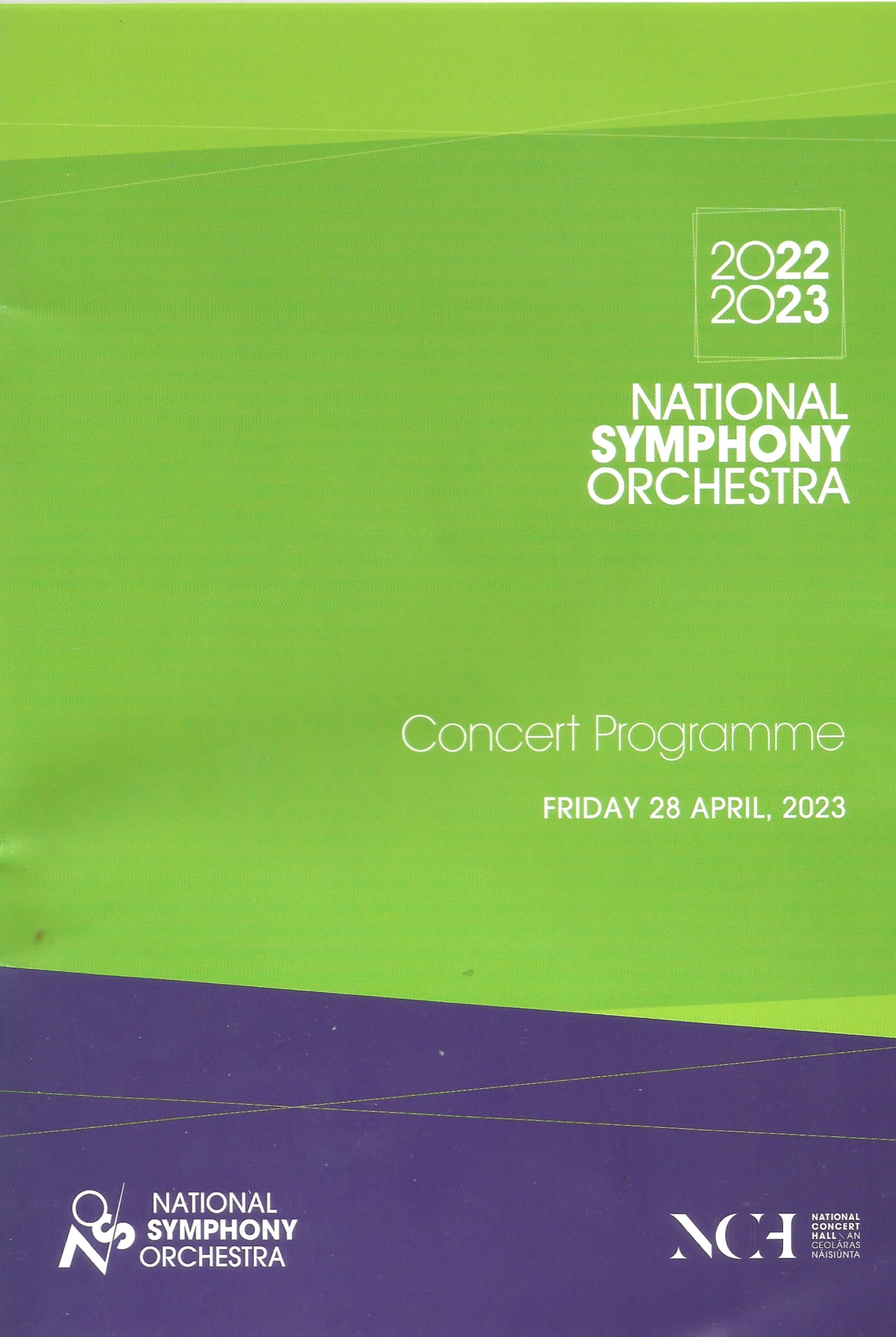

Looking back through my old blog posts, I find that the last time I went to a concert at the National Concert Hall was 10th February 2023. Owing to pressure of work I’ve had neither the time nor the energy to make the trip into Dublin since then, but last night I finally managed to get there for the excellent programme shown above, which was also broadcast live on RTÉ Lyric FM.
On this occasion the National Symphony Orchestra was conducted by Ruth Reinhardt, who last conducted the Orchestra during the pandemic in one of those weird occasions for which most of the musicians were masked, as was she. Anyway, for tonight’s performance she was unmasked long with the rest of the band.
Anton Webern’s Passacaglia (his Opus 1) was a new one on me. It’s not in the 12-tone style he adopted later as a member of the 2nd Viennese School, and can properly be regarded as a (very) late Romantic piece. It’s an intriguing variation of the Passacaglia form (originally a stately dance in triple time built on a bass theme) in that it’s not really a dance and it’s not in triple time, but it is introduced by a theme of eight notes played pizzicato on the strings, which is then followed by a set of variations. The piece only runs about 12 minutes but it packs a lot in. I found it very absorbing and enjoyed it enormously.
The Four Last Songs were published after his death, so Richard Strauss never heard them performed. The very first time they were performed was in 1950 at the Royal Albert Hall, by the London Philharmonia. One can only imagine what it must have been like for the orchestra making this music live for the very first time. Apparently the first time any of them had seen the score was when they turned up for the rehearsal. I’m sure they knew as soon as they started playing that it was a masterpiece.
Last night we heard these songs sung by Amanda Majeski, who arrived on stage resplendent in a black evening gown. I was somewhat surprised to see her using a score for this performance. I would have thought that this was such a standard component of the repertoire that all sopranos would know all the songs off by heart. Perhaps it was just nerves, but I thought the first song, Frühling, lacked warmth but as the concert went on Amanda Majeski got into her stride and by the time she got to Im Abendrot (my favourite) she reached the right level of intensity.
I must single out the leader of the National Symphony Orchestra Elaine Clark for her gorgeous playing of the lovely violin solo in the third song, Beim Schlafengehen. I don’t mind admitting that it brought a tear to my eye.
Incidentally, as far as I know the Four Last Songs were not specifically intended to be performed together as they inevitably are these days. Although the last is my favourite, I think the first three (all based on poems by Herman Hesse) have much more in common with each other than Im Abendrot (which is a poem by Joseph von Eichendorff).
After the wine break we had Symphony No. 3 (“Scottish”) by Felix Mendelssohn. Inspired by a visit to Scotland in 1829 – the first movement was actually composed that year in Edinburgh – it wasn’t completed until over a decade later and should probably be No. 5, but who’s counting? It’s a piece on four movements, with little or no break between them. The first movement starts with a slow theme, like a hymn, but then becomes much more reminiscent of the Hebrides Overture composed in 1830. The landscape of the other three movements is very varied, sometimes cheery, sometimes lush, sometimes tempestuous. The final movement Allegro Vivacissimo has a marking guerriro (“warlike”), which in parts it is, but it also has calmer and more reflective passages before the rumbustious finale.
I always enjoy watching the musicians in these concerts, and could see last night that they were all enjoying themselves hugely. Well done to Ruth Reinhardt and the National Symphony Orchestra for an excellent performance. The hall was by no means full, which was a shame, but the concert was warmly appreciated by those of us there in the audience and no doubt by those listening on the radio.
Now there’s only a month or so to the finale of this concert season so I must try to make the most of the few remaining performances before the summer break…

 In the Dark