Archive for Sergei Rachmaninov

Shostakovich 50 at the National Concert Hall

Posted in Uncategorized with tags , , , , , , , , on May 10, 2025 by telescoper

Last night’s concert at the National Concert Hall in Dublin was billed Shostakovich 50 because 2025 marks the 50th anniversity of the death in 1975 of Dmitri Shostakovich, whose First Symphony was performed after the interval, by the National Symphony Orchestra under the direction of guest conductor John Storgårds. As you can see, though, the programme was quite varied and no fewer than three other composers were represented.

The first piece was The Oceanides, tone poem by Jean Sibelius intended to evoke the sea nymphs of Greek mythology. It’s quite a short piece – only eleven minutes in performance – but full of movement, suggesting the ebb-and-flow of the sea and its different moods, from tranquil to stormy. Its place on the programme made it a good workout for the orchestra and a wonderful starter to whet their appetite of the audience for the rest of the menu.

After that appetizer we had a performance of the Rhapsody on a Theme by Paganini by Sergei Rachmaninov with soloist Yukine Kuroki at the piano. This piece comprises a set of 24 variations on a them from one of Paganini’s caprices for solo violin. The Rhapsody on a theme of Paganini is piece full of contrasts: sometimes pyrotechnical, sometimes lyrical. My favourite section is the 18th variation, in which a lovely romantic melody emerges and is picked up by the whole orchestra in a manner that’s very characteristic of Rachmaninov. This tune is just an inversion of the theme transposed into a different  key and slowed down.

The Rachmaninov alone was worth the cost of the ticket. I was amazed how pianist Yukine Kuroki coped with the technical challenges of this work but also how she managed to generate so much power for a person of such slight build. Rachmaninov himself was quite a large man who had hands like shovels, so his work often places difficult demands on a soloist. Not last night, though, as Yukine Kuroki not only played with great accomplishment but also clearly enjoyed herself. In the passages during which the piano was not playing she was bouncing up and down and tapping her feet waiting for her cue. It was lovely to watch as well as to listen to. I’ll also mention that she was wearing a gorgeous one-shoulder dress with a vivid red colour.

After the wine break interval we returned for a piece that was new to me, the Symphony No. 3 ‘White Interment’ by Ukrainian composer Victoria Vita Polyova. This is described a symphony, but it doesn’t have the traditional structure in terms of movements. It has instead a rather static structure, consisting of thematic blocks based on a poem Now always snows. It’s a sombre and rather minimalist piece, with little of the development you would expect from a true symphony, but the sound world it creates is layered in interesting ways. I enjoyed the performance.

And finally we have the Symphony No. 1 by Dmitri Shostakovich which I don’t think I had heard in concert before. The most astonishing thing about this work was that he wrote it as a graduation piece for the St Petersburg Conservatory. Its first performance was in 1926, when the composer was only 19. It is a substanial work over four movements (the last two played without interruption) and there are passages within it in which you can see that he had already found much of the distinct voice that he used in his later compositions. This piece isn’t really reminiscent of any other composers, either.

The performance was excellent, with particularly strong work by the woodwinds and brass. It was very well received by the NCH audience which is always very generous with its applause.

Rachmaninov (×2) + Tubin at the National Concert Hall

Posted in Biographical, Music with tags , , , , , , , , , on May 27, 2023 by telescoper

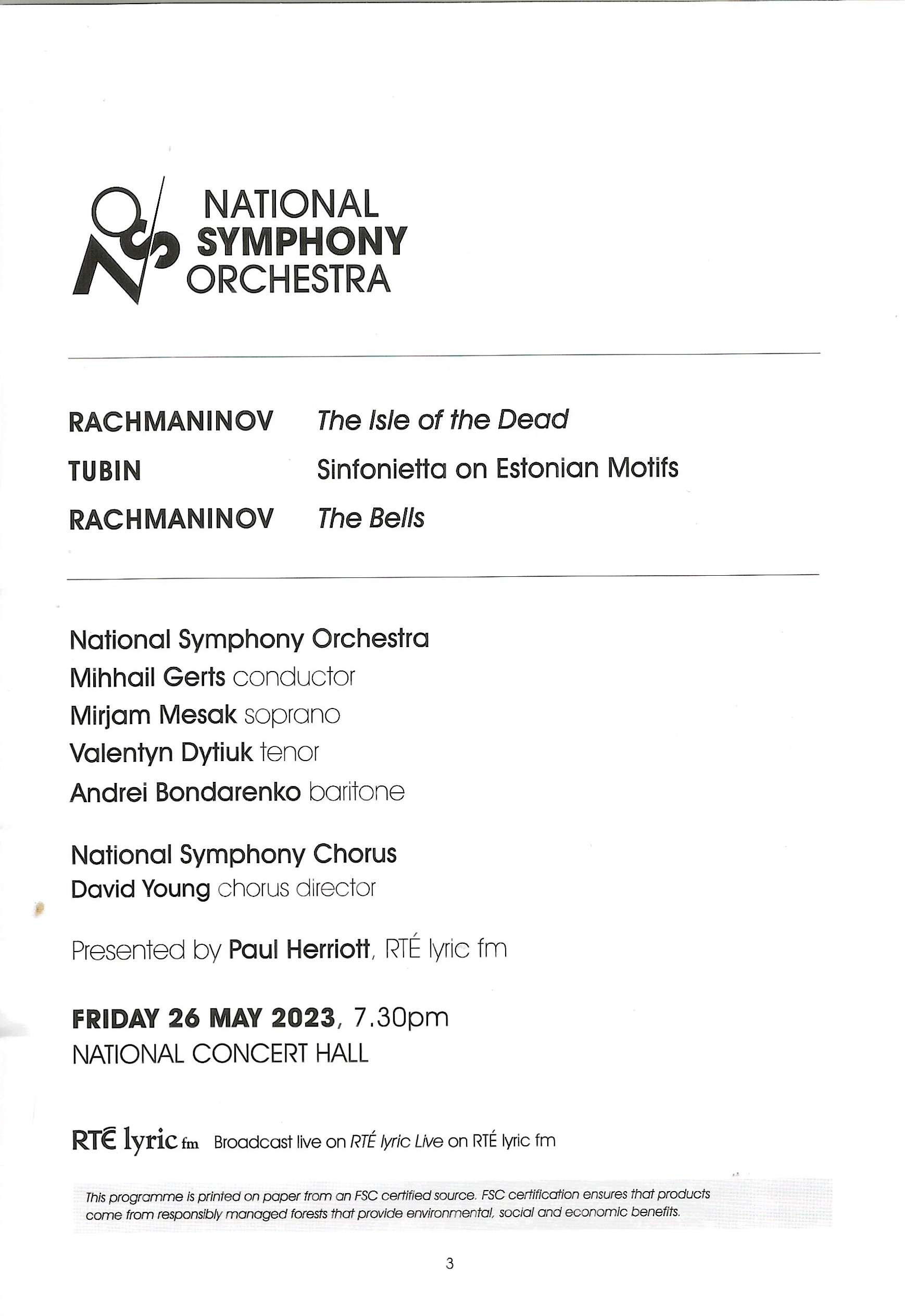
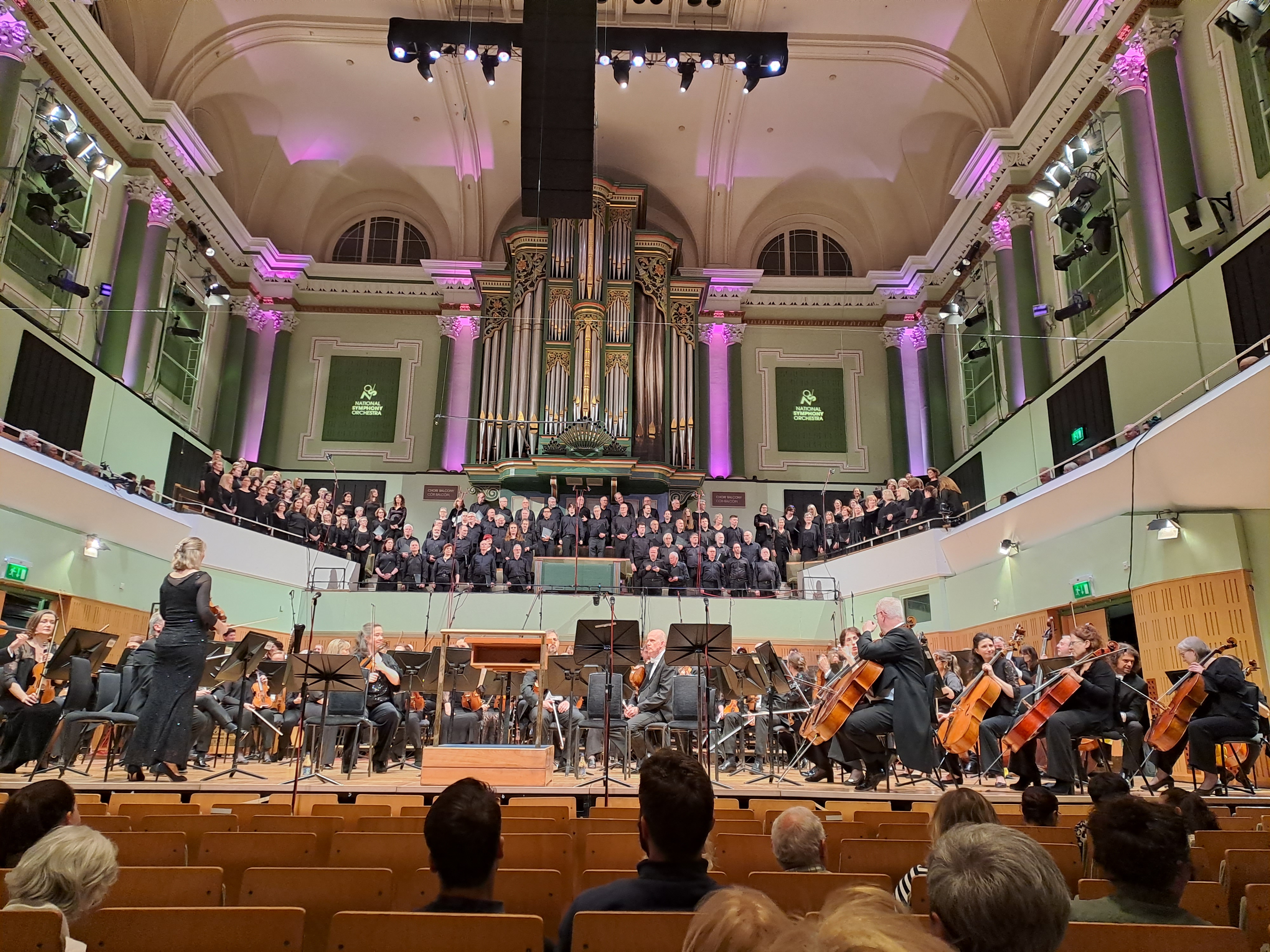
Yesterday, after a nice walk through the sunny streets of Dublin, at the National Concert Hall for the final concert of the season by the National Symphony Orchestra, under the direction of Mihhail Gerts, who were joined, for the second half, by the National Symphony Chorus directed by David Young and three star vocalists. The progamme consisted of two pieces by Sergei Rachmaninov (who was born 150 years ago this year) and one by Eduard Tubin (an Estonian composer who was new to me before last night).

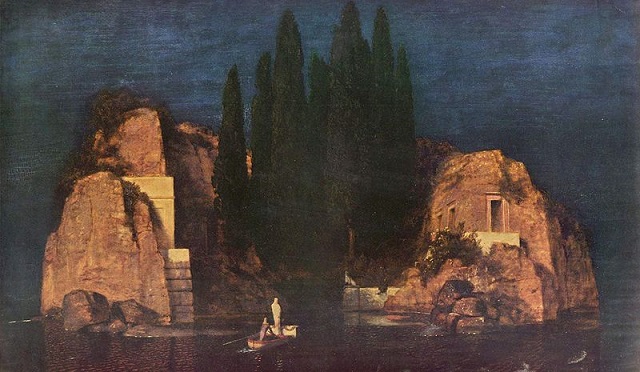
The Isle of the Dead, by Arnold Böcklin

The first item one the menu was The Isle of the Dead, Op. 29 by Sergei Rachmaninov,  inspired by a painting of the same name by Arnold Böcklin and written around 1908. The rhythms of the opening passage evoke the motion of a boat moving across the sea to the island, from which point the piece develops among a cloud of increasingly dense harmonic layers into a dark atmosphere full of foreboding.  It’s a darkly dramatic work that I’ve enjoyed every time I heard it and last night was no exception.

There then followed the Sinfonietta on Estonian Motifs by Eduard Tubin introduced by conductor Mihhail Gerts, who is himself from Estonia. It’s a work in three movements inspired by the folk songs the composer heard as a child growing up in Estonia. I knew that much before the performance started but didn’t realize it would turn out to be such a weighty composition. The two outer movements are rhythmically complex in a way that’s reminiscent of Stravinksy (especially Petrushka) and the overall mood is far from the pastoral tranquility I’d expected: the music is rather edgy, in fact. I suppose that’s not surprising given that it was written in 1940. I enjoyed this but it is strange how much it reminded me of other composers: as well as Stravinsky, there are clear nods in the direction of Sibelius and at times it also reminded me of Arnold Bax. You might say it is a little bit derivative. I couldn’t possibly comment.

After the interval

After the wine break we had The Bells, a choral symphony for soprano, tenor, bass-baritone, chorus and large symphony orchestra by Sergei Rachmaninov (Op. 35). The words are based on a Russian translation of the poem The Bells by Edgar Allan Poe which was very popular in Russia in the early 20th century and which clearly resonated with Rachmaninov:

The sound of church bells dominated all the cities of Russia I used to know, they accompanied every Russian from childhood to the grave and no composer could escape their influence. Most of my life was lived amid vibrations of of the bells of Moscow.

Sergei Rachmaninov

The Bells is in four movements, echoing the four stanzas of the poem, and representing the journey “from childhood to the grave”, the last movement being a Lento subtitled The Mournful Iron Bells. The three soloists sing in one part each; the third movement involves orchestra and chorus only. Ukrainian tenor Valentyn Dytiuk sang in the first movement, Estonian soprano Mirjam Mesak the second and Ukrainian baritone Andrei Bondarenko the fourth. All three soloists were superb but particularly enjoyed the sinewy muscularity of Bondarenko’s baritone which gave a sense of rawness to his performance.

It was a fitting finale to the season. Congratulations to the National Symphony Orchestra for a great performance, and to the National Symphony Orchestra who were outstanding too.

Walking back to Pearse Station to get the train for Maynooth I found myself wondering when my next visit to the National Concert Hall will be. I’ll be away on sabbatical most of next year. Still, there’ll be plenty of music where I’m going…

R.I.P. André Previn (1929-2019)

Posted in Music with tags , , , , on March 1, 2019 by telescoper

Seven years ago – can it have been so long? – I attended a concert at St David’s Hall in Cardiff that included a performance of Rachmaninov’s Second Symphony. I enjoyed the performance so much that at the end of my blog post about the evening I asked for recommendations of a good recording. The clear favourite – which I bought straight away – was by the London Symphony Orchestra conducted by André Previn.

Last night I heard that André Previn had passed away and I wanted to post a little tribute to him. Naturally, I thought of posting that Morecambe and Wise Sketch from 1971, which I love, but almost every website that has mentioned André Previn has included that, so instead I thought I’d post the Third Movement (Adagio) of the Rachmaninov Symphony I heard those years ago. It’s a gorgeous performance of a gorgeous work and, I think, a fitting tribute to a great pianist, both in classical and jazz idioms, conductor and composer who brought music (and laughter) to so many people.

R.I.P. André Previn (1929-2019)

Symphonie Fantastique

Posted in Music with tags , , , , , , , , on May 8, 2017 by telescoper

After a busy weekend I’m gradually trying to catch up on last week’s happenings. One thing I haven’t had time to mention yet is that on Thursday night I went to a concert at St David’s Hall in Cardiff that featured the BBC National Orchestra of Wales under the direction of Xian Zhang. The orchestra repeated the programme the following day (Friday) at the Brangwyn Hall in Swansea, so you can listen to it it for the next month on the BBC iPlayer.

The main item on the menu was the Symphonie Fantastique by Hector Berlioz. I have to confess that I’ve been a bit prejudiced about this piece since I was at school. I had a music teacher who adored Berlioz and wouldn’t shut up about him, basically telling us that he was the best composer ever. I didn’t buy it then, and despite a very fine performance on Thursday, I still don’t buy it now. It’s n0t that Berlioz is short of musical ideas or technical accomplishment: there are some memorable passages in this Symphonie, including the dance-like theme of the second movement, and the  “march to the scaffold” in the fourth movement.  I’m not at all averse to big loud symphonic works, either, as regular readers of this blog will know. My difficulty is that it’s all a bit too obvious. The BBC National Orchestra of Wales is a fine orchestra and I enjoyed their playing enormously. I particularly appreciated seeing the  percussion section get a good workout! I was also impressed by the conducting of Xian Zhang who gave a sense of shape where previously I’d heard only bombast. It’s the composition that’s the problem for me, though. Berlioz lays it on with a shovel, but I still think this is a rather superficial piece.

Before the Berlioz, in the first half, were two much more interesting pieces. The first, a piece called Internet Symphony No. 1 “Eroica” by Tan Dun is less than five minutes long is a hugely entertaining blend of Eastern and Western musical influences.

After that appetizer we had a dazzling performance of the Rhapsody on a Theme by Paganini by Sergei Rachmaninov with soloist Stephen Hough at the piano. This piece comprises a set of 24 variations on a them from one of Paganini’s caprices for solo violin.

Incidentally, the “theme by Paganini” used as the basis of this piece is the same one that was used for the musical introduction to the TV programme “South Bank Show“, although I think quite a lot of people know that.

The Rhapsody on a theme of Paganini is piece full of contrasts: sometimes pyrotechnical, sometimes lyrical. My favourite section is the 18th variation, in which a lovely romantic melody emerges and is picked up by the whole orchestra in a manner that’s very characteristic of Rachmaninov. It gets me every time, but then I am a terrible softy. You can hear this played by Stephen Hough at the Proms in 2013 here (about 20:20 into the video). Incidentally, this tune is just an inversion of the theme transposed into a different  key and slowed down.

The Rachmaninov alone was worth the cost of the ticket! It’s such a shame that he wrote so little music after emigrating from Russia to the United States in 1917. He made a living doing concert tours after that, and had little time to compose. Thank goodness he found time to write this, though!

We also had an encore by Stephen Hough that provided yet another contrast. Debussy’s Clair de Lune is a very familiar piece, but it provided an appropriately light and reflective epilogue to the first half.

I will persevere with Berlioz, I suppose, like I do with Brahms, but I think I’m going to be hard to convince. If anyone can suggest a piece by Hector Berlioz that they think will change my mind, please feel free to suggest it via the comments box!


Vladimir Ashkenazy and the Philharmonia Orchestra

Posted in Music with tags , , , , , , , , , on November 21, 2016 by telescoper

I was indisposed over the weekend so I wasn’t able to do a write-up of the concert I attended at St David’s Hall on Friday evening, featuring the Philharmonia Orchestra conducted by Vladimir Ashkenazy in a programme of all-Russian music. Ashkenazy is of course best known as a pianist, but he has in recent years increasingly appeared in public performances as a conductor, apparently preferring to confine his piano playing to the recording studio. I’d never seen him in the flesh before and was surprised when this rather diminutive man bounded onto the stage and, hardly pausing for breath, started the concert. He’s obviously not one for hanging about.

First item on the menu was the Overture to the Opera Prince Igor by Alexander Borodin. At least the piece is attributed to Borodin, but no trace of the original score has ever been found; the piece as performed nowadays was entirely reconstructed from memory by Alexander Glazunov. It’s a rather conventional overture for the time, consisting of a sort of fast-forward of some of the outstanding themes and musical motifs that occur in the Opera.

In case you didn’t know Borodin was only a part-time composer. His day job was as a Professor of Organic Chemistry. He also died quite young – at the age of 53 – suffering a heart attack at a fancy dress ball.
Given is relatively short life and his occupation with other matters, Borodin didn’t write all that much music, but what survives is of generally very high quality, and this piece is no exception. A very nice warm-up for the larger works to come.

(Yes, I say Borodin was “quite young” at the age of 53 because that’s how old I am…)

Next up was one of the most familiar concert pieces of the entire classical repertoire, the  Piano Concerto No. 1 by Pyotr Ilyich Tchaikovsky. Certainly the spectacular opening, with its fanfare-like introduction followed by a dramatic string theme supported by huge chords from the piano, must be one of the best-known introductions to a classical work. It’s curious though that the theme that gives it such an imposing start is not heard anywhere else in the concerto, though what follows is hugely absorbing and entertaining, if a bit theatrical for some tastes. It’s not too theatrical for me, I hasten to add. I love it.

(Coincidentally, Tchaikovsky also died at the age of 53.)

The soloist for the performance was Alice Sara Ott who played with great verve and virtuosity. It’s a piece that calls for some muscular playing, and despite her slender build, Alice Sara Ott was up tot the task. She practically lifted herself up off the stool on a number of occasions to generate enough downward force on the keys.

After the interval we had Symphony Number 1 in D Minor by Sergei Rachmaninov. The first performance of this work in 1897, conducted by Glazunov with the composer in the audience, was a complete disaster and the piece was so badly received that Rachmaninov refused to allow it to be published (and even destroyed the score). It wasn’t until 1945 that the orchestral parts were found and the symphony reconstructed that it was performed again. I think it’s a very satisfying symphonic work. Although ostensibly in D Minor it spends most of the time in major keys (F major in the second movement, B♭ major in the third, and D major in the finale).  Like all great symphonies it takes the listener on a journey through a very varied soundscape – and times wistful and  and at others exuberant. I particularly enjoyed the lengthy coda at the end of the 4th movement.

I really don’t know why this work was so savaged by the critics when it was first performed, although Rachmaninov laid the blame firmly at  the conductor’s feet. I think he would have appreciated last night’s concert a lot more than

[twitter-f0llow screen_name=’telescoper’]


Gershwin, Adams & Rachmaninov

Posted in Music with tags , , , , , , , , on January 28, 2012 by telescoper

Yesterday (Friday) being the last day of (relative) freedom before teaching resumes on Monday I took the opportunity to go to a concert by the Orchestra of Welsh National Opera at the splendid St David’s Hall in Cardiff. I had been looking forward to it for some time, as the programme featured two favourite pieces of mine, George Gershwin’s Rhapsody in Blue and John Adams’ The Chairman Dances (A Foxtrot for Orchestra), plus one longer piece that I’ve never heard live before, Symphony No. 2 (in E minor) by Sergei Rachmaninov.

There was a good crowd in St David’s last night, not surprisingly given the popularity of the pieces being performed. Conductor for the evening was Frédéric Chaslin, who led the orchestra from the piano during the opening number, Rhapsody in Blue. This is a very famous piece, and is played so often that it is in danger of becoming a bit of a cliché, especially when classical orchestras try too hard to sound like jazz musician; the piece was originally written for Paul Whiteman’s Orchestra. A case in point is the opening clarinet solo, which is often played like a ham-fisted parody. Not last night, though. Principal clarinettist of WNO Leslie Craven gave a very characterful rendition of the notoriously tricky opening, which seemed to inspire the orchestra into an excellent all-round performance. I particularly enjoyed seeing the cello section slapping the strings of their instruments much as a jazz-era double-bass player would.

Chaslin gave an idiosyncratic account of the piano part, to the extent that in the final solo passage before the finale he departed from the script entirely and interpolated an improvised section all of his own. Not everyone in the audience approved – there were a few tuts behind me – but it’s a piece undoubtedly inspired by jazz, so I don’t see anything wrong with doing this. I thought his ad-libbing was charming, and very witty. What I wasn’t so happy about were the changes in tempo, which were too exaggerated. I suppose conducting from the piano means you can do whatever you want, but I think he took the rubato too far. Some sections rely on strict rhythm for their sense of urgency, and I felt he got bogged down a bit in places. Still, on balance, it was very refreshing to hear an orchestra trying to do something different. Nothing hackneyed about last night’s performance, that’s for sure.

Next one up was The Chairman Dances by John Adams. This isn’t actually in the opera Nixon in China, which is what a lot of people seem to think. It was composed at the same time, but cut out and developed as a standalone concert piece. I posted a recording of this yesterday, so won’t say too much today, except that I thoroughly enjoyed my first live experience of this work. So did the orchestra by the look of it! It’s a hugely entertaining piece and had many in the audience tapping their feet along with it. As a matter of fact, I wouldn’t have minded getting up and dancing along myself..

Special mention has to go the percussion section of the orchestra for doing such an excellent job. The four xylophones were  a delight to listen to, and the drums, temple blocks, triangles and assorted ironmongery coped brilliantly with the intricate polyrhythms.

Then it was the interval, and a glass of wine before returing to savour the main piece of the evening, Rachmaninov’s Second Symphony. It’s a remarkable work because it’s not only a “proper” symphony in its construction and development but also the best part of an hour of one glorious melody after another. Rachmaninov’s music is not really very much like Mozart, but they certainly had a similar ear for the Big Tune! I particularly loved the third movement (Adagio), but I thought it was a magnificent performance throughout, not least because you could see how much both conductor and orchestra were enjoying themselves.

The end of the concert was met with rapturous applause from the (normally rather reticent) St Davids audience. Now I have to find the best recording I can of Rachmaninov’s Second Symphony so I can enjoy it again. Any suggestions?

The Orchestra of Welsh National Opera

Posted in Music with tags , , , , , , , , on October 30, 2010 by telescoper

Another Friday evening, another concert at St David’s Hall. This time it was the Orchestra of Welsh National Opera, performing a very mixed programme of pieces (by Rachmaninov, Ravel, Webern and Stravinsky). We’ve been hosting a former PDRA of mine, Chiaki Hikage (now at Princeton) and his wife Mihoko for a week so I invited them along. Chiaki gave a seminar on Friday afternoon at which he endured the usual bombardment of questions from Leonid Grishchuk, so I thought he would need some relaxation afterwards.  I even managed to get front-row seats. It turned out to be a wonderful evening of twentieth century classical music, full of excitement colour and dramatic contrasts.

First up was The Isle of the Dead, Op. 29 by Sergei Rachmaninov,  inspired by a painting of the same name by Arnold Böcklin and written around 1909. The rhythms of the opening passage evoke the motion of a boat moving across the sea to the island, from which point the piece develops among a cloud of increasingly dense harmonic layers into a dark atmosphere full of foreboding. It’s a piece that many probably find a bit melodramatic, but I found it both accessible and fascinating.  In fact it struck me that it wouldn’t be out of place as the soundtrack for a horror movie!

After that we had a short break while the stage crew wheeled in the old Steinway for the second piece, the Piano Concerto in G by Maurice Ravel. This is a relatively late piece by Ravel, written around 1930. Its three movements form a sort of sandwich, with the first and third up tempo, jazzy in style and very Gershwinesque. The second, adagio, movement is very different: longer lyrical and tender, although I still detected a jazz influence in the walking bass of the left hand figures during the nocturne passages. The piece was played in sparkling fashion by Jean-Philippe Collard. We were so close that we could hear him humming along as he played. Apparently that bothers some people, but not me. I suppose that’s because so many jazz pianists behave a similar way, as did Glenn Gould.

Anyway, after a glass of wine at the interval it was time for something completely different, the Six Pieces for Orchestra, Op. 6, by Anton Webern. This is a suite of short, intense, atonal pieces, sort of orchestral aphorisms, that embrace a huge range of musical ideas. Although  sometimes a bit cryptic, I found these pieces in their own way at least as evocative as the Rachmaninov we heard earlier. The disorientating atonality of the compositions gives them an edgy restlessness, which I found very absorbing. If they were to be used in a film soundtrack it would definitely have to be  a psychological thriller or  film noir.

The last work was probably the most familiar, The Firebird Suite (No. 2, 1919 version) by Igor Stravinsky from the ballet of the same name. This consists of five pieces, again of varied tempo and colour, ending in an exhilirating finale.

Overall it was a hugely enjoyable evening, with all parts of the orchestra tested to the limits and emerging with flying colours. I’d like to put in a special word for the percussionists, though. Perhaps because my Dad used to play the drums I always feel they don’t get the credit they deserve standing there at the back. In particular, during the Webern and Stravinsky works, the percussionists – especially the tympanist – had an awful lot to do, and did it absolutely superbly. However, all parts of the orchestra played their parts equally well under the baton of Lothar Koenigs. This orchestra has had a few problems recently so it was a relief to find them on such good form.

The St David’s Hall was only about two-thirds full, but the audience was thoroughly appreciative – especially for the outstanding performance of the Ravel Piano Concerto. I’m going to get hold of a recording of it by Jean-Philippe Collard as soon as I can!

P.S. Our front row tickets only cost £22 each. Amazing.


Share/Bookmark