Archive for Piano Concerto No. 1

Bacewicz, Tchaikovsky and Rachmaninov at the National Concert Hall

Posted in Music with tags , , , , , , on October 3, 2026 by telescoper

Unfortunately I had to miss the opening concert of the 2026/7 season by National Symphony Orchestra Ireland at the National Concert Hall, especially since it was Mahler’s epic Resurrection Symphony. That was three weeks ago and last night was the first time I managed to make it to a concert at the National Concert Hall this season.

Earlier this week I was thinking that, although I’ve been walking to and from the NCH on Fridays quite frequently since I moved to Ireland almost 9 years ago, I’ve managed to avoid getting rained on to a significant extent. Yesterday evening my luck ran out and it was bucketing down. Fortunately I took an umbrella and wore an raincoat so I wasn’t too drenched when I arrived. The cloakroom at the NCH is free, by the way.

Having arrived and divested myself of coat and brolly, I commenced the usual ritual of buying a programme and noticed the format had changed. The new style is much shorter (and cheaper, at just €2) and has QR codes linking to much of the material that would previously have been in the programme. If you’re interested you can follow the links above. I like having a printed copy primarily as a souvenir, and the new format serves that purpose well.
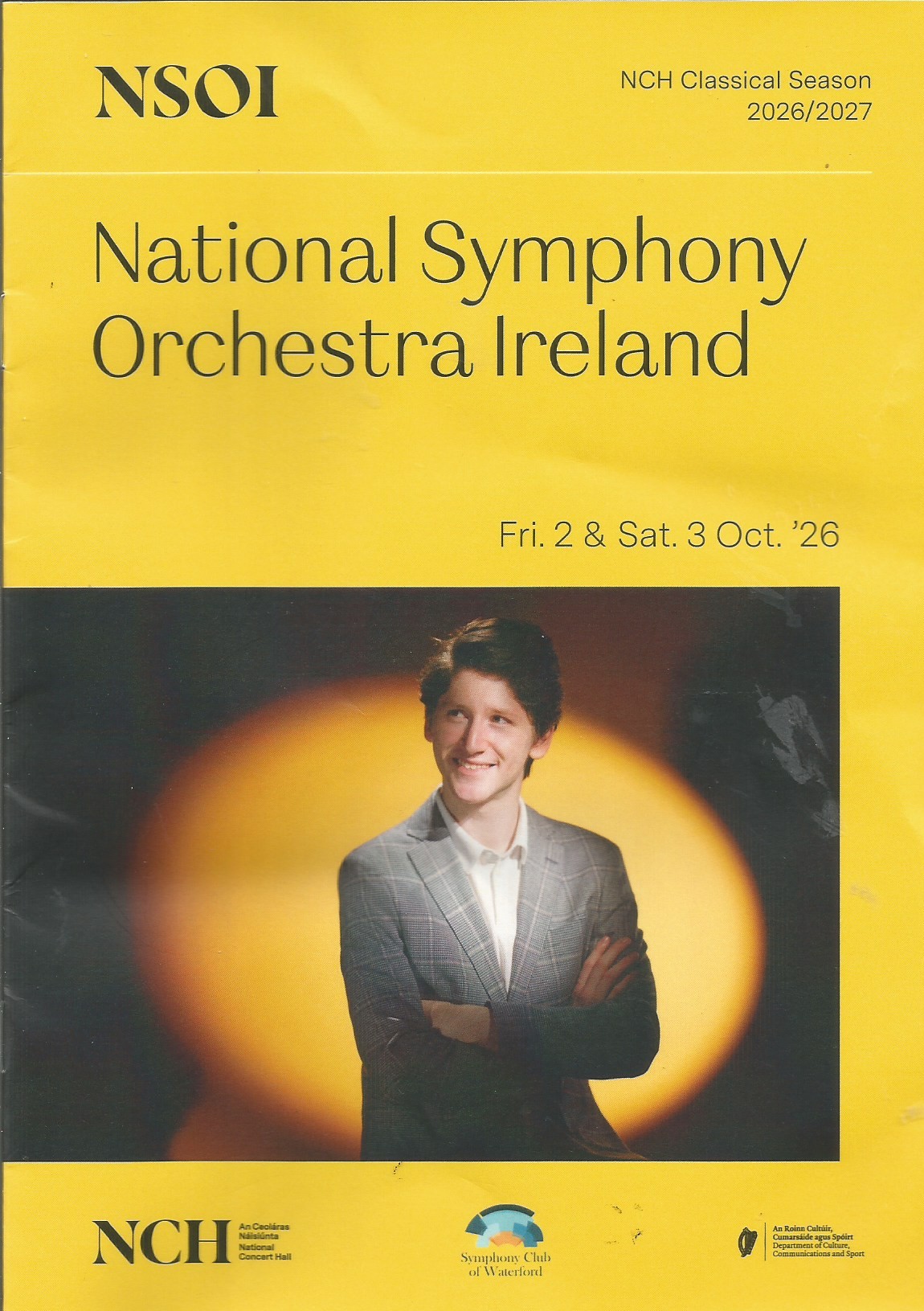
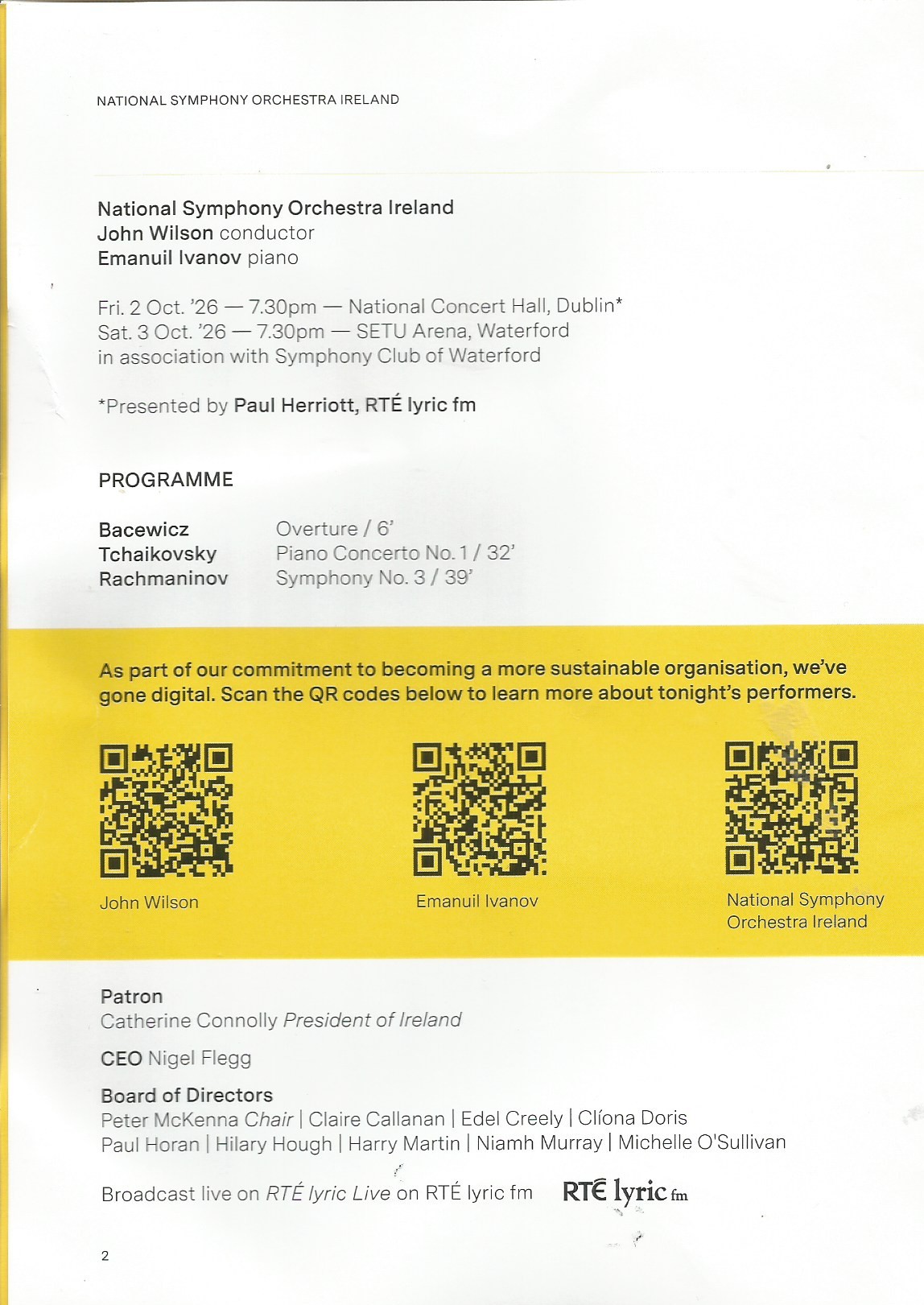
The National Orchestra of Ireland was conducted last night by John Wilson. The first item on the menu last night was a short piece by Polish composer Grażyna Bacewicz called, simply, Overture. This was composed in the depths of the Second World War, but not officially premiered until 1945. Given the time of its composition it is surprisingly optimistic in tone, with its defiant “V for Victory” motif and evocations of pre-war peace.

Next up was one of the most familiar concert pieces of the entire classical repertoire, the  Piano Concerto No. 1 by Pyotr Ilyich Tchaikovsky. Certainly the spectacular opening, with its fanfare-like introduction followed by a dramatic string theme supported by huge chords from the piano, must be one of the best-known introductions to a classical work. It’s curious though that the theme that gives it such an imposing start is not heard anywhere else in the concerto, though what follows is hugely absorbing and entertaining, if a bit theatrical for some tastes. It’s not too theatrical for me, I hasten to add. I love it.

The soloist for the performance was Bulgarian-born Emanuil Ivanov who hit a wrong note early on but thereafter played very well. I thought he really only caught fire in the last movement with its tumultuous climax. The Dublin audience is always generous with its applause and treated the soloist and orchestra to a standing ovation af the end of the performance.

After the wine break we returned to a piece that I’ve never heard in a live concert before, the Symphony No. 3 in A minor by Sergei Rachmaninov. This was written about 30 years after his more famous Second Symphony and is quite different, though still romantic, style. It is in three movements, beginning slowly (Lento) with a statement of a simple theme, but then speeds up (Allegro moderato, then Allegro) as the theme reappears in different guises. The second movement does much the same thing, initially with violin and flute to the fore before the rest of the orchestra joins in, including some of Rachmaninov’s trademark romantic string passages. The final movement starts and ends Allegro Vivace, with several changes of gear in between, but although it was exciting in patches I found it a bit long-winded. My summary would be that I’m glad to have had the opportunity to hear Rachmaninov’s Symphony No. 3, but I don’t think it’s as compelling as his Symphony No. 2.

I usually choose my seat for these concerts to make it easy to get to the bar for the interval, but there was a bonus yesterday. Because of the rain earlier in the evening many more people than usual had checked in coats and umbrellas. When the concert was over I was very quick to get to the cloakroom to extract my things while an enormous queue was growing. It wasn’t raining on the way home.

The Philharmonia Orchestra: Beethoven & Mahler

Posted in Music with tags , , , , , , on February 19, 2018 by telescoper

I spent yesterday afternoon at a very enjoyable concert at St David’s Hall in Cardiff for a programme of music by Beethoven and Mahler given by the Philharmonia Orchestra under Principal Guest Conductor Jakub Hrůša. The picture above was taken about 10 minutes before the concert started, from my seat in Tier 1. Quite a few people arrived between then and the beginning of the performance, but there wasn’t a very big audience. St David’s Hall may have been less than half full but those who did come were treated to some fantastic playing.

The first half of the concert consisted of Beethoven’s Piano Concerto No. 1 (in C) with soloist Piotr Anderszewski. This work was actually composed after his Piano Concerto No. 2 but was published first. It consists of three movements, an expansive slow movement (marked Largo) sandwiched between two sprightly up-tempo movements, marked Allegro con brio and Rondo-Allegro Scherzando, respectively. I think the first part of the last movement, full of energy and wit, is the best part of this work and Anderszewski play it with genuine sparkle. His performance was very well received, and he rounded it off with a charming encore in the form of a piece for solo piano by Bartok.

After the wine break we returned to find the piano gone, and the orchestra greatly expanded for a performance of Mahler’s Symphony No. 5 , the fourth movement of which (the `Adagietto’) is probably Mahler’s best-known music (made famous by its use in Visconti’s 1971 film Death in Venice). This lovely movement is sometimes performed on its own – a practice Mahler himself encouraged – but I think it’s particularly powerful when heard in its proper context, embedded in a large orchestral work that lasts well over an hour.

Although nominally five movements, this work is really in three sections: the first section consists of the first two movements (the first starting with Trauermarsch (a funeral march), and the second a stormy and at times savage movement, punctuated with brief interludes of peace). The last section consists of the beautiful Adagietto 4th movement (played entirely on the strings) followed by an energetic and ultimately triumphant finale. In between there’s an extended Scherzo, which is (unusually for Mahler) rather light and cheerful. Roughly speaking this symphony follows a trajectory from darkness into light and, although it certainly doesn’t go in a straight line, and does start with a death march, this is undoubtedly one of Mahler’s cheerier works!

The Philharmonia Orchestra gave a very accomplished and passionate reading of this piece, with especially fine playing from the brass section (who have lot to do). The exuberant ending brought many members of the audience to their feet and rightly so, as it was a very fine performance – the best I’ve heard live of this work.

Vladimir Ashkenazy and the Philharmonia Orchestra

Posted in Music with tags , , , , , , , , , on November 21, 2016 by telescoper

I was indisposed over the weekend so I wasn’t able to do a write-up of the concert I attended at St David’s Hall on Friday evening, featuring the Philharmonia Orchestra conducted by Vladimir Ashkenazy in a programme of all-Russian music. Ashkenazy is of course best known as a pianist, but he has in recent years increasingly appeared in public performances as a conductor, apparently preferring to confine his piano playing to the recording studio. I’d never seen him in the flesh before and was surprised when this rather diminutive man bounded onto the stage and, hardly pausing for breath, started the concert. He’s obviously not one for hanging about.

First item on the menu was the Overture to the Opera Prince Igor by Alexander Borodin. At least the piece is attributed to Borodin, but no trace of the original score has ever been found; the piece as performed nowadays was entirely reconstructed from memory by Alexander Glazunov. It’s a rather conventional overture for the time, consisting of a sort of fast-forward of some of the outstanding themes and musical motifs that occur in the Opera.

In case you didn’t know Borodin was only a part-time composer. His day job was as a Professor of Organic Chemistry. He also died quite young – at the age of 53 – suffering a heart attack at a fancy dress ball.
Given is relatively short life and his occupation with other matters, Borodin didn’t write all that much music, but what survives is of generally very high quality, and this piece is no exception. A very nice warm-up for the larger works to come.

(Yes, I say Borodin was “quite young” at the age of 53 because that’s how old I am…)

Next up was one of the most familiar concert pieces of the entire classical repertoire, the  Piano Concerto No. 1 by Pyotr Ilyich Tchaikovsky. Certainly the spectacular opening, with its fanfare-like introduction followed by a dramatic string theme supported by huge chords from the piano, must be one of the best-known introductions to a classical work. It’s curious though that the theme that gives it such an imposing start is not heard anywhere else in the concerto, though what follows is hugely absorbing and entertaining, if a bit theatrical for some tastes. It’s not too theatrical for me, I hasten to add. I love it.

(Coincidentally, Tchaikovsky also died at the age of 53.)

The soloist for the performance was Alice Sara Ott who played with great verve and virtuosity. It’s a piece that calls for some muscular playing, and despite her slender build, Alice Sara Ott was up tot the task. She practically lifted herself up off the stool on a number of occasions to generate enough downward force on the keys.

After the interval we had Symphony Number 1 in D Minor by Sergei Rachmaninov. The first performance of this work in 1897, conducted by Glazunov with the composer in the audience, was a complete disaster and the piece was so badly received that Rachmaninov refused to allow it to be published (and even destroyed the score). It wasn’t until 1945 that the orchestral parts were found and the symphony reconstructed that it was performed again. I think it’s a very satisfying symphonic work. Although ostensibly in D Minor it spends most of the time in major keys (F major in the second movement, B♭ major in the third, and D major in the finale).  Like all great symphonies it takes the listener on a journey through a very varied soundscape – and times wistful and  and at others exuberant. I particularly enjoyed the lengthy coda at the end of the 4th movement.

I really don’t know why this work was so savaged by the critics when it was first performed, although Rachmaninov laid the blame firmly at  the conductor’s feet. I think he would have appreciated last night’s concert a lot more than

[twitter-f0llow screen_name=’telescoper’]