
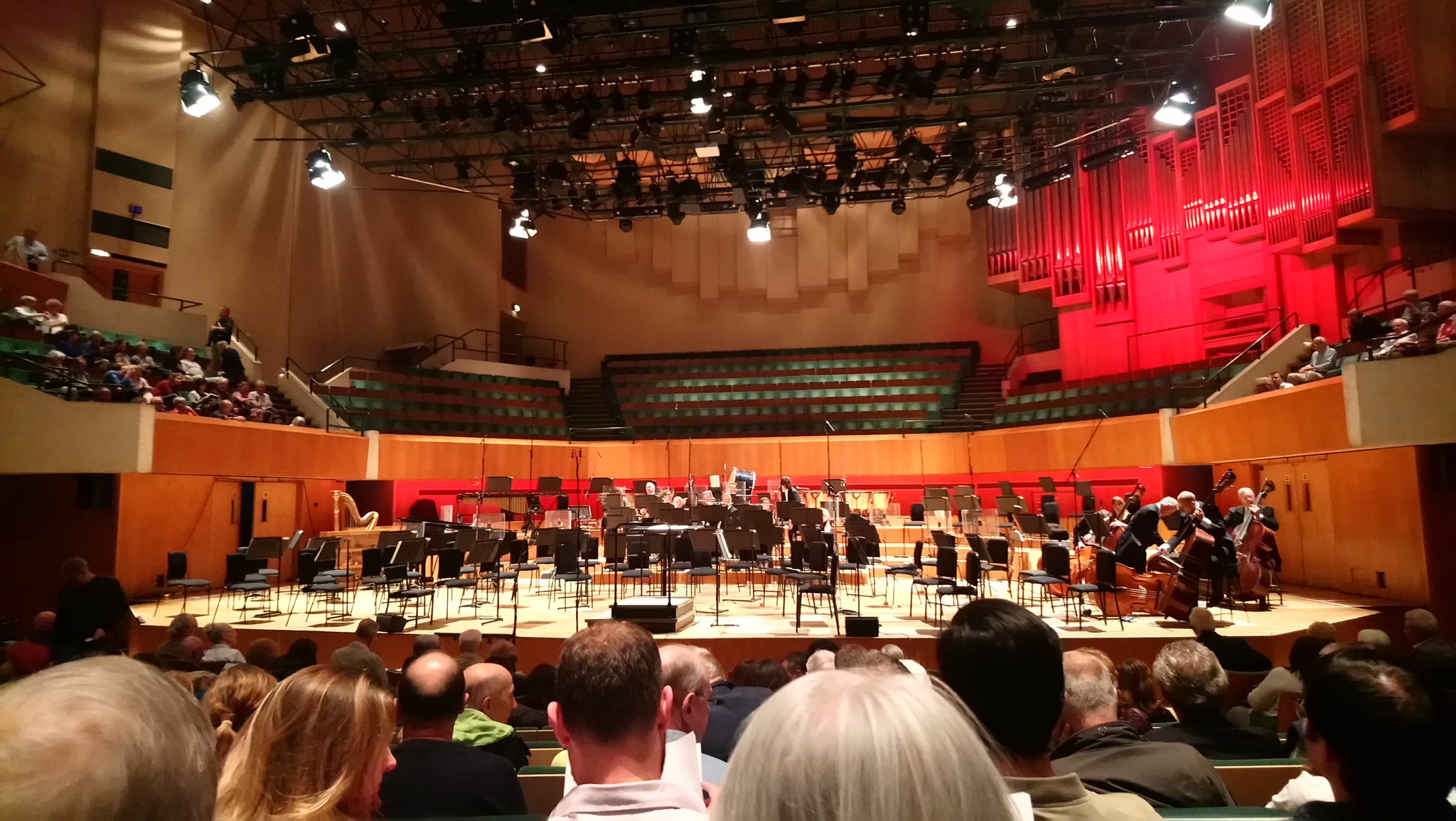
It had been over a month since my last visit to the National Concert Hall in Dublin so I was happy to be able to attend this week’s Friday night concert last night. It was great to see that the venue was very full too. I think that was at least partly down to the fact that one of the pieces featured Irish violinist Mairéad Hickey who has a sizeable local following. Conductor for the evening with National Symphony Orchestra Ireland was Anna Rakitina (who was born in Russia).
The concert began with a short piece by Anna Clyne called Restless Oceans. This is an energetic and an excellent way to get the orchestra revved up for the rest of the evening. I’d never heard this work before and I think it must be the first time I’ve seen a performance in which the string section sang or hummed a wordless accompaniment in one part and, in another, the whole orchestra provided extra percussion by stamping their feet.
After that zesty appetiser, Mairéad Hickey appeared on stage, resplendent in a green dress, to perform the first course proper, the Violin Concerto by Pyotr Ilyich Tchaikovsky. This is a familiar work but it was ravishingly played by Mairéad Hickey, who seem to revel in the virtuosic elements of this work, as well as bringing out the lyricism in the more romantic passages. The only things I don’t like about this composition are the gratuitously showy cadenzas which go on far too long, in my opinion. The audience clearly loved the performance, though, as did I, and we were treated to an encore in the form of some traditional Irish fiddle playing which was lovely.
After the wine break, we had the main dish for the evening, the Symphony No. 5 by Dmitri Shostakovich. This is a very famous work and one of the higlights of the entire symphonic repertoire. It is also perhaps the most accessible of all the Shostakovich symphonies. It was an immediate success with Soviet critics and public alike when it was first performed in 1937, and though it marked Shostakovich’s return to favour with the authorities after his denunciation by Stalin, this work has the composer’s very characteristic sense of things not being quite as they seem on the surface. Indeed, in this and many other of his compositions, seems to manage to say one thing at the same time as saying the exact opposite of that thing; nowadays this might be called `constructive ambiguity’. This is especially true in the finale, in which the sense of triumph it ostensibly portrays seems rather forced, so it approaches a parody of itself. This tension between possible interpretations gives the piece a palpable sense of danger.
Overall the Fifth Symphony is a sombre work, the dark undertone established right at the start with an imposing theme on the cellos and double basses, but it has passages of great beauty too, especially in the slow third movement. Like all great symphonies – and this is one of the greatest – it takes you on a journey full of of excitement and interest. It was a compelling performance by the NSOI, with outstanding playing by the whole orchestra, but especially the woodwinds.The 45 minutes or so of this performance seemed to fly by. It’s ending ending was greeted with rapturous applause and a standing ovation from many in the audience.
It’s interesting to consider that only 60 years had elapsed between the composition of these pieces by Tchaikovsky and Shostakovich, but what different musical worlds they represent!

 In the Dark