Archive for Solar and Stellar Astrophysics

Three New Publications at the Open Journal of Astrophysics

Posted in OJAp Papers, Open Access, The Universe and Stuff with tags , , , , , , , on August 30, 2023 by telescoper

Not unexpectedly because of holidays, August has been rather a quiet month at the Open Journal of Astrophysics, but with people returning to work this week business has picked up again and it’s time to announce the last batch (all published this week).

In fact, this week we have published three papers, which I now present to you here. These take the count in Volume 6 (2023) up to 34 and the total published by OJAp up to 99. Who will be the author(s) of the 100th? We will just have to wait and see! I’ll do a special post for whichever paper wins that honour.

In chronological order, the three papers published this week, with their overlays, are as follows. You can click on the images of the overlays to make them larger should you wish to do so.

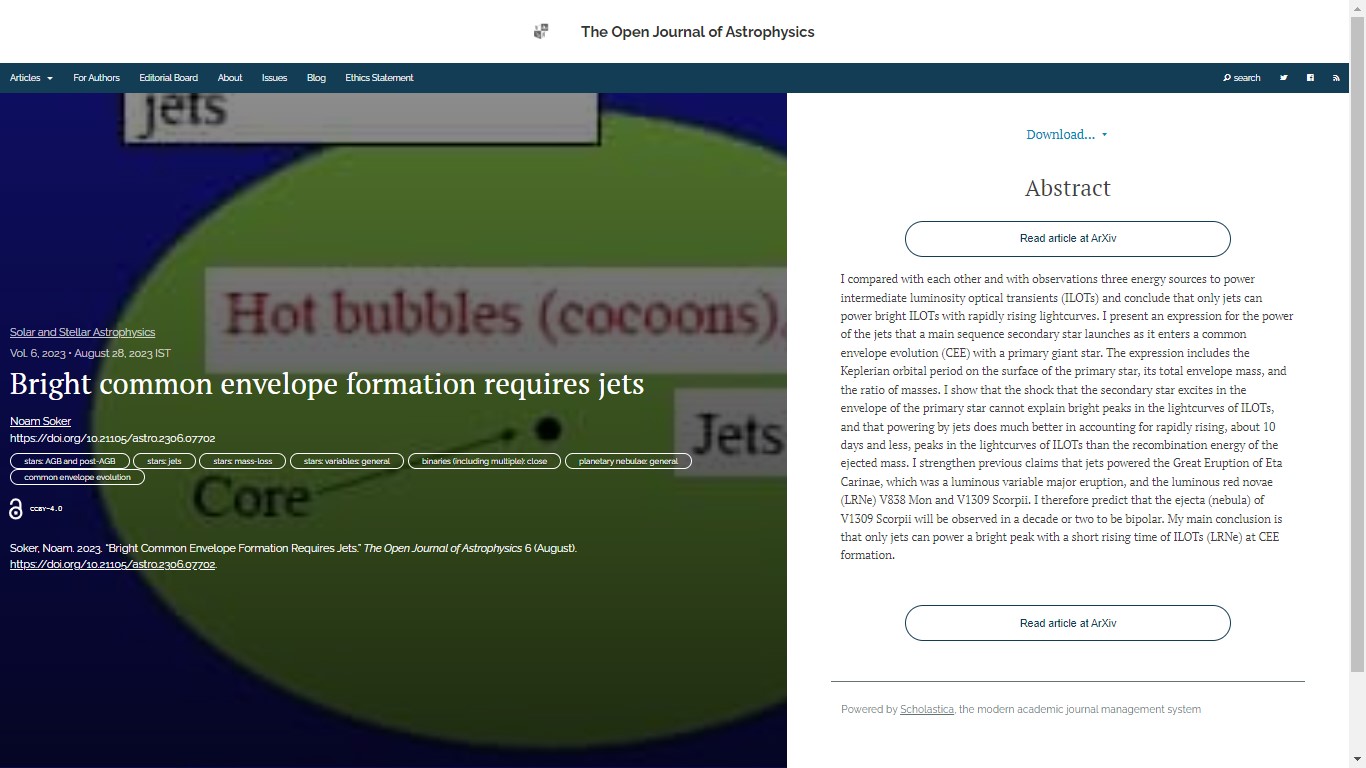
First one up is “Bright common envelope evolution requires jets” by Noam Soker of Technion, Haifa in Israel. This is a discussion of the role of jets that a main sequence secondary star launches as it enters a common envelope evolution (CEE) with a primary giant star. The paper was published on 28th August, is just the fifth item in the folder marked Solar and Stellar Astrophysics and can be found here.

Here is a screen grab of the overlay, which includes the abstract:
 

You can find the officially accepted version of the paper on the arXiv here.

The second paper to announce is “Almanac: MCMC-based signal extraction of power spectra and maps on the sphere” by Elena Sellentin (Leiden), Arthur Loureiro (Stockholm); Lorne Whiteway (UCL); Javier Lafaurie (Leiden); Sreekumar Balan (UCL); Malak Olamaie (York); and Andrew Jaffe & Alan Heavens (Imperial).  This presents a new software tool called Almanac , which uses Hamiltonian Monte Carlo sampling to infer the underlying all-sky noiseless maps of cosmic structures, together with their auto- and cross-power spectra.

This one is  in the folder marked Cosmology and Nongalactic Astrophysics. The paper was also published on 28th August 2023 and you can see the overlay here:


The accepted version of this paper can be found on the arXiv here.

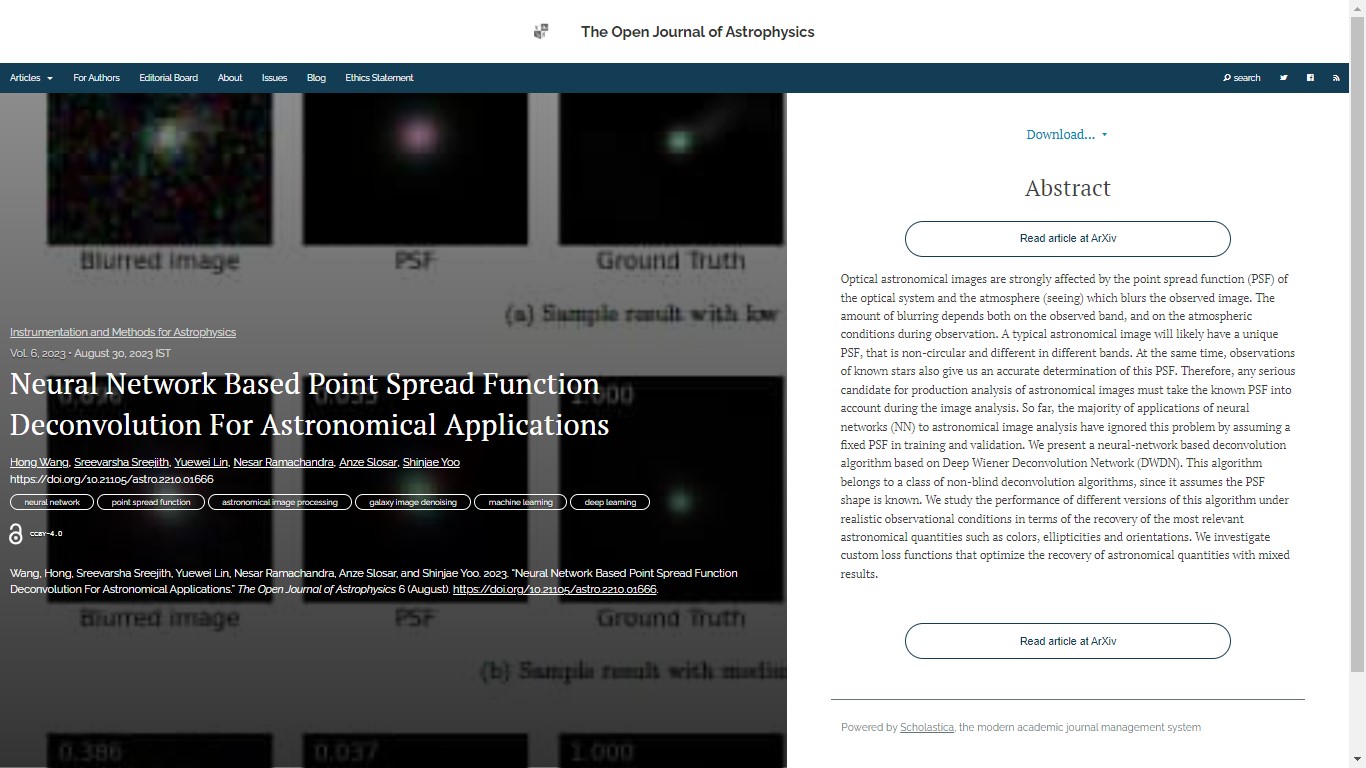
The last paper of this batch paper is in the Instrumentation and Methods for Astrophysics folder. It is entitled “Neural Network Based Point Spread Function Deconvolution For Astronomical Applications” and the authors are: Hong Wang, Sreevarsha Sreejith, Yuewin, Nesar Ramachandra*, Anze Slosar & Shinjae Yoo, all of the Brookhaven National Laboratory (NY) except * who is at the Argonne National Laboratory (IL), all based in the USA. This paper discusses a neural-network based deconvolution algorithm based on Deep Wiener Deconvolution Network (DWDN) and its performance in an astronomical context.

Here is the overlay:


You can find the full text for this one on the arXiv here.

Four New Publications at the Open Journal of Astrophysics

Posted in OJAp Papers, Open Access, The Universe and Stuff with tags , , , , , , , , , , , , , , , , on July 29, 2023 by telescoper

The rate of publication at the Open Journal of Astrophysics has now reached the point at which I think I’ll have to limit myself to weekly updates here rather than announcing every paper as it appears. We still announce individual papers on social media of course, meaning Mastodon, Facebook and the platform formerly known as Twitter…

This week we have published four papers which I now present to you here. These four take the count in Volume 6 (2023) up to 31 and the total published by OJAp up to 96. I speculated earlier this year that we might reach 100 before the end of 2023, now it looks certain we will reach the century mark as early as August! It is gratifying to see the range of papers published increasing, with all four of these in different categories.

In chronological order, the four papers published this week, with their overlays, are as follows. You can click on the images of the overlays to make them larger should you wish to do so.

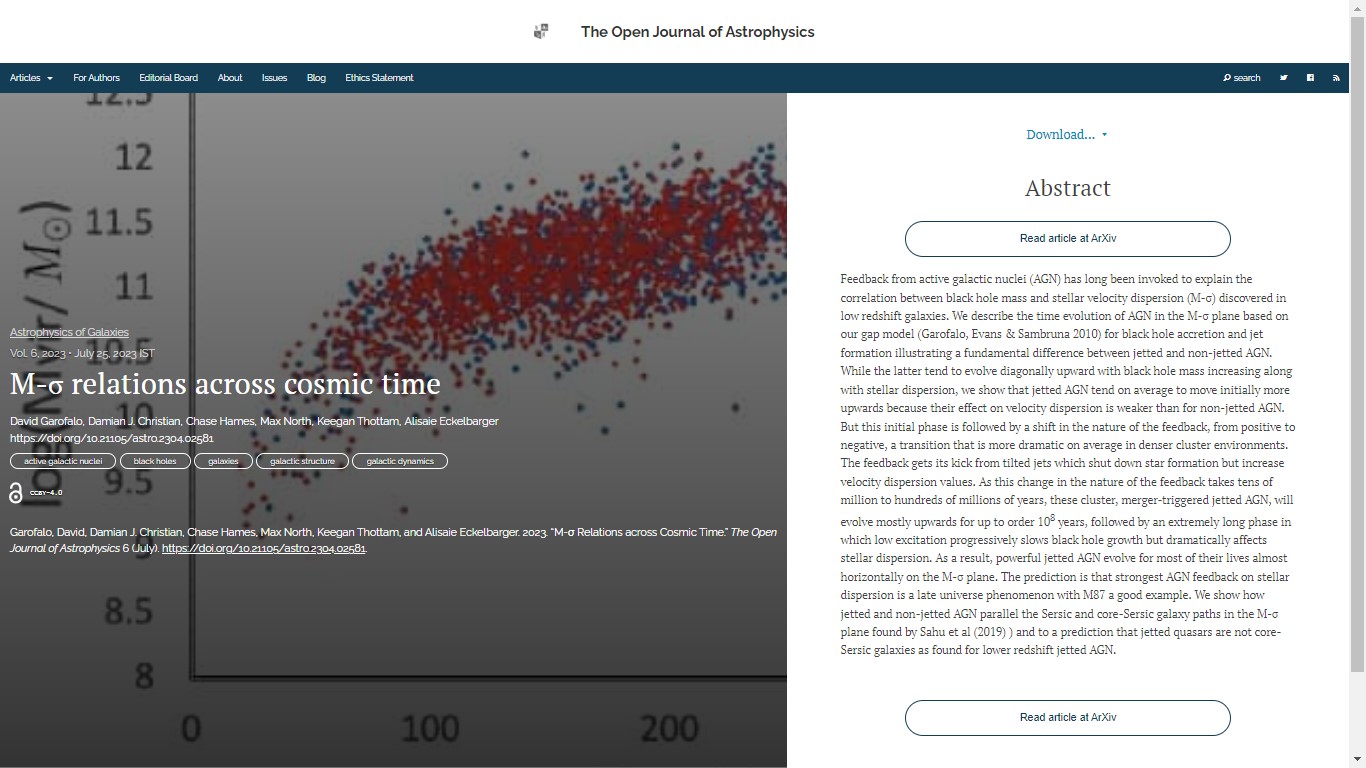
First one up is “M-σ relations across cosmic time” by David Garofalo (1), Damian J. Christian (2), Chase Hames (1), Max North (3), Keegan Thottam (1) & Alisaie Eckelbarger (1). The author affiliations are: (1) Department of Physics, Kennesaw State University, USA; (2) Department of Physics and Astronomy, California State University, Northridge, USA; (3) Department of Information Systems, Kennesaw State University, USA. This is a discussion of the relationship between black hole mass and stellar velocity dispersion discovered in low redshift galaxies and its evolution with cosmic time. The paper was published on 25th July, is in the folder marked Astrophysics of Galaxies and can be found here.

Here is a screen grab of the overlay, which includes the abstract:

You can find the officially accepted version of the paper on the arXiv here.

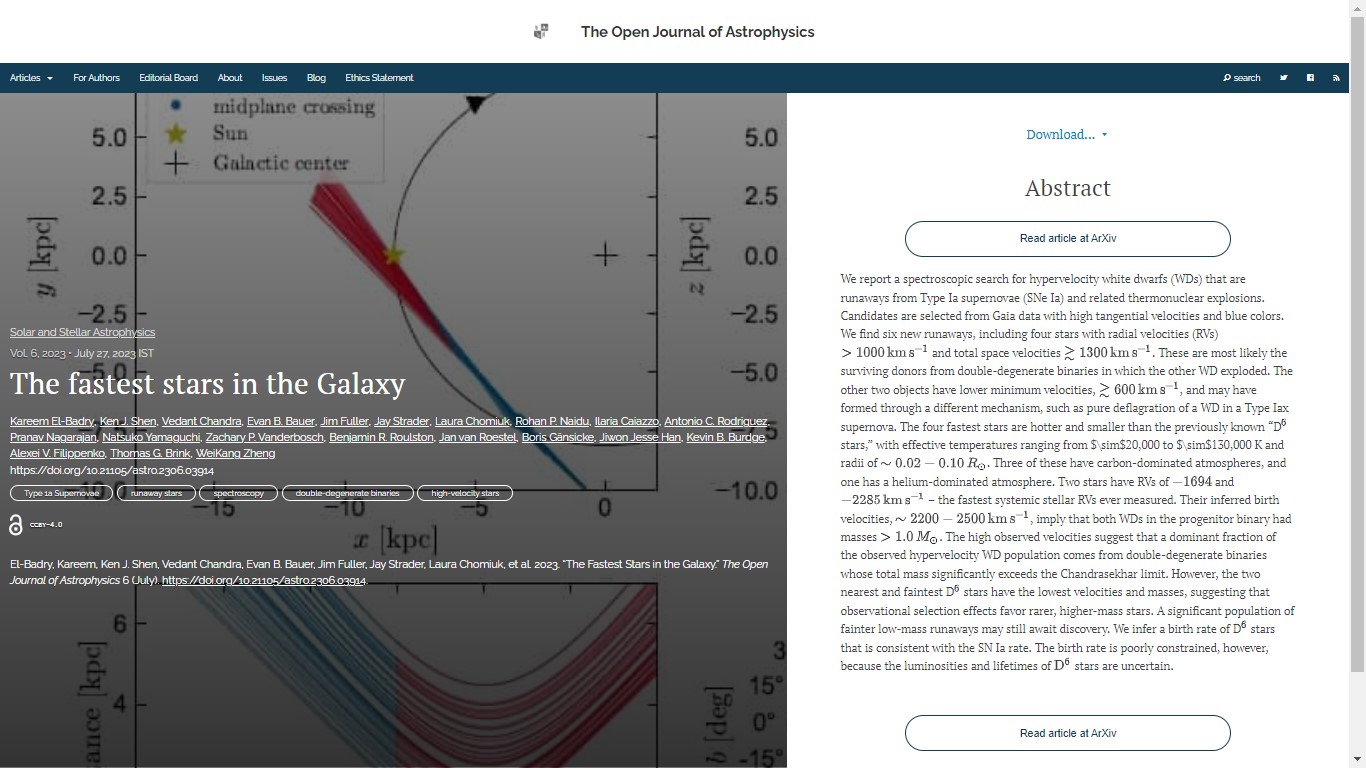
The second paper to announce is “The fastest stars in the Galaxy” by Kareem El-Badry et al. (21 authors. This one is the fourth item in the folder marked Solar and Stellar Astrophysics and it reports the spectroscopic discovery of 6 new “runaway” stars, probably the surviving members of binary star systems in which one star exploded in a Type 1a supernova. The paper was published on 27th July 2023 and you can see the overlay here:

The accepted version of this paper can be found on the arXiv here.

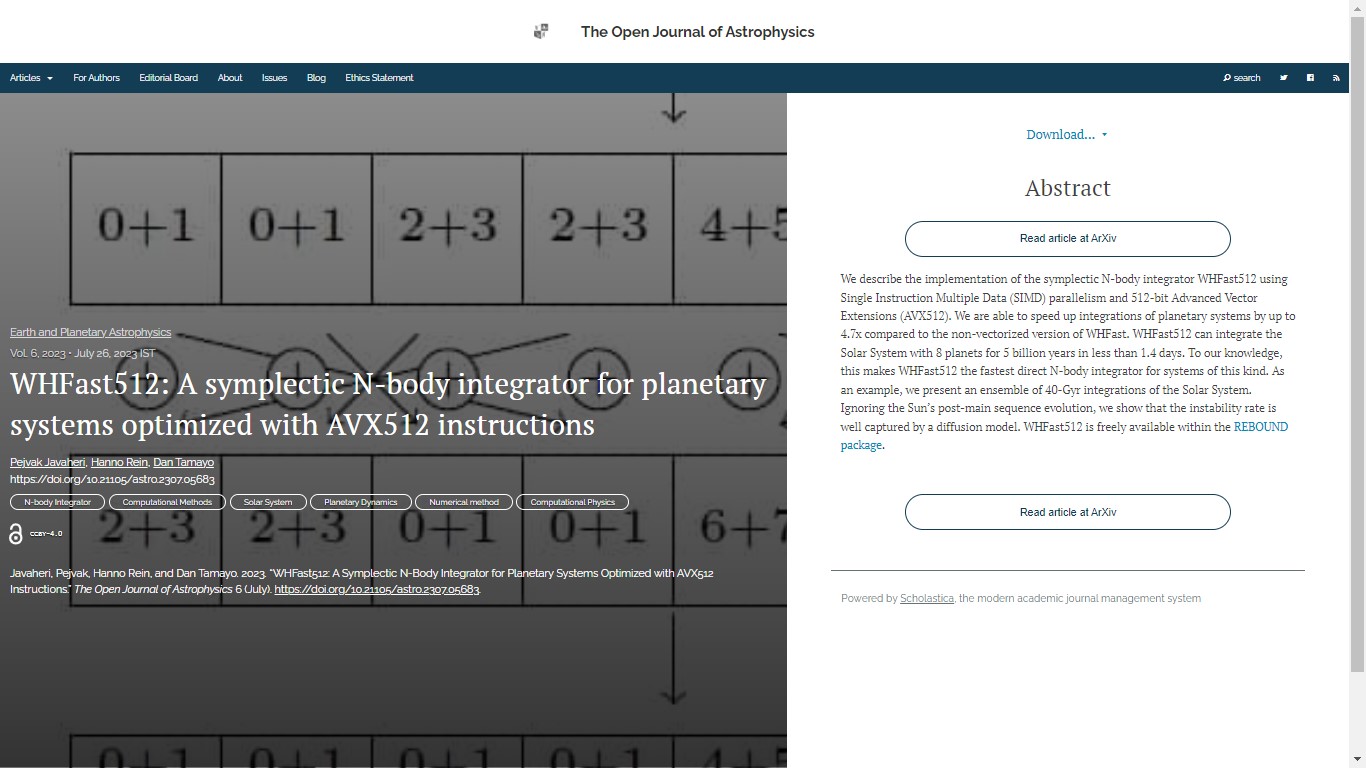
The next paper is in the Earth and Planetary Astrophysics folder. It is in fact only the second paper we have published in that area. It is entitled “WHFast512: A symplectic N-body integrator for planetary systems optimized with AVX512 instructions” by Pejvak Javaheri & Hanno Rein (University of Toronto, Canada) and Daniel Tamayo (Harvey Mudd College, USA). This paper presents a fast direct N-body integrator for gravitational systems, and demonstrates it using a 40 Gyr integration of the Solar System.

Here is the overlay:


You can find the full text for this one on the arXiv here.

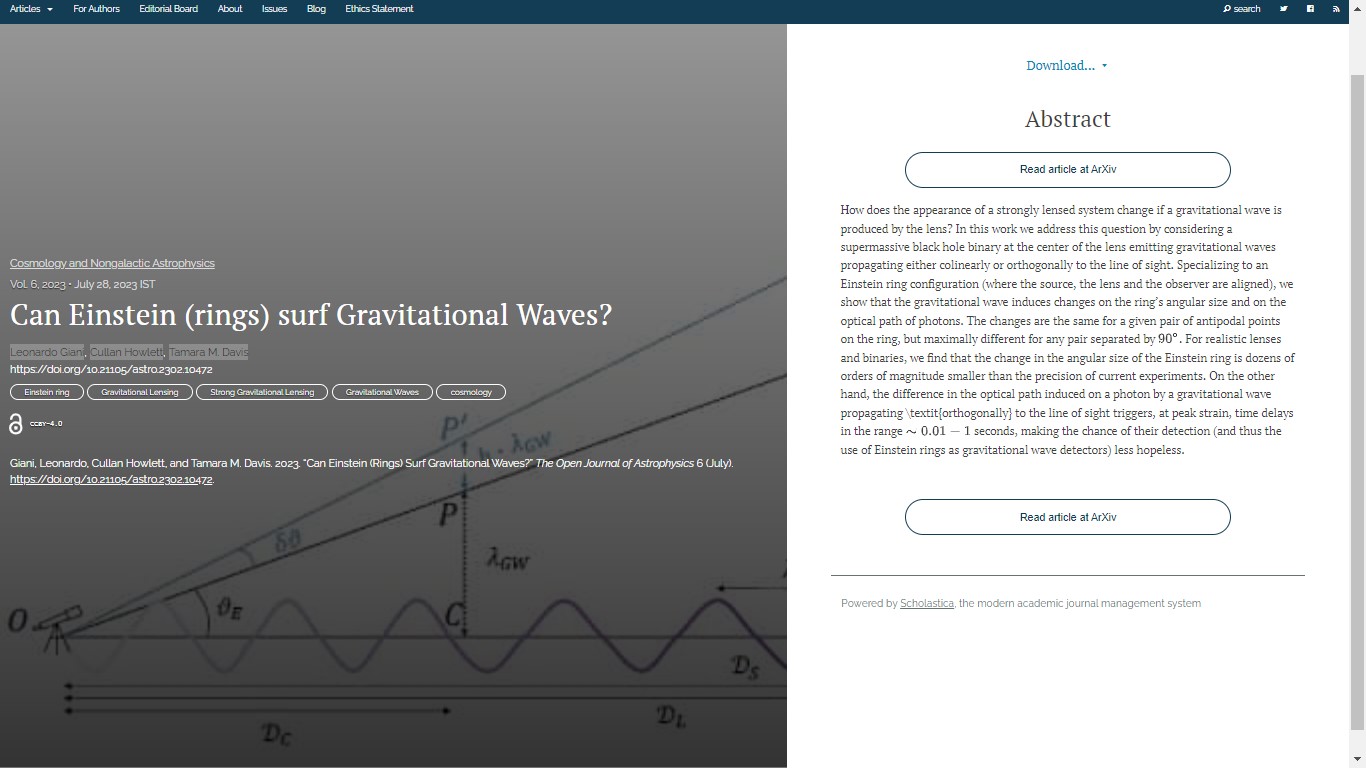
Last but by no means least, published yesterday (29th July), we have a paper that asks the question “Can Einstein (rings) surf Gravitational Waves?” by Leonardo Giani, Cullan Howlett and Tamara M. Davis of the University of Queensland, Australia. The primary classification for this one is Cosmology and Nongalactic Astrophysics and it discusses the possible effect(s) of gravitational waves on gravitational lensing observations.


You can click on the image of the overlay to make it larger should you wish to do so. You can find the officially accepted version of the paper on the arXiv here.

New Publication at the Open Journal of Astrophysics

Posted in OJAp Papers, Open Access, The Universe and Stuff with tags , , , , on April 18, 2023 by telescoper

Back after a short hiatus due to the Easter holidays, it’s time to announce yet another new paper at the Open Journal of Astrophysics. This one was accepted for publication a few weeks ago but the final version only appeared on the arXiv yesterday. Since OJAp is an arXiv-overlay journal, we have to wait for authors to upload the accepted version before we can publish the overlay.

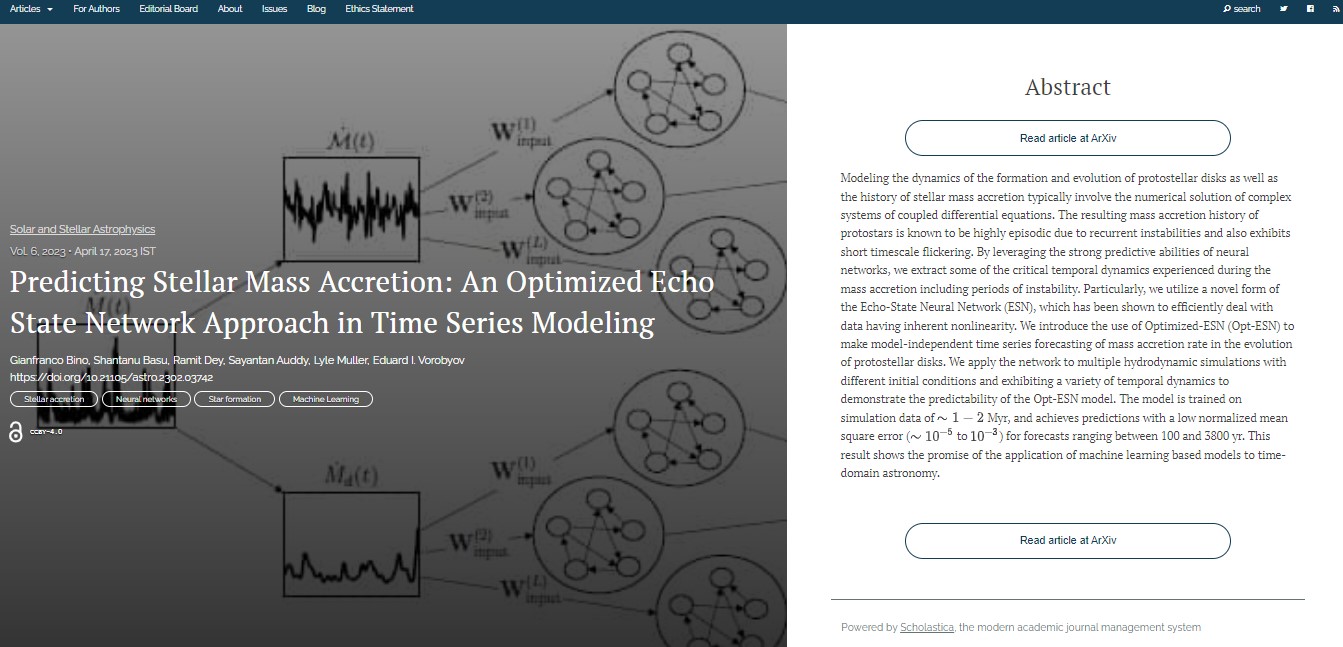
Anyway, the latest paper is the 12th paper so far in Volume 6 (2023) and the 77th in all. This one is in the currently under-populated folder marked Solar and Stellar Astrophysics and its title is “Predicting Stellar Mass Accretion: An Optimized Echo State Network Approach in Time Series Modeling”.

The authors are: Gianfranco Bino, Shantanu Basu & Ramit Dey (all at the University of Western Ontario, Canada), Sayantan Auddy (Jet Propulsion Laboratory, Pasadena, USA), Lyle Muller (University of Western Ontario, Canada) and Eduardo I. Vorobyov (University of Vienna, Austria & Southern Federal University, Russia).

Here is a screen grab of the overlay which includes the  abstract:

You can click on the image of the overlay to make it larger should you wish to do so. You can find the officially accepted version of the paper on the arXiv here.

New Publication at the Open Journal of Astrophysics

Posted in Open Access, The Universe and Stuff with tags , , , on July 17, 2022 by telescoper

Today is ten years to the day that I wrote the blog post that first proposed setting up the Open Journal of Astrophysics. It took a bit longer than I’d expected to get it going. The prototype site opened at the end of 2015 but owing to personal issues the project didn’t get going in full until after I moved to Maynooth in 2017.

It couldn’t have happened without enormous help from Arfon Smith, Chris Lintott, Adam Becker, Robert Simpson, Stuart Lynn and Mark Rohloff so many thanks to them for assistance in getting it off the ground. I also thank the staff at Maynooth University Library, especially Fiona Morley-Clarke, for their support and assistance. I also acknowledge financial support from the Gordon and Betty Moore Foundation.

I’d also like to thank the Editorial Team at OJAp, all unpaid volunteers, for their efforts and of course to all the authors who have trusted their research findings what was, at least at the start, an experimental venture.

Now seems an appropriate time to announce yet another new publication in the Open Journal of Astrophysics! This one, published last week, is the 10th paper in Volume 5 (2022) and the 58th in all.

The latest publication is entitled “V889 Her: abrupt changes in the magnetic field or differential rotation?” and is written by Teemu Willamo (Helsinki), Thomas Hackman (Helsinki), Jyri J. Lehtinen (Turku), Maarit Korpi-Lagg (Aalto) and Oleg Kochukhov (Uppsala). The first four of these are based in Finland and the last in Sweden.

This is another paper in the Solar and Stellar Astrophysics folder; the subject of the paper V889 Herculis is a young and very active dwarf star with some intriguing properties.

Here is a screen grab of the overlay which includes the (very short) abstract:

You can click on the image to make it larger should you wish to do so. You can find the arXiv version of the paper here.

New Publication at the Open Journal of Astrophysics!

Posted in OJAp Papers, Uncategorized with tags , , , , on July 29, 2020 by telescoper

To celebrate yesterday’s news, I have great pleasure today in publishing another paper in The Open Journal of Astrophysics.

A reason to be especially pleased with this article is that this is our first publication in the Solar and Stellar Astrophysics category of astro-ph. It’s good to be spreading out beyond cosmology and extragalactic astrophysics which is where most of our papers appear.

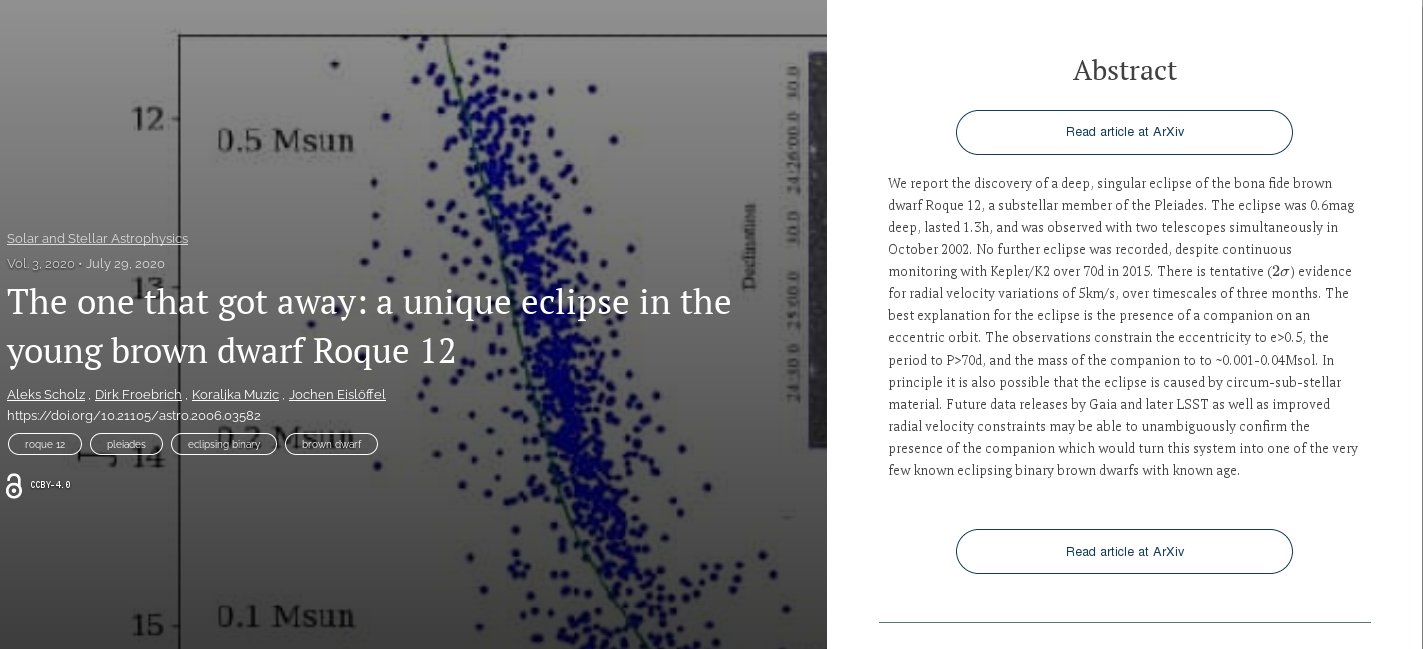
The intriguing title of the latest paper is The one that got away: a unique eclipse in the young brown dwarf Roque 12. There’s also a blog post by one of the authors that tells the fascinating behind-the-scenes story of this paper.

The authors of the paper are Aleks Scholz (University of St Andrews, UK), Dirk Froebrich (University of Kent, Canterbury, UK); Koraljka Muzic (University of Lisbon, Portugal) and Jochen Eislöffel (TLS Tautenburg, Germany).

Here is a screen grab of the overlay:

You might notice that we now have the volume number appearing on the overlay, a change we requested recently from Scholastica.

You can find the arXiv version of the paper here.