Archive for St Brigid’s Day

The Quickening of the Year Again

Posted in Biographical, History, Maynooth with tags , , , , , , , on February 3, 2025 by telescoper

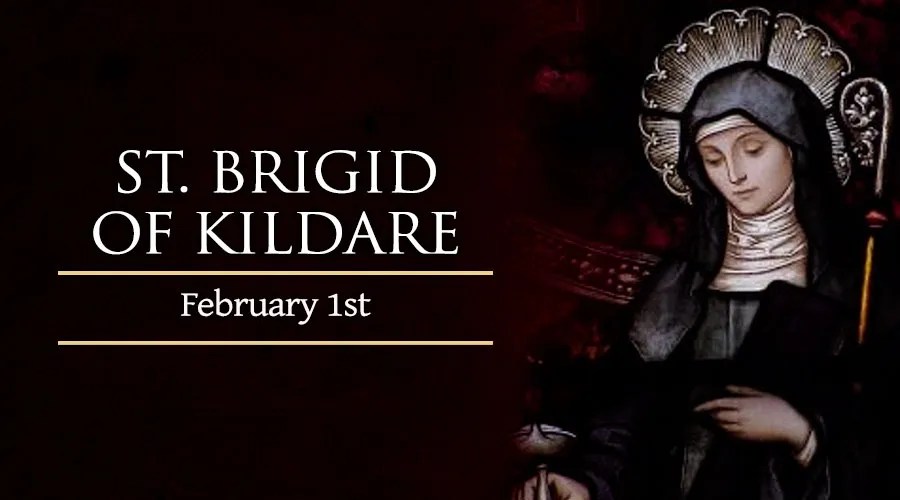
Today would be the first day of teaching in Semester 2 at Maynooth University, were it not for the fact that it is a Bank Holiday in Ireland. The holiday marks Imbolc, an old Celtic festival occurring halfway between the winter solstice and vernal equinox in the Northern hemisphere. In the modern calendar the date is 1st February. In Ireland Imbolc is often referred to as a Lá Fhéile Bríde,  St Brigid’s Day, after St Brigid of Kildare, whose feast day is 1st February. In the old pagan calendar, this day is regarded as the first day of spring, as it is roughly the time when the first spring lambs are born, daffodils, etc, start to appear, and the days get noticeably longer. It corresponds to the Welsh Gŵyl Fair y Canhwyllau and is also sometimes called, rather beautifully, The Quickening of the Year. It’s a time for rebirth and renewal after the darkness of winter.

I noticed some scepticism on social media about 1st February being the first day of spring, but it makes sense to me. I feel the same way about May being the start of summer too. From living 7 years in Ireland, I’ve always found May/June the most summery months – as far as that means anything in Ireland!

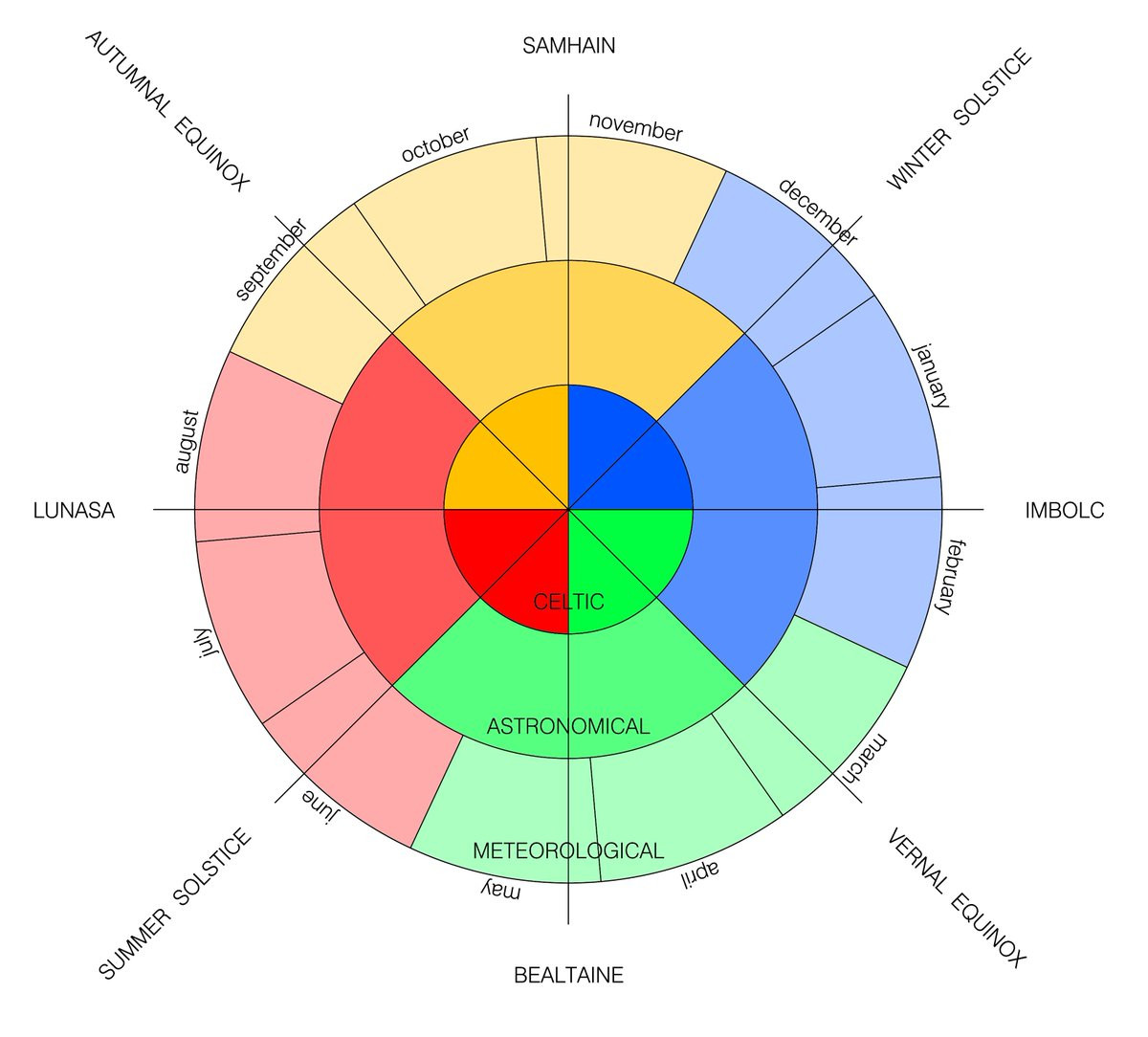
In the Northern hemisphere, in astronomical terms, the solar year is defined by the two solstices (summer, around June 21st, and winter, around December 21st) and the equinoxes (spring, around March 21st, and Autumn, around September 21st). These four events divide the year into four roughly equal parts of about 13 weeks each. If you divide each of these intervals in two you divide the year into eight pieces of six and a bit weeks each. The dates midway between the astronomical events mentioned above are the cross-quarter days, of which Imbolc is one. Here they are represented on a diagram:

The timings are rough because the dates of the equinoxes and solstices vary from year to year. Imbolc is often taken to be the 2nd of February (Groundhog Day) and Samhain is sometimes taken to be October 31st, Halloween but hopefully you get the point that although the Pagan festivals have been appropriated by the Christian church, they have much older origins.

Until 2023 only three of the four cross-quarter days were associated with public holidays in Ireland; there wasn’t a holiday for Imbolc. In 2022 however, the Government decided to create a new Bank Holiday that corrected this anomaly by introducing a new St Brigid’s Day holiday on the first Monday on or after 1st February (or on Friday if 1st February falls on that day), which also happens to be the first national holiday in Ireland to be named after a woman. The first such holiday was Monday, 6th February 2023 and the second was on Monday 5th February 2024. This is the third.

But I digress.

I am glad to have today’s holiday just before teaching starts. Having completed my examination marking duties promptly I was planning to use last week to get my teaching materials ready. Unfortunately I wasn’t at all well for most of the week – though I recovered by Friday – and am way behind schedule. Fortunately, I’ve taught one of the modules (Computational Physics) many times before so not much preparation is required although it is a bigger class than I’ve had on previous occasions which means extra work in due course grading the CA components. The other module, Particle Physics is new for me at Maynooth, though I have taught it elsewhere. This also has a bigger class than I was expecting for a final-year module and my first lecture on it is tomorrow. I’m going to have to spend most of today quickening the writing of the lecture notes and preparing assignments.

P.S. Not particularly relevantly, Particle Physics is an anagram of Happier Cyclists.

On Imbolc and the Quickening of the Year

Posted in Biographical with tags , , , , , on February 1, 2024 by telescoper

It is 1st February 2024, which means that today is Imbolc, a Gaelic festival marking the point halfway between the winter solstice and vernal equinox in the Northern hemisphere.  Incidentally, the Celts counted each day starting from sunset so Imbolc really started yesterday evening, on 31st January.

In the old pagan calendar, this day is regarded as the first day of spring, as it is roughly the time when the first spring lambs are born, daffodils, etc, start to appear, and the days get noticeably longer.  It is also sometimes called, rather beautifully, The Quickening of the Year.  It’s a time for rebirth and renewal after the darkness of winter.

In the Northern hemisphere, in astronomical terms, the solar year is defined by the two solstices (summer, around June 21st, and winter, around December 21st) and the equinoxes (spring, around March 21st, and Autumn, around September 21st). These four events divide the year into four roughly equal parts of about 13 weeks each. If you divide each of these intervals in two you divide the year into eight pieces of six and a bit weeks each. The dates midway between the astronomical events mentioned above are the cross-quarter days, of which Imbolc is one. They are:

  • 1st February: Imbolc (Candlemas)
  • 1st May: Beltane (Mayday)
  • 1st August: Lughnasadh (Lammas)
  • 1st November: Samhain (All Saints Day)

The names I’ve added in italics are taken from the Celtic/neo-Pagan and, in parenthesis the (English) Christian terms, for the cross-quarter daysThese timings are rough because the dates of the equinoxes and solstices vary from year to year. Imbolc is often taken to be the 2nd of February (Groundhog Day) and Samhain is sometimes taken to be October 31st, Halloween but hopefully you get the point that although the Pagan festivals have been appropriated by the Christian church, they have much older origins. In Ireland Imbolc is usually often referred to a Lá Fhéile Bríde,  St Brigid’s Day, after St Brigid of Kildare, whose Feast Day is 1st February, another appropriation of a much older festival.

Until last year only three of the four cross-quarter days were associated with public holidays in Ireland; there wasn’t a holiday for Imbolc. In 2022 however, the Government decided to create a new Bank Holiday that corrected this anomaly by introducing a new St Brigid’s Day holiday on the first Monday on or after 1st February, which also happens to be the first national holiday in Ireland to be named after a woman. The first such holiday was Monday, 6th February 2023 and the second is on Monday 5th February 2024, by which time I will hopefully be in a place where Northern hemisphere considerations do not apply.

P.S. On a personal note, today is also the 6th anniversary of the very first lecture I gave in Maynooth, on Computational Physics on 1st February 2018…

Reflections on the St Brigid’s Day Holiday

Posted in Biographical, Education, Maynooth with tags , , on February 6, 2023 by telescoper

It’s Monday 6th February 2023, which means that today is a new experience for me: a Bank Holiday in February. This is taking place on the first Monday after Imbolc, a Gaelic festival marking the point halfway between the winter solstice and vernal equinox. The 1st day of February is also the Feast day of St Brigid of Kildare (c. 451-525), one of Ireland’s patron saints, along with Saints Patrick and Colm Cille. . From what I’ve read, St Brigid is an a sort of amalgamation of a pagan deity and an early Christian figure, part legend and part real person. One of her miraculous powers was the ability to change water into ale, which perhaps explains her enduring popularity among the Irish.

Anyway, it’s nice to have a day off even if it is just a week after the start of Semester Two, well before exhaustion sets in. Last week I started both my modules. I was particularly apprehensive about the first laboratory session for Computational Physics 1 on Thursday. In previous years the first session has always generated a lot of technical problems. This year we are running a new version of the operating system on our Linux cluster as well as a new version of Python. Students are issued with accounts specifically for use on this cluster and even logging for the first time and changing passwords has proved a challenge. I am now also using a digital display screen instead of the old data projector I used to have and which conked out last year.

This time, however, there were no significant problems at all in the Lab. Let’s hope the same is true for the Tuesday lab, which is a repeat but with a different (and slightly larger) group of students. In recognition of the likelihood of technical hitches I don’t usually aim to do very much in Lab 1, but this time I managed to cover quite a lot of material. By next week I’ll be starting to get the students to write bits of their own code. Thereafter it gets increasingly hands-on. There’s no efficient way to learn coding other than by doing it, so the sooner they get going with that the better.

I don’t actually have any lectures timetabled on Mondays this semester and, since the lab for tomorrow (Tuesday) is a repeat of last Thursday’s, I don’t have anything urgent to prepare. I’m therefore using the time off to do some Open Journal business – including publishing a paper – and, despite the cold, do a bit of gardening to prepare for Spring.

Imbolc – the Quickening of the Year

Posted in Biographical with tags , , on February 1, 2023 by telescoper

It is 1st February 2023, which means that today is Imbolc, a Gaelic festival marking the point halfway between the winter solstice and vernal equinox.  In the old pagan calendar, this day is regarded as the first day of spring, as it is roughly the time when the first spring lambs are born, daffodils etc start to appear, and the days get noticeably longer.  It corresponds to the Welsh Gŵyl Fair y Canhwyllau and is also sometimes called, rather beautifully, The Quickening of the Year.  It’s a time for rebirth and renewal after the darkness of winter. Walking by the canal on my way to work this morning, I passed a place where two swans have nested for many years. I noticed that last year’s cygnets – which I saw on Monday with their parents – now appear to have departed for pastures new. That is the way of things. It won’t be long until this year’s chicks appear.

In Ireland Imbolc is usually often referred to a Lá Fhéile Bríde,  St Brigid’s Day, after St Brigid of Kildare, whose feast day is 1st February.

In the Northern hemisphere, in astronomical terms, the solar year is defined by the two solstices (summer, around June 21st, and winter, around December 21st) and the equinoxes (spring, around March 21st, and Autumn, around September 21st). These four events divide the year into four roughly equal parts of about 13 weeks each.

If you divide each of these intervals in two you divide the year into eight pieces of six and a bit weeks each. The dates midway between the astronomical events mentioned above are the cross-quarter days, of which Imbolc is one. They are:

  • 1st February: Imbolc (Candlemas)
  • 1st May: Beltane (Mayday)
  • 1st August: Lughnasadh (Lammas)
  • 1st November: Samhain (All Saints Day)

The names I’ve added in italics are taken from the Celtic/neo-Pagan and, in parenthesis the Christian terms), for the cross-quarter daysThese timings are rough because the dates of the equinoxes and solstices vary from year to year. Imbolc is often taken to be the 2nd of February (Groundhog Day) and Samhain is sometimes taken to be October 31st, Halloween but hopefully you get the point that although the Pagan festivals have been appropriated by the Christian church, they have much older origins.

The last three of these also coincide closely with existing Bank Holidays in Ireland, though these are always on Mondays so may happen a few days away. Until this year, however, there wasn’t a holiday for Imbolc. Last year, however, the Government decided to create a new Bank Holiday that corrects this anomaly. The first such holiday is next Monday, 6th February, the new St Brigid’s Day holiday.  which also happens to be the first national holiday in Ireland to be named after a woman.


Incidentally, the Celts counted each day starting from sunset, so the Imbolc/St Brigid’s Day celebrations in County Kildare started last night, 31st January. Maynooth Castle – or at least the remains thereof – was illuminated last night, though I was not there to witness it.

As it also happens, today is my first Advanced Electromagnetism lecture of Semester 2 and also the 5th anniversary of the very first lecture I gave in Maynooth, on Computational Physics on 1st February 2018…