Archive for steady state cosmology

R.I.P. Jayant Narlikar (1938-2025)

Posted in Biographical, R.I.P., The Universe and Stuff with tags , , , , , , on May 20, 2025 by telescoper
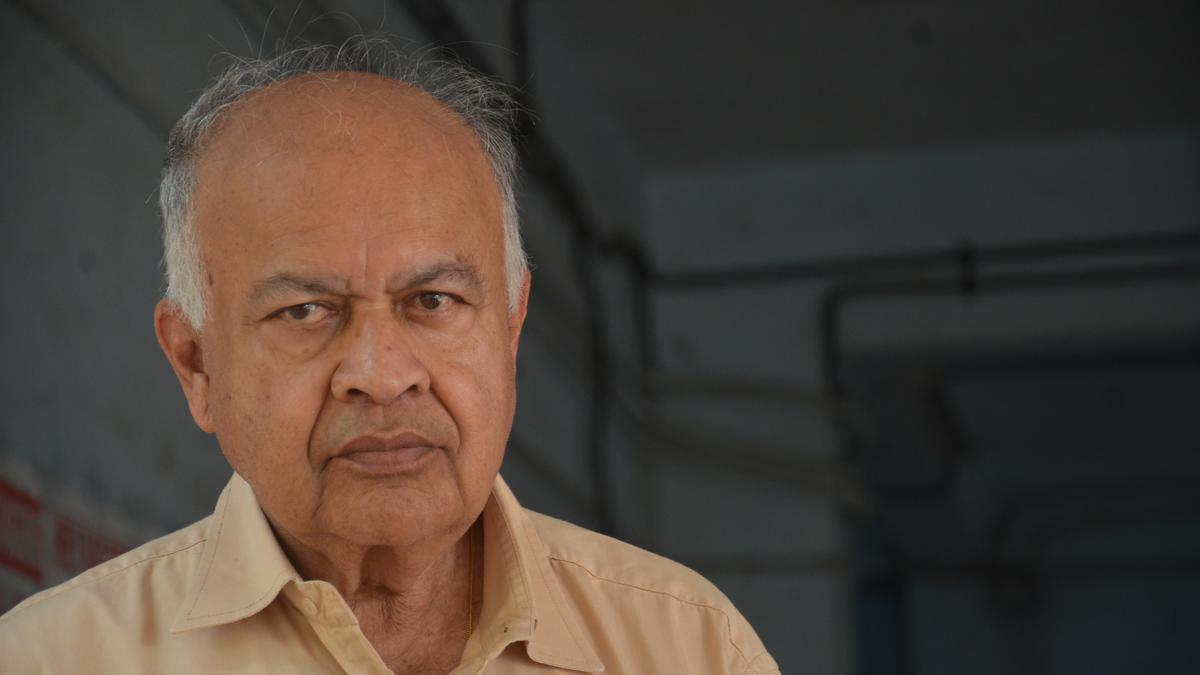
Professor Jayant Vishnu Narlikar (1938-2025)

I heard this morning of the death at the age of 86 of renowned Indian cosmologist Jayant Vishnu Narlikar. I understand he died peacefully in his sleep in Pune after a brief illness.

Scientifically, Jayant Narlikar is probably best known for his work with Fred Hoyle on a conformal gravity theory and as an advocate of the Steady State theory of cosmology. In India however his fame extended far beyond the world of research, as an educator and science popularist, as well as Founder-Director of the Inter-University Centre for Astronomy and Astrophysics (IUCAA) in Pune. Those who met him – as I was lucky enough to do – will also remember him as a kind and gracious man, and a self-effacing inspirer of young scientists. During my visit I gave a talk there, which Narlikar attended, and we had a very nice conversation afterwards from which I learnt a huge amount.

The Directorship at IUCAA came with a house which had a very nice lawn, on which I remember playing croquet with Donald Lynden-Bell and others, but that’s another story. Another random thing I remember is that I remember is that Narlikar’s username on the IUCAA email system was “jvn” and he was often referred to informally by that name.

Although he never really abandoned the Steady State cosmology, despite the weight of evidence in favour if the Big Bang, it is to Narlikar’s great credit that he didn’t try to impose his own scientific ideas on those working at IUCAA. In fact he assembled an excellent group of cosmologists and astrophysicists and encourage them to do whatever they liked.

I first visited IUCAA in 1994 to work with Varun Sahni. In those days Westerners mainly went to Pune to visit an ashram (usually the one run by the guru Rajneesh). I remember when I arrived on the train from Mumbai and tried to get a taxi to the IUCAA campus, the driver asked me “which ashram?” I had long hair and a beard at that time, so I looked a potential hippy. I said, “No ashram. Professor Narlikar”. He knew exactly where to take me; “Narlikar” was a household name in India, where the newspapers are awash with tributes today (e.g. here) and where his loss will be keenly felt.

Rest in peace Jayant Narlikar (1938-2025)

Dead of Night

Posted in The Universe and Stuff with tags , , , , , , , on January 22, 2012 by telescoper

It not being possible to watch Match of the Day last night – I didn’t particularly want to watch the horror story of Newcastle’s 5-2 drubbing by Fulham – I rummaged around in my stack of DVDs of old films and came up with Dead of Night. I was actually very happy to have the excuse  to watch this classic British horror film for the umpteenth time. I’ve actually blogged about a bit of this film before. There is a sequence (to me by far the scariest in the  film) about a ventriloquist who is gradually possessed by his evil dummy which came up in a post I did about Automatonophobia some time ago.

Anyway, Dead of Night was made in 1945 by Ealing Studios and you only have to watch it to appreciate why it its held in such high regard by critics to this day. Indeed you can see ideas in it which have been repeated in a host of subsequent (and usually inferior) horror flicks. I’m not going to spoil it by saying too much about the plot. I’m sure there are many (younger) readers who have never heard of this wonderful film and I don’t want to spoil their enjoyment of it by giving away too much. I would say though that it’s basically a portmanteau film, i.e. a series of essentially separate stories (to the extent of having a different director for each such segment) embedded within an overall narrative. It also involves an intriguing plot device similar to those situations in which you are dreaming, but in the dream you wake up and don’t know whether you’re actually awake or still dreaming…

Anyway, you can watch the whole film on Youtube if you like but you have to keep clicking through the different sections used to be able to watch it on Youtube, but it’s sadly now been removed

It’s the “dream-within-a-dream” structure – what physicists would call a self-similar hierarchy – of the overall framework of this movie that gives it its particular interest from the point of view of this blog, because it played an important role in the evolution of theoretical cosmology. One evening in 1946 the mathematicians and astrophysicts Fred Hoyle, Hermann Bondi and Tommy Gold went to see Dead of Night in Cambridge. Discussing the film afterwards they came up with the idea of the steady state cosmology, the first scientific papers about which were published in 1948. For the best part of two decades this theory was a rival to the now-favoured “Big Bang” (a term coined by Fred Hoyle which was intended to be a derogatory description of the opposing theory).

In the Big Bang theory there is a single “creation event”, so this particular picture of the Universe has a definite beginning, and from that point the arrow of time endows it with a linear narrative. In the steady state theory, matter is created continuously in small bits (via a hypothetical field called the C-field) so the Universe has no beginning and its time evolution not unlike that of the film.

Modern cosmologists sometimes dismiss the steady state cosmology as a bit of an aberration, a distraction from the One True Big Bang but it was undeniably a beautiful theory. The problem was that so many of its proponents refused to accept the evidence that they were wrong.  Supporters of  disfavoured theories rarely change their minds, in fact. The better theory wins out because younger folk tend to support it, while the recalcitrant old guard defending  theirs in spite of the odds eventually die out.

And another thing. If Fred Hoyle had thought of it he might have  called the field responsible for creating matter a scalar field, rather than the C-field, and it would now be much more widely recognized that he (unwittingly) invented many elements of modern inflationary cosmology. In fact, in some versions of inflation the Universe as a whole is very similar to the steady state model, only the continuous creation is not of individual particles or atoms, but of entire Big-Bang “bubbles” that can grow to the size of our observable Universe. So maybe the whole idea was actually right after all..