Archive for STFC

Negative Impact

Posted in Science Politics with tags , , , , , on December 2, 2009 by telescoper

After spending the best part of the last couple of days being prodded and poked and subjected to all manner of indignity in the name of medical science, I think it’s appropriate to return to the blogosphere with another rant. Before I start, however, I’d seriously like to thank everyone at the University Hospital of Wales at Heath Park  for making my visit there as brief and painless as possible. Everyone was very kind and very efficient. I’m not going to blog about the details, as Columbo doesn’t like reading about other peoples’ ailments.

Over the past few weeks there has been a lot of discussion about the UK government’s agenda for research, particularly science research, that includes something called “impact”. The Research Excellence Framework (REF; successor to the Research Assessment Exercise, RAE) will include such a thing:

Significant additional recognition will be given where researchers build on excellent research to deliver demonstrable benefits to the economy, society, public policy, culture and quality of life

Apparently, however, they don’t really know how to do this so they have set up a number of pilot studies to try to find out. I’d feel a little more comfortable if the bureaucrats had thought about what they were going to do before announcing that our future research funds were going to depend on it. Meanwhile, applicants for grants from any of the research councils must  include a statement of the “economic or social” impact their research will have.

Understandably, those of us working in “blue skies” research are very nervous about this new regime. There is more than a suspicion that the new emphasis on impact is intended to divert funds away from “pure” curiosity driven research and into areas where it can have an immediately identifiable short-term economic benefit. This has led to a petition, with over 13000 signatures, by the University and College Union calling for the impact statements to be abandoned.

I don’t know who is going to assess these impact statements, but unless they have a flawless ability to predict future technology I don’t think fundamental physics is going to score very well at all. To see my point, consider the case of  J. J. Thomson, who is generally credited with having discovered the electron and who was awarded the Nobel Prize for Physics in 1906. Thomson made extensive use of cathode ray tubes in his studies; these later found their way into sitting rooms across the world as essential components of the classic television set. But that took decades. I doubt if an impact panel looking at Thomson’s work – even if they were physicists rather than grey-suited bureaucrats – would have found any of it likely to lead to immediate economic benefit. The point is that when he discovered the electron it wasn’t because he was actually trying to invent the television set.

I think there are basically two possible interpretations of this impact business. One is that it is a deliberate plan to wind down fundamental research and use the money saved to subsidise UK industry. The other is that it’s another exercise in pointless box-ticking. I am in two minds. On the one hand, it is clear that the recent behaviour of the Science and Technology Facilities Council shows strong evidence of the former. Fundamental research is being slashed, yet projects involving space technology have been funded on the nod without scientific  peer review. On the other hand, the RCUK Impact “Champion”, a person by the name of David Delpy, has written in the Times Higher to defend the new agenda. Consider the following paragraph

Recently I have read that some believe it is impossible to predict the economic impact of blue-skies research. To be clear, we are not asking for accurate predictions – simply a consideration of potential. Basic research underpins all disciplines and builds pathways to new technologies with economic and social applications. It may build on an existing body of knowledge, connect to other research around the world or attract new industries to the UK. There are many routes to impact. I believe that I could write a statement indicating potential impact for any proposal I have seen, and to hear that bright academics say they can’t do it sounds a little disingenuous.

Champion Delpy thus suggests he could write a statement for any proposal he has seen, which sounds to me like an admission that what is called for is just a load of flannel. In fact, if he’s paid to be the Impact Champion perhaps he should write all the bullshit and save us scientists the need to jump through these silly hoops? Or perhaps we could get one of those little Microsoft Office Assistant things:

Hello. Looks like you’re writing an Impact Assessment. Would you like me to pad it out with meaningless but impressive-looking socio-economic buzzwords for you?

If it’s just another exercise in vacuous bureaucracy then it’s bad enough, but if it is the other possibility then of course it’s even worse. It could be the end for disciplines like astronomy and particle physics as well as the end of Britain’s history of excellence in those areas. I’ve already blogged about my view of short-termism in research funding. Essentially, my point is that government money should be used to fund precisely those things that don’t have immediate economic benefit. Those that do should be funded by the beneficiaries, i.e. commercial companies.

Politicians probably think that all this complaining about impact means that scientists  are arrogantly assuming that the taxpayer should fund them regardless of the cost or the benefit. I can only speak for myself, but I think that’s very unfair. I’m very conscious that my research is funded by Joe Public; that’s one of the reasons I think I should spend time giving public talks and doing other outreach activities. But I think the public funds me and others like me to do “useless” things because, in the end, useless things are more important than money.

The government is probably right to say that the UK economy doesn’t benefit as much from our scientific expertise as is the case with other countries. The reason for that, however, lies not with our universities and research laboratories but with our private industrial and commercial sectors which are, for the most part, managed with a very low level of competence. British universities are demonstrably excellent; our industry is demonstrably feeble. The persistent failure of the private sector to invest in research and development shows that it is in drastic need of a good shake up. British companies, not the taxpayer, should be paying for research that leads to profit for them and for that to happen they will have to learn to engage better with the University sector rather than expecting inventions to be served up on a plate funded by the taxpayer. Universities and research labs should continue do what they’re good at,  maintaining a culture within which curiosity and learning are promoted for their own sake not just as part of the dreary materialistic cycle of production and consumption that is all we seem to be able to think about these days.

So at the end I’ve come to the conclusion that, perhaps, insofar as it can be demonstrated, economic impact should be included in the forthcoming Research Excellence Framework. Research which leads directly to the economic gain of the private sector is  precisely the type of research that the taxpayer should not be paying for. If it can be proven that a given department has engaged in such activity, its state funding should therefore be cut and it should be told to recover the funds it has misused from the company that has benefitted from it. Economic impact should be included with a negative weight.

And if you think that’s a silly point of view, consider what happens with the other major part of a university’s activity, teaching. Students, we are told, are the primary beneficiaries of their education so they should have to pay fees. In the current regime, however, they only do so when their earnings reach a certain level. If commercial companies are to be the primary beneficiaries of state-funded research, why should they not likewise be asked to pay for it?

Exploitation

Posted in Poetry, Science Politics with tags , , on October 27, 2009 by telescoper

At the last Meeting of the RAS Council on October 9th 2009, Professor Keith Mason, Chief Executive of the Science and Technology Facilities Council (STFC), made a presentation after which he claimed that STFC spends too much on “exploitation”, i.e. on doing science with the facilities it provides. This statement clearly signals an intention to cut grants to research groups still further and funnel a greater proportion of STFC’s budget into technology development rather than pure research.

Following on from Phillip Helbig’s challenge a couple of posts ago, I decided to commemorate the occasion with an appropriate sonnet, inspired by Shakespeare’s Sonnet 14.

TO.THE.ONLIE.BEGETTER.OF.THIS.INSU(LT)ING.SONNET.

Mr K.O.M.

It seems Keith Mason doesn’t give a fuck
About the future of Astronomy.
“The mess we’re in is down to rotten luck
And our country’s  ruin’d economy”;
Or that’s the tale our clueless leader tells
When oft by angry critics he’s assailed,
Undaunted he in Swindon’s office dwells
Refusing to accept it’s him that failed.
And now he tells us we must realise:
We spend “too much on science exploitation”.
Forget the dreams of research in blue skies
The new name of the game is wealth creation.
A truth his recent statement underlines
Is that we’re doomed unless this man resigns.

I Did Expect the Spanish Inquisition…

Posted in Biographical, Science Politics with tags , , , on October 14, 2009 by telescoper

So that was it. D-Day.

Our application to the Science and Technology Facilities Council (STFC) for a rolling grant to cover the next 5 years of astronomy research went in a  few months ago. Over the summer we got feedback from independent referees. But today was the crunch. The dreaded panel visit.

In the old days the grants panel used to visit the applicants at their own institute, chat to the postdocs and staff, help themselves to free food, and generally get a feel for the place over a period of a couple of days. Now, all that cosiness has gone. Nowadays the applicants visit the panel.  Mohammed and the Mountain and all that (except I’m not sure which is which).

A large group of astronomers are involved in this application, but STFC rules permit only three representatives to make the pilgrimage to Swindon in order to testify in front of the experts. I was among the chosen few, although I was not particularly grateful for this honour.

This would have been stressful enough, but there is grim talk of slashed budgets and looming financial disaster for UK astronomy. The successful launch of Planck and Herschel in May, followed by the exceptionally promising snippets of data that we’ve been getting, has strengthened what was already a very strong case. These events should have given us all the cards. The trouble is, it looks like the casino has gone bust.

We were all a bit nervous, I can tell you, as we travelled to Swindon on the early train from Cardiff. Steve Eales is Principal Investigator on the grant and he’s a self-confessed morning person so he went on a ludicrously early train in case something happened to delay him. Derek Ward-Thompson and I followed on a more sensible one, but we all got there safely and on time in the end.

We started with a presentation by Steve which he delivered in superb style, keeping exactly to time but also ticking all the boxes we were asked to cover in the instructions we got. The science updates from the last 6 months are really impressive, and it was all made even more dramatic when he told the panel that the new Herschel images they were seeing were not public and therefore that they shouldn’t look at them.

Then we were due for 45 minutes questioning by the panel. I thought it might be something like Blind Date because there were three of us to do the answering. Question Number One for Contestant Number Two, that sort of thing, except that we anticipated slightly more technical questions and we weren’t expecting Cilla Black to be there.

But there weren’t many questions at all. In fact, I had only one question (on the cosmology part). It was curiously anti-climactic after having had a near-sleepless night worrying about it. This could mean either that they’d already decided to close us down, that they’d already decided we were brilliant, or that they already knew there was no money so there wasn’t any point in asking anything.

So 25 minutes into the 45 allotted we were shown the door and headed back to Cardiff by train. It was like Monty Python in reverse: we did expect the Spanish Inquisition, but it never happened…

We jabbered nervously on the return journey because the adrenalin was still going, speculating about what it all meant but not coming to any real conclusions except that Steve had given a great presentation and that we had all answered the questions as well as we could have been expected to. It’s all out of our hands now.

The trouble is that we’re not likely to get a new grant announcement until April 2010, which is actually when the grant is supposed to start. The postdoctoral researchers we currently employ will have to wait until then to hear about possible extensions to their contracts. Perhaps by April  the management will have sorted out the current STFC crisis so we can get on and do some science with the wonderful new data.

On the other hand, perhaps not….

Darwin and After

Posted in Biographical, Science Politics with tags , , , , , , , , on October 10, 2009 by telescoper

Another sign that the academic year is back into full swing is that the monthly meetings of the Royal Astronomical Society have started up again after the usual summer hiatus. Since I’ve got a very heavy week coming up, I thought I’d take the advantage of a bit of breathing space in my timetable to attend yesterday’s meeting and catch up with the gossip at the Club afterwards.

The highlight of the day’s events was the annual George Darwin Lecture which was given this year by Neil Gehrels from the NASA Goddard Space Flight Center on the subject Gamma Ray Bursts and the Birth of Black Holes: Discoveries by SWIFT. This is a very hot topic (of course) and the lecture did full justice to it. The RAS has two other “prize” lectures – the Gerald Whitrow Lecture and the Harold Jeffreys Lecture – which are used to invite eminent speakers from around the world. They’re not always successful as lectures because the speakers sometimes try to make them too specialised and too detailed, but this one was exceptionally clear and well delivered. I enjoyed it, as well as learning a lot; that’s the essence of a good lecture I think.

The main task for visiting speakers when it comes to the George Darwin Lecture is to give their talk without revealing the fact that they hadn’t realised that Charles Darwin had a famous astronomical son!

Then to the Athenaeum, for drinks and dinner, where the current financial crisis at STFC was in the background of a lot of the conversation. Rumours abounded but I didn’t pick up any hard information about what is likely to happen to our funding next year. I suspect that’s because even STFC doesn’t know. After a bit of wine, though, conversation moved onto other,  less depressing, things including football, cheese and the Welsh landscape.

The colleague sitting next to me (an old friend from Queen Mary days, now at Imperial College) reminded me that in January last year Joao Magueijo invited me to give the vote of thanks at his inaugural lecture (as long as I promised to try to make my speech as short and as funny as possible). It turns out his lecture was only twenty minutes long, which didn’t give as much time as I’d hoped to think of something to say so I resorted to a couple of off-colour jokes and a facetious remark about how the brevity of Imperial’s lectures explained why their students never seemed to know anything. I got a very good laugh from the packed lecture theatre, but was told off afterwards by a senior physicist from the Imperial physics department. That particular episode is something I often think about, the pomposity of some of the staff reminding me that I’m not unhappy at not getting a job there I applied for a few years ago.

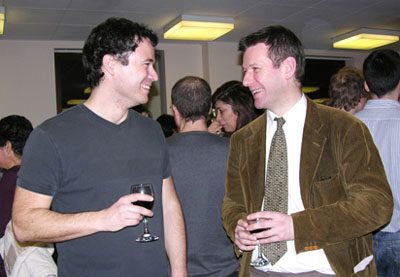
Actually, I just remembered that they took pictures at the party afterwards so here’s one of me and Joao having a chuckle afterwards. Notice I had put a tie on for the occasion, but Joao’s wardrobe is strictly T-shirts only.

37079699

After Friday’s dinner (roast partridge, if you want to know) I got the last train back to Cardiff from Paddington, snoozing comfortably for a large part of the journey. On time until just outside Cardiff Central, the train then sat motionless on the track almost within sight of the platform owing to the presence of a broken down goods train in front of us. We finally got into the station 50 (FIFTY) minutes late, and I didn’t get home until well after 2am.

The Very Big Stupid

Posted in Science Politics with tags , , , on October 5, 2009 by telescoper

Sitting on the train yesterday coming back from a night at the Opera, I was reading The Observer. Last week’s edition had featured a superb piece by comedian David Mitchell on the topic of research funding. His argument, essentially, was that the government shouldn’t be directing its research funding at areas which will yield immediate economic benefit, but should instead be doing precisely the opposite. It is, he argues, the job of industry to invest in R&D that’s “relevant” to its immediate needs. It is the job of academia to do things driven by pure curiosity. If these happen to pay off it’s of course a good thing, but it’s a bonus and can only be expected to deliver a financial return in the long term.

Funding only that bit of science that can deliver immediate profits is a bit like diverting all the Arts Council grants into pop music or pantomimes when instead it should be funding things that are too experimental to  rely on revenue generated by paid customers, such as the Opera. I couldn’t agree more, but I am a bit biased in respect of that particular example. Although his piece was intended to be humorous, like a great deal of great comedy there is a great deal of truth in it.

This week’s edition of the Observer contained a number of letters about Mitchell’s piece. One called for him to be given a position in the government. Of course that would be inappropriate. He’s an intelligent and forward-thinking person, and would therefore be completely out of place in such a job. Another letter produced the following memorable quote from Frank Zappa which is exactly to the point.

The Very Big Stupid is a thing which breeds by eating The Future. Have you seen it? It sometimes disguises itself as a good-looking quarterly bottom line, derived by closing the R&D Department.

Meanwhile I attended a meeting this morning at which we were informed that all universities in England have been told to plan for cuts in their recurrent grants of about 15% next year. It is likely that Wales will follow suit. Since most of a University’s expenditure is on staff salaries, corresponding reductions will have to be made, either by cutting salaries or (more likely) by making redundancies.

Research Councils are also likely to feel the squeeze which will hit responsive mode grants too. For astronomy and particle physics, who rely on the Science & Technology Facilities Council for their funding, the situation is especially dire because even without the anticipated cuts, that particular organization has an enormous black hole in its  budget anyway.There is a strong likelihood that existing grant funding will be clawed back to plug the gap, with immediate consequences for postdoctoral researchers and a catastrophic long-term effect on morale.

Pure science in the UK faces a very grim period. All three main political parties have promised savage spending cuts after the next election. The Tories have promised a budget within a month of coming to power if they win; they certainly won’t increase  taxes to cover the budget deficit, especially not at the top end of the scale. A Conservative budget is very unlikely to contain any good news for science or higher education generally.

It’s time for us all to get lobbying about the importance of pure research, but the difficulty is that the Research Councils that are supposed to be distributing funds for this purpose are largely populated by politically appointed individuals who can’t or won’t fight the corner. The Chief Executive of STFC, for example, seems to be content to turn his organization into a channel through which government subsidy flows into technology and engineering companies with only a cursory nod in the direction of basic research. I suspect there are many within the higher levels of management of  other research council  who also see the current economic crisis as an opportunity to cut back “useless science” still further.

I’m sure  that in the long run people will look back on all this as a Very Big Example of The Very Big Stupid, but I’m also worried that for many research projects and for many scientific careers there may not actually be a long run.

Alarm Bells at STFC

Posted in Science Politics with tags , , on September 30, 2009 by telescoper

The  financial catastrophe engulfing the Science and Technology Facilities Council (STFC) has suddenly reared its (very ugly) head again.

Here is a statement posted yesterday on their webpage.

STFC Council policy on grants

STFC Council examined progress of its current science and technology prioritisation exercise at a strategy session on 21 and 22 September. Without prejudging the outcome of the prioritisation, Council agreed that prudent financial management required a re-examination of upcoming grants.

Council therefore agreed that new grants will be issued only to October 2010 in the first instance. This temporary policy is in place pending the outcome of the prioritisation exercise, expected in the New Year.

According to the e-astronomer the  STFC  has written to all Vice-chancellors and Principals of UK universities to tell them about this move. I gather the intention is that this measure will be temporary, but it looks deeply ominous to me. Those of us whose rolling grant requests for  5 years from April 2010 are currently being assessed face the possibility of receiving grants for only 6 months of funding. On the other hand, I’m told that what is more likely is that our grant won’t be announced until January or February, after the hitlist prioritisation exercise has been completed in the New Year. Hardest hit will be the particle physicists whose rolling grants start on 1st October 2009 (tomorrow), which will have only a year’s funding on them…

It seems that STFC has finally realised the scale of its budgetary problems and payback time is looming. I honestly think we could be doomed…

Atlantes

Posted in Science Politics, The Universe and Stuff with tags , , , , , , on September 10, 2009 by telescoper

I’ve just noticed a  post on another blog about the  meeting of the Herschel ATLAS consortium that’s  going on in Cardiff at the moment, so I thought I’d do a quickie here too. Actually I’ve only just been accepted into the Consortium so quite a lot of the goings-on are quite new to me.

The Herschel ATLAS (or H-ATLAS for short) is the largest open-time key project involving Herschel. It has been awarded 600 hours of observing time  to survey 550 square degrees of sky in 5 wavelenth bands: 110, 170, 250, 350, & 500 microns. It is hoped to detect approximately 250,000 galaxies,  most of them in the nearby Universe, but some will undoubtedly turn out to be very distant, with redshifts of 3 to 4; these are likely to be very interesting for  studies of galaxy evolution.

Herschel is currently in its performance verification (PV) phase, following which there will be a period of science validation (SV). During the latter the ATLAS team will have access to some observational data to have a quick look to see that it’s  behaving as anticipated. It is planned to publish a special issue of the journal Astronomy & Astrophysics next year that will contain key results from the SV phase, although in the case of ATLAS many of these will probably be quite preliminary because only a small part of the survey area will be sampled during the SV time.

Herschel seems to be doing fine, with the possible exception of the HIFI instrument which is currently switched off owing to a fault in its power supply. There is a backup, but the ESA boffins don’t want to switch it back on and risk further complications until they know why it failed in the first place. The problem with HIFI has led to some rejigging of the schedule for calibrating and testing the other two instruments (SPIRE and PACS) but both of these are otherwise doing well.

The data for H-ATLAS proper hasn’t started arriving yet so the meeting here in Cardiff was intended to sort out the preparations, plan who’s going to do what, and sort out some organisational issues. With well over a hundred members, this project has to think seriously about quite a lot of administrative and logistical matters.

One of the things that struck me as particular difficult is the issue of authorship of science papers. In observational astronomy and cosmology we’re now getting used to the situation that has prevailed in experimental particle physics for some time, namely that even short papers have author lists running into the hundreds. Theorists like me usually work in teams too, but our author lists are, generally speaking, much shorter. In fact I don’t have any publications  yet with more than six or seven authors; mine are often just by me and a PhD student or postdoc.

In a big consortium, the big issue is not so much who to include, but how to give appropriate credit to the different levels of contribution. Those senior scientists who organized and managed the survey are clearly key to its success, but so also are those who work at the coalface and are probably much more junior. In between there are individuals who supply bits and pieces of specialist software or extra comparison data. Nobody can pretend that everyone in a list of 100 authors has made an identical contribution, but how can you measure the differences and how can you indicate them on a publication? Or  shouldn’t you try?

Some suggest that author lists should always be alphabetical, which is fine if you’re “Aarseth” but not if you’re “Zel’dovich”. This policy would, however, benefit “al”, a prolific collaborator who never seems to make it as first author..

When astronomers write grant applications for STFC one of the pieces of information they have to include is a table summarising their publication statistics. The total number of papers written has  to be given, as well as the number in which the applicant  is  the first author on the list,  the implicit assumption being that first authors did more work than the others or that first authors were “leading” the work in some sense.

Since I have a permanent job and  students and postdocs don’t, I always make junior collaborators  first author by default and only vary that policy if there is a specific reason not to. In most cases they have done the lion’s share of the actual work anyway, but even if this is not the case it is  important for them to have first author papers given the widespread presumption that this is a good thing to have on a CV.

With more than 100 authors, and a large number of  collaborators vying for position, the chances are that junior people will just get buried somewhere down the author list unless there is an active policy to protect their interests.

Of course everyone making a significant contribution to a discovery has to be credited, and the metric that has been used for many years to measure scientific productivity is the numbered of authored publications, but it does seem to me that this system must have reached breaking point when author lists run to several pages!

It was all a lot easier in the good old days when there was no data…

PS. Atlas was a titan who was forced to hold the sky  on his shoulders for all eternity. I hope this isn’t expected of members of the ATLAS consortium, none of who are titans anyway (as far as I can tell). The plural of Atlas is Atlantes, by the way.

Going Forward

Posted in Uncategorized with tags , , , on July 22, 2009 by telescoper

Since I’ve recently been officially awarded the title of Grumpy Old Man, I now feel I have the necessary authorization to vent my spleen about anything and everything that really irritates me.

This morning I got my regular monthly credit card statement, something likely to put me in a bad mood at the best of times. However, at the end of the itemized list of payments, I found the following:

WE ARE PHASING OUT CREDIT CARD CHEQUES. GOING FORWARD WE WILL NO LONGER ISSUE ANY CREDIT CARD CHEQUES.

I don’t actually care about the credit card cheques – they’re a ridiculously bad way of paying for things anyway –  but what on Earth is the phrase going forward doing in that sentence?

I’ve taken a swipe at this monster once before, when I blogged about the Wakeham Review of Physics. The example I found then was

The STFC’s governance structure must be representative of the community it serves in order to gain stakeholders’ confidence going forward.

Aaargggh!!

Going forward is one of those intensely annoying bits of office-speak that have spread like Swine ‘flu into the public domain. Pushing the envelope is another one. What does it mean?  Why would anyone push an envelope?

Anyway, the worst problem with going forward is that it is now used almost universally in official documents instead of more suitable phrases, such as in future, or from now on. What particularly irritates me about it is that it is usually part of an attempt to present things in a positive light even when they clearly don’t involve any forward movement at all; often, in fact, quite the opposite. It is just one symptom of the insidious culture of spin that seems to be engulfing all aspects of public life, making it impossible to deliver even a simple message without wrapping it up in some pathetic bit of PR. Any kind of change – whether or not there’s any reason for it, and whether or not it improves anything – has to be portrayed as progress. It drives me nuts!

This sort of language is frequently lampooned by Laurie Taylor in his brilliant weekly column for the Times Higher.  The Director of Corporate Affairs for the fictional Poppleton University, Mr Jamie Targett, contributes regularly to his column, always in meaningless business-oriented gibberish of this type. In fact, shortly after reading the Wakeham Review quoted above, I sent a letter to the Times Higher (which was published there) accusing Jamie Targett of moonlighting from his job at Poppleton to work on the Wakeham Report.

In the case of my credit card cheques, the implication is that the withdrawal of the service represents some sort of progress. In fact, it’s just to save money. A friend of mine who uses a local gym told me today that the gym had recently announced that

Going forward, members of the gym will no longer be supplied with free towels.

They went on to portray this as a great leap forward in caring for the environment, but in fact it is obviously just a way of saving their costs. Likewise with a sentence I found in a railway timetable recently:

Going forward the 8.15 train from Paddington will no longer call at Didcot Parkway

At least it’s still going to call at Didcot when it’s going backwards, which is the obvious implication of this sentence.

I’m glad I’m not alone in my disapproval of going forward.  A year or so ago there was an article on the BBC website making much the same point. However, the amount of going forward has continued to increase. Robert Peston, the BBC business editor, once managed three going forwards in a four minute item on the Today programme.

The Science and Technology Facilities Council has obviously taken this phrase to heart. Their website is chock-a-block with going forward. Here’s an example (referring to a budget cut)

It will result in an approximately constant volume of project activity going forward ..

Obviously, once you start going forward there’s no going back, even if what lies in front of you is financial catastrophe…

PS. Feel free to add your own pet hates via the comments box going forward.

Advanced Fellowships

Posted in Science Politics with tags , , , on July 11, 2009 by telescoper

This is just a quick Newsflash that UK Astronomers will be  interested in (and depressed by). My attention was drawn to it yesterday by Frazer Pearce of Nottingham.

The Science and Technology Facilities Council (STFC) has decided in its finite wisdom to cut in half the number of Advanced Fellowships (AFs) it awards each year, that is from 12 to 6, that number to cover all of Astronomy and Particle Physics.

These fellowships are awarded to researchers who do not have a permanent position but wish to pursue research, and are designed to further the careers of individuals with outstanding potential. They last 5 years – longer than the usual 2-3 year postdoctoral positions and have been for many a scientist an important stepping-stone to an academic career. A very large fraction of my colleagues who have permanent positions were awarded one of these fellowships when they were run by PPARC (including Frazer), as was I myself but, being an Oldie, mine was even pre-PPARC so was in fact given by SERC. Of course the fact that they gave me one doesn’t itself serve as much of a recommendation for continuing them, but it is worth drawing attention to the huge amount of  high quality research done in the UK by holders of these Fellowships.

A number of people have expressed to me their shock at this decision but it doesn’t surprise me at all. For one thing, it’s an open secret that STFC considers the academic community in these areas to be too large so the last thing it wants is more people getting permanent jobs through the AF route.  In any case, STFC’s prime concern is with facilities, not with scientific research.

Who needs half a dozen top class scientists when you can have Moonlite instead?

Space Camp

Posted in Uncategorized with tags , , , , , on July 4, 2009 by telescoper

The other day I was looking through my copy of the Men’s Disciplinary Rubberwear Gazette (which I buy for the Spot-the-Ball competition). Turning to the advertisements, I discovered that the Science & Technology Facilities Council is conducting a review of its space facilities and operations. Always eager to push back the frontiers of science, I hurried down to their address in Swindon to find out what was going on.

ME: Hello. Is there anyone there?

JULIAN: Oh hello. My name’s Julian, and this is my friend Sandy.

SANDY: Oooh hello! What can we do for you?

ME: Hello to you both. Is this Polaris House?

JULIAN: Not quite. Since we took over we changed the name…

ME: To?

SANDY: It’s now called Polari House…

JULIAN: On account of that’s the only language spoken around here.

ME: So you’re in charge of the British Space Programme then?

JULIAN:  Yes, owing to the budget, the national handbag isn’t as full as it used to be so now it’s just me and her.

SANDY: But never fear we’re both dab hands with thrusters.

JULIAN: Our motto is “You can vada about in any band, with a satellite run  by Jules and…

SANDY: …Sand.

ME: I heard that you’re looking for some input.

SANDY: Ooooh. He’s bold, in’e?

ME: I mean for your consultation exercise…

JULIAN: Oh yes. I forgot about that. Well I’m sure we’d welcome your contribution any time, ducky.

ME: Well I was wondering what you could tell me about Moonlite?

SANDY: You’ve come to the right place. She had an experience by Moonlight, didn’t you Jules?

JULIAN: Yes. Up the Acropolis…

ME: I mean the Space Mission “Moonlite”

SANDY: Oh, of course. Well, it’s only small but it’s very stimulating.

JULIAN: Hmmm.

SANDY: Yes. It gets blasted off into space and whooshes off to the Moon…

JULIAN: …the backside thereof…

SANDY: ..and when it gets there it shoves these probes in to see what happens.

ME: Why?

SANDY: Why not?

ME: Seems a bit pointless to me.

JULIAN: There’s no pleasing some people is there?

ME: Haven’t you got anything more impressive?

SANDY: Like what?

ME:  Maybe something that goes a bit further out? Mars, perhaps?

JULIAN: Well the French have this plan to send some great butch omi to troll around on Mars but we haven’t got the metzas so we have to satisfy ourselves with something a bit more bijou…

SANDY: Hmm…You can say that again.

JULIAN: You don’t have to be big to be bona.

SANDY: Anyway, we had our shot at Mars and it went willets up.

ME: Oh yes, I remember that thing named after a dog.

JULIAN: That’s right. Poodle.

ME: Do you think a man will ever get as far as Uranus?

JULIAN&SANDY: Oooh! Bold!

SANDY: Well I’ll tell you what. I’ll show you something that can vada out to the very edge of the Universe!

ME: That sounds exciting.

JULIAN: I’ll try to get it up right now.

ME: Well…er…

JULIAN: I mean on the computer

ME: I say, that’s an impressive piece of equipment

JULIAN: Thank you

SANDY: Oh don’t encourage her…

ME: I meant the computer.

JULIAN: Yes, it’s a 14″ console.

SANDY:  And, believe me, 14 inches will console anyone!

JULIAN; There you are. Look at that.

ME: It looks very impressive. What is it?

SANDY: This is an experiment designed to charper for the heat of the Big Bang.

JULIAN. Ooer.

SANDY: The Americans launched WMAP and the Europeans had PLANCK. We’ve merged the two ideas and have called it ….PLMAP.

ME: Wouldn’t it have been better if you’d made the name the other way around? On second thoughts maybe not..

JULIAN: It’s a little down-market but we have high hopes.

SANDY: Yes, Planck had two instruments called HFI and LFI. We couldn’t afford two so we made do with one.

JULIAN: It’s called MFI. That’s why it’s a bit naff.

ME: I see. What are these two round things either side?

SANDY: They’re the bolometers…

ME: What is this this long thing in between pointing up? And why is it leaning to one side?

SANDY: Well that’s not unusual in my experience …

JULIAN:  Shush. It’s an off-axis Gregorian telescope if you must know.

ME: And what about this round the back?

SANDY: That’s your actual dish. It’s very receptive, if you know what I mean.

ME: So what does it all do?

JULIAN: It’s designed to make a map of what George Smoot called “The Eek of God”. It’s fabulosa…

SANDY: Or it would be if someone hadn’t neglected to read the small print.

ME: Why? Is there are problem?

JULIAN: Well, frankly, yes. We ran out of money.

SANDY: It was only when we got it out the box we realised.

ME: What?

JULIAN & SANDY: Batteries Not Included!

(With thanks to cosmic variance for the inspiration, and apologies to Barry Took and Marty Feldman, who wrote the original Julian and Sandy sketches for the radio show Round the Horne.)