Archive for STFC

EPSRC Blues

Posted in Science Politics with tags , , , , , on May 15, 2012 by telescoper

I woke up this morning to find via Twitter an interesting blog post about a demonstration in London against the policies of the Engineering and Physical Sciences Research Council (EPSRC).

For those of you not up with the ins and outs of the UK science funding regime, EPSRC is the agency that funds the more mainstream areas of physics (as well as chemistry, engineering and some mathematics) while the more exotic bits (particle physics, nuclear physics and astronomy) are the responsibility of the Science and Technology Facilities Council (STFC). The current protest seems to be lead by a number of eminent chemists, including Prof. Sir Harry Kroto, Prof. Sir John Cadogan and Prof. Anthony Barrett.

Almost five years ago – was it really so long? – owing to a mixture of funding cuts and incompetent management, STFC was born into a financial crisis that made many of us doing astronomy and particle physics wish that we also were protected by the friendly hands of EPSRC rather than left out in the cold as we felt we were at STFC. Things have slowly improved at STFC, which now has an executive team that actually seems to listen to its community as well as speaking the language that Whitehall wants to hear. Funding is still tight, but STFC is a noticeably happier ship now than it was it first launched.

In the meantime, any envy we might have had about our colleagues in, e.g., condensed matter physics being safer in the EPSRC stable has now well and truly evaporated. Their strategy, “Shaping Capability“, expressed in dreadful management-speak, involves the imposition of arbitrary priorities such as the restriction of fellowship applications to certain areas chosen by The Management. Worse, its new funding rules attempt to target funding at commercially-driven research. Dark clouds are gathering in the “blue skies” under which UK science has hitherto flourished.

The unresponsive top-down character of EPSRC has strengthened under the leadership of David Delpy who must have been made in the same factory as Keith Mason, former Chief Executive of STFC, whose diplomatic skills were similarly remarkable by their absence.

For some reason, this reminds me of the following quote from Smiley’s People

In my time, Peter Guillam, I’ve seen Whitehall skirts go up and come down again. I’ve listened to all the excellent argument for doing nothing, and reaped the consequent frightful harvest. I’ve watched people hop up and down and call it progress. I’ve seen good men go to the wall and the idiots get promoted with a dazzling regularity.

I’ve argued before that I think EPSRC’s approach is fundamentally wrong. When taxpayers’ money used is used to generate immediate commercial returns, it ends up in the pockets of entrepreneurs when the research succeeds and, if it doesn’t, the grant has effectively been wasted. Commercial Impact should not be a factor in awarding public funding, because it is perfectly suited as a criterion for attracting private funding. This is why we have a national fiscal policy: the only justification for levying taxation is to fund projects which will not yield short-term economic returns. There is no reason to spend public money on commercial projects: we need to justify pure research by a non-economic valuation.

This morning EPSRC have issued a press release calling upon scientists to work together ahead of the forthcoming comprehensive spending review. It doesn’t mention the demonstration, or other manifestations of unrest within the EPSRC community, but instead re-asserts the need for its so-called strategy, with a clear message not to rock the boat ahead of the next Comprehensive Spending Review.

I’ve heard that argument many times in the context of STFC during its crisis period. I firmly believe that rocking the boat in that case helped it get off the rocks. It remains to be seen whether the EPSRC protest, which is currently rather small, will gather enough momentum to make a difference. It all depends on what fraction of EPSRC scientists have actually signed up to the Delpy Agenda. Is the new campaign representative of the views of the EPSRC community? No doubt many research groups will be prospering under the new regime, at least in the short term. Time alone will tell what the long-term impact of short-termism will be.

STFC Team Selection

Posted in Football, Science Politics with tags , on February 27, 2012 by telescoper

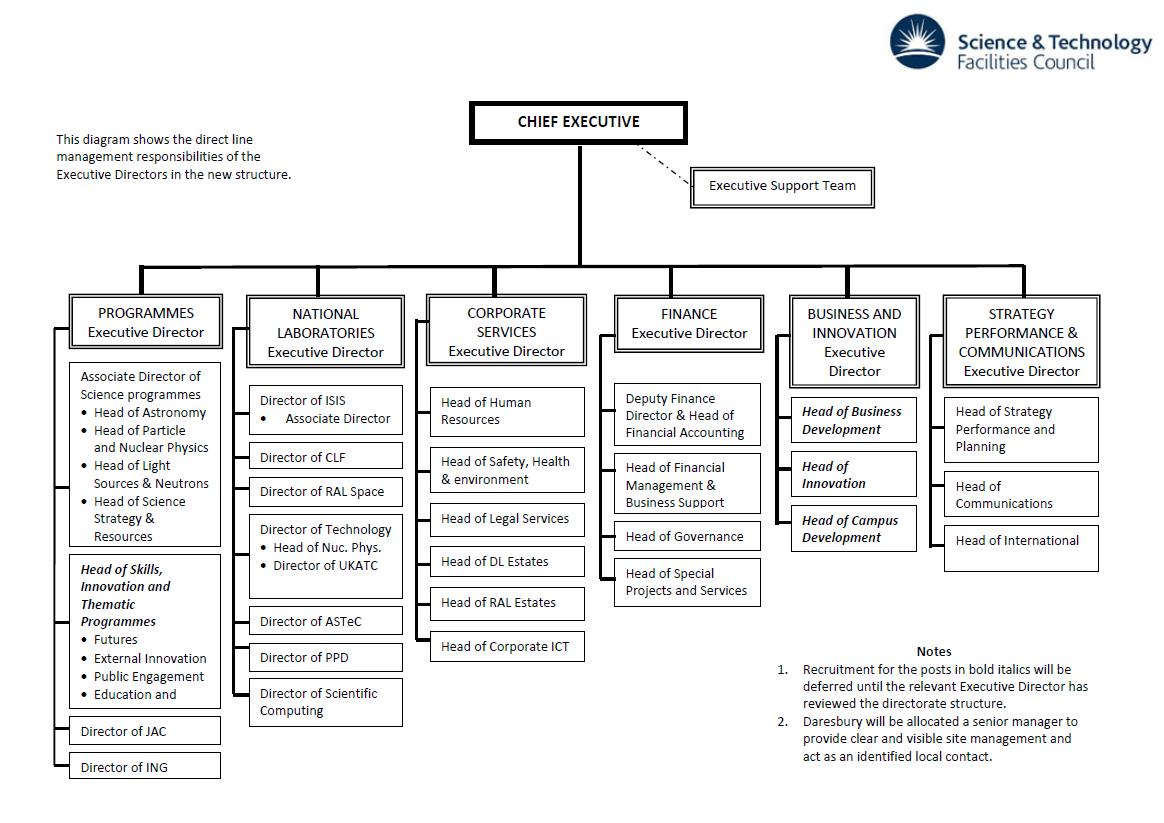
It’s been such a busy day today I almost missed a seemingly unimportant message on Twitter from the Science and Technology Facilities Council about its new management structure. Only when I got home this evening did I read it carefully and discover that it’s not really as innocuous as I’d assumed. In fact it looks like the Chief Executive has been busy during the recent transfer window.

The new team at STFC will line up like this

It doesn’t look all that different from the old one, except it’s a slightly more compact  formation with less width in the wide areas, and perhaps fewer clichés in the final third.

The controversy however comes with ashen-faced manager Ron John Womersley’s team selection. As per the announcement:

Following staff input, and Council approval, I have conducted an internal selection process to fill the new senior positions in the structure and can now announce the following appointments from 1 April 2012:

    • Executive Director National Laboratories: Dr Andrew Taylor
    • Executive Director Business and Innovation: Dr Tim Bestwick
    • Executive Director Corporate Services: Mr Gordon Stewart
    • Executive Director Strategy, Performance and Communications: Dr Sharon Cosgrove

In addition, Mrs Jane Tirard will continue in her role with the new title of Executive Director Finance, and Dr Janet Seed will extend her acting stewardship of the programmes area as Acting Executive Director Programmes pending an open recruitment exercise for the position.

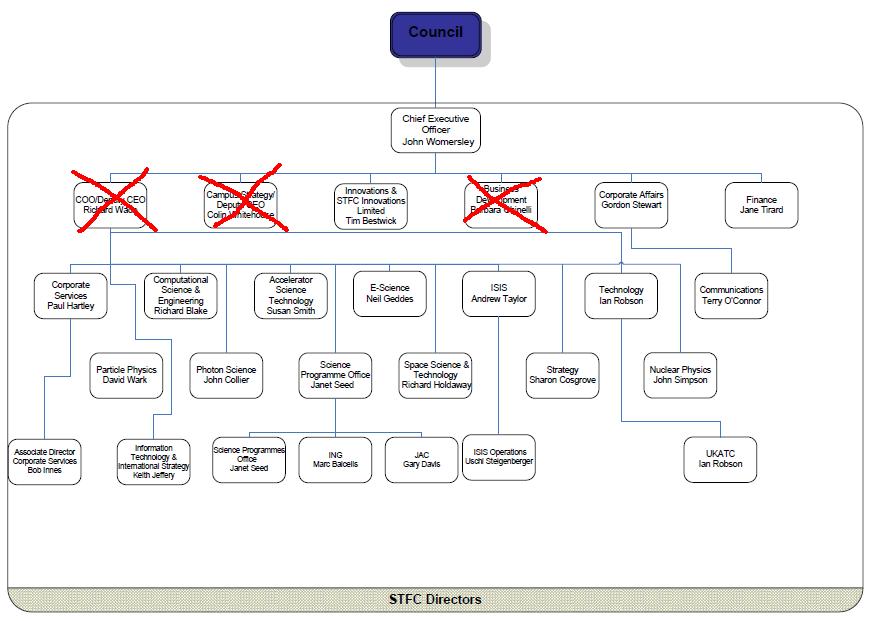
So three prominent members of the previous line-up are no longer part of the team:

For example, out goes hard-tackling wide man and own-goal specialist, Richard Wade, who apparently leaves on a free transfer. Or is he just on the subs’ bench for the time being?  According to the diagram, Tim Bestwick stays but will move from a central position to the right side, roughly changing position with Gordon Stewart who also keeps his place in the team. Andrew Taylor, formerly in midfield, moves to an inside forward role where, as Director of the National Laboratories, he will sometimes be “in the hole” (i.e. Didcot).

Most pundits reckon the new-look STFC will deploy a Diamond-Light Source shaped midfield aimed at closing down the opposition, as opposed to the old team which concentrated more on closing down its own facilities. It looks like the reorganization was made with  one eye on European challenges, but Womersley remains committed to the national game, as last week’s scouting trip to the University of Neasden makes clear.

The STFC supporters’ club  (Sid and Doris Bonkers) expressed delight with the team changes, but former manager Keith Mason remains bound and gagged in the basement of UKSA was unavailable for comment.

Harry Redknapp is 97.

P.S. The STFC statement describes the staff departures thus:

STFC has benefited from the very significant personal contributions of the existing senior management team. They have helped develop STFC into a successful workplace as recognised by the recent Investor in People accreditation (Silver status), and our positive Comprehensive Spending Round outcome. However, the changing dynamics of STFC mean that it is time for a change and not all senior managers will continue with the organisation.

Do I detect a note of insincerity?


Notional Student Survey

Posted in Education with tags , , , on February 15, 2012 by telescoper

The first couple of weeks of this term have been hectic, primarily because of our new-style Consolidated Astronomy Grant Proposal to the Science and Technology Facilities Council which has just gone in with a deadline of tomorrow, but also because I’ve just started teaching Nuclear Physics for the first time, a subject I know absolutely nothing about about which I am a little rusty. I’m only just keeping up with the lectures and problem sheets, and am glad the students are being patient. So far, anyway.

I had only just got back on schedule with this morning’s lecture when I find that tomorrow I have to give up part of the next one by advertising the National Student Survey and encouraging my third-year class of 85 or to participate; the NSS taking place over the next few weeks.  Apparently the rate of return by Physics students is especially low and the University is keen that it should increase. For some reason I’ve been singled out as a suitable person to persuade our third years to provide their input and have been given a special powerpoint presentation to show to encourage all eligible  students – i.e. students in their final year – to complete the survey, so I thought I’d share it here in order to spread the message as widely as possible. I’m not sure what fate awaits me if our rate of return doesn’t improve…

It doesn’t take long to complete – it’s all online – so I hope anyone reading this will take the time to respond. That’s not just for Cardiff Physics students – although I know a few of them do read this blog – but also for students elsewhere in the United Kingdom. If you don’t tell us what you think we don’t know what we could be doing better, so please fill it in. You know it makes sense.

The NSS have also given me a boomerang. I think it’s meant to symbolize a high rate of return. Or something. I may attempt to throw it in tomorrow’s lecture, although I’m not sure that’s allowed on Health and Safety grounds. At least it will provide a bit of light entertainment before I launch into the deep joy that is the semi-empirical mass formula.

P.S. Coincidentally, there’s a nice a typically snarky piece about the NSS by Laurie Taylor in a recent Times Higher.

Thinking of Applying for a PhD in Physics or Astronomy?

Posted in Education with tags , , , , , , on November 21, 2011 by telescoper

This afternoon I gave a short talk to our final-year students about postgraduate research in which I passed on some, hopefully useful,  information about how to go about applying for PhDs  in Physics  and Astronomy. I am, for my sins, the Director of Postgraduate Studies within the School of Physics & Astronomy here at Cardiff University.

Although quite a lot of what I talked about was about our own arrangements in Cardiff, I thought I’d jot down here a few general remarks that might be useful to people elsewhere who are thinking of taking the plunge when they graduate. I’m aiming this primarily at UK students applying for places in the UK; special considerations apply for students wanting to do graduate research abroad.

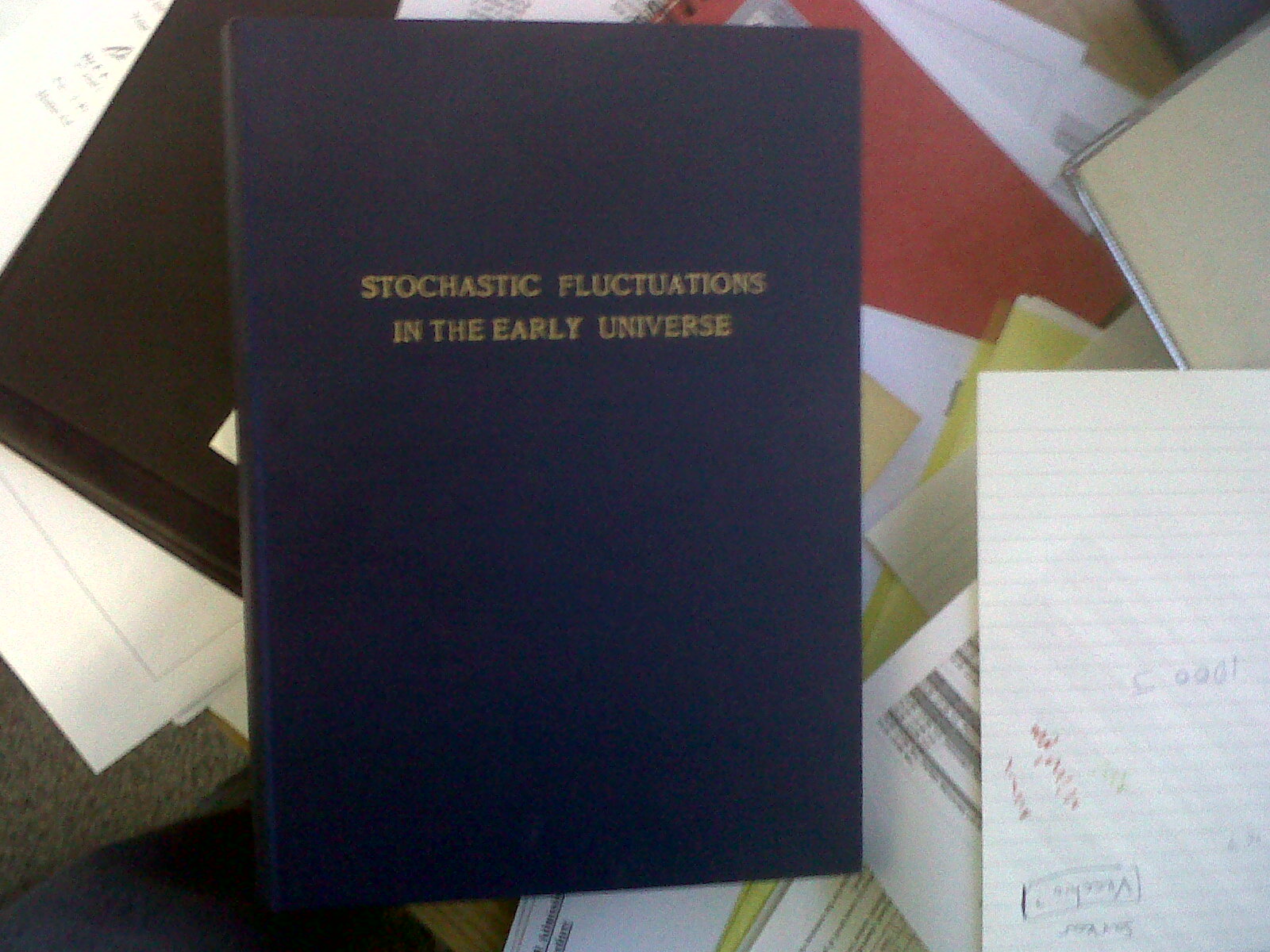
What is a PhD? The answer to that is relatively easy; it’s a postgraduate research degree. In order to obtain a PhD you have to present a thesis like that shown on the left (which happens to be mine, vintage 1988), typically in the range 100-250  pages long. A thesis has to satisfy two conditions for the award of the degree: it should contain original research, which is publishable in an academic journal; and it should present a coherent discussion of that original work within the context of ongoing work in the area of study. In Physics & Astronomy, the PhD is pretty much a prerequisite for any career in academic research, and it usually takes between 3 and 4 years to complete. After submission of the thesis you will have to undergo a viva voce examination conducted by two examiners, one internal and one external. This is quite a tough test, which  can last anywhere between about 2 and about 6 hours, during which you can be asked  detailed questions about your research and wide-ranging questions about the general area.

The Money Side. In the UK most PhDs are supported financially by the research councils, either EPSRC (most physics) or STFC (nuclear & particle physics, astronomy). These generally award quotas of studentships to departments who distribute them to students they admit. A studentship will cover your fees and pay a stipend, currently £13590 pa. That doesn’t sound like a lot, but you should at least remember that it is a stipend rather than a wage; it is therefore not taxed and there is no national insurance payable.

How do I choose a PhD? During the course of a postgraduate degree you are expected to become an expert in the area in which you specialize. In particular you should reach the point where you know more about that specific topic than your supervisor does. You will therefore have to work quite a lot on your own, which means you need determination, stamina and enthusiasm. In my view the most important criterion in your choice of PhD is not the institution where you might study but the project. You need to be genuinely excited by the topic in order to drive yourself to keep through the frustrations (of which there will be many). So, find an area that interests you and find the departments that do active research in that area by looking on the web. Check out the recent publications by staff in each department, to ensure that they are active and to have something to talk about at interview!

Qualifications. Most universities have a formal requirement that candidates for admission to the PhD should have a “good honours degree”, which basically means at least an Upper Second Class Honours degree. Some areas are more competitive than others, however, and in many disciplines you will find you are competing with a great many applicants with First Class degrees.

How to apply successfully. The application procedure at most universities is quite simple and can be done online. You will need to say something about the area in which you wish to do research (e.g. experiment/theory, and particular field, e.g. cosmology or star formation). You’ll also need a CV and a couple of references. Given the competition, it’s essential that you prepare. Give your curriculum vitae some attention, and get other people (e.g. your personal tutor) to help you improve it. It’s worth emphasizing particular skills (e.g. computing). If you get the chance, make use of your summer vacations by taking on an internship or other opportunity to get a taste of research; things like that will undoubtedly give your CV an edge.

The Interview. Good applicants will be invited for an interview, which is primarily to assess whether you have the necessary skills and determination, but also to match applicants to projects and supervisors. Prepare for your interview! You will almost certainly be asked to talk about your final-year project, so it will come across very badly if you’re not ready when they ask you. Most importantly, mug up about your chosen field. You will look really silly if you haven’t the vaguest idea of what’s going on in the area you claimed to be interested in when you wrote your  application!

Don’t be shy! There’s nothing at all wrong with being pro-active about this process. Contact academic staff at other universities by email and ask them about research, PhD opportunities. That will make a good impression. Also, don’t be afraid to ask for advice. Although we’re all keen to recruit good PhD students for our own departments, we academics are  conscious that it is also our job to give impartial advice. Ask your tutor’s opinion.

How many places should I apply for? Some research areas are more fashionable than others so the level of competition varies with field. As a general rule I would advise applying for about half-a-dozen places, chosen because they offer research in the right area. Apply to fewer than that and you might lose out to the competition. Apply to many more and you might not have time to attend the interviews.

What’s the timetable?  Most applications come in early in the new year for entry to the PhD in the following October. The Christmas break is therefore a pretty good time to get your applications sorted out. Interviews are normally held in February or March, and decisions made by late March. STFC runs a deadline system whereby departments can not force students to accept or decline offers before the end of March, so there should be ample time to visit all your prospective departments before having to make any decisions.

That’s all I can think of for now. I hope at least some of these comments are useful to undergraduates anywhere in the UK thinking of applying for a PhD. If there are any further questions, please feel free to ask through the comments box. Likewise if I’ve missed anything important, please feel free to suggest additions in the same manner…
News Flash from STFC

Posted in Science Politics with tags , , on October 18, 2011 by telescoper

At last!

The worst kept secret in science is now out. The new Chief Executive of the Science and Technology Facilities Council is Professor John Womersley. Here’s an official-looking picture of him, although I think it has been photo-shopped to stop him looking so much like Christopher Biggins:

The announcement of appointment of the new CEO has been expected for months now. It appears that the reason for the delay is tied up with the start date. John Womersley will in fact take up the reins at STFC on 1st November 2011, not when the current CEO retires (at the end of March next year) as originally planned. The current CEO, Professor Keith Mason, has been shunted across to kicked into touch at booted into the long grass in given the opportunity to take up a secondment at the UK Space Agency until he retires next year. Apparently he is moving there

to advise on steps needed to leverage the research base to maximise the economic growth of the space sector.

Don’t ask me what it means, but one guesses some form of negotiation must have been going on behind the scenes all this time (a) to persuade Keith Mason to go early and (b) to persuade UKSA to make room in the basement for him.

Anyway, heartiest congratulations to John Womersley (@JohnWomersley on Twitter)  on his new appointment. A change was long overdue, and I wish him well in what is going to be a difficult job.

The Astronomy Career Problem – it starts with the PhD

Posted in Science Politics with tags , , , , , on October 14, 2011 by telescoper

Just time for a quickie today, as I’ve got to run an examples class before dashing off on the train to London to attend the annual George Darwin Lecture which, this year, is to be given by Michael Turner with the title From Quarks to the Cosmos. I expect it to be very enjoyable and may well write a report at the weekend.

Yesterday evening there was a discussion on twitter (#astrojc) about the astronomy careers problem. I didn’t take part – in fact I didn’t realise it was happening – as I was slaving over the Private Eye crossword at the time.

Anyway, it gives me the excuse to rehash an argument I have presented before, which is that most analyses of the problems facing young postdoctoral researchers in astronomy are looking at the issue from the wrong end. I think the crisis is essentially caused by the overproduction of PhDs in this field. To understand the magnitude of the problem, consider the following.

Assume that the number of permanent academic positions in a given field (e.g. astronomy) remains constant over time. If that is the case, each retirement (or other form of departure) from a permanent position will be replaced by one, presumably junior, scientist.

This means that over an academic career, on average, each academic will produce just one PhD who will get a permanent job in academia. This of course doesn’t count students coming in from abroad, or those getting faculty positions abroad, but in the case of the UK these are probably relatively small corrections.

Under the present supply of PhD studentships an academic can expect to get a PhD student at least once every three years or so. At a minimum, therefore, over a 30 year career one can expect to have ten PhD students. A great many supervisors have more PhD students than this, but this just makes the odds worse. The expectation is that only one of these will get a permanent job in the UK. The others (nine out of ten, according to my conservative estimate) above must either leave the field or the country to find permanent employment.

The arithmetic of this situation is a simple fact of life, but I’m not sure how many prospective PhD students are aware of it. There is still a reasonable chance of getting a first postdoctoral position, but thereafter the odds are stacked against them.

The upshot of this is we have a field of understandably disgruntled young people with PhDs but no realistic prospect of ever earning a settled living working in the field they have prepared for. This problem has worsened considerably in recent  years as the number of postdoctoral positions has almost halved since 2006. New PhDs have to battle it out with existing postdoctoral researchers for the meagre supply of suitable jobs. It’s a terrible situation.

Now the powers that be – in this case the Science and Technology Facilities Council – have consistently argued that the excess PhDs go out into the wider world and contribute to the economy with the skills they have learned. That may be true in a few cases. However, my argument is that the PhD is not the right way to do this because it is ridiculously inefficient.

What we should have is a system wherein we produce more and better trained Masters level students  and fewer PhDs. This is the system that exists throughout most of Europe, in fact, and the UK is actually committed to adopt it through the Bologna process.  Not that this commitment seems to mean anything, as precisely nothing has been done to harmonize UK higher education with the 3+2+3 Bachelors+Masters+Doctorate system Bologna advocates.

The training provided in a proper two-year Masters programme will improve the skills pool for the world outside academia, and also better prepare the minority of students who go on to take a PhD. The quality of the  PhD will also improve, as only the very best and most highly motivated researchers will take that path. This used to be what happened, of course, but I don’t think it is any longer the case.

The main problem with this suggestion is that it requires big changes to the way both research and teaching are funded. The research councils turned away from funding Masters training many years ago, so I doubt if they can be persuaded to to a U-turn now.

This won’t solve the existing careers crisis, of course, but in order to make things better you first have to stop them getting worse.

Astronomy (and Particle Physics) Look-alikes, No. 64

Posted in Astronomy Lookalikes with tags , , on October 7, 2011 by telescoper

Not related in any way to rumours which probably don’t exist and which even if they did I’d have to deny for legal reasons let me just mention that John Womersley of the Science and Technology Facilities Council reminds me quite a lot of Christopher Biggins:

Biggins

Womersley

Postcard from Swindon

Posted in Uncategorized with tags , , on September 21, 2011 by telescoper

Surprisingly I have got time for a quick post this morning after all. I got here to Polaris House before most of the rest of the Astronomy Grants Panel so I’ve got 5 minutes on the wireless to put something up. It turns out that my decision to come on an early morning train yesterday rather than come on Monday evening was the right one. The hotel we had been booked into, The Jury’s Inn, Swindon, was full up on Monday night so several of the panel people (who had been booked in for months) didn’t have the rooms they thought they had and had to go elsewhere for the night. When I checked in yesterday the coachloads of alleged Germans responsible for this debacle had left and I had no trouble. When I got to my room I discovered a bottle of wine which had been left there to apologize for the problems with my reservation on Monday night. Which I never had. I guess incompetence cuts both ways and I’m now a bottle of wine up out of the deal!

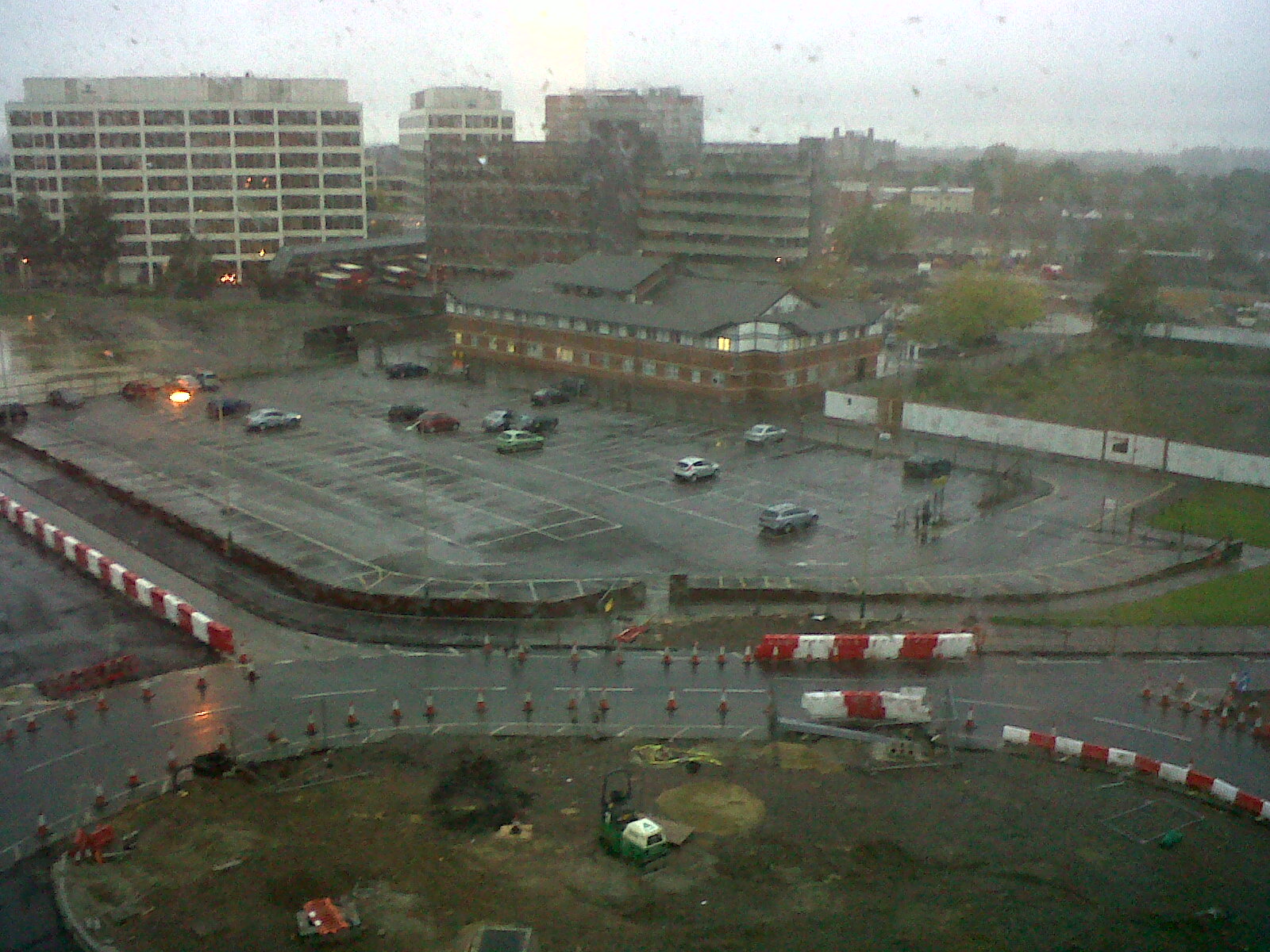
Anyway, we got through yesterday’s business reasonably well, although it was a long day and we were all flagging by the end. I guess that’s why they call it Swindon Wilts. We’re just about to commence Day Two so I’ve just got time to put up the following picture. For those of you who’ve never been to Swindon before, I believe this photograph conveys an accurate impression of what it’s like. This is the view through the rain from my hotel window yesterday evening.

Intermission

Posted in Uncategorized with tags , on September 20, 2011 by telescoper

Well, dear readers, I  am up at the crack of dawn in order to journey forth to Swindon, for  three days of hard labour on the STFC Astronomy Grants Panel for the duration of which I will be confined to a dark dungeon in Polaris House. Given the severity of the sentence  I very much doubt that I’ll have the time or the energy to blog while I’m there so, unless it all gets too much for me and I have to seek solace in a blog post,  there will now follow a short intermission.

Normal service will be resumed as soon as possible.


A Blast from the Past

Posted in Biographical with tags , , , on September 5, 2011 by telescoper

I’ve just remembered that the annual STFC summer school for all new PhD Students in Astronomy finished last week. This year it was held in the fine city of Glasgow and I trust a fine time was had by all,  thanks both to the excellent astronomy staff there who organised the whole thing,  and to the eminent invited speakers who supplied specialist lectures.

When I was just about to start my PhD (or, more accurately, DPhil) in 1985 there was a summer school like this too only that was before STFC and even before its predecessor,  PPARC. The Science and Engineering Research Council (SERC)  summer school I went to was actually held at Durham University; we all stayed in St Mary’s College, just over the road from the Physics Department. I remember it well and indeed still have the notes I took during the lectures there.

Coincidentally, I recently unearthed this picture which has, unfortunately, been slightly damaged on the left  hand side. It might be interesting for all those who attended this year’s School to see how many of this group are still doing research 26 years later; the newbies may even be able to identify their PhD supervisors!

I’m in the middle with the Peter Beardsley haircut, and you can easily pick out a number of people who are still active in astronomy research, e.g. Melvin Hoare (Leeds), Moira Jardine (St Andrews), Alan Fitzsimmons (QUB), Steve Warren (Imperial), Alastair Edge (Durham), and Jon Loveday (Sussex), to name but a few. Anyone else see anyone they recognize? Or anyone else who was there happen to be reading this blog? Please do let me know through the comments box!

UPDATE: I’m grateful to Melvin for pointing out to me that Andy Norton has already posted a version of this picture elsewhere, with a much more complete list of identifications!