Archive for STFC

News Flash from STFC

Posted in Science Politics with tags , , on October 18, 2011 by telescoper

At last!

The worst kept secret in science is now out. The new Chief Executive of the Science and Technology Facilities Council is Professor John Womersley. Here’s an official-looking picture of him, although I think it has been photo-shopped to stop him looking so much like Christopher Biggins:

The announcement of appointment of the new CEO has been expected for months now. It appears that the reason for the delay is tied up with the start date. John Womersley will in fact take up the reins at STFC on 1st November 2011, not when the current CEO retires (at the end of March next year) as originally planned. The current CEO, Professor Keith Mason, has been shunted across to kicked into touch at booted into the long grass in given the opportunity to take up a secondment at the UK Space Agency until he retires next year. Apparently he is moving there

to advise on steps needed to leverage the research base to maximise the economic growth of the space sector.

Don’t ask me what it means, but one guesses some form of negotiation must have been going on behind the scenes all this time (a) to persuade Keith Mason to go early and (b) to persuade UKSA to make room in the basement for him.

Anyway, heartiest congratulations to John Womersley (@JohnWomersley on Twitter)  on his new appointment. A change was long overdue, and I wish him well in what is going to be a difficult job.

The Astronomy Career Problem – it starts with the PhD

Posted in Science Politics with tags , , , , , on October 14, 2011 by telescoper

Just time for a quickie today, as I’ve got to run an examples class before dashing off on the train to London to attend the annual George Darwin Lecture which, this year, is to be given by Michael Turner with the title From Quarks to the Cosmos. I expect it to be very enjoyable and may well write a report at the weekend.

Yesterday evening there was a discussion on twitter (#astrojc) about the astronomy careers problem. I didn’t take part – in fact I didn’t realise it was happening – as I was slaving over the Private Eye crossword at the time.

Anyway, it gives me the excuse to rehash an argument I have presented before, which is that most analyses of the problems facing young postdoctoral researchers in astronomy are looking at the issue from the wrong end. I think the crisis is essentially caused by the overproduction of PhDs in this field. To understand the magnitude of the problem, consider the following.

Assume that the number of permanent academic positions in a given field (e.g. astronomy) remains constant over time. If that is the case, each retirement (or other form of departure) from a permanent position will be replaced by one, presumably junior, scientist.

This means that over an academic career, on average, each academic will produce just one PhD who will get a permanent job in academia. This of course doesn’t count students coming in from abroad, or those getting faculty positions abroad, but in the case of the UK these are probably relatively small corrections.

Under the present supply of PhD studentships an academic can expect to get a PhD student at least once every three years or so. At a minimum, therefore, over a 30 year career one can expect to have ten PhD students. A great many supervisors have more PhD students than this, but this just makes the odds worse. The expectation is that only one of these will get a permanent job in the UK. The others (nine out of ten, according to my conservative estimate) above must either leave the field or the country to find permanent employment.

The arithmetic of this situation is a simple fact of life, but I’m not sure how many prospective PhD students are aware of it. There is still a reasonable chance of getting a first postdoctoral position, but thereafter the odds are stacked against them.

The upshot of this is we have a field of understandably disgruntled young people with PhDs but no realistic prospect of ever earning a settled living working in the field they have prepared for. This problem has worsened considerably in recent  years as the number of postdoctoral positions has almost halved since 2006. New PhDs have to battle it out with existing postdoctoral researchers for the meagre supply of suitable jobs. It’s a terrible situation.

Now the powers that be – in this case the Science and Technology Facilities Council – have consistently argued that the excess PhDs go out into the wider world and contribute to the economy with the skills they have learned. That may be true in a few cases. However, my argument is that the PhD is not the right way to do this because it is ridiculously inefficient.

What we should have is a system wherein we produce more and better trained Masters level students  and fewer PhDs. This is the system that exists throughout most of Europe, in fact, and the UK is actually committed to adopt it through the Bologna process.  Not that this commitment seems to mean anything, as precisely nothing has been done to harmonize UK higher education with the 3+2+3 Bachelors+Masters+Doctorate system Bologna advocates.

The training provided in a proper two-year Masters programme will improve the skills pool for the world outside academia, and also better prepare the minority of students who go on to take a PhD. The quality of the  PhD will also improve, as only the very best and most highly motivated researchers will take that path. This used to be what happened, of course, but I don’t think it is any longer the case.

The main problem with this suggestion is that it requires big changes to the way both research and teaching are funded. The research councils turned away from funding Masters training many years ago, so I doubt if they can be persuaded to to a U-turn now.

This won’t solve the existing careers crisis, of course, but in order to make things better you first have to stop them getting worse.

Astronomy (and Particle Physics) Look-alikes, No. 64

Posted in Astronomy Lookalikes with tags , , on October 7, 2011 by telescoper

Not related in any way to rumours which probably don’t exist and which even if they did I’d have to deny for legal reasons let me just mention that John Womersley of the Science and Technology Facilities Council reminds me quite a lot of Christopher Biggins:

Biggins

Womersley

Postcard from Swindon

Posted in Uncategorized with tags , , on September 21, 2011 by telescoper

Surprisingly I have got time for a quick post this morning after all. I got here to Polaris House before most of the rest of the Astronomy Grants Panel so I’ve got 5 minutes on the wireless to put something up. It turns out that my decision to come on an early morning train yesterday rather than come on Monday evening was the right one. The hotel we had been booked into, The Jury’s Inn, Swindon, was full up on Monday night so several of the panel people (who had been booked in for months) didn’t have the rooms they thought they had and had to go elsewhere for the night. When I checked in yesterday the coachloads of alleged Germans responsible for this debacle had left and I had no trouble. When I got to my room I discovered a bottle of wine which had been left there to apologize for the problems with my reservation on Monday night. Which I never had. I guess incompetence cuts both ways and I’m now a bottle of wine up out of the deal!

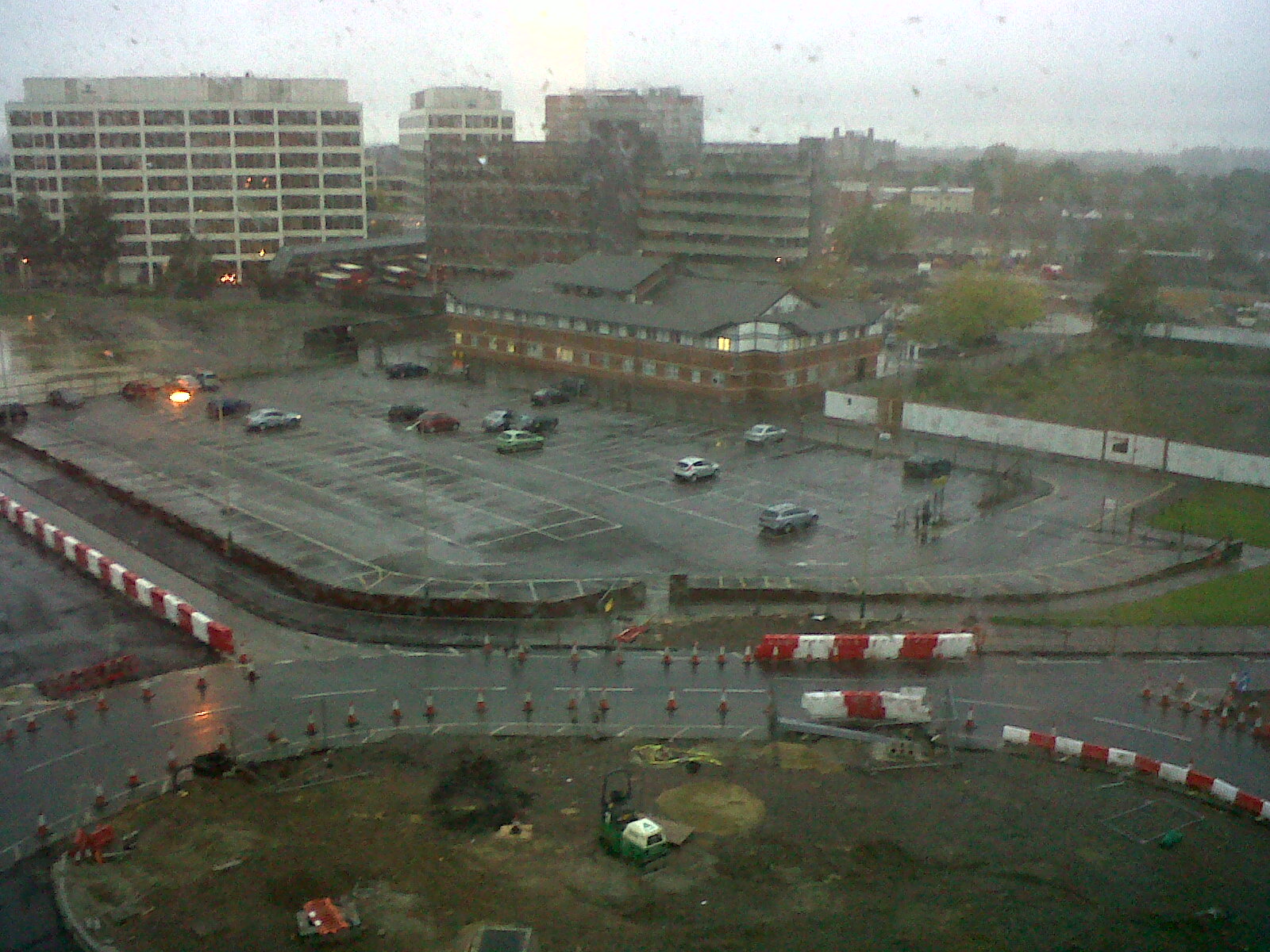
Anyway, we got through yesterday’s business reasonably well, although it was a long day and we were all flagging by the end. I guess that’s why they call it Swindon Wilts. We’re just about to commence Day Two so I’ve just got time to put up the following picture. For those of you who’ve never been to Swindon before, I believe this photograph conveys an accurate impression of what it’s like. This is the view through the rain from my hotel window yesterday evening.

Intermission

Posted in Uncategorized with tags , on September 20, 2011 by telescoper

Well, dear readers, I  am up at the crack of dawn in order to journey forth to Swindon, for  three days of hard labour on the STFC Astronomy Grants Panel for the duration of which I will be confined to a dark dungeon in Polaris House. Given the severity of the sentence  I very much doubt that I’ll have the time or the energy to blog while I’m there so, unless it all gets too much for me and I have to seek solace in a blog post,  there will now follow a short intermission.

Normal service will be resumed as soon as possible.


A Blast from the Past

Posted in Biographical with tags , , , on September 5, 2011 by telescoper

I’ve just remembered that the annual STFC summer school for all new PhD Students in Astronomy finished last week. This year it was held in the fine city of Glasgow and I trust a fine time was had by all,  thanks both to the excellent astronomy staff there who organised the whole thing,  and to the eminent invited speakers who supplied specialist lectures.

When I was just about to start my PhD (or, more accurately, DPhil) in 1985 there was a summer school like this too only that was before STFC and even before its predecessor,  PPARC. The Science and Engineering Research Council (SERC)  summer school I went to was actually held at Durham University; we all stayed in St Mary’s College, just over the road from the Physics Department. I remember it well and indeed still have the notes I took during the lectures there.

Coincidentally, I recently unearthed this picture which has, unfortunately, been slightly damaged on the left  hand side. It might be interesting for all those who attended this year’s School to see how many of this group are still doing research 26 years later; the newbies may even be able to identify their PhD supervisors!

I’m in the middle with the Peter Beardsley haircut, and you can easily pick out a number of people who are still active in astronomy research, e.g. Melvin Hoare (Leeds), Moira Jardine (St Andrews), Alan Fitzsimmons (QUB), Steve Warren (Imperial), Alastair Edge (Durham), and Jon Loveday (Sussex), to name but a few. Anyone else see anyone they recognize? Or anyone else who was there happen to be reading this blog? Please do let me know through the comments box!

UPDATE: I’m grateful to Melvin for pointing out to me that Andy Norton has already posted a version of this picture elsewhere, with a much more complete list of identifications!

The STFC Card: Place your Bets

Posted in Science Politics with tags , on September 3, 2011 by telescoper

The closing of the transfer window for the football Premiership last week left many disappointed with their team’s failure to bring in new talent for the forthcoming season. Meanwhile, talking of things ending in -FC, rumours are circulating as to why there’s been no announcement yet of the new Chief Executive of the Science & Technology Facilities Council. So I thought I’d liven things up by opening a book on the appointment process. Here is the lowdown on  the leading contenders, together with their respective odds, from our man in Polaris House.

5-4 ON, Fav. Colonel Muammar Gaddafi.  The bookies’ favourite. Known to be seeking employment, experienced at running large facilities. Has not been heard of for weeks, so may in fact already have been appointed.

EVENS. Prof. Richard Wade. Current Director of Science Programme at STFC so has good inside knowledge. His gruff northern exterior masks an interior that’s both gruff and northern. Represents continuity with existing management. Er…

13-8. Professor Brian Cocks.  Some bloke off the telly. Popular with the ladies. Born in the Midlands, near Manchester. Currently the only person in the UK who knows anything about either particle physics or astronomy. Will need to stop smiling and get a different haircut, but nevertheless could be worth a punt. Good track record at recording tracks (Groan. Ed).

3-1. George F. Stathew. Enigmatic character thought to be a cosmologist with some sort of connection to Cambridge University. Rarely seen in public so difficult to assess his form. Low profile, together with elusive and uncommunicative nature generally thought to be assets for this position. A bit of a dark horse, this one, but favoured by some smart money in recent months.

7-1. Andy Lawrence. American actor as well as Regius Professor of Astronomy at the University of Edinburgh (Is this right? Ed). Generally considered to be too young for the job (at 58), but known to be particularly fond of the Swindon area and rumoured to be planning to spend several weeks there in the near future. Definitely an outside chance.

10-1. Saddam Hussein. Similar credentials to the favourite. Experienced at dealing effectively with difficult people. Would be an even stronger contender had he not been executed in 2006, but lack of vital signs not thought to preclude appointment to this position.  A drawback is that he is known to be highly strung. Definitely worth an outside  bet, but may turn out to be a non-runner.
20-1. Steve McClaren. Rumoured to be unsettled at Nottingham Forest, so a move to Swindon Town is definitely possible in the near future (That’s the wrong STFC! Ed). Points in favour include an excellent  range of miserable facial expressions, large repertoire of footballing clichés, and a remarkable track-record in management. (Now you’re just being silly. Ed.) Downsides include his remarkable track-record in management.
33-1. Keith Mason. Current Chief Executive of the Science and Technology Facilities Council and prop forward for Huddersfield Giants Rugby Leage Team (Shurely Shome Mishtake? Ed.) Probably a bit old to be a serious contender for the position but an outside chance that he might stay on for another season. Thought to be keen to complete the job that he started (unfortunately). Better the devil you know? Definitely a wild card but don’t rule him out.

50-1. BAR. Are they open yet? (You’re fired. Ed.)

Cutting Remarks

Posted in Finance, Politics, Science Politics with tags , , , , , on May 13, 2011 by telescoper

I know you’ve all been waiting with baited breath for news of the outcome of the House of Commons Science and Technology Committee‘s report into Astronomy and Particle Physics in the UK.

Well, it’s out now. You can find the web version of the report here and it’s also available as a PDF file there. There’s also a press release with the headline

MPs warn astronomy and particle physics budgets cuts will hit UK science hard

Journalists have obviously been busy overnight – the report was released at midnight, I believe – and there are stories all over the press this morning, including The Guardian, and the journal Science as well as the BBC. The Royal Astronomical Society and the Institute of Physics have also been quick to respond.

Apart from the savage cuts themselves – which the committee correctly suggest will reduce astronomy and particle physics spending by 2014/15 to about 50% of the level it was at in 2005 – the great tragedy of this story is that it has taken so long to recognize the scale of the disaster. Most of the damage was done way back in 2007 when the Science and Technology Facilities Council (STFC) was first set up. I’d suggest there is an error in the tense of the verb “to hit” in the headline above. It would be more accurate as

MPs warn astronomy and particle physics budgets cuts HAVE ALREADY hit UK science hard, and are getting worse all the time..

Last year’s Comprehensive Spending Review had relatively good news for STFC, with a settlement corresponding to level funding in cash terms. However, the Bank of England has recently stated that it expects inflation to reach 5% this year, which means that science will actually be getting 5% year-on-year real terms cuts on top of what it received in 2007. It’s a pretty dire situation.

The report also raises a doubt over whether the current Chief Executive, Keith Mason, has the “ability to command the confidence of the scientific community”. No shit.

I don’t have time to write much more on this right now as I have lectures to do, but perhaps others out there might feel the urge to start a discussion through the comments box…

Share/Bookmark

Astronomy Grants: The Harsh Reality

Posted in Science Politics with tags , , , , on May 8, 2011 by telescoper

Time, I think, to return to my role as selfless servant of the astronomical community, with a bit of news about astronomy grants. I was prompted to do this by the following cartoon (from the excellent PhDComics) which I saw this morning:

It’s all completely untrue, of course. *Cough*.

Anyway, as you will probably  know, the Science and Technology Facilities Council (STFC) is introducing a new system of grants this year and the deadline for the first set of applications for the new “consolidated grants” was 4th May, which passed last week while I was away on holiday. Just before leaving I attended a preliminary meeting in London of the Astronomy Grant Panel, of which I am a member. In fact, I delayed my departure specifically in order to attend the meeting. The things I do for science.

At the meeting we discussed a number of issues relating to the new system in order to be ready to get on with the business as quickly as possible when the applications are all in. The timetable is very tight if we’re going to be able to get our recommendations finalised in time for STFC to make announcements in October, as is planned. Thew new system is  going to mean a huge amount of extra work over the summer for the panel members, doing what was always a thankless task in the first place.

Of course I’m not going to write anything on here about the actual process of assessing grants, and certainly not about individual proposals or outcomes. Anything that’s not confidential about the procedure is already explained quite clearly on the STFC website too, so there’s not much point going over that again here. It would also be inappropriate for me to give the impression that anything I put on here is in any way the official AGP (or STFC) line.

What I can do, though, is make a few comments about the current situation using information that is already in the public domain or is otherwise not a breach of confidentiality. The most important observation relates to the following figure, borrowed from the e-astronomer (who also happens to be Chair of the AGP):

The graph shows the number of astronomy postdoctoral research positions funded by STFC (or its forerunner PPARC) as a function of time. The steep decline in recent years has been widely discussed. My own view is that it will be disastrous in the long term if steps are not taken to rectify it soon. The  STFC budget for astronomy grants is fixed for the next few years at a level corresponding to about 60 per year, similar to the number announced in 2010/11.

Now the new consolidated grants will incorporate existing roling grants (which were reviewed on a three-year cycle) and standard grants (which usually lasted three years). A large number of positions announced in 2008 will therefore be hoping for renewal this year. On top of those there will be proposals requesting new positions and other rolling grants coming into this round before their usual renewal date in order to merge with others from the same institution.

I don’t know the actual numbers applied for this year – and couldn’t tell you even if I did – but it’s not unreasonable based on the figures shown in the graph above to estimate that  about 100 PDRA requests will be made, and possibly many more. A significant fraction of these (perhaps 2/3) will be people employed on existing rolling grants hoping to be continued in a new consolidated grant from 2011 onwards.

I probably don’t have to spell it out any further, but it’s clear from the graph that the arithmetic is very tough. Even without any new requests this year, only about 2/3 of the positions funded in 2008 can survive. In reality there may be more than 100 souls standing on deck, but the lifeboats can only hold 60….

Share/Bookmark

Community Matters

Posted in Education, Science Politics with tags , , on April 21, 2011 by telescoper

Well, here I am back in sunny Cardiff after a pleasant journey back from Llandudno and a very enjoyable and productive National Astronomy Meeting. I’d like to take this opportunity to thank all those involved at the Royal Astronomical Society in putting the programme together and doing a huge amount of work behind the scenes. The staff at the Venue Cymru in Llandudno were very friendly as well as highly professional and well organised, and everything seems to run exceptionally smoothly.

Oh, and I shouldn’t forget the conference dinner on Tuesday night, which ended with a serenade from the magnificent Maelgwyn Male Voice Choir. It was fitting to have the chance to experience a fine Welsh tradition, and I thought they were wonderful to listen to.

Anyway, I might get a bit of time over the Easter break to comment on some things that struck me over the course of the past week but for today – because I’m quite tired after the journey (and several late nights at NAM) – I thought I’d just comment a bit further on the first session I attended, on Monday evening, attended by various representatives of STFC, at which John Womersley gave a presentation about the status of various projects in the existing astronomy programme and prospects for the future. It was clear from that presentation that there are many challenges ahead, but I was relieved that the atmosphere of the meeting wasn’t anything like as confrontational as on many previous occasions. This process of reconciliation will no doubt take futher steps forward when the new Chief Executive takes over next year.

Drinking in the bar much later in the evening with a number of senior figures from diverse branches of astronomy the issue arose of the now notorious petition that George Efstathiou blogged about in a guest post some time ago. Two things are now clear about this initiative. One is that it caused deep ructions within the astronomical community, with a number of senior figures vociferously both for and against it – even within the same department. When I revealed that I had signed it myself, a few of the assembled company expressed their views in forthright language about why I had been wrong, but I have to say without much coherence in the actual logic.

The other thing that emerged during the STFC session was an explicit acknowledgment that the petition had, in one particular respect, made a very big difference, namely that the criteria for the appointment of the next Chief Executive of STFC specifically took into account some of the comments made in it.

Anyway, the point of raising the dreaded petition is not to rake over this whole business but simply to try to put it to rest. We need to move on, and should be trying to heal any wounds that it may inadvertantly have caused. There are definitive signs that the STFC Executive is now really starting to listen, so now there’s a chance to really engage with them through the channels they are opening up rather than having to resort to extreme measures such as George’s petition.

Oh, and I’ll just remind anyone who is interested in the vacancy at the top of STFC that the deadline for applications is April 28th….

Share/Bookmark