Archive for Thomas Traherne

The Celestial Stranger – Thomas Traherne

Posted in History, Music, Poetry with tags , , on February 2, 2025 by telescoper

I promised yesterday that I would post the poem that gives its title to the song cycle, The Celestial Stranger, which was performed at the National Concert Hall on Friday night, so here it is as it appeared in the programme:

It’s very interesting to see such thoughts expressed in the mid-17th Century!

Thomas Traherne is an interesting poet in many ways and the associated story of his poetical manuscripts is strange and fascinating. The son of  a cobbler, Traherne was a devoutly religious man who lived most of his short life (1637-1674) in relative obscurity as a clergyman and theologian. He was a prolific writer of both prose and poetry, but very little of his work was published during his lifetime. A vast number of handwritten manuscripts survived his death, however, and many of these remained in the safekeeping of a local family in his native Herefordshire. However, in 1888 the estate of this family was wound up, sold, and the manuscripts became dispersed. Eventually, in 1897, one set of papers was  accidentally discovered in a bookstall. Traherne’s first volume of verse was published in 1903 and a second collection followed in 1908.

When these poems finally found their way into the literary world they were greeted with astonishment as well as deep appreciation and they were widely  influential: T.S. Eliot was a great admirer of Traherne, as was Dorothy L Sayers. There are also truly wonderful musical settings of some of Traherne’s poetry made by a young Gerald Finzi in his cantata Dies Natalis.

Over the years further manuscripts  have also come to light – literally, in one case, because in 1967 another lost Traherne manuscript was found, on fire, in a  rubbish dump and rescued in the nick of time! As late as 1997 more works by Traherne were discovered among 4,000 manuscripts in the Library of Lambeth Palace, the London residence of the Archbishop of Canterbury. The Lambeth manuscripts, from which the above poem is taken, are mostly prose writings, actually, but there are many poems in there too.

Traherne is sometimes described as the last metaphysical poet. However, it seems to me he might equally be described as the first romantic poet. The themes he tackles – love of nature and loss of childhood innocence – and his visionary, rhapsodic style have as much in common with William Blake and, especially, William Wordsworth as they do with better known metaphysical poets such as John Donne.

Debussy, McNeff & Rachmaninov at the NCH

Posted in Uncategorized with tags , , , , , , , , on February 1, 2025 by telescoper

Last night was my first trip of the year to the National Concert Hall in Dublin. I had planned to go on 17th January but by the time I got around to buying a ticket it was sold out. Fortunately, it was broadcast live on the radio and is still available on the RTÉ Player. I had a ticket for last Friday’s concert but bottled out of going because of transport worries about Storm Éowyn. That concert went ahead, apparently, but wasn’t broadcast so I missed it. Last night was third time lucky, and I’m very glad I got there!

The conductor of the National Symphony Orchestra for last night’s performance was Columbian-born Lina González-Granados in what I believe to have been her first appearance with the NSO. I certainly hope she comes back as she was very good indeed. I think the members of the orchestra enjoyed themselves as much as the audience!

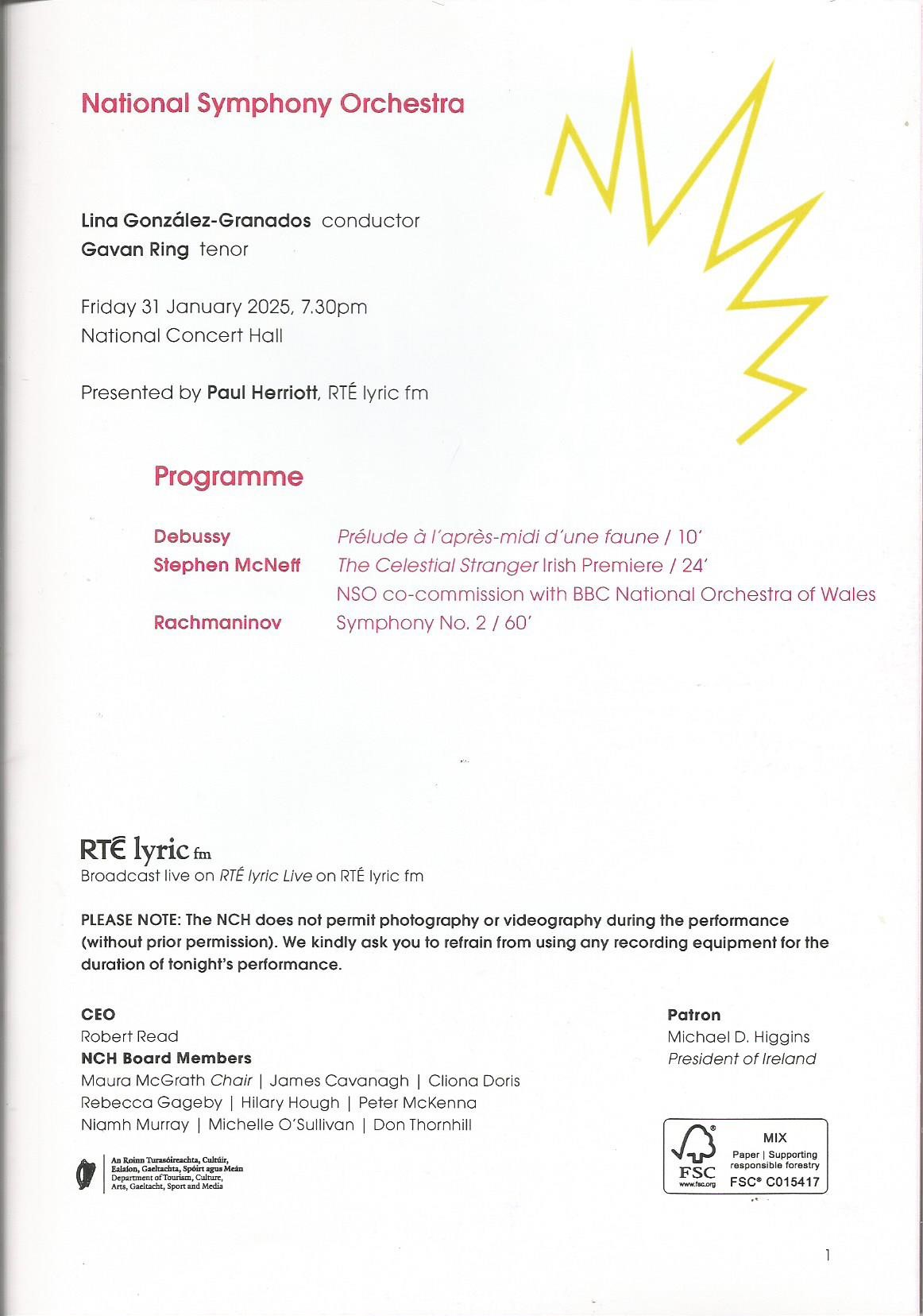
As you can see from the programme, the concert opened with a very familiar piece, Prélude à l’après-midi d’un faune by Claude Debussy, which was performed with all the shimmering sensuality it demands. Some very lush playing by the strings on this one, and lovely work by the woodwinds made it sound very fresh although I’ve heard it many times.

After that tenor Gavan Ring joined the orchestra to perform the Irish Premiere of The Celestial Stranger, a song cycle composed by Belfast born composer Stephen McNeff. This consists of settings of five poems, two by Thomas Traherne (including the one that gives its name to the collection, a remarkable work that I will post in its entirety later on). The next poem is by Walt Whitman and is titled As The Time Draws Nigh in the programme, but is not the well-known Whitman poem of that title but seems to have been adapted from various texts, including Years of the Modern. After that is a famous poem by Dylan Thomas, The hand that signed the paper and the cycle concludes with an adaptation of Farewell to Thee, written by Liliʻuokalani (former monarch of Hawaii). It’s a varied collection but there is a narrative behind the choice: a visitor from outerspace (the Celestial Stranger) arrives on Earth and reacts joyfully to begin with. As time goes on, however, he finds out more about war and and death and finally takes his leave.

The music is as varied as the choice of verse. I felt some influence of Britten in the first piece, but the rest is very different. Gavan Ring was in fine voice and the orchestra responded very well to the very different demands of this work compared to the first.

After the interval it was time for the main course of the evening, Rachmaninov’s Second Symphony. It’s a remarkable work because it’s not only a “proper” symphony in its construction and development but also the best part of an hour of one glorious melody after another. It’s a gorgeous work altogether, but the third movement (Adagio) is especially beautiful. I love the way Rachmaninov starts this movement one of his big romantic tunes, but then hides it while passages develop through a solo  clarinet and strings. You know the tune is coming back though, and when it does the emotional impact brought the audience to a collective swoon. This is romantic music in all senses of the word, just the ticket for a cole January evening. It was a very fine performance, not least because you could see how much both conductor and orchestra were enjoying themselves. Hats off to Lina González-Granados who had just the right balance of control and expressiveness. She look quite exhauasted at the end, actually. She had worked hard to earn her standing ovation.

The Taste and Tincture of Another Education

Posted in Education, Literature, The Universe and Stuff with tags , on December 17, 2017 by telescoper

This is what a University education meant to the poet and theologian Thomas Traherne (1636-1674), according to his Centuries of Meditations. In this astonishing book describing his own voyage of spiritual discovery, Traherne celebrates, among many other things, the beauty and complexity of creation as a manifestation of the power of God. Even  a non-religious person like myself can find much to appreciate in his words about the wonder of the natural world and the joy of learning for learning’s sake:

Having been at the University, and received there the taste and tincture of another education, I saw that there were things in this world of which I never dreamed; glorious secrets, and glorious persons past imagination. 

There I saw that Logic, Ethics, Physics, Metaphysics, Geometry, Astronomy, Poesy, Medicine, Grammar, Music, Rhetoric all kinds of Arts, Trades, and Mechanisms that adorned the world pertained to felicity; at least there I saw those things, which afterwards I knew to pertain unto it: and was delighted in it. 

There I saw into the nature of the Sea, the Heavens, the Sun, the Moon and Stars, the Elements, Minerals, and Vegetables. All which appeared like the King’s Daughter, all glorious within; and those things which my nurses, and parents, should have talked of there were taught unto me.

The Salutation

Posted in Poetry with tags , , on August 22, 2011 by telescoper

It’s been far too long since I posted a poem by my favourite of the metaphysical poets, Thomas Traherne (who lived from c. 1636 to 1674), so here’s another of his remarkable works, called The Salutation, in which he ponders the deepest questions of existence complete with authentic 17th century spelling…

These little Limbs,
These Eys and Hands which here I find,
This panting Heart wherwith my Life begins;
Where have ye been? Behind
What Curtain were ye from me hid so long!
Where was, in what Abyss, my new-made Tongue?

When silent I
So many thousand thousand Years
Beneath the Dust did in a Chaos ly,
How could I Smiles, or Tears,
Or Lips, or Hands, or Eys, or Ears perceiv?
Welcom ye Treasures which I now receiv.

I that so long
Was Nothing from Eternity,
Did little think such Joys as Ear and Tongue
To celebrat or see:
Such Sounds to hear, such Hands to feel, such Feet,
Beneath the Skies, on such a Ground to meet.

New burnisht Joys!
Which finest Gold and Pearl excell!
Such sacred Treasures are the Limbs of Boys
In which a Soul doth dwell:
Their organized Joints and azure Veins
More Wealth include than all the World contains.

From Dust I rise
And out of Nothing now awake;
These brighter Regions which salute mine Eys
A Gift from God I take:
The Earth, the Seas, the Light, the lofty Skies,
The Sun and Stars are mine; if these I prize.

A Stranger here,
Strange things doth meet, strange Glory see,
Strange Treasures lodg’d in this fair World appear,
Strange all and New to me:
But that they mine should be who Nothing was,
That Strangest is of all; yet brought to pass.

Shadows in the Water

Posted in Poetry with tags , on November 2, 2010 by telescoper

Just back from a long day in Swindon, exhausted by the days STFC deliberations, and in need of an early night ahead of another 5am start tomorrow. Apologies then for not having a proper blog post. Here instead is another from my reserve collection of bits and bobs that I’ve been storing for a while. This poem is probably the most famous one by Thomas Traherne, who I’ve posted about before. I think Shadows in the Water is a marvellous mixture of childlike curiosity and deep philosophical reflection. I hope you like it.

In unexperienced infancy
Many a sweet mistake doth lie:
Mistake though false, intending true;
A seeming somewhat more than view;
That doth instruct the mind
In things that lie behind,
And many secrets to us show
Which afterwards we come to know.

Thus did I by the water’s brink
Another world beneath me think;
And while the lofty spacious skies
Reversèd there, abused mine eyes,
I fancied other feet
Came mine to touch or meet;
As by some puddle I did play
Another world within it lay.

Beneath the water people drowned,
Yet with another heaven crowned,
In spacious regions seemed to go
As freely moving to and fro:
In bright and open space
I saw their very face;
Eyes, hands, and feet they had like mine;
Another sun did with them shine.

‘Twas strange that people there should walk,
And yet I could not hear them talk:
That through a little watery chink,
Which one dry ox or horse might drink,
We other worlds should see,
Yet not admitted be;
And other confines there behold
Of light and darkness, heat and cold.

I called them oft, but called in vain;
No speeches we could entertain:
Yet did I there expect to find
Some other world, to please my mind.
I plainly saw by these
A new antipodes,
Whom, though they were so plainly seen,
A film kept off that stood between.

By walking men’s reversèd feet
I chanced another world to meet;
Though it did not to view exceed
A phantom, ’tis a world indeed;
Where skies beneath us shine,
And earth by art divine
Another face presents below,
Where people’s feet against ours go.

Within the regions of the air,
Compassed about with heavens fair,
Great tracts of land there may be found
Enriched with fields and fertile ground;
Where many numerous hosts
In those far distant coasts,
For other great and glorious ends
Inhabit, my yet unknown friends.

O ye that stand upon the brink,
Whom I so near me through the chink
With wonder see: what faces there,
Whose feet, whose bodies, do ye wear?
I my companions see
In you another me.
They seemèd others, but are we;
Our second selves these shadows be.

Look how far off those lower skies
Extend themselves! scarce with mine eyes
I can them reach. O ye my friends,
What secret borders on those ends?
Are lofty heavens hurled
‘Bout your inferior world?
Are yet the representatives
Of other peoples’ distant lives?

Of all the playmates which I knew
That here I do the image view
In other selves, what can it mean?
But that below the purling stream
Some unknown joys there be
Laid up in store for me;
To which I shall, when that thin skin
Is broken, be admitted in.


Share/Bookmark

Consummation

Posted in Music, Poetry, The Universe and Stuff with tags , , on August 27, 2009 by telescoper

Not long ago I put up an item containing a  poem by John Wilmot, Earl of Rochester. Since I’ve been reading a collection which contains poems by another of the metaphysical poets, Thomas Traherne, I thought I’d pick one of his to put up too.

I was also reminded of Traherne’s poetry when John Peacock commented on another recent post because it was he that introduced me to the truly wonderful musical settings of some of Traherne’s poetry made by Gerald Finzi in his cantata Dies Natalis, and pointed me in the direction of the stunning recording of that work made by Wilfred Brown with the English Chamber Orchestra, conducted by Christopher Finzi (son of Gerald). Why Finzi –  and especially that work – is not better known is something I’ll never understand. But that’s another story…

The story of Thomas Traherne’s poetry is strange and fascinating. The son of  a cobbler, he was a devoutly religious man who lived most of his short life (1637-1674) in relative obscurity as a clergyman and theologian. He was a prolific writer of both prose and poetry, but very little of his work was published during his lifetime. Vast number of handwritten manuscripts survived his death, however, and many of these remained in the safekeeping of a local family in his native Herefordshire. However, in 1888 the estate of this family was wound up, sold, and the manuscripts became dispersed. Eventually, in 1897, one set of papers was  accidentally discovered in a bookstall. Traherne’s first volume of verse was published in 1903 and a second collection followed in 1908.

When these poems finally found their way into the literary world they were greeted with astonishment as well as deep appreciation and they were widely  influential: TS Eliot was a great admirer of Traherne, as was Dorothy L Sayers. The timing of their publication probably explains why Finzi’s music teacher, Ernest Farrar, suggested them to his young student; Finzi was born in 1901 and Farrar taught him as a young boy before he was called up for service in the First World War and killed in action in 1918.

Over the years further manuscripts  have also come to light – literally, in one case, because in 1967 another lost Traherne manuscript was found, on fire, in a  rubbish dump and rescued in the nick of time.

Traherne is sometimes described as the last metaphysical poet and, indeed, the last poems in the collection I have been reading are by him. However, it seems to me he might equally be described as the first romantic poet. The themes he tackles – love of nature and loss of childhood innocence – and his visionary, rhapsodic style have as much in common with William Blake and, especially, William Wordsworth as they do with better known metaphysical poets such as John Donne.

Traherne’s most famous poem is probably Shadows in the Water, but I decided to pick a relatively obscure one, primarily because it deals with matters close to the concerns of a cosmologist! The central theme is the inadequacy of human thought processes in finding a true description of reality or, if you like, full intercourse with nature. For the poet, this can only be achieved through God. This is the consummation referred to in the title.

He’s particularly good at capturing  how we tend to gloss over difficulties with our conceptual framework and how we invent things to plug the gaps. I particularly like the lines from the fourth verse “Wherein because we no//Object distinctly find or know,//We sundry things invent,//That may our fancy give content.” Dark matter?

Consummation

The thoughts of men appear
Freely to move within a sphere
Of endless reach; and run
Though in the soul, beyond the sun.
The ground on which they acted be
Is unobserved infinity.

Extended through the sky,
Though here, beyond it far they fly:
Abiding in the mind
An endless liberty they find:
Throughout all spaces can extend,
Nor ever meet or know an end.

They, in their native sphere,
At boundless distances appear:
Eternity can measure;
Its no beginning see with pleasure.
Thus in the mind an endless space
Doth naturally display its face.

Wherein because we no
Object distinctly find or know,
We sundry things invent,
That may our fancy give content;
See points of space beyond the sky,
And in those points see creatures lie;

Spy fishes in the seas,
Conceit them swimming there with ease;
The dolphins and the whales,
Their very fins, their very scales,
As there within the briny deep
Their tails the flowing waters sweep.

Can see the very skies,
As if the same were in our eyes;
The sun, though in the night,
As if it moved within our sight;
One space beyond another still
Discovered; think while ye will.

Which though we don’t descry,
(Much like by night an idle eye,
Not shaded with a lid,
But in a darksome dungeon hid)
At last shall in a glorious day
Be made its objects to display,

And then shall ages be,
Within its wide eternity;
All kingdoms stand
Howe’er remote, yet nigh at hand;
The skies, and what beyond them lie,
Exposed unto every eye.

Nor shall we then invent
Not alter things; but with content
All in their places see,
As doth the glorious deity;
Within the scope of whose great mind,
We all in their true nature find.