Archive for Universities

Uncertain Universities…

Posted in Education, Politics with tags , , , , on November 24, 2010 by telescoper

Interesting snippets of Higher Education news today from the BBC website.

It seems that the Higher Education Funding Council for Wales (HECFW) has voiced concerns about the sustainability of no less than five Welsh universities. Although it hasn’t named them, I think it’s likely to be those most dependent on state funding which is pretty certain to shrink drastically over the next few years. I’ll leave it as an exercise for the reader to identify the five most likely to fold. This news has emerged as a result of a request by the BBC under the Freedom of Information Act.

This comes as no surprise to me, actually. It’s clear that, for its size and population,  Wales has too many separate institutions currently regarded as “universities”. A sustainable system would have less than half the number than we have now, but managing the change to a more rational structure is bound to be a difficult process, especially if it is allowed to happen by organized neglect (which seems to be the plan). Wales drastically underfunds its Higher Education sector compared to England anyway and, with what jam there is spread over far too many institutions, there’s very little by way of resources to devote to any real sort of strategic development.

Another interesting bit of information in the BBC report is that the Welsh Assembly is expected to outline its response to the Browne Review before Christmas. I was expecting the WAG to but  the introduction of any new fee system will probably have to wait until after the Welsh Assembly elections next May.

Meanwhile Cardiff University students are holding a protest against the possible introduction of fees at the very moment I am writing this, as part of a day of action across the UK. Although there are no definite plans to increase fees in Wales at the moment because the WAG has not announced its policy, I think most of us working in academia think a big increase in fees is imminent in Wales, just as it is in England (provided the necessary legislation gets through the House of Commons). It remains to be seen, however, whether Welsh universities will be allowed to charge as much as English ones, i.e. up to £9000 per annum.


Share/Bookmark

Did HE fall, or was it pushed?

Posted in Education, Politics with tags , , , , , , on October 30, 2010 by telescoper

One of the other scary bits of news to emerge last week concerns proposed changes to the arrangements for tuition fees in English universities. According to the Times Higher, the Minister responsible for universities, David Willetts, has admitted that the cuts to university budgets announced in the Comprehensive Spending Review, will occur before any new money flows into universities from whatever new fee arrangements emerge from the government’s deliberations following the Browne Report.

One of the recommendations of the Browne Report was that central government funding for arts, humanities and social sciences be scrapped entirely. Although I’m a scientist and I do think Science is Vital this is a very bad move, as I think other forms of scholarship and learning are vital too, for a wide range of reasons including cultural ones. It was never clear whether arts & humanities departments would be able to recoup the money lost as a result of cuts to central funding, but now it appears they will have to survive for an indeterminate time without any prospect of extra income to offset the shortfall.

The upshot of all this will be a huge and immediate cut in the budgets of many university departments, a  state of affairs about which Willetts commented only thus:

You have to expect that there will be pressure on universities to save money, and we don’t think they should be exempt from the pursuit of efficiencies.

Can an immediate 40% cut in teaching income be made by efficiency savings? I don’t think so, Mr Willetts. Even making large-scale redundancies won’t help there, as that costs a lot of money up front.

So why is the government pushing through cuts to university funding before ensuring that the new fee arrangements are in place? A variety of answers are possible. One would be incompetence, always a possibility when politicians are involved. However, although this government has tried to rush things through very quickly, I do not believe that this is something that hasn’t been considered very carefully. I think it’s deliberate.  I believe that this government wants some universities to fail, and has found an opportunity to push them over the edge.

It’s not about efficiency savings, it’s about survival of the fattest. Only those places able to dig into their reserves for several years will be able to weather the storm. Some will cope, some won’t. That’s the point.

It’s well known that several universities, most of them post-1992 institutions, have been struggling financially for a considerable time. In the past, special procedures have always been implemented to protect organizations of this type that have been close to insolvency. This government has said that will do things differently, and that universities that go bust will now be allowed to fail. This may involve them closing altogether, or being taken over by private companies. If I were working in a university heavily dependent on income from arts, humanities and social science teaching, I would be extremely nervous about the future. I mean, more nervous than I am anyway, working as a scientist in an institution which is financially sound. And that  is already very nervous indeed.

The other side of this particularly nasty coin, is that more “prestigious” institutions specialising in non-STEM areas, such as the London School of Economics, are already considering the option of going private. If the government gives them no support directly, yet insists – as seems likely – in capping the fee students pay at a figure around £7K per annum as well as strangling them with yards of red tape as HEFCE is wont to do, then why not just withdraw from the system and set fees at whatever level they like? It’s unlikely that an institution with a strong science base will go down this road, as the taxpayer is going to continue supporting STEM subjects, but it seems to me that it would make sense for the LSE to opt out of a system whether the costs of membership exceed the benefits received.

In the longer term, the squeeze is set of continue. According again to the Times Higher, the net revenue from fees will only replace part of the funding withdrawn over the CSR period. It looks like five years of struggle during which many departments may go under. The more you think about it, the worse it looks.

However, perhaps a better question than the one I asked a couple of paragraphs ago is the following. Why is the government intent on slashing the budgets of HE institutions, when it appears to have  let Vodafone off without paying a bill for £6 billion tax?

That amount would have been more than enough to tide the HE sector over until the new fee stream came online…


Share/Bookmark

The Day After: A Welsh Perspective

Posted in Education, Politics, Science Politics with tags , , , , , , , on October 21, 2010 by telescoper

It’s well after 11am and I’m still at home. Came down last night with some sort of bug that kept me awake nearly all night with frequent visits to the smallest room in the house. Whatever it is is still rumbling on so I’ve decided to stay at home until I give myself the all clear.

This sudden attack of lurgy is probably not connected with yesterday’s dramatic announcements of the results of the comprehensive spending review, which are now being dissected and analysed all over the mainstream press, the blogosphere, and countless common rooms around the country.

I haven’t got the energy right now to go over the ramifications in detail, but encourage you to read the whole thing, which is available in a nifty online reader for your perusal. I will, however, make a few brief comments, with particular emphasis on the situation here in Wales.

First, the announcement of large cuts to the teaching budget administered by HEFCE has clearly sent shockwaves through academia. It appears that only STEM subjects will continue to receive the state contribution and in future students will have to bear the full cost of tuition (but only after they’ve graduated and started to earn over the threshold of £21K). As a supporter of the Science is Vital campaign I was relieved that we seem to won a victory, although the war is far from over. However, I feel great sadness at the cost that our success seems likely to inflict on other disciplines. If you think these are nervous times for scientists, imagine what it must be like working in the Arts and Humanities.

Of course this all applies directly only to English universities: the budgets for Higher Education in Scotland, Wales and Northern Ireland are administered separately, so in principle things could work out very differently for Higher Education here in Wales.

However, the total amount of money available for the Welsh Assembly Government (WAG) to spend is fixed by the Westminster government through the Barnett Formula. This determines the overall cash for the devolved governments by allocating a proportion of what England spends on those things that are devolved., i.e. Wales is notionally allocated an amount for Higher Education which is proportional to HEFCE’s allocation and similar for other areas of spending such as Health. Once the size of the overall pot is fixed, however, the WAG is not obliged to spend its money in the same way that England does.

Buried in the pages of the CSR document is Wales’ allocation over the CSR period, which shows real terms cut of about 7.5% over the term. However, the Welsh Assembly Government’s reaction puts it rather differently:

In real terms, our total Budget is set to fall by around 3.1% per year on average, or 12% in total over the coming four years. This means that our Budget in 2014/15 will be £1.8bn lower in real terms than it is this year. Overall, in cash terms the reductions to our Budget will be 3% over the period.

Our capital Budget has been hit particularly hard, and will be cut by 40% in real terms – 34% in cash terms – over the next four years. This substantial reduction, particularly next year, where the cut is more than 25% in real terms, will clearly have a major impact on the private as well as the public sectors.

These figures seem different from those in the CSR document, which might be because of some nuance such as the way capital expenditure is accounted. If anyone can explain the discrepancy through the comments box I’d be grateful.

The main point is, though, that if Wales is going to keep current levels of investment in Higher Education (or even cut less than the English are doing) then it will have to take the money from elsewhere, which is not going to be easy to get through the Welsh Assembly. The picture, therefore, may not be any better here in Wales than it is in England, and could well turn out even worse, depending on how the WAG sets its own spending priorities. To complicate matters further, there’s an election next year for the Welsh Assembly, so there’s a wider political perspective to consider.

Within the overall issue of Higher Education spending is the question of whether Wales will decide to protect funding for STEM disciplines at the expense of all others. The WAG has already produced a document that suggests a strong focus on the so-called regional agenda, which may mean more money going into Further Education, vocational training, and part-time studies rather than, say, research-led science. I know what I would prefer, but whatever I say, it’s the WAG’s decisions that really count. And so it should be. After all, unlike me, they were elected!

Of course, if STEM subjects aren’t protected in Wales, those of us working in those areas are likely to lose even more ground to English universities, which already out-perform us in many respects. We have to make our case as best we can and see what happens.

However, I will end with some more local news which is extremely promising. Yesterday we had a staff meeting in the School of Physics & Astronomy at Cardiff University during which two extremely positive items came to light. One is that we will shortly be interviewing for the extra physics posts we advertised some time ago. Hopefully there will be a new Professor and three new Lecturers joining the staff in the very near future. I’m told we had a huge number of applicants for these positions, and the shortlists for these positions are very strong indeed. This is all very encouraging.

On top of this there is another exciting development on the horizon. After the disappointing outcome of the last RAE for physics in Wales, we have been thinking very hard at working closer with colleagues at Swansea with a view to building a sort of South Wales Physics Alliance. The departments are complementary in many ways: Swansea does particle physics, but Cardiff doesn’t; Cardiff does astronomy, but Swansea doesn’t. Where we are both relatively weak is in so-called “mainstream” physics, which is in the minority in both departments. With a bit of help, I think these two small(ish) departments could form a research institute that really challenges our competitors abroad (especially in England). I’m strongly in favour of this plan, and hope it goes ahead with full HEFCW support (including extra cash), but in this as in some many things, it’s a case of “fingers crossed”.


Share/Bookmark

The Browne Stuff

Posted in Education, Finance, Politics with tags , , on October 13, 2010 by telescoper

I’m basically in purdah this week, shuttling to and fro between Cardiff and Swindon on the business of the STFC Astronomy Grants Panel. However, I couldn’t resist a brief early morning post about yesterday’s news about the report on higher education funding by Lord Browne. I haven’t had time to read the report in full, so won’t comment in detail on it, but a few things did strike me from what I’ve picked up from the media. Perhaps others will add their views through the comments box.

  • For a start it’s quite amusing how far wide of the mark most of the rumour-mongering about the report’s recommendations has been. In fact the proposals are far more radical than had been touted.
  • The suggestion of lifting the cap on fees entirely, and allowing universities to decide how much to charge for tuition, will delight the so-called “elite” universities, but will alarm those (like me) who worry about the impact on students from poorer backgrounds. Most difficult, however, as far as I’m concerned will be the impact on middle-grade universities who won’t know where to pitch themselves in the free market that such a move would create. We know that Oxbridge will be able to get away with charging pretty much whatever they like, and many of the former polytechnics will clearly go for the budget end of the market, but in between there will be tricky decisions to make.
  • The increased fee is to be offset by a cut of a whopping 80% (from £3.5bn to £0.8bn) in the teaching grant to English universities. A cut of this scale may well mean that some courses do not receive any direct contribution from the taxpayer at all (the so-called “unit of resouce”). If this goes ahead it will undoubtedly lead to course closures across the country. Although I would oppose a blanket cut of this scale, I’m not against the idea of withdrawing support from Mickey Mouse courses and concentrating it on important subjects.
  • It seems likely, and indeed there are already signs, that full implementation of the Browne proposals will be politically difficult for the ConDem coalition.  In fact, unless some of the recommendations are diluted, this may well lead to a full-scale revolt. We’ll have to wait and see.
  • Vince Cable has endorsed the report, despite his own party’s previous opposition to raising tuition fees. Any resisual respect I had for him is going down the plughole very rapidly indeed.
  • Finally, I’ll just point out that, even if they are fully implemented, the draconian cuts to English higher education funding are not necessarily going to be replicated here in Wales (or in Scotland or Northern Ireland). The Welsh Assembly has issued a statement on the Browne report, but clearly doesn’t know what to do about it. If they make good decisions now, Welsh universities could prosper by bucking the English trend, but if they get it wrong….

Anyway, that’s all for this am. Got a train to catch!


Share/Bookmark

Student Grants and/or Research Loans

Posted in Politics, Science Politics with tags , , , on September 9, 2010 by telescoper

I’m still a bit depressed after the events I blogged about yesterday. Some days you wonder why you bother, and this has been one of them. However, at least it’s got me rattled enough to stand back and think about the state of the UK university system in more general terms so I thought I’d jot down an idea which is probably barking mad, but has been at the back of my mind for some time.

The basic point is that universities essentially do two things, teaching and research. However, when you think about it, there’s a fundamental inconsistency in the way these are funded. It seems to me that correcting this anomaly could significantly improve  both the main benefits  universities contribute to the UK economy.

First, research. I wrote yesterday about using taxpayer’s money to fund research in universities:

If it’s going to pay off in the short term it should be funded by private investors or venture capitalists of some sort. Dragon’s Den, even. When the public purse is so heavily constrained, it should only be asked to fund those things that can’t in practice be funded any other way.

I’ve just remembered that a similar thing was said in in the Times Higher recently, in a piece about the new President of the Royal Astronomical Society:

Notwithstanding the Royal Academy of Engineering’s “very unfortunate” recent submission to the government spending review – which argued that the need to rebalance the UK economy required public spending to be concentrated on applied science – Professor Davies is confident he can make a good case for spending on astrophysics to be protected.

Research with market potential can already access funding from venture capitalists, he argued, while cautioning the government against attempting to predict the economic impact of different subjects.

This is pretty much the opposite of what the Treasury thinks. It wants to concentrate public funds in projects that  can demonstrate immediate commercial potential. Taxpayer’s money used in this way ends up in the pockets of entrepreneurs if the research succeeds and, if it doesn’t,  the grant has effectively been wasted. My proposal, therefore, is  to phase out research grants for groups that want to concentrate on commercially motivated research and replace them with research loans. If the claims they make to secure the advance are justified they should have no problem repaying it  from the profits they make from patent income or other forms of exploitation. If not, then they will have to pay back the loan from their own funds (as well as being exposed as bullshit merchants). In the current economic situation the loans could be made at very low interest rates and still save a huge amount of the current research budget for higher education. Indeed after a few years – suggest the loans should be repayable in 3-5 years, it would be self-financing. I think a large fraction of research in the Applied Sciences and Engineering should be funded in this way.

The money saved by replacing grants  to commercially driven research groups with loans could be re-invested in those areas where public investment is really needed, such as pure science and medicine. Here grants are needed because the motivation for the research is different. Much of it does, in fact, lead to commercial spin-offs, but that is accidental and likely to appear only in the very long term. The real motivation of doing this kind of research is to enrich the knowledge base of the UK and the world in general. In other words, it’s for the public good. Remember that?

Most of you probably think that this is a crazy idea, but if you do I’ll ask you to now think about how the government funds teaching in universities and ask yourself why research is handled in such a  different way.

Way back in the mists of time when I was a student, I didn’t have to pay fees and even got a maintenance grant from the government that was more-or-less sufficient to live on. That system changed so that students don’t get grants any more, but may qualify for loans. They also have to pay a contribution to their fees, but the government still pays an amount directly to the university on their behalf.

This change of policy happened because the (then) Labour government wanted to boost the rate of participation in universities, but didn’t think the taxpayer should pay the whole cost. The logic goes that the students benefit from their education, e.g. in terms of increased earnings over their working lifetime, so they should pay a contribution to it.

The problem with all this is that it has led to a huge increase in enrolment on degree courses in “vocational” areas such as Leisure & Tourism, Media Studies, and Business while traditional courses, such as those in STEM disciplines, providing the sort of rigorous intellectual training that is essential for many sectors of the economy, have struggled to keep up. This is partly because subjects like Mathematics and Physics are difficult, partly because they are expensive, and partly because the UK school system has ceased to function as preparation for such courses.

I’m by no means against universities supplying training in vocational subjects, but because these are the areas where the primary beneficiary is indeed the student, I don’t think the government should subsidise them as much as the more rigorous courses that we really need to encourage the brightest students to take up.

The fix I’d propose for this within the current tightly constrained budget is to cut government funding for vocational subjects and use the money to subsidise those courses contributing to the intellectual wealth of the country. I don’t mean just science, incidentally, I think we have a big problem with participation many other areas, such as modern languages. The best students – in chosen areas – should not only get their fees paid, they should also get maintenance grants as in the old days. Students should not be prevented from doing, e.g., a Business studies degree, or from doing anything without a state scholarship, but should understand that they have to pay for it.

If it’s fair to ask students to contribute to their teaching, it’s fair to ask commercial companies to pay for the research that they exploit. Just as student grants should be re-introduced for certain disciplines, so should research loans be introduced for others. You know it makes sense.

However, if you want to tell me why it doesn’t, via the comments box, please feel free!


Share/Bookmark

STFC Grants Consultation

Posted in Science Politics with tags , , , , on August 31, 2010 by telescoper

I thought I’d put my community service badge on today and draw the attention of any astronomers or particle physicists reading this blog that the Science and Technology Facilities Council (STFC) is consulting on proposed changes to the ways it funds research grants. I can hardly over-emphasize the importance of this issue, especially for those of us working in University departments who rely on grant funding in order to carry out our research.

There is a consultation form on which you can post comments on the alternatives outlined in the accompanying document.

Regrettably, only three options are offered. In brief, they are

  1. All grants to be 3-year “standard” grants (i.e. no more “rolling” grants at all)
  2. Some (a small number?) of 6-year “core” grants introduced, mainly to cover the cost of technical support staff.
  3. The status quo (i.e. mixture of 3-year “standard” and 5-year “rolling” grants).

I’m not going to comment on these here, as my intention is just to draw your attention to the fact that this consultation is open and that the deadline is very soon: Monday 6th September 2010, at 4pm. I would have thought it’s probably a good idea for groups to submit collective responses where possible, but I’m sure all feedback would be welcomed.

We don’t know how much of a grant programme will remain after the forthcoming Comprehensive Spending Review, but it’s even more important to make the system as efficient and fair as possible when we know money is going to be tight.


Share/Bookmark

Political Correlation

Posted in Bad Statistics, Politics with tags , , , , on August 28, 2010 by telescoper

I was just thinking that it’s been a while since I posted anything in my bad statistics category when a particularly egregious example jumped up out of this week’s Times Higher and slapped me in the face. This one goes wrong before it even gets to the statistical analysis, so I’ll only give it short shrift here, but it serves to remind us all how feeble is many academic’s grasp of the scientific method, and particularly the role of statistics within it. The perpetrator in this case is Paul Whiteley, who is Professor of Politics at the University of Essex. I’m tempted to suggest he should go and stand in the corner wearing a dunce’s cap.

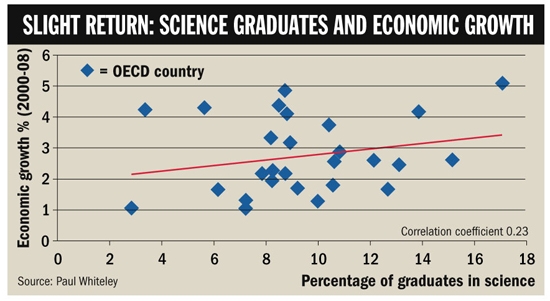
Professor Whiteley argues that he has found evidence that refutes the case that increased provision of science, technology, engineering and maths (STEM) graduates are -in the words of Lord Mandelson – “crucial to in securing future prosperity”. His evidence is based on data relating to 30 OECD countries: on the one hand, their average economic growth for the period 2000-8 and, on the other, the percentage of graduates in STEM subjects for each country over the same period. He finds no statistically significant correlation between these variates. The data are plotted here:

This lack of correlation is asserted to be evidence that STEM graduates are not necessary for economic growth, but in an additional comment (for which no supporting numbers are given), it is stated that growth correlates with the total number of graduates in all subjects in each country. Hence the conclusion that higher education is good, whether or not it’s in STEM areas.

So what’s wrong with this analysis? A number of things, in fact, but I’ll start with what seems to me the most important conceptual one. In order to test a hypothesis, you have to look for a measurable effect that would be expected if the hypothesis were true, measure the effect, and then decide whether the effect is there or not. If it isn’t, you have falsified the hypothesis.

Now, would anyone really expect the % of students graduating in STEM subjects  to correlate with the growth rate in the economy over the same period? Does anyone really think that newly qualified STEM graduates have an immediate impact on economic growth? I’m sure even the most dedicated pro-science lobbyist would answer “no” to that question. Even the quote from Lord Mandelson included the crucial word “future”! Investment in these areas is expected to have a long-term benefit that would probably only show after many years. I would have been amazed had there been a correlation between measures relating to such a short period, so  absence of one says nothing whatsoever about the economic benefits of education in STEM areas.

And another thing. Why is the “percentage of graduates” chosen as a variate for this study? Surely a large % of STEM graduates is irrelevant if the total number is very small? I would have thought the fraction of the population with a STEM degree might be a better choice. Better still, since it is claimed that the overall number of graduates correlates with economic growth, why not show how this correlation with the total number of graduates breaks down by subject area?

I’m a bit suspicious about the reliability of the data too. Which country is it that produces less than 3% of its graduates in science subjects (the point at the bottom left of the plot). Surely different countries also have different types of economy wherein the role of science and technology varies considerably. It’s tempting, in fact, to see two parallel lines in the above graph – I’m not the only one to have noticed this – which may either be an artefact of small numbers chosen or might indicate that some other parameter is playing a role.

This poorly framed hypothesis test, dubious choice of variables, and highly questionable conclusions strongly suggest that Professor Whiteley had made his mind up what result he wanted and simply dressed it up in a bit of flimsy statistics. Unfortunately, such pseudoscientific flummery is all that’s needed to convince a great many out there in the big wide world, especially journalists. It’s a pity that this shoddy piece of statistical gibberish was given such prominence in the Times Higher, supported by a predictably vacuous editorial, especially when the same issue features an article about the declining standards of science journalism. Perhaps we need more STEM graduates to teach the others how to do statistical tests properly.

However, before everyone accuses me of being blind to the benefits of anything other than STEM subjects, I’ll just make it clear that, while I do think that science is very important for a large number of reasons, I do accept that higher education generally is a good thing in itself , regardless of whether it’s in physics or mediaeval latin, though I’m not sure about certain other subjects.  Universities should not be judged solely by the effect they may or may not have on short-term economic growth.

Which brings me to a final point about the difference between correlation and causation. People with more disposal income probably spend more money on, e.g., books than people with less money. Buying books doesn’t make you rich, at least not in the short-term, but it’s a good thing to do for its own sake. We shouldn’t think of higher education exclusively on the cost side of the economic equation, as politicians and bureaucrats seem increasingly to be doing,  it’s also one of the benefits.


Share/Bookmark

The Shoe Event Horizon

Posted in Education, Politics, Science Politics with tags , , , , , on July 16, 2010 by telescoper

After yesterday’s  satisfying and enjoyable graduation festivities, it’s back to reality today with a clutch of scary news items about future cuts.

Vince Cable, the coalition Minister responsible for Universities, has revealed plans for Higher Education that include introducing a graduate tax and encouraging the growth of private universities,  the latter to be introduced at the expense of some current institutions which are to be allowed to go bankrupt. You can find some discussion of his speech in the Times Higher as well as in the Guardian piece I linked to earlier.

The graduate tax isn’t a new idea, but it does seem rather strange to be suggesting it right now. The proposal won’t lead to any significant income for universities in the short term so presumably either the government or the institutions themselves will have to borrow until the cash starts to flow in. But I thought we were supposed to be cutting public borrowing?

In fact, it seems to me that the announcements made by Cable are little more than a ragbag of ill-considered uncosted measures likely to do little but cause alarm across the Higher Education sector. Perhaps he would have been wiser to have kept the Ministerial trap shut until he’d actually worked out whether any of the half-baked ideas he announced were worth thinking through properly, as some of them just might be.

Apart from anything else, Vince Cable’s dramatic U-turn on Higher Education funding shows that the LibDem contingent have now been completely subsumed by the dominant right-wing, pro-market political stance of the Conservatives. In other words, we now know there’s no reason ever to vote LibDem again; they’re Tories in all but name.

I hope this year’s new graduates realised how lucky they’ve been to get their education before universities turn into Discount Education Warehouses, although I cling to the hope that the Welsh and Scottish assemblies might take a stand against if some of the worst aspects of the ConDem policy look like becoming reality in England, where the Tories live.

Meanwhile, the Royal Society has submitted its, er, submission to the ongoing debate about research funding. The headline in an accompanying article from the Times – which you won’t be able to read unless you give money to the Evil Empire of Murdoch – suggests that it could be “game over” for British science if the suggested cuts go ahead. Paul Crowther has done his usual fabulously quick job of hacking his way through the documentary jungle to get to the juiciest quotes, including this one:

Short-term budget cuts will put our long-term prosperity at risk.. The UK should maintain its breadth of research .. a flat cash settlement will be painful but manegeable; a 10% cash cut will be damaging .. while a 20% cut will be irreversibly catastrophic for the future of UK science and economic growth.

I’m sorry if I’m introducing a note of pessimism here, but I think we’ll be very lucky indeed if the cuts are as small as 20%.

And finally, not unexpectedly, the news this week includes an announcement that university staff are to have their pensions reduced and/or deferred and will have to pay more for the privilege. Employee’s contributions to the USS scheme will increase from 6% to 7.5%. For new members the pension will not be based on their final salary, but on average earnings. This isn’t a surprise as it’s been clear for some time that USS was actuarially unsound, but it’s one more sign of the forthcoming squeeze on academics, those of them that don’t get made redundant anyway…

Looking around for a bit of good news, I could only manage this. If you’re worried about the future of UK universities and scientific research then consider how lucky you are that you’re not Italian. Owing to budget cuts imposed by the Berlusconi regime, several Italian institutions will no longer be able to pay scientists’ wages. Responding to this situation the Italian premier replied with all his usual tact and intelligence:

Why do we need to pay scientists when we make the best shoes in the world?

Fans of the late Douglas Adams will be reminded of the following passage from The Restaurant at the End of the Universe:

Many years ago this was a thriving, happy planet – people, cities, shops, a normal world. Except that on the high streets of these cities there were slightly more shoe shops than one might have thought necessary. And slowly, insidiously, the number of the shoe shops were increasing. It’s a well-known economic phenomenon but tragic to see it in operation, for the more shoe shops there were, the more shoes they had to make and the worse and more unwearable they became. And the worse they were to wear, the more people had to buy to keep themselves shod, and the more the shops proliferated, until the whole economy of the place passed what I believe is termed the Shoe Event Horizon, and it became no longer economically possible to build anything other than shoe shops. Result – collapse, ruin and famine.

I see that Big Brother isn’t the only dystopian vision to have become reality, but perhaps Douglas Adams should have called his book The Restaurant at the End of the University?

Universities Challenged

Posted in Education, Politics with tags , , , , , on June 10, 2010 by telescoper

The news headlines over the last couple of days have been dominated by remarks made by David Willetts, Minister for Universities and Science, who has called for a radical overhaul of the way UK universities are organized and funded. Predictably, his comments set alarm bells ringing about the savage cuts likely to be coming our way, but I hope it’s not just about slash-and-burn and that some imagination is applied to the problem of sorting out the mess the system has become. We’ll see.

According to a piece in the Guardian, for example, Willetts suggested that some students could study at smaller local colleges instead of going to a big university, but these colleges would teach courses designed and administered by the larger “elite” institutions, such as the University of London. This suggestion isn’t  exactly new because it’s actually how things used to work many years ago. In fact, Nottingham University, where I used to work used to be Nottingham University College and its degrees, along with those of a number of similar provincial universities, were University of London degrees. Nottingham University only got the power to award its own degrees in 1948. Of course, there wasn’t really such a thing as distance learning in those days, so there’s a possibility that a 21st Century revival of this basic idea could turn out very differently in terms of how things are actually taught.

On the up side of this suggestion is the fact that it would be a lot easier to maintain standards, if examinations were set by a common body. On the down side is the fact that the distinctive flavour of speciality courses taught in different colleges, which is a strength of research-led teaching, would be lost. In between these positives and negatives there is a huge grey area of questions, such as where the funding would go, precisely which universities should administer the changes and so on. A lot of thinking and planning will be  needed before anything like this could be implemented.

Let me add two more specific comments to this. First, I think Willetts’ suggestion would make a lot of sense here in Wales where it could be easily implemented by returning to the old University of Wales.  As I’ve mentioned before, as well as suffering from many of the problems besetting the English university system, the Principality has a few extra ones all its own. Among the most pressing is the proliferation of small colleges and the consequent duplication of administrative systems. I think a great deal of money could be saved and teaching quality improved by cutting out the unnecessary bureaucracy and having the smaller places administered by a larger central University (as Willetts imagined with the University of London).

My other comment is specific to my own subject, physics (and astronomy). The problem with this – and other laboratory based STEM subjects – is that it’s very difficult to imagine how they can actually be taught at all at degree level without access to research laboratories for, e.g., project work. This is why physics is only taught in 40-0dd of the 131 universities and colleges around the UK. You can call me old-fashioned, but I just don’t think it’s either possible or desirable to separate teaching from research in science subjects in the way this plan seems to suggest. I know some colleagues of mine disagree strongly with this, but there you go.

Behind this proposal is the issue of student funding, as it is at least partly motivated by the suggestion that students could stay at home and study at a local college instead of moving to a university further away, which would necessitate them taking out student loans which the Treasury has to pay out. 

There’s also the issue of fees. At the moment students in England are expected to pay a flat-rate annual fee of £3225. In addition to this the government pays to the University concerned an amount called the “Unit of Resource”. Last year, in England, the basic amount was around £4K but there is multiplier for more expensive courses. Clinical medicine, for example, attracts four times the basic rate. Subjects like physics and chemistry get a multiplier of 1.7 (so each student comes with around £6.7K of funding). Subjects with no laboratory component, i.e. most Arts and Humanities courses,  just get the bog-standard amount.

I think there’s an obvious problem with this system, namely that physics (and other science subjects) are  much more expensive to teach than the formula allows for. The total income per student for an arts subject would be about £7.2K, while that for physics is about £10K. Why bother with all that expensive laboratory space and shiny new kit when the funding differential is so small. That’s another reason why so many universities have scrapped their physics departments in favour of cheaper disciplines that generate a profit much more easily.

Coincidentally I attended a lunch yesterday with some of our soon-to-be-graduating students. I’ve been a member of a committee working on updating our Physics courses and we wanted to discuss the proposed changes with them. One of the group was a mature student who had already done an English degree (at another university). She said that a physics drgee was much harder work, but was impressed at how much more contact she had with staff. Like most physics department, virtually all our teaching is done by permanent academic staff. Students doing  Physics at Cardiff get about three times as many contact hours with staff as students doing English. It’s unfair to compare apples with oranges, but I’m convinced the funding model is stacked against STEM subjects.

The awful financial climate we’re in has led to a general sense of resignation that the government contribution to university education (the Unit of Resource) is going to decrease and the student contribution go up to compensate. However, there’s a Catch-22 here for the Treasury. If the tuition fee goes up students will have to borrow more, and the Treasury doesn’t want to take on more  subsidised student loans. It seems much more likely to me that the cuts will be achieved by simply reducing the number of funded places. However, in the light of what I argued above, I think this is a great opportunity to think about what is the correct Unit of Resource for different subjects. If we all agree the country needs more scientists and engineers, not less, I’d argue that funded places elsewhere should be cut, and that the difference between arts and science units of resource also be substantially increased.

I’d even go so far as to suggest that there should be zero-rated courses, i.e. those which students are welcome to take if they pay the full cost but to which the government will not contribute at all. That should put an end to the Mickey Mouse end of Higher Education provision once and for all.

PS. A review of the tuition fee system is currently taking place but isn’t due to report until the autumn. It is led by Lord Browne who was formerly the boss of BP. I wonder if there’ll be any leaks?

Education and Careers

Posted in Science Politics with tags , , , , , on March 16, 2010 by telescoper

The piece I posted a few days ago about the effect of recent cuts in Astronomy funding by the Science and Technology Facilities Council (STFC) has generated quite a lot of comment so I thought I’d try to open up the debate by adding a few comments of my own. I’ve made some of them before and I know many of my colleagues disagree entirely with them, but I think they might prove useful in stimulating some further dialogue.

Of course the backdrop to this discussion is the decision by STFC to impose heavy cuts on the funding it sets aside for the “exploitation” of astronomical facilities. This funding, primarily in the form of research grants awarded to University groups, is used among other things to support early career researchers as postdoctoral research assistants on short-term contracts. Although its own advisory panels were unanimous in placing such funding the highest priority in the recent consultation exercise, STFC Executive  nevertheless decided to impose additional cuts this year. This decision, made very late in the cycle of grant awards, has led to many groups having their budgets slashed from 1st April 2010. Many young researchers facing a very uncertain future, with many of them facing redundancy in a few months.

The fallout from STFC’s financial collapse  has brought to a head a crisis that has been brewing for several years, but in my view it is symptomatic of wider problems within UK science as a whole. There are many problems, but I think the biggest problem with astronomy in particular is that we drastically overproduce PhDs. Even in times of plenty there were too many people competing for too few postdoctoral positions. Now that STFC has decided it wants to cut the number of working astronomers by more than 25% this looming problem has become a full-scale disaster. Many of the most talented scientists in the UK are certain to leave for greener pastures and few will ever return.

The argument I’ve heard over and over again is that training so many people to the level of a PhD in astronomy is good because the skills acquired will benefit the wider economy as those that fail to find a job as a postdoctoral researcher move into other areas, such as finance or industry.

I am not convinced by this argument. I think what we’re doing is producing large number of highly intelligent yet extremely disgruntled scientists who feel – quite rightly – that they’ve been duped into taking on a PhD when they are unlikely to be able to make use of it in their future careers unless they go abroad.

What we’re also doing is deluding ourselves about the quality of a PhD. The UK system produces too many PhDs who are not sufficiently experienced or skilled to take the next step onto a postdoctoral position. Of course there are exceptions, but generally speaking we produce too many PhDs too few of whom have any realistic chance of making a career in science research. The reason for this is that despite the introduction of 4-year degrees in subjects like physics, the UK undergraduate degree is not fit for the purpose of training a scientific researcher.

You may find that harsh, and maybe it is, but I think it’s true.

What I think the UK economy does require is more science graduates (including more physicists) rather than more science post-graduates. I believe we need a radical overhaul in the entire system of science education from undergraduate  through to postdoctoral level.

I have said it before and I’ll no doubt say again that I think we need something similar to what the Bologna process is designed to achieve. This essentially means a 3-year Bachelors degree, followed (for some) by a two-year Masters, then for a subset of them a 3 year PhD.

I think the structure of funding for university courses needs to change in order that we produce more graduates with BSc degrees. Passage from that qualification to a MSc should be highly selective, so fewer such degrees would be awarded. The final selection to a PhD should be more selective still. I’m sure the influx of MSc graduates this system would generate into the wider economy would produce a greater benefit to society as large than the current system, and at a lesser cost.

I’d suggest that in the particular case of astronomy we should be producing about half the PhDs nationally that we do at present.

What about the next step, the postdoctoral research assistantship or fellowship? I hope that STFC can be persuaded to reverse its recent savage cuts in the budget that supports such positions but the government and STFC Executive are showing no inclination to change their position. The current situation for PDRAs is grim. The number of positions available is small and funding for these is insecure.

My first suggestion will probably lead in time to a reduction in the number of  people competing for postdoctoral positions but will not in itself make a career in science seem more attractive.

I think the government also needs to guarantee the stability of  research grant funding over a longer timescale than the current 3-year cycle. Rolling grants used to do this, to some extent anyway, but these have for all practical purposes been abandoned by STFC. I think we need ring-fenced protection for grant funding to be installed at a high level of the Research Council structure to prevent individual research councils playing God with the careers of junior scientists.

I don’t in fact have a problem with the principle that scientists should serve apprenticeships in the form of fixed-term contracts as postdoctoral researchers. What is wrong is that the instability of current funding makes survival in the current system a lottery.

And finally, though it doesn’t really fit with my other comments, I have some advice for young scientists. Your best chance of securing a permanent job in the long run is by being good, not by being shy. Put yourself about. Get involved in teaching – you’ll almost certainly need to do it in a future career, so embrace it. Do outreach work. Work hard at your research. Believe in yourself.

If you don’t, nobody else will.