Archive for University of Sussex

Happy Retirement, James Hirschfeld!

Posted in mathematics with tags , , on July 22, 2025 by telescoper

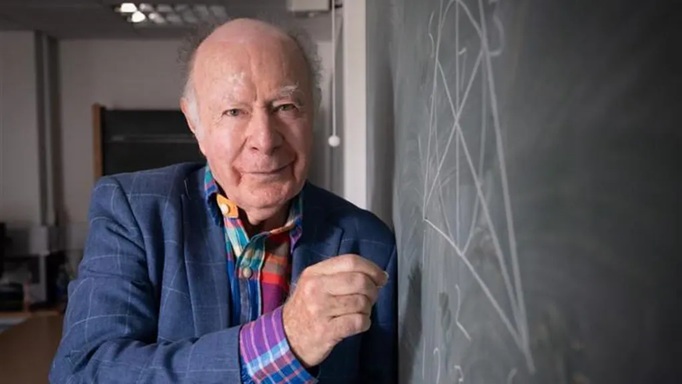
I’m indebted to my erstwhile colleague from Sussex days, Dorothy Lamb, for passing on the news that another former colleague from Sussex days, mathematician Professor James Hirschfeld, has finally retired at the age of 84. He formally retired some years ago, but remained in employment as a Tutorial Fellow. He was very popular with students and staff alike.

Prof. James Hirschfeld, picture credit: University of Sussex

James started as a lecturer at Sussex University in 1966, soon after the opening of the University, and remained working there for almost 60 years. I remember him well from both my stints here: from 1985-990 when I was a research student and then postdoc in the Astronomy Centre, and then from 2013 to 2016 when I was Head of the School of Mathematical and Physical Sciences, of which the Department of Mathematics was a part. He was an excellent colleague who knew the workings of the University inside out and provided valuable advice on many occasions.

James’s retirement was marked by an event at Sussex University. I’m sure I speak for many present and past colleagues and students in wishing him a long and happy retirement.

The Cuts in UK Higher Education

Posted in Biographical, Cardiff, Education, Maynooth, Politics with tags , , , , on November 28, 2024 by telescoper

Today friend of mine send me a message pointing out that in order to save money the University of Sussex is planning to make about 300 staff redundant; you can see an article about it in the Times Higher here. For the time being it seems the plan to make these savings via a voluntary severance scheme. I don’t know whether academic and administrative staff will be treated equally, either.

This is grim news. I worked at Sussex from 2013 until 2016 when I resigned my post as Head of School of Mathematical and Physical Sciences. I took that decision largely for personal reasons but there were professional reasons too. From 2013 the University had embarked on an ambitious growth plan based on buoyant student numbers and the fee income generated thereby. Staff numbers grew too, to cope with the increased demand for teaching. Unfortunately the management was unable to match this with real improvements in infrastructure, largely due to the disastrous outsourcing of campus estates and services. Many promises made to me as Head of School by Senior Management were broken. I wasn’t the only Head of School to compain of this, either. Although things were still going relatively well when I left in 2016, and I was optimistic for the future of the School then, there were severe risks to its financial stability if student recruitment dived. Sadly, that’s exactly what happened. Falling student numbers – especially from overseas – left the institution very vulnerable, especially since the fee per student did not change. That problem was exacerbated by a burst of inflation. AlthoughIt has clearly been a very difficult time for the University of Sussex, largely due to national and international forces beyond its control, but exacerbated by ineffective, and at times incompetent, institutional management. It should be said also that many University leaders enthusiastically embraced the fees-based system that has led their institutions where they are now, though most of them have now departed and left others to carry the can.

It worries me that Maynooth University is also trying to grow very quickly, without adequate investment in infrastructure especially teaching. It isn’t increasing the number of academic staff much either, preferring to hire more and more managers; yet another such position was advertised this week. I don’t know whether Maynooth’s financial trajectory will follow that of Sussex. The funding environment is very different in Ireland compared to the UK, so it may not. It is clear that the enviroment for education and research here is being steadily degraded by the current leadership.

Anyway, when I saw the announcement about Sussex, I checked other Universities I’ve worked in over the years. There’s a list here. It seems that while there are particular factors at play at Sussex, there are similar difficulties across the Board. Cardiff University has a deficit of £35 million and the VC has refused to rule out compulsory redundancies there. I’m not sure how this is all affecting the School of Physics & Astronomy. Nottingham University, where I worked from 1999 to 2007, has deficit of £30 million, in response to which it has opened a voluntary severance scheme, introduced hiring freezes, cut non-pay budgets, and refused to renew 500 fixed-term contracts.

There certainly are cold winds blowing across the University landscape in the United Kingdom, and there is no sign of any respite. This is just the start.

The Cyclic Universe of the UK Astronomy Grant System

Posted in Biographical, Science Politics, The Universe and Stuff with tags , , , on April 17, 2023 by telescoper

I stumbled by accident yesterday on a bit of news relating to UK Astronomy Grant funding via the Science and Technology Facilities Council (STFC). I am of course completely out of that system, and have been for years, but I am nevertheless quite nosy so was interested to find out about the changes. Thanks to Alan Heavens and Paul Crowther for enlightening me.

Way back in 2010 I wrote in somewhat critical terms about the new-style Consolidated Grants that STFC was planning to introduce. This system replaced a dual approach of so-called “Standard Grants” – which were typically rather small, usually funding one postdoctoral researcher and bits and bobs – and “Rolling Grants” – which were usually larger, covering all the activities of a department or institution – with a single system of “Consolidated Grants”. The Standard Grants were “responsive”, in that investigators could put in an application whenever they wanted, whereas Rolling Grants were on a fixed timetable. After the change, the responsive mode went out the window and Departments were forced to apply collectively, once every three years.

Much of the reason for the change was the administrative cost of the system. There were huge numbers of standard grant applications. Back in the mists of time there were two application deadlines per year so it was a heavy burden on the panels and the Swindon office, especially since so little funding was available in the first place. Standard grants were also the first to get squeezed when there was a funding shortfall, whereas Rolling grants generally carried on rolling.

Well, the news is that the current Astronomy grant round, with applications in 2022 and grants starting in 2023, will see the last of these Consolidated Grants. From this year on, there will be a new system of – wait for it – “Small” and “Large” grants, thought these are officially called Type 1 and Type 2. The Small Awards scheme is described here and it looks very much like the old Standard Grant system. Details of the Large grants scheme are not yet available, but I believe they will start next year. You can find more details here (PDF).

So now it seems something very like the old system is returning, and there are no doubt the same worries that Large grants will eat up most of the money, leaving very little for the Small grants. Déjà vu.

Anyway, the way I came across this piece of news was via the announcement of a clutch of PDRA positions in cosmology and extragalactic astrophysics at the University of Sussex (where I worked from 2013-16). It seems the Astronomy Centre must have done pretty well in the (final) STFC Consolidated Grant round, which is very good to hear! It seems there might be a bit more money generally in the grant line this year too, which is also good news.

REF 2021 Results and Ranking

Posted in Biographical, Cardiff with tags , , , on May 12, 2022 by telescoper

The results of the UK’s Research Excellence Framework (REF) 2021 have now been published. You can find them all here at the REF’s own website because they are presented there in a much more informative way than the half-baked “rankings” favoured by, e.g., The Times Higher.

To give some background: the overall REF score for a Unit of Assessment (UoA; usually a Department or School) is obtained by adding three different components: outputs (quality of research papers); impact (referring to the impact beyond academia); and environment (which measures such things as grant income, numbers of PhD students and general infrastructure). Scores are assigned to these categories, e.g. for submitted outputs on a scale of 4* (world-leading), 3* (internationally excellent), 2* (internationally recognized), 1* (nationally recognized) and unclassified. Similar star ratings are applied to the impact and environment. These are weighted at 60%, 25% and 15% respectively in the current incarnation of REF.

You can find further discussion of the REF submission rules, especially concerning changes with respect to 2014, here.

The way the star ratings are often reported is via a Grade Point Average reflecting the percentage of in each band. A hypothetical UoA that scored 100% in the top category would have a GPA of 4.0, for example. One that had 50% 4* and 50* 3* would be 3.5, and so on.

In the 2014 REF institutions were allowed to be selective in the number of staff submitted so the GPA wasn’t really a very appropriate measure: some institutions chose to submit only their very best research in order to get a high GPA. The funding allocated as a result of REF turned out to be highly weighted towards 4* so this was a sensible strategy for them, but it made the simple GPA-based rankings even more meaningless than usual. That didn’t stop e.g. The Times Higher making such rankings though.

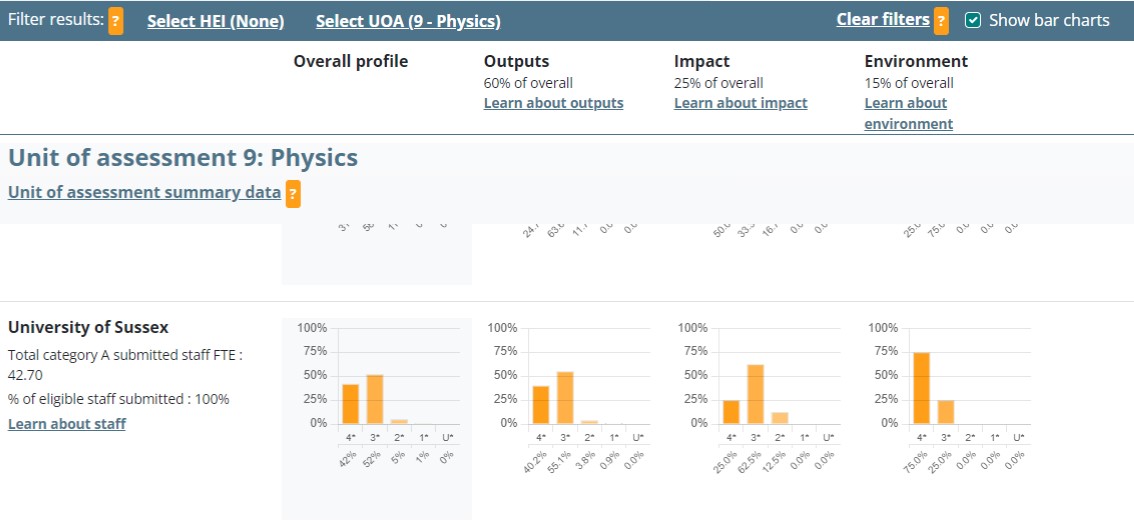
This time the rules on selection are stricter so the GPA is arguably more relevant, though many institutions have achieved selectivity anyway by moving certain staff onto teaching-only contracts. Staff on such contracts do not have to be submitted. I note that the main REF website does not use the GPA at all but instead gives profiles like this:

I show the example of Sussex because of my bad memories of the last REF (the 2014 exercise). I had moved to Sussex in 2013 at which point preparations were not well advanced and although everyone concerned worked very hard to put together the best submission for Physics & Astronomy we had to face the problem that our staff numbers had grown significantly in 2013 response to an increase in student numbers. While new staff could bring publications with them they couldn’t bring impact or environment, and while the outputs scored well the latter two categories didn’t so the Department of Physics & Astronomy did poorly in the ensuing rankings.

It must be said however that the primary purpose of the REF (allegedly) is to allocate blocks of funding- the so-called QR funding – to support research in the UoA concerned and while the GPA at Sussex was disappointing the fact that the money depends on the number of staff submitted meant that we got a substantial increase in QR dosh. Note further that the formula for allocation of funds to 4*, 3*, etc is not even specified in advance of the exercise: it is likely to be highly concentrated on research graded 4* and that the funding formula will probably different in England, Wales, Scotland and Northern Ireland. A ranking in terms of money earned is likely to look rather different from one based on GPA.

Another, even more fundamental, problem with the GPA is that the scores are so close together that the differences are of doubtful significance. In the Physics UoA, for example, the gap between top GPA (Sheffield) and 5th place (Bristol) is just 0.05 (3.65 versus 3.60) respectively. I see also that Cardiff is ranked equal 18th (with Imperial College) on a GPA of 3.45.

I say these things just to illustrate how much more subtle the criteria for success are compared to a simple GPA. It’s even hard to tell on an objective basis who to congratulate and who to commiserate.

Anyway, back to Sussex I see that Physics & Astronomy has done far better on environment and impact than last time round and the outputs (95% of which are either 4* or 3*) are comparable to last time (96%) so by those measures they have done well although this might not be reflected in a GPA-based ranking. Sussex is 26th in the rankings with a GPA of 3.35, if you’re interested, which is better than last time, though they will probably be disappointed at the presence of 2* elements in their profile.

Indeed, looking through the Physics list I can’t see any UoA that has a lower GPA this time than last time. The pot of money to be allocated for QR funding is fixed so if every UoA does better that doesn’t mean every UoA gets more money; some institutions will no doubt find that their improved GPA is accompanied by a cut in QR funding.

I’ll end by re-iterating that, having moved to Ireland in 2017, I’m very glad to be out of the path of the bureaucratic juggernaut that is the REF. In its first incarnations (as the Research Assessment Exercise) it did fulfil a useful purpose and did, I believe, improve the quality of UK research. Since then, however, it has become an industry that is largely self-serving. I quote from an article in the Times Higher itself:

The allocation of QR funding could be done in a much simpler and fairer way but the REF is now such a huge edifice it will resist being replaced by something smaller. No doubt before long the staff who spent so much time preparing for REF 2021 will start work on the next exercise. And so it goes on.

The changes in ranking that now occur from exercise to exercise are generally small in magnitude and in number. In other words, huge effort and cost are being invested to discover less and less information.

P.S. For completeness I should say that I am glad we don’t have an equivalent of the REF here in Ireland, we don’t have an equivalent of the QR funding either. This latter is a serious problem for the sustainability of research in third-level institutions, and it is not addressed at all in the recent proposals for reform.
The REF goes on

Posted in Biographical, Cardiff, Maynooth with tags , , , , on March 27, 2021 by telescoper

A few communications with former colleagues from the United Kingdom last week reminded me that, despite the Covid-19 pandemic, the deadline for submissions to the 2021 Research Excellence Framework is next week. It seems very strange to me to push ahead with this despite the Coronavirus disruption, but it’s yet another sign that academics have to serve the bureaucrats rather than the other way round.

I know quite a few people at quite a few institutions that are completely exhausted by the workload required to deal with the enormous exercise in paperwork that is intended to assess the quality and impact of research at UK universities.

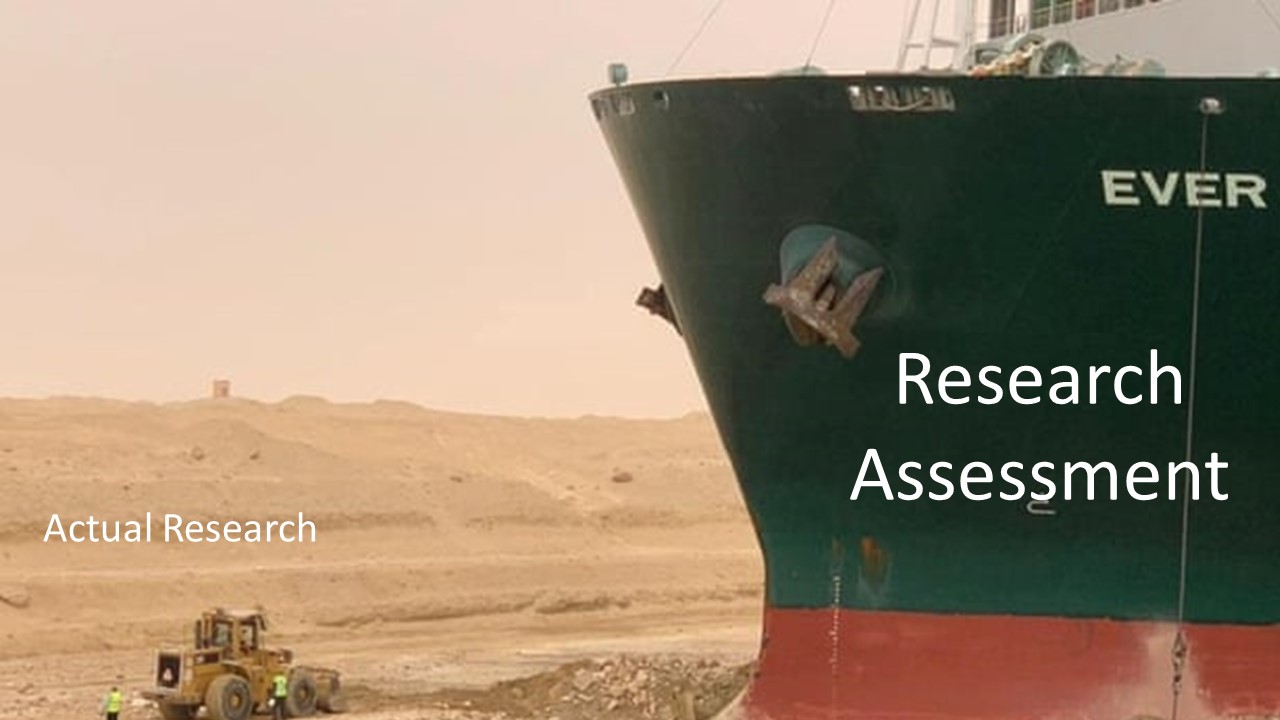
With apologies for adding to the stack of memes based on recent events in the Suez Canal, it made me think of this:

One of the major plusses of being in Ireland is that there is no REF, so I’m able to avoid the enormous workload and stress generated by this exercise in bean-counting. That’s good because there are more than enough things on my plate right now, and more are being added every day.

My memories of the last REF in 2014 when I was Head of School at Sussex are quite painful, as it went badly for us then. I hope that the long-term investments we made then will pay off, though, and I hope things turn out better for Sussex this time especially for the Department of Physics & Astronomy for which the impact and environment components of the assessment dragged the overall score down.

Not being involved personally in the REF this time round I haven’t really paid much attention to the changes that have been adopted since 2014. One I knew about is that the rules make it harder for institutions to leave staff out of their REF return. Some universities played the system in 2014 by being very selective about whom they put in. Only staff with papers considered likely to be rated top-notch were submitted.

Having a quick glance at the documents I see two other significant differences.

One is that in 2014, with very few exceptions, all staff had to submit four research outputs (i.e. papers) to be graded. in 2021 the system is more flexible: the total number of outputs must equal 2.5 times the summed FTE (full-time equivalent) of the unit’s submitted staff, with no individual submitting more than 5 and none fewer than 1 (except in special cases related to Covid-19). Overall, then there will be fewer outputs than before, the multiplier of FTE being 2.5 (2021) instead of 4 (2014). There will still be a lot of papers, of course, not least because many Departments have grown since 2014, so the panels will have a great deal of reading to do. If that’s what they do with the papers. They’ll probably just look up citations…

The other difference relates to staff who have left an institution during the census period. In 2014 the institution to which a researcher moved got all the credit for the publications, while the institution they left got nothing. In 2021, institutions “may return the outputs of staff previously employed as eligible where the output was first made publicly available during the period of eligible employment, within the set number of outputs required.” I suppose this is to prevent the departure of a staff member causing too much damage to the institution they left and also to credit the institution where the work was done rather than specifically the individual who did it.

Thinking about the REF an amusing thought occurred to me about Research Assessment. My idea was to set up a sort of anti-REF (perhaps the Research Inferiority Framework) based not on the best outputs produced by an institutions researchers, but on the worst. The institutions producing the highest number of inferior papers could receive financial penalties and get relegated in the league tables for encouraging staff to write too many papers that nobody ever reads or are just plain wrong. My guess is that papers published in Nature might figure even more prominently in this…

Anyway, let me just take this opportunity to wish former colleagues at Cardiff and Sussex all the best for their REF submission on Wednesday 31st March. I hope it turns out well

Out of the REF

Posted in Biographical, Cardiff, Maynooth with tags , , , , on November 25, 2020 by telescoper

I was talking over Zoom with some former colleagues from the United Kingdom last week, and was surprised to learn that, despite the Covid-19 pandemic, the 2021 Research Excellence Framework is ploughing ahead next year, only slightly delayed. There’s no stopping bureaucratic juggernauts once they get going…

One of the major plusses of being in Ireland is that, outside the UK academic system, there is no REF. One can avoid the enormous workload and stress generated by this exercise in bean-counting My memories of the last REF in 2014 when I was Head of School at Sussex are quite painful, as it went badly for us then. I hope that the long-term investments we made then will pay off, though, and I hope things turn out better for Sussex this time especially for the Department of Physics & Astronomy for which the impact and environment components of the assessment dragged the overall score down.

The census period for the new REF is 1st August 2013 to 31st July 2020. Not being involved personally in the REF this time round I haven’t really paid much attention to the changes that have been adopted since 2014. One I knew about is that the rules make it harder for institutions to leave staff out of their REF return. Some universities played the system in 2014 by being very selective about whom they put in. Only staff with papers considered likely to be rated top-notch were submitted.

Having a quick glance at the documents I see two other significant differences.

One is that in 2014, with very few exceptions, all staff had to submit four research outputs (i.e. papers) to be graded. in 2021 the system is more flexible: the total number of outputs must equal 2.5 times the summed FTE (full-time equivalent) of the unit’s submitted staff, with no individual submitting more than 5 and none fewer than 1 (except in special cases related to Covid-19). Overall, then there will be fewer outputs than before, the multiplier of FTE being 2.5 (2021) instead of 4 (2014). There will still be a lot, of course, so the panels will have a great deal of reading to do. If that’s what they do with the papers. They’ll probably just look up citations…

The other difference relates to staff who have left an institution during the census period. In 2014 the institution to which a researcher moved got all the credit for the publications, while the institution they left got nothing. In 2021, institutions “may return the outputs of staff previously employed as eligible where the output was first made publicly available during the period of eligible employment, within the set number of outputs required.” I suppose this is to prevent the departure of a staff member causing too much damage to the institution they left.

I was wondering about this last point when chatting with friends the other day. I moved institutions twice during the relevant census period, from Sussex to Cardiff and then from Cardiff to Maynooth. In principle, therefore, both former employees could submit my outputs I published while I was there to the 2021 REF. I only published a dozen or so papers while I was at Sussex – the impact of being Head of School on my research productivity was considerable – and none of them are particularly highly cited so I don’t think that Sussex will want to submit any of them, but they could if they wanted to. They don’t have to ask my permission!

I doubt if Cardiff will be worried about my papers. Among other things they have a stack of gravitational wave papers that should all be 4*.

Anyway, thinking about the REF an amusing thought occurred to me about Research Assessment. My idea was to set up a sort of anti-REF (perhaps the Research Inferiority Framework) based not on the best outputs produced by an institutions researchers but on the worst. The institutions producing the highest number of inferior papers could receive financial penalties and get relegated in the league tables for encouraging staff to write too many papers that nobody ever reads or are just plain wrong. My guess is that papers published in Nature might figure even more prominently in this

Thirty Years as a Doctor!

Posted in Biographical, The Universe and Stuff with tags , , , , , on July 11, 2019 by telescoper

A chance discovery while rummaging around in my filing cabinet reminded me that today is the anniversary of a momentous event. What I found was this:

It’s the programme of the summer Graduation Ceremony in 1989 at which I formally received my DPhil (Doctor of Philosophy). As you will see that was precisely thirty years ago today!

I actually submitted my thesis the previous summer (either at the end of August or start of September 1988) but had to wait a few months for the examination, which I think was in December.  By the time I had done my corrections (mainly typographical errors) the next available date for the degree to be formally conferred was in July 1989 so that’s when I officially got doctored. I was actually still in Brighton at the time, as had started work as a postdoctoral researcher soon after I had submitted my thesis.

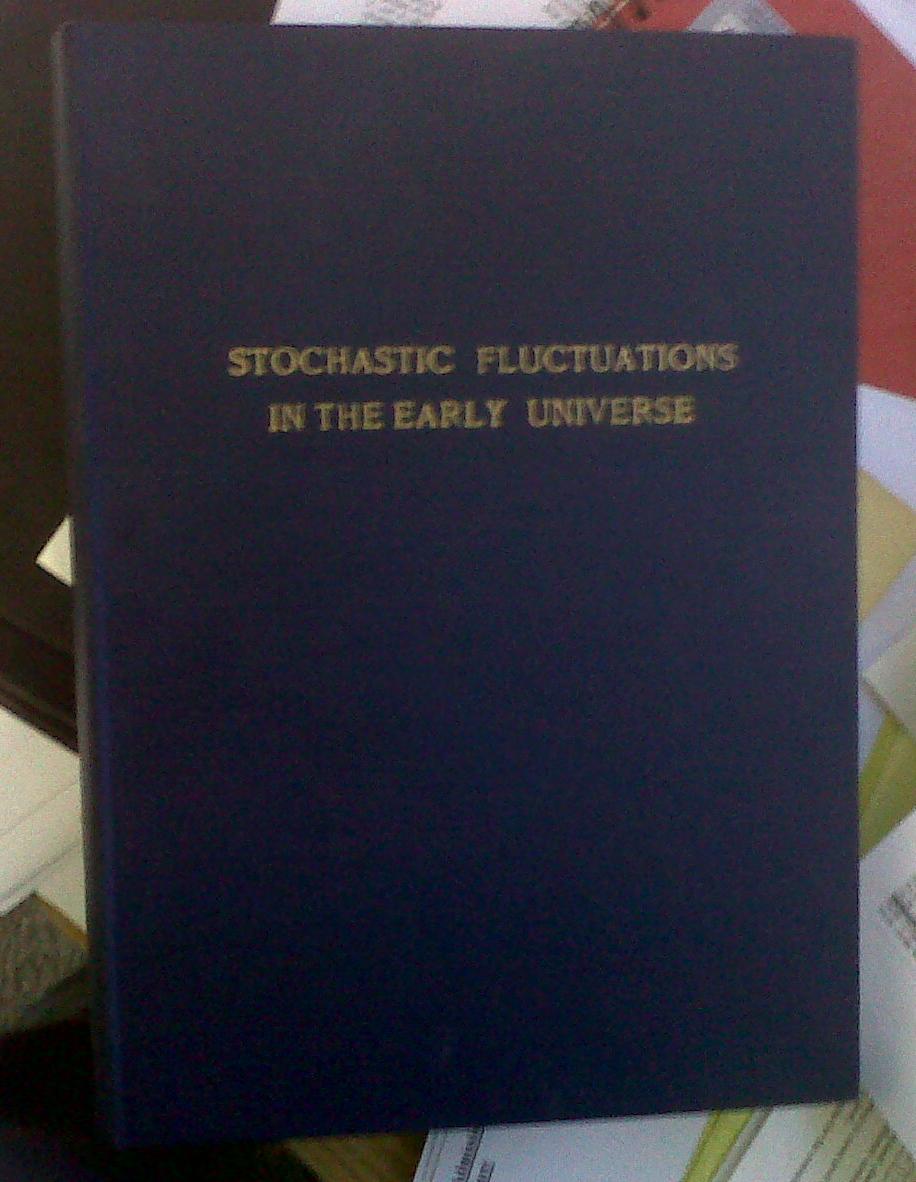
Here’s my thesis:

In those days they actually printed the thesis title in the programme, alongside the graduand’s name in the case of DPhil degrees.

It’s normal practice for people to assume the title of Doctor as soon as they have passed the viva voce examination but although I’ve never objected to that,  I’ve always been a bit unsure of the legality. Probably one doesn’t actually have a doctorate until it is conferred (either at a ceremony or in absentia).

Anyway, here is a picture of me (aged 26!)  emerging from the Brighton Centre wearing the old-style Sussex doctoral gown just after I received my DPhil:

Graduation

Unfortunately the University of Sussex decided a while ago to change the style of its academic dress recently to something a bit more conventional and as far as I know it’s not possible to obtain the old-style gowns any more. They also changed the title DPhil to PhD because it confused potential students, especially those not from the UK.

My first degree came from Cambridge so I had to participate in an even more archaic ceremony for that institution. The whole thing is done in Latin there (or was when I graduated) and involves each graduand holding a finger held out by their College’s Praelector and then kneeling down in front of the presiding dignitary, who is either the Vice-Chancellor ot the Chancellor. I can’t remember which. It’s also worth mentioning that although I did Natural Sciences (specialising in Theoretical Physics), the degree I got was Bachelor of Arts. Other than that, and the fact that the graduands had to walk to the Senate House from their College through the streets of Cambridge,  I don’t remember much about the actual ceremony.

I was very nervous for that first graduation. The reason was that my parents had divorced some years before and my Mum had re-married. My Dad wouldn’t speak to her or her second husband. Immediately after the ceremony there was a garden party at my college, Magdalene, at which the two parts of my family occupied positions at opposite corners of the lawn and I scuttled between them trying to keep everyone happy. It was like that for the rest of the day and I have to say it was very stressful. A few years later I got my doctorate from the University of Sussex, at the Brighton Centre on the seafront. It was pretty much the same deal again with the warring family factions, but I enjoyed the whole day a lot more that time. And I got to wear the funny gown.

The Signs of Age

Posted in Biographical, The Universe and Stuff with tags , , , , on October 23, 2018 by telescoper

I was feeling very tired yesterday evening and in my vegetative state I suddenly realised that last month I missed a significant personal anniversary. In September 1988, now over thirty years ago I submitted my DPhil thesis at the University of Sussex. Here it is..

It was to be another couple of months until I had my viva (an experience I’d definitely rather forget) so I didn’t get to receive the postgraduate degree formally until the following summer, but at least I finished and submitted within the three years my funding allowed. Incidentally, mine was one of the first generation of theses at the University of Sussex to be typeset in LaTeX. At least I avoided the hassle of having carbon copies made!

The field of cosmology has changed so much in the three intervening decades that I’m sure current graduate students would find my thesis as incredibly simple-minded as I do. There weren’t any measurements of CMB temperature patterns in those days (the COBE results were not announced not until 1992) so I had to generate simulated observations, for example. Still, a few of the things in my thesis have stood the test of time, in the form of papers that still get cited to this day. I was lucky that my research  was in an area that was about to take off, rather than one that was already in decline, and that there will still problems around that were easy enough for me to tackle!

The way of working was very different too: the fact that my generation didn’t have computers on our desks makes younger graduate students wonder how we managed to do anything at all! I still amuse my colleagues with my habit of writing out bits of code in longhand on paper  and `desk-checking’ them before typing them in.

The fact that I now have over 30 years’ postdoctoral experience definitely adds to the feeling of getting very old, along with the all-pervading fatigue, the random aches and pains that afflict me from time to time, failing eyesight, and the tendency of Facebook to send me advertisements about stairlifts, hearing aids, and (worst of all) golf equipment.

The start of University term in late September brings with it a new intake of students that always looks even  younger than the last. That produces a strange alternation of feelings. On the one hand, working in a University means that you’re always surrounded by bright young students which is a good thing when you’re getting on a bit in that it reminds you that you were once like that. On the other, the proliferation of young persons around does force you to face up to how old you actually are.

I remember some years ago I was teaching a module on astrophysics as part of which I did a lecture on supernovae. In the middle of that I said to my class: “of course, you will all remember SN 1987A” (which was detected while I was a PhD student). Blank faces. I then realized that none of them had even been born in 1987. Nowadays it is the case that I was already a Professor when all my undergraduate students were born.

But these signs of age are as nothing compared to the shock I underwent when a few months ago I discovered that I’m older than Nigel Farage.

A Rambling Post

Posted in Biographical, Maynooth with tags , , , , on March 15, 2018 by telescoper

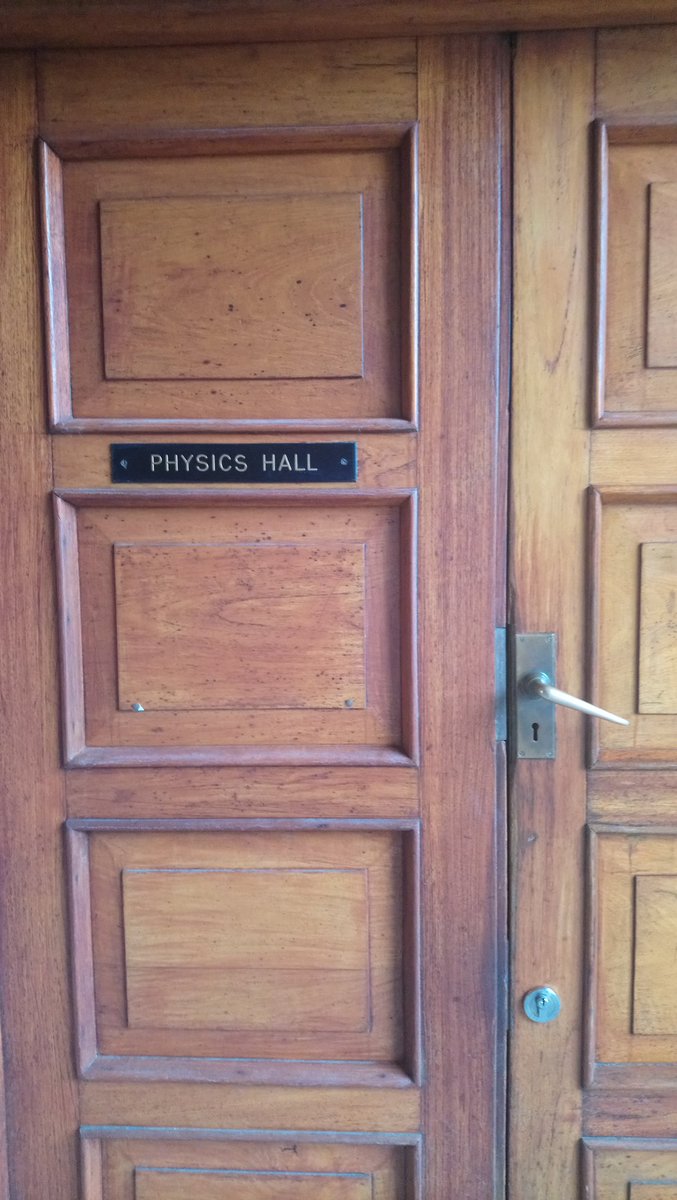
Thursdays are busy days for me, starting with a 9am lecture on Computational Physics in Physics Hall, followed in the afternoon by a two-hour laboratory session on the same subject. Today we did exercises on root-finding and numerical integration, but didn’t get through as many examples as I had hoped. In between I had a number of jobs to do, including a lunchtime meeting off campus with my landlord to pay the rent (which he collects in person). I was a bit late back for the lab and, after apologizing, complained that I was too old for all this running around. One of the students kindly said that `age is only a number’. I replied `I know, but unfortunately in my case it’s a rather large one..’

I now have a bit of a break from teaching in Maynooth. There is no teaching next week as it is `Study Week’ and Monday 19th March is a public holiday (for St Patrick’s Day, 17th March, which this year falls on a Saturday). Study week is followed by a week’s holiday because of Easter. Teaching resumes here on Tuesday April 3rd. Somewhat surprisingly the Easter break here is shorter than in the UK.

The four-week batch of strikes in UK universities over pensions in which I have been participating ends tomorrow, which means that I will be lecturing in Cardiff again next Tuesday (20th March). This lecture will be Lecture 8 of 11, with lectures 5, 6 and 7 missing in action (industrial action, to be precise). Cardiff students are then on vacation for three weeks for the Easter break, with lectures resuming on 16th April. All of this means that for the next three weeks I won’t have to do the mid-week trip from Cardiff to Maynooth (which I am beginning to find rather tedious). I plan to stay all next week in Wales and return to Ireland the following week, as I have been invited to give a seminar then at the Dublin Institute for Advanced Studies (which I have never visited before).

Anyway, all that rambling just serves to illustrate that it’s a complicated business being in a superposition of jobs. I’m looking forward to the summer, when my wavefunction will collapse onto Ireland (if I haven’t collapsed from exhaustion before that).

To end on a very sad note, I heard today that Emeritus Professor David Bailin passed away yesterday. I knew David from both times I was at Sussex (as a graduate student and postdoc in the 1980s, and as Head of School of Mathematical and Physical  Sciences from 2013 to 2016). He was a very fine theoretical physicist and a very nice man who was held in a very high regard by all who worked with him. Condolences to his family, friends and colleagues.

The Future is Unpredictable

Posted in Biographical, Cardiff, Maynooth with tags , , on January 31, 2018 by telescoper

I decided to take the early morning flight from Cardiff to Dublin today as I have quite a few things to prepare before my first lecture at Maynooth, which is at 9am. I actually got up at 4am and took the 5.10am bus to the airport so that I would arrive in time to have a coffee and a bacon sandwich before the 6.55am flight. Everything went to plan apart from the inclement weather, which resulted in me getting soaked on the way to the bus stop. The plane struggled against a strong headwind, taking 70 minutes to get to Dublin instead of the usual 40, and there was quite a lot of turbulence en route but we arrived on time in Dublin in time for my bus to Maynooth. It was freezing cold this morning, and as I arrived in Maynooth it started snowing but has now stopped.

While waiting in the airport I checked Facebook, which reminded me that it was exactly five years ago today that I left Cardiff to take up the job of Head of Mathematical and Physical Sciences at the University of Sussex. One of my last acts was to sign the work of art I left on the whiteboard in my old office.

The initial term of my appointment at the University of Sussex was 5 years, which would have been finishing today had I stayed there. If somebody had told me then that within five years I would have left Sussex, returned to Cardiff temporarily, and be about to move permanently to Ireland it would have seemed most implausible. More importantly, way back then I had no plans to grow a beard!

It just goes to show that Niels Bohr was right when he stated that `Prediction is very difficult, especially about the future’….

..on the other hand, when I got back to Maynooth I found that my new Public Services Card had arrived, which seems to make a definite prediction of the date of my ultimate demise: