Archive for University of Sussex

Sussex University – the Place for Undergraduate Physics Research!

Posted in Education, The Universe and Stuff with tags , , , , , , , on February 27, 2014 by telescoper

One of the courses we offer in the School of Physics & Astronomy here at the University of Sussex is the integrated Masters in Physics with a Research Placement. Aimed at high-flying students with ambitions to become research physicists, this programme includes a paid research placement as a Junior Research Associate each summer vacation for the duration of the course; that means between Years 1 & 2, Years 2 & 3 and Years 3 & 4 . This course has proved extremely attractive to a large number of very talented students and it exemplifies the way the Department of Physics & Astronomy integrates world-class research with its teaching in a uniquely successful and imaginative way.

Here’s a little video made by the University that features Sophie Williamson, who is currently in her second year (and who also in the class to whom I’m currently teaching a module on Theoretical Physics:

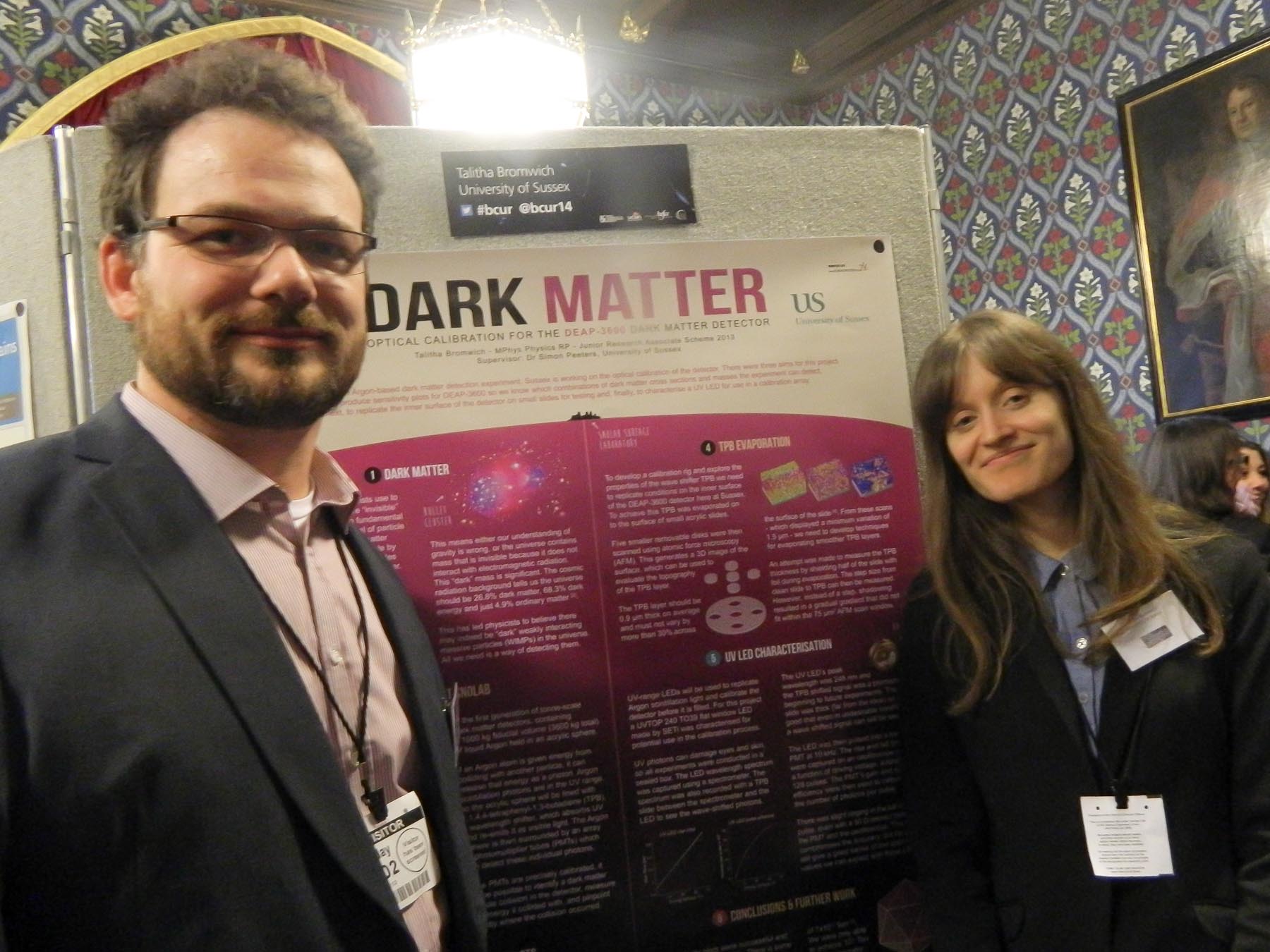
This week we had some very good news about another of our undergraduate researchers, Talitha Bromwich, who is now in the final year of her MPhys degree, and is pictured below with her supervisor Dr Simon Peeters:

Talitha Bromwich with her JRA supervisor Dr Simon Peeters at 'Posters in Parliament' event 25 Feb 14

Talitha spent last summer working on the DEAP3600 dark-matter detector after being selected for the University’s Junior Research Associate scheme. Her project won first prize at the University’s JRA poster exhibition last October, and she was then chosen to present her findings – alongside undergraduate researchers from 22 other universities – in Westminster yesterday as part of the annual Posters in Parliament exhibition, organized under the auspices of the British Conference of Undergraduate Research (BCUR).

A judging panel – consisting of Ben Wallace MP, Conservative MP for Wyre and Preston North; Sean Coughlan, Education Correspondent for the BBC; and Professor Julio Rivera, President of the US Council of Undergraduate Research; and Katherine Harrington of the Higher Education Academy – decided to award Talitha’s project First Prize in this extremely prestigious competition.

Congratulations to Talitha for her prizewinning project! I’m sure her outstanding success will inspire future generations of Sussex undergraduates too!

From Real Time to Imaginary Time

Posted in Brighton, Education, The Universe and Stuff with tags , , , , , , , , , , , on February 24, 2014 by telescoper

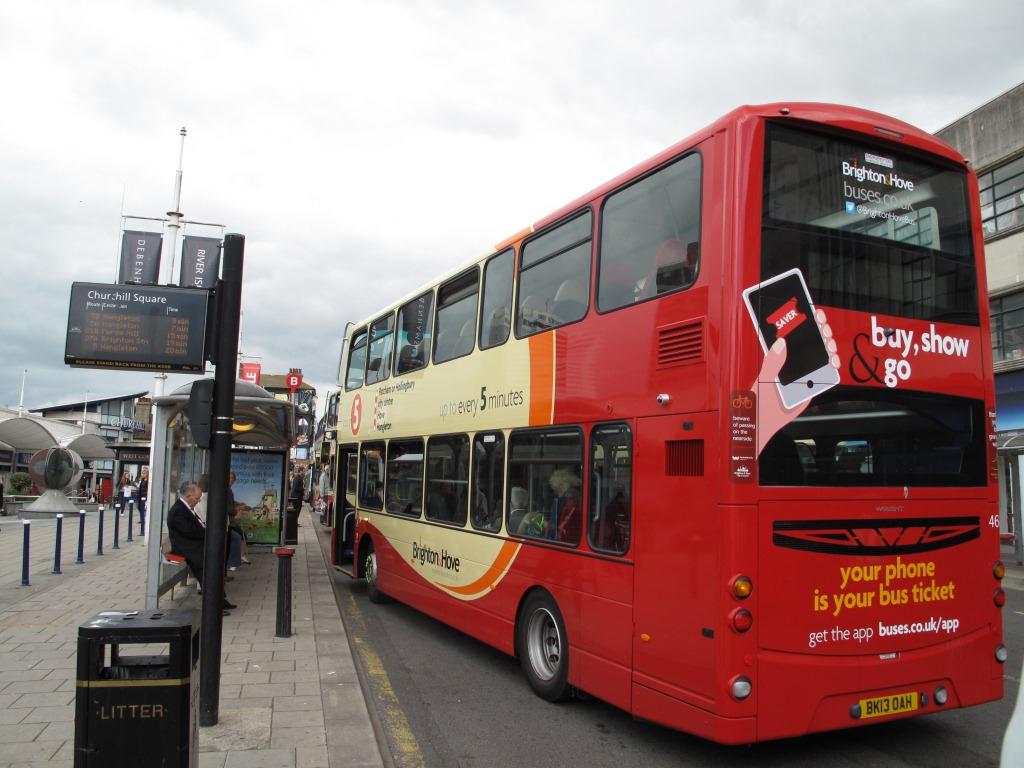
Yesterday, after yet another Sunday afternoon in my office on the University of Sussex campus, I once again encountered the baffling nature of the “real time boards” at the bus-stop at Falmer Station (just over the road from the University). These boards are meant to show the expected arrival times of buses; an example can be seen on the left of the picture below, taken at Churchill Square (in the City Centre).
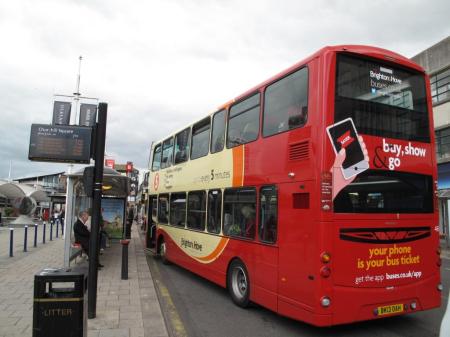
???????????????????????????????

The real-time board system works pretty well in central Brighton, but it’s a very different story at Falmer, especially for the Number 23 which is my preferred bus home. Yesterday provided a typical illustration of the problem: the time of the first bus on the list, a No. 23, was shown as “1 min” when I arrived at the stop. It then quickly moved to “due” (a word which I’ll comment about later). It then moved back to “2 mins” for about 5 minutes and then back to “due” again. It stayed like that for over 10 minutes at which point the bus that was second on the list (a No. 28 from Lewes) appeared. Rather than risk waiting any longer for the 23 I got on the 28 and had a slightly longer walk home from the stop at the other end. Just as well I did because the 23 vanished entirely from the screen as soon as I boarded the other bus. This apparent time-travel isn’t unusual at Falmer, although I’ve never really understood why.

By sheer coincidence when I got to the bus stop to catch a bus to campus this morning there was a chap from Brighton and Hove buses there. He was explaining what sometimes goes wrong with the real time boards to a lady, so I joined in the conversation and asked him if he knew why Falmer is so unreliable. He was happy to oblige. It turns out that the way the real-time boards work depends on each bus having a GPS system that communicates to a central computer via a radio link. If the radio link drops out for some reason – as it apparently does quite often up at Falmer (mobile phone connectivity is poor here also) – the system looks up the expected time of the bus after the one that it has lost contact with. Thus it is that a bus can apparently be “due” and then apparently go back in time. Also, if a bus has to divert from the route programmed into the GPS tracker then it is also removed from the real-time boards.

However, there is another system in operation alongside the GPS tracker. When a bus actually stops at a stop and opens its doors the onboard computer communicates this to the central system at the same time as the location signs inside the bus are updated. At this point the real-time boards are reset.

The unreliability I’ve observed at Falmer is in fact caused by two problems: (i) the patchy radio coverage as the bus wanders around the hilly environs of Falmer campus; and (ii) the No. 23 is on a new route around the back of campus which means that it vanishes from the system entirely when it wanders off the old route, as would happen if the bus were to break down.

Mystery solved then, in a sense, but it means there’s a systematic problem that isn’t going to be fixed in the short-term. Would it be better to switch off the boards than have them show inaccurate information? Perhaps, but only if it were always wrong. In fact the boards seem to work OK for the more frequent bus, the No. 25. My strategy is therefore never to rely on the information provided concerning the No. 23 and just get the first bus that comes. It’s not a problem anyway during the week because there’s a bus every few minutes, but on a Sunday evening it is quite irksome to see apparently random times on the screens.

All this talk about real-time boards reminds me of a question I was asked in a lecture last week. I was starting a new section of my Theoretical Physics module for 2nd Year students on Complex Analysis: the Cauchy-Riemann equations, Conformal Transformations, Contour Integrals and all that Jazz. To start the section I went on a bit of a ramble about the ubiquity of complex numbers in physics and whether this means that imaginary numbers are, in some sense, real. You can find an enjoyable polemic on this subject, given the answer “no” to the question here.

Anyway, I got the class to suggest examples of the use of complex numbers in physics. The things you’d expect came up such as circuit theory, wave propagation etc. Then somebody mentioned that somewhere they had heard of imaginary time. The context had probably been provided Stephen Hawking who mentioned this in his book A Brief History of Time. In fact the trick of introducing imaginary time is called a Wick Rotation and the basic idea is simple. In special relativity we deal with four-dimensional space-time intervals of the form

ds^2 = -c^2dt^2 + dx^2 + dy^2 +dz^2,

i.e. the metric describing Minkowski space. The minus sign in front of the time bit is essential to the causal structure of space-time but it causes quite a few mathematical difficulties. However if we make the substitution

\tau \rightarrow i c t

then the metric becomes

ds^2 = d\tau^2 + dx^2 + dy^2 +dz^2,

which corresponds to a four-dimensional Euclidean space which is in many situations much easier to handle mathematically.

Complex variables and complex functions provide the theoretical physicist with a host of extremely elegant techniques for solving tricky problems. But does that mean they are somehow “built in” to nature? I don’t think so. I don’t think the Brighton & Hove Bus company uses imaginary time on its display boards either, although it does sometimes seem that way.


POSTSCRIPT. I forgot to include my planned rant about the use of the word “due”. The boards displaying train times at railway stations usually give the destination and planned departure time of the train, e.g. “Brighton 11.15”. If things are running to schedule this information is supplemented by the phrase “On Time”. If not, which is sadly a more likely contingency in the UK, this changes to “due 11.37” or some such. This really annoys me.: the train is due at 11.15. If it doesn’t come until after then, it’s overdue or, in other words, late.
Graduation and Pronunciation

Posted in Biographical, Brighton, Education with tags , , on February 22, 2014 by telescoper

Here’s a chance to relive (if you were there) or experience for the first time (if you weren’t)  the hilarity of my attempts to pronounce the names of all the graduands from the School of Mathematical and Physical Sciences at the Winter Graduation Ceremony for the University of Sussex at the Dome, in Brighton, last month.  I blogged about this here and there are also some pictures here. My stint commences at about 1:35:30 and finishes about 1:48:00 so there’s not too much of me to put up with, and if you get bored with my voice there’s always the irrepressible Chancellor, Sanjeev Baskar, to keep you entertained…

The National Student Survey: Feedback and Response

Posted in Education with tags , , , on February 21, 2014 by telescoper

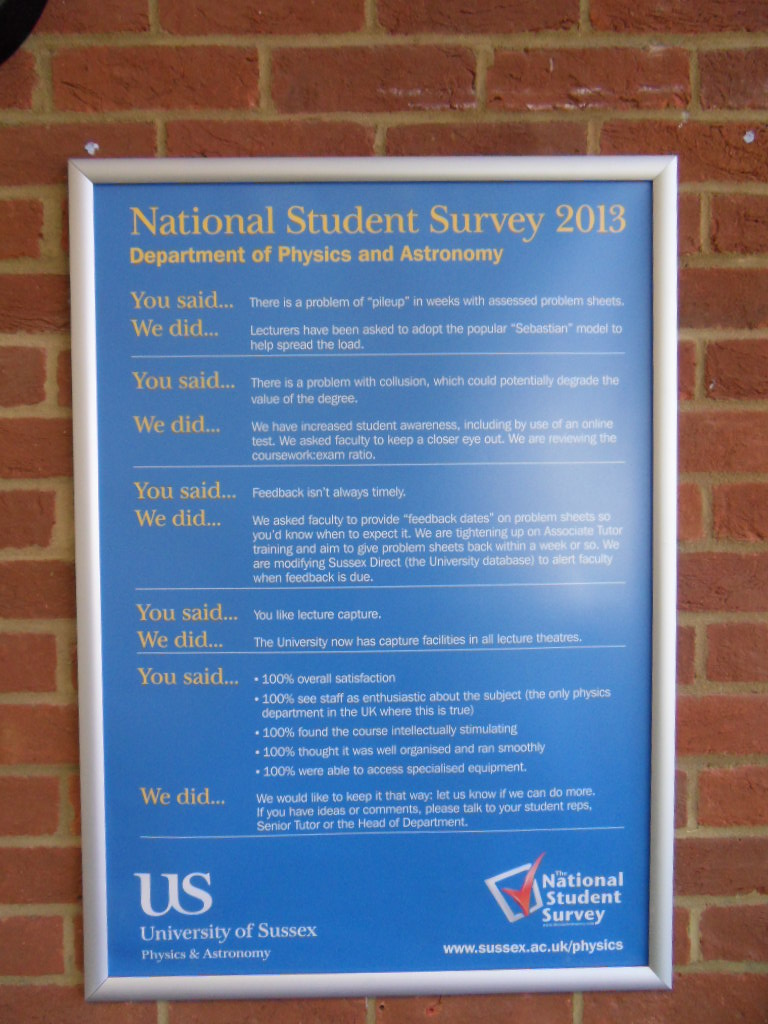
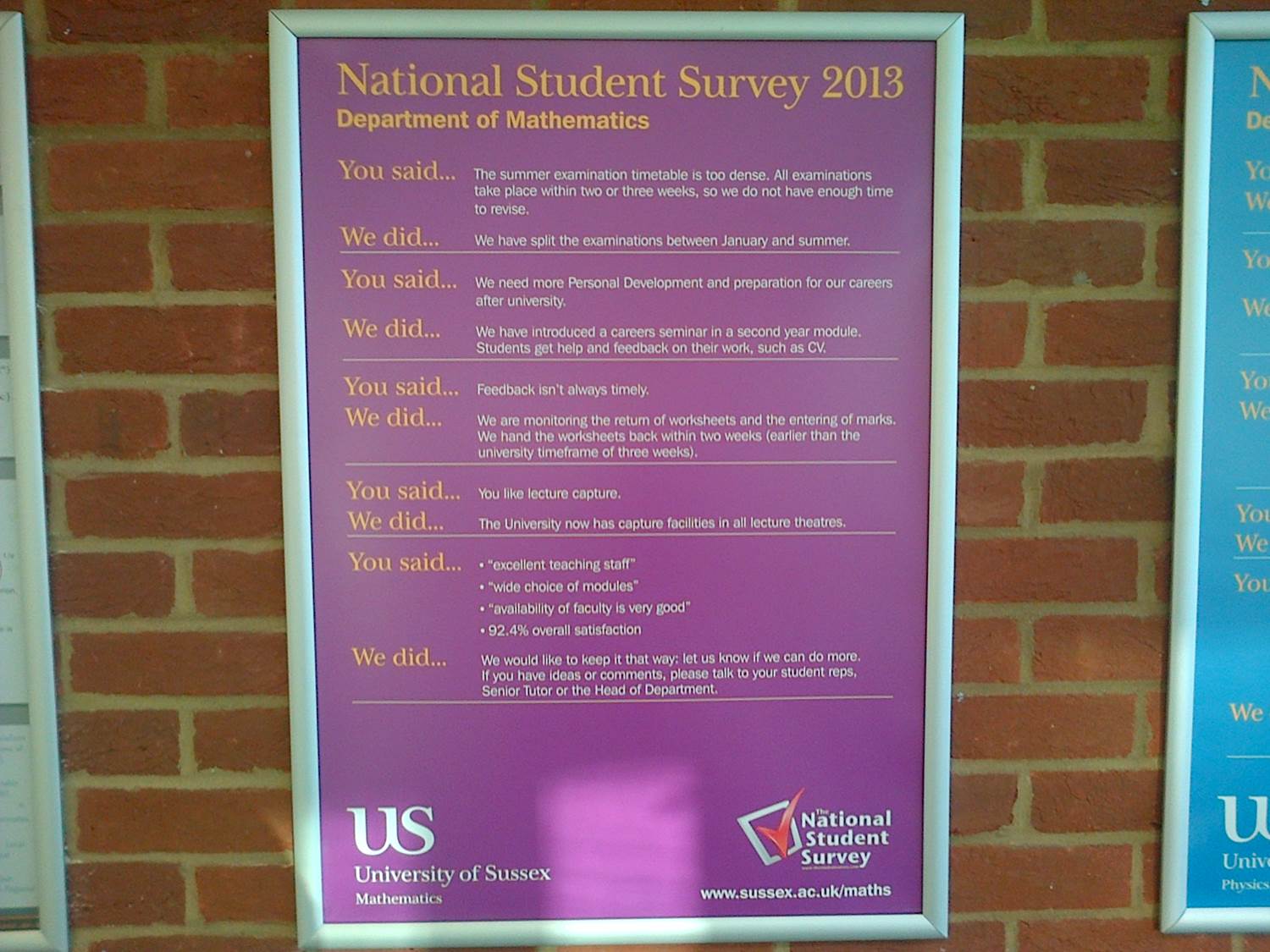
So the 2014 National Student Survey is under way. The NSS is much maligned, largely because it seems to be regarded by the powers that be solely for the purpose of constructing meaningless league tables. In reality I think the NSS survey is actually rather valuable because it allows us to gather systematic feedback on things that we do well and things we do not so well so we can look to improve our teaching for future generations of students. This isn’t just a PR exercise, at least not here in the School of Mathematical and Physical Sciences at the University of Sussex. We really do listen. Here are our responses to last year’s survey in the Department of Physics & Astronomy:

SAMSUNG DIGITAL CAMERA

and for the Department of Mathematics:

Picture1

I hope the fact that we have responded to the feedback we’ve got will encourage more students to participate in this year’s National Student Survey, regardless of what they have to say; that way we can try to improve still further.

Coming out as a scientist

Posted in Education, LGBTQ+, The Universe and Stuff with tags , on February 14, 2014 by telescoper

So here I am sitting in the library at Burlington House, the Royal Astronomical Society Council meeting I was attending having just finished slightly ahead of schedule.

I only have time for a brief post, so I’ll take the opportunity to direct your attention to an interesting piece in the Grauniad by Tom Welton. Tom is Professor of Sustainable Chemistry at Imperial College. He was also a contemporary of mine in old Sussex days. He was doing a PhD in Chemistry in MOLS while I was doing mine in Astrophysics in MAPS. Come to think of it we both did DPhils actually.

Anyway, Tom’s piece is related to something I blogged about a while ago (being a gay scientist) but he turns it the other way round and writes about how the difficulties of coming out as a scientist to your gay friends..

One Year in Sussex

Posted in Biographical, Brighton with tags , on February 1, 2014 by telescoper

Well, it’s the First of February which means it’s a year to the day since I started my current job as Head of the School of Mathematical Sciences at the University of Sussex, or MPS for short.

It’s been an eventful year, and not really like I expected. What I mean is that I knew it would be hard work, but the hardest bits were not the things I’d imagined. The first half of the year was primarily involved with appointing new staff to the School. All the interviews and other activities associated with that took up a huge amount of time but I think it all went well in the end. The number of full-time staff in MPS has increased by more than 50% over this time; from 15 to 23 in Mathematics (including 3 new Professors) and from 23 to 38 in Physics & Astronomy. The primary motivation for this is growth in student numbers: the number of undergraduates in Physics & Astronomy has doubled in the last three years or so, and this year we had our biggest ever intake of over 140 students.

All that wasn’t my doing, of course. The expansion of staff numbers was planned before I arrived, and the increase in student numbers is down to hard work by the admissions team.

I spent the latter part of last year involved with planning further expansion of our research activity as the contribution of MPS to the University’s Strategic Plan and am looking forward to turning that into reality over the next year or so.

I’ve tried to ensure that MPS is a friendly and open place for all staff and students, where everyone has a say and everyone feels valued. It’s not for me to say how well I’ve succeeded in that, but I’ll carry on trying.

I should mention some of the frustrations. One is that I became an academic in the first place because I enjoy both teaching and research. When I became Head of School here I found I had so many administrative duties that I had very little time for either of those activities. I got especially depressed about not being involved in teaching because I didn’t see how I could properly understand how things work in MPS without working at the coalface.

Against the advice of several colleagues I decided to teach a full module this year on Theoretical Physics to a class of about 50 students. It’s been a struggle to find the time to prepare everything, as I’m doing this for the first time, but I’ll persevere. Hopefully the students will bear with me while I get my act together. I’m very impressed with their engagement with the material so far, but then they have chosen the Theoretical Physics option so are obviously the intellectual elite of MPS; obviously, that’s my theorist’s bias speaking!

Oh, and in my spare time I grew a beard:

me

I suppose that will have to do. I’ll be heading up to campus shortly to spend Saturday afternoon in the office. A Head of School’s work is never done..

Breakfast with BIMM and Cake with MPS

Posted in Biographical, Education, Music with tags , on January 31, 2014 by telescoper

Another very busy day means I’ve almost reached the end of a very busy week. I spent this morning in a meeting with colleagues from the University of Sussex and representatives of the Brighton Institute for Modern Music (also known as BIMM), which focusses on courses intended to prepare students to work in some aspect of the popular music industry, including performing and songwriting as well as, e.g., management.

It’s one of the odd things about being a Head of School that you get invited to do strange things every now and again and this was one such occasion. The University of Sussex validates degree programmes for a number of education institutions, BIMM being one of them and it was my job to Chair a session this morning (at a location in central Brighton) that formed part of the validation process. We had some nice pastries for breakfast too.

Regular readers of this blog (both of them) will know that I’m not really up to date on popular beat combos so I wasn’t picked for this task for any music expertise; the idea was rather that being a complete ignoramus I could be an impartial Chair…

It was great to talk to have the chance to talk to some of the current BIMM students as well as the staff and one of the things that struck me was that although I work in a very different discipline, many of the educational challenges faced by the School of Mathematical and Physical Sciences and BIMM are very similar. I can’t talk about the details we discussed, but it was a very friendly meeting and there was lots of constructive discussion.

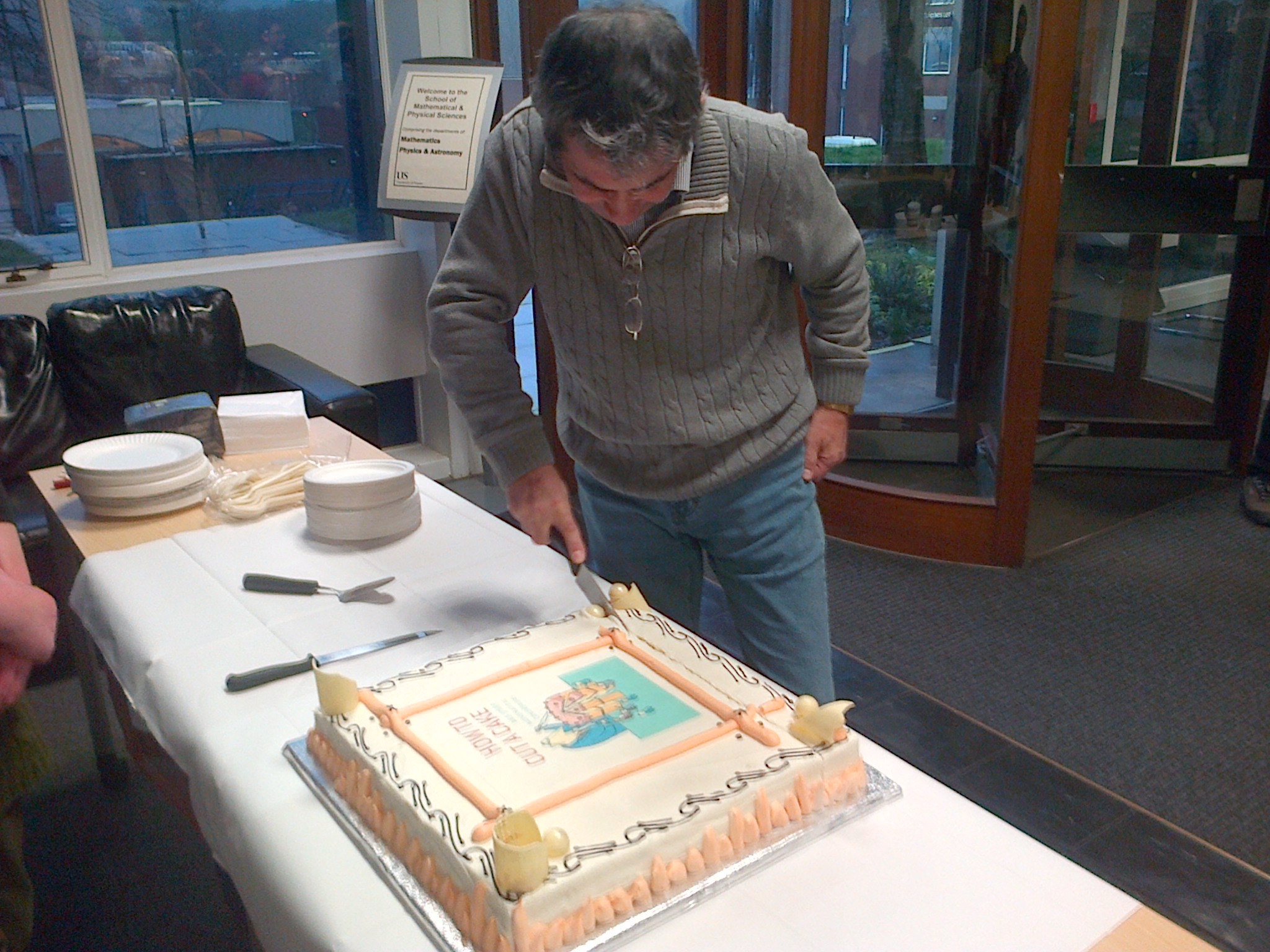
That business concluded it was back up to Falmer for a quick lunch and a meeting about undergraduate admissions. And finally, because it’s the last Friday of the month it was time this afternoon for our monthly MPS cake event. This month’s cake had a vaguely mathematical theme and also raised the issue of the correct plural of the word conundrum:

IMG-20140131-00273

I thought it was appropriate to invite the Head of the Department of Mathematics, Miro Chlebik, to solve this particular conundrum by cutting the cake:

IMG-20140131-00274

The cake vanished pretty quickly thereafter.

Rites of Passage

Posted in Brighton, Education with tags , , , on January 28, 2014 by telescoper

Just back home from the drinks reception that followed today’s Winter Graduation Ceremony at the University of Sussex at the Dome, in Brighton. And a very nice event it was too!

The Winter Graduation ceremony is primarily taken up with postgraduate degrees, and within School of Mathematical and Physical Sciences the largest proportion of those are in Mathematics, especially in the MSc courses in Financial Mathematics and Corporate and Financial Risk Management on which we have a large number of overseas students, e.g. From China. My first graduation ceremony as Head of School therefore presented me with some pronunciation challenges as I read out the names of the graduands. I was a bit nervous beforehand, not because I’m afraid of making a fool of myself but because these days everything is captured on video for posterity and I didn’t want to ruin anyone’s record of their Big Day. I practised quite a lot actually, and think it was OK.

I am always impressed at students who have the courage to travel halfway around the world to study in a foreign land. Graduation is a rite of passage for all students, but it must be of even greater significance for students from abroad.

I’ve attended graduation ceremonies at a number of other universities, and the big difference with Sussex is how much less formal it is. A great deal of credit for that must go to the Chancellor, the brilliantly funny and approachable Sanjeev Bhaskar, who ran the show in inimitable style. He also has a lovely head of hair.

Sanjeev always had a word with the graduands as they crossed the stage, often a hug, and very allowed them to take a selfie, once sitting in the Chancellor’s chair! I found it all very amusing, which helped me relax before my turn at the podium with the list of names. I’ve sat through a large number of dull and stuffy graduation ceremonies in my time, and much prefer the Sussex style!

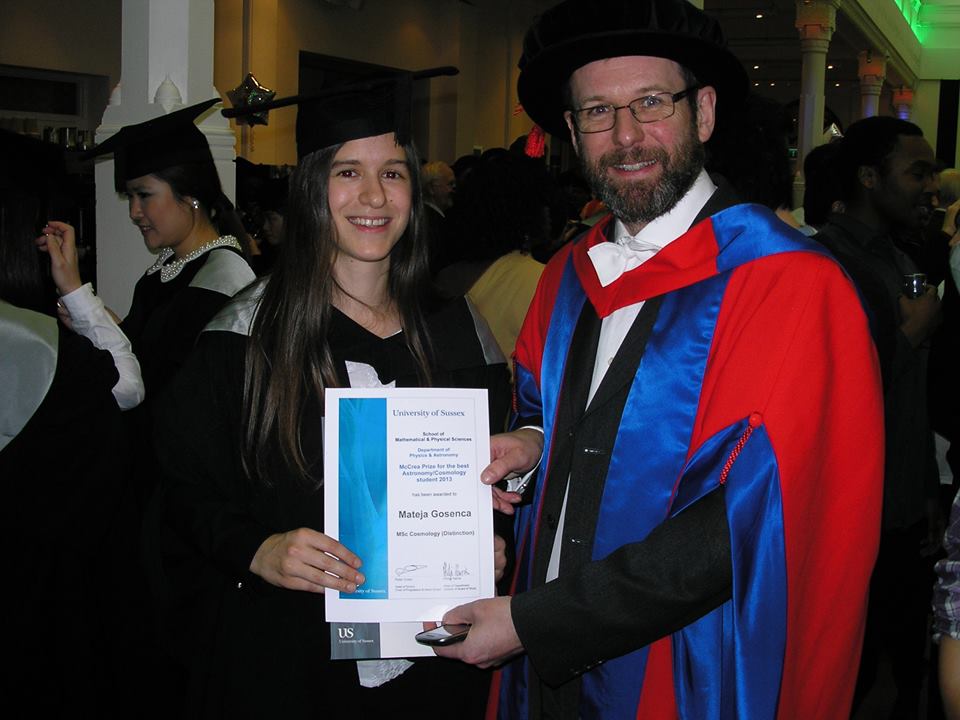
Also graduating with top marks in our MSc in Cosmology was Mateja Gosenca, who is now my PhD student. Here we are at the drinks party after the graduation ceremony; Mateja is looking very happy holding her certificate as winner of the Sir William McCrea Prize for the best student on the MSc programme!

That one was taken with my Blackberry; here’s a much nicer version taken with a proper camera:

Mateja_again

Qualification Matters

Posted in Biographical, Education with tags , , , on January 18, 2014 by telescoper

Yesterday evening I had a very enjoyable dinner with a seminar speaker and group of students from the Kobayashi-Maskawa Institute at Nagoya University. On the way back to the guest house I’m staying in, at about 9.30pm, we passed a group of young kids in uniform apparently returning from school. I was told that they were students from a Junior High School (chūgaku) who had been studying late in preparation for an entrance examination to the (selective) Senior High Schools (kōtōgakkō). I was a bit surprised to see young teenagers putting in such long hours, but such behaviour seems quite normal here in Japan.

One of the things I have to get to grips with when I get back to the School of Mathematical Sciences at the University of Sussex on Monday is the annual admissions cycle. I have meetings in my calendar for next week about this, and we are hosting an applicant visit day on Saturday 25th January; we have of course already made offers to a large number of students based on their predicted grades at GCE A-level. This process is fraught with difficulties, not least because there some schools seem to over-predict the grades that their pupils achieve in order to maximise the chance of them getting into University. Predicted grades being rather unreliable, it would of course be fairer on all concerned to use actual grades, i.e. to defer university applications until after the A-level results come out, but that would be far too sensible so obviously will not happen in the United Kingdom. I’m actually quite sceptical of the usefulness of A-levels for preparing students for University in general, but that’s another matter.

Anyway, the mini-rant above isn’t main point of this post, which is instead to issue a warning to those  students taking A-levels later this year. It is  based on anecdotal evidence, but quite a lot thereof. The point is that universities will often reduce their usual offer at A-level when they find an applicant with very high predicted grades, sometimes even making an unconditional offer (actually the minimum is two E grades) to high-fliers. This happened a lot in the old days when I was applying for a place at university. Though it is less common nowadays the government’s policy of lifting controls on universities’ ability to recruit students with three A-level grades at ABB or better is bound to increase the amount of game-playing as competition between recruiters intensifies.

This creates a number of issues, but the one I want to pick out arises when a student is predicted to get three As at A-level, but his/her first-choice university gives them an unconditional offer. Their first reaction will obviously be “whoopee! I’ll accept that offer and, what’s more, I don’t need to fret too much about my summer examinations..”.

In fact I’ve known plenty of students who came into university with quite modest A-level grades, but did brilliantly well at their studies and ended up with first-class degrees. There can be many explanations behind such cases quite apart from the relaxation effect. Some schools don’t have good specialist science teachers, for example; this can mean that a student’s interest is really only ignited once they get into university.

The problem is, though, that A-levels results are not just for university entry, they’re for life. A student may graduate with a good degree, even a First,  but so do many others. When selecting for postgraduate jobs, or even postgraduate study, recruiters often have a large number of people with excellent degrees; that’s an obvious consequence of the expansion of the Higher Education sector in recent years. What happens, therefore, is that employers and PG admissions tutors have to look at other factors; naturally, that includes A-level results but also even GCSEs. You might be surprised to learn that even if you get a first-class degree, your chances of getting a PhD place at a top institution depends on your performance at School but they definitely do. I’m not saying that this should, be the case, just that it in practice it is.

I recall hearing recently from one former student who had a first-class degree in Physics and a PhD from an excellent University, and who was applying for a job in a research institute (not in the university sector). The application form he received asked him to list not only his A-levels but also his GCSE results!

I hope I’ve made my point to any prospective students, but I’ll summarize it in case I haven’t. If you get a generous offer from your chosen university then that’s a good thing, because it means that they want you. You should be happy. But don’t ease off on your studies because if you end up getting poorer A-levels than you deserve, they may one day come back to haunt you.

A Summer of Undergraduate Physics Research

Posted in Biographical, Education, The Universe and Stuff with tags , , , , on January 14, 2014 by telescoper

I was compiling a bibliography for a new paper yesterday and noticed that a paper published in December 2013 cited one I wrote in 2005 with Andrew Stannard while I was working at the University of Nottingham; the rarity of anyone actually referring to any of my papers caught my attention. I include the abstract of the Stannard-Coles paper here for reference:

We investigate the properties of the (complex) coefficients obtained in a spherical harmonic representation of temperature maps of the cosmic microwave background (CMB). We study the effect of the coefficient phase only, as well as the combined effects of phase and amplitude. The method used to check for anomalies is to construct a `random walk’ trajectory in the complex plane where the step length and direction are given by the amplitude and phase (respectively) of the harmonic coefficient. If the fluctuations comprise a homogeneous and isotropic Gaussian random field on the sky, the path so obtained should be a classical `Rayleigh flight’ with very well known statistical properties. We illustrate the use of this random-walk representation by using the net walk length as a test statistic, and apply the method to the coefficients obtained from a Wilkinson Microwave Anisotropy Probe (WMAP) preliminary sky temperature map.

This seems like ancient history now, particularly with regard to the use of “preliminary” WMAP data, but it was only just over 8 years ago. I never imagined during the time that we were working on this paper that I’d be moving twice! By contrast, Andrew Stannard remained in Nottingham, doing a PhD there and is now employed as a Research Fellow, although he switched fields after the project and moved into nanoscience.

Anyway, I wasn’t posting this so I could take a trip down memory lane. I thought I’d post it in order to point out that this paper actually came about as an undergraduate research project that Andrew did under my supervision during the summer of 2005, funded by a Mary Cannell Summer Studentship. Mary Cannell was the author of a book about the life of George Green (the famous mathematician who came from Nottingham); she passed away in 2000 leaving some money to the School of Physics & Astronomy to fund summer research placements for undergraduates. If I recall correctly, we completed the analysis and wrote the paper during the summer of 2005, submitting it in August and having it accepted in September. If only it were always so straightforward! Since publication it has garnered 15 citations according to the ADS website; not exactly earth-shattering, but respectable enough, especially given the background. I think it may get a few more in the next few years because the quality of data from Planck may now be good enough to actually detect the features we were looking for all those years ago!

It’s worth mentioning that in the School of Physics and Astronomy at the University of Sussex we have a degree programme in which students receive a stipend to cover living expenses during a summer vacation placement with one of the research groups each and every year of their studies. This is in addition to the usual lectures and laboratory work of the standard  course. This involves many more students than was the case back in Nottingham in 2005, but since I’ve only been at the University of Sussex for  a year I don’t know how many such placements have led to actual publications.

Does anyone know of any really important papers out there that came from undergraduate research projects? If so, please let me know through the comments box..