Archive for University of Sussex

Higher Energy Physics at the LHC

Posted in The Universe and Stuff with tags , , , , on June 3, 2015 by telescoper

I’ve been busy with meetings most of the day but couldn’t resist a quick post to catch up on the exciting events at CERN. Today is the day that the Large Hadron Collider was due to start operating at its highest collision energies so far, 13 TeV. It was quite a nervous morning, and the first attempt to ramp up to this energy failed.

Here was the scene this morning in the control room of the ATLAS experiment.

Control Room

This kind of photograph always reminds me of the inside of a betting shop..

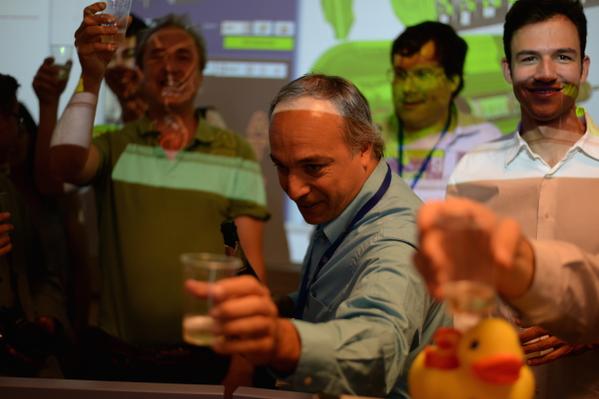
However, it didn’t take long to succeed, at which point much celebration ensued. This story has a strong local connection here in the Department of Physics & Astronomy at the University of Sussex. The run coordinator for the ATLAS experiment on the Large Hadron Collider is Dr Alessandro Cerri of Sussex  and he has figured prominently in today’s action. Here he is, having a glass of bubbly (purely medicinal, I’m assured) when they first achieved stable beams at the new collision scale:

Cerri

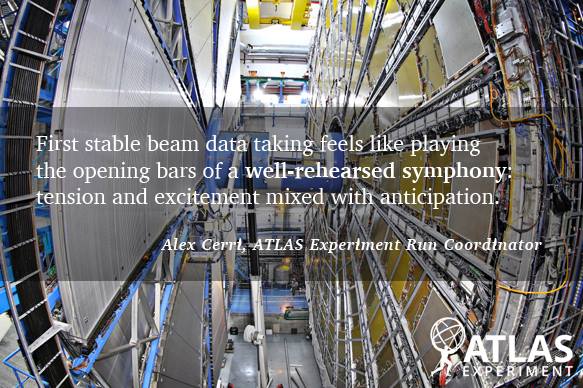
He also produced this nice quote which I took from the ATLAS Twitter feed.

LHC_Restart

It is hoped that operating at 13 TeV will allow the various detectors on the Large Hadron Collider to probe the possible existence of supersysmmetric particles which have so far defied detection. On the other hand if it doesn’t find them it will cause a lot of theorists to go back to the drawing board. Incidentally I’ve been going around asking particle physicists how much they’d be willing to bet on the LHC finding evidence of supersymmetry and I can’t get any of them to make a wager with me. Any one willing to rise to the challenge please do so via the Comments Box.

Of course we all know that the main reason for increasing the LHC’s energy is not to detect supersymmetric particles, or indeed any other evidence of physics beyond the standard model that had previous been accessible. It’s to generate papers with even longer author lists

Through My Vision

Posted in Education with tags , , , , on May 31, 2015 by telescoper

I just saw this video and thought I would post it here. It features Daniel Hajas, one of our second-year Theoretical Physics students in the Department of Physics and Astronomy at the University of Sussex. In this short documentary he talks about his life and the challenges he faces as a blind person studying physics. Some of it was filmed inside the School of Mathematical and Physical Sciences, so you might see some people you recognise…

League Table Positions

Posted in Education, Football with tags , , , , , , , on May 26, 2015 by telescoper

Among the things I didn’t have time to blog about over a very busy Bank Holiday Weekend was the finish of the English Premiership season. I haven’t posted much about my own team, Newcastle United, this season because I haven’t been able to think of anything particularly positive to say. Since Alan Pardew quit in January to join Crystal Palace, Newcastle slumped to such an alarming extent that they went into their last game of the season (against West Ham) just two points above the drop zone. Had they lost their game, which did not seem unlikely on the basis of their recent form, and had Hull won against Manchester United, which did not seem unlikely on the grounds that Man Utd wwould finish in 4th place whatever happened in that game, then Newcastle would be relegated to the Championship. In the event, however, Newcastle won 2-0 which made them safe while Hull could only draw 0-0 which meant that Newcastle would have survived even if they had lost against West Ham. Moreover, Sunderland also lost their last game, which meant that the final Premier League Table looked like this:

Premiership_League

(courtesy of the BBC Website). The important places are 15 and 16, obviously. The natural order of things has been restored….

Another League Table came out over the Bank Holiday. This was the annual Guardian University Guide. I’m deeply sceptical of the value of these league tables, but there’s no question that they’re very important to potential students so we have to take them seriously. This year was pretty good for Sussex as far as the Guardian Table is concerned: the University of Sussex rose to 19th place overall and the two departments of the School of Mathematical and Physical Sciences both improved: Physics & Astronomy is back in the top 10 (at number 9, up from 11th place last year) and Mathematics rose 22 places to take 21st place. Gratifyingly, both finished well above Sunderland.

While these results are good news in themselves, at least around my neck of the woods, as they will probably lead to increased applications to Sussex from students next year, it is important to look behind the simplistic narrative of “improvements”. Since last year there have been several substantial changes to the Guardian’s methodology. The weighting given to “spend-per-student” has been reduced from 15% to 10% of the overall score and the method of calculating “value added” has excluded specific predictions based on “non-tariff” students (i.e. those without UK entry qualifications, especially A-levels). What the Guardian consistently fails to do is explain the relative size of the effect of arbitrary methodological changes on its tables compared to actual changes in, e.g., cash spent per student.

Imagine the outrage there would be if football teams were not told until the end of a Premier League season how many points would be awarded for a win….

Examination Time Again

Posted in Biographical, Education with tags , , , , , on May 11, 2015 by telescoper

Once again it’s time for examinations at the University of Sussex, so here’s a lazy rehash of my previous offerings on the subject that I’ve posted around this time each year since I started blogging.

My feelings about examinations agree pretty much with those of  William Wordsworth, who studied at the same University as me, as expressed in this quotation from The Prelude:

Of College labours, of the Lecturer’s room
All studded round, as thick as chairs could stand,
With loyal students, faithful to their books,
Half-and-half idlers, hardy recusants,
And honest dunces–of important days,
Examinations, when the man was weighed
As in a balance! of excessive hopes,
Tremblings withal and commendable fears,
Small jealousies, and triumphs good or bad–
Let others that know more speak as they know.
Such glory was but little sought by me,
And little won.

It seems to me a great a pity that our system of education – both at School and University – places such a great emphasis on examination and assessment to the detriment of real learning. On previous occasions, before I moved to the University of Sussex, I’ve bemoaned the role that modularisation has played in this process, especially in my own discipline of physics.

Don’t get me wrong. I’m not opposed to modularisation in principle. I just think the way modules are used in many British universities fails to develop any understanding of the interconnection between different aspects of the subject. That’s an educational disaster because what is most exciting and compelling about physics is its essential unity. Splitting it into little boxes, taught on their own with no relationship to the other boxes, provides us with no scope to nurture the kind of lateral thinking that is key to the way physicists attempt to solve problems. The small size of many module makes the syllabus very “bitty” and fragmented. No sooner have you started to explore something at a proper level than the module is over. More advanced modules, following perhaps the following year, have to recap a large fraction of the earlier modules so there isn’t time to go as deep as one would like even over the whole curriculum.

In most UK universities (including Sussex), tudents take 120 “credits” in a year, split into two semesters. In many institutions, these are split into 10-credit modules with an examination at the end of each semester; there are two semesters per year. Laboratories, projects, and other continuously-assessed work do not involve a written examination, so the system means that a typical  student will have 5 written examination papers in January and another 5 in May. Each paper is usually of two hours’ duration.

Such an arrangement means a heavy ratio of assessment to education, one that has risen sharply over the last decades,  with the undeniable result that academic standards in physics have fallen across the sector. The system encourages students to think of modules as little bit-sized bits of education to be consumed and then forgotten. Instead of learning to rely on their brains to solve problems, students tend to approach learning by memorising chunks of their notes and regurgitating them in the exam. I find it very sad when students ask me what derivations they should memorize to prepare for examinations. A brain is so much more than a memory device. What we should be doing is giving students the confidence to think for themselves and use their intellect to its full potential rather than encouraging rote learning.

You can contrast this diet of examinations with the regime when I was an undergraduate. My entire degree result was based on six three-hour written examinations taken at the end of my final year, rather than something like 30 examinations taken over 3 years. Moreover, my finals were all in a three-day period. Morning and afternoon exams for three consecutive days is an ordeal I wouldn’t wish on anyone so I’m not saying the old days were better, but I do think we’ve gone far too far to the opposite extreme. The one good thing about the system I went through was that there was no possibility of passing examinations on memory alone. Since they were so close together there was no way of mugging up anything in between them. I only got through  by figuring things out in the exam room.

I think the system we have here at the University of Sussex is much better than I’ve experienced elsewhere. For a start the basic module size is 15 credits. This means that students are usually only doing four things in parallel, and they consequently have fewer examinations, especially since they also take laboratory classes and other modules which don’t have a set examination at the end. There’s also a sizeable continuously assessed component (30%) for most modules so it doesn’t all rest on one paper. Although in my view there’s still too much emphasis on assessment and too little on the joy of finding things out, it’s much less pronounced than elsewhere. Maybe that’s one of the reasons why the Department of Physics & Astronomy does so consistently well in the National Student Survey?

We also have modules called Skills in Physics which focus on developing the problem-solving skills I mentioned above; these are taught through a mixture of lectures and small-group tutorials. I don’t know what the students think of these sessions, but I always enjoy them because the problems set for each session are generally a bit wacky, some of them being very testing. In fact I’d say that I’m very impressed at the technical level of the modules in the Department of Physics & Astronomy generally. I’ve been teaching Green’s Functions, Conformal Transformations and the Calculus of Variations to second-year students this semester. Those topics weren’t on the syllabus at all in my previous institution!

Anyway, my Theoretical Physics paper is next week (on 18th May) so I’ll find out if the students managed to learn anything despite having such a lousy lecturer. Which reminds me, I must remember to post some worked examples online to help them with their revision.

End of Term Balls

Posted in Biographical, Education with tags , , , , on April 18, 2015 by telescoper

I haven’t had time to post for the last couple of days because I’ve been too bust with end-of-term business (and pleasure). Yesterday (Friday) was the last day of teaching term and this week I had to get a lot of things finished because of various deadlines, as well as attending numerous meetings. It’s been quite an exhausting week, not just because of that but also because by tradition the two departments within the School of Mathematical and Physical Sciences at the University of Sussex, the Department of Mathematics and the Department of Physics & Astronomy, hold their annual Staff-Student Balls on consecutive days. When I arrived here just over two years ago I decided that I should attend both or neither, as to attend at only one would look like favouritism. In fact this is the third time I’ve attended both of them. Let no-one say I don’t take my obligations seriously.  It’s a tough job, but someone has to do it. Holding both balls so close together  poses some problems for a person of my age, but I coped and also tried to weigh them up relative to each other and see  which was  most impressive.

Actually, both were really well organized. The Mathematics Ball was held in the elegant Hilton Metropole hotel and the Physics one in the Holiday Inn, both on the seafront. As has been the case in previous years the Mathematics ball is a bit more refined and sedate, the Physics one a little more raucous. Also this year there was a very large difference in the number of people going, with over 200 at the Physics Ball and only just over half that number at the Mathematics one. In terms of all-round fun I have to declare the Physics Ball the winner last year, but both occasions were very enjoyable. I’d like to say a very public thank you to the organizers of both events, especially Sinem and Jordan for Mathematics and Francis for Physics. Very well done.

The highlight of the Physics Ball was an after-dinner speech by particle physicist Jon Butterworth, who has an excellent blog called Life and Physics on the Guardian website. I’ve actually been in contact with Jon many times through social media (especially Twitter) over a period of over six years, but we never actually met in person until last night. I think he was a bit nervous beforehand because he had never done an after-dinner speech before, in the end though his talk was funny and wise, and extremely well received. Mind you, I did make it easy for him by giving a short speech to introduce him, and after a speech by me almost anyone would look good!

Thereafter the evening continued with drinking and dancing. After a while most people present were rather tired and emotional.  I even think some might even have been drunk. I eventually got home about 2am, after declining an invitation to go to the after-party. I’m far too old for that sort of thing. Social events like this can be a little bit difficult, for a number of reasons. One is that there’s an inevitable “distance” between students and staff, not just in terms of age but also in the sense that the staff have positions of responsibility for the students. Students are not children, of course, so we’re not legally  in loco parentis, but something of that kind of relationship is definitely there. Although it doesn’t stop either side letting their hair down once in a while, I always find there’s a little bit of tension especially if the revels get a bit out of hand. To help occasions like this run smoothly I think it’s the responsibility of the staff members present to drink heavily in order to put the students at ease. United by a common bond of inebriation, the staff-student divide crumbles and a good time is had by all.

There’s another thing I find a bit strange. Chatting to students last night was the first time I had spoken to many of my students like that, i.e. outside the lecture  or tutorial. I see the same faces in my lectures day in, day out but all I do is talk to them about physics. I really don’t know much about them at all. But it is especially nice when on occasions like this students come up, as several did last night, and say that they enjoyed my lectures. Actually, it’s more than just nice. Amid all the bureaucracy and committee meetings, it’s very valuable to be reminded what the job is really all about.


P.S. Apologies for not having any pictures. I left my phone in the office on Friday when I went home to get changed. I will post some if anyone can supply appropriate images. Or, better still, inappropriate ones!


Quantum Technology and the Frontier of Computing

Posted in The Universe and Stuff with tags , , , on March 26, 2015 by telescoper

Here’s a short video I just found featuring our own Winfried Hensinger, Professor of Quantum Technologies at the University of Sussex.

It’s part of a pilot documentary that explores the connection between science fiction and science reality. Here is the official blurb:

“The science fiction genre has a history of playing with our imagination; inventing “impossible” technologies and concepts such as time travel and teleportation. The “spooky” discoveries that quantum physicists have recently made are challenging the very “impossibility” of sci-fi. This documentary will explore the ways in which sci-fi has catalysed the imagination of scientists who are pioneering these discoveries.

The theme will explore the causal link between science and science fiction, using the inner workings of the quantum computer that Dr Winfried Hensinger is currently developing as a case study. Dr Hensinger, the head of the Sussex Ion Quantum Technology research group, was inspired early on by the well known 60s science fiction television show Star Trek. Having led multiple breakthroughs in the field of Quantum Computing research, he speaks to the importance of not losing our imagination, citing his childhood desire to be the science officer on Star Trek’s Enterprise as the prime motivator of going into the scientific field. Exploring the relationship between the human beings developing this technology and the non-human genre of science fiction, we will demonstrate that the boundaries between imagination and reality are blurrier than conventionally thought.”

I’ll take the opportunity presented by this video to remind you that the University of Sussex is the only university in the UK to offer an MSc course in Quantum Technologies, and this year there are special bursaries that make this an extremely attractive  option for students seeking to extend their studies into this burgeoning new area. We’ve already seen a big surge in applications for this course this course so if you’re thinking of applying don’t wait too long or it might fill up!

Stargazing Live on Sussex University Campus – Tonight!

Posted in The Universe and Stuff with tags , , , , on March 18, 2015 by telescoper

Just a quick post to advertise the fact that the BBC Television series Stargazing Live will be broadcast in the evenings this week from Wednesday 18th to Friday 20th March, 2015. The programme is hosted by Professor Brian Cox and Dara O Briain and will be beamed to you (or at least to those of you who have television sets) from Jodrell Bank, which is near Manchester (in the Midlands).

Closer to home, at least for those of you whose home is closer to mine than it is to Jodrell Bank, the Department of Physics & Astronomy at the University of Sussex will be running a series of astronomical activities (including planetarium shows, observing sessions and lectures) for all ages to coincide with the programme tonight (i.e. Wednesday 18th March). This also takes place within One World Week at the University of Sussex, which gives it added interest for both staff and students. There’s nothing like astronomy to make you aware of our shared existence on this little planet…

There are two sessions this evening. One is from 6pm to 7.30pm and the other from 8pm to 9.30pm. You can find full details of both sessions here, but here’s a taster of the menu for the earlier session:

stargazing

It’s lovely and sunny on Sussex University campus as I write this, and the forecast is good for this evening too. Might we be able to get a glimpse of the Aurorae that lit up the skies over Britain last night? I can’t promise that, but there’s a chance! Sadly the forecast for Friday’s partial solar eclipse is not so good, but we live in hope.

Anyway, wherever you are and whatever you do this evening, here’s wishing you Happy Stargazing!

Essays in Physics

Posted in Biographical, Education with tags , , , , , , on March 6, 2015 by telescoper

In the course of a rare episode of tidying-up in my office I came across this. You can click on it to make it bigger if it’s difficult to read. It was the first paper of my finals examination at the University of Cambridge way back in 1985. Yes, that really was thirty years ago…

wpid-wp-1425648226410.jpeg

As you can probably infer from the little circle around number 4, I decided to write an Essay about topic 4. I’ve always been interested in detective stories so this was an easy choice for me, but I have absolutely no idea what I wrote about for three hours. Nor do I recall actually ever getting a mark for the essay, so I never really knew whether it really counted for anything. I do remember, however, that I had another 3-hour examination in the afternoon of the same day, two three-hour examinations the following day, and would have had two the day after that had I not elected to do a theory project which let me off one paper at the end.

I survived this rigorous diet of examinations (more-or-less) and later that year moved to Sussex to start my DPhil, returning here couple of years ago as Head of the same School in which I did my graduate studies. To add further proof that the universe is cyclic, this year I’ve taken on the job of being External Examiner for physics at the University of Cambridge, the same place I did my undergraduate studies.

Anyway, to get back to the essay paper, we certainly don’t set essay examinations like that here in the Department of Physics & Astronomy at the University of Sussex and I suspect they no longer do so in the Department of Physics at Cambridge. I don’t really see the point of making students write such things under examination conditions. On the other hand, I do have an essay as part of the coursework in my 2nd Year Theoretical Physics module. That may seem surprising and I’m not sure the students like the idea, but the reason for having it is that theoretical physics students don’t do experimental work in the second year so they don’t get the chance to develop their writing skills through lab reports. The essay titles I set are much more specific than those listed in the paper above and linked very closely to the topics covered in the lectures, but it’s still an opportunity for physics students to practice writing and getting some feedback on their efforts. Incidentally, some of the submissions last year were outstandingly good and I’m actually quite looking forward to reading this year’s crop!

Uncertainty, Risk and Probability

Posted in Bad Statistics, Science Politics with tags , , , , , , , , on March 2, 2015 by telescoper

Last week I attended a very interesting event on the Sussex University campus, the Annual Marie Jahoda Lecture which was given this year by Prof. Helga Nowotny a distinguished social scientist. The title of the talk was A social scientist in the land of scientific promise and the abstract was as follows:

Promises are a means of bringing the future into the present. Nowhere is this insight by Hannah Arendt more applicable than in science. Research is a long and inherently uncertain process. The question is open which of the multiple possible, probable or preferred futures will be actualized. Yet, scientific promises, vague as they may be, constitute a crucial link in the relationship between science and society. They form the core of the metaphorical ‘contract’ in which support for science is stipulated in exchange for the benefits that science will bring to the well-being and wealth of society. At present, the trend is to formalize scientific promises through impact assessment and measurement. Against this background, I will present three case studies from the life sciences: assisted reproductive technologies, stem cell research and the pending promise of personalized medicine. I will explore the uncertainty of promises as well as the cunning of uncertainty at work.

It was a fascinating and wide-ranging lecture that touched on many themes. I won’t try to comment on all of them, but just pick up on a couple that struck me from my own perspective as a physicist. One was the increasing aversion to risk demonstrated by research funding agencies, such as the European Research Council which she helped set up but described in the lecture as “a clash between a culture of trust and a culture of control”. This will ring true to any scientist applying for grants even in “blue skies” disciplines such as astronomy: we tend to trust our peers, who have some control over funding decisions, but the machinery of control from above gets stronger every day. Milestones and deliverables are everything. Sometimes I think in order to get funding you have to be so confident of the outcomes of your research to that you have to have already done it, in which case funding isn’t even necessary. The importance of extremely speculative research is rarely recognized, although that is where there is the greatest potential for truly revolutionary breakthroughs.

Another theme that struck me was the role of uncertainty and risk. This grabbed my attention because I’ve actually written a book about uncertainty in the physical sciences. In her lecture, Prof. Nowotny referred to the definition (which was quite new to me) of these two terms by Frank Hyneman Knight in a book on economics called Risk, Uncertainty and Profit. The distinction made there is that “risk” is “randomness” with “knowable probabilities”, whereas “uncertainty” involves “randomness” with “unknowable probabilities”. I don’t like these definitions at all. For one thing they both involve a reference to “randomness”, a word which I don’t know how to define anyway; I’d be much happier to use “unpredictability”. Even more importantly, perhaps, I find the distinction between “knowable” and “unknowable” probabilities very problematic. One always knows something about a probability distribution, even if that something means that the distribution has to be very broad. And in any case these definitions imply that the probabilities concerned are “out there”, rather being statements about a state of knowledge (or lack thereof). Sometimes we know what we know and sometimes we don’t, but there are more than two possibilities. As the great American philosopher and social scientist Donald Rumsfeld (Shurely Shome Mishtake? Ed) put it:

“…as we know, there are known knowns; there are things we know we know. We also know there are known unknowns; that is to say we know there are some things we do not know. But there are also unknown unknowns – the ones we don’t know we don’t know.”

There may be a proper Bayesian formulation of the distinction between “risk” and “uncertainty” that involves a transition between prior-dominated (uncertain) and posterior-dominated (risky), but basically I don’t see any qualititative difference between the two from such a perspective.

Anyway, it was a very interesting lecture that differed from many talks I’ve attended about the sociology of science in that the speaker clearly understood a lot about how science actually works. The Director of the Science Policy Research Unit invited the Heads of the Science Schools (including myself) to dinner with the speaker afterwards, and that led to the generation of many interesting ideas about how we (I mean scientists and social scientists) might work better together in the future, something we really need to do.

Funding for Masters in Science

Posted in Education with tags , , , , , , , , on February 11, 2015 by telescoper

My recent post about postgraduate scholarships at the University of Sussex has generated quite a lot of interest so I thought I’d spend a few moments today trying to answer some of the questions I’ve been asked recently, by current and prospective students (or parents thereof).

I’ll start by explaining what the difference is between the different forms of Masters degrees in science that you can get in the United Kingdom, chiefly the distinction between an MSc  and one of the variations on the MPhys or MMath we have here in the School of Mathematical and Physical Sciences here at the University of Sussex. I have to admit that it’s all very confusing so here’s my attempt to explain.

The main distinction is that the MSc “Master of Science” is a (taught) postgraduate (PG) degree, usually of one (calendar) year’s duration, whereas the MPhys etc are undergraduate (UG) degrees usually lasting 4 years. This means that students wanting to do an MSc must already have completed a degree programme (and usually have been awarded at least Second Class Honours)  before starting an MSc whereas those doing the MPhys do not.

Undergraduate students wanting to do Physics in the Department of Physics & Astronomy at the University of Sussex, for example, can opt for either the 3-year BSc or the 4-year MPhys programmes. However, choosing the 4-year option does not lead to the award of a BSc degree and then a subsequent Masters qualification;  graduating students get a single qualification usually termed an “integrated Masters”.

It is possible for a student to take a BSc and then do a taught MSc programme afterwards, perhaps at a different university, but there are relatively few MSC programmes for Physics  in the UK because the vast majority of students who are interested in postgraduate study will already have registered for 4-year undergraduate programmes. That’s not to say there are none, however. There are notable MSc programmes dotted around, but they tend to be rather specialist; examples related to my own area include Astronomy and Cosmology at Sussex and Astrophysics at Queen Mary. Our own MSc in Frontiers in Quantum Technology is the only such course in the United Kingdom.

To a large extent these courses survive by recruiting students from outside the UK because the market from home students is so small. No department can afford to put on an entire MSc programme for the benefit of just one or two students. Often these stand-alone courses share modules with the final year of the undergraduate Masters, which also helps keep them afloat.

So why does it matter whether one Masters is PG while the other is UG? One difference is that the MSc lasts a calendar year (rather than an academic year). In terms of material covered, this means it contains 180 credits compared to the 120 credits of an undergraduate programme. Typically the MSc will have 120 credits of taught courses, examined in June as with UG programmes, followed by 60 credits worth of project work over the summer, handed in in September, though at Sussex some of our programmes are split 90 credits coursework and 90 credits of project.

The reason why this question comes up so frequently nowadays is that the current generation of applicants to university (and their parents) are facing fees of £9K per annum. The cost of doing a 3-year BSc is then about £27K compared to £36K for an MPhys. When rushing through the legislation to allow universities to charge this amount, the Powers That Be completely forgot about PG programmes, which have accordingly maintained their fees at a relatively low level, despite the fact that these are not controlled by government. For example, the MSc Astronomy at Sussex attracts a fee of about £6K for home students and £17K for overseas students. These levels are roughly consistent with the UG fees paid by  home students on the previous fee regime (approx £3.5K per annum, bearing in mind that you get 1.5 times as much teaching on an MSc compared to a year of an MPhys).

Being intelligent people, prospective physicists look at the extra £9K they have to pay for the 4th year of an MPhys and compare it with the current rate for an entire MSc and come to the conclusion that they should just do a BSc then switch. This seems to be not an unreasonable calculation to make.

However, there are some important things to bear in mind. Firstly, unlike UG programmes, the fee for PG programmes is basically unregulated. Universities can charge whatever they like and can increase them in the future if they decide to. See, for example, the list at Sussex University which shows that MSc fees already vary by more than a factor of four from one school to another. Incidentally, that in itself shows the absurdity of charging the same fee for UG degrees regardless of subject…

Now the point is that if one academic year of UG teaching costs £9K for future students, there is no way any department can justify putting on an entire calendar of advanced courses (i.e. at least 50% more teaching at an extremely specialist level) for less than half the  income per student. Moreover undergraduate courses in laboratory-based sciences attract an additional contribution of around £1.4K (“the unit of resource”) paid by the government to the University concerned via HEFCE.  The logical fee level for MSc programmes is mininum of about 1.5 times the UG fee, plus the unit of resource applied to full calendar year, which is a whopping £15.6K (similar to the current whopping amount already paid by overseas students for these programmes). It’s therefore clear that you cannot take the current MSc fee levels as a guide to what they will be in three years’ time, when you will qualify to enter a taught PG programme. Prices will certainly have risen by then. I doubt if there will be a sudden step-change, but they will rise.

The picture has changed significantly since the Chancellor of the Exchequer announced in the Autumn Statement last year that loans of up to £10,000 would be made available to students on postgraduate (Masters) courses from 2016/17 onwards.  Welcome though this scheme may be it does not apply to students wanting to start a Masters programme this September (i.e. for Academic Year 2015/16).

I’d say that, contrary to what many people seem to think,  if you take into the full up-front fee and the lack of student loans etc, the cost of a BSc + MSc is  already significantly greater than doing an MPhys, and in future the cost of the former route will inevitably increase. I therefore don’t think this is a wise path for most Physics undergraduates to take, assuming that they want their MSc to qualify them for a career in Physics research, either in a university or a commercial organization, perhaps via the PhD degree, and they’re not so immensely rich that money is no consideration.

The exception to this conclusion is for the student who wishes to switch to another field at Masters level,  to do a specialist MSc in a more applied discipline such as medical physics or engineering. Then it might make sense, as long as you can find a way to deal with the need to pay up-front for such courses.

Now comes the plug for Sussex. Last week the University of Sussex unveiled a huge  boost to the University’s flagship Chancellor’s Masters Scholarships means that 100 students graduating this summer with a first-class degree from any UK university will be eligible to receive a £10,000 package (non-repayable)  to study for a Masters degree at Sussex. There are also specific schemes to support students who are already at Sussex; see here.

I’m drawing this to the attention of readers of this blog primarily to point out that the Department of Physics & Astronomy at the University of Sussex is one of relatively few UK universities to have a significant and well-established programme of Masters (MSc) courses, including courses in Physics, Particle Physics,  Cosmology, and Astronomy. In particular, as I mentioned above, we are the only Department in the United Kingdom to have an MSc in Quantum Technology, an area which has just benefitted from a substantial cash investment from the UK government.

Wisely, the University of Sussex has introduced special measures to encourage current Integrated Masters students to stay on their degree rather than bailing out into a BSc and taking a Masters. However, this scheme is a great opportunity for high-flying physics graduates from other universities to get a funded place on any of our MSc programmes to start later this year. Indeed, the deal that is being offered is so good that I would recommend students who are currently in the third year of 4-year MPhys or MSci integrated Masters programmes, perhaps at a dreary University in the Midlands, to consider ditching  your current course, switching to a BSc and graduating in June in order to take up this opportunity. The last year of an integrated Masters consists of 120 credits of material for which you will have to be a further £9K of fees; a standalone Masters at Sussex would involve 180 credits and be essentially free if you get a scholarship.

Think about it, especially if you are interested in specializing in Quantum Technology. Sussex is the only university in the UK where you can take an MSc in this subject! This is a one-off opportunity, since (a) this scheme will be replaced by loans from 2016/17 and (b) the fees will almost certainly have risen by next year for the reasons I outlined above.

In conclusion, though, I have to say that, like many other aspects of Higher Education in the Disunited Kingdom, this system is a mess. I’d prefer to see the unified system of 3 year UG Bachelor degrees, 2-year Masters, and 3-year PhD that pertains throughout most of continental Europe.

P.S. In the interest of full disclosure, I should point out an even worse anomaly. I did a 3-year Honours degree in Natural Science at Cambridge University for which I was awarded not a BSc but a BA (Bachelor of Arts). A year or so later this – miraculously and with no effort on my part – turned into an MA. Work that one out if you can.