Archive for University of Sussex

Helping Blind Physicists

Posted in Education with tags , , , , on February 4, 2015 by telescoper

The Department of Physics & Astronomy at the University of Sussex has been supporting some fantastic research into the accessibility of science education. Daniel Hajas, a blind second year physics undergraduate student has been working with Dr. Kathy Romer, Reader in Astrophysics, on a research project related to innovative assistive technology.

Daniel came up with the idea of an audio-tactile graphics display (TGD) that should allow representation of graphical information in audio and tactile modalities, mostly focusing on figures used in mathematical sciences such as graphs, geometric shapes etc. The TGD is a device  with approximate dimensions of a tablet that can sit on a table top and can be connected with a PC using either a wired or wireless solution.

During the summer of 2014, Daniel wrote a research proposal, attended an assistive technology oriented conference and since the beginning of this academic year has been searching for partners/funding. Daniel and Kathy recently submitted an application to the Inclusive Technology Price (ITP).

Since October they have made contact with IT and cognitive science experts from the Sussex IT department and are also in contact with an LHC Sound project (CERN) team member to assist with sonification. Daniel and Kathy plan to establish collaboration with experts from various fields, find research partners and funding. Such an interdisciplinary research requires collaboration of various Sussex Departments if not other Universities from across the UK.

Daniel's 3D Vector Board

Daniel’s 3D Vector Board

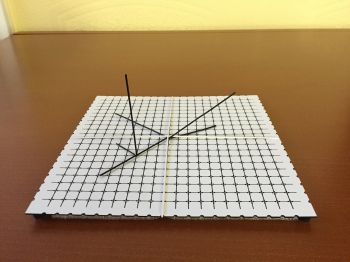
Daniel has also been busy inventing the ‘3D vector board’, a small plastic board with two flexible rubber stripes perpendicular to each other which can be can moved around such that they show the axes of a coordinate system. The board has a grid on it with 1×1 cm squares. At the junctions four little holes are drilled in the corner of the squares. This allows the vectors (metal sticks of different length) to be fixed on the board. Since there are horizontal, diagonal and vertical sticks i.e. the sticks are either in the plane, perpendicular to or in an angle respect to the plane of the board 3D vector scenarios can be modelled easily.

Although Daniel intended to use the board solely for his own purposes, feedback suggests this relatively simple tool could be used efficiently in education for demonstrational purposes. Both visually impaired and sighted students could benefit from it. Sketches on paper or black boards only allow 2D representations. The 3D vector board might also work well in illustrating aims of the TGD project. Although the main goal is to develop a very advanced high-tech assistive device over a period of years, Daniel and Kathy might also come up with a number of low-tech ideas to improve accessibility of mathematical sciences for visually impaired students.

See Daniel’s project website for further details about his research.

That Was The REF That Was..

Posted in Finance, Science Politics with tags , , , , , , on December 18, 2014 by telescoper

I feel obliged to comment on the results of the 2014 Research Excellence Framework (REF) that were announced today. Actually, I knew about them yesterday but the news was under embargo until one minute past midnight by which time I was tucked up in bed.

The results for the two Units of Assessment relevant to the School of Mathematical and Physical Sciences are available online here for Mathematical Sciences and here for Physics and Astronomy.

To give some background: the overall REF score for a Department is obtained by adding three different components: outputs (quality of research papers); impact (referrring to the impact beyond academia); and environment (which measures such things as grant income, numbers of PhD students and general infrastructure). These are weighted at 65%, 20% and 15% respectively.

Scores are assigned to these categories, e.g. for submitted outputs (usually four per staff member) on a scale of 4* (world-leading), 3* (internationally excellent), 2* (internationally recognised), 1* (nationally recognised) and unclassified and impact on a scale 4* (outstanding), 3* (very considerable), 2* (considerable), 1* (recognised but modest) and unclassified. Impact cases had to be submitted based on the number of staff submitted: two up to 15 staff, three between 15 and 25 and increasing in a like manner with increasing numbers.

The REF will control the allocation of funding in a manner yet to be decided in detail, but it is generally thought that anything scoring 2* or less will attract no funding (so the phrase “internationally recognised” really means “worthless” in the REF, as does “considerable” when applied to impact). It is also thought likely that funding will be heavily weighted towards 4* , perhaps with a ratio of 9:1 between 4* and 3*.

We knew that this REF would be difficult for the School and our fears were born out for both the Department of Mathematics or the Department of Physics and Astronomy because both departments grew considerably (by about 50%) during the course of 2013, largely in response to increased student numbers. New staff can bring outputs from elsewhere, but not impact. The research underpinning the impact has to have been done by staff working in the institution in question. And therein lies the rub for Sussex…

To take the Department of Physics and Astronomy, as an example, last year we increased staff numbers from about 23 to about 38. But the 15 new staff members could not bring any impact with them. Lacking sufficient impact cases to submit more, we were obliged to restrict our submission to fewer than 25. To make matters worse our impact cases were not graded very highly, with only 13.3% of the submission graded 4* and 13.4% graded 3*.

The outputs from Physics & Astronomy at Sussex were very good, with 93% graded 3* or 4*. That’s a higher fraction than Oxford, Cambridge, Imperial College and UCL in fact, and with a Grade Point Average of 3.10. Most other departments also submitted very good outputs – not surprisingly because the UK is actually pretty good at Physics – so the output scores are very highly bunched and a small difference in GPA means a large number of places in the rankings. The impact scores, however, have a much wider dispersion, with the result that despite the relatively small percentage contribution they have a large effect on overall rankings. As a consequence, overall, Sussex Physics & Astronomy slipped down from 14th in the RAE to 34th place in the REF (based on a Grade Point Average). Disappointing to say the least, but we’re not the only fallers. In the 2008 RAE the top-rated physics department was Lancaster; this time round they are 27th.

I now find myself in a situation eerily reminiscent of that I found myself facing in Cardiff after the 2008 Research Assessment Exercise, the forerunner of the REF. Having been through that experience I’m a hardened to disappointments and at least can take heart from Cardiff’s performance this time round. Spirits were very low there after the RAE, but a thorough post-mortem, astute investment in new research areas, and determined preparations for this REF have paid dividends: they have climbed to 6th place this time round. That gives me the chance not only to congratulate my former colleagues there for their excellent result but also to use them as an example for what we at Sussex have to do for next time. An even more remarkable success story is Strathclyde, 34th in the last RAE and now top of the REF table. Congratulations to them too!

Fortunately our strategy is already in hand. The new staff have already started working towards the next REF (widely thought to be likely to happen in 2020) and we are about to start a brand new research activity in experimental physics next year. We will be in a much better position to generate research impact as we diversify our portfolio so that it is not as strongly dominated by “blue skies” research, such as particle physics and astronomy, for which it is much harder to demonstrate economic impact.

I was fully aware of the challenges facing Physics & Astronomy at Sussex when I moved here in February 2013, but with the REF submission made later the same year there was little I could do to alter the situation. Fortunately the University of Sussex management realises that we have to play a long game in Physics and has been very supportive of our continued strategic growth. The result of the 2014 REF result is a setback but it does demonstrate that the stategy we have already embarked upon is the right one.

Roll on 2020!

Campus Christmas!

Posted in Brighton with tags , , , on December 9, 2014 by telescoper

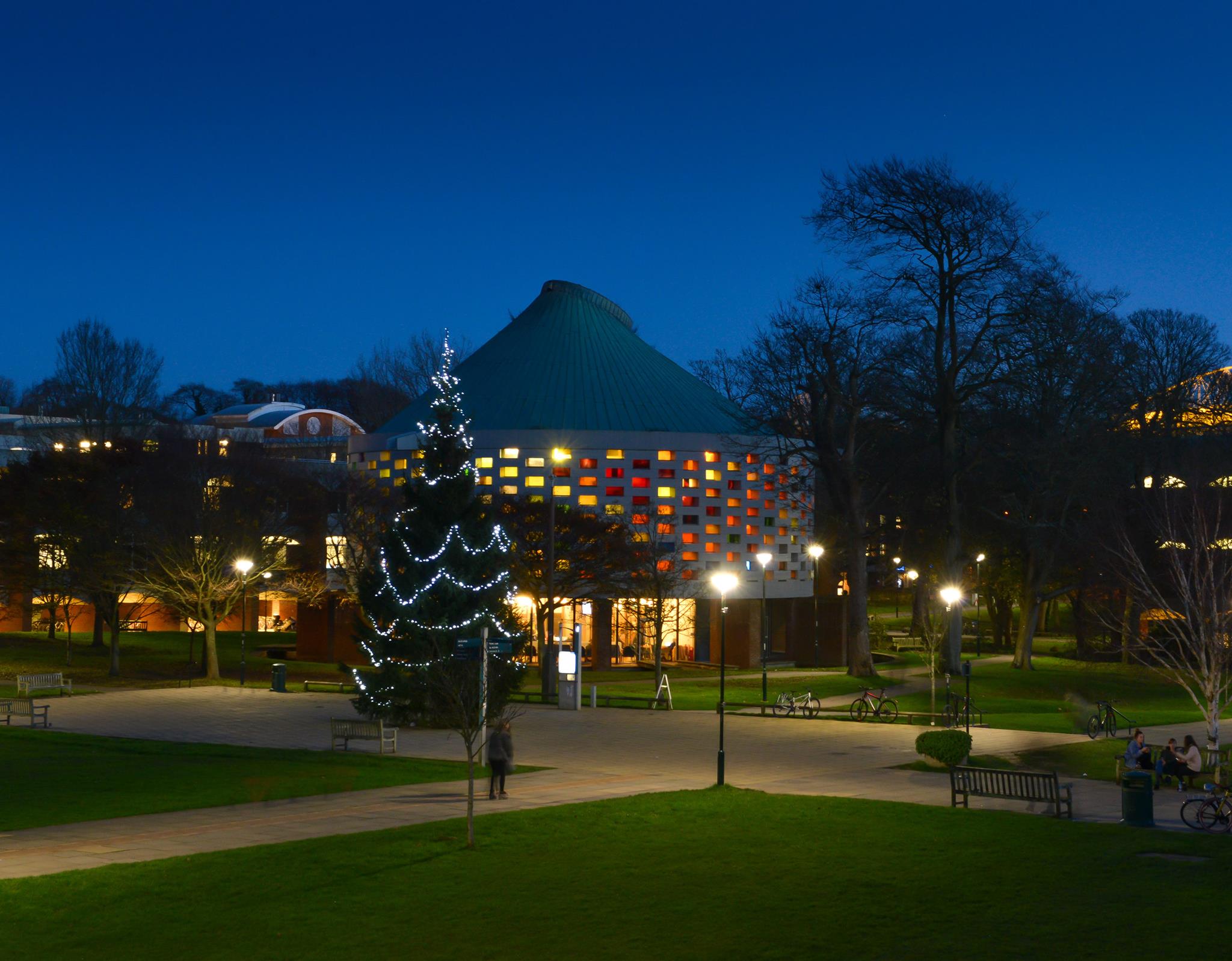
Now that I’m back in Brighton I thought I’d share this very nice picture of the University of Sussex Campus at Falmer, complete with Christmas tree and decorations. I got the picture from the University’s facebook page. That’s the Meeting House you can see behind the tree, by the way..

Christmas_campus

Starlink Memories

Posted in Biographical with tags , , , , , , , on December 3, 2014 by telescoper

This lunchtime I put on a black tie and went to the funeral of Stuart Keir, who died suddenly a few weeks ago at the aged of 55. Stuart had only just retired, on grounds of ill health, having worked in IT services for over twenty years here at the University of Sussex. When I first started in 1985 the observational astronomers at Sussex were primarily based at the Royal Greenwich Observatory (RGO), which was at that time located in Herstmonceux and Stuart was one of the staff there supporting the computer systems. The RGO moved to Cambridge in 1990 (for reasons which still escape me) at which point some of the astronomers and support staff relocated permanently to the University of Sussex while others went to Cambridge; Stuart moved to Sussex when the Starlink node was consolidated here following the loss of the RGO.

stuart

Stuart Keir

I remember Stuart very well from my life here as a PhD student and then as a postdoc in the Astronomy Unit, both before and after he moved full-time to Falmer campus. He wasn’t always the easiest of characters to work with – he insisted on doing everything his own way, which sometimes conflicted with what the astronomers wanted – but it has to be said that he did usually know better than us about the important things. He also worked extremely hard at his job and was definitely a great help to me during my time at Sussex. I’m very sad that he didn’t have long to enjoy his well-earned retirement.

The news of Stuart’s death made me all nostalgic for my days as a PhD student, when life was definitely much simpler. It also made me look back affectionately at the Starlink system as it was in the 80s. I had been lucky enough to get a series of temporary jobs, between school and university and during summer vacations at university, that involved the use of VAX computers of exactly the same type as that used in Starlink so I was well prepared when I started my PhD. In fact, looking back, I still think the native Virtual Memory System (VMS) and Digital Command Language (DCL) were terrific to work with. Unfortunately it seems that DEC, the company that manufactured the VAX systems, made some unwise business decisions and they lost ground to SUN. During the 1990s there was a rapid phase transition within Starlink from VAX machines to a range of SUN workstations.

Much of the value of Starlink in the old days was the connectivity it provided in what was basically a pre-internet (enabled by DECNET) which allowed sharing of software across all UK astronomy groups. In this sense it was an important step towards Open Science. The growth of the internet however let to a reduced role for Starlink from the mid-1990s onwards. Stuart transferred from Starlink to general IT services at the University of Sussex when Starlink was winding down.

In its heyday, Starlink was a great resource that provided a superb environment for astronomical researchers. It would have been nothing, however, without the dedicated team of Starlink Managers like Stuart who managed the local nodes and worked so help the astronomers that worked there. Data-intensive subjects like astronomy depend as much now as they did then on the hard work of computer support staff, an effort that is in my view not given anything like sufficient recognition by universities and other research institutions.

Rest in Peace, Stuart Keir.

Graphic Display

Posted in Art, Biographical with tags , , , , on November 29, 2014 by telescoper

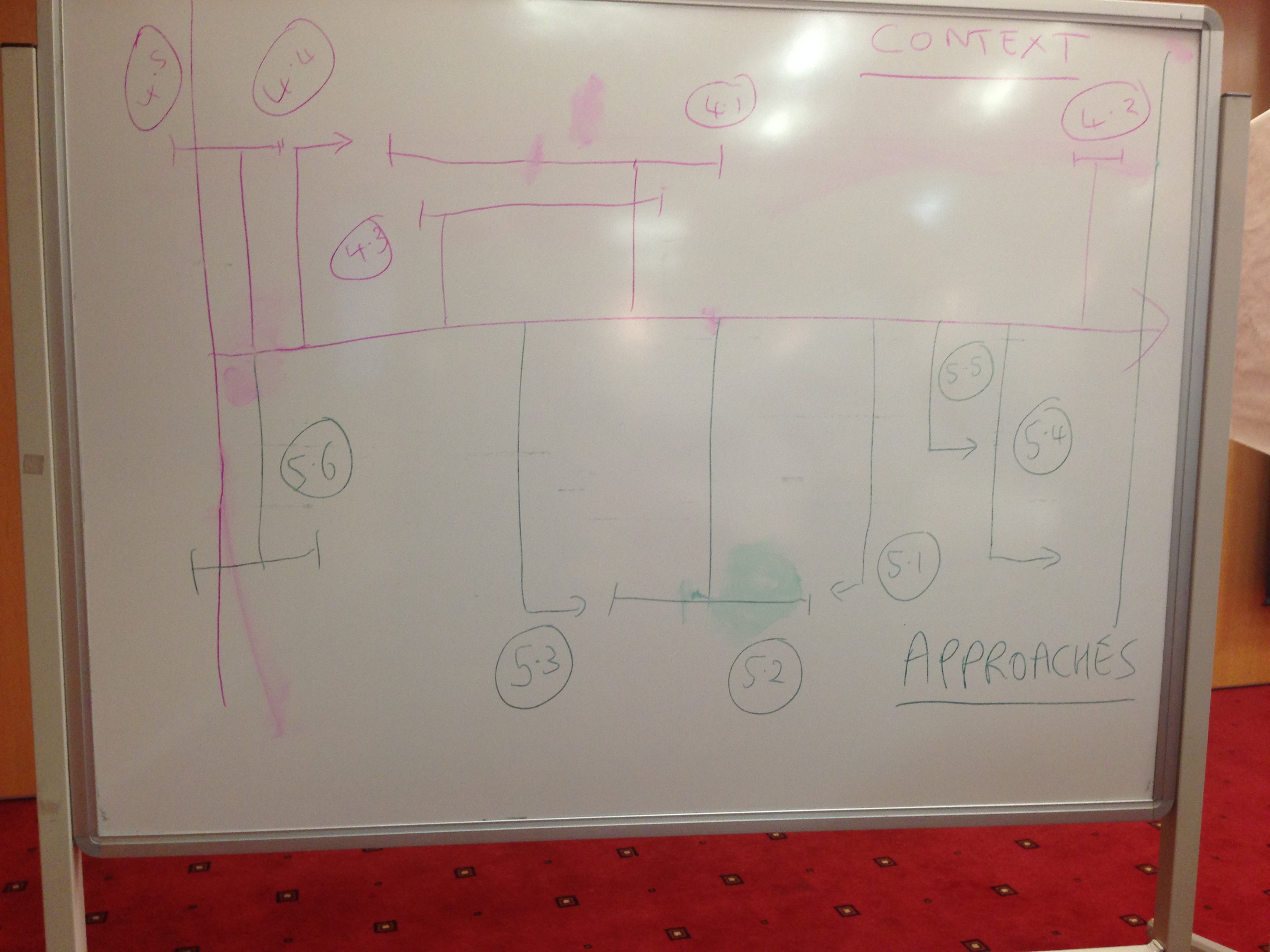
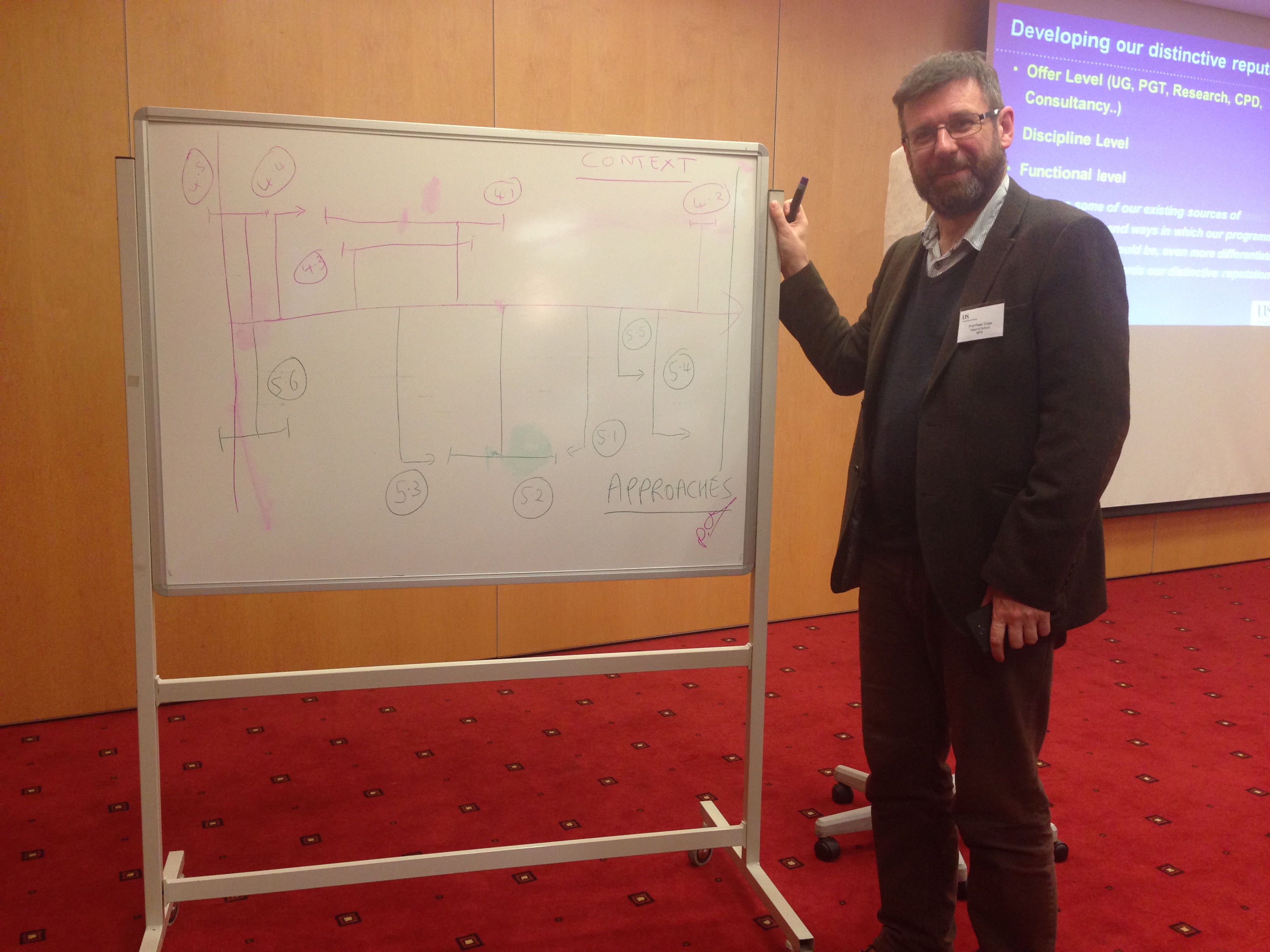
Two days ago, on Thursday, I had the pleasure of spending all day at an “Awayday” trying to work out how to implement the University of Sussex Strategic Plan, Making the Future. My main contribution was this beautifully clear diagram summarising a lengthy discussion on research strategy:
IMG_0974
Obviously the diagram needs no further explanation, but members of the audience were so impressed with it as a piece of graphic art that the end of the day I was asked to sign it.

Research Strategy

Now, who’s going to nominate me for the Turner Prize?

Quantum Technologies at Sussex

Posted in The Universe and Stuff with tags , , , , , on November 26, 2014 by telescoper

Some good news arrived today. We had been hoping to hear it since September but it finally appeared today. It involves several physicists from the Atomic, Molecular and Optical (AMO) Group of the Department of Physics & Astronomy in the School of Mathematical and Physical Sciences here at the University of Sussex who bid to participate in a major investment (of ~£270M) in quantum technology overseen by the Engineering and Physical Sciences Research Council (EPSRC). Today we learned that Sussex physicists were successful in their applications and in fact will participate in two of the four new Quantum Technology “hubs” now being set up. One of the hubs is led by the University of Oxford and the other by the University of Birmingham. We will be starting work on these projects on 1st December 2014 (i.e. next Monday) and the initial funding is for five years. Congratulations to all those involved, not just at Sussex but also in those other institutions participating in the new programme.

For a relatively small Department this is an outstanding achievement for Sussex, and the funding gained will help us enormously with our strategy of expanding laboratory-based experiment physics on the University of Sussex campus. Since I arrived here last year it has been a priority for the School to increase and diversify its research portfolio, both to enhance the range and quality of our research itself and to allow us to teach a wider range of specialist topics at both undergraduate and postgraduate level. This particular subject is also one in which we hope to work closely with local comanies, as quantum technology is likely to be a key area for growth over the next few years.

I’m very excited by all this, because it represents a successful first step towards the ambitious goals the Department has set and it opens up a pathway for further exciting developments I hope to be able to post about very soon.

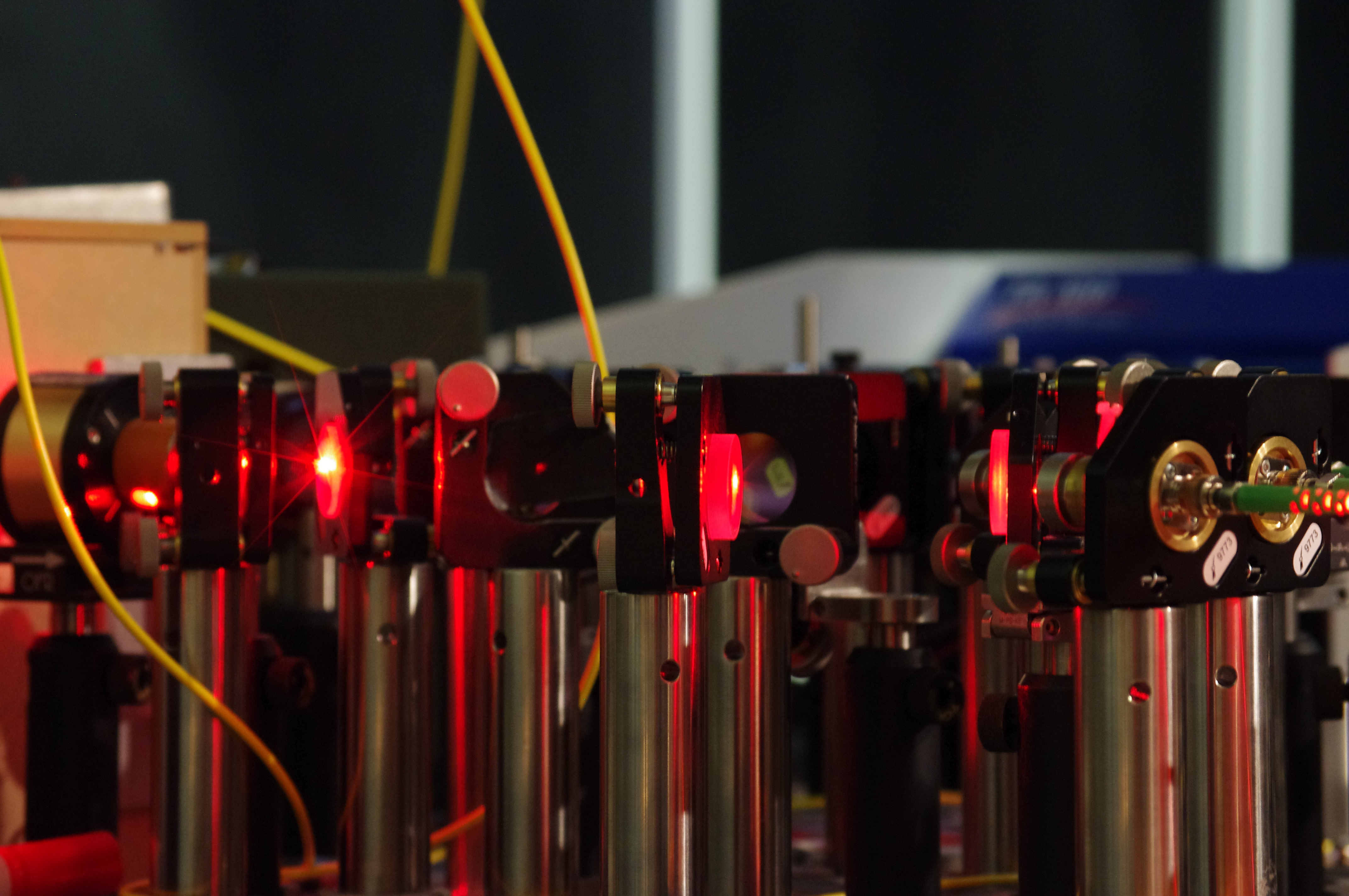
To celebrate, here’s a gratuitous picture of a laser experiment:

laser

You can find more information about the Quantum Technology hubs altogether here.

The text of the official University of Sussex  press release follows:

Sussex scientists have been awarded £5.5 million to develop devices that could radically change how we measure time, navigate our world and solve seemingly impossible mathematical equations.

The grants, received by members of the University’s Atomic, Molecular and Optical Physics (AMO) research group, represent part of a £270 million UK government investment announced today (26 November) to convert quantum physics research into commercial products.

Quantum technology is the applied field of quantum theory. It includes such phenomena as “quantum entanglement”, the idea that objects are not independent if they have interacted with each other or come into being through the same process, and that changing one will also change the other, no matter how far apart they are.

Members of the AMO group have become part of two major national quantum centres: the UK Quantum Technology Hub on Networked Quantum Information Technologies and the UK Quantum Technology Hub for Sensors and Metrology. These centres bring together universities and industry to develop and construct quantum technologies.

The award from the Engineering and Physical Sciences Research Council (EPSRC) will help to fund several Sussex research projects:

  • Dr Jacob Dunningham will be developing a theory to understand how remote objects can be detected with exquisite precision by making use of a networks of sensors linked by quantum entanglement.
  • Dr Winfried Hensinger, as part of one hub, will develop the quantum processor microchip architecture and a new technique of quantum processing using microwave radiation to enable the construction of a large-scale “super-fast” quantum computer. As part of the other hub, he will develop powerful portable sensors able to detect magnetic fields with unprecedented accuracy utilizing a new generation of microchips capable of holding arrays of individual charged atoms.
  • Dr Alessia Pasquazi will develop miniature, ultra-fast, photonic sources of light that form the heart of a new generation of quantum sensors and navigation devices.
  • Dr Marco Peccianti will shrink to the size of a shoe box an “optical frequency comb”, a highly accurate clock currently found only in state-of-the-art laboratories.
  • Prof Barry Garraway will design new rotation sensors for compact navigation devices using atom-chip technology.
  • Dr Matthias Keller will develop a network connecting several quantum processors through the exchange of single photons, resulting in a new version of the internet, the so-called ‘quantum internet’.

In response to the funding news, Professor Peter Coles, Head of the School of Mathematics and Physical Sciences, said: “Quantum sensors offer amazing possibilities for smaller and lighter devices with extraordinary precision. As a consequence, quantum theory promises revolutionary technological applications in computing, measurement, navigation, and security.”

Professor Michael Davies, Pro-Vice-Chancellor for Research, said: “This new research programme will consolidate the reputation of the University of Sussex as one of the world-leading centres for the development of ground-breaking quantum technologies.”

The research will be supplemented by a significant Sussex investment and will make use of the world-leading multi-million pound quantum technology laboratories located at the University.

Professor Coles added: “Our pioneering ‘MSc in Frontiers of Quantum Technology’ program along with numerous PhD positions will provide training for a new generation of researchers and developers to be employed in the emerging quantum technology sector.”

Greg Clark, Minister of State for Universities, Science and Cities, said: “This exciting new Quantum Hubs network will push the boundaries of knowledge and exploit new technologies, to the benefit of healthcare, communications and security.

“Today’s announcement is another example of the government’s recognition of the UK’s science base and its critical contribution to our sustained economic growth”.

Working for Different Masters

Posted in Education with tags , , , , , , , on November 1, 2014 by telescoper

Quite a few times recently, current and prospective students (or parents thereof) have asked me what the difference is between the different forms of Masters degrees that you can get in the United Kingdom, chiefly the distinction between an MSc  and one of the variations on the MPhys or MMath we have here in the School of Mathematical and Physical Sciences here at the University of Sussex. I have to admit that it’s all very confusing so here’s my attempt to explain.

The main distinction is that the MSc “Master of Science” is a (taught) postgraduate (PG) degree, usually of one (calendar) year’s duration, whereas the MPhys etc are undergraduate (UG) degrees usually lasting 4 years. This means that students wanting to do an MSc must already have completed a degree programme (and usually have been awarded at least Second Class Honours)  before starting an MSc whereas those doing the MPhys do not.

Undergraduate students wanting to do Physics in the Department of Physics & Astronomy at the University of Sussex, for example, can opt for either the 3-year BSc or the 4-year MPhys programmes. However, choosing the 4-year option does not lead to the award of a BSc degree and then a subsequent Masters qualification;  graduating students get a single qualification usually termed an “integrated Masters”.

It is possible for a student to take a BSc and then do a taught MSc programme afterwards, perhaps at a different university, but there are relatively few MSC programmes for Physics  in the UK because the vast majority of students who are interested in postgraduate study will already have registered for 4-year undergraduate programmes. That’s not to say there are none, however. There are notable MSc programmes dotted around, but they tend to be rather specialist; examples related to my own area include Astronomy and Cosmology at Sussex and Astrophysics at Queen Mary.  To a large extent these courses survive by recruiting students from outside the UK because the market from home students is so small. No department can afford to put on an entire MSc programme for the benefit of just one or two students. Often these stand-alone courses share modules with the final year of the undergraduate Masters, which also helps keep them afloat.

So why does it matter whether one Masters is PG while the other is UG? One difference is that the MSc lasts a calendar year (rather than an academic year). In terms of material covered, this means it contains 180 credits compared to the 120 credits of an undergraduate programme. Typically the MSc will have 120 credits of courses, examined in June as with UG programmes, followed by 60 credits worth of project work over the summer, handed in in September, though at Sussex some of our programmes are split 90 credits coursework and 90 credits of project.

The reason why this question comes up so frequently nowadays is that the current generation of applicants to university (and their parents) are facing up to fees of £9K per annum. The cost of doing a 3-year BSc is then about £27K compared to £36K for an MPhys. When rushing through the legislation to allow universities to charge this amount, the Powers That Be completely forgot about PG programmes, which have accordingly maintained their fees at a similar level. For example, the MSc Astronomy at Sussex attracts a fee of about £5K for home students and about £15K for overseas students. These levels are roughly consistent with the UG fees paid by  home students on the previous fee regime (approx £3.5K per annum, bearing in mind that you get 1.5 times as much teaching on an MSc compared to a year of an MPhys).

Being intelligent people, prospective physicists look at the extra £9K they have to pay for the 4th year of an MPhys and compare it with the current rate for an entire MSc and come to the conclusion that they should just do a BSc then switch. This seems to be not an unreasonable calculation to make.

However, there are some important things to bear in mind. Firstly, unlike UG programmes, the fee for PG programmes is basically unregulated. Universities can charge whatever they like and can increase them in the future if they decide to. See, for example, the list at Sussex University which shows that MSc fees already vary by more than a factor of four from one school to another. Incidentally, that in itself shows the absurdity of charging the same fee for UG degrees regardless of subject…

Now the point is that if one academic year of UG teaching is going to cost £9K for future students, there is no way any department can justify putting on an entire calendar of advanced courses (i.e. 50% more teaching at an extremely specialist level) for less than half the  income per student. The logical fee level for MSc programmes must rise to a mininum of about 1.5 times the UG fee, which is a whopping £13.5K (similar to the current whopping amount already paid by overseas students for these programmes). It’s therefore clear that you cannot take the current MSc fee levels as a guide to what they will be in three years’ time, when you will qualify to enter a taught PG programme. Prices will certainly have risen by then.

Moreover, it’s much harder to get financial support for postgraduate than undergraduate study.  MSc students do not qualify for student loans as undergraduates do, for example. Also the MSc fee usually has to be paid in full, up front, not collected later when your income exceeds some level. Some PG courses do run their own bursary schemes, such as many of those at Sussex, for example, but generally speaking students on taught PG programmes have to find their own funding. On the other hand,  undergraduate students often qualify for generous packages, including fee waivers and reduction in accommodation, especially if they qualify for support for widening participation, such as the “First Generation Scholar” scheme at Sussex.

I’d say that, contrary to what many people seem to think,  if you take into the full up-front fee and the lack of student loans etc, the cost of a BSc + MSc is  already significantly greater than doing an MPhys, and in future the cost of the former route will inevitably increase. I therefore don’t think this is a sensible path for most Physics undergraduates to take, assuming that they want their MSc to qualify them for a career in Physics research, either in a university or a commercial organization, perhaps via the PhD degree, and they’re not so immensely rich that money is no consideration.

The exception to this conclusion is for the student who wishes to switch to another field at Masters level,  to do a specialist MSc in a more applied discipline such as medical physics or engineering. Then it might make sense, as long as you can find a way to deal with the need to pay up-front for such courses.

There are indications that the government might be planning to introduce student loans for postgraduate degrees similar to those currently offered for undergraduates, but for me that would only make sense if the fees were to increase as described above, so this would not be an entirely positive move (to say the least).

In conclusion, though, I have to say that, like many other aspects of Higher Education in the Disunited Kingdom, this system is a mess. I’d prefer to see the unified system of 3 year UG Bachelor degrees, 2-year Masters, and 3-year PhD that pertains throughout most of continental Europe. To colleagues there, the system of two types of Masters degree looks like a complete mess.  Which it is. In fact some countries do not accept out integrated Masters as preparation for a PhD at all.

P.S. In the interest of full disclosure, I should point out an even worse anomaly. I did a 3-year Honours degree in Natural Science at Cambridge University for which I was awarded not a BSc but a BA (Bachelor of Arts). A year or so later this – miraculously and with no effort on my part – turned into an MA. Work that one out if you can.
Athena SWAN Bronze for Physics & Astronomy at Sussex

Posted in Education with tags , , , , , , on September 25, 2014 by telescoper

Athena Swan

Only  time for the quickest of quickies today, but I have some very good news to pass on so, without further ado, here we go. Today we learned that the Department of Physics & Astronomy at the University of Sussex has received a the Athena SWAN Bronze Award in recognition of our commitment to advancing women’s careers in science, technology, engineering, maths and medicine (STEMM) employment in higher education and research. The Athena SWAN charter has been running since 2005, recognising the commitment of the higher education sector to address gender inequalities, tackle the unequal representation of women in science and to improve career progression for female academics.

This award has been the result of a huge effort led by Dr Kathy Romer but also involving many other members of staff in the Department and across entire  the School of Mathematical and Physical Sciences generally. The Department scored at or above the national average in all key areas: student intake (UG, PGT, PGR), research staff, academic staff, REF submissions and so on. That said, the Athena SWAN process has highlighted several areas where improvements can be made, such as in the mentoring of female postdoctoral researchers, and enhanced levels of training in equality and diversity matters such as the influence of unconscious bias. We are very pleased to have received the bronze award, but there is still a very great deal to do. Many other institutions and departments have already progressed to the Silver or even Gold award, but our Bronze is at least a start!


Life, Work and Postgraduate Research

Posted in Biographical, Crosswords, Education with tags , , , , on September 21, 2014 by telescoper

A very busy Freshers’ Week at the University of Sussex is now behind us and lectures proper start tomorrow morning. As far as I was concerned all the Freshers’ events were superimposed on a week that was already filled with other things, some good (of which more anon), and some not so good (of which I will say nothing further).

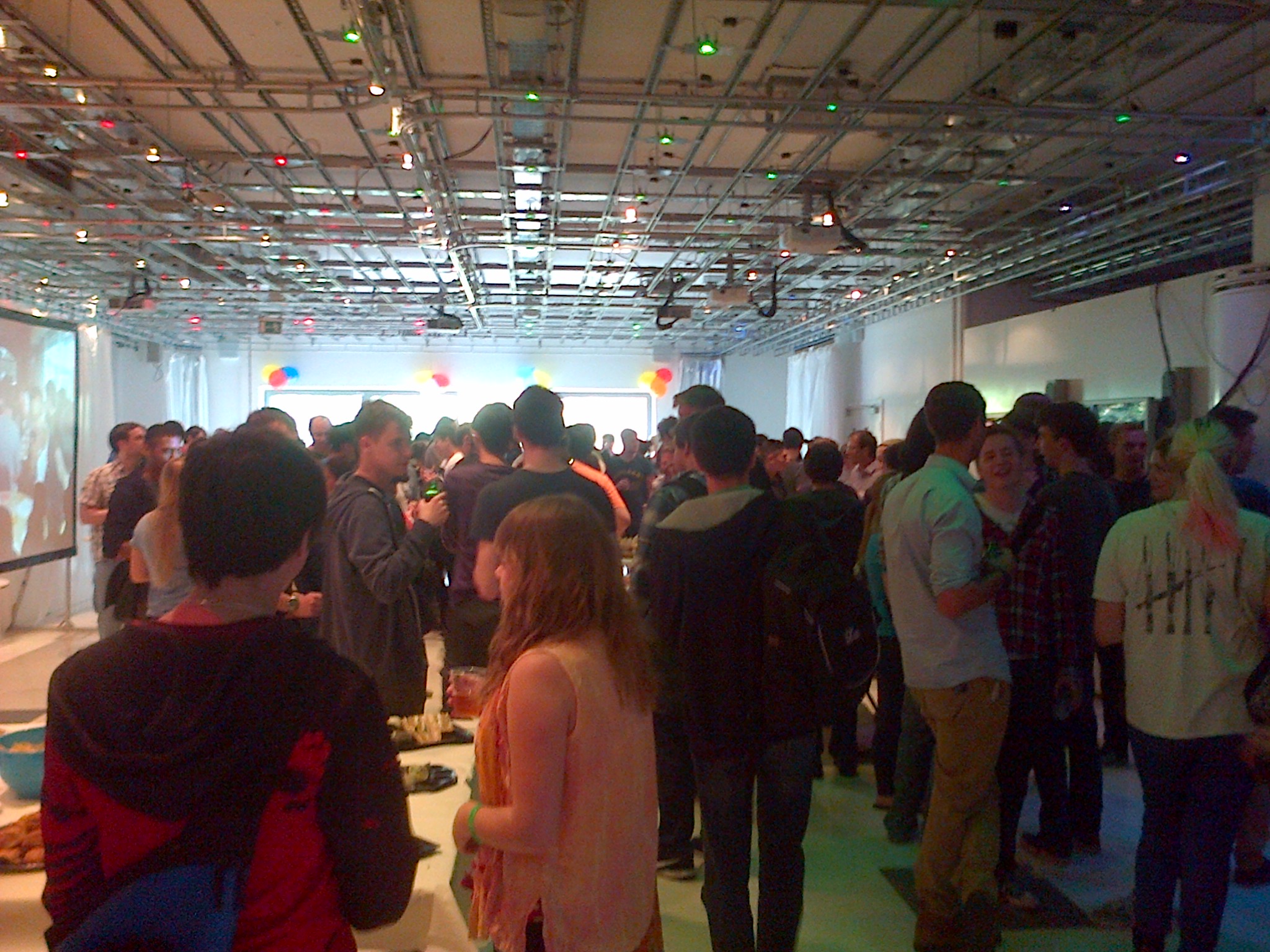
After welcome receptions at the weekend, Freshers’ Week for me began with an induction lecture with all the new students in the School of Mathematical and Physical Sciences (MPS) or at least as many as could rouse themselves for a 10am start the day after a big welcome party. In the event, the turnout was good. I then gave another little speech at a much less formal event in the Creativity Zone (which is situated in the building occupied by MPS. I then had to dash off to a couple of meetings but when I returned a couple of hours later the party was still going, so I helped myself to a beer and rejoined the socializing.

IMG-20140915-00402

Welcome to the new students in MPS!

And so it was for the rest of the week, dominated by meetings of one sort or another including one in London, until Friday and my last formal induction task in the form of a session for new postgraduate students in MPS. Since this happened at the end of Induction Week there wasn’t much of a practical nature say to the students that they hadn’t already heard during the School-based induction sessions that preceded it, so I decided to scrap the Powerpoint I had planned to use and just give a general pep talk. Doing so was quite an interesting experience because it reminded me of the time I started my own postgraduate education, here at Sussex.

As a matter of fact it was on the corresponding day in 1985 (Sunday 22nd September) that I moved down to Brighton in advance of starting my DPhil (as Sussex doctorates were called in those days). It’s hard to believe that was 29 years ago. As it turned out, I finished my thesis within three years and stayed on here at Sussex as a postdoctoral research fellow in the Astronomy Centre until 1990, whereupon I left to take up a teaching and research position at what is now Queen Mary, University of London. That was the start of a mini-tour of UK universities that ended up with me returning to Sussex last year as Head of the same school in which I started my research career.

This morning I noticed a story in the Times Higher about the loneliness and sense of isolation often faced by postgraduate research students which often leads to a crisis of confidence. I can certainly attest to that, for reasons I will try to explain below, so tried to reassure the students about it in the induction session on Friday.

The point is that a postgraduate research degree is very different from a programme of undergraduate study. For one thing, as a research student you are expected to work on your own a great deal of the time. That’s because nobody else will be doing precisely the same project so, although other students will help you out with some things, you’re not trying to solve the same problems as your peers as is the case with an undergraduate. Your supervisor will help you of course and make suggestions (of varying degrees of helpfulness), but a PhD is still a challenge that you have to meet on your own. I don’t think it is good supervisory practice to look over a research student’s shoulder all the time. It’s part of the purpose of a PhD that the student learns to go it alone. There is a balance of course, but my own supervisor was rather “hands off” and I regard that as the right way to supervise. I’ve always encouraged my own students to do things their own way rather than try to direct them too much.

That loneliness is tough in itself, but there’s also the scary fact that you do not usually know whether your problem has a solution, let alone whether you yourself can find it. There is no answer at the back of the book; if there were you would not be doing research. A good supervisor will suggest a project that he or she thinks is both interesting and feasible, but the expectation is that you will very quickly be in a position where you know more about that topic than your supervisor.

I think almost every research student goes through a phase in which they feel out of their depth. There are times when you get thoroughly stuck and you begin to think you will never crack it. Self-doubt, crisis of confidence, call it what you will, I think everyone who has done a postgraduate degree has experienced it. I certainly did. A year into my PhD I felt I was getting nowhere with the first problem I had been given to solve. All the other research students seemed much cleverer and more confident than me. Had I made a big mistake thinking I could this? I started to panic and began to think about what kind of job I should go into if I abandoned the idea of pursuing a career in research.

So why didn’t I quit? There were a number of factors, including the support and encouragement of my supervisor, staff and fellow students in the Astronomy Centre, and the fact that I loved living in Brighton, but above all it was because I knew that I would feel frustrated for the rest of my life if I didn’t see it through. I’m a bit obsessive about things like that. I can never leave a crossword unfinished either.

What happened was that after some discussion with my supervisor I shelved that first troublesome problem and tried another, much easier one. I cracked that fairly quickly and it became my first proper publication. Moreover, thinking about that other problem revealed that there was a way to finesse the difficulty I had failed to overcome in the first project. I returned to the first project and this time saw it through to completion. With my supervisor’s help that became my second paper, published in 1987.

I know it’s wrong to draw inferences about other people from one’s own particular experiences, but I do feel that there are general lessons. One is that if you are going to complete a research degree you have to have a sense of determination that borders on obsession. I was talking to a well-known physicist at a meeting not long ago and he told me that when he interviews prospective physics students he asks them “Can you live without physics?”. If the answer is “yes” then he tells them not to do a PhD. It’s not just a take-it-or-leave-it kind of job being a scientist. You have to immerse yourself in it and be prepared to put long hours in. When things are going well you will be so excited that you will find it as hard to stop as it is when you’re struggling. I’d imagine it is the just same for other disciplines.

The other, equally important, lesson to be learned is that it is essential to do other things as well. Being “stuck” on a problem is part-and-parcel of mathematics or physics research, but sometimes battering your head against the same thing for days on end just makes it less and less likely you will crack it. The human brain is a wonderful thing, but it can get stuck in a rut. One way to avoid this happening is to have more than one thing to think about.

I’ve lost count of the number of times I’ve been stuck on the last clue in a crossword. What I always do in that situation is put it down and do something else for a bit. It could even be something as trivial as making a cup of tea, just as long as I don’t think about the clue at all while I’m doing it. Nearly always when I come back to it and look at it afresh I can solve it. I have a large stack of prize dictionaries to prove that this works!

It can be difficult to force yourself to pause in this way. I’m sure that I’m not the only physicist who has been unable to sleep for thinking about their research. I do think however that it is essential to learn how to effect your own mental reboot. In the context of my PhD research this involved simply turning to a different research problem, but I think the same purpose can be served in many other ways: taking a break, going for a walk, playing sport, listening to or playing music, reading poetry, doing a crossword, or even just taking time out to socialize with your friends. Time spent sitting at your desk isn’t guaranteed to be productive.

So, for what it’s worth here is my advice to new postgraduate students. Work hard. Enjoy the challenge. Listen to advice from your supervisor, but remember that the PhD is your opportunity to establish your own identity as a researcher. Above all, in the words of the Desiderata:

Beyond a wholesome discipline,
be gentle with yourself.

Never feel guilty about establishing a proper work-life balance. Having more than one dimension to your life is will not only improve your well-being but also make you a better researcher.

Freshers’ Week Reminiscences

Posted in Biographical, Education with tags , , , , on September 13, 2014 by telescoper

So here I am again, on campus, on a Saturday, this time to attend some receptions for new students (“Freshers”) who have just arrived at the University of Sussex to start their courses. I always enjoy meeting the new intake at this time of year; we sometimes call them “The Autumn Collection”, although it’s only mid-September and definitely not autumn yet. In fact it’s very warm and sunny and summery on Falmer campus today. The  downside of these annual events is that the students look much younger every year, so every one makes me feel a lot older than the one before!

Looking through my back catalogue of blog posts I realize that this blog is six years old next week. One of my first blog posts was about  memories of my own first day at University and it seems appropriate to repeat some of it here. I notice actually that virtually all Freshers’ weeks I’ve written about over the past six years have been accompanied by fine weather. I find this kind of weather a bit spooky because it always takes me back to the time when I left home to go to University, as thousands of fledgling students are about to do this year in their turn. I did it 32 years ago, getting on a train at Newcastle Central station with my bags of books and clothes. I said goodbye to my parents there. There was never any question of them taking me in the car all the way to Cambridge. It wasn’t practical and I wouldn’t have wanted them to do it anyway. After changing from the Inter City at Peterborough onto a local train, we trundled through the flatness of East Anglia until it reached Cambridge. The weather, at least in my memory, was exactly like today.

I don’t remember much about the actual journey, but I must have felt a mixture of fear and excitement. Nobody in my family had ever been to University before, let alone to Cambridge. Come to think of it, nobody from my family has done so since either. I was a bit worried about whether the course I would take in Natural Sciences would turn out to be difficult, but I think my main concern was how I would fit in generally.

I had been working between leaving school and starting my undergraduate course, so I had some money in the bank and I was also to receive a full grant. I wasn’t really worried about cash. But I hadn’t come from a posh family and didn’t really know the form. I didn’t have much experience of life outside the North East either. I’d been to London only once before going to Cambridge, and had never been abroad.

I didn’t have any posh clothes, a deficiency I thought would mark me as an outsider. I had always been grateful for having to wear a school uniform (which was bought with vouchers from the Council) because it meant that I dressed the same as the other kids at School, most of whom came from much wealthier families. But this turned out not to matter at all. Regardless of their family background, students were generally a mixture of shabby and fashionable, like they are today. Physics students in particular didn’t even bother with the fashionable bit. Although I didn’t have a proper dinner jacket for the Matriculation Dinner, held for all the new undergraduates, nobody said anything about my dark suit which I was told would be acceptable as long as it was a “lounge suit” (whatever that is).

Taking a taxi from the station, I finally arrived at Magdalene College. I waited outside, a bundle of nerves, for some time before entering the Porter’s Lodge and starting my life as a student. My name was found and ticked off and a key issued for my room in the Lutyens building. It turned out to be a large room, with a kind of screen that could be pulled across to divide the room into two, although I never actually used this contraption. There was a single bed and a kind of cupboard containing a sink and a mirror in the bit that could be hidden by the screen. The rest of the room contained a sofa, a table, a desk, and various chairs, all of them quite old but solidly made. Outside my  room, on the landing, was the gyp room, a kind of small kitchen, where I was to make countless cups of tea over the following months, although I never actually cooked anything there.

I struggled in with my bags and sat on the bed. It wasn’t at all like I had imagined. I realized that no amount of imagining would ever really have prepared me for what was going to happen at University.

I  stared at my luggage. I suddenly felt like I had landed on a strange island where I didn’t know anyone, and couldn’t remember why I had gone there or what I was supposed to be doing. I’ve had that feeling ever since, but after 32 years I think I’m used to it.