I may be away at a conference, but it’s still time to announce yet another new paper at the Open Journal of Astrophysics. This one was published on Monday 19th June.
The latest paper is the 20th so far in Volume 6 (2023) and the 85th in all, so with still more than half of 2023 remaining and many papers still in the pipeline, we’re on track to reach a total of 100 papers by the end of 2023!
The primary classification for this paper is Cosmology and Nongalactic Astrophysics and its title is “Sparse Bayesian mass-mapping using trans-dimensional MCMC”. The paper describes a new trans-dimensional Markov Chain Monte Carlo sampler for mass-mapping, using wavelets, for the construction of mass maps from weak gravitational lensing which, as I’ve previously mentioned on this blog, is what the cool kids do these days.
The authors are: Augustin Marignier, Thomas D. Kitching & Jason D. McEwen (MSSL, Mullard Space Science Laboratory), Ana M. G. Ferreira (Department of Earth Sciences), all at University College London.
Here is a screen grab of the overlay which includes the abstract:
You can click on the image of the overlay to make it larger should you wish to do so. You can find the officially accepted version of the paper on the arXiv here.
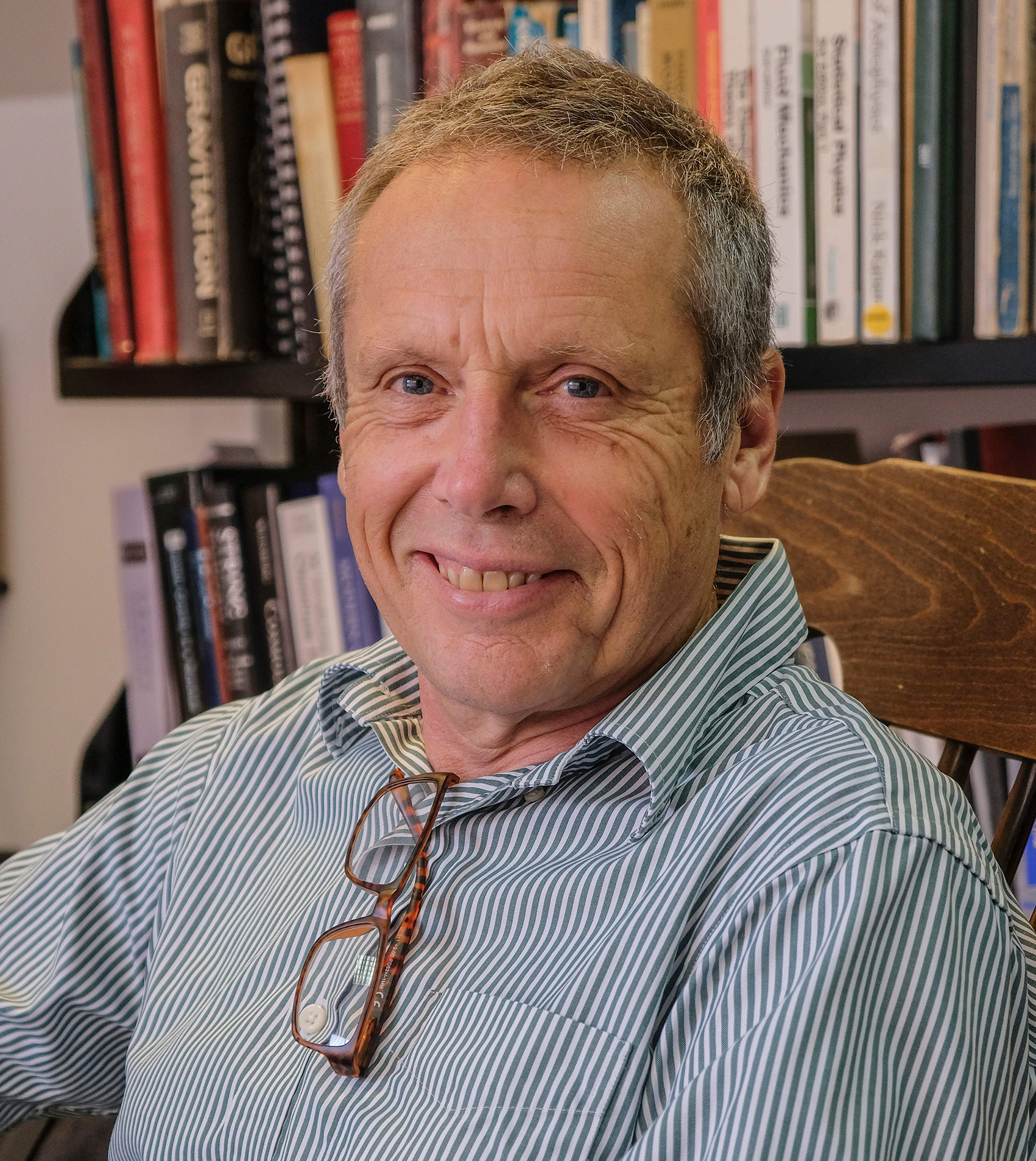
It was with a sense of shock that I heard this afternoon of the death of the age of 68 of cosmologist Nick Kaiser. It seems like only yesterday that we were celebrating the award of the Gruber Prize to Nick, but that was back in 2019. In a field filled with very clever people, Nick was one of the cleverest and also one of the nicest.
I have never worked directly with Nick Kaiser but he had an enormous influence on me, especially early on in my career. When I was doing my PhD, Nick was based in Cambridge and if I remember correctly he was the first person ever to ask me a question during a conference talk when I gave one there in 1987. Nick was never shy about making such interventions, sometimes somewhat mischievously. At first he terrified me because I didn’t know him except by scientific reputation, and didn’t realize what a nice guy he was. His question was actually very helpful, as it allowed me explain something that I’d skipped because I was under time pressure. His response to my explanation was very complimentary and supportive, which encouraged me a lot, and we chatted for quite a while after the session (in a pub). He was very friendly and approachable, and very far from the intimidating character I’d expected. Anyway, his 1984 paper on cluster correlations was the direct motivation for my very first publication (in 1986).
I mentioned yesterday that many of the papers published by the Open Journal of Astrophysics over the last few years have been in the field of weak gravitational lensing. It is safe to say that is a field that was basically created by Nick; see the paper by Kaiser & Squires (1993) that kicked it all off. You could also say the same about the use of redshift-space distortions, concerning which he wrote a seminal paper in 1987. These are two techniques that will be applied in the analysis of data from the Euclid spacecraft, to be launched next month.
These are just a few of things that Nick did. He did many others, always original and always interesting. In recognition of his achievements he was made a Fellow of the Royal Society in 2008, won the Gold Medal of the Royal Astronomical Society in 2017, the Daniel Chalonge and Hector de Vega Medals in 2018, and the Gruber Prize for Astronomy in 2019.
It’s hard to characterize someone of such intellectual breadth, but it always seemed to me that his approach was driven by a very deep physical insight. He was often able to identify what were the fundamental aspects of apparently complicated phenomena and build simple models that captured most of the physics. Using this approach he could penetrate the thickets in which others might get lost. He was perfectly capable of undertaking more complicated calculations to elaborate the details, but he always started by focussing on the basics.
I met Nick many times here and there, usually at conferences. He was always enthusiastic and energetic and entertaining, and was great company to talk to over a drink or several. You always had a good laugh talking to Nick, but you always learnt something too. His son studied in Cardiff some years ago, while I was working there, and Nick sometimes came to visit on the pretext of giving a seminar. I remember once he almost missed his own talk because we were sitting in a pub chatting.
Nick spent recent years in Paris; I remember his presence when I did an online colloquium for the Daniel Chalonge – Hector de Vega School in 2021. He certainly seemed in fine health and good spirits then. Indeed, he gave a talk in the same series that year which you can download here.
Nick’s untimely death is particularly shocking because he was ultra-fit. I think he got hooked on ultra-endurance events while living in Hawaii, as the first Ironman events were held there. Mere marathons were not enough for him. I think I last saw him in person in 2016 during a meeting in Italy. While most of us laboured on the “easy” hiking trails, Nick found them uninteresting and went running off looking for greater challenges.
It still hasn’t really sunk in that Nick has gone. I know I’m not the only one who feels that way. I think the sense of loss will pervade the cosmological community for a considerable time. I send deepest condolences to his family, friends, colleagues and co-workers. He’ll be hugely missed by a huge number of people.
It’s time to announce yet another new paper at the Open Journal of Astrophysics. This one was published yesterday (25th May).
The latest paper is the 18th paper so far in Volume 6 (2023) and the 83rd in all. With this one we have now published more papers in 2023 than we did in all of last year. With significantly less than half the year gone, and a large number of papers in the pipeline, I think it’s quite likely we will exceed a total of 100 papers by the end of 2023.
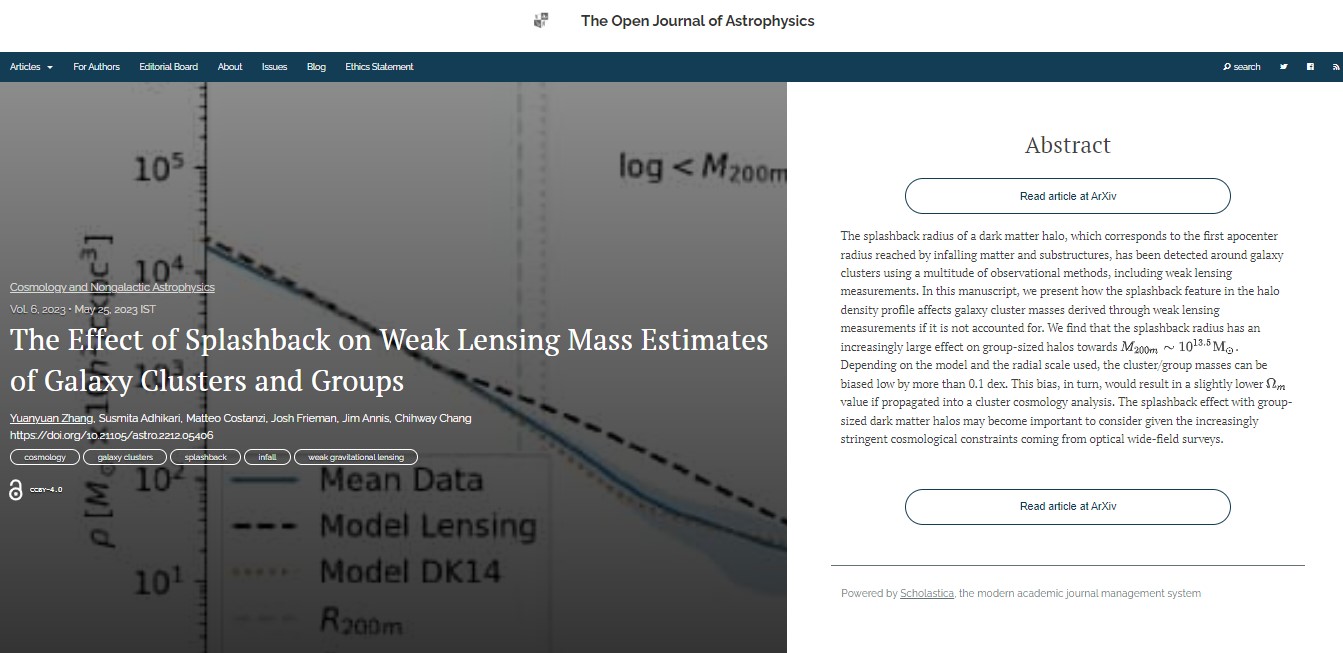
The primary classification for this paper is Cosmology and Nongalactic Astrophysics and its title is “The Effect of Splashback on Weak Lensing Mass Estimates of Galaxy Clusters and Groups”. For the uninitiated “Splashback” of infalling material produces features in the radial density profile of galaxy clusters. This paper discusses the effect of this on cluster masses derived from weak lensing measurements.
The authors, most of whom have multiple affiliations, are: Yuanyuan Zhang (NOIRLab, Tucson, AZ, USA), Susmita Adhikari (IISER, Pune, India), Matteo Costanzi (Univ. Trieste, Italy) and Josh Frieman, Jim Annis & Chihway Chang (Univ. Chicago, IL, USA).
Here is a screen grab of the overlay which includes the abstract:
You can click on the image of the overlay to make it larger should you wish to do so. You can find the officially accepted version of the paper, along with all other astrophysics and cosmology research papers worth reading, on the arXiv here.
It’s time to announce yet another new paper at the Open Journal of Astrophysics. This one was published yesterday (17th May).
The latest paper is the 17th paper so far in Volume 6 (2023) and the 82nd in all. With this one we have now published as many papers so far in 2023 as we did in all of last year. With significantly less than half the year gone, and a large number of papers in the pipeline, I think it’s quite likely we will exceed a total of 100 papers by the end of 2023. How’s that for cosmic acceleration?
The primary classification for this paper is Instrumentation and Methods for Astrophysics and its title is “Deep-field Metacalibration”. This article describes a technique that reduces the pixel noise in estimators of weak gravitational lensing shear signals by using a deeper imaging survey for calibration.
The authors are Zhuoqi (“Jackie”) Zhang (University of Chicago, IL, USA), Erin Sheldon (Brookhaven National Laboratory, NY, USA), and Matthew Becker (Argonne National Laborary, IL, USA).
Here is a screen grab of the overlay which includes the abstract:
You can click on the image of the overlay to make it larger should you wish to do so. You can find the officially accepted version of the paper, along with all other astrophysics and cosmology research papers worth reading, on the arXiv here.
As the launch of the European Space Agency’s Euclid mission approaches, though we don’t know official launch date yet, the associated publicity machines are ramping up for the big occasion. The latest bit of merch is the Euclid Launch Kit.
Sadly, this does not allow you to build your own Falcon 9 launcher which is what I inferred from the name. What it is is an interactive PDF file that allows you to navigate around and learn things about the satellite, its orbit, its instruments and the science case. I think it’s pretty good. You can download it here. It’s over 100 MB though, so beware if you have a very slow connection.
To whet your appetite, here some graphics extracted from the launch kit. You can click on the tiles to make them bigger.
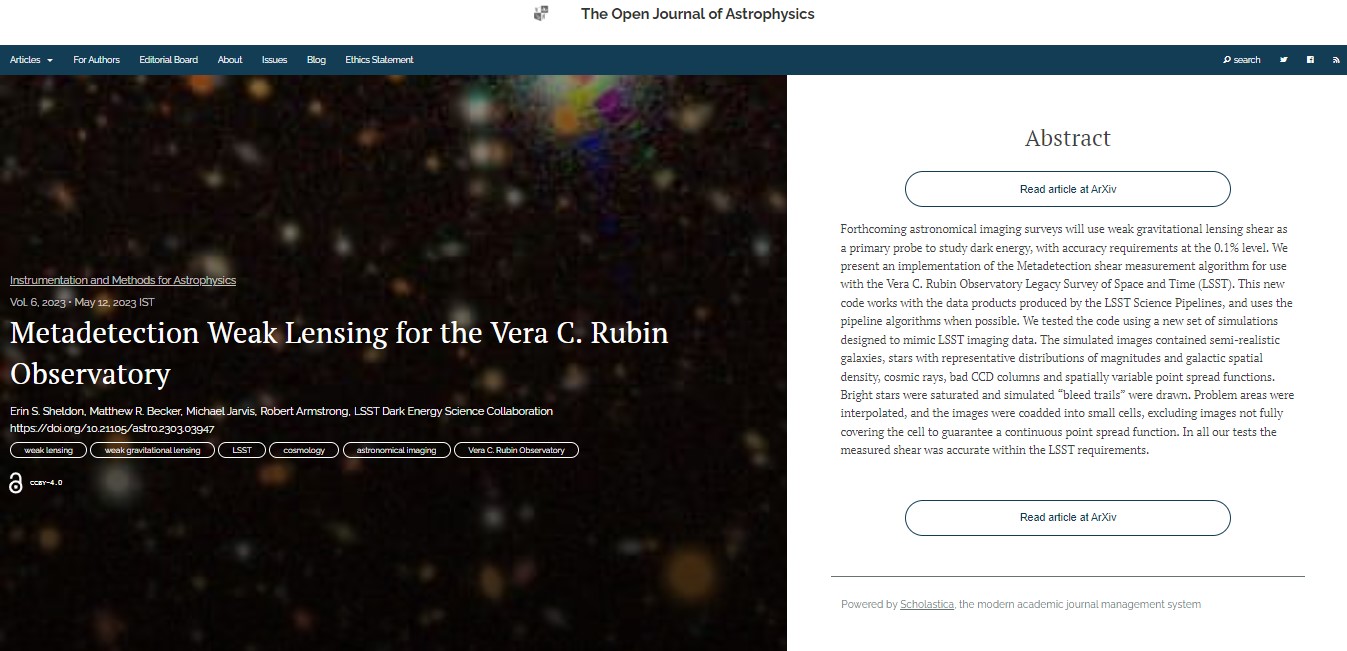
It’s time to announce yet another new paper at the Open Journal of Astrophysics. In fact it’s a little overdue, because we published this one on Friday 12th May, but I just got round to posting it on here.
The authors are Erin Sheldon (Brookhaven National Laboratory, NY, USA), Matthew Becker (Argonne National Laborary, IL, USA), Michael Jarvis (University of Pennsylvania, PA) and Robert Armstrong (Lawrence Livermore National Laboratory, CA) – all in the USA – and the LSST Dark Energy Science Collaboration, who have published a significant number of publications with OJAp. In fact, we’ll have another one in a day or two.
Here is a screen grab of the overlay which includes the abstract:
You can click on the image of the overlay to make it larger should you wish to do so. You can find the officially accepted version of the paper, along with all other astrophysics and cosmology research papers worth reading, on the arXiv here
We’re on a bit of a roll at the Open Journal of Astrophysics and it’s time to announce yet another paper. We actually published this one yesterday (7th February 2023), which makes it two in two days. I don’t think we’ll keep up that rate but we have seen a big increase in submissions recently and these are working their way through the system very nicely. We aim to publish accepted papers within a day of the revised version appearing on arXiv.
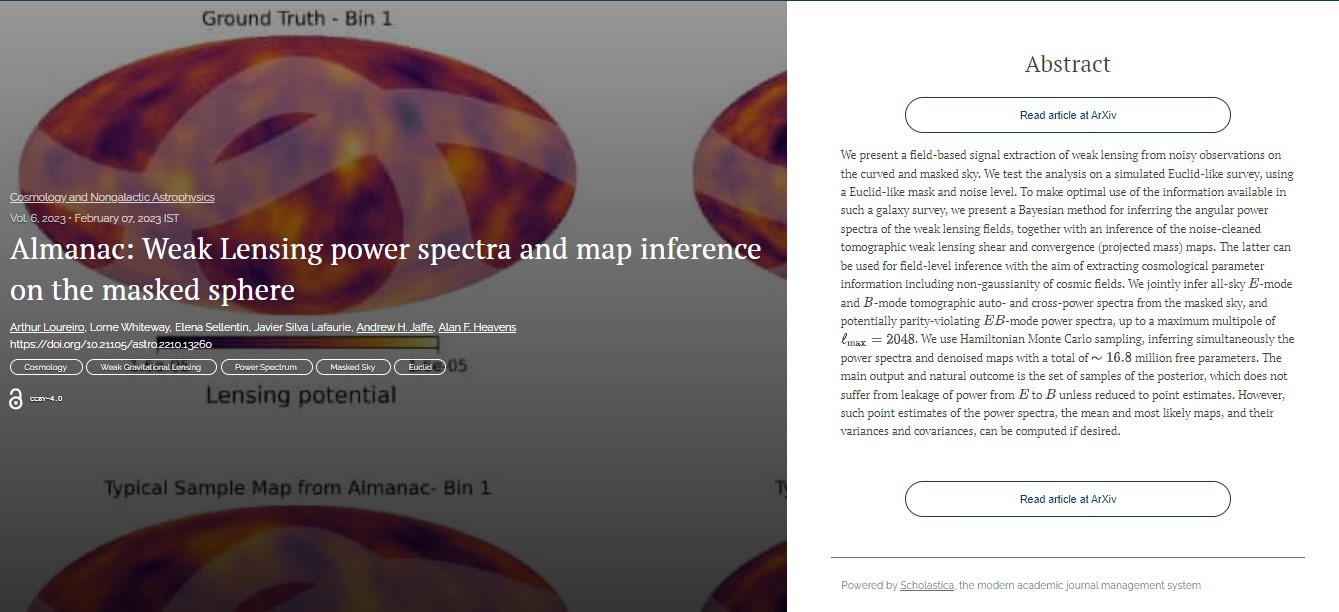
The latest paper is the 6th paper in Volume 6 (2023) as well as the 71st in all. This one is another one for the folder marked Cosmology and Nongalactic Astrophysics. The title is “Almanac: Weak Lensing power spectra and map inference on the masked sphere”. The nub of the problem addressed by this paper is that the usual statistical analysis of data presented in projection on the sky involves spherical harmonics, which are orthogonal functions on the celestial sphere, but when the sky is not completely covered (i.e. part of it is masked), these functions are not orthogonal on what remains.
The authors of this paper are Arthur Loureiro (University of Edinburgh, UK), Lorne Whiteway (University College London, UK), Elena Selentin (Leiden University, NL), Javier Silva Lafaurie (Leiden University, NL), Andrew Jaffe (Imperial College London, UK) and Alan Heavens (Imperial College London, UK)
Here is a screen grab of the overlay which includes the abstract:
You can click on the image of the overlay to make it larger should you wish to do so. You can find the officially accepted version of the paper on the arXiv here.
To much media interest the Dark Energy Survey team yesterday released 11 new papers based on the analysis of their 3-year data. You can find the papers together with short descriptions here. There’s even a little video about the Dark Energy Survey here:
Scientists measured that the way matter is distributed throughout the universe is consistent with predictions in the standard cosmological model, the best current model of the universe.
The results are a surprise because they show that it is slightly smoother and more spread out than the current best theories predict.
The observation appears to stray from Einstein’s theory of general relativity – posing a conundrum for researchers.
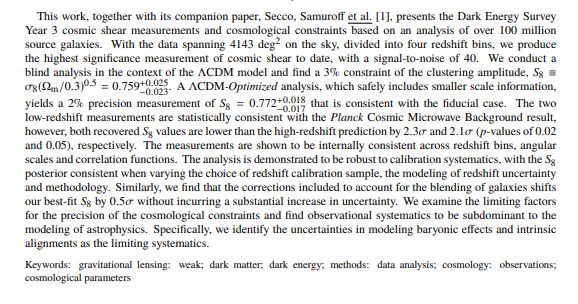
The reason for this appears to be that the BBC story focusses on the weak lensing paper (found here; I’ll add a link to the arXiv version if and when it appears there). The abstract is here:
The parameter S8 is a (slightly) rescaled version of the more familiar parameter σ8 – which quantifies the matter-density fluctuations on a scale of 8 h-1 Mpc – as defined in the abstract; cosmic shear is particularly sensitive to this parameter.
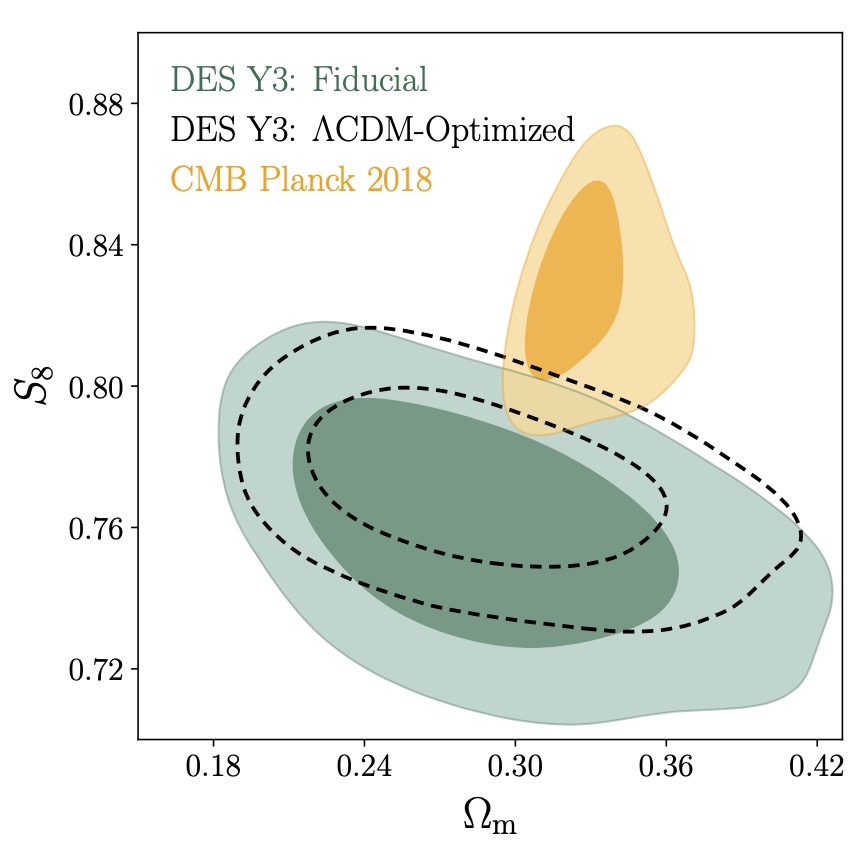
The key figure showing the alleged “tension” with Planck is here:
The companion paper referred to in the above abstract (found here has an abstract that concludes with the words (my emphasis).
We find a 2.3σ difference between our S8 result and that of Planck (2018), indicating no statistically significant tension, and additionally find our results to be in qualitative agreement with current weak lensing surveys (KiDS-1000 and HSC).
So, although certain people have decided to hype up a statistically insignificant l discrepancy, everything basically fits the standard model…
So here I am, in that London, getting ready for the start of a two-day conference at the Royal Astronomical Society on cosmology, large-scale structure, and weak gravitational lensing, to celebrate the work of Professor Alan Heavens, on (or near) the occasion of his 60th birthday. Yes, it is a great name for an astronomer.
I was honoured to be invited to give a talk at this meeting, though my immediate reaction when I was told about was `But he can’t be sixty! He’s only a few years older than me…oh.’ I gather I’m supposed to say something funny after the conference dinner tomorrow night too.
Courtesy of alphabetical order it looks like I’m top of the bill!
Anyway, I’ve known Alan since I was a research student, i.e. over thirty years, and we’re co-authors on 13 papers (all of them since 2011). I’m looking forward to the HeavensFest not only for the scientific programme (which looks excellent) but also for the purpose of celebrating an old friend and colleague.
Just to clear up a couple of artistic points.
First, the title of the meeting, The Most Ancient Heavens, is taken from Ode to Duty by William Wordsworth.
Second, the image on the conference programme shown above is a pastiche of The Creation of Alan Adam which is part of the ceiling of the Sistine Chapel painted by Michelangelo di Lodovico Buonarroti Simoni, known to his friends as Michelangelo. Apparently he worked flat out painting this enormous fresco. It was agony but the ecstasy kept him going. I’ve often wondered (a) who did the floor of the Sistine Chapel and (b) how could Michelangelo create such great art when it was so clearly extremely cold? Anyway, I think that is a picture of Alan at high redshift on the far right, next to the man with beard who at least had the good sense to wear a nightie to spare his embarrassment.
Anyway, that’s all for now. I must be going. Time for a stroll down to Piccadilly.
Update: you can find a bunch of pictures of this conference here.
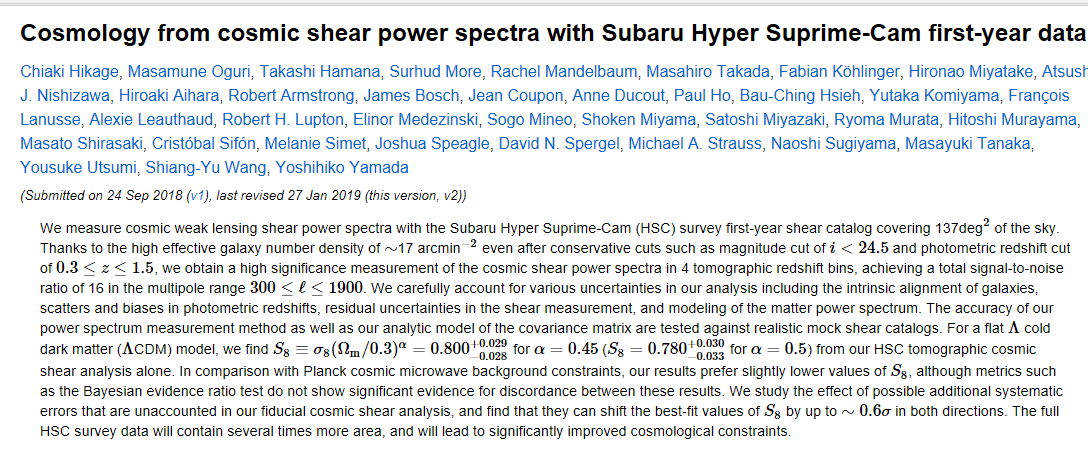
Up with the lark this morning I suddenly remembered I was going to do a post about a paper which actually appeared on the arXiv some time ago. Apart from the fact that it’s a very nice piece of work, the first author is Chiaki Hikage who worked with me as a postdoc about a decade ago. This paper is extremely careful and thorough, which is typical of Chiaki’s work. Its abstract is here:
The work described uses the Hyper-Suprime-CamSubaru Telescope to probe how the large-scale structure of the Universe has evolved by looking at the statistical effect of gravitational lensing – specifically cosmic shear – as a function of redshift (which relates to look-back time). The use of redshift binning as demonstrated in this paper is often called tomography. Gravitational lensing is sensitive to all the gravitating material along the line of sight to the observer so probes dark, as well as luminous, matter.
Here’s a related graphic:
The article that reminded me of this paper is entitled New Map of Dark Matter Spanning 10 Million Galaxies Hints at a Flaw in Our Physics. Well, no it doesn’t really. Read the abstract, where you will find a clear statement that these results `do not show significant evidence for discordance’. Just a glance at the figures in the paper will convince you that is the case. Of course, that’s not to say that the full survey (which will be very much bigger; the current paper is based on just 11% of the full data set) may not reveal such discrepancies, just that analysis does not. Sadly this is yet another example of misleadingly exaggerated science reporting. There’s a lot of it about.
Incidentally, the parameter S8 is a (slightly) rescaled version of the more familiar parameter σ8 – which quantifies the matter-density fluctuations on a scale of 8 h-1 Mpc – as defined in the abstract; cosmic shear is particularly sensitive to this parameter.
Anyway, if this is what can be done with just 11%, the full survey should be a doozy!
The views presented here are personal and not necessarily those of my employer (or anyone else for that matter).
Feel free to comment on any of the posts on this blog but comments may be moderated; anonymous comments and any considered by me to be vexatious and/or abusive and/or defamatory will not be accepted. I do not necessarily endorse, support, sanction, encourage, verify or agree with the opinions or statements of any information or other content in the comments on this site and do not in any way guarantee their accuracy or reliability.







 In the Dark