Not from the stars do I my judgment pluck, And yet methinks I have astronomy, But not to tell of good or evil luck, Of plagues, of dearths, or seasons’ quality. Nor can I fortune to brief minutes tell, Pointing to each his thunder, rain, and wind, Or say with princes if it shall go well By oft predict that I in heaven find. But from thine eyes my knowledge I derive, And, constant stars, in them I read such art As truth and beauty shall together thrive, If from thyself to store thou wouldst convert. Or else of thee this I prognosticate; Thy end is truth’s and beauty’s doom and date.
When, in disgrace with fortune and men’s eyes, I all alone beweep my outcast state And trouble deaf heaven with my bootless cries And look upon myself and curse my fate, Wishing me like to one more rich in hope, Featured like him, like him with friends possess’d, Desiring this man’s art and that man’s scope, With what I most enjoy contented least; Yet in these thoughts myself almost despising, Haply I think on thee, and then my state, Like to the lark at break of day arising From sullen earth, sings hymns at heaven’s gate; For thy sweet love remember’d such wealth brings That then I scorn to change my state with kings.
Like as the waves make towards the pebbled shore,
So do our minutes hasten to their end;
Each changing place with that which goes before,
In sequent toil all forwards do contend.
Nativity, once in the main of light,
Crawls to maturity, wherewith being crown’d,
Crooked eclipses ‘gainst his glory fight,
And Time that gave doth now his gift confound.
Time doth transfix the flourish set on youth
And delves the parallels in beauty’s brow,
Feeds on the rarities of nature’s truth,
And nothing stands but for his scythe to mow:
And yet to times in hope my verse shall stand,
Praising thy worth, despite his cruel hand.
Come, night; come, Romeo; come, thou day in night; For thou wilt lie upon the wings of night Whiter than new snow on a raven’s back. Come, gentle night, come, loving, black-brow’d night, Give me my Romeo; and, when he shall die, Take him and cut him out in little stars, And he will make the face of heaven so fine That all the world will be in love with night And pay no worship to the garish sun.
When I do count the clock that tells the time, And see the brave day sunk in hideous night; When I behold the violet past prime, And sable curls all silvered o’er with white; When lofty trees I see barren of leaves Which erst from heat did canopy the herd, And summer’s green all girded up in sheaves Borne on the bier with white and bristly beard, Then of thy beauty do I question make That thou among the wastes of time must go, Since sweets and beauties do themselves forsake And die as fast as they see others grow; And nothing ‘gainst Time’s scythe can make defence Save breed, to brave him when he takes thee hence.
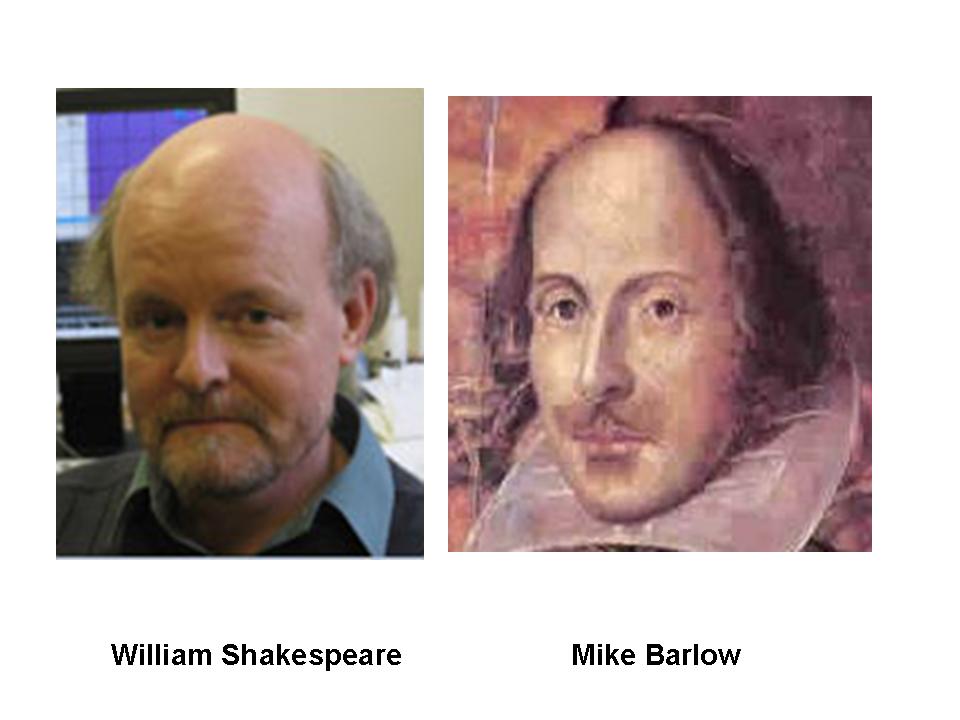
Seeing Professor Mike Barlow‘s contribution to the written evidence submitted to the House of Common’s inquiry into particle physics and astronomy reminded me that he bears a striking resemblance to another noted man of letters…
Gearing up for another stint in Swindon for the STFC Astronomy Grants Panel this week, I was trying to think of an appropriate theme for a blog post. The following short soliloquy from Macbeth somehow came up in a conversation in the pub last week, so I thought I’d post it here.
We actually “did” Macbeth at school and I was lucky enough to be cast in the best part, Lady Macbeth. No jokes please. I went to an all-boys school and, anyway, in Shakespeare’s time all the female roles were actually played by boys. I still remember quite a lot of the speeches I learned then, including all of Lady Macbeth’s famous Act I soliloquy The raven himself is hoarse. I’ll keep that for another post, so that no compunctious visitings of nature distract me from reading grant applications.
The speech below is remarkable for two things, I think. One is that it’s where one of the central themes of the play is laid bare: the numbing of the moral sense. Lady Macbeth has just died, but Macbeth himself seems no longer to care. He’s indifferent to everything around him, as the events that his ambitions have set in motion carry him to his ultimate doom. The incessant, mechanical rhythm of the verse accentuates this sense of inevitability.
The other thing is that, with the exception of some passages from Hamlet, this short excerpt has a higher density of familiar phrases than just about anything else in Shakespeare. Titles of novels and TV programmes figure prominently throughout the text but somehow it has survived all that borrowing without any diminution of its dramatic effect.
To-morrow, and to-morrow, and to-morrow, Creeps in this petty pace from day to day, To the last syllable of recorded time; And all our yesterdays have lighted fools The way to dusty death. Out, out, brief candle! Life’s but a walking shadow, a poor player, That struts and frets his hour upon the stage, And then is heard no more. It is a tale Told by an idiot, full of sound and fury, Signifying nothing.
It’s almost as if the immortal bard himself knew what it was like to have to travel to Swindon over and over again…
I’ve just realised that the Summer Solstice happened this morning at about 6.47am British Summer Time (5h 46m 45s UTC). Astronomy buffs will know that’s the time when the Sun reaches its most northerly position in the sky, leading to the longest day in the northern hemisphere.
Whenever anyone mentions that play I can’t help remembering the version of it we did at School. I only got to act in two plays when I was a schoolboy, but they were both authentically Shakespearean in the sense that all the parts, including the female ones, were played by boys. It was an all-boys school, you see. My best role was undoubtedly as Lady Macbeth in the Scottish play – a much more interesting part than her husband, if you ask me. The only other attempt at acting I ever engaged in was in A Midsummer Night’s Dream. Although I say so myself, my Bottom was the talk of the sixth form.
(I was going to say “and thereby hangs a tail”, but decided not to…)
I should also mention that I also saw Andy Lawrence playing the same part in the Queen Mary Players production of The Dream. I wonder if he remembers doing that?
Curiously, the phrase from which I got the title of this post (“this is very midsummer madness”) is not from this play but from Twelfth Night, a play whose title refers to winter time. I think it might have been a joke.
Anyway, I’m rambling. This clip is a plug for a new recording which sounds pretty good to me. I’ve picked the wonderful Notturno:
Postscript: I’m aware that some people might have been offended by some of the clerihews recently posted on this site. Sometimes the lure of a rhyme can take these into areas best left unvisited. I’d therefore like to offer these, the closing lines of A Midsummer Night’s Dream, by way of an apology. I’ve also now taken the Clerihews themselves offline, owing to a number of attempts to post abusive and/or threatening comments on that page (none of which came from anyone actually named there).
If we shadows have offended,
Think but this, and all is mended,
That you have but slumber’d here
While these visions did appear.
And this weak and idle theme,
No more yielding but a dream,
Gentles, do not reprehend:
if you pardon, we will mend:
And, as I am an honest Puck,
If we have unearned luck
Now to ‘scape the serpent’s tongue,
We will make amends ere long;
Else the Puck a liar call;
So, good night unto you all.
Give me your hands, if we be friends,
And Robin shall restore amends.
I’m glad at least that nobody tried to do a clerihew about Puck. I mean, how could you possible find a rhyme for “Robin Goodfellow”?
The views presented here are personal and not necessarily those of my employer (or anyone else for that matter).
Feel free to comment on any of the posts on this blog but comments may be moderated; anonymous comments and any considered by me to be vexatious and/or abusive and/or defamatory will not be accepted. I do not necessarily endorse, support, sanction, encourage, verify or agree with the opinions or statements of any information or other content in the comments on this site and do not in any way guarantee their accuracy or reliability.


 In the Dark