Archive for December, 2009

Interesting Times

Posted in Biographical, Science Politics, The Universe and Stuff with tags , , , on December 14, 2009 by telescoper

The next few days promise to be extremely interesting, although there is more than a hint of the Chinese Curse in that statement! Today is the day of our annual departmental Christmas Lunch. That’s not itself the subject of any kind of curse, but if last year’s is anything to go by it may take several days to recover from it. I’m preparing myself for it mentality as I write.

Tomorrow, however, 15th December, is the date of the next meeting of the Council of the Science and Technology Facilities Council. On their agenda is the programme of cuts that is proposed as a result of the recent prioritisation exercises initiated to try to find a way out of their ongoing funding crisis. This programme has been through various committees before reaching the Council and, if the Council accepts it, the plans will be unveiled at a press conference on Wednesday 16th (at 2pm) and those about to die will be informed immediately. I’ll try to post a summary on here as soon as I get the facts.

I don’t have any particular inside information who is going to get the chop, but rumour suggests that there will be cuts right across the board. I think it’s going to be very grim news indeed, especially because there is an additional £600 million of savings to be found over the next few years on top of the current shortfall. It’s bound to be a terrible Christmas for those about to find out their contracts are being axed, and no happy New Years for a while either.

I’m not privy to the Council discussions or to the recommendations that have been passed to them so it’s not my place to say what they should do. However, in the unlikely event that anyone from STFC Council is reading this, I hope he/she at least bears in mind that it is not – or at least it shouldn’t be – the job of the Council simply to rubber stamp everything that is passed before it. I wonder, though, if the current Council has the guts to pass a vote of no confidence in the STFC Executive? I doubt it, because there’s been no reason to have confidence in them for the past two years and no such motion has been carried.

Ironically, later in the week there’s going to be a big jamboree in Madrid, at which the initial results of the Science Demonstration Phase of Herschel will be announced. Quite a few of the Cardiff crowd are going along and will be presenting some of the wonderful things that they’ve been working on for the past few weeks. I’ve seen quite a lot of the data from the SPIRE instrument and it’s truly amazing. At least there’s some (infrared) light among the darkness. However, it’s all covered by an ESA press embargo until Wednesday…

War Games

Posted in Biographical, History with tags , , , , , on December 13, 2009 by telescoper

It’s strange how esoteric facts – dates, numbers, names or whatever – can stay with you for years despite your best efforts to forget them. I have a notoriously bad memory for most things. I struggle to remember my own phone number, for example.  However, today’s date, it seems, will be stuck in my rather chaotic mental filing system forever although it probably remains obscure for most readers of this blog. In fact, 13th December 2009 is the 70th anniversary of  the Battle of the River Plate which took place on December 13th 1939.

You’re probably wondering why I remember this so well, so I have to go into confessional mode to explain. When I was a youngster, about 11 or 12, for some reason I developed a complete fascination for naval history. I don’t really know how this happened because there’s no seafaring tradition in my family and I wasn’t brought up near the sea either. The first manifestation of this interest was that I borrowed every book I could find in the local library on the subject of naval warfare. I then moved onto the idea of actually recreating famous battles using die-cast models, a very large table (or more often  a floor) and printed tables of hit probabilities. I spent hours engrossed in this type of thing, after school, until the interest faded or, in other words, I grew out of it.

I think I found naval battles absorbing for a number of reasons. First was that it was easier to see them as a kind of game than with hand-to-hand combat, the thought of which always unsettled me. A battle fought at a distance of many miles,  in which one never really sees one’s enemy, seemed to me a less personal and more abstract kind of thing. Another thing was that the pace was very slow: the large range and relatively slow speed of surface warships meant that an engagement would unfold over many hours, and it was possible to recreate it more or less in real time.

Since the Battle of the River Plate involved a small number of ships, it was a set piece I fought several times (as both British and German captain) against various schoolmates. The most interesting thing I learned through all these re-runs was that, whoever was in charge on whichever side, the result of all our games was always a German victory. I think it’s this that makes me remember it all so well, because what really happened way back in 1939 was remarkably different. So, with my apologies for turning back into a teenage anorak, let me give you a quick account of what happened and why it was all so fascinating to me.

The Admiral Graf Spee was a German warship that was sent to the South Atlantic at the outbreak of World War II in order to sink allied merchant shipping. The Treaty of Versailles that ended  World War I had forbidden Germany from building really big warships, such as battleships, but the Graf Spee packed a much more powerful punch than most ships of its relatively small size. Technically a heavy cruiser, the Graf Spee quickly acquired the more accurate nickname of pocket battleship because she was heavily armoured, fast, and with a powerful main armament of  six 11-inch guns, more than a match for any of the Royal Navy’s  own heavy cruisers.

Under  the captaincy of  Hans Langsdorff, the Graf Spee was initially very successful in sinking  nine merchantships in the Indian Ocean and off the coast of South Africa. Langsdorff, however, was absolutely scrupulous in his behaviour towards the crews of the ships he sank, taking pains to rescue all the crews and ensuring that no lives were lost. Merchant seamen held on the Graf Spee were unstinting in their respect for this most chivalrous and kindly man.

The Graf Spee was enjoying such success that, back home in Blighty, the Admiralty decided to assemble ships into eight separate forces to look for her.  Sensing that things might get a bit hot around the African coast, Langsdorff disappeared into the deep ocean and headed across to the other side of the Atlantic to seek rich pickings in the main shipping lane leading from the ports of Buenos Aires and Montevideo. One of the British hunting groups – Force G – had anticipated this move.

Commanded by Commodore Henry Harwood, Force G consisted of two light cruisers of the Leander class, HMS Ajax (Harwood was on board this ship, which was captained by Charles Woodhouse) and HMS Achilles (captained by Edward Parry, from the New Zealand division of the Royal Navy) and one heavy cruiser HMS Exeter, captained by Frederick “Hooky” Bell. Although Harwood had the numerical advantage, his ships were severely outgunned:  there were only 8-inch guns on the Exeter and 6-inch guns on the Ajax and Achilles. He knew that if they came upon the Graf Spee they would certainly have a fight on their hands, but he knew he had to attack and he prepared the best plan he could think of.

Early in the morning of 13th December 1939 the Graf Spee appeared on the horizon to the North of Force G, and the British ships took to their action stations. Harwood’s battle plan was to separate his forces and engage from two sides in an attempt to split the Graf Spee‘s main armament. He also knew that Graf Spee‘s guns had much longer range than any of his ships as well as firing much larger shells. He had to close quickly in order to have any hope of scoring a hit with his lighter guns. The British ships were only lightly armoured and could not absorb heavy shells from their opponent without being seriously damaged, so this was a very risky strategy, but it was a gamble he felt he had to take.

In our childish after-school wargames, in fact, the Graf Spee always won. All you have to do as commander of the German ship is keep your distance. The British cruisers have an edge in speed, but not by an enormous factor. As long as you manoeuvre in such a way as to keep them at reasonable distance, the accuracy of your long-range gunnery will see you through. Like a boxer with a longer reach than your opponent, you keep out of trouble and score with straight jabs instead of mixing it up at close range.

However, on the bridge of the Graf Spee, Langsdorff made a couple of serious mistakes. The first was not entirely his fault. His lookouts had misidentified the British ships as one light cruiser and two destroyers. Langsdorff jumped to the conclusion that the ships he could see were actually convoy escort vessels and that, beyond the horizon behind them to the south, would be a collection of merchant ships that would be entirely at his mercy once he had disposed of their relatively light protection. He therefore gave the order to increase speed and close with the oncoming ships. A few minutes later he was told of the initial error of identification, but although these were clearly not convoy escorts he still couldn’t believe that such lightly armed ships would come charging at him the way these ones were.

This is when Langsdorff  made his real blunder. Realising that these were warships that were actually looking for him, rather than just escorting unarmed merchantmen, he decided that the only reason they would engage him now – when they were clearly outgunned – was that they were trying to push him out towards the bigger ships he thought would be to the north. He had received intelligence that British battlegroup (Force H), containing the battlecruiser Renown  and the aircraft carrier Ark Royal, might be sailing south to find him, as they had  been spotted leaving harbour in Gibraltar some days earlier. Langsdorff therefore continued to close, his error giving the British a chance to fight at close range. It was an opportunity they did not expect to come their way, and they did their best to take advantage of it. However, the Graf Spee was still the strong favourite to win the battle because of her superior firepower and protective armour.

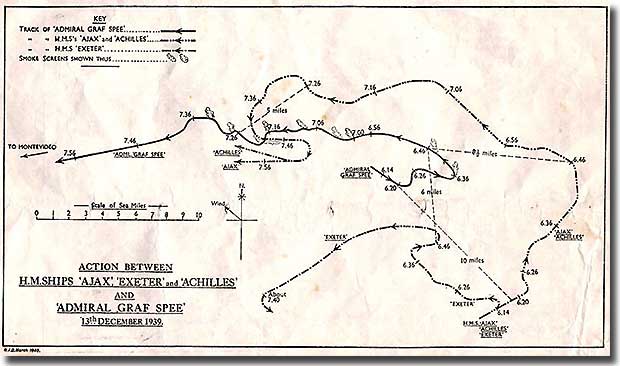
What happened thereafter is shown in the map below, taken from the official Admiralty report into the battle. You can see that Harwood attacked from the south, with Exeter initially turning to port while Ajax and Achilles turned starboard. Langsdorff realised the main threat came from Exeter so he concentrated all his main guns on her, leaving his secondary 5.9 inch guns to engage the two lighter cruisers as they used their superior speed to attack from the other side.

The accuracy of the Graf Spee‘s gunnery soon had Exeter in all sorts of trouble: three out of four main gun turrets were out of action, and the other was being aimed by a gunnery officer standing on the roof with binoculars as the control systems were all shot to pieces; the bridge had been hit, killing most of the officers and knocking out the steering controls, so that for the rest of the battle Exeter was navigated using a small compass taken from one of the ship’s boats; she was also listing about 7 degrees and taking in water. In all, Exeter took seven direct hits from 11-inch shells and 61 of her crew were killed. It was a grim situation but, in the middle of all this, she did manage to score a direct hit on the Graf Spee which didn’t appear at first to be critical but which, it later emerged, was another  stroke of luck for the British.

RiverPlateBattleChart
Realising that Exeter could not go on taking such heavy punishment, and with his own ships too far away to inflict any real damage on their target, Harwood decided to throw caution to the winds, charging repeatedly with Ajax and Achilles to almost suicidally close range to fire torpedoes, and then turning side on to fire full broadsides at the Graf Spee. Although they only inflicted superficial damage, and didn’t by any means emerge unscathed themselves, they did succeed in putting Langsdorff off  his stroke. While Graf Spee switched her attention to the Ajax and Achilles, Exeter used the  breathing space given to her by the courageous action of her sister ships to retire, heavily damaged, under the cover of a smokescreen, southwards to the Falkland Islands for emergency repairs.

Harwood knew he could not carry on the battle with only two ships, so he fell back, expecting the Graf Spee to come after him scenting victory. However, to his surprise, Langsdorff had apparently decided not to finish off the two ligher vessels – nor had he made sure of the Exeter – but instead was steaming due West towards the estuary of River Plate and the port of Montevideo, in neutral Uruguay. The British  fell back and shadowed him, wondering what on earth he was up to.

The reason for Langsdorff’s strange actions seems to be the 8-inch shell hit from the Exeter, which had put the Graf Spee‘s fuel systems out of action. This meant that she only had a few hours fuel left and if she didn’t make it into harbour for repairs then she would be a sitting duck. There were no friendly ports within range, so there was no alternative but to head for the nearest neutral one, which was Montevideo.

The following morning  (14th December 1939) found the Admiral Graf Spee at anchor in Montevideo. The naval battle was over, but another fascinating episode was just starting. The Hague Convention allowed warships to effect repairs in neutral harbours, but only those  that improved their seaworthiness not their fighting efficiency. The British knew that if the Graf Spee came out of harbour she could brush aside force waiting outside in the Estuary. The Ajax and Achilles had been joined by HMS Cumberland, a similar ship to Exeter, but the odds were against them being able to cope. The larger warships of Force H were in fact on their way but would take days to get there.

The British therefore launched an elaborate deception scheme. Unencrypted messages were sent (accidentally on purpose) suggesting battleships were arriving, false  requisitions for aviation fuel for the Ark Royal‘s aircraft were tendered. Phoney wireless traffic filled the Uruguayan airwaves and the notoriously leaky telephone system in Montevideo was used as a highly effective rumour mill. The three British ships outside the harbour busied themselves with making as much smoke as they could to give the impression that a large number of ships were gathering close to the shore.

The Germans were entirely deceived and were convinced that the Graf Spee was cornered by a huge fleet of British warships. Langsdorff took stock. He had used up most of his ammunition in the preceding battle and only had enough left for about 20 minutes action. He had to follow the obligations of international treaties and leave port by 17th December otherwise his ship would be interned. He had been ordered that the latter was not acceptable. He made his decision.

On the appointed date, the Graf Spee slipped out of harbour and proceeded slowly along the Estuary watched by a huge crowd wondering what was going to happen. It appeared that much of the crew had remained behind, suggesting that there might be a skeleton crew onboard preparing to fight one last suicidal battle. Suddenly she stopped. A small launch was seen to leave. A few minutes later a series of enormous explosions ripped the ship apart. Langsdorff had decided to avoid any further loss of life and also avoid the ship falling into enemy hands by deliberately scuttling her. The Admiral Graf Spee sank in the deepest part of the channel, where she remains to this day.

I’m aware of a growing sense of guilt at reliving my childhood fascination with this episode through this blog post. Coming back to it as an adult, however, I am painfully aware of the things I didn’t think about at all when I was much younger. The reality isn’t a game, of course. Over a hundred brave men died in the Battle of the River Plate – 36 on board the Graf Spee and 72 on the British ships (most on HMS Exeter) and one, Captain Langsdorff, committed suicide (on 19th December 1939, by shooting himself in the head while wrapped in the flag of the German Navy).

In fact the character that most exemplifies the sense of tragedy surrounding this story is Hans Langsdorff. An experienced naval officer who served at the Battle of Jutland in 1917 and, by all accounts, a decent and humane man, I see him as someone compelled to fight by a sense of duty rather than anything else. He certainly had no ill-will towards his enemies, and spoke with great admiration of the courage shown by his adversaries. He clearly had no taste for the indiscriminate sinking of defenceless merchant vessels which was what he had been called upon to do.   He may not have been particulrly effective as a tactical commander during the battle, but his errors largely arose from him being supplied with incorrect information.

It should also be noted that, at the funeral of the German sailors who had died in the Battle of the River Plate, Langsdorff gave the traditional German military salute, in contrast to all other officers present who gave the Nazi straight-arm version.

Tate Collection | Gordon’s Makes Us Drunk by Gilbert & George

Posted in Art with tags on December 11, 2009 by telescoper

I don’t know about you, but I think this is brilliant….

Vodpod videos no longer available.

more about “Tate Collection | Gordon’s Makes Us D…“, posted with vodpod

Author Credits

Posted in Science Politics, The Universe and Stuff with tags , , , , , , on December 10, 2009 by telescoper

I’ve posted before about the difficulties and dangers of using citation statistics as measure of research output as planned by the forthcoming Research Excellence Framework (REF). The citation numbers are supposed to help quantify the importance of research as judged by peers. Note that, in the context of the REF, this is a completely different thing to impact which counts a smaller fraction of the assessment and which is supposed measure the influence of research beyond its own discipline. Even the former is difficult to measure, and the latter is well nigh impossible.

One of the problems of using citations as a metric for research quality is to do with how one assigns credit to large teams of researchers who work in collaboration. This is a particularly significant, and rapidly growing, problem in astronomy where large consortia are becoming the exception rather than the rule. The main questions are: (i) if paper A is cited 100 times and has 100 authors should each author get the same credit? and (ii) if paper B is also cited 100 times but only has one author, should this author get the same credit as each of the authors of paper A?

An interesting suggestion over on the e-astronomer addresses the first question by suggesting that authors be assigned weights depending on their position in the author list. If there are N authors the lead author gets weight N, the next N-1, and so on to the last author who gets a weight 1. If there are 4 authors, the lead gets 4 times as much weight as the last one.

This proposal has some merit but it does not take account of the possibility that the author list is merely alphabetical which I understand will be the case in forthcoming Planck publications, for example. Still, it’s less draconian than another suggestion I have heard which is that the first author gets all the credit and the rest get nothing. At the other extreme there’s the suggestion of using normalized citations, i.e. just dividing the citations equally among the authors and giving them a fraction 1/N each.

I think I prefer this last one, in fact, as it seems more democratic and also more rational. I don’t have many publications with large numbers of authors so it doesn’t make that much difference to me which you measure happen to pick. I come out as mediocre on all of them.

No suggestion is ever going to be perfect, however, because the attempt to compress all information about the different contributions and roles within a large collaboration into a single number, which clearly can’t be done algorithmically. For example, the way things work in astronomy is that instrument builders – essential to all observational work and all work based on analysing observations – usually get appended onto the author lists even if they play no role in analysing the final data. This is one of the reasons the resulting papers have such long author lists and why the bibliometric issues are so complex in the first place.

Having dozens of authors who didn’t write a single word of the paper seems absurd, but it’s the only way our current system can acknowledge the contributions made by instrumentalists, technical assistants and all the rest. Without doing this, what can such people have on their CV that shows the value of the work they have done?

What is really needed is a system of credits more like that used in the television or film. Writer credits are assigned quite separately from those given to the “director” (of the project, who may or may not have written the final papers), as are those to the people who got the funding together and helped with the logistics (production credits). Sundry smaller but still vital technical roles could also be credited, such as special effects (i.e. simulations) or lighting (photometic calibration). There might even be a best boy. Many theoretical papers would be classified as “shorts” so they would often be written and directed by one person and with no technical credits.

The point I’m trying to make is that we seem to want to use citations to measure everything all at once but often we want different things. If you want to use citations to judge the suitability of an applicant for a position as a research leader you want someone with lots of directorial credits. If you want a good postdoc you want someone with a proven track-record of technical credits. But I don’t think it makes sense to appoint a research leader on the grounds that they reduced the data for umpteen large surveys. Imagine what would happen if you made someone director of a Hollywood blockbuster on the grounds that they had made the crew’s tea for over a hundred other films.

Another question I’d like to raise is one that has been bothering me for some time. When did it happen that everyone participating in an observational programme expected to be an author? It certainly hasn’t always been like that.

For example, go back about 90 years to one of the most famous astronomical studies of all time, Eddington‘s measurement of the bending of light by the gravitational field of the Sun. The paper that came out from this was this one

A Determination of the Deflection of Light by the Sun’s Gravitational Field, from Observations made at the Total Eclipse of May 29, 1919.

Sir F.W. Dyson, F.R.S, Astronomer Royal, Prof. A.S. Eddington, F.R.S., and Mr C. Davidson.

Philosophical Transactions of the Royal Society of London, Series A., Volume 220, pp. 291-333, 1920.

This particular result didn’t involve a collaboration on the same scale as many of today’s but it did entail two expeditions (one to Sobral, in Brazil, and another to the Island of Principe, off the West African coast). Over a dozen people took part in the planning,  in the preparation of of calibration plates, taking the eclipse measurements themselves, and so on.  And that’s not counting all the people who helped locally in Sobral and Principe.

But notice that the final paper – one of the most important scientific papers of all time – has only 3 authors: Dyson did a great deal of background work getting the funds and organizing the show, but didn’t go on either expedition; Eddington led the Principe expedition and was central to much of the analysis;  Davidson was one of the observers at Sobral. Andrew Crommelin, something of an eclipse expert who played a big part in the Sobral measurements received no credit and neither did Eddington’s main assistant at Principe.

I don’t know if there was a lot of conflict behind the scenes at arriving at this authorship policy but, as far as I know, it was normal policy at the time to do things this way. It’s an interesting socio-historical question why and when it changed.

Budget Bombshell

Posted in Science Politics with tags , , , on December 9, 2009 by telescoper

As pointed out by Roger Highfield, there’s some grim news for science and higher education  in today’s pre-budget report by Chancellor of the Exchequer Alistair Darling.

In Chapter 6 of the document there is a  list of cuts to be made in public expenditure as a response to the worse-than-expected state of the public finances. Among them you can find a whopping

£600 million from higher education and science and research budgets from a combination of changes to student support within existing arrangements; efficiency savings and prioritisation across universities, science and research; some switching of modes of study in higher education; and reductions in budgets that do not support student participation;

The first means students will suffer because of cuts to the support they will be offered. “Efficiency savings” means what it always means, reducing the level of service to save money. I’ve no idea what “switching of modes of study” means, but I guess it has something to do with having a larger proportion of part-time students. The last bit is completely lost on me. If anyone reading this can translate it into English for me I’d be very grateful.

It is clear that the Research Councils will have to find their share of the efficiency savings. Since the one most directly relevant to me, the Science and Technology Facilities Council (STFC) is already on the ropes after a series of financial catastrophes this does not augur well the level of cuts expected to be announced in the next few days as a result of their recent prioritisation exercise:

The primary focus of Council’s latest meeting was a review of the programme prioritisation now underway. The chair and deputy chair of Science Board, Professors Jenny Thomas and Tony Ryan, discussed the process of input from advisory panels to the Physical And Life Sciences Committee (PALS) and the Particle Physics, Astronomy and Nuclear Physics Science Committee (PPAN), and thence to Science Board which will meet 7-8 December to finalise its recommendations to the Council meeting on 15 December. Council agreed the importance of informing the community as quickly as possible after its meeting of the outcome.

So we can expect to hear next week who’s for the shredder. I’m sure STFC were making contigency plans for different possible outcomes, but I’m pretty sure this was close to their worst possible case. Many of us are going to have a very depressing Christmas, as the axe is sure to fall on the astronomy programme in extremely brutal fashion. The cuts will be deep and the injuries sustained will leave scars that will last for many years. The pre-budget statement shows that there’s going to be a long dark tunnel for British science with very little evidence of light at the end of it.

It won’t just be astronomy research that suffers, of course. The Higher Education sector is feeling the pinch already, with redundancies already looming at several institutions. You can place your bets as to how many departments will close over the next year or two, and how many talented scientists will be moving abroad to secure their future rather than stay in a country that seems to place so little value on science.

Dark Matter Rumour

Posted in The Universe and Stuff with tags , , on December 8, 2009 by telescoper

In between a morning session – technically a “half-away-day” discussing Strategic Issues in the Development of Postgraduate Research at Cardiff University (zzzz..) and tootling off to Bristol this afternoon to give a recapitulation of my public lecture on the Cosmic Web to the South-West Branch of the Institute of Physics in Bristol, I don’t have time to post much today.

I will, however, take the opportunity to do what the blogosphere does best, which is to spread unfounded (or perhaps partly founded rumours). If it’s true this one is a biggy, but I’m not responsible for any loss or damage arising if it turns out to be untrue…

The rumour (which I first heard about here and then, a bit later, there) is that the Cryogenic Dark Matter Search (CDMS) experiment (which is based down  a mine in Minnesota, but  run from the University of California at Berkeley) is about to announce the direct discovery of dark matter.

I don’t have any inside information, but it is alleged that the collaboration has had paper accepted in Nature – and they generally only publish really significant results rather than upper limits (unless they are to do with gravitational waves).  Nature articles are embargoed until publication, meaning that the collaboration can’t release the results or talk about them until December 18…

..so I guess you will just have to wait!

Bright Star

Posted in Biographical, Poetry with tags , , on December 7, 2009 by telescoper

After spending the best part of the day ploughing through a succession of tedious jobs and wasting most of my lunch break trying to cope with a recalcitrant IPod, I came home with a brain completely drained of any bloggable material. However, picking up the paper instead of switching the television on proved to be a good move. It reminded me that I went to see the film Bright Star a couple of weeks ago. Since yesterday’s post was in poetic vein a quick post about it would seem to be in order, although I’ve never attempted a movie review on here before.

Directed by Jane Campion, Bright Star is a film about the life of John Keats (played by Ben Whishaw) and his passionate infatuation with the girl next door, a young lady by the name of Fanny Brawne (Abby Cornish). This romance inspired Keats to compose some of the most famous  love letters ever written in the English language. Keats’  letters were published in the 1870s (long after his death in 1821 at the aged of 25) but the other half of the correspondence – the letters written by Fanny – are lost. This is a problem for literary historians, who don’t really know what to make of her, but a boon for the dramatist, who has the chance to create a character from scratch unfettered by too many preconceptions. What emerges is a dignified, slightly eccentric and highly fashion-conscious heroine who makes stylish hats and frocks while her admirer is scribbling his verses. There’s more sewing in this film than in any other I’ve ever seen. The clothes look great, if a bit anachronistic. It’s a costume drama with a difference. Overall, in fact, the film looks gorgeous. The photography is just stunning – it has been a very long time since I last saw anything so beautiful on the big screen.

Keats once described Fanny as “beautiful, elegant, graceful, silly, fashionable and strange”. I think Abby Cornish conveys all of that. But at other times he was less flattering, calling her

ignorant – monstrous in her behaviour, flying out in all directions, calling people such names that I was forced lately to make use of the term Minx – this I think not from any innate vice but from a penchant she has for acting stylishly.  I am however tired of such style and shall decline any more of it.

Of course he did no such thing. Keats’ friend Charles Amitage Brown thought Fanny was an interfering flirt and American critic  Richard Henry Stoddard said “She made him look ridiculous in the eyes of his friends”.  There’s no way of knowing what she was really like – it’s always hard for outsiders to understand other people’s obsessions anyway – but in the movie she is definitely a bit prickly at times.

By contrast with Fanny’s perky glamour, Keats himself is a drab, introspective, almost ghostly figure. His brother dies of tuberculosis – the disease which will shortly get him too. His descent into poverty and illness is exacerbated by the terrible critical reception that greets his poetry. The only thing he really has to cling to is his relationship with “The Minx” which is beautifully portrayed, their growing intimacy only gradually revealed. Much of their dialogue is taken, word for word, directly from Keats’ letters but somehow it doesn’t sound stilted. Their passion is restrained, but keenly observed.

The title of the movie is actually taken from that of one of Keats’ poems. Written in 1819, a year after he met Fanny, this expresses a desire to withdraw from the shifting uncertain world of change and enter a world of timelessness where he can be with his beloved for all eternity.

Bright star, would I were stedfast as thou art–
Not in lone splendour hung aloft the night
And watching, with eternal lids apart,
Like nature’s patient, sleepless Eremite,
The moving waters at their priestlike task
Of pure ablution round earth’s human shores,
Or gazing on the new soft-fallen mask
Of snow upon the mountains and the moors–
No–yet still stedfast, still unchangeable,
Pillow’d upon my fair love’s ripening breast,
To feel for ever its soft fall and swell,
Awake for ever in a sweet unrest,
Still, still to hear her tender-taken breath,
And so live ever–or else swoon to death.

Keats himself died just a couple of years after writing this, although I doubt that his death from tuberculosis amounted to the kind of blissful rapture he suggests in the last two lines.

Walking back home afterwards, it struck me that  if you didn’t know anything about Keats and Fanny Brawne before watching the film, you would think it was Fanny who was the “Bright Star” of the title. During his lifetime there was never any suggestion that John Keats would ever – even in death – acquire a reputation as one of the greatest poets in the English language.  His work was never popular in his lifetime and was pretty universally reviled by critics too. In poetry as well as in science, it is well nigh impossible to know what is going to last. Only time will tell.

Science and Poetry

Posted in Poetry, The Universe and Stuff with tags , , , on December 6, 2009 by telescoper

In amongst all the doom and gloom about job cuts and the oncoming onslaught that goes by the name of impact, I found in this week’s Times Higher a thought-provoking article about the demise of poetry. The author, Neil McBride, is principal lecturer in Informatics at De Montfort University and the piece is made all the more interesting by the fact that it includes some of his own verse. In fact, with his permission, I’ve included one of the poems below.

I agree with some of what McBride says in his article and disagree with some too. I don’t intend to dissect the piece here, and suggest instead that you read it yourself and form your own opinion. Since I wanted to include one of the poems here, however, I thought I should at least address its context in the article. The opening paragraph states

Dame Jocelyn Bell Burnell, the renowned astrophysicist, hid her love for poetry from the world until she retired, out of fear for what people would think.

In fact, I posted an item about an anthology of astronomy-inspired poems edited by Jocelyn on this blog many moons ago. McBride goes on to describe an anthology of poetry written by scientists that was published in 2001 wherein all the writers remained anonymous, the reason being

Good intelligent men and women, clothed in cold rationality, considered it professional suicide to admit to any literary emotions.

The following poem, McBride’s own, develops this image to the point of caricature:

Science and Poetry

In his lab he’s hid “Whitsun Weddings” behind the sink,
The latest volume of Fuller sandwiched between reagent catalogues.
Shakespeare’s sonnets encoded in the lab book
Rossetti pasted to the wall behind the periodic table.

Amongst the chaotic dishes and tubes, there cannot be anything poetic at all
Rhythm and language must be neutralised, the third person
Is the wash of objectivity, the veneer of scientific discipline:
Verse is hidden at the back of a draw covered with Millipore.

The poets of science have no names, clothed in the shame
Of irrationality, the atrocity of the literary mind is unspoken
Words must be disguised, sanitised. Any evidence of life
Outside the rational, the objective, must be denied.

The observatory is cold, dark, starless. Pulsars blip
The steady drip, drip of numbers stripped of spirit
The poetry of the stars must be denied
Planets are mathematical objects swimming in an emotional vacuum.

Do not suggest that patterns, laws, and the aesthetics of structure
Hold anything of the spirit. Don’t speak poetry to me:
We silence our critics, mute emotions, declare ourselves ‘observers’.
There is no soul, nothing but a rotting body of clockwork chemicals.

It’s certainly a finely crafted piece of satire, but as a scientist myself I have to stand up for my brothers and sisters and say that it is very far from my experience of their view of literature. Perhaps astronomy attracts more romantic types more likely to wear their hearts (and literary sensibilities) on their sleeves than computer scientists or chemists. The many scientists I know who do read and write poetry do not hide- and, as far as I know, never have hid – this from their peers or anyone else. And I doubt if it ever occurred to any of them that confession to a love of poetry would damage their careers. I don’t think there ever was a reason for Dame Jocelyn to have hidden it away for all those years, or perhaps she was just using poetic license?

McBride goes on to discuss a number of possible reasons for poetry’s falling popularity. Modern poetry is too difficult , too obscure, too “academic” , for the reader-in-the-street to understand. That’s not helped by the fact that, in this digital age people, the immediate availability of easier visual forms of entertainment is making people less receptive to literature that requires prolonged reflection. I think there’s truth in both of these arguments, but I think there’s another possibility: that the internet revolution may just be changing the way literature is conceived and delivered, just as technological and sociological change has done many times in the past.

In the course of his very interesting piece, McBride also touches on another theme I’ve posted about a number of times. To quote:

Perhaps the power of poetry is its downfall. It addresses uncertainty. It questions, it leaves frayed edges and loose wires. We reject poetry because we shun its emotional engagement.

This reminds me of the stereotypical image of a scientist as an arrogant god of certainty, one that I don’t recognize at all. Scientists are constantly addressing uncertainty. That’s their job. I’m sure we’re all too aware of frayed edges and loose wires too. The conflict and indeterminacy we face in our work is not the same as people find in their emotional lives, of course, but the need to engage with it causes similar levels of stress!

Most people don’t care much for either science or poetry. Both are considered too hard, but probably in different ways. The digital age hasn’t turned everyone into unthinking zombies, but I think it has probably led to more people opting out of difficult ways of earning a living and finding easier ways of spending their leisure time. But there are still some who find pleasure in what’s difficult. Perhaps the reason why so many scientists love poetry is that they know how hard it is.

You can find more of Neil McBride’s poetical work here.

The Chromoscope

Posted in The Universe and Stuff with tags , , , , on December 5, 2009 by telescoper

Just a quick post to plug the chromoscope, which is “an accessible, easy tool that anyone can use to explore and understand the sky at multiple wavelengths”. It was originally created for the Royal Society Summer Science Exhibition 2009 by Stuart Lowe (Jodrell Bank), Chris North (Cardiff), and Robert Simpson (Cardiff) and is now available online for your education and enjoyment.

It has its own blog on which there’s a load of information about  all the different data sets used to make it (covering the range from radio to X-ray), and there’s even a video to explain how it works so I don’t have to!

I was there for part of the Summer Exhibition (I blogged about it, in fact) so had the chance to play with the original version, which was set up for  large display screens on the Herschel/Planck exhibit. Have a go with it yourself on the small screeen by clicking here!

The Curve of Growth

Posted in History with tags , , on December 4, 2009 by telescoper

While I was indisposed earlier this week, I had the chance to read some interesting books about local history. Among the quite surprising facts I turned up about the City of Cardiff was its spectacular population growth. The first official census was held in 1801 and it  showed Cardiff to have a population of 1,870 – much smaller than other Welsh towns like Merthyr Tydfil (7,700) and Swansea (6,000). Every ten years another census was carried out, with the figures for Cardiff growing as follows:

1801 – 1,870
1811 – 2,457
1821 – 3,251
1831 – 6,187
1841 – 10,079
1851 – 18,351
1861 – no data
1871 – 57,363
1881 – no data
1891 – 128,915
1901 – 164,333
1911 – 182,259
1921 – 222,827
1931 – 226,937
1941 – no data
1951 – 243,632
1961 – 283,998
1971 – 293,220
1981 – 286,740
1991 – 296,900
2001 – 305,353

The growth of the docks in Cardiff Bay, driven by the export of coal from the valleys, seems to have been the main factor in driving the population increase, and this accelerated markedly from the middle of the 19th century until the early 20th century.

Early on in the industrial revolution the South Wales valleys were primarily concerned with the production of iron. In February 1794, the 25-mile-long Glamorganshire Canal was opened between Cardiff and Merthyr Tydfil to bring iron products down to the coast and for nearly 50 years was unchallenged as the main transport link between the two towns.  It was later to become the primary route for carrying coal to the Bay.

In October 1839, the Bute West Dock covering 19 acres with 9,400 feet of quays was opened, and the construction of the Dock Feeder to regulate the water supply to the dock from the River Taff was completed.  Entirely paid for by the second Marquis of Bute, this new dock set in motion Cardiff’s amazing growth to become the world’s biggest coal exporting port. The Taff Vale Railway was opened in 1841 between Cardiff and Abercynon and soon overtook the Glamorganshire Canal in economic importance. Coal shipments from Cardiff exceeded one million tons for the first time in 1851. In December 1855, the first historical trainload of Rhondda steam coal arrived at Cardiff, where the Bute East Dock was opened. By 1883 the docks handled six million tons of coal and by 1913 this figure had grown to a staggering 107 million tons.

Much of the labour needed to handle this volume of coal came from immigrants, including very large numbers of Irish but also lots of other people from all around the world. By 1850 there were no less than 20 foreign consulates in Cardiff and the city quickly established the cosmopolitan reputation it has kept to this day.

After the end of the First World War the coal trade suffered because the market was flooded with cheap German coal used for war reparations. That, and the subsequent depression, led to a decline in Cardiff as a port, although it was very busy during the Second World War. About 75 per cent of the supplies for the American forces in Europe were shipped out through Cardiff docks following the D-Day landings in June 1944.  This was a short-lived renaissance; the last ever shipment of coal left Bute Dock in 1950.

Finally, another thing I hadn’t known. Cardiff was only officially recognized as the capital city of Wales in 1955. Prior to that Wales had no separate legal existence, was entirely governed by English Law and was run entirely from Westminster. The strong local rivalry between Cardiff and Swansea largely stems from this time, as Swansea – a much older city – was an unsuccessful contender for the title of capital.

For a whole load of other interesting facts and figures about Cardiff, see the Cardiff Timeline.