Archive for December, 2010

Ulysses

Posted in Poetry with tags , , on December 13, 2010 by telescoper

I hope you don’t mind me digging  into my poetry collection for today’s post. It’s the last week of term and the days are so manic with so much to do I’m struggling to find time to post anything original. This poem, Ulysses by Alfred Lord Tennyson,  comes from the file marked “uplifting”. Like many great poems it works on several levels. It’s a scholarly treatment, with references to Virgil, Homer, and even Shakespeare. It carries a universal message not to surrender meekly to the advancing years. Above all, though, it’s a dramatic monologue, its forceful use of language, for my money, the match for anything in Shakespeare. If any poem needs to be read out loud to be enjoyed, this is it…

It little profits that an idle king,
By this still hearth, among these barren crags,
Matched with an aged wife, I mete and dole
Unequal laws unto a savage race,
That hoard, and sleep, and feed, and know not me.

I cannot rest from travel: I will drink
Life to the lees: all times I have enjoyed
Greatly, have suffered greatly, both with those
That loved me, and alone; on shore, and when
Through scudding drifts the rainy Hyades
Vext the dim sea: I am become a name;
For always roaming with a hungry heart
Much have I seen and known; cities of men
And manners, climates, councils, governments,
Myself not least, but honoured of them all;
And drunk delight of battle with my peers;
Far on the ringing plains of windy Troy.
I am part of all that I have met;
Yet all experience is an arch wherethrough
Gleams that untravelled world, whose margin fades
For ever and for ever when I move.
How dull it is to pause, to make an end,
To rust unburnished, not to shine in use!
As though to breath were life. Life piled on life
Were all to little, and of one to me
Little remains: but every hour is saved
From that eternal silence, something more,
A bringer of new things; and vile it were
For some three suns to store and hoard myself,
And this gray spirit yearning in desire
To follow knowledge like a sinking star,
Beyond the utmost bound of human thought.

This is my son, mine own Telemachus,
To whom I leave the scepter and the isle
Well-loved of me, discerning to fulfill
This labour, by slow prudence to make mild
A rugged people, and through soft degrees
Subdue them to the useful and the good.
Most blameless is he, centered in the sphere
Of common duties, decent not to fail
In offices of tenderness, and pay
Meet adoration to my household gods,
When I am gone. He works his work, I mine.

There lies the port; the vessel puffs her sail:
There gloom the dark broad seas. My mariners,
Souls that have toiled, and wrought, and thought with me
That ever with a frolic welcome took
The thunder and the sunshine, and opposed
Free hearts, free foreheads you and I are old;
Old age had yet his honour and his toil;
Death closes all: but something ere the end,
Some work of noble note, may yet be done,
Not unbecoming men that strove with Gods.
The lights begin to twinkle from the rocks:
The long day wanes: the slow moon climbs: the deep
Moans round with many voices. Come, my friends,
‘Tis not too late to seek a newer world.
Push off, and sitting well in order smite
The sounding furrows; for my purpose holds
To sail beyond the sunset, and the baths
Of all the western stars, until I die.
It may be that the gulfs will wash us down:
It may be we shall touch the Happy Isles,
And see the great Achilles, whom we knew.
Though much is taken, much abides; and though
We are not now that strength which in the old days
Moved earth and heaven; that which we are, we are,
One equal-temper of heroic hearts,
Made weak by time and fate, but strong in will
To strive, to seek, to find, and not to yield.

And I couldn’t resist putting this little clip of the late John Gielgud‘s majestic reading of the last few measures. Forget the fact that it’s from a commercial for a bank and, in my opinion, is nearly ruined by completely unnecessary and intrusive musical accompaniment, just listen to the words and how Gielgud (near the end of his own life)  gets perfectly inside their meaning.   There’s none of Dylan Thomas’ “rage against the dying of the light” here, just a dignified refusal to surrender. Listen to the way he speaks “..until I die”, and you’ll understand what I mean.


Share/Bookmark

Messiah

Posted in Biographical, Music with tags , , , on December 12, 2010 by telescoper

Just back from St David’s Hall, Cardiff, where I’ve been listening to a performance of Handel‘s great oratorio Messiah by the Orchestra, Soloists and Chorus of Welsh National Opera under the baton of Conductor Lothar Koenigs. I haven’t got time to write much (as I’m famished), but I enjoyed the concert so much I wanted to write something before the buzz disappeared.

I don’t mind admitting that Messiah is a piece that’s redolent with nostalgia for me – some of the texts remind me a lot of Sunday School and singing in a church choir when I was little and then, a bit later, listening to the whole thing at Christmas time at the City Hall in Newcastle. I loved it then, and still do now, almost 40 years later. I know it’s possible to take nostalgia too far – nobody can afford to spend too much time living in the past – but I think it’s good to stay in contact with your memories and the things that shaped you when you were young. I haven’t seen Messiah live for a very long time, and tonight was like meeting an old friend after a long absence, and discovering that he’s just like you remembered him all those years ago.

Setting aside the wistful reminiscences it brought to mind, tonight’s performance was in any case exceptional. The Orchestra of WNO was on top form, and Lothar Koenigs directed them with great skill and vision. The tempo might have been a bit brisk in places for some tastes – or so I was told in the bar at the interval – but I thought the pace was excellent. Soprano Laura Mitchell and tenor Robin Tritschler both sang with crystal clarity, and bass baritone Darren Jeffrey was in fine voice too. Mezzo Patricia Bardon seemed to struggle a little bit to assert herself; her chest tones have a slightly woolly sound which at times got lost in the undergrowth of the orchestra’s string section, but that was only a problem in a few places.

The centerpiece of the performance, however, was a magnificent display by the WNO chorus. They were kept under a pretty tight rein for most of the time by Chorus Master Stephen Harris, who had them holding back enough in reserve that when they unleashed the full fortissimo the dramatic effect was truly thrilling. Little surprise that they got such warm applause at the end; I thought they were magnificent.

The one thing I wasn’t sure about before the concert started was whether and to what extent the folk at St David’s Hall would observe the tradition of standing during the Hallelujah Chorus. I’ve never been sure how widespread this practice was; it was definitely accepted (and indeed expected) way back when in the City Hall, Newcastle, but I fear many in the rest of the UK think of us Geordies as uncivilised rabble and for all I knew the posher parts of England might have abandoned this quaint practice decades ago.

Cardiff is actually a bit like Newcastle in some ways, but the tradition of music making is much stronger here in Wales. On the other hand -as one of my former colleagues from London days warned me when he heard I’d decided to move here – Cardiff is also a bit old-fashioned. I know what he meant, and I think he was right, but I don’t think it’s at all the worse for being so.

Anyway, I was delighted that, when the time came for the Hallelujah Chorus, the entire audience rose as one to its feet to hear a stunning rendition of this most majestic piece of music. It was King George II’s decision to stand in acknowledgement of Handel’s genius that initiated this ritual, and there’s a very special feeling knowing that you’re celebrating something that’s been celebrated the same way for over 250 years and is still something that’s completely exhilirating to listen to.


Share/Bookmark

Years

Posted in Poetry, The Universe and Stuff with tags , , on December 12, 2010 by telescoper


They enter as animals from the outer
Space of holly where spikes
Are not thoughts I turn on, like a Yogi,
But greenness, darkness so pure
They freeze and are.

O God, I am not like you
In your vacuous black,
Stars stuck all over, bright stupid confetti.
Eternity bores me,
I never wanted it.

What I love is
The piston in motion —-
My soul dies before it.
And the hooves of the horses,
Their merciless churn.

And you, great Stasis —-
What is so great in that!
Is it a tiger this year, this roar at the door?
It is a Christus,
The awful

God-bit in him
Dying to fly and be done with it?
The blood berries are themselves, they are very still.

The hooves will not have it,
In blue distance the pistons hiss.

by Sylvia Plath (1932-63).

Et in Arcadia Lego…

Posted in The Universe and Stuff with tags , , on December 11, 2010 by telescoper

The Antikythera Mechanism is a remarkable mechanical computer that’s thought to date from somewhere around 150 B.C. Our own Mike Edmunds is the lead academic on the Antikythera Mechanism Research Project which has been studying this amazing artefact so I thought he and other Cardiff folks would enjoy this, which shows a reproduction of the device made from Lego:


Share/Bookmark

Deductivism and Irrationalism

Posted in Bad Statistics, The Universe and Stuff with tags , , , , , , , , , , , on December 11, 2010 by telescoper

Looking at my stats I find that my recent introductory post about Bayesian probability has proved surprisingly popular with readers, so I thought I’d follow it up with a brief discussion of some of the philosophical issues surrounding it.

It is ironic that the pioneers of probability theory, principally Laplace, unquestionably adopted a Bayesian rather than frequentist interpretation for his probabilities. Frequentism arose during the nineteenth century and held sway until recently. I recall giving a conference talk about Bayesian reasoning only to be heckled by the audience with comments about “new-fangled, trendy Bayesian methods”. Nothing could have been less apt. Probability theory pre-dates the rise of sampling theory and all the frequentist-inspired techniques that modern-day statisticians like to employ.

Most disturbing of all is the influence that frequentist and other non-Bayesian views of probability have had upon the development of a philosophy of science, which I believe has a strong element of inverse reasoning or inductivism in it. The argument about whether there is a role for this type of thought in science goes back at least as far as Roger Bacon who lived in the 13th Century. Much later the brilliant Scottish empiricist philosopher and enlightenment figure David Hume argued strongly against induction. Most modern anti-inductivists can be traced back to this source. Pierre Duhem has argued that theory and experiment never meet face-to-face because in reality there are hosts of auxiliary assumptions involved in making this comparison. This is nowadays called the Quine-Duhem thesis.

Actually, for a Bayesian this doesn’t pose a logical difficulty at all. All one has to do is set up prior probability distributions for the required parameters, calculate their posterior probabilities and then integrate over those that aren’t related to measurements. This is just an expanded version of the idea of marginalization, explained here.

Rudolf Carnap, a logical positivist, attempted to construct a complete theory of inductive reasoning which bears some relationship to Bayesian thought, but he failed to apply Bayes’ theorem in the correct way. Carnap distinguished between two types or probabilities – logical and factual. Bayesians don’t – and I don’t – think this is necessary. The Bayesian definition seems to me to be quite coherent on its own.

Other philosophers of science reject the notion that inductive reasoning has any epistemological value at all. This anti-inductivist stance, often somewhat misleadingly called deductivist (irrationalist would be a better description) is evident in the thinking of three of the most influential philosophers of science of the last century: Karl Popper, Thomas Kuhn and, most recently, Paul Feyerabend. Regardless of the ferocity of their arguments with each other, these have in common that at the core of their systems of thought likes the rejection of all forms of inductive reasoning. The line of thought that ended in this intellectual cul-de-sac began, as I stated above, with the work of the Scottish empiricist philosopher David Hume. For a thorough analysis of the anti-inductivists mentioned above and their obvious debt to Hume, see David Stove’s book Popper and After: Four Modern Irrationalists. I will just make a few inflammatory remarks here.

Karl Popper really began the modern era of science philosophy with his Logik der Forschung, which was published in 1934. There isn’t really much about (Bayesian) probability theory in this book, which is strange for a work which claims to be about the logic of science. Popper also managed to, on the one hand, accept probability theory (in its frequentist form), but on the other, to reject induction. I find it therefore very hard to make sense of his work at all. It is also clear that, at least outside Britain, Popper is not really taken seriously by many people as a philosopher. Inside Britain it is very different and I’m not at all sure I understand why. Nevertheless, in my experience, most working physicists seem to subscribe to some version of Popper’s basic philosophy.

Among the things Popper has claimed is that all observations are “theory-laden” and that “sense-data, untheoretical items of observation, simply do not exist”. I don’t think it is possible to defend this view, unless one asserts that numbers do not exist. Data are numbers. They can be incorporated in the form of propositions about parameters in any theoretical framework we like. It is of course true that the possibility space is theory-laden. It is a space of theories, after all. Theory does suggest what kinds of experiment should be done and what data is likely to be useful. But data can be used to update probabilities of anything.

Popper has also insisted that science is deductive rather than inductive. Part of this claim is just a semantic confusion. It is necessary at some point to deduce what the measurable consequences of a theory might be before one does any experiments, but that doesn’t mean the whole process of science is deductive. He does, however, reject the basic application of inductive reasoning in updating probabilities in the light of measured data; he asserts that no theory ever becomes more probable when evidence is found in its favour. Every scientific theory begins infinitely improbable, and is doomed to remain so.

Now there is a grain of truth in this, or can be if the space of possibilities is infinite. Standard methods for assigning priors often spread the unit total probability over an infinite space, leading to a prior probability which is formally zero. This is the problem of improper priors. But this is not a killer blow to Bayesianism. Even if the prior is not strictly normalizable, the posterior probability can be. In any case, given sufficient relevant data the cycle of experiment-measurement-update of probability assignment usually soon leaves the prior far behind. Data usually count in the end.

The idea by which Popper is best known is the dogma of falsification. According to this doctrine, a hypothesis is only said to be scientific if it is capable of being proved false. In real science certain “falsehood” and certain “truth” are almost never achieved. Theories are simply more probable or less probable than the alternatives on the market. The idea that experimental scientists struggle through their entire life simply to prove theorists wrong is a very strange one, although I definitely know some experimentalists who chase theories like lions chase gazelles. To a Bayesian, the right criterion is not falsifiability but testability, the ability of the theory to be rendered more or less probable using further data. Nevertheless, scientific theories generally do have untestable components. Any theory has its interpretation, which is the untestable baggage that we need to supply to make it comprehensible to us. But whatever can be tested can be scientific.

Popper’s work on the philosophical ideas that ultimately led to falsificationism began in Vienna, but the approach subsequently gained enormous popularity in western Europe. The American Thomas Kuhn later took up the anti-inductivist baton in his book The Structure of Scientific Revolutions. Kuhn is undoubtedly a first-rate historian of science and this book contains many perceptive analyses of episodes in the development of physics. His view of scientific progress is cyclic. It begins with a mass of confused observations and controversial theories, moves into a quiescent phase when one theory has triumphed over the others, and lapses into chaos again when the further testing exposes anomalies in the favoured theory. Kuhn adopted the word paradigm to describe the model that rules during the middle stage,

The history of science is littered with examples of this process, which is why so many scientists find Kuhn’s account in good accord with their experience. But there is a problem when attempts are made to fuse this historical observation into a philosophy based on anti-inductivism. Kuhn claims that we “have to relinquish the notion that changes of paradigm carry scientists ..closer and closer to the truth.” Einstein’s theory of relativity provides a closer fit to a wider range of observations than Newtonian mechanics, but in Kuhn’s view this success counts for nothing.

Paul Feyerabend has extended this anti-inductivist streak to its logical (though irrational) extreme. His approach has been dubbed “epistemological anarchism”, and it is clear that he believed that all theories are equally wrong. He is on record as stating that normal science is a fairytale, and that equal time and resources should be spent on “astrology, acupuncture and witchcraft”. He also categorised science alongside “religion, prostitution, and so on”. His thesis is basically that science is just one of many possible internally consistent views of the world, and that the choice between which of these views to adopt can only be made on socio-political grounds.

Feyerabend’s views could only have flourished in a society deeply disillusioned with science. Of course, many bad things have been done in science’s name, and many social institutions are deeply flawed. One can’t expect anything operated by people to run perfectly. It’s also quite reasonable to argue on ethical grounds which bits of science should be funded and which should not. But the bottom line is that science does have a firm methodological basis which distinguishes it from pseudo-science, the occult and new age silliness. Science is distinguished from other belief-systems by its rigorous application of inductive reasoning and its willingness to subject itself to experimental test. Not all science is done properly, of course, and bad science is as bad as anything.

The Bayesian interpretation of probability leads to a philosophy of science which is essentially epistemological rather than ontological. Probabilities are not “out there” in external reality, but in our minds, representing our imperfect knowledge and understanding. Scientific theories are not absolute truths. Our knowledge of reality is never certain, but we are able to reason consistently about which of our theories provides the best available description of what is known at any given time. If that description fails when more data are gathered, we move on, introducing new elements or abandoning the theory for an alternative. This process could go on forever. There may never be a final theory. But although the game might have no end, at least we know the rules….


Share/Bookmark

The Old Astronomer to his Pupil

Posted in Poetry with tags , , on December 10, 2010 by telescoper
Reach me down my Tycho Brahe, I would know him when we meet,
When I share my later science, sitting humbly at his feet;
He may know the law of all things, yet be ignorant of how
We are working to completion, working on from then to now.
Pray remember that I leave you all my theory complete,
Lacking only certain data for your adding, as is meet,
And remember men will scorn it, ’tis original and true,
And the obliquy of newness may fall bitterly on you.
But, my pupil, as my pupil you have learned the worth of scorn,
You have laughed with me at pity, we have joyed to be forlorn,
What for us are all distractions of men’s fellowship and smiles;
What for us the Goddess Pleasure with her meretricious smiles.
You may tell that German College that their honor comes too late,
But they must not waste repentance on the grizzly savant’s fate.
Though my soul may set in darkness, it will rise in perfect light;
I have loved the stars too fondly to be fearful of the night.

by Sarah Williams (1837-1868)


Share/Bookmark

How are things in Glocca Morra?

Posted in Jazz with tags , , on December 10, 2010 by telescoper

As regular readers of this blog (both of them) will know, I listen to quite a lot of jazz. In the course of doing that it has often struck me that there can hardly be a tune that’s ever been written – however unpromising – that some jazz musician somewhere hasn’t taken a fancy to and done their own version. Louis Armstrong turned any amount of base metal into gold during his long career, but here’s an example from a more modern legend, Sonny Rollins, who is still going strong at the age of 80. It’s a tune called How are thing in Glocca Morra? and it was written for the 1947 musical Finian’s Rainbow (which I hate). This version, though, recorded in the mid 50s by a band led by Sonny Rollins on tenor sax, is absolutely gorgeous. It doesn’t take much to inspire a genius…


Share/Bookmark

Extra-curricular look-alike..

Posted in Astronomy Lookalikes, Football with tags , , , on December 9, 2010 by telescoper

It appears that Newcastle United Football Club have appointed our own Rob Tucker as their new manager!

Rob Tucker

Alan Pardew


Share/Bookmark

(Guest Post) The GREAT10 Challenge

Posted in The Universe and Stuff with tags , , on December 8, 2010 by telescoper

I haven’t had any guest posts for a while, so I was happy to respond to an offer from Tom Kitching to do one about the GREAT10 challenge. I’ve been working a bit on weak gravitational lensing myself recently – or rather my excellent and industrious postdoc Dipak Munshi has, and I’ve been struggling to keep up! Anyway, here’s Tom’s contribution…

–0–

This guest post is about the the GREAT10 challenge, which was launched this week, I’ll briefly explain why this is important for cosmology, what the GREAT10 challenge is, and how you can take part. For more information please visit the website, or read the GREAT10 Handbook.

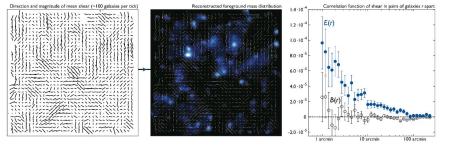
GREAT10 is focussed on weak gravitational lensing. This is an effect that distorts the shape of every galaxy we see, introducing a very small additional ellipticity to galaxy images. Weak lensing is a interesting cosmological probe because it can be used to measure both the rate of growth of structure and the geometry of the Universe. This enables extremely precise determinations of dark energy, dark matter and modified gravity. We can either use it to make maps of the dark matter distribution or to generate statistics, such as correlation functions, that depend sensitively on cosmological parameters.

As shown in the Figure (click it for a higher-resolution version), the weak lensing effect varies as a function of position (left; taken from Massey et al. 2007), which can be used to map dark matter (centre) or the correlation function of the shear can be constructed (right; taken from Fu et al. 2008).

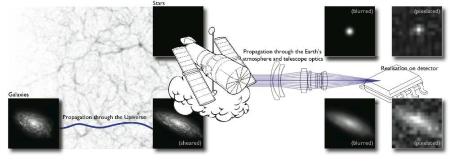
However, the additional ellipticity induced by weak lensing generates only about a 1% change in the surface brightness profile for any galaxy, far too small to been seen by eye, so we need to extract this “shear” signal using software and analyse its effect statistically over many millions of galaxies. To make things more complicated,  images contain noise, and are blurred by a PSF (or convolution kernel) caused by atmospheric turbulence and telescope effects.

So the image of a galaxy is sheared by the large scale structure, then blurred by the PSF of the atmosphere and telescope, and finally distorted further by being represented by pixels in a camera. Star images are not sheared, but are blurred by the PSF. The challenge is to measure the shear effect (which is small) in the presence of all these other complications.

GREAT10 provides an environment in which algorithms and methods for measuring the shear, and dealing with the PSF, can be developed. GREAT10 is a public challenge, and we encourage everyone to take part, in particular we encourage new ideas from different areas of astronomy, computer science and industry. The challenge contains two aspects :

  • The Star Challenge : Is to the reconstruct the Point Spread Function, or convolution kernel, in astronomical images, which occurs because of the slight blurring effects of the telescope and atmosphere. The PSF varies across each image and is only sparsely sampled by stars, which are pixelated and noisy. The challenge is to reconstruct the PSF at non-star positions.
  • The Galaxy Challenge : Is to measure the shapes of galaxies to reconstruct the gravitational lensing signal in the presence of noise and a known Point Spread Function. The signal is a very small change in the galaxies’ ellipticity, an exactly circular galaxy image would be changed into an ellipse; however real galaxies are not circular. The challenge is to measure this effect over 52 million galaxies.

The challenges are run as a competition, and will run for 9 months. The prize for the winner is a trip to the final meeting at JPL, Pasadena, and an iPad or similar (sorry Peter! I know you don’t like Apple), but of course the real prize is the knowledge that you will have helped in creating the tools that will enable us to decipher the puzzle of understanding our Universe.

For more discussion on GREAT10 see MSNBC, WIRED and NASA.

–0–

EDITOR’S NOTE: I assume that second prize is two iPads…


Share/Bookmark

Astronomy Look-alikes, No. 43

Posted in Astronomy Lookalikes with tags , , on December 7, 2010 by telescoper

It’s been a while since I posted a lookee-likee, so how about this one?

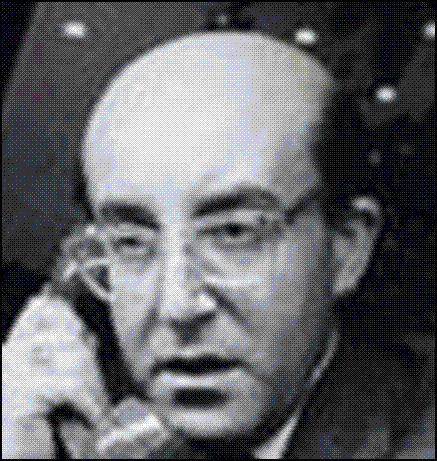
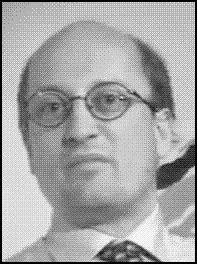
Has anyone else noticed that astronomer Dave Clements bears a strong resemblance to President Merkin Muffley, a character played by Peter Sellers in the motion picture Dr Strangelove? I wonder if by any chance they might be related?

Dr Dave Clements

Merkin Muffley


Share/Bookmark