Archive for 2010

Cricket in the Park

Posted in Biographical, Bute Park, Cricket with tags , , , on May 24, 2010 by telescoper

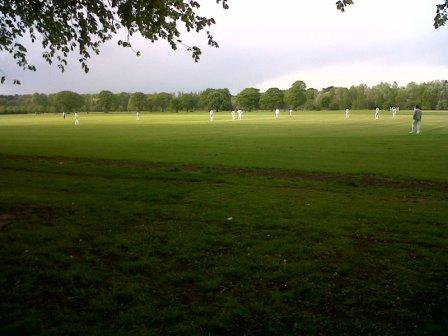
I was walking home a couple of weeks ago and noticed that there were several cricket matches going on in the Park, just over the road from my house in Cardiff. I stopped to watch a few overs, taking one or two experimental pictures with my phone, and was quite impressed at the standard of play. Two distinctly lively quick bowlers were causing the batsmen quite a few problems, though they were not just blocking  but also taking every available opportunity to score. It was attritional, but absorbing stuff.

The use of these fields for cricket was interrupted in 2008 when the National Eisteddfod was held here in Cardiff, on this very spot. It tipped down with rain for the entire week and the fields turned to mud. It has taken the best part of two years for Cardiff City Council to repair the damage and get everything back to working order so that the many local clubs that use the fields here could resume their sporting activities. Of course they had nowhere to play for all that time, thanks to the fools at the Council who totally underestimated the time it would take, not to mention the amount it would cost. You can see in the foreground that some of the grass is still in need of attention.

Just a few hundred yards to the South (right in the picture) lies Sophia Gardens, and the SWALEC stadium home to Glamorgan Cricket Club, currently at the top of the Second Division of the County Championship. I hope the good weather stays with us long enough that I can actually get to see a decent amount of cricket once term finally finishes.

Incidentally, the view is roughly eastwards.  The River Taff flows from left to right, concealed by the trees which are part of the landscaping performed by Capability Brown. They don’t show up too well in the photo, but they were clearly carefully chosen to provide a variety of colour and texture, especially in the changing light of the spring sunshine.  Also hidden  is a weir (Blackweir), where the Dock Feeder Canal is taken off the river to supply water to the docks at Cardiff Bay, and a small bridge. On the far side of the river is Bute Park and, further South, Cardiff Castle.

I may not have a very big garden, but it’s lovely having this beautiful park just a short walk from the house. I hope the Council learn their lesson and stop buggering about with it.

The Graveyard of Ambition?

Posted in Education, Finance, Politics, Science Politics with tags , , , , , on May 23, 2010 by telescoper

The news today is full of speculation about the nature and extent of impending public spending cuts expected to be announced in the Queen’s Speech next Tuesday. Among the more specific figures being bandied about is a £700 million cut to the budget Department of Business, Innovation and Skills (BIS) which encompasses both scientific research and the university sector. It’s impossibly to say precisely where the axe will fall, but it’s very likely that university-based science groups in England will face a double-whammy, losing income both from HEFCE and from the Research Councils. The prospect looks particular dire for Physics & Astronomy, which rely for their research grants on the Science and Technology Facilities Council (STFC) which savagely cut back science research even before the credit crunch arrived. If STFC gets cut any further  then the result will be even worse carnage un universities than we’ve experienced over the last year or two, especially since it looks like there will be no changes in its Executive.

Here in Wales the situation is even more complicated, as is explained in a long article in this week’s Times Higher. Cuts to the Research Councils will, of course, affect university research groups in the Principality as their remit covers the whole of the United Kingdom. However, responsibility for Higher Education in Wales is devolved to the Welsh Assembly Government. This means that any cuts to the University budget announced next week will not apply here (nor indeed in Scotland or Northern Ireland).

However, as I’ve blogged about before, it’s not obvious that this is good news for fundamental science in Wales. The Welsh Assembly Government’s blueprint for the shape of Higher Education in Wales, For Our Future, signals what could be dramatic changes in the way university funding is allocated here. There’s a lot of nervousness about how things will pan out.

Currently, most university funding in Wales comes through HEFCW in the form of recurrent grants. However the WAG has recently set up a Strategic Implementation Fund which in future supply 80% of all university funding. The new(ish) Minister responsible for Higher Education, Leighton Andrews (who will be giving a public lecture in Cardiff about the changes next week) seems to be determined to take control of the sector. It’s good to have a Minister who shows some interest in Higher Education, but I’m wary of politicians with Big Ideas.

We’ll have to wait and see what happens over the next year or so, but I think there’s an opportunity for Wales to do something truly radical and break away from systems that simply copy those in place in England with a much lower level of resource. Given that HEFCW has already been told how 80% of its funding should be administered, why bother with HEFCW at all? Scrapping this quango will remove a buffer between the universities and the WAG, which might be a dangerous thing to do, but will also save money that could be spent on higher education rather than bureaucracy. And while we’re at it, why doesn’t the WAG take Welsh universities out of the Research Excellence Framework? In the new era why should Welsh universities be judged according to English priorities?

On the teaching side, the WAG wants to see more flexible study options, more part-time degrees (including PhDs), more lifelong learning, and so on. I think that’s a reasonable thing to aim for given the particular socio-economic circumstances that pertain in Wales, but I can’t really see scope for significant numbers of part-time degrees in physics, especially at the doctoral level.

A crucial issue that has to be addressed is the proliferation of small universities in Wales. England has a population of 49.1 million, and has  91 universities (a number that many consider to be way too high in any case). The population of Wales is just 2.98 million but has 12 universities which is about twice as many per capita as in England. I for one think this situation is unsustainable, but I’m not sure to what extent mergers would be politically acceptable.

The WAG also wants to focus funding on “priority areas” that it perceives to be important to future development of industry in Wales, including health and biosciences, the digital economy, low-carbon technologies, and advanced engineering and manufacturing.  Fair enough, I say, as long as “focus on” doesn’t mean “scrap everything else but”.  The big worry for me is that research doesn’t feature very strongly at all in the WAG’s document, and it isn’t in good shape in any case. According to the last Research Assessment Exercise (RAE), only around 14% of Welsh research is of world-leading quality and most of that (90%)  is concentrated in just four institutions (Aberystwyth, Bangor, Cardiff and Swansea).

Physics in Wales did particularly poorly in the RAE and in any case only involves three universities, Bangor having closed its Physics department many years ago. Indeed the RAE panel went out of its way to make unfavourable comments about the lack of coordination in Welsh  physics – comments, I might add, that went entirely beyond the panel’s remit and should have attracted censure. Physics is also an expensive subject so if we are to do better in future we need additional investment. Cardiff University is doing its best bring this about, but I think we should explore closer ties with Swansea and explicit encouragement from the WAG.

STEM areas are woefully under-represented in Wales. Some think the WAG should seize the chance to boost this area of activity, but others think it’s already too late. According to the Times Higher,

Julie Lydon, vice-chancellor of the University of Glamorgan and the first female head of a university in Wales, says expertise in STEM will have to be developed in “distinct areas”. Given its small size, Wales must be careful to set itself realistic aims, she says.

The country faces a complex challenge, Lydon adds. “We don’t have anywhere near the range and extent of research (that we should) for our size. We’ve got to move it up a gear, and we’ve got to raise aspirations. We’ll do that in niche areas, and we’ll do that by partnership, not on our own.

“We haven’t the scope and scale; Wales isn’t a large enough sector to be able to do that across the board, but it’s an agenda that is slightly wider than the narrow view of STEM.”

A focus on STEM would neglect some areas in which Wales is strong, Lydon says. Thanks to investment from major employers such the BBC, disciplines such as media are growth areas and critical to the economy, but they are not strictly defined as STEM subjects.

No, media studies isn’t a STEM subject. Nor do I think Wales can continue to rely on its economy being propped up by public bodies such as the BBC. The expected round of wider public spending cuts I mentioned at the start of this piece will effectively scupper that argument and I’m sure privatisation of the BBC is on the new government’s agenda anyway. The future requires more ambition than this kind of thinking exemplifies. Sadly, however, ambition doesn’t seem to be something that the Welsh are particularly good at.  Dylan Thomas’s phrase “The Graveyard of Ambition” was specifically aimed at his home town of Swansea, but it does sum up an attitude you can find throughout the country: a  resolute determination to be mediocre.

 Wales is indeed a small country. So is Scotland (population about 5 million), but the Scots have for a long time placed a much higher premium on science and university education generally than the Welsh (and even the English) and they have a thriving university sector that’s the envy of other nations (including England). I think it’s time for a change of mentality.
Influence of Natural Objects

Posted in Poetry with tags on May 22, 2010 by telescoper

For no particular reason I thought it would be good to post some more Wordsworth. Influence of Natural Objects, not one of his better known poems,  was written in 1799, just a year or so after this great Tintern Abbey; it deals with similar themes and contains several memorable passages and turns of phrase. I especially love “cut across the reflex of a star”….

Wisdom and Spirit of the universe!
Thou Soul, that art the Eternity of thought!
And giv’st to forms and images a breath
And everlasting motion! not in vain,
By day or star-light, thus from my first dawn
Of childhood didst thou intertwine for me
The passions that build up our human soul;
Not with the mean and vulgar works of Man;
But with high objects, with enduring things,
With life and nature; purifying thus
The elements of feeling and of thought,
And sanctifying by such discipline
Both pain and fear,–until we recognise
A grandeur in the beatings of the heart.
Nor was this fellowship vouchsafed to me
With stinted kindness. In November days,
When vapours rolling down the valleys made
A lonely scene more lonesome; among woods
At noon; and ‘mid the calm of summer nights,
When, by the margin of the trembling lake,
Beneath the gloomy hills, homeward I went
In solitude, such intercourse was mine:
Mine was it in the fields both day and night,
And by the waters, all the summer long.
And in the frosty season, when the sun
Was set, and, visible for many a mile,
The cottage-windows through the twilight blazed,
I heeded not the summons: happy time
It was indeed for all of us; for me
It was a time of rapture! Clear and loud
The village-clock tolled six–I wheeled about,
Proud and exulting like an untired horse
That cares not for his home.–All shod with steel
We hissed along the polished ice, in games
Confederate, imitative of the chase
And woodland pleasures,–the resounding horn,
The pack loud-chiming, and the hunted hare.
So through the darkness and the cold we flew,
And not a voice was idle: with the din
Smitten, the precipices rang aloud;
The leafless trees and every icy crag
Tinkled like iron; while far-distant hills
Into the tumult sent an alien sound
Of melancholy, not unnoticed while the stars,
Eastward, were sparkling clear, and in the west
The orange sky of evening died away.
Not seldom from the uproar I retired
Into a silent bay, or sportively
Glanced sideway, leaving the tumultuous throng,
To cut across the reflex of a star;
Image, that, flying still before me, gleamed
Upon the glassy plain: and oftentimes,
When we had given our bodies to the wind,
And all the shadowy banks on either side
Came sweeping through the darkness, spinning still
The rapid line of motion, then at once
Have I, reclining back upon my heels,
Stopped short; yet still the solitary cliffs
Wheeled by me–even as if the earth had rolled
With visible motion her diurnal round!
Behind me did they stretch in solemn train,
Feebler and feebler, and I stood and watched
Till all was tranquil as a summer sea.

Winner Takes All

Posted in Football with tags , on May 22, 2010 by telescoper

Just a quick post for the record. Today was the day that the last promotion from the Championship to the Premiership was decided at the Playoff final between Blackpool and Cardiff City.  I couldn’t get into the local to see the match as there were so many crowded in there already, so I seized on the chance to do some shopping in the deserted Tesco nearby. It sounds like it was an exciting  game, with Cardiff City leading twice, but it ended 3-2 to Blackpool.

I did have a look at the odds a few hours before the game started and found to my surprise that Cardiff were quite strong favourites, at 13/10 compared to Blackpool’s price of 21/10. Blackpool were clearly the form team so I decided to make an investment on the outcome which turned out to be successful. I’ll be having an especially nice bottle of wine tonight.

This was a match with huge financial implications for both clubs,  of course, with an estimated £90 million at stake in TV and other revenues. Cardiff City FC’s money troubles are well documented, and promotion to the Premiership would have been a tremendous boost to the city as a whole too. However, it wasn’t to be and they’ll have to get their house in order and try again next season. I’m actually a little bit relieved that Cardiff City won’t be playing my team Newcastle United in the premiership next season – so I won’t have divided loyalties about that – but it would have been great to have the big teams playing in Cardiff. Of course I also feel sad for the local Cardiff City fans, especially those (including some from the department) who made the trip all the way to Wembley to watch the game. It’s going to be a long journey home.

As for Blackpool, they should be proud of what they’ve achieved this season. I certainly wouldn’t have picked them at the start of the season to get promoted, and I wish them well. I’m sure the players and their fans are ecstatic at this moment. I’m skeptical about their ability to survive more than one Premiership season – with an average home gate of just over 8,000 they don’t really have the resources to compete with the big boys – but I wish them well. I hope they enjoy their time in the sun.

PS. Before anyone asks, yes, I am old enough to remember Blackpool playing in the old First Division, about 40 years ago.

Summer Columbo

Posted in Columbo with tags , on May 22, 2010 by telescoper

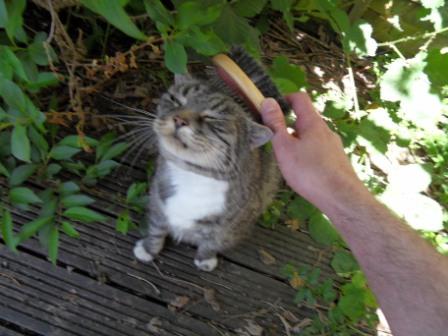
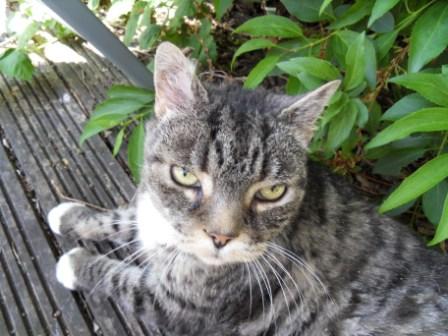
People keep asking me how Columbo is getting on and I realise it’s been ages since I posted an update, so I thought I’d take the opportunity afforded by the fine weather to take a few snaps in the garden and put them on here. It’s actually 26 degrees in the shade as I post this, which is warm enough for Columbo to see refuge behind the Forsythia. It can’t be much fun having to wear a fur coat in this weather.

I took Columbo to the vet yesterday for a six-monthly check up during which they took a blood sample to test his blood sugars. There was only one vet on duty yesterday so there was a long wait to get into the consulting room during which time lots of people with dogs arrived. It was also very warm, with the result that both dogs and owners were a bit tetchy because of the delay. I was a bit worried when a rather nasty-looking pit bull came in, thinking he might take an unhealthy interest in Columbo’s box, but he confined himself to having a go at one of the other dogs and was banished to the car park.

Columbo wasn’t at all bothered by the heat and noise. In fact I could hear him purring in his box. He likes this vet more than any other I can remember, and when we did get called in he continued to purr, at least until they took the blood sample.

I hadn’t seen this particular vet before, but she had all his notes. Columbo turned 16 in March this year, but he’s still doing pretty well especially when you consider he’s been diabetic for the last 5 years or so and has needed special food and twice-daily injections of insulin. He’s showing his age a bit and has slowed down quite a bit, but still has his moments. He’s taken on quite a bit of ballast since the last visit – at 7.35 kilos he’s quite a heavyweight – but the vet said that she wasn’t very worried about that given his age. He’s always been a bit greedy and if he ever lost his appetite that would be a bad sign.

I have to wait for the blood works to come back before we know whether his insulin dose needs changing, so there’s no news on that. However, there is one development since his last visit. The vet last time wasn’t sure, but after yesterday’s examination this vet was pretty certain that he has a bit of arthritis. I’ve notice he has pretty stiff legs from time to time, which don’t seem to cause any pain, but they do stop him jumping onto the kitchen table. Anyway, he’s been started on glucosamine tablets now. It’s not a big deal as I take glucosamine myself. I’ve got knackered legs too, you see.

One of the effects of his weight and arthritis is that he finds it a little difficult to groom himself all over, so I have to give him a good going over with a metal brush. He likes this on his head and upper body, but isn’t very happy when I brush his belly or hind quarters. Given the season, loads of hair comes off on the brush and without this he’d get a bit matted and moth-eaten.

Anyway, that’s all for now. He’s basically doing fine and, as you can see from the first picture, despite the advancing years he’s still a handsome chap!

POSTSCRIPT 24th May. Got the blood results back. They’re fine. Back to the vet in 6 months.

Astronomy Look-alikes, No. 26

Posted in Astronomy Lookalikes with tags , on May 21, 2010 by telescoper

I have a theory that erstwhile Professor of Astronomy at Cardiff University Mike Edmunds and celebrated poet Seamus Heaney are in fact the same person. Well, you never see them together, do you?

Lazy River

Posted in Jazz with tags , , , on May 20, 2010 by telescoper

I couldn’t resist putting up this jaunty duet version of the old Hoagy Carmichael song “Up a Lazy River”, which I first heard over 30 years ago, not only because the (British-born) pianist George Shearing plays so wonderfully on it (listen to his little foray into Harlem Stride around 3.00), but also because it gives me a chance to pay homage to the bass player Brian Torff. Just listen to his solo (starting around 1.55) and you’ll immediately understand why he’s revered amongst jazz musicians for his incredible technique and musical imagination and why so many other double bass players are completely terrified of him!

Astronomy Look-alikes, No. 25

Posted in Astronomy Lookalikes with tags , on May 20, 2010 by telescoper

One of the best things about having visiting seminar speakers here in Cardiff is that they often tend to bring ideas for my astronomy look-alike series with them.  One of the best I’ve had for a while was suggested last night over dinner with yesterday’s speaker.

I wonder how many of you have noticed the similarity – tonsorial issues apart – between cheeky boy Rob Ivison and former Liberal Democrat Member of Parliament Lembit Opik? I wonder if by any chance they might be related?

Incidentally, it might be worth mentioning that Lembit Opik himself has an interesting family connection with astronomy.

Lembit Opik

Rob Ivison

Astronomy Look-alikes, No. 24

Posted in Astronomy Lookalikes with tags , , , on May 19, 2010 by telescoper

In view of the recent installation of Professor Roger Davies as the new President of the Royal Astronomical Society, I feel obliged to do him the honour of adding to my collection of look-alikes. How about Mr Mackey from South Park?

Exam Time

Posted in Education with tags , , on May 18, 2010 by telescoper

A busy day today, marking undergraduate examinations most of the time, but also keeping an eye on the viva voce examination for a PhD student too. In the end both tasks went off satisfactorily. I finished my batch of marking third-year examinations scripts and my PhD student Rockhee Sung also passed her PhD. The completion of the former task wasn’t so much of a cause for celebration, because I still have a second paper to do, but Rockhee’s successful PhD defence definitely was. The viva was probably no more than the formality I expected it to be, but it was great to see the look on her face when she emerged from the room. In anticipation of a successful outcome I’d bought a few bottles of champagne which I had secreted in the departmental fridge. A few minutes after the viva had finished, I sprang into action,  corks were popped, and we were all congratulating Rockhee on her success. We then adjourned to a local bar and thence to dinner in a nice restaurant.

Rockhee started her PhD with me when I was at Nottingham. When I decided to move in 2007, she moved with me and transferred her registration to Cardiff. Moving wasn’t as easy as I had anticipated  owing to the Credit Crunch. It took me the best part of a year to fully relocate, causing considerable disruption to my research (and Rockhee’s PhD). However she managed to complete her thesis some time ago and managed to get a  postdoctoral position in the beautiful city of Cape Town, South Africa. She flew back yesterday for her viva, just escaping the dreaded Icelandic Volcano Ash, and passed (with flying colours) today. Well done Rockhee!

Although the outcome of the examination was hardly unexpected, I don’t mind saying that I was absolutely delighted, as I am every time one of my PhD students passes this final hurdle. It’s one of the things that makes this job so very special. That’s a round dozen now, and I’m so very proud of all of them. Especially considering what a crap supervisor they all had.

That’s not to say that I won’t feel proud when this year’s undergraduates finally qualify for their degrees,  but postgraduates have a much closer personal connection than undergraduates do to their tutors and lecturers, and that  inevitably makes their success that bit more special…