Archive for 2010

The Remorseful Day

Posted in Biographical, Poetry with tags , , , on May 17, 2010 by telescoper

Not for the first time, I’m going to make an admission that will no doubt expose me to public ridicule. I can’t watch the last episode of the TV series Inspector Morse (The Remorseful Day) without bursting into tears at the end when it is revealed that the eponymous detective has died. Not that it comes as a surprise – the story has plenty of scenes that make it clear that Morse knows his days are numbered. Take this one, for example, wonderfully acted by John Thaw who was himself very ill while this episode was being filmed; he died in 2002.

The poignant quotation is from a poem by A. E. Housman. Here’s the poem in its entirety.

 Yonder see the morning blink:
The sun is up, and up must I,
To wash and dress and eat and drink
And look at things and talk and think
And work, and God knows why.

Oh often have I washed and dressed
And what’s to show for all my pain?
Let me lie abed and rest:
Ten thousand times I’ve done my best
And all’s to do again.

How clear, how lovely bright,
How beautiful to sight
Those beams of morning play;
How heaven laughs out with glee
Where, like a bird set free,
Up from the eastern sea
Soars the delightful day.

To-day I shall be strong,
No more shall yield to wrong,
Shall squander life no more;
Days lost, I know not how,
I shall retrieve them now;
Now I shall keep the vow
I never kept before.

Ensanguining the skies
How heavily it dies
Into the west away;
Past touch and sight and sound
Not further to be found,
How hopeless under ground
Falls the remorseful day.

When Morse talks about Wagner in the clip, you know this is a man coming to terms with his own mortality. It even makes me feel a bit guilty for not being all that keen on Wagner myself. Perhaps I should persevere too. In that respect, as well as many others, I’m rather more like Lewis than Morse, although I do share the Chief Inspector’s love of crossword puzzles.

I watched this episode when it was first broadcast in 2000 and cried at the end then. I’ve seen it many times since, including a late-night repeat last saturday night, and it’s always had the same effect. The very first episode, The Dead of Jericho, was screened way back in 1987 and I’d enjoyed the series right from the word go. Morse became like an old friend to me over the following twenty-odd years and it’s never easy saying goodbye to people you’ve grown accustomed to for a long time.

Should I be embarrassed about crying whenever Inspector Morse dies? Perhaps.  But I’m not.

A Star is Porn

Posted in The Universe and Stuff with tags , , , on May 16, 2010 by telescoper

I started thinking about the analogy between astronomy and pornography after seeing a hilarious blog post by Amanda Bauer  that has a connection with my forthcoming (popular) book, which has the working title Naked Universe. It’s basically a collection of essays about cosmology, trying to look at the subject from unusual and provocative angles. I decided to give you a bit of a flavour of this connection here. It’s intended to be a bit of a joke, but it does make a semi-serious point about the difference between astronomy and other branches of science.

Although it’s one of the oldest fields of scientific enquiry, astronomy possesses a number of features that set it apart from most other branches of science. One of the most important is that it isn’t really an experimental science, but an observational one. Hands-on disciplines, specifically those involving laboratory experiments,  require a dialogue between the scientist and nature. The scientist can control the physical parameters of the system under scrutiny and explore its behaviour under different conditions in order to establish patterns and test theoretical explanations. The scientist chooses the questions to ask, the experiment is run, and nature gives its answer. If more information is needed, another experiment is set up with different parameter choices.

Astronomy is different. Its subject matter, the Universe of stars and galaxies,  is remote and inaccessible.   We only have what is “out there” already. We had no hand in setting it up, and we can’t intervene if it behaves in an unexpected way. We are forced to work only with what has been given to us. Out there in the darkness the Cosmos may be beautiful, but all we can do is look at  pictures of it. We never get to experience it in the flesh. Experimentalists have real intercourse with nature, but astronomers have to be content with being mere voyeurs.

This is not to say that all astronomers are dirty old men in grubby raincoats – although I have to say that I know a few who could be described like that – but  many mainstream scientists do indeed tend to look down on us, at least partly because of the unconventional practices I’ve alluded to. On the other hand,  I suspect they also secretly envy us. From time to time they probably also have a guilty peek at their favourite pictures too.  Every time physicists look at astronomical images, do they feel just a little bit guilty?

You can hardly go on the internet these days without finding a website devoted to pornography astronomy.This is hardly surprising because both astronomy and pornography have led to technological advances that helped fuel the digital revolution. Astronomy gave us the CCD camera, which ushered in the digital camera that has made it much easier for both amateurs and professionals to make their own pornographic astronomical images. On the other hand, the porn industry was largely responsible for the rapid evolution of video-streaming technology. That must be why astronomers spend so much of their time doing video conferences…

Astronomers also led the way in the development of virtual reality. Frustrated by their inability to get  up close and personal with the objects of their desire, they have resorted to the construction of elaborate three-dimensional computer simulations. In these they can interact with and manipulate what goes on until they reach a satisfactory outcome. I’ve never found this kind of thing at all rewarding – the simulations are just not sufficiently realistic –  but large numbers of cosmologists seem to be completely hooked on them.

The Club Guest

Posted in Uncategorized with tags , , on May 15, 2010 by telescoper

Yesterday I went, as I do from time to time, to the Royal Astronomical Society’s monthly meeting and thence to the RAS Club for dinner. This was the last such meeting before the summer hiatus – they resume in October – and also incorporated the Society’s Annual General Meeting at which new officers are elected, amongst them the new President.  Andy Fabian was the outgoing President, having completed his two-year tour of duty, and he was replaced by Roger Davies.

It was also revealed at this meeting that next year’s National Astronomy Meeting would be in Llandudno. Usually this event is organized by a university and is held in a university town. This year it was in Glasgow, for example. However, the University of Sheffield has pulled out of organizing the 2011 NAM and no other was willing to take on the considerable task of organizing it at such short notice. It was therefore decided to break with tradition and hold the event not on a university campus but at a holiday resort. I’ve never been to Llandudno, but I think it could be great for us astronomers here in Wales to have the Principality host NAM. I suspect, however, that it wasn’t regional politics, but economics, that held sway in reaching the decision. Llandudno is perhaps a bit cheaper than most English seaside towns. I can already hear some of my English colleagues starting to whinge about how difficult it will be to get there, but we’ll see. I just hope I can persuade them to hold it outside Cardiff’s teaching term otherwise I won’t be able to  go even if it is in Wales.

It was interesting to learn about all these developments, and the subsequent Open Meeting was not without interest either. We had talks about volcanic ash (topical, that one), martian meteorites, high-altitude balloon flights and stellar disks. A mixed bag of talks, but all of them very enjoyable.

However, this meeting turned out to be remarkable for a completely different reason. At the end of one of the lectures in the open meeting, a strange woman entered the lecture theatre, walked down the aisle and took a seat in the front row. In fact she first tried to sit in Roger Davies’ seat – he was standing in order to supervise the question-and-answers at the end of the talk – but he asked her to move. Finding a free seat a bit further along,  she removed her hat and  proceeded to brush her hair ostentatiously. As the other talks went on she appeared to pay very little attention to them, preferring instead to look around the room.  I had never seen her before, but open meetings like this often attract visitors and in any case acting a bit strangely is by no means inconsistent with being an astronomer.

The Mystery Guest

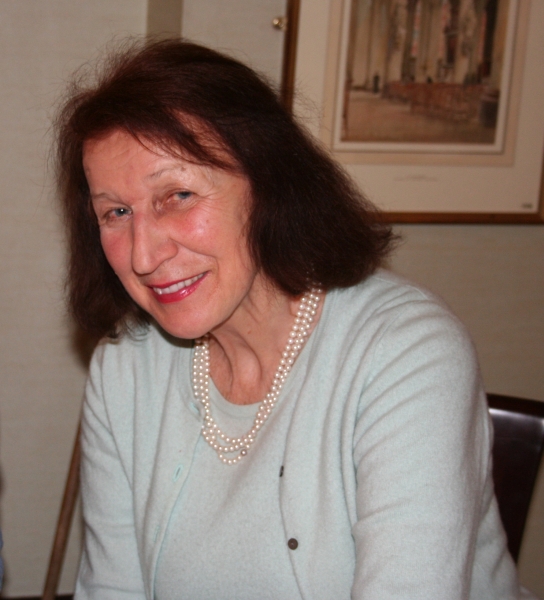
After the meeting closed I went for a glass of wine to Burlington House and then to the Athenaeum. There was quite a crowd there and as usual we all had a glass of wine before sitting down. It was only when we started to eat that I realised that this mysterious lady (left) was actually sitting at another table. Since the RAS Club is for members (and their guests) only, I assumed she was with one of the invited speakers at the meeting who, as is usual in such cases, had been invited to the club afterwards as a club guest.

I thought nothing more about this until I saw the Club Treasurer, Margaret Penston, looking a bit agitated,  go to her table and ask The Mystery Guest a question. I couldn’t hear what. Our visitor then stood up, announced she had to be going and left quickly before anyone could do anything about it. It turned out she wasn’t anyone’s guest at all, but had just latched onto a group of people leaving for the club, each of whom assumed one of the others knew her. It being England, nobody asked her who she was or what she was doing there. I have no idea who she was or why she had decided to attach herself to the RAS Club that evening.

All this was hilarious enough but, after she’d gone, it emerged that she had paid for her dinner by “borrowing” money from a genuine club guest, an American astronomer who happened to be sitting next to her and to whom she had introduced herself as the “Contessa” of something or other. Our American friend may have thought it was all an elaborate practical joke, but he was clearly completely dumbfounded by the episode. The Club had a whip round to pay him back the money he had lent her.

On top of all this, some other members of the Club  then pointed out that she had done something  similar on at least three  previous occasions, in locations ranging from Paris to London. Why none of her previous victims had identified her yesterday and drawn attention to her past history I have no idea. If they had she would have been removed earlier.

If the relatively small gathering we had on Friday could furnish three previous examples of this kind of behaviour, then it seems likely that it’s part of a pattern. However, it doesn’t seem likely that she makes her living doing this sort of thing because she’s only  “borrowed” amounts from £5 to £70. Perhaps astronomers aren’t the best choice of target.

I wonder if anyone reading this blog recognizes her and can shed light on her curious behaviour?

Herschel’s First Year in Space

Posted in The Universe and Stuff with tags , , on May 14, 2010 by telescoper

Just about to journey to the RAS for the Annual General Meeting  and the last club dinner before the summer break, I’m reminded by a tweet from Chris North that it’s exactly a year since we gathered nervously, fortified by booze, to watch the launch of the far-infrared observatory Herschel, together with its sister spacecraft Planck.  I haven’t got time to write much about this because I’ve got a train to catch, but you can in any case find a nice retrospective of the Herschel’s first year in space here. I couldn’t resist, however, putting up the nice video that’s been put together by the European Space Agency to mark the anniversary.

It’s all  been going swimmingly on the Herschel front since the launch, and the first science papers have been making their way onto the ArXiv this week. Thankfully it’s not been quite the deluge that I’d feared, more of a steady stream. I’ve even had a chance to read a few of them.

The next major milestone coming up will be announcement of opportunity for open time access (OT1) which will  be released on 20th May with a deadline of 22nd July. I’m sure the huge success that Herschel has been so far will mean a lot of people putting in proposals. There is talk of putting in a proposal for a big cosmology survey – a sort of son of ATLAS and HERMES –  which will be good timing for me and my little team at Cardiff because our theoretical models are almost ready to rumble…

Anyway, here’s to at least another three years of Herschel, although I’ll have to wait until this evening to raise a glass!

A Reith Lecture

Posted in Politics, The Universe and Stuff with tags , , on May 13, 2010 by telescoper

I’m a bit late getting around to blogging today, primarily because I spent the evening at a lecture by Martin Rees. Not just any lecture, but one of the annual series of Reith Lectures that he has been chosen to present this year. This event took place in the splendid Reardon Smith Theatre in the National Museum in Cardiff, and was preceded by a wine reception where we mingled amongst the relics of Welsh prehistory. The audience for the lecture  included academics, politicians, journalists and students and there was a lively question-and-answer session afterwards.

The Reith Lectures were inaugurated in 1948 by the BBC to mark the historic contribution made to public service broadcasting by Sir John (later Lord) Reith, the corporation’s first director-general. John Reith maintained that broadcasting should be a public service which enriches the intellectual and cultural life of the nation. It is in this spirit that the BBC each year invites a leading figure to deliver a series of lectures on radio. The aim is to advance public understanding and debate about significant issues of contemporary interest.

The very first Reith lecturer was the philosopher, Bertrand Russell who spoke on “Authority and the Individual”. Among his successors were Arnold Toynbee (The World and the West, 1952), Robert Oppenheimer (Science and the Common Understanding, 1953) and J.K. Galbraith (The New Industrial State, 1966). More recently, the Reith lectures have been delivered by the Chief Rabbi, Dr Jonathan Sacks (The Persistence of Faith, 1990) and Dr Steve Jones (The Language of the Genes, 1991). Since 2002, the Reith Lectures have been presented as was tonight’s,  by Sue Lawley.

I think this is the first time any of these lectures have been delivered in Cardiff. Martin Rees is, in fact, almost a Welshman himself ,  being born in Ludlow in Shropshire only about a mile the wrong side of the border; since being elevated to the peerage a few years ago, he is now known as Baron Rees of Ludlow. He is, of course, an immensely distinguished astrophysicist (he has been Astronomer Royal since 1995) but now has a broader portfolio of responsibility in the higher echelons of British science as President of the Royal Society.

As well as being an eminent scientist, Martin Rees is also a very fine public speaker, possessing an effortless gravitas that  any politician would die for.  He speaks with great clarity, thoughtfully and to the point, but with an economical use of language. He comes across as not only highly intelligent , which he undoubtedly is, but also deeply humane, another rare combination. Martin Rees was therefore an excellent choice to give the Reith Lectures. I had been looking forward to the evening for months after I got a phone call from Auntie Beeb asking me if I’d like to attend.

His lecture this evening wasn’t about astrophysics, and neither are the others in the series which has the pretty vague overall title Scientific Horizons. This lecture, the second of the series of four, was entitled Surviving the Century,and it concerned the role of science in identifying and possibly counteracting the threats facing humanity over the next few decades. He touched on climate change, renewable energy, and the possibility of nuclear or bio-terrorism. Although he spelled out the dangers in pretty stark terms he nevertheless claimed to be an optimist to the extent that he believed science could find solutions to the most pressing problems facing our planet, but I also sensed he was more of a pessimist as to whether the necessary measures could be implemented owing to socio-economic and political constraints. Science is vital to safeguarding the future of the planet, but it isn’t sufficient. People need to change the way they live their lives.

I won’t say any more about the lecture – or the interesting audience discussion that followed it – because you’ll be able to hear it yourselves on BBC Radio 4. The Lectures will be broadcast at 9am on Radio 4 starting on Tuesday 1st June (Lecture 1, called The Scientific Citizen). The lecture I attended tonight will be broadcast at the same time the following week (8th June). Lectures 3 and 4 will follow on 15th and 22nd June. Of course they will also be available as podcasts from the BBC website. If you want to be informed, enriched and challenged then I recommend you check them out.

Into the Blue

Posted in Education, Finance, Politics, Science Politics with tags , , , on May 12, 2010 by telescoper

So there we are.  Britain has a new government. For the time being. Last night David Cameron became the Prime Minister of a coalition government involving the Conservative and Liberal Democrat parties (as I predicted). This is hardly a surprise given the arithmetic; Labour and the LibDems wouldn’t have had enough seats to command a majority anyway. It took five days from the election for the new Prime Minister to take over, much longer than the few hours it normally takes when there is a conclusive result, but nowhere near as long as it takes on the continent where coalition-building involves smaller and more diverse parties. In the UK the three main political parties are all centre-right, at least when it comes to economic policy,  and they share a great deal of common ground, so I never thought there would be much problem with the Conservatives and LibDems coming to a deal, which they have done.

Another prediction I got right was that Gordon Brown would resign as leader of the Labour Party, which he has also done. Who will lead the Labour Party now, and for how long, is anyone’s guess.

My third prediction was that the coalition government would fall within a year and there’ll be another general election. As for that, we’ll have to wait and see. It is, after all, a marriage of convenience. I think it won’t be long before a big row develops and the coalition unravels. There’s a lot of overlap between the two parties, but it’s a long way from the left of the LibDems to the right of the Tories. I give it 6 months to the first vote of confidence, assuming the Queen’s Speech passes.

Now that we have a government once more, the unreal business of electioneering is going to be set aside and all the facts that the media have kept quiet about during the election campaign will start to come out. For example, a story in the Financial Times of 11th May (yesterday), which has clearly been on the spike for the duration of the election campaign, reveals how huge cuts in university funding are set to fall hardest on science departments. Vice-chancellors have been making contingency plans for 25% cuts in recurrent funding for some time now, and there’s an obvious temptation to cut the more expensive subjects first.

I’ve already confessed my annoyance that the main parties connived to keep the details of the deep cuts they were all planning to implement out of the election campaign. Now we’re going to find out the true extent of what’s in store, and it’s too late to change.

Niels Bohr once said “Prediction is very difficult, especially about the future”, and I have no idea whether I’m being overly pessimistic here, but here are  some of  the things I think will affect my own life  as an astrophysicist working in a British university.

First, it’s now clear that there’s  no chance of a reversal in the fortunes of STFC. There never was much of a chance of that, to be honest. It’s more likely now that  STFC will now face further cuts on top of what it has endured already.  Fundamental science in the UK is in for a very lean time.

Second, university funding – the part that comes directly from central government – will be cut by at least 25%, probably more.  This could be achieved in a number of ways. The unit of resource (the payment made per student by the government to a university) could be cut. The number of students funded could be cut. Students could be charged higher fees or have less generous loan arrangements. These options are by no means exclusive, of course. They might all happen.

University V-Cs will have to make very difficult decisions  where to make savings:  some may tighten budgets across the board; others may shut entire departments to save the rest.

Another issue with university funding, however, is that it is not entirely the preserve of central government.  The Scottish Assembly runs higher education in Scotland, not the Westminster government. The Scottish Funding Council has generally funded universities more generously than HEFCE has in England. It’s also much less likely to implement higher tuition fees. More generally, with only one Scottish Tory MP in Westminster and a Scottish Nationalist-flavoured Assembly government, there’s no way of knowing what will happen in Scotland or, indeed, how much strain will be generated there by an English Tory government very few Scots voted for.

In Wales its a bit different. Here higher education is run by the Welsh Assembly government, which currently comprises a Labour-Plaid Cymru coalition. With the Westminster government consisting of an alliance between the other two major parties in Wales we have two levels of administration roughly orthogonal to each other. In principle, the WAG could decide to protect the university system in Wales against the level of cuts being imposed in England, but since we already get a lower unit of resource from HEFCW than HEFCE allocates to English universities, I doubt we’ll be any different in future.

So this is where we’re headed:  fewer science departments with fewer staff with increased teaching loads with less time to do research and with less funding to carry it out and vanishing career opportunities for the scientists they’re supposed to be training.

Still, at least the bankers will get their bonuses.
Astronomy Look-alikes, No. 23

Posted in Astronomy Lookalikes with tags , on May 11, 2010 by telescoper

Since my Head of School is currently on his way to a boondoggle in Mexico I thought it might be safe to point out, as many have done to me, that he bears more than a passing resemblance to Swiss Tony from the Fast Show. Doing astronomy, you see, is very like making love to a beautiful woman…

Walter Gear

Swiss Tony

Starchild

Posted in The Universe and Stuff with tags , , , on May 10, 2010 by telescoper

It’s been a busy day today,  so I’ve decided to be lazy and plunder the online stack of juicy Herschel images for a pretty picture to show. This one has done the rounds in the popular media recently, which is not surprising given how strange it looks.

Image Credits: ESA / PACS & SPIRE Consortium, Dr. Annie Zavagno, LAM, HOBYS Key Programme Consortia

This image shows a Galactic bubble (technically an HII emission region) called RCW 120 that contains an embryonic star that looks set to turn into one of the brightest stars in the Galaxy. It lies about 4300 light-years away. The star is not visible at these infrared avelengths but its radiation pressure pushes on the surrounding dust and gas. In the approximately 2.5 million years the star has existed, it has raised the density of matter in the bubble wall by so much that the material trapped there can now collapse to form new stars.

The bright knot to the right of the base of the bubble is an unexpectedly large, embryonic star, triggered into formation by the power of the central star. Herschel’s observations have shown that it already contains between 8-10 times the mass of our Sun. The star can only get bigger because it is surrounded by a cloud containing an additional 2000 solar masses.

Not all of that will fall onto the star, because even the largest stars in the Galaxy do not exceed 150 solar masses. But the question of what stops the matter falling onto the star is an astrophysical puzzle. According to theory, stars should stop forming at about 8 solar masses. At that mass they should become so hot that they shine powerfully at ultraviolet wavelengths exerting so much radiation pressure that it should push the surrounding matter away, much as the central star did to form this bubble in the first place. But this mass limit is must be exceeded sometimes, otherwise there would be no giant stars in the Galaxy. So astronomers would like to know how some stars can seem to defy physics and grow so large. Is this newly discovered stellar embryo destined to grow into a stellar monster? At the moment, nobody knows but further analysis of this Herschel image could give us invaluable clues.

It also reminds me a little bit of the Starchild from 2001: A Space Odyssey…

Parallels and Tangents

Posted in Politics with tags , on May 9, 2010 by telescoper

An inconclusive general election, mass protests about electoral reform, another stock market crash – Britain’s got the jitters. I think it’s time for a bit of old-fashioned stoicism. In fact, yesterday, when I saw a lot of comments on the unprecedented politicial situation facing Britain, I changed my facebook image to the following poster dating from the Second World War.

I meant it as a bit of a joke but it got me thinking about parallels between the UK’s current situation and that of this month 70 years ago when we faced problems of an altogether different magnitude.

I’m no historian so I’ll just include an excerpt from Simon Schama‘s BBC TV series A History of Britain. The last programme of the series cleverly follows the story of the Second World War through the eyes of two very different Englishmen, George Orwell and Winston Churchill. Here Schama describes how close this nation came, in May 1940, to doing a deal with Hitler. Meeting after meeting behind closed doors in Whitehall took place until eventually Churchill held sway. There was no to be no surrender.

Of course the problems facing the nation in 1940 make those facing us now pale into insignificance, so I’m not going to push the parallel too far. Nevertheless, 70 years on, we once again have lengthy and no doubt heated secret negotiations whose outcome is still by no means certain, but which will probably alter the political landscape of this country for many years to come. This time it’s not so much a matter of danger, but one of opportunity. I think change is in the air, and I also think we need it.

Another parallel is that the war in Europe came to an end almost exactly five years after the installation of Churchill as Prime Minister. Victory in Europe (VE) Day, which marks the anniversary unconditional surrender of the Germans on May 8th 1945, was yesterday. In fact the leaders of all three political parties took time out from their haggling to take part in the commemoration ceremony. Soon after the end of the War, on July 5th 1945, a General Election was held that yielded a Labour landslide and booted Churchill out of office. I don’t think that people were ungrateful, just that their wartime experiences made them aspire to a more progressive vision of the future than the old guard could provide. Clement Attlee‘s government took over a country bankrupted by war, with most of its cities in ruins, and with terrible labour shortages. Not  surprisingly given that it was beset by so many problems, the Attlee government struggled to deliver what it set out to do. Nevertheless, it gave us – amongst other things – a National Health Service and a Welfare State that, to me, are emblematic of the “real” Britain.

I think Schama gets it exactly right in the clip when he talks about the War not just being about Britain as a physical entity but about much more abstract notions, such as freedom and democracy. We weren’t just fighting the Germans, we were fighting Nazism and the threat it posed to the liberties the British people had taken hundreds of years to win. The pricewas very heavy, but it was certainly worth paying. I too, would rather have died fighting than live under Fascism. My only worry would have been whether I had it in me to show the courage and resourcefulness needed to meet the challenge.

This all brings me to the question of what “Britain” actually represents in the modern age.  The BNP present their views as a vision of Britishness, but most British people find their attitudes repugnant.  Not only did they fail to win any seats at the General Election, they also lost all their council representation in Barking, previously thought to be a stronghold. The people of Barking clearly aren’t as mad as they’ve been portrayed.

We probably have very different views on many aspects of our national identity – or even  if there is such a thing at all –  but we can probably agree on, as Schama puts it in the clip, “freedom, democracy, and the rule of law”. Outside that core, people clearly differ. For myself, I would add a sense of social justice and compassion, which is why the Welfare State and NHS  are so important to me.

To me, inclusiveness (whether cultural, religious, racial, or whatever) is also essential to what it means to be British, but that view clearly isn’t shared by everyone. Immigration is a hot potato in British politics these days, a fact  that surprises given our existence as a mongrel nation that has been enriched over the centuries by people coming here from elsewhere. I suppose its natural that people are suspicious of strangers, and this can be exploited by unscrupulous people looking for scapegoats, but we should remember, for example,  that sixty years ago we were desperate to persuade people from the West Indies to move here in order to deal with  the post-war  labour shortage. Nowadays we too need immigration to deal with shortages of skilled labour and to counteract the economic effects of our rapidly ageing population.  I can’t imagine what state our universities would be in if it weren’t for the many excellent researchers who have come here from all round the world, and that also goes for the UK as a whole.I’m not trying to say that immigration is a non-issue, just that it’s neither new nor something we need to panic about. We can cope with it.

After all, we’re British.

Experiments and Observations

Posted in Science Politics, The Universe and Stuff with tags , , , , , on May 8, 2010 by telescoper

It’s nice to be able to pass on some upbeat news for once.

The first thing is that, after a lot of delays and a bit of haggling, the School of Physics & Astronomy at Cardiff University has finally issued advertisements for a bunch of new Faculty positions in Experimental Physics. The positions, which are tenured,  involve both Chair and Lecturer/Reader levels and there are several positions available. The School and University  have  put together a handsome start-up package for a new group and there’s plenty of spanking new experimental laboratory space to set up shop. Coupled with the fact that Cardiff is a great city to live in, with low costs and great sporting and cultural infrastructure, this should prove a tempting opportunity for someone to set up their own group.

It’s also a welcome vote of confidence from Cardiff University which, despite cuts in its overall budget, has decided to invest heavily in the School’s strategic plan. I hope and believe we’ll attract a strong field for these appointments and look forward to seeing what develops. We need a shot in the arm and this might just deliver it.

What’s particularly interesting about this clutch of new appointments is that they are open to people working in any area of physics, with the exception of astrophysics. Given the massive cuts in STFC’s budget, this is no time to be expanding in areas covered by its remit. I say that as an astrophysicist, with considerable regret but pragmatism in the face of the changing landscape of British science funding. In times of risk you have to broaden your portfolio. However, that’s not to say that astrophysics at Cardiff is downbeat. Far from it, in fact.

ESA held an international press conference to present exciting new results from the Herschel Observatory at the European Space Research and Technology Centre, Noordwijk, The Netherlands, on Thursday 6 May. A webcast of the press conference with Cardiff’s Professors Matt Griffin and Steve Eales taking part, can be seen at from http://www.esa.int/SPECIALS/Herschel. At the conference Steve Eales talked about the latest results from the Herschel ATLAS survey: an ATLAS of the Universe. ATLAS will cover one eightieth of the sky, four times larger than all the other Herschel surveys combined and is led by Professor Eales and Dr Loretta Dunne at Nottingham University.

Herschel ATLAS has measured the infrared light from thousands of galaxies, spread across billions of light-years. Each galaxy appears as just a pinprick but its brightness allows astronomers to determine how quickly it is forming stars. Roughly speaking, the brighter the galaxy the more stars it is forming. The Herschel images show that in the past there were many more galaxies forming stars much faster than our own Galaxy. But what triggered this frantic activity is not completely understood. Steve Eales said

every time astronomers have observed the universe in a new waveband, they have discovered something new. So as well as our regular science programmes, I am hoping for the unexpected.

I am hoping to get involved with the ATLAS data myself at some point as I am formally a member of the consortium, but I’ve been too busy doing other things to get involved in these initial stages so am not on any of the preliminary science papers. I hope I can get properly involved in this project sooner rather than later…

The ATLAS survey, image courtesy of ESA and the ATLAS consortium

The full press release also includes surprises on how stars are formed including work carried out by Cardiff’s Professor Derek Ward-Thompson. Herschel’s star formation surveys are beginning to reveal the mysteries behind how massive stars are created.