An amazing composite image of M31 in Andromeda using both infra-red and X-rays was recently obtained using Herschel and XMM space observatories. It featured in the BBC Stargazing Live programme earlier this week and I’m told that, typically for astronomy, the inspiration behind it was … beer.
We've been sitting on this image since just before Christmas so that it could be unveiled during the BBC Stargazing Live show last night, but I've been aching to get this onto the blog ever since I saw it. This is a Herschel image of our nearest neighbour galaxy, the Andromeda galaxy, also known as M31, along with comparison images at other wavelengths. [/captio … Read More
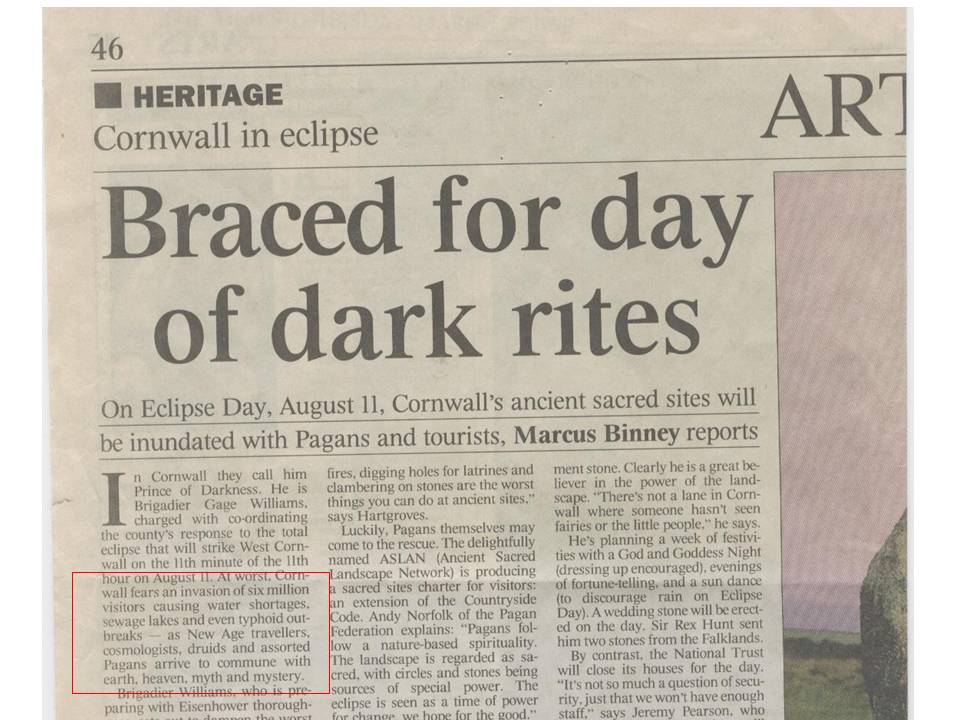
I was reminded yesterday of the following clipping, which I found in The Times, in 1999, just before the total eclipse that was visible from parts of the United Kingdom in that year. It was a feature about the concerns raised by certain residents of Cornwall about the possible effects of the sudden influx of visitors on the local community. Here is a scan of a big chunk of the story, which you probably can’t read…
.and here is a blow-up of the section shown in the red box, which places cosmologists in rather strange company:
This makes it clear what journalists on this rag think about cosmology! In protest, I wrote a letter to the The Times saying that, as a cosmologist, I thought this piece was very insulting … to Druids.
Following on from my previous post, I thought you might be interested in this. It’s the last programme in a series called Six Experiments that Changed the World which was presented by the late Ken Campbell. It was made for Channel 4 and first broadcast in 2000. It’s in two parts. If you watch the second one, you might see someone you recognize…
I’m told that there was a partial eclipse of the Sun visible from the UK this morning, although it was so cloudy here in Cardiff that I wouldn’t have seen anything even if I had bothered to get up in time to observe it. For more details of the event and pictures from people who managed to see it, see here. There’s also a nice article on the BBC website. The BBC are coordinating three days of programmes alongside a host of other events called Stargazing Live presumably timed to coincide with this morning’s eclipse. It’s taking a chance to do live broadcasts about astronomy given the British weather, but I hope they are successful in generating interest especially among the young.
As a spectacle a partial solar eclipse is pretty exciting – as long as it’s not cloudy – but even a full view of one can’t really be compared with the awesome event that is a total eclipse. I’m lucky enough to have observed one and I can tell you it was truly awe-inspiring.
If you think about it, though, it’s a very strange thing that such a thing is possible at all. In a total eclipse, the Moon passes between the Earth and the Sun in such a way that it exactly covers the Solar disk. In order for this to happen the apparent angular size of the Moon (as seen from Earth) has to be almost exactly the same as that of the Sun (as seen from Earth). This involves a strange coincidence: the Moon is small (about 1740 km in radius) but very close to the Earth in astronomical terms (about 400,000 km away). The Sun, on the other hand, is both enormously large (radius 700,000 km) and enormously distant (approx. 150,000,000 km). The ratio of radius to distance from Earth of these objects is almost identical at the point of a a total eclipse, so the apparent disk of the Moon almost exactly fits over that of the Sun. Why is this so?
The simple answer is that it is just a coincidence. There seems no particular physical reason why the geometry of the Earth-Moon-Sun system should have turned out this way. Moreover, the system is not static. The tides raised by the Moon on the Earth lead to frictional heating and a loss of orbital energy. The Moon’s orbit is therefore moving slowly outwards from the Earth. I’m not going to tell you exactly how quickly this happens, as it is one of the questions I set my students in the module Astrophysical Concepts I’ll be starting in a few weeks, but eventually the Earth-Moon distance will be too large for total eclipses of the Sun by the Moon to be possible on Earth, although partial and annular eclipses may still be possible.
It seems therefore that we just happen to be living at the right place at the right time to see total eclipses. Perhaps there are other inhabited moonless planets whose inhabitants will never see one. Future inhabitants of Earth will have to content themselves with watching eclipse clips on Youtube.
Things may be more complicated than this though. I’ve heard it argued that the existence of a moon reasonably close to the Earth may have helped the evolution of terrestrial life. The argument – as far as I understand it – is that life presumably began in the oceans, then amphibious forms evolved in tidal margins of some sort wherein conditions favoured both aquatic and land-dwelling creatures. Only then did life fully emerge from the seas and begin to live on land. If it is the case that the existence of significant tides is necessary for life to complete the transition from oceans to solid ground, then maybe the Moon played a key role in the evolution of dinosaurs, mammals, and even ourselves.
I’m not sure I’m convinced of this argument because, although the Moon is the dominant source of the Earth’s tides, it is not overwhelmingly so. The effect of the Sun is also considerable, only a factor of three smaller than the Moon. So maybe the Sun could have done the job on its own. I don’t know.
That’s not really the point of this post, however. What I wanted to comment on is that astronomers basically don’t question the interpretation of the occurence of total eclipses as simply a coincidence. Eclipses just are. There are no doubt many other planets where they aren’t. We’re special in that we live somewhere where something apparently unlikely happens. But this isn’t important because eclipses aren’t really all that significant in cosmic terms, other than that the law of physics allow them.
On the other hand astronomers (and many other people) do make a big deal of the fact that life exists in the Universe. Given what we know about fundamental physics and biology – which admittedly isn’t very much – this also seems unlikely. Perhaps there are many other worlds without life, so the Earth is special once again. Others argue that the existence of life is so unlikely that special provision must have been made to make it possible.
Before I find myself falling into the black hole marked “Anthropic Principle” let me just say that I don’t see the existence of life (including human life) as being of any greater significance than that of a total eclipse. Both phenomena are (subjectively) interesting to humans, both are contingent on particular circumstances, and both will no doubt cease to occur at some point in perhaps not-too-distant the future. Neither tells us much about the true nature of the Universe.
The last day of the winter break has arrived, in the form of a bank holiday Monday in lieu of New Year’s Day which this year happened on a Saturday. It has also started snowing again. I’m determined to get all the rest and recuperation I can get before starting back at work so instead of posting anything strenuous I thought I’d put up this wonderful piece of music.
This is the third and undoubtedly the most famous song in Gustav Mahler‘s cycle of five Rückert Lieder, settings of poems by Friedrich Rückert. Perhaps the best known version of this is the marvellous recording mezzo Dame Janet Baker made in the 1960s with Sir John Barbirolli and the Hallé Orchestra, which I listen to over and over again. It is also to be heard in a version with piano rather than orchestral accompaniment, and sometimes with male rather than female vocalist. I firmly prefer the orchestral setting, however.
The German text of this poem reads
Ich bin der Welt abhanden gekommen,
Mit der ich sonst viele Zeit verdorben,
Sie hat so lange nichts von mir vernommen,
Sie mag wohl glauben, ich sei gestorben!
Es ist mir auch gar nichts daran gelegen,
Ob sie mich für gestorben hält,
Ich kann auch gar nichts sagen dagegen,
Denn wirklich bin ich gestorben der Welt.
Ich bin gestorben dem Weltgetümmel,
Und ruh’ in einem stillen Gebiet!
Ich leb’ allein in meinem Himmel,
In meinem Lieben, in meinem Lied!
As always with poetry, it’s not easy to translate, but a reasonable English version is
I am lost to the world
with which I used to waste so much time,
It has heard nothing from me for so long
that it may very well believe that I am dead!
It is of no consequence to me
Whether it thinks me dead;
I cannot deny it,
for I really am dead to the world.
I am dead to the world’s tumult,
And I rest in a quiet realm!
I live alone in my heaven,
In my love and in my song!
Although I only did one year of German at school, I think “I have become a stranger to the world” is a better version of the first line; it scans better, at least. Nevertheless, the gist of it is that the poet is celebrating his escape from the hustle and bustle of everyday life. Because it’s about solitude people tend to assume that it’s a sad song. I don’t think of it like that at all. I’m sure artists, musicians, poets, and even – dare I say it – scientists, all experience times when they’re so focussed on what they’re doing that nothing else seems to matter. Solitude is then not to do with loneliness or sadness, but with self-fulfilment.
This is what Mahler’s music seems to me to convey anyway. For me it’s one of the most joyful pieces of music he ever wrote, although, as is inevitable with Mahler, whenever there’s radiance you know that darkness is never far away. He seems to know exactly how to trigger the deepest emotional response, by introducing those shadowy undercurrents. Gets me every time.
This performance, which I chanced upon on Youtube, has a strong local connection. I don’t know where the performance took place, but the conductor is Carlo Rizzi who was conductor of the Orchestra of Welsh National Opera until 2007, and the mezzo soprano vocalist is Katarina Karnéus, who won the Cardiff Singer of the World competition in 1995 and performed in Mahler’s Third Symphony in Cardiff last year. There’s just a chance, therefore, that this recording was made in St David’s Hall. Wherever it was, I think this is a lovely performance, to see as well as hear.
If there is a more beautiful piece of music than this, I’d really love to hear it.
Posted in Uncategorized on January 2, 2011 by telescoper
The stats helper monkeys at WordPress.com mulled over how this blog did in 2010, and here’s a high level summary of its overall blog health:
The Blog-Health-o-Meter™ reads Wow.
Crunchy numbers
The Louvre Museum has 8.5 million visitors per year. This blog was viewed about 280,000 times in 2010. If it were an exhibit at The Louvre Museum, it would take 12 days for that many people to see it.
In 2010, there were 408 new posts, growing the total archive of this blog to 790 posts. There were 99 pictures uploaded, taking up a total of 30mb. That’s about 2 pictures per week.
I’m preparing myself mentally for the impending return to work next week, trying to get my brain back into gear after the long layoff. One of the few things that has prevented me from descending to a state of complete vegetation has been the steady supply of crosswords over the holiday season. I’ve lost track of the number I’ve done over the last week or so. I enjoyed yesterday’s Araucaria puzzle in the Guardian nearly as much as the bumper double-sized one he set as the Christmas special puzzle. However, the Royal Mail has been so unreliable recently I fear I’ve little chance of winning the prize even though I posted my solution in what should have been good time. I didn’t get any mail at all for about a fortnight leading up to Christmas. In fact a card posted to me from Brighton, correctly addressed with full postcode a first class stamp, and postmarked on 15th December, didn’t arrived in Cardiff until Thursday 30th December.
One item of post that obviously did get through was my entry to the Azed Competition puzzle number 2010. This was a slightly strange one because the word (or in this case, phrase) to which entrants were requested to provide a clue wasn’t actually given a proper definition but implied by a rather cryptic preamble:
Special instructions: This puzzle marks an unrepeatable occasion, hinted at by the unclued entry at 1 Across (not given in Chambers as such). Further help in identifying the theme is provided elsewhere. Competitors should submit a cryptic clue to 1 Across with their entries.
I managed to do the puzzle quite quickly, which gave sufficient checked letters to make it obvious that 1 Across (which ran across the top of the puzzle) had to be “A COMING OF AGE”. It took me ages to find the “further help” alluded to in the preamble, however, until eventually realised that the first letters of each clue read “CROSSWORDNUMBERANDDATEOFYEARCOINCIDE”. In other words the clues themselves provide an acrostic reference to the phrase. The “unrepeatable occasion” is thus that puzzle number 2010 happens to be in 2010, which can’t possibly happen again – 2011 has started with puzzle number 2014.
“A COMING OF AGE” is a tricky one to provide a clue because it doesn’t appear in the standard Chambers dictionary. Although it has a wikipedia page it’s actually rather vague.
My attempt at a clue was
Breaking of German Enigma by one early pair of computers gives something to celebrate
I chose an appropriately unspecific definition “something to celebrate” and the rest is an anagram of OF G (for German)+ENIGMA, indicated by “BREAKING”, by (i.e. next to) A+CO (early pair of computers). The reference to Bletchley Park and the Colossus Mark I and II computers was a deliberate red herring. I thought it was a bit clumsy, but was delighted to find it got me a VHC and has pulled me up to 19th in the annual honours table, with five competitions complete. As always, though, the winning clues were a lot better than mine!
Azed’s competition puzzles usually appear about once a month (there are thirteen in each year). However, there was another competition puzzle (No. 2012) just before Christmas, which I didn’t really enjoy as much because of the number of non-words that needed to be entered in the grid. Today’s Observer has another one, No. 2014, which I shall do this afternoon. I don’t know why there’s such a glut – perhaps Azed is planning a holiday in the New Year?
I hope the blogosphere hasn’t got too bad a hangover this morning. I don’t, although I did have a nice lie in until about 11am when the lure of the Guardian prize crossword drew me out of bed and down to the newsagents. Luckily, I remembered to get dressed first. The crossword turned out to be quite a nice one to start the year with, by the perennial Araucaria, but it didn’t take all that long to do so I’ve got time to do a bit of shopping and a go on my exercise bike. Yes, that’s my New Year’s resolution. More shopping.
I know 2010 was a tough year for many people for many different reasons. I wouldn’t say it’s exactly been brilliant for me either, but I am looking forward to 2011 whatever it might bring. The first results from Planck will be released very soon (on 11th January, in fact), which will give me something exciting to blog about. More generally, the recent financial settlement for STFC was not as poor as many of us expected so the future doesn’t look quite as grim for UK astronomy as we feared.
There are exciting developments in store for the School of Physics & Astronomy at Cardiff University, where I work, with (hopefully) a number of new staff members joining us soon. Later on in the year we’ll be rolling out a completely redsigned set of physics courses which we’ve been working on for over a year. In addition we’ll be starting to work more closely with Swansea University in order to provide a broader range of advanced options for physics students at both institutions.
Of course behind all this there’s still considerable uncertainty about the funding situation for universities which are facing big cuts in government grants and having to increase tuition fees charged to students. Whether and to what extent this will deter students from going to university remains to be seen. The financial pressure will certainly lead to mergers and possibly to closures across the UK over the next few years, although only time will tell how many.
On the cultural side there’s a large number of concerts at St David’s Hall and a full season of Opera at WNO to look forward to, including a performance of Cosi fan Tutte on my birthday. Cardiff plays host to the First Test match between England and Sri Lanka at the end of May, and a one-day international against India in September. I might even get myself a membership of Glamorgan Cricket Club, something I’ve toyed with doing for a couple of years now. There’s also a good chance that Cardiff City F.C. might get themselves promoted to the Premiership, something that would be great for the city of Cardiff. It wouldn’t be beyond them to fall at the last fence, as they have a habit of doing..
On the wider political scene the question is whether the governing coalition’s cuts will force the economy back into recession or not. I don’t know the answer to that, but I do know that many ordinary working people are going to lose their jobs and many less advantaged members of society will have their benefits cut. Meanwhile the people who took us to the brink of economic ruin will no doubt carry on getting their bonuses.
In spite of all that, let me end by wishing you peace and prosperity for the New Year and beyond. And if that’s not possible, just remember Nil Illegitimi Carborundum.
The views presented here are personal and not necessarily those of my employer (or anyone else for that matter).
Feel free to comment on any of the posts on this blog but comments may be moderated; anonymous comments and any considered by me to be vexatious and/or abusive and/or defamatory will not be accepted. I do not necessarily endorse, support, sanction, encourage, verify or agree with the opinions or statements of any information or other content in the comments on this site and do not in any way guarantee their accuracy or reliability.





 In the Dark