Archive for February, 2011

The Ongoing Saga of Bute Park

Posted in Bute Park, Cardiff, Uncategorized with tags , , on February 22, 2011 by telescoper

Recently a wooden fence appeared around the Council Nursery in Bute Park, clearly erected to hide what’s going on inside from prying eyes. Walking into work the other day I noticed that one of the gates was open so I went and had a look. I was shocked by the scale of the building work I saw inside. Foundations are being laid for an enormous new building, mysteriously entitled the Nursery Education and Training Centre.

There’s a helpful sign on the fence to explain what’s going on:
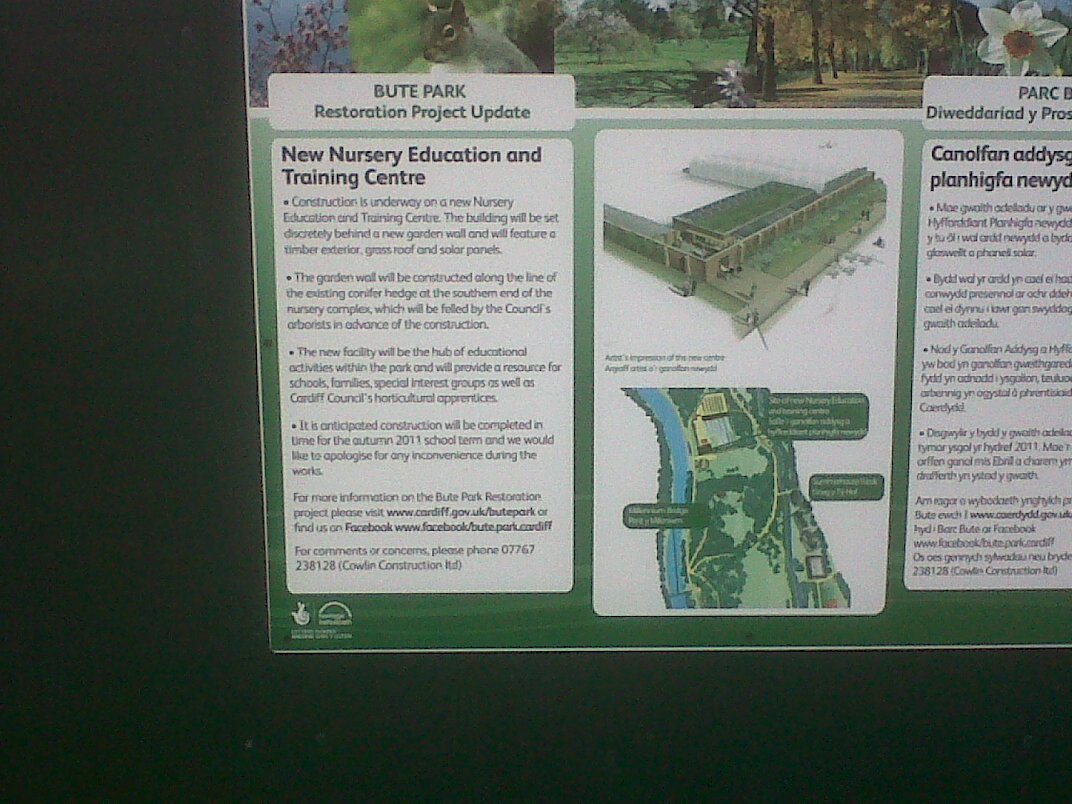
You probably can’t read the text but, amongst other things, it states that a new wall will be built “along the line of the existing conifer hedge, which will be felled by the Council’s arborists in advance of the construction” (my emphasis). Nasty pesky hedges. Nearly as bad as trees. Get in the way of our nice new brick wall. Get rid of them. Still, at least the brick wall might hide some of the horrors lurking inside…

Apparently

It will allow people an insight into the council’s impressive horticultural operation which supplies the city with its colourful displays of flowers and shrubs. For example, there will be a special area for teaching demonstrations by horticultural staff and large windows situated at the back of the centre will allow people to look out over the working part of the nursery.

The facility will also boast excellent learning assets including a classroom and an IT and archive room which will house a variety of resources on park heritage, natural history and environmental themes.

The centre will be available for hire by community and corporate groups and additional facilities will include a catering kiosk and public toilets.

Excellent. People can go inside and see what plants and trees look like on the internet, rather than actually having to walk around in the outside in the fresh air and see the real thing. Mind you, before long so much of Bute Park will have been covered in tarmac that’s the only way people will be able to see foliage of any sort.

I’ve nothing against the idea of encouraging more people into the Park, but not by ploughing it up and building things in it! Do people really want to go into Bute Park to look at greenhouses rather than simply enjoy its serene natural beauty out in the open?

Even more disturbingly, take a look at the artist’s impression to the right of the map. It shows a path wide enough to be considered a road. There are even pedestrians on it. They’re taking a bit of a risk, as the Council clearly intends this to be used by motor vehicles driving into and out of the Nursery. All the speed limit signs in the park have been removed to allow the new influx of road vehicles to drive around at high speed, so this new path will no doubt be just as dangerous as the rest of the park has become.

But wait a minute. Look where the path goes. It doesn’t stop at the planned new entrance to the Nursery. It carries on towards the River Taff, which is just a few yards away. I wonder why?

Let’s take a look across the River from the Nursery gate:

That’s one of the stands of the SWALEC Stadium (the cricket ground) to the right, and part of the Wales Institute of Sport to the left. In between these two is a road which runs from Sophia Gardens towards the River Taff where it comes to a dead end exactly opposite the new Nursery Road.

Let’s have a sweepstake on when the Council starts building its new bridge…

There’s a Council byelection in my ward next month. There’s only one party standing to have stated its opposition to the rapacious exploitation of this beautiful park, and that’s the Green Party.  They’ve got my vote.

Meet the Panel …

Posted in Education, Science Politics with tags , , , , , , , on February 21, 2011 by telescoper

Just a quick post to pass on the news that the Higher Education Funding Council for England (HEFCE) has announced the list of panel members for the forthcoming Research Excellence Framework (REF), a massive exercise in bean counting which will drag on until 2014.

Much as I enjoy ploughing through HEFCE’s fascinating documents, in this case I went straight to the Physics (& Astronomy) sub-panel, which is:

All estimable folk and a good selection of different expertise. There’s also a good geographical spread with members from the English regions, Scotland, Northern Ireland, and of course Wales. Oh, wait a minute. Not Wales. Apparently Wales doesn’t merit any representation on the Physics REF panel. Nor did it last time. Why am I thinking to myself “here we go again”?

To be perfectly honest, I don’t really understand why Welsh universities are being forced to take part in the REF anyway. Or those from Scotland and Northern Ireland for that matter. The REF is driven by an English agenda which is certainly at variance with Welsh priorities. Whereas in England, HEFCE is allocating funding using a formula involving an exceedingly steep weighting towards “internationally leading” research, here in Wales the equivalent body HEFCW is resisting the urge to concentrate research cash so heavily according to such a doubtful measure of research quality.

And don’t get me started on the so-called “impact” measures. All I can say about them is that Kafka would have been proud.

The Welsh Assembly Government has recently taken steps to protect Welsh students against the effects of Higher Education cuts imposed by Westminster. However, there will be substantial cuts in resource to Welsh universities in order to pay for this. At the same time as making “efficiency savings”, as is appropriate for the age of austerity, we’re also being forced to participate in a monstrously wasteful bureaucratic exercise of little relevance to the needs or aspirations of Welsh universities.

I think there’s a strong case for HEFCW to show a bit of real independence and withdraw from the REF altogether.


Share/Bookmark

It Never Entered My Mind

Posted in Jazz with tags , , on February 21, 2011 by telescoper

Before going to bed I couldn’t resist a late night post of this wonderful  version of a Rodgers & Hart ballad called It Never Entered My Mind recorded by Miles Davis for the Blue Note label in the early 50s. Listening to the later Miles Davis playing a standard tune such as this is a bit like trying to recognise an old friend from a photograph of his skeleton, but here he sticks quite closely  to the original composition.  With that hauntingly melancholic tone, however,  it is  pure Miles Davis all the way through.

The composition is a standard AABA form, but with interesting harmonic movements: the A sections (which aren’t identical) consist of repeated notes followed by descending scales whereas the B section – the middle eight – starts with a drop of a minor sixth followed by an ascending scale. It’s a simple device but wonderfully effective, especially in the hands of a genius. I think this track is an absolute gem.

The other musicians featured are Horace Silver (piano), Percy Heath (bass) and Art Blakey (drums). Bonus marks to those who can put names to the other jazz legends shown in the photographs, but don’t let the task of identifying them distract you from the beautiful music…


Share/Bookmark

An Englishman in New York

Posted in Biographical, Literature, Music with tags , , , on February 20, 2011 by telescoper

Yesterday’s post about Bayesian statistics has generated over a thousand hits in just a day – highly unusual for a Saturday posting at In the Dark. I guess that proves that there’s a lot of interest out there in such matters, so I’ll return to the theme as soon as I have both the time and the energy, which might take a while because those are conjugate variables!

After yesterday’s exertions I felt like relaxing this morning, and I did so by transferring some of my old vinyl (and even shellac!) records into digital format using a USB turntable. I’m a bit frustrated by the fact that some of my favourite classic old jazz records aren’t available on Youtube and am thinking of correcting that at some point myself, despite my latent technophobia.

However, in the course of rooting about in my record collection I found a vinyl single of this record by Sting, the Ben Liebrand remix to be precise. It is, of course, a homage to the late Quentin Crisp whose book The Naked Civil Servant I read after seeing the wonderful film starring John Hurt, which was broadcast on the BBC in 1975, when I was 12. I found inspiration in both, for reasons I probably don’t need to spell out. Crisp emigrated to the United States in 1981 and lived the last years of his life in a dingy one-room apartment in New York City.

There’s another quasi-biographical connection with this record. When I was a little kid living in Benwell, my Dad used to play the drums with local jazz bands. At the time Sting (or plain Gordon Sumner as he was then known) was working as a supply teacher in the area and he played the double-bass with local groups too, including the Phoenix Jazz Band and the River City Jazz Band; the latter was certainly a band my father played with from time to time. My Dad once told me that he had played with Sting on a number of occasions, and he’d even practised in our garage, but I’m not sure how much of that is actually true.

Incidentally, in case you didn’t know, Sting got his nickname playing with jazz bands in the North-East. He always refused to wear the band uniforms but instead tended to turn up for gigs wearing a black and yellow hooped jumper which made him look a bit like a bee, hence the name.

This isn’t a jazz record, of course, but it does feature Branford Marsalis (brother of the trumpeter Wynton Marsalis) on soprano saxophone. I bought a soprano saxophone some time ago and tried to play along with the track just now – the chords aren’t very complicated so it shouldn’t have been too difficult even for an incompetent like me. However, I’m finding the soprano sax quite a recalcitrant beast which is very difficult to play in tune. I’m not sure why. I manage all right with its bigger brother the tenor sax. Perhaps it’s my embouchure? Or, as jazz musicians say, I haven’t got the chops?

I’ll just quote one particularly telling  verse from the lyrics:

Takes more than combat gear to make a man
Takes more than a license for a gun
Confront your enemies, avoid them when you can
A gentleman will walk but never run


Share/Bookmark

Bayes’ Razor

Posted in Bad Statistics, The Universe and Stuff with tags , , , , , , , , , on February 19, 2011 by telescoper

It’s been quite while since I posted a little piece about Bayesian probability. That one and the others that followed it (here and here) proved to be surprisingly popular so I’ve been planning to add a few more posts whenever I could find the time. Today I find myself in the office after spending the morning helping out with a very busy UCAS visit day, and it’s raining, so I thought I’d take the opportunity to write something before going home. I think I’ll do a short introduction to a topic I want to do a more technical treatment of in due course.

A particularly important feature of Bayesian reasoning is that it gives precise motivation to things that we are generally taught as rules of thumb. The most important of these is Ockham’s Razor. This famous principle of intellectual economy is variously presented in Latin as Pluralites non est ponenda sine necessitate or Entia non sunt multiplicanda praetor necessitatem. Either way, it means basically the same thing: the simplest theory which fits the data should be preferred.

William of Ockham, to whom this dictum is attributed, was an English Scholastic philosopher (probably) born at Ockham in Surrey in 1280. He joined the Franciscan order around 1300 and ended up studying theology in Oxford. He seems to have been an outspoken character, and was in fact summoned to Avignon in 1323 to account for his alleged heresies in front of the Pope, and was subsequently confined to a monastery from 1324 to 1328. He died in 1349.

In the framework of Bayesian inductive inference, it is possible to give precise reasons for adopting Ockham’s razor. To take a simple example, suppose we want to fit a curve to some data. In the presence of noise (or experimental error) which is inevitable, there is bound to be some sort of trade-off between goodness-of-fit and simplicity. If there is a lot of noise then a simple model is better: there is no point in trying to reproduce every bump and wiggle in the data with a new parameter or physical law because such features are likely to be features of the noise rather than the signal. On the other hand if there is very little noise, every feature in the data is real and your theory fails if it can’t explain it.

To go a bit further it is helpful to consider what happens when we generalize one theory by adding to it some extra parameters. Suppose we begin with a very simple theory, just involving one parameter p, but we fear it may not fit the data. We therefore add a couple more parameters, say q and r. These might be the coefficients of a polynomial fit, for example: the first model might be straight line (with fixed intercept), the second a cubic. We don’t know the appropriate numerical values for the parameters at the outset, so we must infer them by comparison with the available data.

Quantities such as p, q and r are usually called “floating” parameters; there are as many as a dozen of these in the standard Big Bang model, for example.

Obviously, having three degrees of freedom with which to describe the data should enable one to get a closer fit than is possible with just one. The greater flexibility within the general theory can be exploited to match the measurements more closely than the original. In other words, such a model can improve the likelihood, i.e. the probability  of the obtained data  arising (given the noise statistics – presumed known) if the signal is described by whatever model we have in mind.

But Bayes’ theorem tells us that there is a price to be paid for this flexibility, in that each new parameter has to have a prior probability assigned to it. This probability will generally be smeared out over a range of values where the experimental results (contained in the likelihood) subsequently show that the parameters don’t lie. Even if the extra parameters allow a better fit to the data, this dilution of the prior probability may result in the posterior probability being lower for the generalized theory than the simple one. The more parameters are involved, the bigger the space of prior possibilities for their values, and the harder it is for the improved likelihood to win out. Arbitrarily complicated theories are simply improbable. The best theory is the most probable one, i.e. the one for which the product of likelihood and prior is largest.

To give a more quantitative illustration of this consider a given model M which has a set of N floating parameters represented as a vector \underline\lambda = (\lambda_1,\ldots \lambda_N)=\lambda_i; in a sense each choice of parameters represents a different model or, more precisely, a member of the family of models labelled M.

Now assume we have some data D and can consequently form a likelihood function P(D|\underline{\lambda},M). In Bayesian reasoning we have to assign a prior probability P(\underline{\lambda}|M) to the parameters of the model which, if we’re being honest, we should do in advance of making any measurements!

The interesting thing to look at now is not the best-fitting choice of model parameters \underline{\lambda} but the extent to which the data support the model in general.  This is encoded in a sort of average of likelihood over the prior probability space:

P(D|M) = \int P(D|\underline{\lambda},M) P(\underline{\lambda}|M) d^{N}\underline{\lambda}.

This is just the normalizing constant K usually found in statements of Bayes’ theorem which, in this context, takes the form

P(\underline{\lambda}|DM) = K^{-1}P(\underline{\lambda}|M)P(D|\underline{\lambda},M).

In statistical mechanics things like K are usually called partition functions, but in this setting K is called the evidence, and it is used to form the so-called Bayes Factor, used in a technique known as Bayesian model selection of which more anon….

The  usefulness of the Bayesian evidence emerges when we ask the question whether our N  parameters are sufficient to get a reasonable fit to the data. Should we add another one to improve things a bit further? And why not another one after that? When should we stop?

The answer is that although adding an extra degree of freedom can increase the first term in the integral defining K (the likelihood), it also imposes a penalty in the second factor, the prior, because the more parameters the more smeared out the prior probability must be. If the improvement in fit is marginal and/or the data are noisy, then the second factor wins and the evidence for a model with N+1 parameters lower than that for the N-parameter version. Ockham’s razor has done its job.

This is a satisfying result that is in nice accord with common sense. But I think it goes much further than that. Many modern-day physicists are obsessed with the idea of a “Theory of Everything” (or TOE). Such a theory would entail the unification of all physical theories – all laws of Nature, if you like – into a single principle. An equally accurate description would then be available, in a single formula, of phenomena that are currently described by distinct theories with separate sets of parameters. Instead of textbooks on mechanics, quantum theory, gravity, electromagnetism, and so on, physics students would need just one book.

The physicist Stephen Hawking has described the quest for a TOE as like trying to read the Mind of God. I think that is silly. If a TOE is every constructed it will be the most economical available description of the Universe. Not the Mind of God.  Just the best way we have of saving paper.


Share/Bookmark

Harriet Presents…

Posted in Education with tags , on February 18, 2011 by telescoper

Now here’s a short video called a (presented by the legendary Harriet Parfitt) explaining the joys of studying  in the School of Physics & Astronomy at Cardiff University. It’s somewhat spoiled by the appearance of yours truly (filmed during a recent first-year  Astrophysical Concepts lecture) but apart from that it’s really rather good!


Share/Bookmark

O Superman

Posted in Music with tags , , on February 17, 2011 by telescoper

I dozed off on the train from Reading to Cardiff earlier on, and for some reason I had a small dreamette that included this  track by the wonderful Laurie Anderson. It reached Number 2 in the UK singles charts in 1981, an amazing feat for such an offbeat track, especially one that lasts over eight minutes. I loved it at the time, while I was studying for the Cambridge Entrance Examinations, and only later discovered that it’s based on an aria from the Opera Le Cid by Jules Massenet. I don’t know why it popped into my head, but I thought I’d share it anyway…


Share/Bookmark

MSSL & CSS

Posted in Biographical, The Universe and Stuff with tags , , , on February 17, 2011 by telescoper

I was up early yet again this morning to catch a train to Guildford. From there I was whisked off by a taxi into the Surrey countryside to visit MSSL,  or the Minimal Supersymmetric Standard Mullard Space Science Laboratory, which is an outpost of University College London. No sooner had I got there and I was whisked off again to a very nice local country pub for lunch and a pint, before being returned, suitably inebriated, to give my seminar.

I’ve never been to MSSL before – nor Guildford, for that matter – and my day out was a very pleasant surprise. Not only were there no disasters on the trains, despite having to travel via Reading, but the fine springlike weather gave me good views of the green and pleasant land that is Surrey. MSSL is itself on the top of a hill, and on a clear day you can see as far as the Sussex downs to the South. But not quite today as it was a little misty.

I had to leave not long after my talk finished in order to get back to Guildford, a drive of about 40 minutes. I got there with about 15 minutes to spare, but it turned out that the train before the one I was intending to catch was about 15 minutes late so I got straight on it. I thus got to Reading two minutes ahead of the train before the one I was planning to catch there, so in the end got home about half an hour early. Which was nice.

I enjoyed the visit there enormously. Everyone was very friendly. Apparently, some of them even read this blog so I’d like to say thanks for the invitation and for struggling manfully to stay awake as I droned on after the pub lunch.

I didn’t get much time to post yesterday either, because I had to attend a function organised by Cardiff Scientific Society (of which I am a Committee Member). This was the occasion of the annual Lord Phillips Memorial Lecture, given this year by Professor Sir Brian Hoskins on the subject of Jet Streams in Weather and Climate. Jet streams are fascinating but highly complex phenomena and it’s clear that there’s a lot about them meteorologists don’t understand fully. One thing I did learn during the lecture, however, was that when people say that changes in the Atlantic jet stream “cause” unusual weather (such as our recent cold spell, or the floods of 2007), they’re wrong. It seems clear that the jet stream is part of the atmospheric pattern that gives rise to such events but can’t be said to be responsible for them.

Anyway, after a fascinating lecture we adjourned with the speaker to the Vice-Chancellor’s dining room, for a (fairly) late supper. One of the perks of the job, I guess. I wasn’t too late getting home, and got to bed early enough to make getting up at 6am not too stressful.

With another busy day tomorrow, and a UCAS event on Saturday that I (unwisely) volunteered to help with, I think I’m going to get an early night tonight.


Toodle-pip!


Share/Bookmark

Ozymandias

Posted in Poetry with tags , , on February 16, 2011 by telescoper

Since I posted an item about Shelley a couple of days ago I’ll use that as an excuse to post this famous poem by him.It’s a well-known piece, but not a lot of people know that it was actually written in 1817, as part of a sonnet-writing contest between Shelley and Horace Smith.

I wonder why it always makes me think of STFC?

I met a traveller from an antique land
Who said: “Two vast and trunkless legs of stone
Stand in the desert. Near them on the sand,
Half sunk, a shattered visage lies, whose frown
And wrinkled lip and sneer of cold command
Tell that its sculptor well those passions read
Which yet survive, stamped on these lifeless things,
The hand that mocked them and the heart that fed.
And on the pedestal these words appear:
`My name is Ozymandias, King of Kings:
Look on my works, ye mighty, and despair!’
Nothing beside remains. Round the decay
Of that colossal wreck, boundless and bare,
The lone and level sands stretch far away”.


Share/Bookmark

Biology done like Particle Physics

Posted in Uncategorized with tags , , on February 16, 2011 by telescoper

Here, courtesy of Abstruse Goose, is an illustration of what Biology would be like if it were done by particle physicists. I hasten to add that no actual frogs were harmed in the making of this post.


Share/Bookmark