I just realised that today is a solemn anniversary which surprisingly hasn’t been marked in the media. On this day 70 years ago, i.e. 24th May 1941, the Royal Navy battlecruiser HMS Hood was sunk by the German Battleship Bismarck in the Battle of the Denmark Strait. Of a ship’s complement of 1418 only three survived the sinking of HMS Hood; it was one of the greatest maritime disasters of the Second World War. I’m not one for dwelling excessively on the past, but I think it’s a shame this event has not been remembered. We owe a lot to people like the 1415 who gave their lives that day, so I’m glad I remembered in time to pay my respects.
An interesting article on the BBC website about the innate nature of our understanding of geometry reminded me that I have been meaning to post something about the importance of geometry in mathematics education – and, more accurately, the damaging consequences of the lack of geometry in the modern curriculum.
When I was a lad – yes, it’s one of those tedious posts about how things were better in the old days – we grammar school kids spent a disproportionate amount of time learning geometry in pretty much the way it has been taught since the days of Euclid. In fact, I still have a copy of the classic Hall & Stevens textbook based on Euclid’s Elements, from which I scanned the proof shown below (after checking that it’s now out of copyright).
This, Proposition 5 of Book I of the Elements, is in fact quite a famous proof known as the Pons Asinorum:
The old-fashioned way we learned geometry required us to prove all kinds of bizarre theorems concerning the shapes and sizes of triangles and parallelograms, properties of chords intersecting circles, angles subtended by various things, tangents to circles, and so on and so forth. Although I still remember various interesting results I had to prove way back then – such as the fact that the angle subtended by a chord at the centre of a circle is twice that subtended at the circumference (Book III, Proposition 20) – I haven’t actually used many of them since. The one notable exception I can think of is Pythagoras’ Theorem (Book I, Proposition 47), which is of course extremely useful in many branches of physics.
The apparent irrelevance of most of the theorems one was required to prove is no doubt the reason why “modern” high school mathematics syllabuses have ditched this formal approach to geometry. I think this was a big mistake. The bottom line in a geometrical proof is not what’s important – it’s how you get there. In particular, it’s learning how to structure a mathematical argument.
That goes not only for proving theorems, but also for solving problems; many of Euclid’s propositions are problems rather than theorems, in fact. I remember well being taught to end the proof of a theorem with QED (Quod Erat Demonstrandum; “which was to be proved”) but end the solution of a problem with QEF (Quod Erat Faciendum; “which was to be done”).
You can see what I mean by looking at the Pons Asinorum, which is a very simple theorem to prove but which illustrates the general structure:
GIVEN
TO PROVE
CONSTRUCTION
PROOF
When you have completed many geometrical proofs this way it becomes second nature to confront any problem in mathematics (or physics) by first writing down what is given (or can be assumed), often including the drawing of a diagram. These are key ingredients of a successful problem solving strategy. Next you have to understand precisely what you need to prove, so write that down too. It seems trivial, but writing things down on paper really does help. Not all theorems require a “construction”, and that’s usually the bit where ingenuity comes in so is more difficult. However, the “proof” then follows as a series of logical deductions, with reference to earlier (proved) propositions given in the margin.
This structure carries over perfectly well to problems involving algebra or calculus (or even non-Euclidean geometry) but I think classical geometry provides the ideal context to learn it because it involves visual as well as symbolic logic – it’s not just abstract reasoning in that compasses, rulers and protractors can help you!
I don’t think it’s a particular problem for universites that relatively few students know how to prove the perpendicular bisector theorem, but it definitely is a problem that so many have no idea what a mathemetical proof should look like.
Well, it’s 1pm and my third-year students are just sitting down for two hours of fun with their Nuclear and Particle Physics examination. For my part I’m obliged to sit by the phone for the next two hours in case there’s a problem with the examination paper. Ideal excuse for a quick blog post while I eat my sandwich.
I also notice from my trusty wordpress dashboard that this is my 1000th post since I started blogging, way back in late 2008. Time to indulge myself, then. I haven’t posted much jazz recently so I thought I’d share this classic recording with you. It’s from my favourite era of jazz – the late 1950s – and my favourite kind of jazz, bebop, which by then had matured, ripened and hardened considerably since its birth in the 1940s.
This gives me the excuse to mention a nice article in Saturday’s Grauniad about the poet Philip Larkin, his love for “trad” and his hatred for the “modern” jazz exemplified by bebop. It’s entirely a matter of personal taste, of course, but speaking for myself I can say that I’ve never had any problem loving jazz of all ages. For me, though, it reached a peak in the late 50s with musicians of the calibre of Miles Davis, John Coltrane, and Ornette Coleman.
This particular track features alto-saxophonist Lou Donaldson whom many jazz critics regarded as a pale imitation of the pioneering be-bop icon Charlie Parker but whose playing I’ve always admired. In my book, anyone brave enough to follow Charlie Parker deserves the highest esteem. In any case when Lou Donaldson walked into the Van Gelder studio in Hackensack, New Jersey on July 28th 2008 he clearly had fire in his belly.
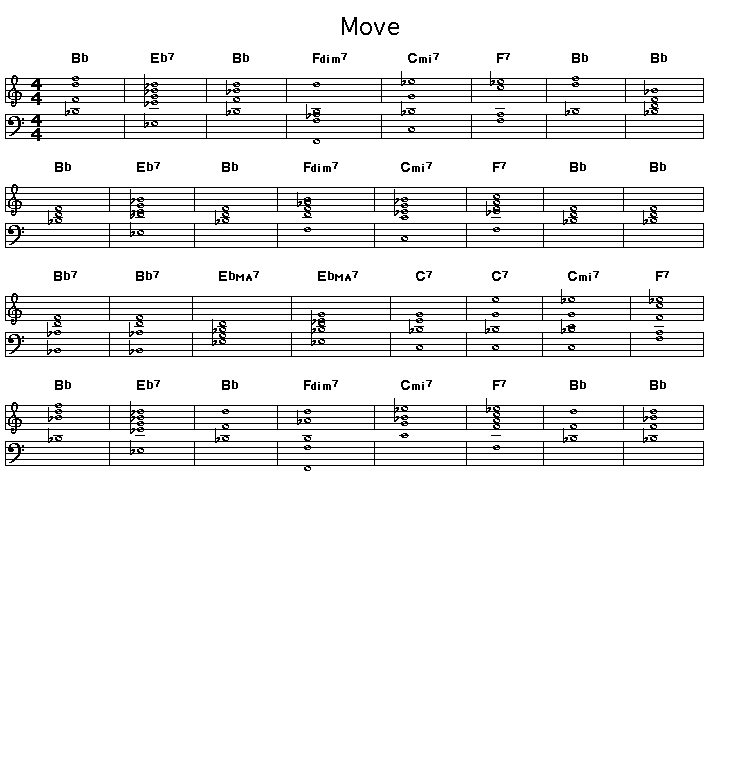
The tune is entitled Move and it was written by drummer Denzil Best. It’s quite unusual for a drummer also to be a composer, but Best wrote a number of classic jazz tunes. I even managed to find the chords that make up this one’s 32 bar AABA structure…
Many bebop compositions are based on the chord progressions of standard tunes, such as How High the Moon or I Got Rhythm, but with the melody replaced by something much more intricate than the original tune. I don’t recognize the chords above from anywhere else so it may be an entirely original composition by Denzil Best. I’m sure there’s a jazz buff out there who will correct me if I’m wrong. In any case the jagged melody is archetypal bebop stuff – complex and angular, very difficult to play but intensely exciting to listen to.
While I’m in reblogging mood I’ll try to send some traffic the way of this post, which is somewhat related to Friday’s one about the Wigglezeddy survey (or whatever it’s called)…
Paper Title: The Atacama Cosmology Telescope: Evidence for Dark Energy from the CMB Alone Authors: Blake D. Sherwin et al. 1st Author’s Affiliation: Dept. of Physics, Princeton University Introduction Continuing with Monday’s theme of cosmology, today’s astrobite features an ApJ Letter that describes new evidence for dark energy. In the past decade a number of cosmological tests have been developed that show a need for a cosmological constant th … Read More
Well, I guess the Rapture didn’t come after all. Or maybe it did and I’m unsurprisingly not among the chosen few to be saved? I studiously avoided try to make fun of the whole thing, despite the fact that yesterday everyone seemed to be posting rapture jokes like there was no tomorrow.
Anyway, for those who were disappointed by the poor turnout for the Apocalypse here is another poem by R.S. Thomas; this one is called called Judgment Day…
Yes, that’s how I was,
I know that face,
That bony figure
Without grace
Of flesh or limb;
In health happy,
Careless of the claim
Of the world’s sick
Or the world’s poor;
In pain craven –
Lord breathe once more
On that sad mirror
Let me be lost
In mist for ever
Rather than own
Such bleak reflections,
Let me go back
On my two knees
Slowly to undo
The knot of life
That was tied there.
A “Mr Smith” from Portugal drew my attention to this post. I’ve posted from time to time about my scepticism about bibliometricism and this piece suggests some radical alternatives to the way citations are handled. I’m not sure I agree with it, but it’s well worth reading.
In this, the 4th post in this series (the others on video abstracts, object oriented paper writing and freelance postdocs are here: 1,2,3), I would like to chat about a tough but important problem and present some proposals to address it, which vary from conservative to bordering on the extreme. Crazy ideas can be stimulating and fun, and I hope the proposals achieve at least one of these. They might even turn out to be useful. One can hope. The … Read More
It’s been a long time since I posted an opera review. That’s because neither of the operas offered by Welsh National Opera earlier this year appealed to me very much and since then I’ve been too busy doing other things to take in an opera anywhere else. However, the summer season of WNO has now started so now at last there’s something of an operatic nature to write about. In fact, I was lucky enough to get tickets for the first night of WNO’s new production of Così fan tutte by Wolfgang Amadeus Mozart and duly went along yesterday evening. The Millennium Centre was pretty full – as you’d expect for a first night of an enduringly popular opera.
In case you weren’t aware, Così fan tutte is a masterpiece of comic opera (or, technically speaking, opera buffa) written in collaboration with Lorenzo da Ponte who also wrote the libretti for Don Giovanni and The Marriage of Figaro. The title can be loosely translated as “That’s how all women behave”; the -e on “tutte” indicates a feminine plural. The plot -such as it is – revolves around two pays of lovers: Guglielmo, who is engaged to Fiordiligi, and Ferrando, who is engaged to Fiordiligi’s sister, Dorabella. Both Guglielmo and Ferrando are sailors. All four are friends with the scheming Don Alfonso, who orchestrates the unfolding events, presumably for his own amusement.
Don Alfonso suggests to Ferrando and Guglielmo that their beloved fiancées are not as faithful as they seem to imagine and the three agree a wager. Ferrando and Guglielmo pretend that they’ve been called up for active service. Don Alfonso joins Fiordiligi and Dorabella in the sumptuous trio Soave sia il vento as the men appear to sail off for battle. The ladies are heartbroken and pledge fidelity to their departed lovers. However, the two sailors soon return in disguise in order to attempt their seduction. After various goings-on the men succeed in seducing each others fiancees and a mock wedding is staged. The marriage is interrupted by the sound of the sailors’ return. After the quickest of quick changes the two men re-appear without their disguises and confront their unfaithful women. Don Alfonso has won his bet.
Like all opera buffa the plot sounds faintly ridiculous – which it is – but of course the key to its success as a piece is not just the comic action, but also the gorgeous music which carries it along. In this particular opera there’s almost no end to the musical loveliness as Mozart has each principal singing alone, and in combinations of twos and threes. Mozart’s writing for two, three or four voices is truly wonderful to listen to, and there are many fine examples of such in this opera.
In this production Guglielmo and Ferrando are sailors who are stationed in a British seaside resort, complete with promenade, pier, Punch & Judy show and Italian ice-cream parlour (named Botticelli‘s). This setting takes it quite a long way downmarket compared to the original location of Naples, especially when the Butlins-style redcoats appear, and this is carried through to the much coarser way the comedy is handled than you find in many productions of this piece. This approach does provide enjoyable moments of slapstick hilarity but also causes some difficulties.
For example, it is key to this opera that the character of Don Alfonso has to have some sort of power over the four main protagonists. In other words, it has to be credible that they believe what he says and go along with his suggestions. In this production, however, Don Alfonso is meant to be a “local pier entertainer” – in fact he actually looks more like Flash Harry. I found it hard to accept that anyone would believe anything that this particularly dodgy spiv had to say, and his interaction with the two ladies in particular lacked all credibility.
Another thing I didn’t like was the way the opening of the piece was handled. Like most of Mozart’s operas, Così fan tutte is blessed with a splendid overture, perhaps not as brilliant the other Da Ponte operas but full of playful exuberance and very much worth listening to. You can call me old-fashioned, but I do like to hear the overture, preferably with an empty stage or with the curtain down. In this production, however, as soon as the overture started, the stage began to fill with various extras doing various (admittedly comic) things. A particularly funny sequence of people walking dogs backwards and forwards got a huge laugh, but which drowned out the music entirely. What a waste.
I suppose the overall point I’m trying to make is that this production tried too hard to get cheap laughs. It’s just not necessary to milk it like that – it’s funny enough anyway!
However, these are relatively small objections. I’ll temper them by adding that some of the comedy in this production is inspired. Ferrando wore a false nose that made him look like Barry Manilow and Guglielmo’s false moustache gave him the appearance of Comrade Stalin. The latter looked particularly louche in white tennis shorts and ghastly red blazer.
Neal Davies (baritone) was Don Alfonso, amusingly played but lacking the deep sonority in his voice really needed to carry the role off. Ferrando was played by Robin Tritschler (tenor), whose light agile voice is ideal. Gary Griffiths (baritone) as Guglielmo was outstanding, with an excellent voice and obvious flair for the comic touches. Fiordiligi (Camilla Roberts) and Dorabella (Helen Lepalaan) were also good. Despina – a waitress in Botticelli’s ice-cream parlour and Don Alfonso’s accomplice (often in disguise) – was pert and feisty but her voice lacked projection; at times she was barely audible.
Anyway, in view of the fact that the comedy dog-walking interfered with last night’s overture I thought I’d end by posting a version here. I love the way that little phrase is thrown around among the wind instruments!
I don’t have much time to post today after spending all morning in a meeting about Assuring a Quality Experience in the Graduate College and in between reading project reports this afternoon.
However, I couldn’t resist a quickie just to draw your attention to a cosmology story that’s made it into the mass media, e.g. BBC Science. This concerns the recent publication of a couple of papers from the WiggleZ Dark Energy Survey which has used the Anglo-Australian Telescope. You can read a nice description of what WiggleZ (pronounced “Wiggle-Zee”) is all about here, but in essence it involves making two different sorts of measurements of how galaxies cluster in order to constrain the Universe’s geometry and dynamics. The first method is the “wiggle” bit, in that it depends on the imprint of baryon acoustic oscillations in the power-spectrum of galaxy clustering. The other involves analysing the peculiar motions of the galaxies by measuring the distortion of the clustering pattern introduced seen in redshift space; redshifts are usually denoted z in cosmology so that accounts for the “zee”.
The paper describing the results from the former method can be found here, while the second technique is described there.
This survey has been a major effort by an extensive team of astronomers: it has involved spectroscopic measurements of almost a quarter of a million galaxies, spread over 1000 square degrees on the sky, and has taken almost five years to complete. The results are consistent with the standard ΛCDM cosmological model, and in particular with the existence of the dark energy that this model implies, but which we don’t have a theoretical explanation for.
This is all excellent stuff and it obviously lends further observational support to the standard model. However, I’m not sure I agree with the headline of press release put out by the WiggleZ team Dark Energy is Real. I certainly agree that dark energy is a plausible explanation for a host of relevant observations, but do we really know for sure that it is “real”? Can we really be sure that there is no other explanation? Wiggle Z has certainly produced evidence that’s sufficient to rule out some alternative models, but that’s not the same as proof. I worry when scientists speak like this, with what sounds like certainty, about things that are far from proven. Just because nobody has thought of an alternative explanation doesn’t mean that none exists.
The problem is that a press release entitled “dark energy is real” is much more likely to be picked up by a newspaper radio or TV editor than one that says “dark energy remains best explanation”….
We sow the glebe, we reap the corn, We build the house where we may rest, And then, at moments, suddenly, We look up to the great wide sky, Inquiring wherefore we were born… For earnest or for jest?
The senses folding thick and dark About the stifled soul within, We guess diviner things beyond, And yearn to them with yearning fond; We strike out blindly to a mark Believed in, but not seen.
We vibrate to the pant and thrill Wherewith Eternity has curled In serpent-twine about God’s seat; While, freshening upward to His feet, In gradual growth His full-leaved will Expands from world to world.
And, in the tumult and excess Of act and passion under sun, We sometimes hear-oh, soft and far, As silver star did touch with star, The kiss of Peace and Righteousness Through all things that are done.
God keeps His holy mysteries Just on the outside of man’s dream; In diapason slow, we think To hear their pinions rise and sink, While they float pure beneath His eyes, Like swans adown a stream.
Abstractions, are they, from the forms Of His great beauty?-exaltations From His great glory?-strong previsions Of what we shall be?-intuitions Of what we are-in calms and storms, Beyond our peace and passions?
Things nameless! which, in passing so, Do stroke us with a subtle grace. We say, ‘Who passes?’-they are dumb. We cannot see them go or come: Their touches fall soft, cold, as snow Upon a blind man’s face.
Yet, touching so, they draw above Our common thoughts to Heaven’s unknown, Our daily joy and pain advance To a divine significance, Our human love-O mortal love, That light is not its own!
And sometimes horror chills our blood To be so near such mystic Things, And we wrap round us for defence Our purple manners, moods of sense- As angels from the face of God Stand hidden in their wings.
And sometimes through life’s heavy swound We grope for them!-with strangled breath We stretch our hands abroad and try To reach them in our agony,- And widen, so, the broad life-wound Which soon is large enough for death.
From time to time on this blog I post rants about the state of scientific publishing, open access, the importance of the arXiv for astronomy and cosmology, and so on.
This morning, however, I discovered an “alternative” side to the whole business of online science, a site by the name of viXra. Most readers will probably be familiar with this site already – many no doubt publish there, in fact – but I have to say that it’s completely new to me. I urge you to check it out.
The structure and layout of viXra is almost identical to the arXiv, but the content is a bit … er … different. Naturally, I went straight for the section that mirrors astro-ph on the arXiv. The viXra version of astro-ph so far contains only 88 publications, but among them are papers of such outstanding quality that I’m sure this remarkable collection will grow very quickly when like-minded authors around the world find out about it.
I thought I’d post my favourite as an example. Initially, I was going to go with one entitledBall Lightning, Micro Comets, Sprite-Fireballs and X-Ray/gamma Flashes According to Quantum FFF Theory, with the abstract
FUNCTION FOLLOWS FORM in Quantum FFF THEORY. The FORM and MICROSTRUCTURE of elementary particles, is supposed to be the origin of FUNCTIONAL differences between Higgs- Graviton- Photon- and Fermion particles. As a consequence, a NEW splitting, accelerating and pairing MASSLESS BLACK HOLE, able to convert vacuum energy (ZPE) into real energy by entropy decrease, seems to be able to explain quick Galaxy- and Star formation, down to Sunspots, (Micro) Comets, Lightning bolts, Sprite Fireballs and Ball Lightning.
I decided against this one, however, because of the tendency to burst inexplicably into upper case every now and again, which I found rather alarming.
I was also forced to reject this one, The Structuring Force of the Natural World, on the grounds that (a) it’s in Chinese so I can’t read it and (b) I don’t know what a “basket graph” is. Otherwise I’m sure its a splendid piece of work.
The assumption that the mass distribution of spiral galaxies is rational was suggested 11 years ago. The rationality means that on any spiral galaxy disk plane there exists a special net of orthogonal curves. The ratio of mass density at one side of a curve (from the net) to the one at the other side is constant along the curve. Such curve is called a proportion curve. Such net of curves is called an orthogonal net of proportion curves. I also suggested that the arms and rings are the disturbance to the rational structure. To achieve the minimal disturbance, the disturbing waves trace the orthogonal or non-orthogonal proportion curves. I proved 6 years ago that exponential disks and dual-handle structures are rational. Recently, I have also proved that rational structure satisfies a cubic algebraic equation. Based on these results, this paper ultimately demonstrates visually what the orthogonal net of proportion curves looks like if the superposition of a disk and dual-handle structures is still rational. That is, based on the natural solution of the equation, the rate of variance along the ‘radial’ direction of the logarithmic mass density is obtained. Its image is called the ‘basket graph’. The myth of galaxy structure will possibly be resolved based the further study of ‘basket graphs’.
In the end I decided to go for this impressive article, A Cantorian Superfluid Vortex and the Quantization of Planetary Motion
This article suggests a preliminary version of a Cantorian superfluid vortex hypothesis as a plausible model of nonlinear cosmology. Though some parts of the proposed theory resemble several elements of what have been proposed by Consoli (2000, 2002), Gibson (1999), Nottale (1996, 1997, 2001, 2002a), and Winterberg (2002b), it seems such a Cantorian superfluid vortex model instead of superfluid or vortex theory alone has never been proposed before. Implications of the proposed theory will be discussed subsequently, including prediction of some new outer planets in solar system beyond Pluto orbit. Therefore further observational data is recommended to falsify or verify these predictions. If the proposed hypothesis corresponds to the observed facts, then it could be used to solve certain unsolved problems, such as gravitation instability, clustering, vorticity and void formation in galaxies, and the distribution of planet orbits both in solar system and also exoplanets.
I’m not an expert on the “Cantorian superfluid vortex theory”, but I suspect the author may well be correct in saying that it has not previously been proposed as an explanation for the planetary orbits…
The views presented here are personal and not necessarily those of my employer (or anyone else for that matter).
Feel free to comment on any of the posts on this blog but comments may be moderated; anonymous comments and any considered by me to be vexatious and/or abusive and/or defamatory will not be accepted. I do not necessarily endorse, support, sanction, encourage, verify or agree with the opinions or statements of any information or other content in the comments on this site and do not in any way guarantee their accuracy or reliability.




 In the Dark