Archive for November, 2012

Leonids over us

Posted in Poetry, The Universe and Stuff with tags , , , on November 17, 2012 by telescoper

The sky is streaked with them
burning hole in black space —
like fireworks, someone says
all friendly in the dark chill
of Newcomb Hollow in November,
friends known only by voices.

We lie on the cold sand and it
embraces us, this beach
where locals never go in summer
and boast of their absence. Now
we lie eyes open to the flowers
of white ice that blaze over us

and seem to imprint directly
on our brains. I feel the earth,
rolling beneath as we face out
into the endlessness we usually
ignore. Past the evanescent
meteors, infinity pulls hard.

by Marge Piercy (b. 1936)

P.S. In case you didn’t know, the Leonids is an often prolific meteor shower that has its radiant in the constellation of Leo and which peaks at about this time of year.

LHC Lights up NBI

Posted in Art, Biographical, The Universe and Stuff with tags , , , on November 16, 2012 by telescoper

Well, first things first. Congratulations to Dr Sabir Ramazanov on his successful thesis defence today! I’ll perhaps write a bit more about the process in due course.

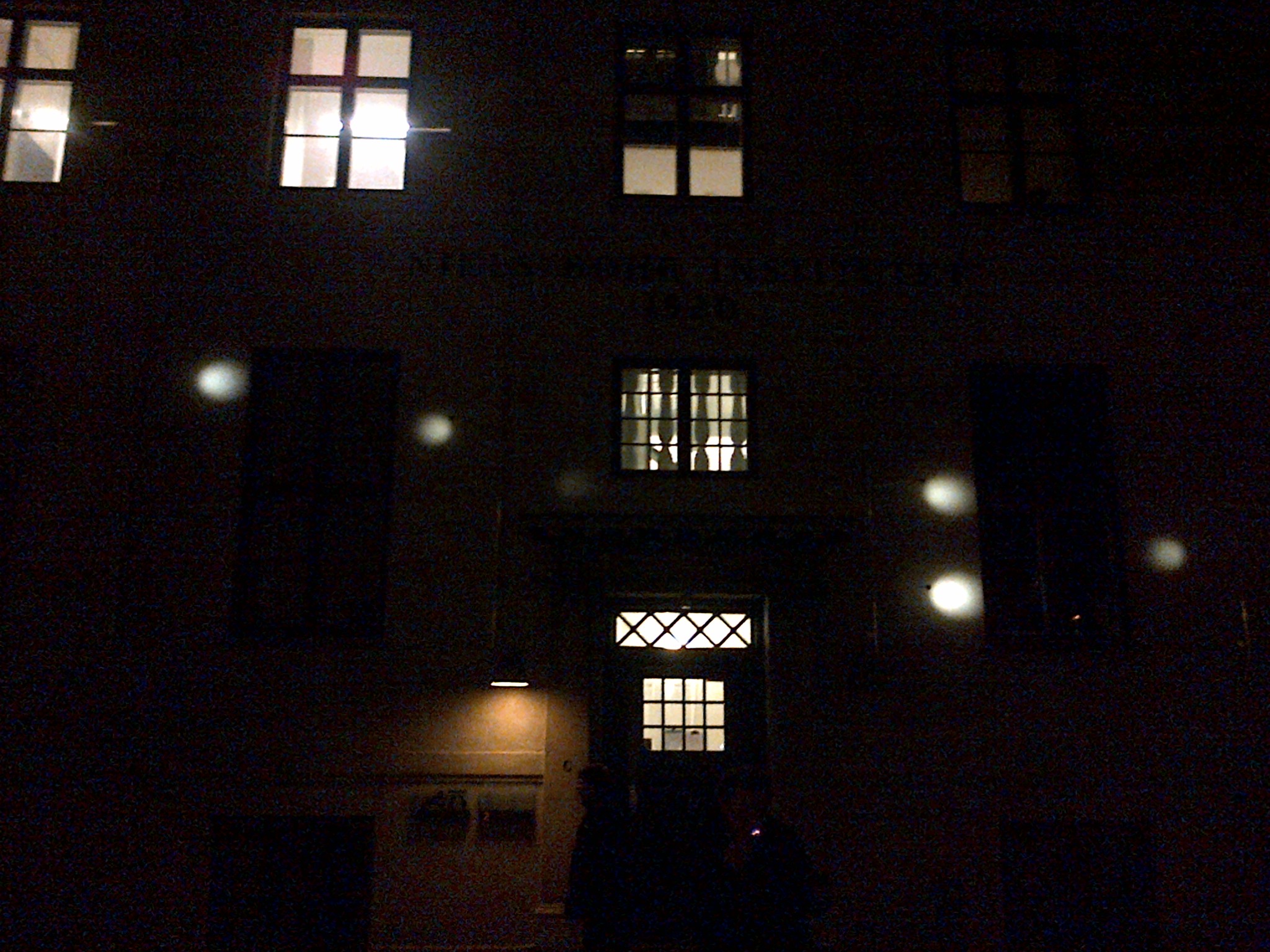
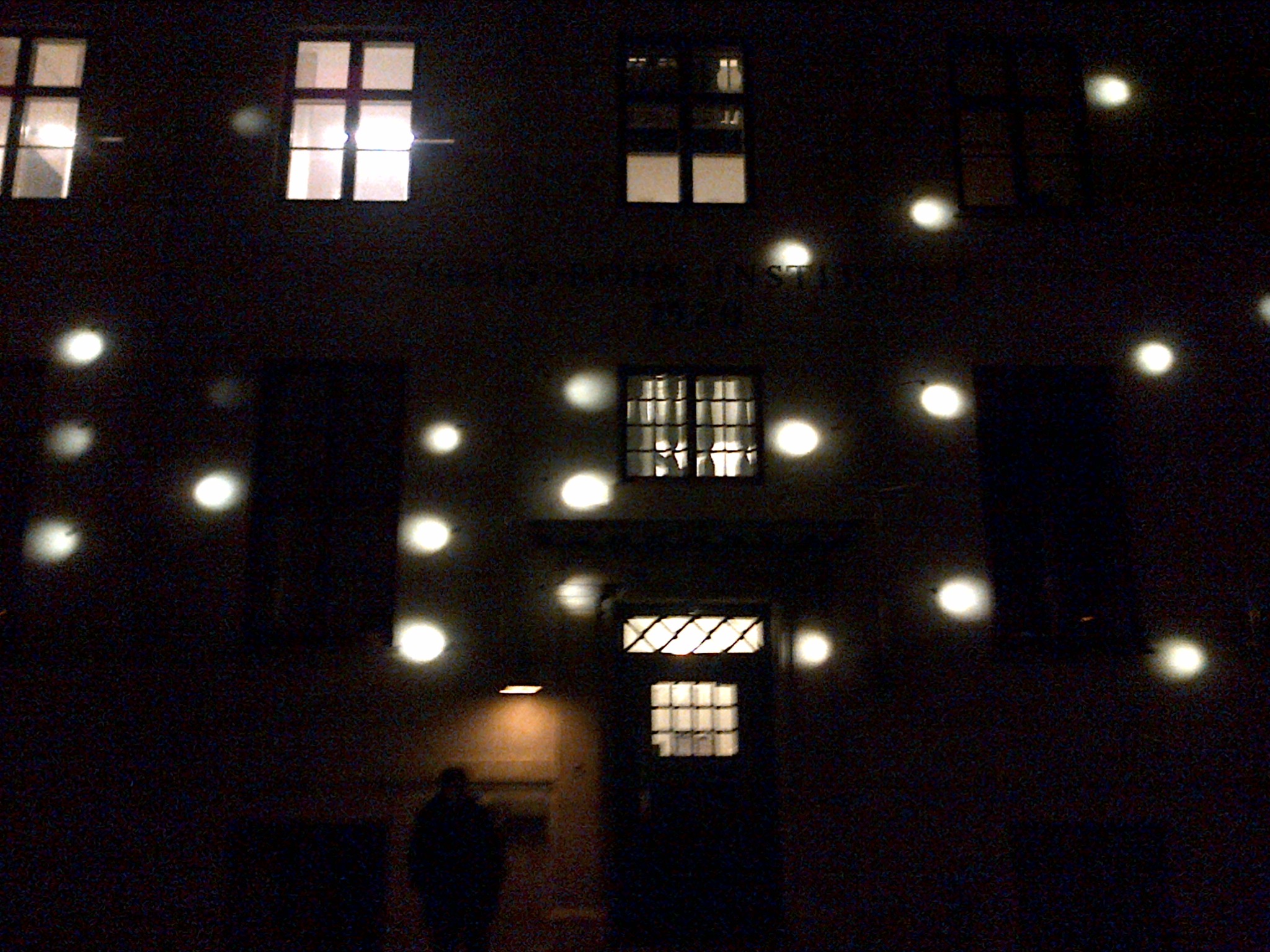
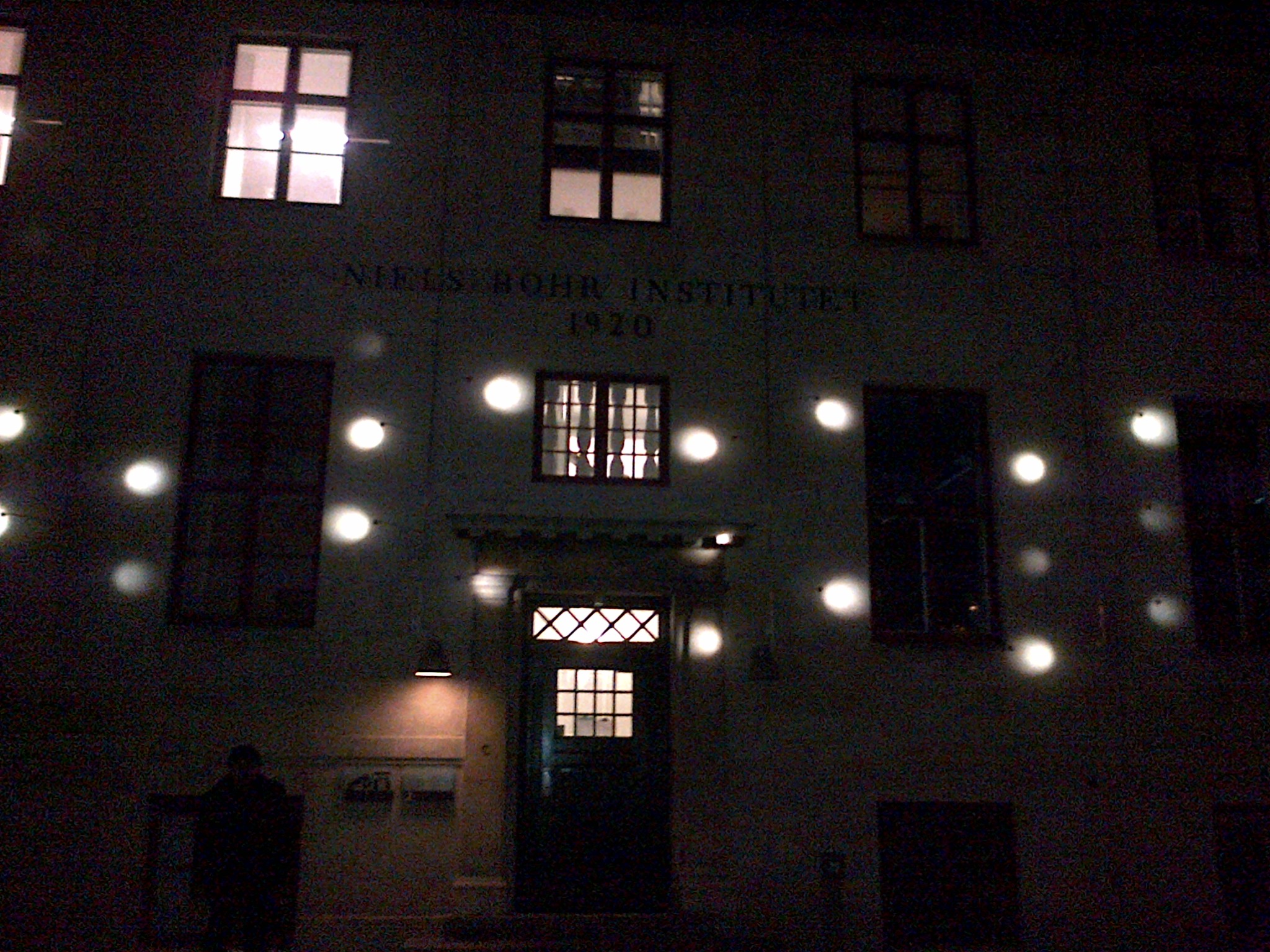
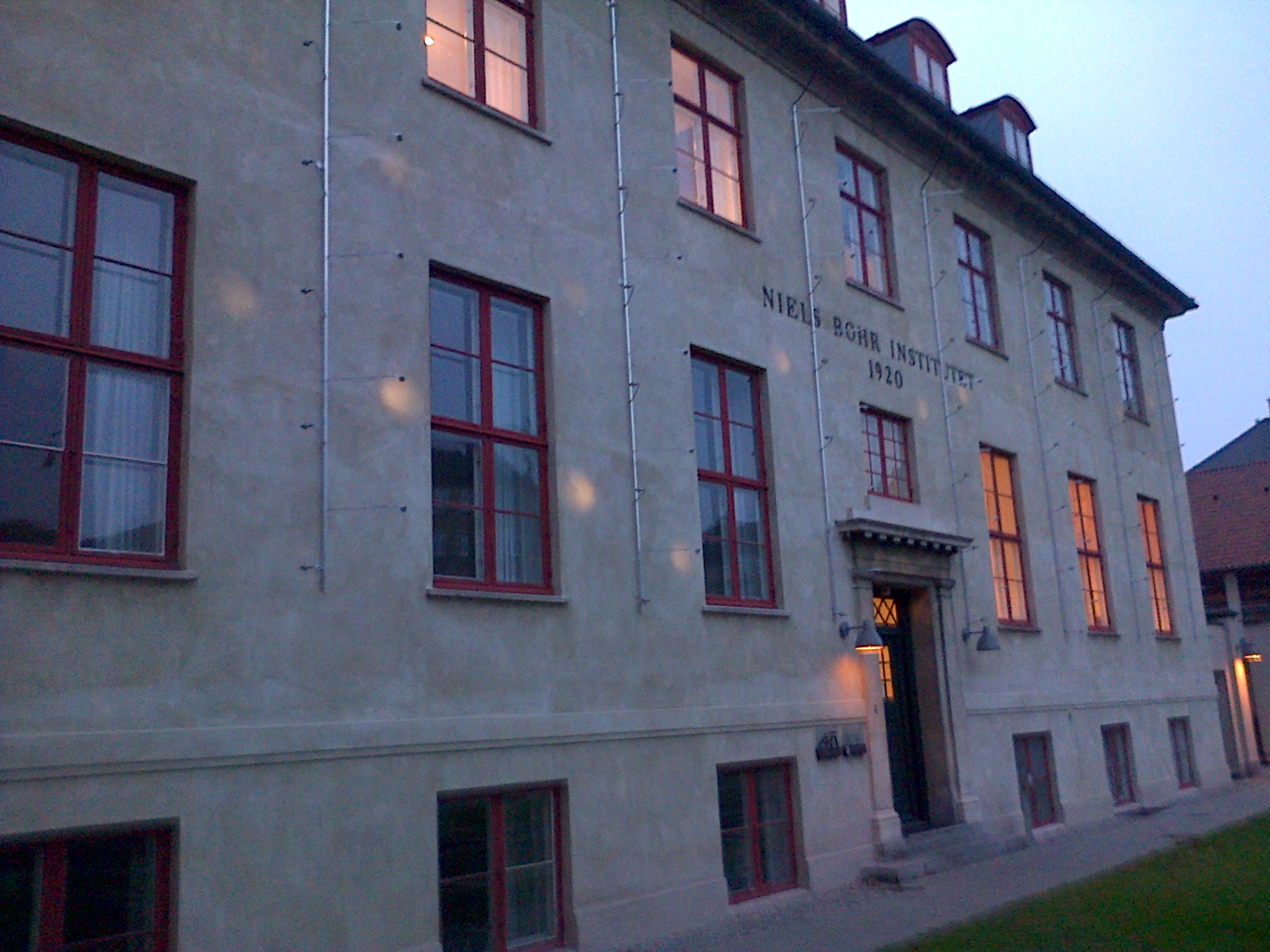
After the formalities were concluded, however, the committee took a breath of fresh air outside the Niels Bohr Institute where, in the fading November twilight, we were treated to a peculiar light show; a set of small spotlights on the front wall of the NBI building is hooked up directly to the ATLAS experiment on the Large Hadron Collider at CERN so that every time an event registers in Geneva it is displayed almost immediately in public here in Copenhagen. Quite appropriate for a place so steeped in physics history. The resolution of the particle tracks is of course not marvellous, but it’s actually quite a remarkable thing to see, although not all that easy to catch it on camera, especially if you’ve had a couple of glasses of wine!

A Psychological Tip

Posted in Biographical, Poetry with tags , , , , on November 16, 2012 by telescoper

So here I am, then, in Copenhagen. Yesterday evening, as far as I’m concerned, at least, my wavefunction collapsed along with the rest of me into a definite location. Ibsen’s Hotel, in fact. I had a pleasantly uneventful journey to Heathrow by train. The plane thence arrived in Copenhagen twenty minutes ahead of time, and then I had the chance to marvel at wonderful Copenhagen’s wonderfully efficient public transport in the form of the Metro that took me to about 100 metres from my hotel. All very relaxed and stress-free.

This morning I got up bright and early, determined to avoid the queues at breakfast, but was inevitably foiled by dozens of uber-efficient Germans who were already there at 7am when it opened. Fortunately I managed to find a quiet place in the corner to drink my coffee while they basked in their own smugness and barked orders at the waitresses.

Anyway, it’s still pretty dark outside so I thought I’d post something before walking to the Niels Bohr Institute for the day’s business. Since I’m in Denmark I thought I’d put up one of the wonderfully witty little poems written by Danish mathematician Piet Hein. He called each of these verses a “grook” (or actually, in Danish, the word is gruk) and he wrote thousands of them over his long life. Many, like this one, are utterly brilliant.

Whenever you’re called on to make up your mind,
and you’re hampered by not having any,
the best way to solve the dilemma, you’ll find,
is simply by spinning a penny.

No – not so that chance shall decide the affair
while you’re passively standing there moping;
but the moment the penny is up in the air,
you suddenly know what you’re hoping.

by Piet Hein (1905-1996).

Flying Visit

Posted in Biographical, Education, Politics, The Universe and Stuff with tags , , on November 15, 2012 by telescoper

I’m still at home at 10am on a weekday, which is unusual, but that’s because I’m soon going to be doing the familiar schlepp to Heathrow airport in order to get a flight to Copenhagen. The purpose of this little trip is to participate in a PhD examination at the Niels Bohr Institute. I’ve never taken part in a Thesis Defence in the Danish system before, although I’ve done many equivalent examinations elsewhere, so I’m quite looking forward to finding out how it works. Will it be much different from the system we have in the UK? Probably, as it is a much more public occasion. Will that necessarily make it better? I don’t know. I was reading the thesis last night, actually, and it’s very interesting which is another reason to look forward to the occasion. I might even get time for some shopping too.

Anyway, before going to the airport I am going to pop along to the local polling station. Today is the day for the Election of the Police and Crime Commissioner for the South Wales Police Area. I’m going to the polling station not because I have a burning desire to vote – the list of candidates is extremely uninspiring – but because I feel I should register a protest at this farcical waste of public money at what is supposed to be a time of austerity. The political class in this country has never been held in lower esteem than at present and the last thing we need is more politicians, helping themselves to six-figure salaries at taxpayers’ expense.  More politicians does not mean more democracy. We already have local council elections, Welsh Assembly elections, General (Parliamentary) Elections and European Parliament Elections. We don’t need any more! This Election is a complete waste of time and money.

I intend, therefore, to visit the polling station and, instead of putting a cross in a box, write a strongly (but politely) worded message voicing my opinion on the matter thus spoiling my ballot paper. It will be the first time I’ve ever done such a thing, but this is the first time we’ve had such a stupid election.

Skepsis Revived

Posted in Politics, The Universe and Stuff with tags , , , , , , , , on November 14, 2012 by telescoper

I appear to be in recycling mode this week, so I thought I’d carry on with a rehash of an old post about skepticism.  The excuse for this was an item in one of the Guardian science blogs about the distinction between Skeptic and sceptic. I must say I always thought they were simply alternative spellings, the “k” being closer to the original Greek and “c” being Latinised (via French). The Oxford English dictionary merely states that “sceptic” is more widespread in the UK and Commonwealth whereas “skeptic” prevails in North America. Somehow, however, this distinction has morphed into one variant meaning a person who has a questioning attitude to or is simply unconvinced by what claims to be knowledge in a particular area, and another meaning a “denier”, the latter being an “anti-sceptic” who believes wholeheartedly and often without evidence in whatever is contrary to received wisdom. A scientists should, I think, be the former, but the latter represents a distinctly unscientific attitude.

Anyway, yesterday I blogged a little bit about dark energy as, according to the standard model, this accounts for about 75% of the energy budget of the Universe. It’s also something we don’t understand very well at all. To make a point, take a look at the following picture (credit to the High-z supernova search team).

 What is plotted is the redshift of each supernova (along the x-axis), which relates to the factor by which the universe has expanded since light set out from it. A redshift of 0.5 means the universe was compressed by a factor 1.5 in all dimensions at the time when that particular supernova went bang. The y-axis shows the really hard bit to get right. It’s the estimated distance (in terms of distance modulus) of the supernovae. In effect, this is a measure of how faint the sources are. The theoretical curves show the faintness expected of a standard source observed at a given redshift in various cosmological models. The bottom panel shows these plotted with a reference curve taken out so the trend is easier to see. Actually, this is quite an old plot and there are many more points now but this is the version that convinced most cosmologists when it came out about a decade ago, which is why I show it here.

The argument drawn from these data is that the high redshift supernovae are fainter than one would expect in models without dark energy (represented by the \Omega_{\Lambda}  in the diagram. If this is true then it means the luminosity distance of these sources is greater than it would be in a decelerating universe. Their observed properties can be accounted for, however, if the universe’s expansion rate has been accelerating since light set out from the supernovae. In the bog standard cosmological models we all like to work with, acceleration requires that \rho + 3p/c^2 be negative. The “vacuum” equation of state p=-\rho c^2 provides a simple way of achieving this but there are many other forms of energy that could do it also, and we don’t know which one is present or why…

This plot contains the principal evidence that has led to most cosmologists accepting that the Universe is accelerating.  However, when I show it to first-year undergraduates (or even to members of the public at popular talks), they tend to stare in disbelief. The errors are huge, they say, and there are so  few data points. It just doesn’t look all that convincing. Moreover, there are other possible explanations. Maybe supernovae were different beasties back when the universe was young. Maybe something has absorbed their light making them look fainter rather than being further away. Maybe we’ve got the cosmological models wrong.

The reason I have shown this diagram is precisely because it isn’t superficially convincing. When they see it, students probably form the opinion that all cosmologists are gullible idiots. I’m actually pleased by that.  In fact, it’s the responsibility of scientists to be skeptical about new discoveries. However, it’s not good enough just to say “it’s not convincing so I think it’s rubbish”. What you have to do is test it, combine it with other evidence, seek alternative explanations and test those. In short you subject it to rigorous scrutiny and debate. It’s called the scientific method.

Some of my colleagues express doubts about me talking as I do about dark energy in first-year lectures when the students haven’t learned general relativity. But I stick to my guns. Too many people think science has to be taught as great stacks of received wisdom, of theories that are unquestionably “right”. Frontier sciences such as cosmology give us the chance to demonstrate the process by which we find out about the answers to big questions, not by believing everything we’re told but by questioning it.

My attitude to dark energy is that, given our limited understanding of the constituents of the universe and the laws of matter, it’s the best explanation we have of what’s going on. There is corroborating evidence of missing energy, from the cosmic microwave background and measurements of galaxy clustering, so it does have explanatory power. I’d say it was quite reasonable to believe in dark energy on the basis of what we know (or think we know) about the Universe.  In other words, as a good Bayesian, I’d say it was the most probable explanation. However, just because it’s the best explanation we have now doesn’t mean it’s a fact. It’s a credible hypothesis that deserves further work, but I wouldn’t bet much against it turning out to be wrong when we learn more.

I have to say that too many cosmologists seem to accept the reality of dark energy  with the unquestioning fervour of a religious zealot.  Influential gurus have turned the dark energy business into an industrial-sized bandwagon that sometimes makes it difficult, especially for younger scientists, to develop independent theories. On the other hand, it is clearly a question of fundamental importance to physics, so I’m not arguing that such projects should be axed. I just wish the culture of skepticism ran a little deeper.

Another context in which the word “skeptic” crops up frequently nowadays is  in connection with climate change although it has come to mean “denier” rather than “doubter”. I’m not an expert on climate change, so I’m not going to pretend that I understand all the details. However, there is an interesting point to be made in comparing climate change with cosmology. To make the point, here’s another figure.

There’s obviously a lot of noise and it’s only the relatively few points at the far right that show a clear increase (just as in the first Figure, in fact). However, looking at the graph I’d say that, assuming the historical data points are accurate,  it looks very convincing that the global mean temperature is rising with alarming rapidity. Modelling the Earth’s climate is very difficult and we have to leave it to the experts to assess the effects of human activity on this curve. There is a strong consensus from scientific experts, as monitored by the Intergovernmental Panel on Climate Change, that it is “very likely” that the increasing temperatures are due to increased atmospheric concentrations of greenhouse gas emissions.

There is, of course, a bandwagon effect going on in the field of climatology, just as there is in cosmology. This tends to stifle debate, make things difficult for dissenting views to be heard and evaluated rationally,  and generally hinders the proper progress of science. It also leads to accusations of – and no doubt temptations leading to – fiddling of the data to fit the prevailing paradigm. In both fields, though, the general consensus has been established by an honest and rational evaluation of data and theory.

I would say that any scientist worthy of the name should be skeptical about the human-based interpretation of these data and that, as in cosmology (or any scientific discipline), alternative theories should be developed and additional measurements made. However, this situation in climatology is very different to cosmology in one important respect. The Universe will still be here in 100 years time. We might not.

The big issue relating to climate change is not just whether we understand what’s going on in the Earth’s atmosphere, it’s the risk to our civilisation of not doing anything about it. This is a great example where the probability of being right isn’t the sole factor in making a decision. Sure, there’s a chance that humans aren’t responsible for global warming. But if we carry on as we are for decades until we prove conclusively that we are, then it will be too late. The penalty for being wrong will be unbearable. On the other hand, if we tackle climate change by adopting greener technologies, burning less fossil fuels, wasting less energy and so on, these changes may cost us a bit of money in the short term but  frankly we’ll be better off anyway whether we did it for the right reasons or not. Of course those whose personal livelihoods depend on the status quo are the ones who challenge the scientific consensus most vociferously. They would, wouldn’t they?

This is a good example of a decision that can be made on the basis of a  judgement of the probability of being right. In that respect , the issue of how likely it is that the scientists are correct on this one is almost irrelevant. Even if you’re a complete disbeliever in science you should know  how to respond to this issue, following the logic of Blaise Pascal. He argued that there’s no rational argument for the existence or non-existence of God but that the consequences of not believing if God does exist (eternal damnation) were much worse than those of behaving as if you believe in God when he doesn’t. For “God” read “climate change” and let Pascal’s wager be your guide….
Dexter Gordon

Posted in Jazz with tags , on November 13, 2012 by telescoper

Here’s a lovely and rare video of a performance by Dexter Gordon, playing What’s New in 1963 (after a characteristically jaunty introduction by him) which I just had to post. Actually, he reminds me a lot of Barack Obama in this clip…

It also gives me the excuse to post one of my all-time favourite Jazz photographs, which happens also to show Dexter Gordon but was taken in 1948 by the great Herman Leonard. Jazz clubs just haven’t been the same since the smoking ban…

A Dark Expletive

Posted in Poetry, The Universe and Stuff with tags , , , , , , , on November 13, 2012 by telescoper

A news item today about BOSS (yet another observational cosmology survey) gives me an excuse to recycle an idea from an old post.

The phrase expletive deleted was made popular at the time of Watergate after the release of the expurgated tapes made by Richard Nixon in the Oval Office when he was President of the United States of America. These showed that, as well as been a complete crook, he was practically unable to speak a single sentence without including a swear word.

Nowadays the word expletive is generally taken to mean an oath or exclamation, particularly if it is obscene, but that’s not quite what it really means. Derived from the latin verb explere (“to fill out”) from which the past participle is expletus, the meaning of the word in the context of English grammar is  “something added to a phrase or sentence that isn’t strictly needed for the grammatical sense”.  An expletive is added either to fill a syntactical role or, in a poem, simply to make a line fit some metrical rule.

Examples of the former can be found in constructions like “It takes two to Tango” or “There is a lot of crime in Nottingham”; neither  “it” nor “there” should really be needed but English just seems to like to have something before the verb.

The second kind of use is illustrated wonderfully by Alexander Pope in his Essay on Criticism, which is a kind of guide to what to avoid in writing poetry. It’s a tour de force for its perceptiveness and humour. The following excerpt is pricelessly apt

These equal syllables alone require,
Tho’ oft the open vowels tire;
While expletives their feeble aid do join;
And ten low words oft creep in one dull line

Here the expletive is “do”,  and it is cleverly incorporated in the line talking about expletives, adding  the syllable needed to fit with a strict pentameter. Apparently, poets often used this construction before Pope attacked it but it quickly fell from favour afterwards.

His other prosodic targets are the “open vowels” which means initial vowels that produce an ugly glottal sound, such as in “oft” (especially ugly when following “Tho”). The last line is brilliant too, showing how using only monosyllabic “low” words makes for a line that plods along tediously just like it says.

It’s amazing how much Pope managed to fit into this poem, given the restrictions imposed by the closed couplet structure he adopted. Each idea is compressed into a unit of twenty syllables, two lines of ten syllables with a rhyme at the end of each. This is such an impressive exercise in word-play that it reminds me a lot of the skill showed by the best cryptic crossword setters. Needless to say I’m no more successful at writing poetry than I am at setting crossword clues.

Anyway, what’s all this got to do with cosmology?

Well, I was reminded of it when I attended the 2012 Gerald Whitrow Lecture by Andrew Liddle last Friday at the Royal Astronomical Society, during which he talked, amongst other things, about Dark Energy.

The Dark Energy is an ingredient added to the standard model of cosmology to reconcile  observations of a flat Universe with a matter density that seems too low to account for it.

Other than that it makes the  cosmological metric work out satisfactorily (geddit?), we don’t understand what Dark Energy really is  or why there is as much of it. Indeed, many of us would rather it wasn’t there at all, because we think the resulting model is inelegant or even ugly, and are trying to think of other cosmological models that do not require  its introduction.

In other words, Dark Energy is an expletive (though not one that’s been deleted).

Incidentally, one of the things Andrew said in his talk – and I agree with him 100% – is that in some sense we already know enough about dark energy from observations that we know we don’t understand it at all from a theoretical point of view. Bigger and better surveys, such as Euclid, producing more and more data will characterize its properties with greater statistical accuracy, but they won’t on their own solve the Dark Energy puzzle. For that we need better theoretical understanding.

My own view is that the problem of the vacuum energy is of the same character as the ultraviolet catastrophe that ushered in the era of quantum physics: a big problem that needs a big solution. What I mean by that is that it’s not something that can be resolved by tinkering with the existing theoretical framework. Something much more radical is needed.

In the Dark on Youtube

Posted in Education with tags , , , on November 12, 2012 by telescoper

Once again I find myself too busy to do a substantial post this lunchtime. However, I’ve been rescued by  Prof.  Philip Moriarty who tipped me off about the following video from the series “Sixty Symbols” which features this blog in a supporting a role as a source of old examination papers. The theme is the dire state of mathematics education in British schools, something I’ve moaned about on many occasions myself, so I thought I’d post it here. You’ll get a flash of my organ  about 6 minutes and 15 seconds  into the clip, so if you don’t want to see it please watch with your eyes closed.

Futility

Posted in Poetry with tags , on November 11, 2012 by telescoper

Move him into the sun–
Gently its touch awoke him once,
At home, whispering of fields unsown.
Always it awoke him, even in France,
Until this morning and this snow.
If anything might rouse him now
The kind old sun will know.

Think how it wakes the seeds–
Woke, once, the clays of a cold star.
Are limbs so dear-achieved, are sides
Full-nerved,–still warm,–too hard to stir?
Was it for this the clay grew tall?
–O what made fatuous sunbeams toil
To break earth’s sleep at all?

by Wilfred Owen (1893-1918)

Lest we forget

Posted in Uncategorized with tags , , , on November 11, 2012 by telescoper


It’s Remembrance Sunday which happens this year to fall exactly on Remembrance Day, so I scheduled this in advance to be posted on the eleventh hour as seems appropriate. I’ll be observing two minutes’ silence as this goes online, on my own as I prefer to do it on such occasions. I’ve written long posts about my feelings about Remembrance Day (see the tag Poppy for examples), so I won’t repeat myself here.

I will however take the liberty of posting this video about shell shock and other reactive disorders, as a reminder that the Poppy Appeal is not just about remembering the fallen, but also about helping the survivors who have been maimed or traumatised by war. It’s not an easy clip to watch, but then it’s not supposed to be. Click through to the other segments if you can stand it.

I’ll also add that many victims of shell shock were shot as cowards, including three seventeen year-old British soldiers who had lied about their age in order to enlist. Nowadays this is recognised as a form of post-traumatic stress disorder and although it can be treated, there is no complete cure.

Some people say that Remembrance Day glorifies war. I don’t see it that way at all. It’s there as a reminder of  the horrors of  past wars to urge us avoid armed conflict in the future. It’s a pity our politicians seem not to understand this.

Lest we forget.