Archive for April, 2013

Dirac Lectures

Posted in The Universe and Stuff with tags , , on April 11, 2013 by telescoper

Earlier this year I posted a review of a book about the great theoretical physicist Paul Dirac. Presumably by a complete coincidence, on the very same day that I wrote that piece, somebody put the following video on Youtube. It’s very rare footage of the man himself giving some lectures in Christchurch, New Zealand in 1975 (when he was in his 70s). A great deal of conflicting stuff has been written about what Dirac was like as a lecturer – now you can see for yourself. The video isn’t very high quality – it breaks up entirely in a few places – but it’s nevertheless fascinating to hear Dirac talk physics!

My opinion? I’ve had worse!

p.s thanks to Ian Harrison (@itrharrison) for drawing this to my attention!

Sometimes it happens…

Posted in Poetry with tags , , on April 10, 2013 by telescoper

And sometimes it happens that you are friends and then
You are not friends,
And friendship has passed.
And whole days are lost and among them
A fountain empties itself.

And sometimes it happens that you are loved and then
You are not loved,
And love is past.
And whole days are lost and among them
A fountain empties itself into the grass.

And sometimes you want to speak to her and then
You do not want to speak,
Then the opportunity has passed.
Your dreams flare up, they suddenly vanish.

And also it happens that there is nowhere to go and then
There is somewhere to go,
Then you have bypassed.
And the years flare up and are gone,
Quicker than a minute.

So you have nothing.
You wonder if these things matter and then
As soon you begin to wonder if these things matter
They cease to matter,
And caring is past.
And a fountain empties itself into the grass.

by Brian Patten (b. 1946)

Open Access Update

Posted in Open Access with tags , , , on April 9, 2013 by telescoper

Very busy today with meetings. It’s a pleasant job introducing myself to all the new staff we’ve been appointing, but it does take quite a bit of time!

Anyway, I’ve just got a few moments  for a quick post while I eat a sandwich – sorry for the crumbs – in order to pass on some news about Open Access. The main thing is that, after a brief consultation last month, RCUK has (yet again) revised its policy on Open Acsess. The new guidance can be found here and there’s a Frequently Asked Questions (FAQ) supplement here. There’s even an explanatory blog post here.

Here’s an excerpt from the latter:

One of the most high profile additions to the guidance that we were asked for was, through Stephen Curry’s blog and subsequent letter, clarification that journal impact factors are not taken in to account when the Research Councils make funding decisions.

It’s good to see a science blogger making a real difference to policy! One can only dream.  Incidentally, I did post a little commentary on his post on here too and I’m very glad to see this clarified. Impact Factors are, frankly, bollocks. Perhaps that’s why so many publishers are obsessed with them?

I won’t copy the whole policy document here, but it is perhaps worth including the “Key Points to Note”:

  • This policy applies only to the publication of peer‐reviewed research articles (including review articles not commissioned by publishers) and conference proceeding sthat acknowledge funding from the UK’ s Research Councils.
  •  The Research CouncilsUK (RCUK) policy supports both ‘Gold’ and ‘Green’ routes to Open Access, though RCUK has a preference forimmediateOpen Access with the maximum opportunity for re‐use;
  •  Funding for Open Access arising from Research Council‐supported research will be available through a block grant awarded directly to research organisations;
  •  RCUK recognises that the journey to full Open Access is a process and not a single event and therefore it expects compliance to grow over a transition period anticipated to be five years; RCUK will undertake a comprehensive, evidence‐based review of the effectiveness and impact of its Open Access policy in 2014 and periodically thereafter(probably in 2016 and 2018);
  • When assessing proposals for research funding RCUK considers that it is the quality of the research proposed, and not where an author has or is intending to publish, that is of paramount importance;
  • RCUK is mindful that the impact ofits policy on different disciplinary areas is likely to be varied and has therefore made allowance for a different pace of adjustment by permitting different embargo periods across the discipline supported by the Research Councils. We will also be mindful of these differences between disciplines when monitoring the impact of the policy and, in future processes, when looking at compliance.

This is all very much more encouraging than the original guidance, but it remains to be seen whether it will evolve further.

P.S. A new Open-Access-O-Meter is available here. Just type in the Research Council funding your research, the journal you wish to publish in, and hey presto!

Thatcher: A Nation Mourns

Posted in Politics on April 8, 2013 by telescoper

A Small Problemette related to Cosmological non-Gaussianity

Posted in Cute Problems, The Universe and Stuff with tags , , , on April 8, 2013 by telescoper

Writing yesterday’s post I remembered doing a calculation a while ago which I filed away and never used again. Now that it has come back to my mind I thought I’d try it out on my readers (Sid and Doris Bonkers). I think the answer might be quite well known, as it is in a closed form, but it might be worth a shot if you’re bored.

The variable x has a normal distribution with zero mean and variance \sigma^{2}. Consider the variable

y = x + \alpha \left( x^2 - \sigma^2 \right),

where \alpha is a constant. What is the probability density of y?

Answers on a postcard through the comments box please..

Has Planck closed the window on the Early Universe?

Posted in The Universe and Stuff with tags , , , , , , , , on April 7, 2013 by telescoper

A combination of circumstances – including being a bit poorly – has made me rather late in getting around to reading the papers released by the Planck consortium a couple of weeks ago. I’ve had a bit of time this Sunday so I decided to have a look. Naturally I went straight for, er, paper No. 24, which you can find on the arXiv, here.

I picked this one to start with because it’s about primordial non-Gaussianity. This is an important topic because the simplest theories of cosmological inflation predict the generation of small-amplitude irregularities in the early Universe that form a statistically homogeneous and isotropic Gaussian random field. This means that the perturbations (usually defined in terms of departures of the metric from a pure Robertson-Walker form) are defined by probability distributions which are invariant under translations and rotations in 3D space.

In a nutshell, such perturbations arise quite simply in inflationary cosmology as zero-point oscillations of a scalar quantum field, in a very similar way the Gaussian distributions that arise from the quantized harmonic oscillator. Assuming the fluctuations are small in amplitude the scalar field evolves according to

\ddot{\Phi} +3H\dot{\Phi} + V^{\prime}(\Phi),

which is similar to that describing a ball rolling down a potential V, under the action of a force given by the derivative V^{\prime}, opposed by a “frictional” force depending on the ball’s speed; in the inflationary context the frictional force depends on the expansion rate H(\Phi, \dot{\Phi}). If the slope of the potential is relatively shallow then there is a slow-rolling regime during which the kinetic energy of the field is negligible compared to its potential energy; the term in \ddot{\phi} then becomes negligible in the above equation. The universe then enters a near-exponential phase of expansion, during which the small Gaussian quantum fluctuations in \Phi become Gaussian classical metric perturbations.

On the one hand, Gaussian fluctuations are great for a theorist because so many of their statistical properties can be calculated analytically: I played around a lot with them in my PhD thesis many moons ago, long before Planck, in fact long before any fluctuations in the cosmic microwave background were measured at all! The problem is that if we keep finding that everything is consistent with the Gaussian hypothesis then we have problems.

The point about this slow-rolling regime is that it is an attractor solution that resembles the physical description of a body falling through the air: eventually such a body reaches a terminal velocity defined by the balance between gravity and air resistance, but independent of how high and how fast it started. The problem is that if you want to know where a body moving at terminal velocity started falling from, you’re stumped (unless you have other evidence). All dynamical memory of the initial conditions is lost when you reach the attractor solution. The problem for early Universe cosmologists is similar. If everything we measure is consistent with having been generated during a simple slow-rolling inflationary regime, then there is no way of recovering any information about what happened beforehand because nothing we can observe remembers it. The early Universe will remain a closed book forever.

So what does all this have to do with Planck? Well, one of the most important things that the Planck collaboration has been looking for is evidence of non-Gaussianity that could be indicative of primordial physics more complicated than that included in the simplest inflationary models (e.g.  multiple scalar fields, more complicated dynamics, etc).  Departures from the standard model might just keep the window on the early Universe open.

A simple way of defining a parameter that describes the level of non-Gaussianity is as follows:

\phi = \phi_{G} + f_{NL} \left( \phi_{G}^2 -< \phi_{G}^2 > \right)

the parameter f_{NL} describes a quadratic contribution to the overall metric perturbation \phi: you can think of this as being like a power series expansion of the total fluctuation in terms of a Gaussian component \phi_{G}; the term in angle brackets is just there to ensure the whole thing averages to zero. This definition of non-Gaussianity is not the only one possible, but it’s the simplest and it’s the one for which Planck has produced the most dramatic result:

f_{NL}=2.7 \pm 5.8,

which is clearly consistent with zero. If this doesn’t look impressive, bear in mind that the typical fluctuation in the metric inferred from cosmological measurements is of order 10^{-5}. The quadratic terms are therefore of order 10^{-10}, so the upper limit on the level of non-Gaussianity allowed by Planck really is minuscule. This is one of the reasons why some people have described the best-fitting model emerging from Planck as the Maximally Boring Universe

So it looks like only very unwise investors will be buying shares in cosmological non-Gaussianity at least in the short-term. More fundamentally we may be approaching the limit of what we can learn about inflation in particular, or even the early Universe in general, using the traditional techniques of observational cosmology. But there remain very intriguing questions that may yet shed light on the pre-inflationary epoch. Among these are the large-scale anomalies seen in the very same Planck data that have put such stringent limits on non-Gaussianity. But that question, described in Planck Paper 23, will have to wait for another day…

The Meeting Place

Posted in Biographical with tags , on April 6, 2013 by telescoper

Spring seems to be arriving in Brighton at last, so I decided to take a stroll along the seafront. There were substantial crowds out and about who obviously had the same idea. Nice to see the place coming to life as the weather improves.

This little cafe is just on the Hove side of town. I used to be a regular here about 25 years ago, and it hasn’t changed much at all since then.

I can’t visit this spot without rekindling a very sad memory of that time. I was just sitting having a coffee on a Sunday morning when an odd-looking, rather gangly man approached the cafe. He was about 50 years old, wearing a suit and tie, and carrying a newspaper under his arm. As he got closer, however, I saw that he wasn’t just slightly eccentric; he had an expression of pure terror on his face.

The man went up to the counter and after some time managed to order tea and a scone, although by then he was visibly trembling. He sat down. Before he could do any more, however, his nerves got the better of him and he was sick over his table, and a bit on his clothes. He began to cry and left the cafe as quickly as he could, crestfallen. He left his newspaper behind.

I had no idea what torments that poor soul endured that morning, although I probably understand a bit better after recent experiences. I guess that he was trying to conquer a fear of crowds, was unused to everyday situations for some reason, or had some other anxiety-related problem. Sadly he lost that particular battle. I never saw him again at The Meeting Place, and have no idea what became of him.

I should add that neither I nor anyone else at the Meeting Place lifted a finger to help him. If he ever did managed to find some way of handling his problem, it was certainly no thanks to me. Shame lasts a lifetime.

A Song of the Weather

Posted in Music with tags , on April 5, 2013 by telescoper

Dark Matter from AMS? Not really…

Posted in The Universe and Stuff with tags , on April 4, 2013 by telescoper

Here’s a refreshingly hard-nosed take on the recently-announced results from the Alpha Muon Spectrometer (which were rather excessively hyped, in my opinion…)

Matt Strassler's avatarOf Particular Significance

The Alpha Magnetic Spectrometer [AMS] finally reported its first scientific results today. AMS, a rather large particle physics detector attached to the International Space Station, is designed to study the very high-energy particles found flying around in outer space. These “cosmic rays” (as they are called, for historical reasons) have been under continuous study since their discovery a century ago, but they are still rather mysterious, and we continue to learn new things about them. They are known to be of various different types — commonly found objects such as photons, electrons, neutrinos, protons, and atomic nuclei, and less common ones like positrons (antiparticles of electrons) and anti-protons.  They are known to be produced by a variety of different processes. It is quite possible that some of these high-energy particles come from physical or astronomical processes, perhaps very exciting ones, that we have yet to discover. And…

View original post 1,518 more words

Important News from Sussex

Posted in Biographical with tags , on April 4, 2013 by telescoper

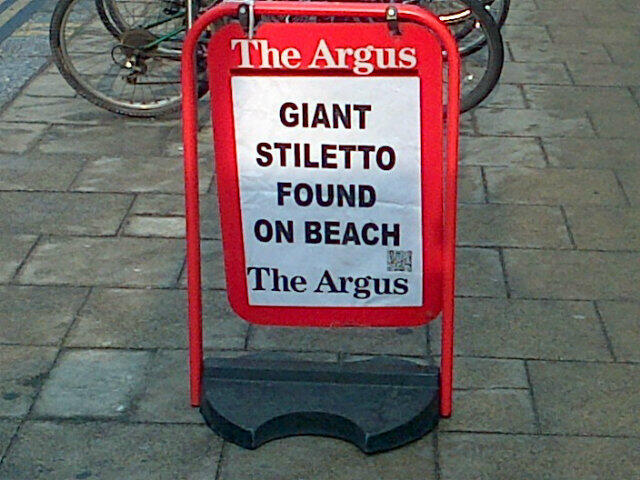
I’m back in Brighton after a week off. Not really much of a holiday, actually, as I’ve been a bit poorly (not helped by the cold weather). Anyway, I thought I’d announce my return with an update of important news from the Brighton Evening Argus. I think it shows that it would have been an even bigger drag to have spent my holiday here…

BG_bEwdCYAERXgW

And here’s one I missed over Easter (via @cjsnowdon on Twitter):

BG8TnhzCAAATr_s