Archive for September, 2013

Another Equinox

Posted in Biographical, Education on September 22, 2013 by telescoper

Well, that’s the end of Freshers Week at the University of Sussex. Hopefully new and returning students are settling into their courses now. Today is also the Autumnal Equinox, which gives me the excuse to post an edited and updated version of an item from the corresponding day five years ago. Although I’ve since moved from Cardiff to Brighton, not much has changed except me being five years older. Even the weather is similar:

The weather is unsettling. It’s warm, but somehow the warmth doesn’t quite fill the air; somewhere inside it there’s a chill that reminds you that autumn is not far away.

I find this kind of weather a bit spooky because it always takes me back to the time when I left home to go to University, as thousands of fledgling students are about to do this year in their turn. I did it 31 years ago, getting on a train at Newcastle Central station with my bags of books and clothes. I said goodbye to my parents there. There was never any question of them taking me in the car all the way to Cambridge. It wasn’t practical and I wouldn’t have wanted them to do it anyway. After changing from the Inter City at Peterborough onto a local train, we trundled through the flatness of East Anglia until it reached Cambridge. The weather, at least in my memory, was exactly like today.

I don’t remember much about the actual journey, but I must have felt a mixture of fear and excitement. Nobody in my family had ever been to University before, let alone to Cambridge. Come to think of it, nobody from my family has done so since either.

I was a bit worried about whether the course I would take in Natural Sciences would turn out to be difficult, but I think my main concern was how I would fit in generally.

I had been working between leaving school and starting my undergraduate course, so I had some money in the bank and I was also to receive a full grant. I wasn’t really worried about cash. But I hadn’t come from a posh family and didn’t really know the form. I didn’t have much experience of life outside the North East either. I’d been to London only once before going to Cambridge, and had never been abroad.

I didn’t have any posh clothes, a deficiency I thought would mark me as an outsider. I had always been grateful for having to wear a school uniform (which was bought with vouchers from the Council) because it meant that I dressed the same as the other kids at School, most of whom came from much wealthier families. But this turned out not to matter at all. Regardless of their family background, students were generally a mixture of shabby and fashionable, like they are today. Physics students in particular didn’t even bother with the fashionable bit. Although I didn’t have a proper dinner jacket for the Matriculation Dinner, held for all the new undergraduates, nobody said anything about my dark suit which I was told would be acceptable as long as it was a “lounge suit”. Whatever that is.

Taking a taxi from the station, I finally arrived at Magdalene College. I waited outside, a bundle of nerves, before entering the Porter’s Lodge and starting my life as a student. My name was found and ticked off and a key issued for my room in the Lutyen’s building. It turned out to be a large room, with a kind of screen that could be pulled across to divide the room into two, although I never actually used this contraption. There was a single bed and a kind of cupboard containing a sink and a mirror in the bit that could be hidden by the screen. The rest of the room contained a sofa, a table, a desk, and various chairs, all of them quite old but solidly made. Outside my  room, on the landing, was the gyp room, a kind of small kitchen, where I was to make countless cups of tea over the following months, although I never actually cooked anything there.

I struggled in with my bags and sat on the bed. It wasn’t at all like I had imagined. I realised that no amount of imagining would ever really have prepared me for what was going to happen at University.

I  stared at my luggage. I suddenly felt like I had landed on a strange island where I didn’t know anyone, and couldn’t remember why I had gone there or what I was supposed to be doing.

After 31 years you get used to that feeling.

Cherokee, by Clifford Brown

Posted in Jazz with tags , , on September 21, 2013 by telescoper

The blog’s been quite busy this week, so I’ll take it easy today and just indulge my love of 1950s jazz. This version of Ray Noble’s standard Cherokee is a vehicle for the virtuosity and creativity of the trumpeter Clifford Brown. The changes of this tune are notoriously difficult to improvise on, 64 bars of harmonic twists and turns that have led countless musicians onto the rocks, but Clifford Brown navigates them at full pelt with amazingly agility. Enjoy!

Of the Terrible Doubt of Appearances

Posted in Poetry with tags , , on September 20, 2013 by telescoper

Of the terrible doubt of appearances,
Of the uncertainty after all, that we may be deluded,
That may-be reliance and hope are but speculations after all,
That may-be identity beyond the grave is a beautiful fable only,
May-be the things I perceive, the animals, plants, men, hills,
shining and flowing waters,
The skies of day and night, colors, densities, forms, may-be these
are (as doubtless they are) only apparitions, and the real
something has yet to be known,
(How often they dart out of themselves as if to confound me and mock me!
How often I think neither I know, nor any man knows, aught of them,)
May-be seeming to me what they are (as doubtless they indeed but seem)
as from my present point of view, and might prove (as of course they
would) nought of what they appear, or nought anyhow, from entirely
changed points of view;
To me these and the like of these are curiously answer’d by my
lovers, my dear friends,
When he whom I love travels with me or sits a long while holding me
by the hand,
When the subtle air, the impalpable, the sense that words and reason
hold not, surround us and pervade us,
Then I am charged with untold and untellable wisdom, I am silent, I
require nothing further,
I cannot answer the question of appearances or that of identity
beyond the grave,
But I walk or sit indifferent, I am satisfied,
He ahold of my hand has completely satisfied me.

by Walt Whitman (1819-92)

A New Theory of Electromagnetism?

Posted in Cute Problems, Education, The Universe and Stuff with tags , , on September 19, 2013 by telescoper

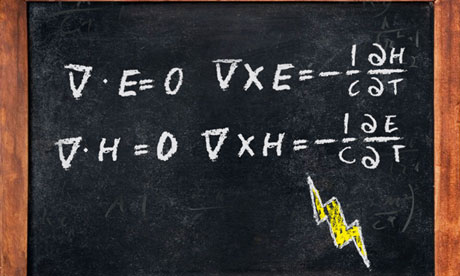
I was delighted to see an article by Alok Jha in the Observer on Sunday discussing Maxwell’s Equations, but my rapture was rapidly modified when I saw the image that accompanied the piece:

Maxwell's Equations

Since our new students are just settling into their courses in the Department of Physics & Astronomy here at the University of Sussex, I thought it would be fun to post this here and invite my readers (some of whom are students) to spot the deliberate mistake(s). More amusingly, how about offering suggestions as to what the Universe would be like if electromagnetism did indeed behave the way described by the alternative theory outlined in the Observer article.

Answers through the comment box please!

Open Access Repositories should be based on Subject, not Institution

Posted in Open Access with tags , , , , on September 18, 2013 by telescoper

Just when we thought that the powers that be might be starting to see the light on Open Access, round comes another circular from the Higher Education Funding Council for England (HEFCE) that shows that policymakers have an unlimited ability to get things wrong at the most basic level.

The document concerned opens a “Consultation on open access in the post-2014 Research Excellence Framework” by putting forward a number of proposals.

Now it’s depressing enough that the entire document is predicated on the assumption that there will be another Research Excellence Framework, perhaps in 2020. The current REF is such a disaster that one might have hoped somebody up there would have decided that enough is enough. But then we thought that about Research Assessment Exercise in 2008. Even the most pessimistic of us hope that the REF would have a “lighter touch” than the RAE, but as it has turned out it’s many times worse both in the time it has taken to prepare submissions and the ridiculous game-playing and dodgy employment practices that it has encouraged among participation institutions.

I hope there’s still time to drive a stake through the heart of the runaway bureaucracy that keeps imposing this idiocies on us. After all, a new Chief Executive about to take over at HEFCE. Perhaps a new broom will be wielded? I hope against hope.

However, setting all that to one side, I had a look at the proposals for Open Access after 2014 contained in the document. Here is the summary of the proposals:

HEFCE

Aarrgh!

Why on Earth should the proposals favour national institutional repositories over international subject-based ones? A shining example of the latter is the arXiv which has, for Physics and Astronomy, become the basic resource for researchers around the world; it’s a one-stop shop at which one can access research from all around the world. By contrast, having work in the same field stored over a plethora of institutional repositories will serve no useful purpose at all, because UK research will not  treated in the same way as work from other countries and in any case individual repositoes will lead to an absurd level of duplication of infrastructure and other resources. This requirement is particularly indefensible in Physics and Astronomy, as it would require us to duplicate in (probably inferior) institutional repositories what we already do with the arXiv.

The UK Funding Councils need realize that the solution to many of the challenges of Open Access has already been found. In fact, the European Research Council seems to have acknowledged this and is now directly funding the arXiv. The UK Research Councils should be required to construct similar archives for their disciplines. That shouldn’t be difficult, because all the hard work has already been done. There is a working model.

I’ll be responding to the consultation document in no uncertain terms. The Royal Astronomical Society is also collating responses for a collective submission. We have to resist these, and other proposals such as another REF, which are being foisted on us by people who have no idea what they’re doing and no idea what damage they’re causing.

Any resemblance is purely coincidental..

Posted in Brighton with tags on September 18, 2013 by telescoper

They are my initials, but…

BUbgpziCYAAjD72

Coronal Rain

Posted in The Universe and Stuff with tags , , , on September 17, 2013 by telescoper

Well it’s dark and gloomy and pouring with rain on the day on which I’m required to do the most running about on campus. I think we could all do with another look at the Sun – which might otherwise fade into a distant memory. This is no ordinary look at the Sun, though, it’s a spectacular video taken by NASA’s Solar Dynamics Observatory. According to the description on Youtube,

Eruptive events on the Sun can be wildly different. Some come just with a solar flare, some with an additional ejection of solar material called a coronal mass ejection (CME), and some with complex moving structures in association with changes in magnetic field lines that loop up into the Sun’s atmosphere, the corona.

On July 19, 2012, an eruption occurred on the sun that produced all three. A moderately powerful solar flare exploded on the Sun’s lower right hand limb, sending out light and radiation. Next came a CME, which shot off to the right out into space. And then, the Sun treated viewers to one of its dazzling magnetic displays — a phenomenon known as coronal rain.

Over the course of the next day, hot plasma in the corona cooled and condensed along strong magnetic fields in the region. Magnetic fields, themselves, are invisible, but the charged plasma is forced to move along the lines, showing up brightly in the extreme ultraviolet wavelength of 304 Angstroms, which highlights material at a temperature of about 50,000 Kelvin. This plasma acts as a tracer, helping scientists watch the dance of magnetic fields on the Sun, outlining the fields as it slowly falls back to the solar surface.

The footage in this video was collected by the Solar Dynamics Observatory’s AIA instrument. SDO collected one frame every 12 seconds, and the movie plays at 30 frames per second, so each second in this video corresponds to 6 minutes of real time. The video covers 12:30 a.m. EDT to 10:00 p.m. EDT on July 19, 2012.

Those are the facts, and here is the video, which is simply stunning:

Five Years in the Dark

Posted in Biographical on September 16, 2013 by telescoper

I came in this morning to find a little message from WordPress pointing out that it’s five years ago today that I first registered on their website and started this blog. They even gave me a logo with a laurel. At least I think that’s what it is.

My first post on September 16th 2008 actually came out second because, with characteristic incompetence, I forgot to press the “publish” button on it before writing another one later the same day. D’Oh!

birthday-five

I’d like to take this opportunity to send my best wishes to everyone, and to thank everyone, who reads this blog, however occasionally. According to the WordPress stats, I’ve got readers from all round the world, including one in the Vatican! If you’re interested in statistics then, as of 9.15 this morning, I have published 2107 blog posts in all, and have received 1,592,554 hits altogether (I get about 1300 per day, but this varies very erratically). There have been 17,650 comments published on here and 356,694 rejected as spam or abuse; a lot goes on behind the scenes that you don’t want to know about!

Anyway, the numbers don’t really matter but it does mean a lot to know that there are people who find my ramblings interesting enough to look at, and sometimes even to come back for more! I’m read by a number of powerful and influential people too, and John Womersley….

Do keep the comments coming. I don’t always have time to respond when a thread gets busy, but I do find it fascinating how the discussion tends to go off in random directions.

It’s the start of Fresher’s Week here at Sussex University, so I’m going to be quite busy today, but I may just have a quiet drink this evening to celebrate!

Toodle-pip!

The Little Red Book Revisited

Posted in Biographical, Poetry with tags , , , , on September 15, 2013 by telescoper

I can hardly believe it, but tomorrow this blog will be five years old; my first ever post was on September 16th 2008. I’ve decided to use this occasion as an excuse to wallow in self-indulgence by reposting some vintage items, with appropriate updates. This one was originally posted on 27th September 2008, but I’ve updated it with a picture of the eponymous little red book and a scan from one of its pages.

–0–


It’s now late September and there’s no sign that the Indian summer we’ve been having is going to fade. Once again, I’m sitting outside in the sunshine while Columbo daydreams. In the newspapers there’s yet more panic about the global financial crisis and the US Government’s attempts to persuade Congress to bail out the profligate bankers. The Republicans don’t want to play along, apparently because they don’t like the idea of government getting involved in the markets. I’m opposed to it for the opposite reason, which is I think those who have caused the problem should be the ones that pay for it. If the UK government decides to bail out any banks, I hope it will be at the price of public representation on their boards or even nationalisation.

Not long ago there was talk about energy companies having a windfall tax levied upon them owing to the sudden leap in their profits arising from high oil and gas prices. This seemed like a good idea to me. A retrospective windfall tax on city bonuses to pay for any packages cobbled together to pay the financial sector’s debts appears at least as justifiable as that proposed for the energy sector.

It’s now about a year since my father died. He hadn’t left a will so I had to travel to Weymouth to tidy up his things and organise a funeral. I hadn’t seen him much in recent years and was never particularly close, since my parents split up when I was about 12 and I went to live with my mother when that happened.

My dad never really came to terms with life after the break up of the family. His business eventually went down the tubes and he left Newcastle to live in Weymouth near his sister, my Auntie Ann, who had lived there for quite a while. He had a history of heart problems so his death wasn’t really a shock, but it did bring feelings of guilt to me, for not having kept in touch very well, as well sudden and unpredictable pangs of nostalgia which I’m still a bit prone to.

Among the memories that popped uncontrollably into my mind last year was a visit we made as a family to the house of my late Auntie Vi, who I don’t think I ever met. I don’t remember when this was but it was just after she died, when I guess I was probably about seven or eight which would make it around 1970 or so. My dad was among those invited to the house to help clear it by taking away anything they wanted.

I don’t remember the house very well except that it was rather dark, decorated with Victorian designs, and cluttered with heavy old-fashioned furniture. I imagined Auntie Vi (or “Violetta”, which was her real name) to be quite scary, perhaps like a governess in some gothic novel. I don’t know much about her except that she wasn’t well liked by the rest of the family. There was talk of some scandal, but I never found out what it was. I was just intrigued how she got the name Violetta. Perhaps her parents liked opera.
Wordsworth

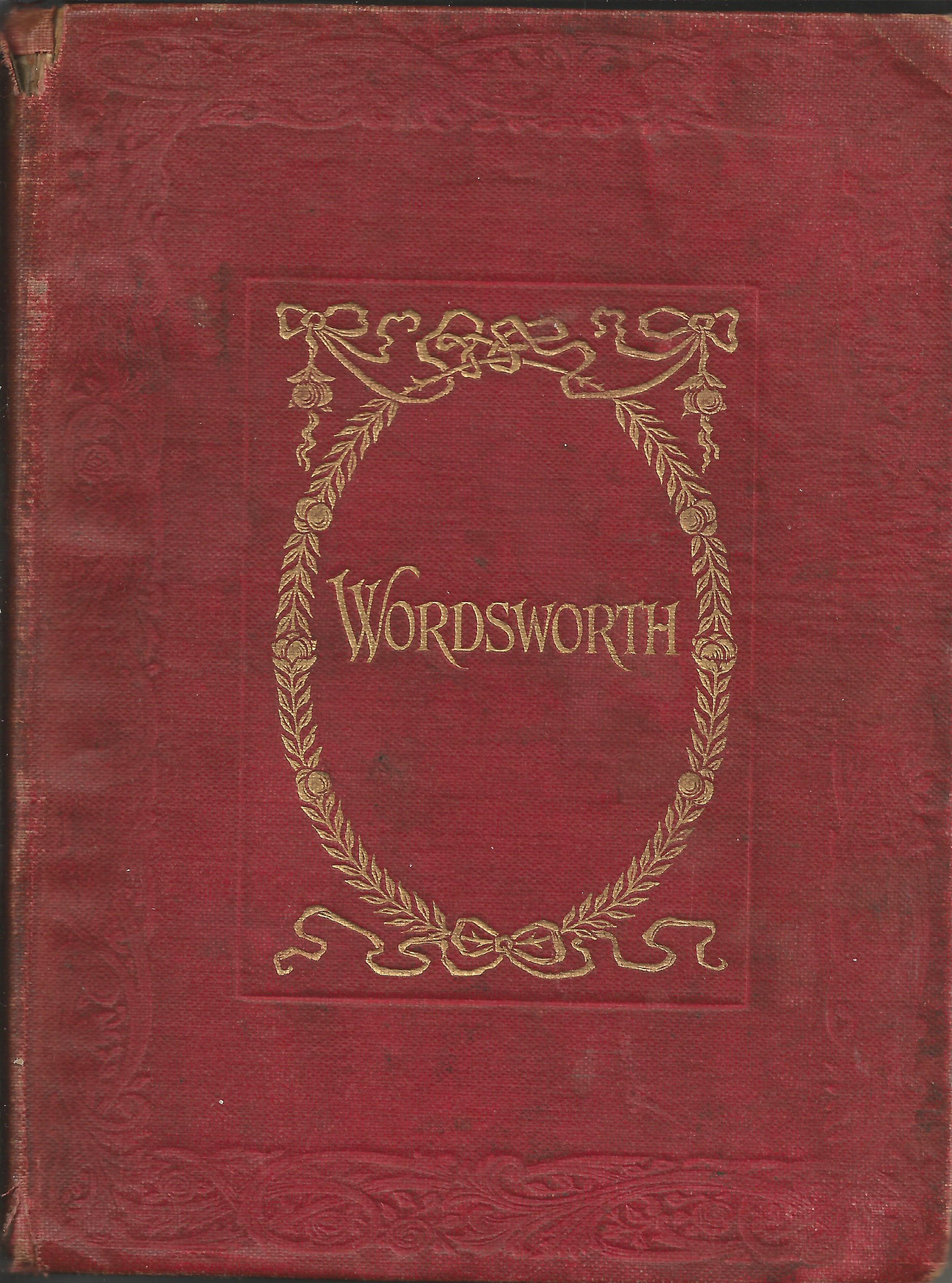
The only relic from that visit that I still know about was a little red book that we took home with us. It was a book of Poems by Wordsworth which my mum kept when she split up with my dad and moved out. I asked her about it last year, after my dad’s funeral, and was quite surprised to find she still had it. She gave it to me to keep, and it is on the table beside me now as I write this.

Out of curiosity last year I looked for the date the little book was published, but couldn’t find one anywhere inside. I don’t know why, but the lack of that little bit of information bothered me. I looked on the web to see if there was information about this or similar books was to be found. No luck.

I turned instead to the task of finding out whatever I could about the publisher. The book is in a series called “Canterbury Poets” which was published by the Walter Scott Publishing company (London, New York and Felling). That made be laugh. As if anyone could ever have imagined Felling to be on a par with New York or London!

I had assumed that Sir Walter Scott was the famous novelist of Ivanhoe and the Waverley novels, but digging about a little I found out that it was named for someone else entirely. This particular Sir Walter Scott was born in 1826. He had very little formal education, but became a highly successful businessman. By the 1880s he owned a large network of business interests in the North East, primarily involving engineering and construction companies. In 1882 Scott expanded his empire by buying a publishing company “The Tyne Publishing Company”, which had just gone bust. Scott built a new factory (at Felling) and established a new office in London for his new publishing house, and the Walter Scott Publishing Company was born.

I think Scott must have been a very shrewd entrepreneur because the printing business grew rapidly, primarily through its list of editions of classic works of literature that were out of copyright. The Canterbury Poets series was first published in 1884, which is also the date of their first edition of the Wordsworth. These books were extremely well made, with hard covers, fine quality paper and good stitching . They sold for a shilling, which is an astonishingly low price for books of this quality. I can’t be sure, but have a feeling that a lot of them were given as “rewards” , for good behaviour at sunday schools and the like. That market accounted for a lot of the book trade in those days.Sir Walter Scott died in 1910 and the company ceased trading in 1931. At its peak it did indeed have offices in New York, and also sold large quantities of books in Australia.

I found this all out quite easily, because the Walter Scott Company turned out to be quite famous for the role it played in the story of working class literacy, but it didn’t tell me about the specific edition I had. However, I did discover that a scholarly work had been published in 1997 that contained a complete biliography of all the works it published until the company finally went down the tubes. Quite apart from the connection with my peculiar Aunt, I found the whole story quite fascinating. I sent off for the bibliography, which is basically a kind of catalogue that painstakingly records the size, typeface, cover design, and printers colophons for all known editions. (It’s quite boring to read, as you can imagine). I searched through it to find references to William Wordsworth. Number 99c is the entry for the “Poems” of William Wordsworth.

With a bit of work I established that the specific edition I have was first published in 1892 but reprinted many times after that. Details of the book, however, indicate that my version was actually printed in 1902. Among the clues is the fact that the colophon states “The Walter Scott Publishing Co, Ltd.” and it didn’t become a limited company until 1902. The company also moved its London and New York offices a couple of times which helps pin down the date, as these changes are noted on the imprint.

So there you have it. The little red book was printed in Felling in 1902, which happens to be the same year that my little house in Pontcanna was built, just after the death of Queen Victoria. I don’t know how old Auntie Vi was when she died, but she must have been a young girl when she got it and had obviously kept it all the rest of her life. That fits with the way her name is written in pencil, in what looks like a child’s hand, inside the front cover.

The book isn’t particularly valuable. A lot were printed and it’s not particularly rare. I’m not sure Wordsworth is very collectible nowadays either. I am still amazed, though, how well it had withstood the passage of time. Today’s books are cheaply bound and printed on chatty paper. Most modern paperbacks are in bad condition only a few years after you buy them. They made things to last in those days.

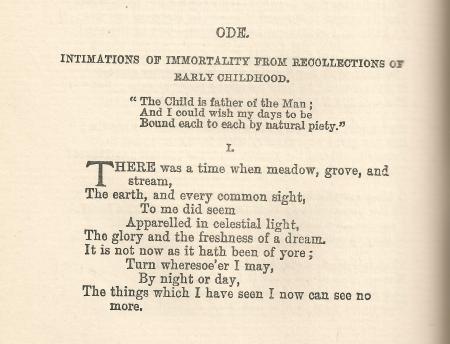
It seems appropriate to end with one of Wordsworth’s poems, of which (I forgot to mention) I’m very fond indeed. I’ve picked the start of the Ode “Intimations of Immortality from Recollections of Early Childhood”, partly because there’s a wonderful setting of this work to music by Gerald Finzi which was performed at this years Proms.

I think it’s apt enough. Here is the first verse as it appears in the Little Red Book:
wordsworth_intiminations


Welcome to Astronomy (unless you’re female)

Posted in Biographical, Education with tags , , , , , on September 14, 2013 by telescoper

I’m here on campus preparing to attend a series of receptions at the start of Freshers’ Week to welcome new students to the University of Sussex. Over the next few days I’m going to be involved in a lot of events aimed at helping all our new undergraduate students settle in, before teaching starts properly. There’ll also be events for our new postgraduates, at both Masters and Doctoral levels.

Every year the Science and Technology Facilities Council (STFC) funds an Introductory Summer School for new postgraduate research students in Astronomy. It’s held at a different university each year and is a long-running tradition. I attended such a School at Durham University way back in 1985, long before STFC was invented! We organized and ran one at Nottingham while I was there and last year the corresponding fixture was held at Sussex University, though that was before my time here and I wasn’t involved in it at all. This year, the Introductory Summer School was held at Queen Mary, University of London (often abbreviated to QMUL).

I spent eight happy years at Queen Mary (from 1990-98) so it pains me to have to criticize my friends and former colleagues there, but I really feel that I have to. Look at the programme for the Summer School. You will see that 18 (eighteen) lecturers were involved, covering virtually all areas of current research interest in the field. There is not a single female lecturer among them.

Yesterday I blogged about the invisibility of LGBT astrophysicists, but this is a glaring example of the problems facing female scientists embarking on a career in the same discipline. What message does a male-only programme send to aspiring female astronomers and astrophysicists? The lack of female speakers probably wasn’t deliberate, but was clearly thoughtless. Discrimination by omission is real and damaging. I mean no disrespect at all to the lecturers chosen, but looking through the topics covered I could easily have picked a female alternative who would have done just as good a job, if not better.

I think this is a scandal. I’ll be writing a letter of complaint to STFC myself, and I encourage you to do likewise if you agree. It’s too late to do anything about this year’s School, of course, but STFC must make sure that nothing like this happens again.