Archive for October, 2014

Controlled Nuclear Fusion: Forget about it

Posted in The Universe and Stuff with tags , , , on October 20, 2014 by telescoper

You’ve probably heard that Lockheed Martin has generated a lot of excitement with a recent announcement about a “breakthrough” in nuclear fusion technology. Here’s a pessimistic post from last year. I wonder if it will be proved wrong?

Michael de Podesta's avatarProtons for Breakfast

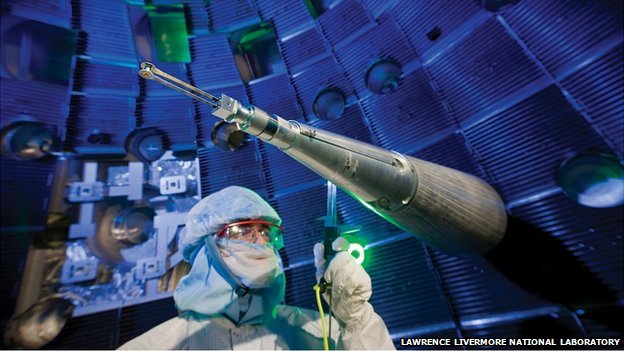
Man or woman doing a technical thing with a thingy told with laser induced nuclear fusion. Man or woman adjusting the ‘target positioner’ (I think) within the target chamber of the US Lawrence Livermore National Laboratory.

The future is very difficult to predict. But I am prepared to put on record my belief that controlled nuclear fusion as a source of power on Earth will never be achieved.

This is not something I want to believe. And the intermittent drip of news stories about ‘progress‘ and ‘breakthroughs‘ might make one think that the technique would eventually yield to humanity’s collective ingenuity.

But  in fact that just isn’t going to happen. Let me explain just some of the problems and you can judge for yourself whether you think it will ever work.

One option for controlled fusion is called Inertial Fusion Energy, and the centre of research is the US National Ignition Facility. Here the most powerful laser…

View original post 601 more words

What’s the point of conferences?

Posted in Education, The Universe and Stuff with tags , , , , , on October 19, 2014 by telescoper

Well, here I am back in the office making a start on my extensive to-do list. Writing it, I mean. Not actually doing any of it.

It was nice to get away for a couple of weeks, to meet up with some old friends I haven’t seen for a while and also to catch up on some of the developments in my own field and other related areas. We do have pretty good seminar series here at Sussex which should in principle allow me to keep up to date with developments in my own research area, but unfortunately the timing of these events often clashes with other meetings  that I’m obliged to attend as Head of School. Escaping to a conference is a way of focussing on research for a while without interruption. At least that’s the idea.

While at the meeting, however, I was struck by a couple of things. First was that during the morning plenary lectures given by invited speakers almost everyone in the audience was spending much more time working on their laptops than listening to the talk.  This has been pretty standard at every meeting I’ve been to for the last several years. Now that everyone uses powerpoint (or equivalent) for such presentations nobody in the audience feels the need to take notes so to occupy themselves they spend the time answering emails or pottering about on Facebook. That behaviour does not depend on the quality of the talk, either. Since nobody seems to listen very much the question naturally arises as to whether the presentations have any intrinsic value at all. It often seems to me that the conference talk has turned into a kind of ritual that persists despite nobody really knowing what it’s for or how it originated. An hour is too long to talk if you really want people to listen, but we go on doing it.

The part of a conference session that’s more interesting is the discussion after each talk. Sometimes there’s a genuine discussion from which you learn something quite significant or get an idea for a new study.  There’s often also a considerable amount of posturing, preening and point-scoring which is less agreeable but in its own way I suppose fairly interesting.

At the meeting I was attending the afternoons were devoted to discussion sessions for which we split into groups. I was allocated to “Gravitation and Cosmology”; others were on “Cosmic Rays”, “Neutrino Physics and Astrophysics”, and so on. The group I was, of about 25 people, was a nice size for discussion. These sessions were generally planned around short “informal” presentations intended to stimulate discussion, but generally these presentations were about the same length as the plenary talks and also given in Powerpoint. There was discussion, but the format turned out to be less different from the morning sessions than I’d hoped for. I’m even more convinced than ever that Powerpoint presentations used in this way stifle rather than stimulate discussion and debate. The pre-prepared presentation is often used as a crutch by a speaker reluctant to adopt a more improvisatory approach that would probably be less polished but arguably more likely to generate new thoughts.

I don’t know whether the rise of Powerpoint is itself to blame for our collective unwillingness inability to find other ways of talking about science, but I’d love to try organizing a workshop or conference along lines radically different from the usual “I talk, you listen” format in which the presenter is active and the audience passive for far too long.

All this convinced me that the answer to the question “What is the point of conferences?” has very little to do with the formal  programme and more with the informal parts, especially the conversations over coffee and at dinner. Perhaps I should try arranging a conference that has nothing but dinner and coffee breaks on the schedule?

Bagaglio Mancante

Posted in Biographical with tags , on October 18, 2014 by telescoper

I should have known something would go wrong.

When my flight landed at Gatwick yesterday, I was quickly off the plane, through passport control and into the Baggage Reclaim. And there I waited. My baggage never arrived.

After almost an hour waiting in vain went to the counter and filed a missing baggage report before getting the train back to Brighton.

By then my phone battery was flat but the charger was in my lost bag so I was unable to receive the text message I was told I would get when my bag was located. This morning I had to buy another charger and when I recharged my phone I discovered the bag had arrived at London Gatwick at 0800 this morning and a Courier would call to arrange delivery.

Great, I thought. Gatwick is only 30 minutes away from Brighton so I would soon get my stuff.

Wrong. Using the online tracking system I found the bag had been sent to Heathrow and had sat there until after 2pm before being loaded onto a vehicle for delivery.

There’s nobody answering phones at the courier company so I guess I just have to wait in the flat until they decide to deliver it.

I don’t know how BA managed to lose a bag on a direct flight in the first place, but their idiotic courier has added at least half a day’s delay in returning it.

UPDATE: My bag finally arrived at 1940. It seems it was never put on the plane I flew on.

,

Arrivederci L’Aquila!

Posted in Architecture, Biographical with tags , on October 17, 2014 by telescoper

So here I am, then. In the British Airways Lounge at Roma Fiumicino Airport waiting for a flight back to Gatport Airwick. This morning’s bus journey from L’Aquila was as incident-free as the outbound journey, and I actually got to the airport about 10 minutes early. As I always do I planned the journey so I’d arrive in plenty of time for my flight, so now I get to relax and drink free wine among the Business Class types until I’m called to totter to the gate.

Fiumicino is strange airport, clearly built in the 1960s with the intention that it should look futuristic but with the inevitable result that it now feels incredibly dated, like a 1950s Science Fiction film.

Anyway, I’ve at last got a bit of time to kill so I’ll take the opportunity to brush up on my Italian. Let’s try translating this:

gusto

It’s obvious of course. House of Wind.

Ciao Ciao

Dark Matter from the Sun?

Posted in The Universe and Stuff with tags , , , , , , , on October 16, 2014 by telescoper

This afternoon while I was struggling to pay attention during one of the presentations at the conference I’m at, when I noticed a potentially interesting story going around on Twitter. A little bit of research revealed that it relates to a paper on the arXiv, with the title Potential solar axion signatures in X-ray observations with the XMM-Newton observatory by Fraser et al. The first author of this paper was George Fraser of the University of Leicester who died the day after it was submitted to Monthly Notices of the Royal Astronomical Society. The paper has now been accepted and the final version has appeared on the arXiv in advance of its publication on Monday. The Guardian has already run a story on it.

This is the abstract:

The soft X-ray flux produced by solar axions in the Earth’s magnetic field is evaluated in the context of ESA’s XMM-Newton observatory. Recent calculations of the scattering of axion-conversion X-rays suggest that the sunward magnetosphere could be an observable source of 0.2-10 keV photons. For XMM-Newton, any conversion X-ray intensity will be seasonally modulated by virtue of the changing visibility of the sunward magnetic field region. A simple model of the geomagnetic field is combined with the ephemeris of XMM-Newton to predict the seasonal variation of the conversion X-ray intensity. This model is compared with stacked XMM-Newton blank sky datasets from which point sources have been systematically removed. Remarkably, a seasonally varying X-ray background signal is observed. The EPIC count rates are in the ratio of their X-ray grasps, indicating a non-instrumental, external photon origin, with significances of 11(pn), 4(MOS1) and 5(MOS2) sigma. After examining the constituent observations spatially, temporally and in terms of the cosmic X-ray background, we conclude that this variable signal is consistent with the conversion of solar axions in the Earth’s magnetic field. The spectrum is consistent with a solar axion spectrum dominated by bremsstrahlung- and Compton-like processes, i.e. axion-electron coupling dominates over axion-photon coupling and the peak of the axion spectrum is below 1 keV. A value of 2.2e-22 /GeV is derived for the product of the axion-photon and axion-electron coupling constants, for an axion mass in the micro-eV range. Comparisons with limits derived from white dwarf cooling may not be applicable, as these refer to axions in the 0.01 eV range. Preliminary results are given of a search for axion-conversion X-ray lines, in particular the predicted features due to silicon, sulphur and iron in the solar core, and the 14.4 keV transition line from 57Fe.

The paper concerns a hypothetical particle called the axion and I see someone has already edited the Wikipedia page to mention this new result. The idea of the axion has been around since the 1970s, when its existence was posited to solve a problem with quantum chromodynamics, but it was later realised that if it had a mass in the correct range it could be a candidate for the (cold) dark matter implied to exist by cosmological observations. Unlike many other candidates for cold dark matter, which experience only weak interactions, the axion feels the electromagnetic interaction, despite not carrying an electromagnetic charge. In particular, in a magnetic field the axion can convert into photons, leading to a number of ways of detecting the particle experimentally, none so far successful. If they exist, axions are also expected to be produced in the core of the Sun.

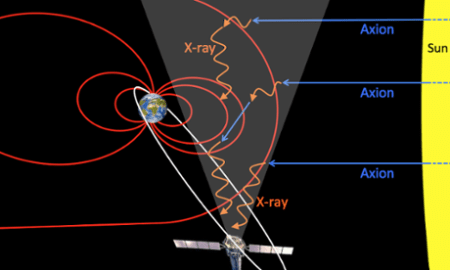
This particular study involved looking at 14 years of X-ray observations in which there appears to be an unexpected seasonal modulation in the observed X-ray flux which could be consistent with the conversion of axions produced by the Sun into X-ray photons as they pass through the Earth’s magnetic field. Here is a graphic I stole from the Guardian story:
axions

Conversion of axions into X-rays in the Earth’s magnetic field. Image Credit: University of Leicester

I haven’t had time to do more than just skim the paper so I can’t comment in detail; it’s 67 pages long. Obviously it’s potentially extremely exciting but the evidence that the signal is produced by axions is circumstantial and one would have to eliminate other possible causes of cyclical variation to be sure. The possibilities that spring first to mind as an alternatives to the axion hypothesis relate to the complex interaction between the solar wind and Earth’s magnetosphere. However, if the signal is produced by axions there should be characteristic features in the spectrum of the X-rays produced that would appear be very difficult to mimic. The axion hypothesis is therefore eminently testable, at least in principle, but current statistics don’t allow these tests to be performed. It’s tantalising, but if you want to ask me where I’d put my money I’m afraid I’d probably go for messy local plasma physics rather than anything more fundamental.

It seems to me that this is in some sense a similar situation to that of BICEP2: a potentially exciting discovery, which looks plausible, but with alternative (and more mundane) explanations not yet definitively ruled out. The difference is of course that this “discovery paper” has been refereed in the normal way, rather than being announced at a press-conference before being subjected to peer review…

Choose My Mugshot

Posted in Beards, Biographical on October 15, 2014 by telescoper

For some time now staff and students of the School of Mathematical & Physical Sciences at the University of Sussex have complained that the picture of me on my office door is of a non-bearded person. Recently therefore I made a visit to a professional photographer so he could take a picture of the hirsute me and tried his best to make me look presentable in the process. I am now told I have to pick one of the following three shortlisted photographic representations. They all suffer from the problem that they look like me, so I have no idea what to pick. I thought I’d have a bit of a laugh and see if I can crowd-source a favourite.

Here are the contenders:


Please vote here

Physicists and astronomers followed by physicists and astronomers on Twitter

Posted in Uncategorized on October 15, 2014 by telescoper

For those of you interested in this sort of thing, this is the sort of thing you will find interesting…

Autumn Song

Posted in Poetry with tags on October 14, 2014 by telescoper

Know’st thou not at the fall of the leaf
How the heart feels a languid grief
         Laid on it for a covering,
         And how sleep seems a goodly thing
In Autumn at the fall of the leaf?

And how the swift beat of the brain
Falters because it is in vain,
         In Autumn at the fall of the leaf
         Knowest thou not? and how the chief
Of joys seems—not to suffer pain?

Know’st thou not at the fall of the leaf
How the soul feels like a dried sheaf
         Bound up at length for harvesting,
         And how death seems a comely thing
In Autumn at the fall of the leaf?

by Dante Gabriel Rossetti (1828-1882)

More of L’Aquila

Posted in Uncategorized with tags , , on October 12, 2014 by telescoper

At the risk of boring you all with even more pictures of L’Aquila, here are a few more pictures I took with my phone while out and about over the past week.

First, here’s the Gran Sasso Science Institute (GSSI) where our workshop is being held:

IMG-20141010-00423

The following sites can all be found within a few minutes’ walk of the GSSI (which is itself just a few minutes from my hotel). In particular there is the historically important Romanesque church of Santa Maria di Collemaggio which dates back to the 13th Century. The façade looks in good nick, although there is evidence of recent repair. However, the back of the church collapsed completely during the 2009 Earthquake and is currently being rebuilt. There is also cracking and significant bowing of the wall on the left hand side, hence the supporting structures.

Roy Keane shaves beard but will still compete for Beard of Autumn

Posted in Beards with tags , , on October 12, 2014 by telescoper

I felt the urge to reblog this to encourage folks to vote in the Beard of Autumn poll, despite not having been nominated myself, especially since the great Leonard Cohen is a candidate. Surely he deserves to win more than Roy Keane who has already shaved off his beard?

kmflett's avatarKmflett's Blog

Beard Liberation Front

Press Release 10th October Contact Keith Flett 07803 167266

Roy Keane shaves beard but will still compete for Beard of Autumn

The Beard Liberation Front, the informal network of beard wearers, has said that it regrets but respects the decision of Roy Keane to shave his beard ahead of Ireland’s European Championship game against Gibraltar on Saturday.

Keane has a history of suddenly shaving his beard but the campaigners say that the four seasonal awards run each year are designed to capture in particular those who have noteworthy but transient beards.

The BLF has for that reason decided to keep Keane on the longlist for Beard of Autumn, the winner of which is announced on October 24th after a public on-line poll

The Award is the final one of four seasonal Awards before the announcement of the coveted Beard of the Year Award at…

View original post 184 more words