Archive for October, 2014

Excursion to Sulmona

Posted in Uncategorized with tags , , on October 11, 2014 by telescoper

I’m here on my own over the weekend so I decided to make the most of the lovely weather (it was a sunny 28° C today) and take a small excursion by train. The railway station at L’Aquila is situated on a branch line so the options from here are limited: up or down. I decided to take the “up” line to the town of Sulmona, which is 61km away by train. The ticket cost a mere €4.80 and though the train was a bit old, it was right on time in both directions. The journey time of an hour each way might seem a bit long, but the journey is through rather mountainous terrain and the service is a slow Regionale stopping service so I didn’t expect it to be a quick journey. On arrival I discovered that the Stazione Centrale is in fact pretty far from central but it was a pleasant walk of about half an hour into the small city centre.

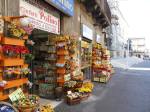
Sulmona is famous for two things. One is that it is the birthplace of the poet Ovid who is  remembered by a fine bronze statue in the Piazza XX Settembre. The other famous thing is the Confetti di Sulmona, sugar-coated almonds coloured in such a way to look like oversized Smarties and presented in various disguises, e.g. as flower petals.

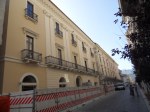
The town itself was almost totally destroyed by an earthquake in 1706. That’s a bit of a theme around these parts. You might think people would get fed up living in a place where natural catastrophes happen so regularly, but apparently not. Anyway, quite aside from the fact that many of the buildings are clearly of late eighteenth or early nineteenth century, which is not the case in L’Aquila, the reconstruction of Sulmona has made it a much airier place: the squares are larger and more open, and the streets wider. While the topography around L’Aquila is complex – the town itself sits on a hill surrounded by numerous local maxima, minima and saddle-points –  Sulmona sits in a broad flat plain on which the first and second derivatives behave in a much more sensible fashion.  I have to say that I have found L’Aquila quite oppressive at times during this visit. I don’t believe in ghosts of course, but there is so much evidence of destruction all around that it definitely has something of a haunted atmosphere. It was good to get away to a town whose wounds have healed.

The Slow Rebirth of L’Aquila

Posted in Architecture with tags , on October 10, 2014 by telescoper

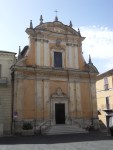
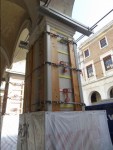
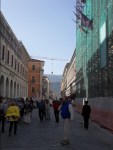
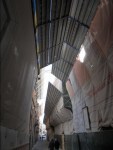
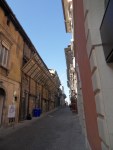
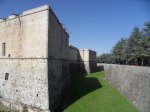
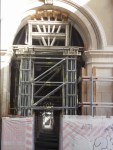
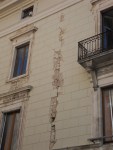
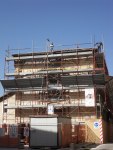
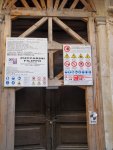
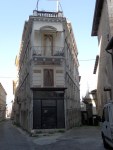
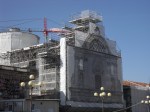
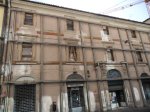
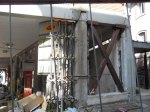
This morning there was a gap in the programme at the workshop I’m attending here in L’Aquila so I took the opportunity to dust off my camera and go for a walk around the town. It’s hard to convey in words the extent of the structural damage you can still see more than five years after the earthquake, so I’ll mainly let the pictures to the talking. What you see here is the rule rather than the exception. To preface the pictures, however, I’ll say that the main square, the Piazza del Duomo, which clearly used to be the hub of the city is a strange place now as most of the buildings around it are so badly damaged as to be unsafe. The few shops and cafes open basically operate out of the ground floor.

L’Aquila isn’t exactly a ghost town – there were quite a few people around last night when I walked back to my hotel after dinner – but it’s clearly a shadow of its former self. Only a few per cent of the properties near the city centre are habitable.

Leading out from the Piazza del Duomo is a labyrinth of narrow streets flanked by tall buildings, and most of the them now also unoccupied. The numerous shops inside the galleries that run alongside the larger thoroughfares are all closed. The earthquake happened in the early hours of the morning so there would not have been many people out and about at that time, but it would have been a terrifying experience to have been caught between rows of buildings shaking, with rubble falling down everywhere.

A couple of things are clear having walked around all morning. One is that if there’s so much work still to be done after 5 years then it will take a very long time indeed for L’Aquila to be rebuilt. You can find the phrase L’Aquila Rinasce all round the city, but if there is to be a rebirth it will be a slow and painful one. The other thing is that there must have been a very drastic triage to decide which buildings to repair and which to simply shore up and leave for later. Many seem to me to be so badly damaged that the only practical option is to knock them down and start again. Only a few are fully restored, most of them key civic institutions, although clearly a lot of work is going on in the historic centre especially on old churches.

Neutrini via NOVA

Posted in The Universe and Stuff with tags , , , , on October 9, 2014 by telescoper

There’s been quite a lot of discussion at this meeting so far about neutrino physics (and indeed neutrino astrophysics) which, I suppose, is not surprising given the proximity of my current location, the city of L’Aquila, to the Gran Sasso Laboratory which is situated inside a mountain a few kilometres away. If I were being tactless I could at this point mention the infamous “fast-than-light-neutrino” episode that emanated from here a while ago, but obviously I won’t do that.

Anyway, I thought I’d take the opportunity to put up this video which describes how neutrinos are detected at the NOVA experiment on which some of my colleagues in the Department of Physics & Astronomy at the University of Sussex work and which is now up and running. If you want to know how to detect particles so elusive that they can pass right through the Earth without being absorbed, then watch this:

Getting the Measure of Space

Posted in The Universe and Stuff with tags , , , , , , , on October 8, 2014 by telescoper

Astronomy is one of the oldest scientific disciplines. Human beings have certainly been fascinated by goings-on in the night sky since prehistoric times, so perhaps astronomy is evidence that the urge to make sense of the Universe around us, and our own relationship to it, is an essential part of what it means to be human. Part of the motivation for astronomy in more recent times is practical. The regular motions of the stars across the celestial sphere help us to orient ourselves on the Earth’s surface, and to navigate the oceans. But there are deeper reasons too. Our brains seem to be made for problem-solving. We like to ask questions and to try to answer them, even if this leads us into difficult and confusing conceptual territory. And the deepest questions of all concern the Cosmos as a whole. How big is the Universe? What is it made of? How did it begin? How will it end? How can we hope to answer these questions? Do these questions even make sense?

The last century has witnessed a revolution in our understanding of the nature of the Universe of space and time. Huge improvements in the technology of astronomical instrumentation have played a fundamental role in these advances. Light travels extremely quickly (around 300,000 km per second) but we can now see objects so far away that the light we gather from them has taken billions of years to reach our telescopes and detectors. Using such observations we can tell that the Universe was very different in the past from what it looks like in the here and now. In particular, we know that the vast agglomerations of stars known as galaxies are rushing apart from one another; the Universe is expanding. Turning the clock back on this expansion leads us to the conclusion that everything was much denser in the past than it is now, and that there existed a time, before galaxies were born, when all the matter that existed was hotter than the Sun.

This picture of the origin and evolution is what we call the Big Bang, and it is now so firmly established that its name has passed into popular usage. But how did we arrive at this description? Not by observation alone, for observations are nothing without a conceptual framework within which to interpret them, but through a complex interplay between data and theoretical conjectures that has taken us on a journey with many false starts and dead ends and which has only slowly led us to a scheme that makes conceptual sense to our own minds as well as providing a satisfactory fit to the available measurements.

A particularly relevant aspect of this process is the establishment of the scale of astronomical distances. The basic problem here is that even the nearest stars are too remote for us to reach them physically. Indeed most stars can’t even be resolved by a telescope and are thus indistinguishable from points of light. The intensity of light received falls off as the inverse-square of the distance of the source, so if we knew the luminosity of each star we could work out its distance from us by measuring how much light we detect. Unfortunately, however, stars vary considerably in luminosity from one to another. So how can we tell the difference between a dim star that’s relatively nearby and a more luminous object much further away?

Over the centuries, astronomers have developed a battery of techniques to resolve this tricky conundrum. The first step involves the fact that terrestrial telescopes share the Earth’s motion around the Sun, so we’re not actually observing stars in the sky from the same vantage point all year round. Observed from opposite extremes of the Earth’s orbit (i.e. at an interval of six months) a star appears to change position in the sky, an effect known as parallax. If the size of the Earth’s orbit is known, which it is, an accurate measurement of the change of angular position of the star can yield its distance.

The problem is that this effect is tiny, even for nearby stars, and it is immeasurably small for distant ones. Nevertheless, this method has successfully established the first “rung” on a cosmic distance ladder. Sufficiently many stellar distances have been measured this way to enable astronomers to understand and classify different types of star by their intrinsic properties. A particular type of variable star called a Cepheid variable emerged from these studies as a form of “standard candle”; such a star pulsates with a well-defined period that depends on its intrinsic brightness so by measuring the time-variation of its apparent brightness we can tell how bright it actually is, and hence its distance. Since these stars are typically very luminous they can be observed at great distances, which can be accurately calibrated using measured parallaxes of more nearby examples.

Cepheid variables are not the only distance indicators available to astronomers, but they have proved particularly important in establishing the scale of our Universe. For centuries astronomers have known that our own star, the Sun, is just one of billions arranged in an enormous disk-like structure, our Galaxy, called the Milky Way. But dotted around the sky are curious objects known as nebulae. These do not look at all like stars; they are extended, fuzzy, objects similar in shape to the Milky Way. Could they be other galaxies, seen at enormous distances, or are they much smaller objects inside our own Galaxy?

Only a century ago nobody really knew the answer to that question. Eventually, after the construction of more powerful telescopes, astronomers spotted Cepheid variables in these nebulae and established that they were far too distant to be within the Milky Way but were in fact structures like our own Galaxy. This realization revealed the Cosmos to be much larger than most astronomers had previously imagined; conceptually speaking, the Universe had expanded. Soon, measurements of the spectra of light coming from extragalactic nebulae demonstrated that the Universe was actually expanding physically too. The evidence suggested that all distant galaxies were rushing away from our own with speed proportional to their distance from us, an effect now known as Hubble’s Law, after the astronomer Edwin Hubble who played a major role in its discovery.

A convincing theoretical interpretation of this astonishing result was only found with the adoption of Einstein’s General Theory of Relativity, a radically new conception of how gravity manifests itself as an effect of the behaviour of space-time. Whereas previously space and time were regarded as separate and absolute notions, providing an unchanging and impassive stage upon which material bodies interact, after Einstein space-time became a participant in the action, both influencing, and being influenced, by matter in motion. The space that seemed to separate galaxies from one another, was now seen to bind them together.
Hubble’s Law emerges from this picture as a natural consequence an expanding Universe, considered not as a collection of galaxies moving through static space but embedded in a space which is itself evolving dynamically. Light rays get bent and distorted as they travel through, and are influenced by, the changing landscape of space-time the encounter along their journey.

Einstein’s theory provides the theoretical foundations needed to construct a coherent framework for the interpretation of observations of the most distant astronomical objects, but only at the cost of demanding a radical reformulation of some fundamental concepts. The idea of space as an entity, with its own geometry and dynamics, is so central to general relativity that one can hardly avoid asking what it is space in itself, i.e. what is its nature? Outside astronomy we tend to regard space as being the nothingness that lies in between the “things” (i.e. material bodies of one sort or another). Alternatively, when discussing a building (such as an art gallery) “a space” is usually described in terms of the boundaries enclosing it or by the way it is lit; it does not have attributes of its own other than those it derives from something else. But space is not simply an absence of things. If it has geometry and dynamics it has to be something rather than nothing, even if the nature of that something is extremely difficult to grasp.

Recent observations, for example, suggest that even a pure vacuum of “empty space” possesses “dark energy” energy of its own. This inference hinges on the type Ia supernova, a type of stellar explosion so luminous it can (briefly) outshine an entire galaxy before gradually fading away. These cataclysmic events can be used as distance indicators because their peak brightness correlates with the rate at which they fade. Type Ia supernovae can be detected at far greater distances than Cepheids, at such huge distances in fact that the Universe might be only about half its current size when light set out from them. The problem is that the more distant supernovae look fainter, and consequently at greater distances, than expected if the expansion of the Universe were gradually slowing down, as it should if there were no dark energy.

At present there is no theory that can fully account for the existence of vacuum energy, but it is possible that it might eventually be explained by the behaviour of the quantum fields that arise in the theory of elementary particles. This could lead to a unified description of the inner space of subatomic matter and the outer space of general relativity, which has been the goal of many physicists for a considerable time. That would be a spectacular achievement but, as with everything else in science, it will only work out if we have the correct conceptual framework.


Arrival in L’Aquila

Posted in Biographical, The Universe and Stuff with tags , on October 7, 2014 by telescoper

If you were baffled by yesterday’s post then I hope today’s will explain. Yesterday, after an early morning meeting at the University of Sussex, I took the train to Gatwick Airport and thence a flight to Rome; hence volare. The British Airways Flight to Fiumicino Airport I was on arrived about 8 minutes ahead of schedule at 18.12, and I managed to get my luggage and clear passport control and all that in time to catch the 7pm coach to my present location, the city of L’Aquila, which is in the Abruzzo region, about 65 miles East of Rome. I’ve never made this trip before so I was a bit anxious about finding my way here and indeed it would have been a pain had I not caught the 7pm bus, because that would have meant either waiting for the next one (not until 9.30) or going by an alternative route involving a train and a different coach. As it happened, I needn’t have worried.

I’m here to attend a meeting entitled Multiple Messengers and Challenges in Astroparticle Physics, which is taking place at the Gran Sasso Science Institute. As well as the cosmology sessions, which are directly related to my own research, I’m hoping over the next ten days or so to take the opportunity to catch up on the  wider developments in astroparticle physics.

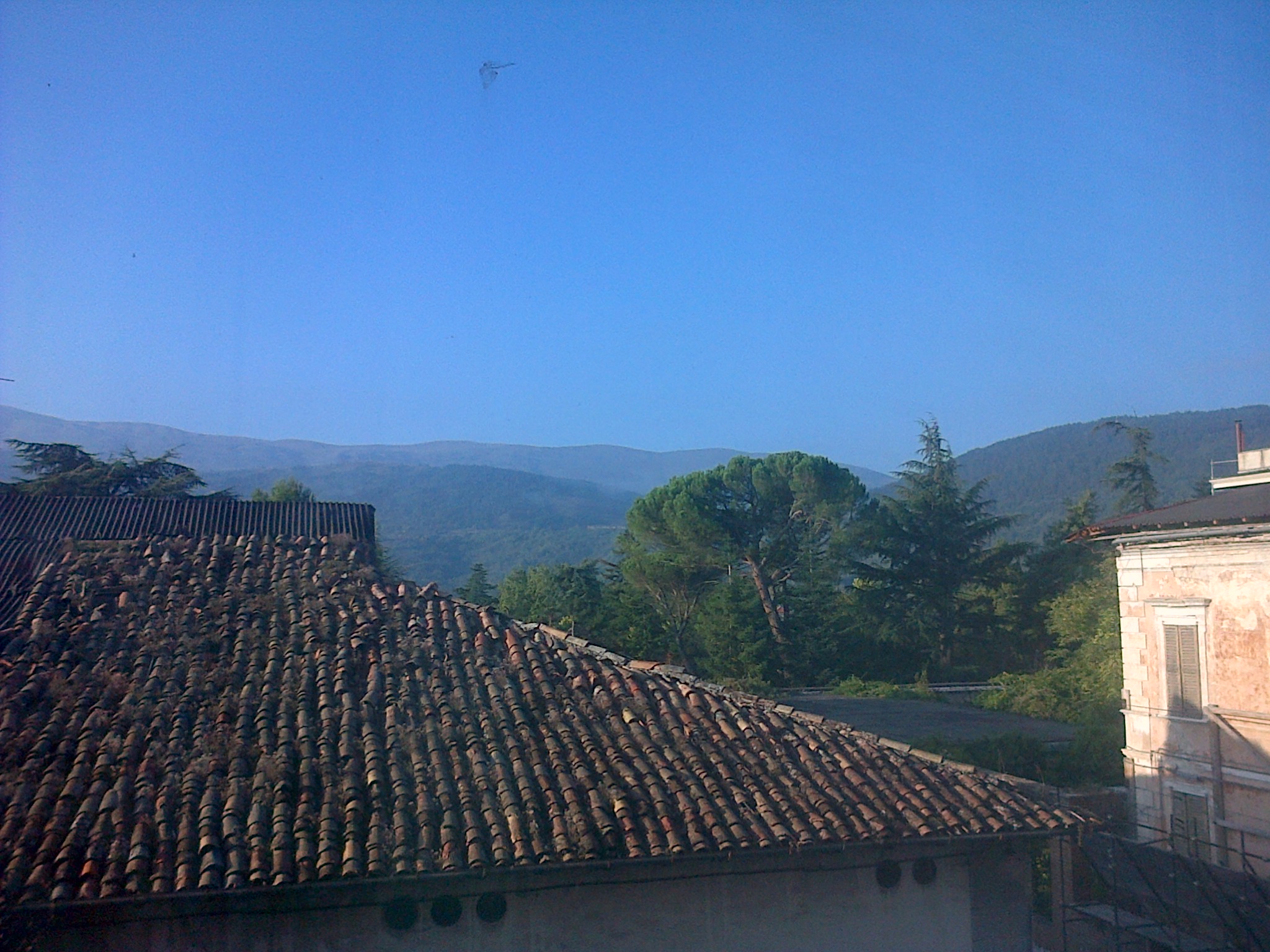
L’Aquila was badly damaged by an earthquake in 2009 and there was plenty of evidence of repair and reconstruction work still going on. I’ll take a few pictures here and there, but for the time being I’ll just share the view from my hotel window for the enjoyment of any readers back in rainy England…

IMG-20141007-00420

Volare

Posted in Music with tags , on October 6, 2014 by telescoper


A Problem of Wires on the Rails

Posted in Cute Problems with tags , , , on October 5, 2014 by telescoper

It’s been a long time since I posted a cute physics problem so here’s one about magnetism for your edification and/or amusement.

Two long wires are laid flat on a pair of parallel rails perpendicular to the wires. The spacing d between the rails is large compared with x, the distance between the wires. Both wires and rails are made of material which has a resistance ρ per unit length. A magnetic flux density B is applied perpendicular to the rectangle formed by the rails and the wires. One wire is moved along the rails with uniform speed v while the other is held stationary. Derive a formula to show how the force on the stationary wire varies with x and use it to show that the force vanishes for a value of x approximately equal to μ0v/4πρ.

Give a physical interpretation of this result.

HINT: Think about the current induced in the wires…


Mathematical and Physical Sciences Open Day at Sussex

Posted in Biographical, Education with tags , , , , on October 4, 2014 by telescoper

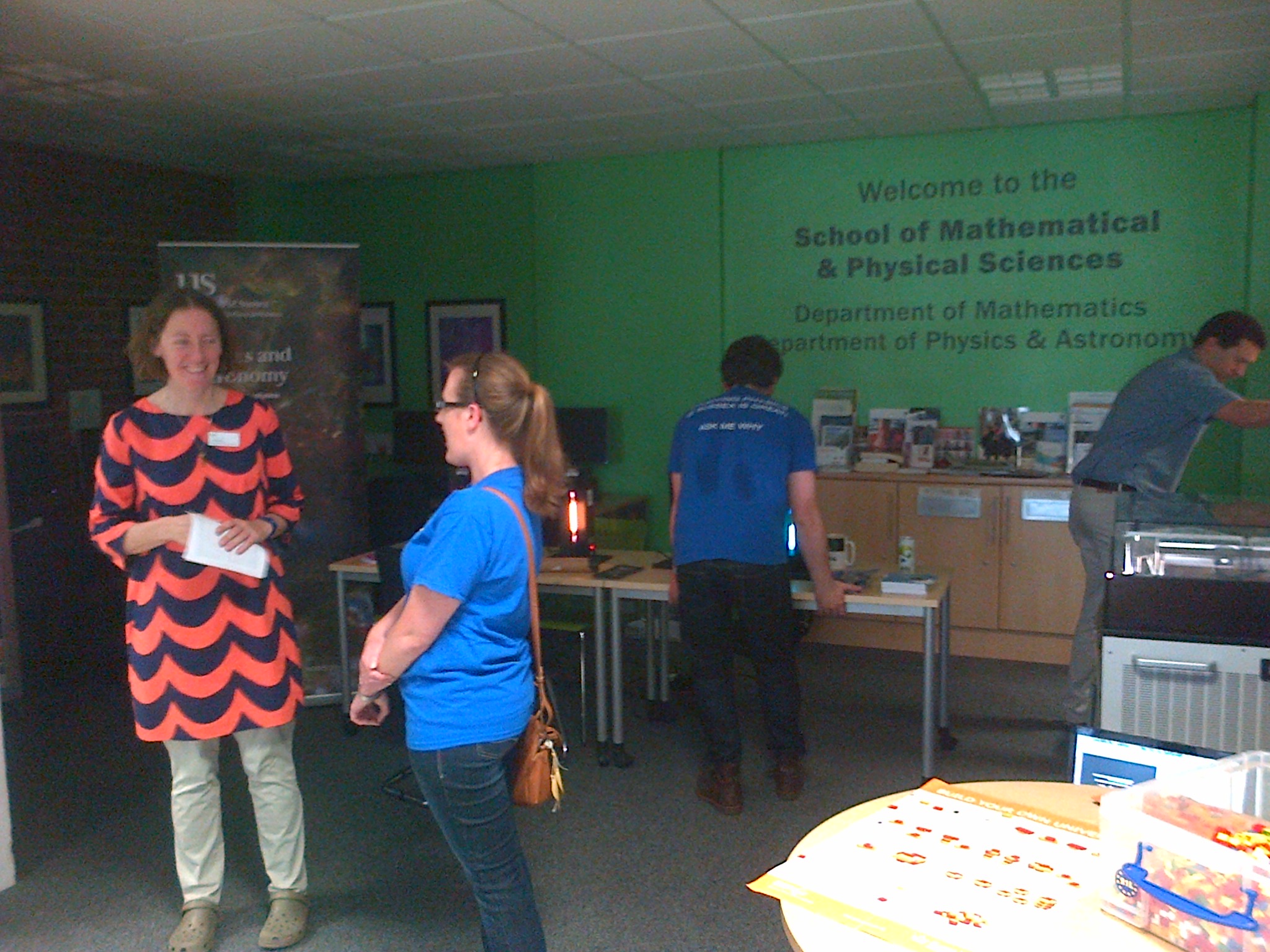
It’s another open day at the University of Sussex so I’m on campus again to help out as best I can, although I have to admit that all the hard work is being done by others! It’s been extremely busy so far; in fact, I’m told that about 6000 visitors are on campus today. This a good sign for the forthcoming admissions round, probably buoyed by the improved position of the University of Sussex in the latest set of league tables and in excellent employment prospects for graduates.

Anyway the good folks of  the Department of Physics & Astronomy  and Department of Mathematics were here bright and early to get things ready:

IMG-20141004-00413

IMG-20141004-00414

All morning we’ve had a steady stream of visitors to the School of Mathematical and Physical Sciences (which comprises both Departments mentioned above). While I’m at it let me just give a special mention to Darren Baskill’s Outreach Team (seen in the team photograph below).
outreachThey have had absolutely amazing year, running a huge range of events and activities that have reached a staggering 14,000 people of all ages (including 12,000 of school age).

Anyway, I think I’ll toddle off and see if I can sit in on one of today’s lectures. It’s about time I learned something.


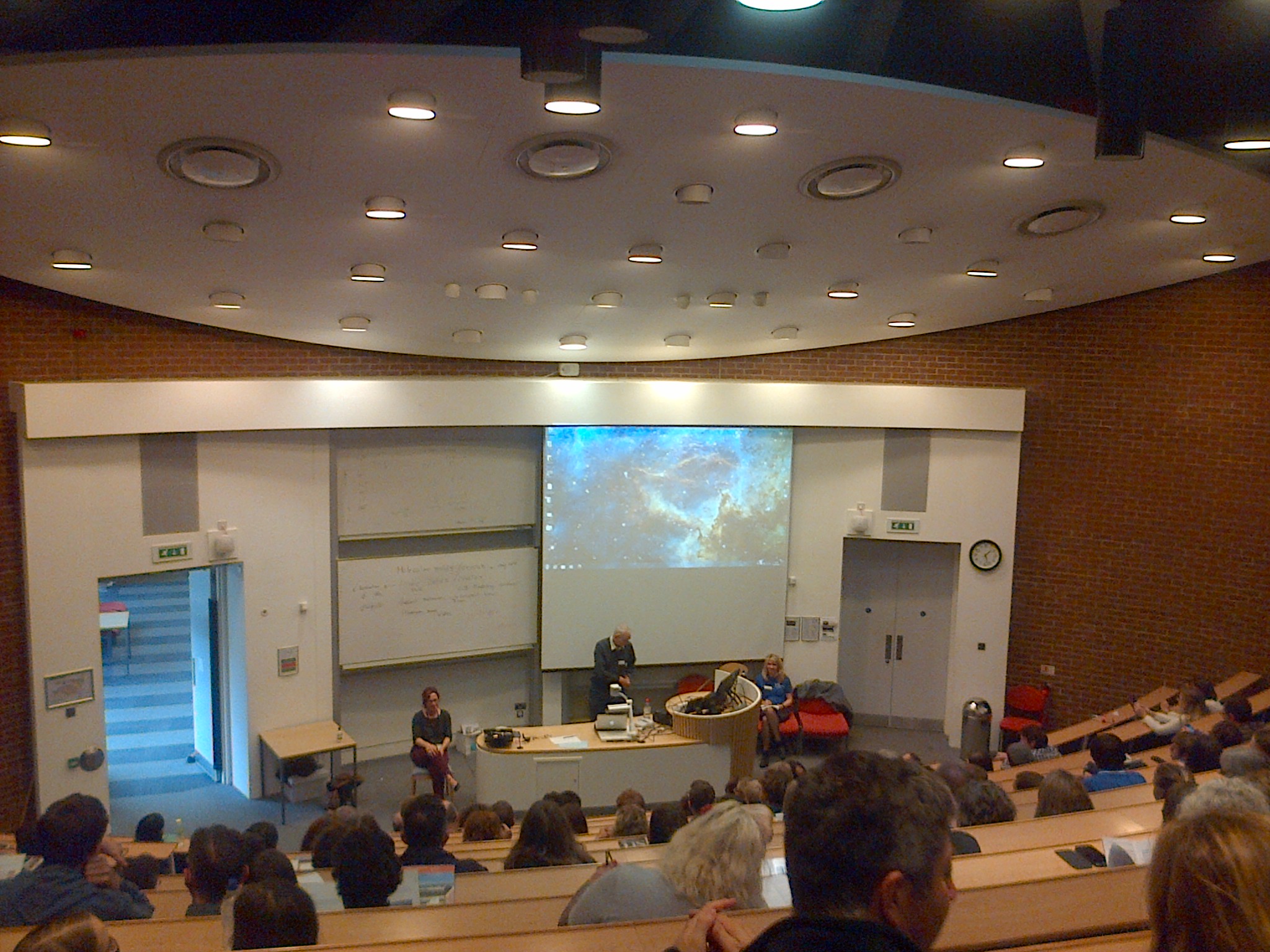
UPDATE: Here is Mark Hindmarsh about to get started on his lecture.

IMG-20141004-00415

You could have knocked me down with a feather when I saw that he had included a quote from this blog in his talk:

I’ve worked in some good physics departments in my time, but the Department of Sussex is completely unique both for the level of support it offers students and the fact that so many of the undergraduates are so highly motivated.

And, yes, I did mean every word of that.

Signore, ascolta!

Posted in Opera with tags , , , , on October 3, 2014 by telescoper

Time for a Friday lunchtime end-of-the-week kind of a post. This is the great Montserrat Caballé singing the beautiful aria Signore, ascolta! from the Opera Turandot by Giacomo Puccini. As the title suggests, you should listen to the whole thing because it’s lovely, but be prepared for something truly astonishing from about 2.16 onwards as the singer demonstrates unbelievable control by holding that final high note in a way that doesn’t seem humanly possible..

The Curse of Assessment-led Teaching

Posted in Education with tags , , on October 2, 2014 by telescoper

Yesterday I took part in a University Teaching and Learning Strategy meeting that discussed, among other things, how to improve the feedback on student assessments in order to help them learn better. It was an interesting meeting, involving academics, administrative staff and representatives of the Students Union, that generated quite a few useful ideas. Looking through my back catalogue I realise that around this time year I was at a similar event based in the School of Mathematical and Physical Sciences at the University of Sussex of which I am Head.

Positive though yesterday’s discussion was, it didn’t do anything to dissuade me from a long-held view that the entire education system holds back the students’ ability to learn by assessing them far too much. One part of the discussion was about trying to pin down essentially what is meant by “Research-led Teaching” which is what we’re supposed to be doing at universities. In my view too much teaching is not really led by research at all, but mainly driven by assessment. The combination of the introduction of modular programmes and the increase of continuously assessed coursework has led to a cycle of partial digestion and regurgitation that involves little in the way of real learning and certainly nothing like the way research is done.

I’m not going to argue for turning the clock back entirely, but for the record my undergraduate degree involved no continuous assessment at all (apart from a theory project I opted for in my final year. Having my entire degree result based on the results of six three-hour unseen examinations in the space of three days is not an arrangement I can defend, but note that despite the lack of continuous assessment I still spent less time in the examination hall than present-day students.

That’s not to say I didn’t have coursework. I did, but it was formative rather than summative; in other words it was for the student to learn about the subject, rather for the staff to learn about the student. I handed in my stuff every week, it was marked and annotated by a supervisor, then returned and discussed at a supervision.

People often tell me that if a piece of coursework “doesn’t count” then the students won’t do it. There is an element of truth in that, of course. But I had it drummed into me that the only way really to learn my subject (Physics) was by doing it. I did all the coursework I was given because I wanted to learn and I knew that was the only way to do it.

The very fact that coursework didn’t count for assessment made the feedback written on it all the more useful when it came back because if I’d done badly I could learn from my mistakes without losing marks. This also encouraged me to experiment a little, such as using a method different from that suggested in the question. That’s a dangerous strategy nowadays, as many seem to want to encourage students to behave like robots, but surely we should be encouraging students to exercise their creativity rather than simply follow the instructions? The other side of this is that more challenging assignments can be set, without worrying about what the average mark will be or what specific learning outcome they address.

I suppose what I’m saying is that the idea of Learning for Learning’s Sake, which is what in my view defines what a university should strive for, is getting lost in a wilderness of modules, metrics, percentages and degree classifications. We’re focussing too much on those few aspects of the educational experience that can be measured, ignoring the immeasurable benefit (and pleasure) that exists for all humans in exploring new ways to think about the world around us.