Posted in Beards on December 20, 2015 by telescoper
It’s hard to believe it’s a whole year since I found myself as a surprising contender for this coveted award (only to see my challenge fade badly in the final stages). Anyway, here’s a reblog to encourage you to cast your vote in this year’s poll. As usual I don’t know who most of the contenders are, but I’m sure you will all find a favourite.
Strictly Coming Dancing winner Jay McGuiness joins Beard of Year shortlist
The Beard Liberation Front, the informal network of beard wearers, has said that Jay McGuiness part of the winning pair in the 2015 Strictly Come Dancing final has joined the Beard of the Year 2015 shortlist.
The winner is determined by an on-line poll of supporters currently in progress.
The poll will close at 6pm on December 28th with the winner announced on December 29th
The winner in 2014 was singer Conchita Wurst
The Award is focused on those whose beard has had the most positive impact in the public eye during 2015.
BLF organiser Keith Flett said, Jay McGuiness has been a fantastic positive ambassador for the hirsute on Strictly so it’s entirely appropriate that he joins the Beard of the Year shortlist
Back from a two-day meeting in Edinburgh about the Euclid Mission, I have to spend a couple of days this weekend in the office before leaving for the holidays. I was a bit surprised at the end of the meeting to be asked if I would be on the panel for the closing discussion, discussing questions raised by the audience. The first of these questions was – and I have to paraphrase becase I don’t remember exactly – whether it would be disappointing if the Euclid mission merely confirmed that observations were consistent with a “simple” cosmological constant rather than any of the more exotic (and perhaps more exciting) alternatives that have been proposed by theorists. I think that’s the likely outcome of Euclid, actually, and I don’t think it would be disappointing if it turned out to be the case. Moreover, testing theories of dark energy is just one of the tasks this mission will undertake and it may well be the case that in years to come Euclid is remembered for something other than dark energy. Anyway, this all triggered a memory of an old post of mine about Alfred Hitchcock so with apologies for repeating something I blogged about 4 years ago, here is a slight reworking of an old piece.
–0–
Unpick the plot of any thriller or suspense movie and the chances are that somewhere within it you will find lurking at least one MacGuffin. This might be a tangible thing, such the eponymous sculpture of a Falcon in the archetypal noir classic The Maltese Falcon or it may be rather nebulous, like the “top secret plans” in Hitchcock’s The Thirty Nine Steps. Its true character may be never fully revealed, such as in the case of the glowing contents of the briefcase in Pulp Fiction, which is a classic example of the “undisclosed object” type of MacGuffin, or it may be scarily obvious, like a doomsday machine or some other “Big Dumb Object” you might find in a science fiction thriller. It may even not be a real thing at all. It could be an event or an idea or even something that doesn’t exist in any real sense at all, such the fictitious decoy character George Kaplan in North by Northwest. In fact North by North West is an example of a movie with more than one MacGuffin. Its convoluted plot involves espionage and the smuggling of what is only cursorily described as “government secrets”. These are the main MacGuffin; George Kaplan is a sort of sub-MacGuffin. But although this is behind the whole story, it is the emerging romance, accidental betrayal and frantic rescue involving the lead characters played by Cary Grant and Eve Marie Saint that really engages the characters and the audience as the film gathers pace. The MacGuffin is a trigger, but it soon fades into the background as other factors take over.
Whatever it is or is not, the MacGuffin is responsible for kick-starting the plot. It makes the characters embark upon the course of action they take as the tale begins to unfold. This plot device was particularly beloved by Alfred Hitchcock (who was responsible for introducing the word to the film industry). Hitchcock was however always at pains to ensure that the MacGuffin never played as an important a role in the mind of the audience as it did for the protagonists. As the plot twists and turns – as it usually does in such films – and its own momentum carries the story forward, the importance of the MacGuffin tends to fade, and by the end we have usually often forgotten all about it. Hitchcock’s movies rarely bother to explain their MacGuffin(s) in much detail and they often confuse the issue even further by mixing genuine MacGuffins with mere red herrings.
Here is the man himself explaining the concept at the beginning of this clip. (The rest of the interview is also enjoyable, convering such diverse topics as laxatives, ravens and nudity..)
There’s nothing particular new about the idea of a MacGuffin. I suppose the ultimate example is the Holy Grail in the tales of King Arthur and the Knights of the Round Table and, much more recently, the Da Vinci Code. The original Grail itself is basically a peg on which to hang a series of otherwise disconnected stories. It is barely mentioned once each individual story has started and, of course, is never found.
Physicists are fond of describing things as “The Holy Grail” of their subject, such as the Higgs Boson or gravitational waves. This always seemed to me to be an unfortunate description, as the Grail quest consumed a huge amount of resources in a predictably fruitless hunt for something whose significance could be seen to be dubious at the outset.The MacGuffin Effect nevertheless continues to reveal itself in science, although in different forms to those found in Hollywood.
The Large Hadron Collider (LHC), switched on to the accompaniment of great fanfares a few years ago, provides a nice example of how the MacGuffin actually works pretty much backwards in the world of Big Science. To the public, the LHC was built to detect the Higgs Boson, a hypothetical beastie introduced to account for the masses of other particles. If it exists the high-energy collisions engineered by LHC should reveal its presence. The Higgs Boson is thus the LHC’s own MacGuffin. Or at least it would be if it were really the reason why LHC has been built. In fact there are dozens of experiments at CERN and many of them have very different motivations from the quest for the Higgs, such as evidence for supersymmetry.
Particle physicists are not daft, however, and they have realised that the public and, perhaps more importantly, government funding agencies need to have a really big hook to hang such a big bag of money on. Hence the emergence of the Higgs as a sort of master MacGuffin, concocted specifically for public consumption, which is much more effective politically than the plethora of mini-MacGuffins which, to be honest, would be a fairer description of the real state of affairs.
Even this MacGuffin has its problems, though. The Higgs mechanism is notoriously difficult to explain to the public, so some have resorted to a less specific but more misleading version: “The Big Bang”. As I’ve already griped, the LHC will never generate energies anything like the Big Bang did, so I don’t have any time for the language of the “Big Bang Machine”, even as a MacGuffin.
While particle physicists might pretend to be doing cosmology, we astrophysicists have to contend with MacGuffins of our own. One of the most important discoveries we have made about the Universe in the last decade is that its expansion seems to be accelerating. Since gravity usually tugs on things and makes them slow down, the only explanation that we’ve thought of for this perverse situation is that there is something out there in empty space that pushes rather than pulls. This has various possible names, but Dark Energy is probably the most popular, adding an appropriately noirish edge to this particular MacGuffin. It has even taken over in prominence from its much older relative, Dark Matter, although that one is still very much around.
We have very little idea what Dark Energy is, where it comes from, or how it relates to other forms of energy we are more familiar with, so observational astronomers have jumped in with various grandiose strategies to find out more about it. This has spawned a booming industry in surveys of the distant Universe (such as the Dark Energy Survey or the Euclid mission I mentioned in the preamble) all aimed ostensibly at unravelling the mystery of the Dark Energy. It seems that to get any funding at all for cosmology these days you have to sprinkle the phrase “Dark Energy” liberally throughout your grant applications.
The old-fashioned “observational” way of doing astronomy – by looking at things hard enough until something exciting appears (which it does with surprising regularity) – has been replaced by a more “experimental” approach, more like that of the LHC. We can no longer do deep surveys of galaxies to find out what’s out there. We have to do it “to constrain models of Dark Energy”. This is just one example of the not necessarily positive influence that particle physics has had on astronomy in recent times and it has been criticised very forcefully by Simon White.
Whatever the motivation for doing these projects now, they will undoubtedly lead to new discoveries. But my own view is that there will never be a solution of the Dark Energy problem until it is understood much better at a conceptual level, and that will probably mean major revisions of our theories of both gravity and matter. I venture to speculate that in twenty years or so people will look back on the obsession with Dark Energy with some amusement, as our theoretical language will have moved on sufficiently to make it seem irrelevant.
But that’s how it goes with MacGuffins. Even the Maltese Falcon turned out in the end to be a fake.
The press office at the European Space Agency is apparently determined to release as much interesting material as possible in the week before Christmas so that as few people as possible will notice. I mentioned one yesterday, and here is another.
The map is of preliminary data from the XXL Cluster Survey, the largest survey of galaxy clusters ever undertaken, and was obtained using the XMM-Newton telescope. (Thanks to various people, including Ben Maughan below who pointed out the error I made by relying on the accuracy of the ESA Press Release.)
The press-release marks the publication of the first results from this survey on 15th December 2015. The clusters of galaxies surveyed are prominent features of the large-scale structure of the Universe and to better understand them is to better understand this structure and the circumstances that led to its evolution. So far 450 clustershave been identified – they are indicated by the red rings in the picture. Note that the full moon is shown at the top left to show the size of the sky area surveyed.
If you’ll pardon a touch of autobiography I should point out that my very first publication was on galaxy clusters. It came out in 1986 and was based on data from optically-selected clusters; X-rays emission from the very hot gas they contain is a much better way to identify these than through counting galaxies by their starlight. Cluster cosmology has moved on a lot. So has everything else in cosmology, come to think of it!
Was yesterday the day when a crack appeared in the Standard Model that will lead to its demise? Maybe. It was a very interesting day, that’s for sure. [Here’s yesterday’s article on the results as they appeared.]
I find the following plot useful… it shows the results on photon pairs from ATLAS and CMS superposed for comparison. [I take only the central events from CMS because the events that have a photon in the endcap don’t show much (there are excesses and deficits in the interesting region) and because it makes the plot too cluttered; suffice it to say that the endcap photons show nothing unusual.] The challenge is that ATLAS uses a linear horizontal axis while CMS uses a logarithmic one, but in the interesting region of 600-800 GeV you can more or less line them up. Notice that CMS’s bins are narrower than ATLAS’s by a factor…
This morning I flew from London Gatwick to Edinburgh to attend the UK Euclid meeting at the Royal Observatory, which lasts today and tomorrow. It turns out there were two other astronomers on the plane: Alan Heavens from Imperial and Jon Loveday from my own institution, the University of Sussex.
The meeting is very useful for me as it involves a number of updates on the European Space Agency’s Euclid mission. For those of you who don’t know about Euclid here’s what it says on the tin:
Euclid is an ESA mission to map the geometry of the dark Universe. The mission will investigate the distance-redshift relationship and the evolution of cosmic structures by measuring shapes and redshifts of galaxies and clusters of galaxies out to redshifts ~2, or equivalently to a look-back time of 10 billion years. In this way, Euclid will cover the entire period over which dark energy played a significant role in accelerating the expansion
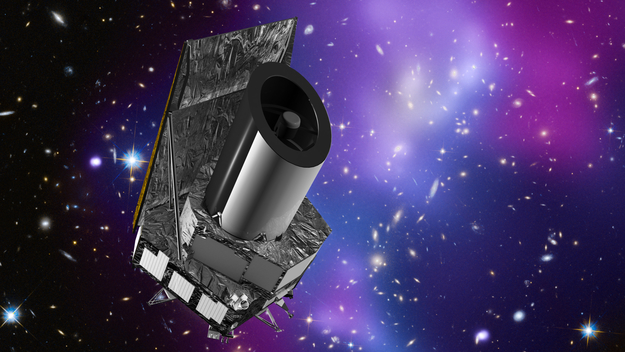
Here’s an artist’s impression of the satellite:
Do give you an idea of what an ambitious mission this is, it basically involves repeated imaging of a large fraction of the sky (~15,000 square degrees) over a period of about six years. Each image is so large that it would take 300 HD TV screens to display it at full resolution. The data challenge is considerable, and the signals Euclid is trying to measure are so small that observational systematics have to be controlled with exquisite precision. The requirements are extremely stringent, and there are many challenges to confront, but it’s going well so far. Oh, and there are about 1,200 people working on it!
Coincidentally, this very morning ESA issued a press release announcing that Euclid has passed its PDR (Preliminary Design Review) and is on track for launch in December 2020. I wouldn’t bet against that date slipping, however, as there is a great deal of work still to do and a number of things that could go wrong and cause delays. Nevertheless, so far so good!
Posted in Poetry with tags Robert Burns on December 16, 2015 by telescoper
The wintry west extends his blast,
And hail and rain does blaw;
Or the stormy north sends driving forth
The blinding sleet and snaw:
While, tumbling brown, the burn comes down,
And roars frae bank to brae;
And bird and beast in covert rest,
And pass the heartless day.
“The sweeping blast, the sky o’ercast,”
The joyless winter day
Let others fear, to me more dear
Than all the pride of May:
The tempest’s howl, it soothes my soul,
My griefs it seems to join;
The leafless trees my fancy please,
Their fate resembles mine!
Thou Power Supreme, whose mighty scheme
These woes of mine fulfil,
Here firm I rest; they must be best,
Because they are Thy will!
Then all I want—O do Thou grant
This one request of mine!—
Since to enjoy Thou dost deny,
Assist me to resign.
Very busy, so just a quickie today. Yesterday the good folk at the Large Hadron Collider announced their latest batch of results. You can find the complete set from the CMS experiment here and from ATLAS here.
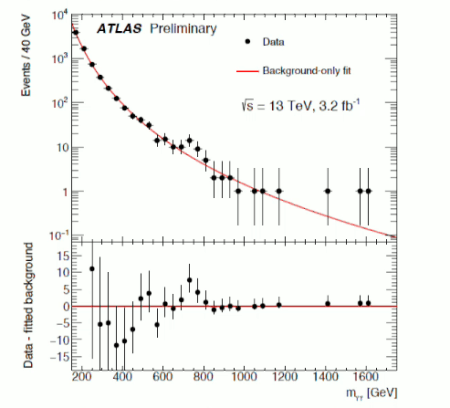
The result that everyone is talking about is shown in the following graph, which shows the number of diphoton events as a function of energy:
Attention is focussing on the apparent “bump” at around 750 GeV; you can find an expert summary by a proper particle physicist here and another one here.
It is claimed that the “significance level” of this “detection” is 3.6σ. I won’t comment on that precise statement partly because it depends on the background signal being well understood but mainly because I don’t think this is the right language in which to express such a result in the first place. Experimental particle physicists do seem to be averse to doing proper Bayesian analyses of their data.
However if you take the claim in the way such things are usually presented it is roughly equivalent to a statement that the odds against this being a real detection are greater that 6000:1. If any particle physicists out there are willing to wager £6000 for £1 of mine that this result will be confirmed by future measurements then I’d happily take them up on that bet!
P.S. Entirely predictably there are 10 theory papers on today’s ArXiv offering explanations of the alleged bump, none of which says that it’s a noise feature..
Many years ago I had to take a day off School to travel down to Cambridge in order to be interviewed for a place on the Natural Sciences Tripos at Magdalene College. One of the questions I was asked was the following:
If you put a bucket of hot water and a bucket of cold water outside on a freezing cold day, which would freeze first?
I think I gave the right answer, which is that it’s not obvious..
My main argument was that evaporation would increase the rate of cooling of the hot water and also mean that when it did get down to freezing point there would be less of it to freeze. I attempted to work something out based on the heat capacity of liquid water versus the latent heat of freezing, but didn’t get very far with that as I couldn’t remember any numbers. I do remember saying that this would also depend on the shape of the bucket, especially on the surface area exposed: water in a flat dish would experience more evaporation than a narrow cylinder.
I only realised later that it wasn’t really the purpose of such questions to arrive at a definite answer, more to give the interviewer an idea of whether the interviewee is capable of thinking on his/her feet. I guess I must have waffled enough to give the misleading impression that I could, and was offered a place.
The reason I am rambling on about this now is that I stumbled across a blog post yesterday about something called the Mpemba Effect from which I quote:
The Mpemba effect is the observation that warm water freezes more quickly than cold water. The effect has been measured on many occasions with many explanations put forward. One idea is that warm containers make better thermal contact with a refrigerator and so conduct heat more efficiently. Hence the faster freezing. Another is that warm water evaporates rapidly and since this is an endothermic process, it cools the water making it freeze more quickly.
None of these explanations are entirely convincing, which is why the true explanation is still up for grabs
It appears that, depending on the circumstances, hot water does indeed freeze faster than cold water but that the reason why is apparently still not obvious.
However, there is a (fairly) recent paper on the arXiv that claims to solve this problem. The abstract reads:
We demonstrate that the Mpemba paradox arises intrinsically from the release rate of energy initially stored in the covalent H-O part of the O:H-O bond in water albeit experimental conditions. Generally, heating raises the energy of a substance by lengthening and softening all bonds involved. However, the O:H nonbond in water follows actively the general rule of thermal expansion and drives the H-O covalent bond to relax oppositely in length and energy because of the inter-electron-electron pair coupling [J Phys Chem Lett 4, 2565 (2013); ibid 4, 3238 (2013)]. Heating stores energy into the H-O bond by shortening and stiffening it. Cooling the water as the source in a refrigerator as a drain, the H-O bond releases its energy at a rate that depends exponentially on the initially storage of energy, and therefore, Mpemba effect happens. This effect is formulated in terms of the relaxation time tau to represent all possible processes of energy loss. Consistency between predictions and measurements revealed that the tau drops exponentially intrinsically with the initial temperature of the water being cooled.
Although I did study chemistry as part of my Natural Sciences degree, I dropped it after the first year and have subsequently forgotten almost everything I learned. I’m therefore not really qualified to judge whether the explanation presented in this paper is reasonable. I would be convinced if the theory could predict other observable outcomes but at the moment it doesn’t seem to.
Yesterday I posted about a map that “changed the world”. Clearly the world changed a lot and for many different reasons because when I got home I noticed the following picture on Facebook, depicting 17 equations that also “changed the world”:
Friday was the last day of teaching term here at the University of Sussex. Aided by the general winding down of things I managed the unusual feat of geting up to London in time to catch some of the monthly discussion meeting of the Royal Astronomical Society, which was on A Critical Assessment of Cluster Cosmology. Usually I only just manage to get there in time for some of the Ordinary Meeting which follows the specialist meetings at 4pm. And sometimes I only get there in time for the drinks reception at Burlington House followed by the RAS Club dinner at the Athenaeum!
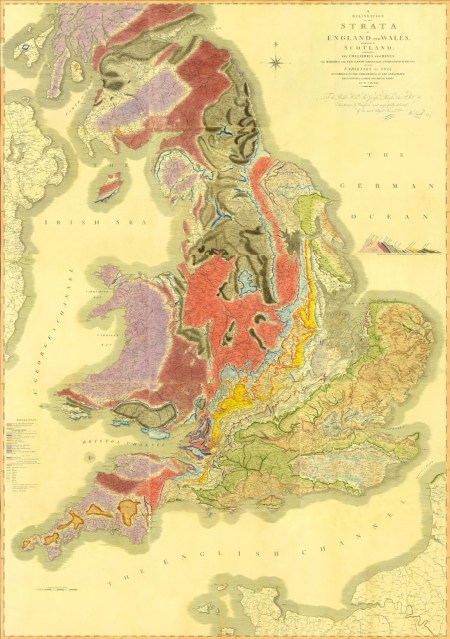
I may write something about Cluster Cosmology if I get time before Christmas, but I thought I’d post an item now inspired by one of the talks in the Ordinary Meeting by Tom Sharpe of Lyme Regis Museum and Cardiff University. This talk was timed to mark the 200th anniversary of the publication of the first ever geological map of England and Wales in 1815. To make it even more topical, the talk was given in the lecture theatre of the Geological Society of London where an original print of the Map is on permanent display:
The person responsible for this map, which was the first to show nationwide geological strata, was a chap called William Smith who surveyed England and Wales on foot and on horseback, travelling over 10,000 miles to make it. It was a remarkable achievement which, among many other things, led the way to great changes in the understanding of geological time. Unfortunately his work didn’t have much impact when it was first published. Smith, who was evidently not a very astute businessman, eventually went bankrupt and spent some time in a debtor’s prison.
The map itself is extremely beautiful as well as very clever in the way it uses colours and shading to represent three-dimensional information on a two dimensional surface.
Anyway, there is a book entitled The Map that Changed the Worldwritten by Simon Winchester which tells the story of William Smith and his map. I haven’t read it but I’m told it’s excellent. I’ll probably buy a copy with the book tokens I inevitably get for Christmas!
The views presented here are personal and not necessarily those of my employer (or anyone else for that matter).
Feel free to comment on any of the posts on this blog but comments may be moderated; anonymous comments and any considered by me to be vexatious and/or abusive and/or defamatory will not be accepted. I do not necessarily endorse, support, sanction, encourage, verify or agree with the opinions or statements of any information or other content in the comments on this site and do not in any way guarantee their accuracy or reliability.






 In the Dark