Archive for February, 2017

Haydn and the Herschels

Posted in History, Music, The Universe and Stuff with tags , , , , , on February 14, 2017 by telescoper

Last night I was listening to a broadcast of a concert performance of Haydn’s “Creation” on BBC Radio 3, featuring the London Philharmonic under the direction of Sir Roger Norrington. During the interval (between Parts I and II) the presenter Sara Mohr-Pietsch cast doubt in the story (which I’ve heard quite often), that Joseph Haydn was at least partly inspired to write The Creation by a trip he took during a stay in England to see the observatory of astronomer William Herschel. This story is repeated in a number of places around the web, including here, from which source I quote:

On 15 June 1792. Joseph Haydn visited William Herschel – basoonist, composer, astronomer – at his observatory near Slough. Herschel introduced Haydn to the Milky Way and, quite possibly, the planet Uranus, which he’d discovered ten years earlier. Some say Haydn took this glimpse of the infinite as the inspiration for his oratorio The Creation. Seems plausible.

It does indeed seem plausible. It is a matter of record that Haydn did  visit the Observatory House in Slough on 15th June 1792, which is where William Herschel lived with his sister Caroline at the time. (Interestingly, the day before this visit Haydn was at Ascot watching the horse-racing.)

However, according to William Herschel’s own records he wasn’t at the Observatory House on this day. In fact he had been away since May 1792 visiting various locations in England and Wales, before eventually arriving in Glasgow to receive an honorary degree. The notion that Herschel provided Haydn with the inspiration to write The Creation is therefore false.

Or is it?

William Herschel may not have been at home when Haydn called on 15th June 1792, but Caroline certainly was: Haydn’s name is recorded in her visitor’s book on that date. In his diary Haydn makes a note of the dimensions of the telescope (40ft) but does not mention actually looking through it, which is not surprising if he was there during the day.  There’s no other record of this visit of which I’m aware that says for sure what happened on that day, but Caroline certainly could have described what she had observed during her career as an astronomer, both on her own and with William, and also shown Haydn drawings, catalogues and star charts. Caroline Herschel was an extremely accomplished astronomer in her own right, so who’s to say it was not she rather than her brother who provided Haydn with the inspiration for his oratorio?

So it could well be that it was Herschel that inspired The Creation after all, but Caroline rather than William…

Signs of the Data Innovation Institute

Posted in Biographical with tags on February 13, 2017 by telescoper

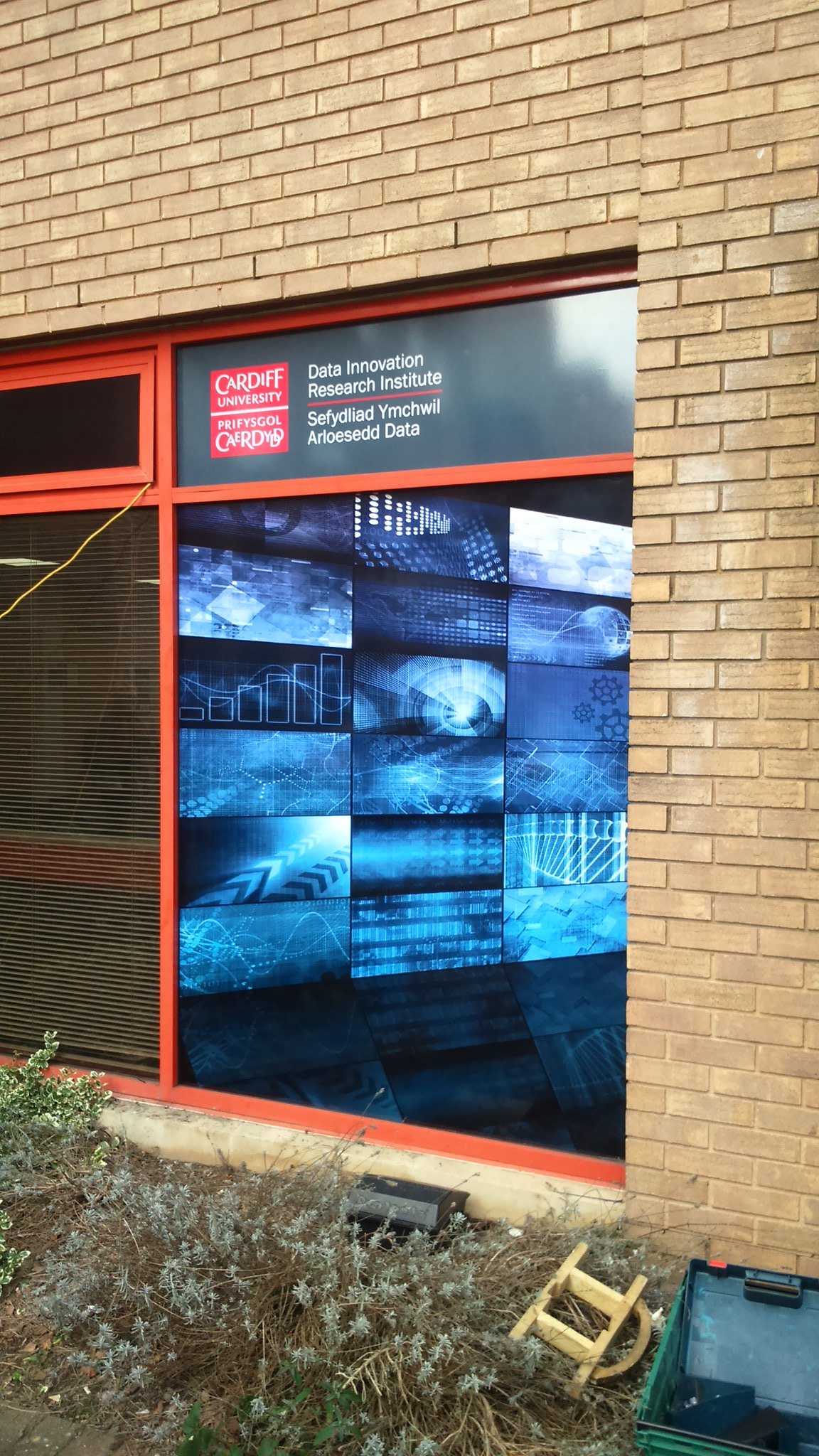
I’ve only been in my new office in the Data Innovation Research Institute for 5 months so it came as a big surprise to see that they’ve already started putting up the signs telling people where we are. In fact a couple of chaps came this  morning to do the necessary, and now we look very professional. It’s hard to tell that this used to be a chip shop.

dii_out

Please don’t tell the Health & Safety people about the power cable trailing through the window!

And here’s me answering the door to strangers…

dii_2

Thanks to Dan Read for taking that second one.

R.I.P. Nicolai Gedda (1925-2017)

Posted in Opera with tags , , , on February 13, 2017 by telescoper

I only heard yesterday the very sad news that the fine Swedish operatic tenor Nicolai Gedda passed away on 8th January 2017 at the age of 91.  The news wasn’t announced by his family until February 9th, which explains part of the reason I am so late to post a little tribute. This is from the first recording I ever heard of die Zauberflöte by Wolfgang Amadeus Mozart (made in 1964, conducted by Otto Klemperer) in which Gedda sings Tamino alongside the equally wonderful Gundula Janowitz as Pamina.  This CD played a huge role in getting me interested in Opera, so it is with special sadness but also special admiration that I say farewell to Nicolai Gedda.

R.I.P. Nicolai Gedda (1925-2017)


Cosmological perturbation effects on gravitational-wave luminosity distance estimates [CL]

Posted in The Universe and Stuff on February 13, 2017 by telescoper

Interesting paper about the effect of cosmological inhomogeneity on gravitational wave propagation. The effect could be import for the more distant sources likely to be detected with future experiments.

arxiver's avatararXiver

http://arxiv.org/abs/1702.01750

Waveforms of gravitational waves provide information about a variety of parameters for the binary system merging. However, standard calculations have been performed assuming a FLRW universe with no perturbations. In reality this assumption should be dropped: we show that the inclusion of cosmological perturbations translates into corrections to the estimate of astrophysical parameters derived for the merging binary systems. We compute corrections to the estimate of the luminosity distance due to velocity, volume, lensing and gravitational potential effects. Our results show that the amplitude of the corrections will be negligible for current instruments, mildly important for experiments like the planned DECIGO, and very important for future ones such as the Big Bang Observer.

Read this paper on arXiv…

D. Bertacca, A. Raccanelli, N. Bartolo, et. al.
Wed, 8 Feb 17
18/65

Comments: 16 pages, 3 figures

View original post

The View from the Castle Keep

Posted in Uncategorized on February 12, 2017 by telescoper

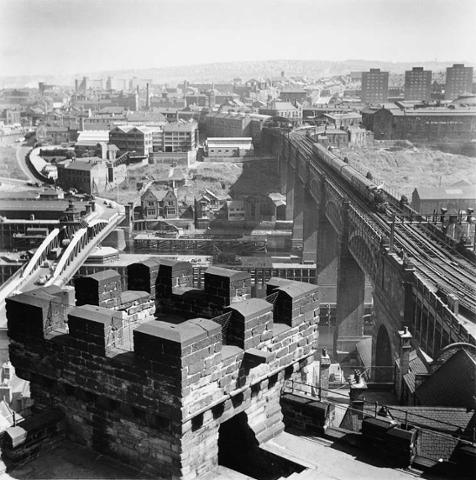
I couldn’t resist sharing this wonderful photograph, taken in 1957 by Jimmy Forsyth from the top of the Castle Keep in Newcastle upon Tyne, looking South across the Tyne towards the Midlands.

The two historic bridges in view are the Swing Bridge (left; completed in 1876) and the High Level Bridge (right; completed in 1849). The more famous Tyne Bridge is just out of shot to the left of the frame.

The picture was posted by the Twitter account of  Tyne & Wear Archives a few days ago.

Llŷr Williams plays more Beethoven

Posted in Music with tags , , , , , , , on February 10, 2017 by telescoper

Still determined to enjoy civilisation as much as I can while we still have it, last night I went to a splendid concert at the Royal Welsh College of Music and Drama in Cardiff featuring acclaimed Welsh pianist Llŷr Williams in the eighth (and penultimate) concert in a three-year series in which he is playing all the solo piano compositions of Ludwig van Beethoven.

The first half of last night’s recital comprised two very contrasting works united by the fact that both were dedicated to pupils of Beethoven. The first, the “Grande Sonata” No. 4 in E-flat major (Opus 7) dedicated to Anna Louise Barbara Keglevich (also known as Babette). This is an early work, in four movements in a relatively conventional classical style, and you can hear the influence of both Haydn and Mozart in it.

The second piece, much later and more famous, was the Opus 78 “a Therese“, dedicated to the Countess von Brunswick. This is a radically different piece, in just two movements, with a very brief slow introduction of just a few bars after which it is all at a sprightly tempo. It’s quite a odd work, really, and probably quite hard to play with flurries of notes coming thick and fast.


After the interval we heard two more sonatas, the connection between them being that both have nicknames: Sonata No. 15 (Opus 28) “Pastoral” and Sonata No. 26 (Opus 81a) “Les Adieux”. The nicknames given to some of these works are usually not by the composer and are sometimes rather misleading. The name “Pastoral” was attached by a music publisher not by Beethoven himself, but it does describe the mood of at least some of this piece, which does evoke the countryside. It’s a lovely work, actually, one of my favourites from the entire repertoire.

‘Les Adieux’ is a work in three movements describing respectively the farewell, absence and return of the Archduke Rudolf as he was forced to leave Vienna when it was attacked by Napoleon’s army in 1809.  The second movement’s moving expression of loss and loneliness, is followed by a jubilant finale marking Rudolf’s return.

That was the end of the advertised programme, but not quite the end of the concert because after very warm applause, Llŷr Williams returned to play a rather substantial encore – the 32 Variations in C Minor (also by Beethoven). It’s not quite as substantial as it seems, though, as each variation is only 10-15 seconds long.

Anyway, this was another  hugely enjoyable evening of piano music. I’m just sorry I came to the series rather late and there’s now only one left (in May 2017). Still, he happened to mention that the entire set is being released as an 11 CD Box set later this year…


Ten Years of the European Research Council

Posted in Politics, Science Politics with tags , , , , on February 9, 2017 by telescoper

This little video reminded me that we’re coming up to the tenth anniversary of the founding of the European Research Council (ERC).


In my opinion the ERC has been an outstanding success that has revitalized science across the continent and here in the United Kingdom. Sadly the UK government has decided that the United Kingdom will play no further part in ERC-funded schemes or any other programme funded by the EU.  The participation of UK scientists has already started to diminish and when it dries up completely there will be a significant loss of research income, especially for fundamental science. I’m grateful to Paul Crowther for pointing out that over the past decade there have been no fewer than 176 ERC awards to UK physics departments, meaning over  1/3 of a billion Euros in research funding.

I estimate that most physics & astronomy departments in the UK will lose 20-30% of their research income as a result of leaving the EU. Most also have a similar fraction of staff who are EU nationals, many of whom will leave because of the UK government’s shocking refusal to guarantee their right to remain. I find it sad beyond words that we as a nation are not only about to throw away our leading role in so many excellent research projects but also destroy our own credibility as a civilized nation by the mean-spirited way we are behaving.

But the ERC will at least offer British scientists two ways to continue their involvement with EU programmes. The first is that existing grants are portable, so principal investigators who decided to relocate to an EU country can take their funding with them. The second is that future ERC grants are open to applicants from any country in the world who wish to carry out their research within the EU.

As Niels Bohr famously remarked “prediction is very difficult, especially about the future”. I don’t know whether there will be a significant brain drain to the EU from the UK as a result of BrExit, but I do know many colleagues are talking about it right now. As for myself, if someone were to offer me a job in Europe I’d definitely take it.

(My CV is available on request).


One Hundred Years of the Cosmological Constant

Posted in History, The Universe and Stuff with tags , , , , , , on February 8, 2017 by telescoper

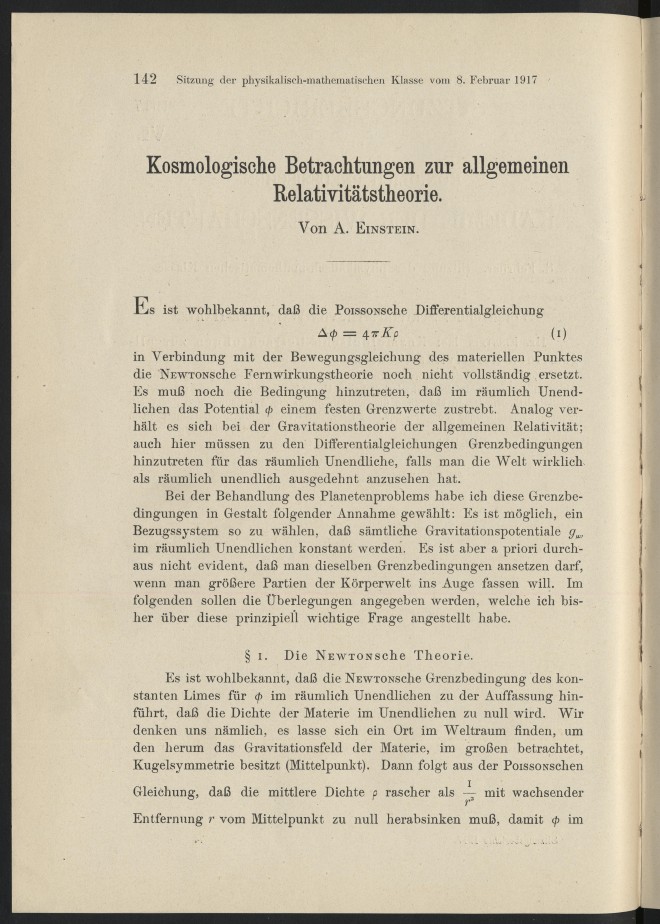
It was exactly one hundred years ago today – on 8th February 1917 – that a paper was published in which Albert Einstein explored the cosmological consequences of his general theory of relativity, in the course of which he introduced the concept of the cosmological constant.

For the record the full reference to the paper is: Kosmologische Betrachtungen zur allgemeinen Relativitätstheorie and it was published in the Sitzungsberichte der Königlich Preußischen Akademie der Wissenschaften. You can find the full text of the paper here. There’s also a nice recent discussion of it by Cormac O’Raifeartaigh  and others on the arXiv here.

Here is the first page:

cosmo

It’s well worth looking at this paper – even if your German is as rudimentary as mine – because the argument Einstein constructs is rather different from what you might imagine (or at least that’s what I thought when I first read it). As you see, it begins with a discussion of a modification of Poisson’s equation for gravity.

As is well known, Einstein introduced the cosmological constant in order to construct a static model of the Universe. The 1917 paper pre-dates the work of Friedman (1923) and Lemaître (1927) that established much of the language and formalism used to describe cosmological models nowadays, so I thought it might be interesting just to recapitulate the idea using modern notation. Actually, in honour of the impending centenary I did this briefly in my lecture on Physics of the Early Universe yesterday.

To simplify matters I’ll just consider a “dust” model, in which pressure can be neglected. In this case, the essential equations governing a cosmological model satisfying the Cosmological Principle are:

\ddot{a} = -\frac{4\pi G \rho a }{3} +\frac{\Lambda a}{3}

and

\dot{a}^2= \frac{8\pi G \rho a^2}{3} +\frac{\Lambda a^2}{3} - kc^2.

In these equations a(t) is the cosmic scale factor (which measures the relative size of the Universe) and dots are derivatives with respect to cosmological proper time, t. The density of matter is \rho>0 and the cosmological constant is \Lambda. The quantity k is the curvature of the spatial sections of the model, i.e. the surfaces on which t is constant.

Now our task is to find a solution of these equations with a(t)= A, say, constant for all time, i.e. that \dot{a}=0 and \ddot{a}=0 for all time.

The first thing to notice is that if \Lambda=0 then this is impossible. One can solve the second equation to make the LHS zero at a particular time by matching the density term to the curvature term, but that only makes a universe that is instantaneously static. The second derivative is non-zero in this case so the system inevitably evolves away from the situation in which $\dot{a}=0$.

With the cosmological constant term included, it is a different story. First make \ddot{a}=0  in the first equation, which means that

\Lambda=4\pi G \rho.

Now we can make \dot{a}=0 in the second equation by setting

\Lambda a^2 = 4\pi G \rho a^2 = kc^2

This gives a static universe model, usually called the Einstein universe. Notice that the curvature must be positive, so this a universe of finite spatial extent but with infinite duration.

This idea formed the basis of Einstein’s own cosmological thinking until the early 1930s when observations began to make it clear that the universe was not static at all, but expanding. In that light it seems that adding the cosmological constant wasn’t really justified, and it is often said that Einstein regard its introduction as his “biggest blunder”.

I have two responses to that. One is that general relativity, when combined with the cosmological principle, but without the cosmological constant, requires the universe to be dynamical rather than static. If anything, therefore, you could argue that Einstein’s biggest blunder was to have failed to predict the expansion of the Universe!

The other response is that, far from it being an ad hoc modification of his theory, there are actually sound mathematical reasons for allowing the cosmological constant term. Although Einstein’s original motivation for considering this possibility may have been misguided, he was justified in introducing it. He was right if, perhaps, for the wrong reasons. Nowadays observational evidence suggests that the expansion of the universe may be accelerating. The first equation above tells you that this is only possible if \Lambda\neq 0.

Finally, I’ll just mention another thing in the light of the Einstein (1917) paper. It is clear that Einstein thought of the cosmological as a modification of the left hand side of the field equations of general relativity, i.e. the part that expresses the effect of gravity through the curvature of space-time. Nowadays we tend to think of it instead as a peculiar form of energy (called dark energy) that has negative pressure. This sits on the right hand side of the field equations instead of the left so is not so much a modification of the law of gravity as an exotic form of energy. You can see the details in an older post here.

Anachronic Anthropology

Posted in Jazz with tags , , , , on February 7, 2017 by telescoper

I’m struggling a bit with a heavy cold (or at least I hope that’s what it is) and I had a two-hour lecture earlier today so I’m going to go home and crash out. To keep my readers (Sid and Doris Bonkers) amused, I decided to repost this piece which I’ve actually posted before almost eight years ago. It’s an oddity, but quite an interesting one I think.

The Anachronic Jazz Band is, I think, now defunct but they were from Paris originally. The style they played in could probably be described as like the New York style of the late 1920s, with definite touches of Bix Beiderbecke. On the other hand, the tunes they played all came from the bebop era of modern jazz, such as this one which is the Charlie Parker classic Anthropology. 

You might think that an uncompromising bebop number like this would pose unsurmountable challenges for a traditional jazz outfit, but I think they pull it off rather well. I think though that they were probably helped by the fact that this tune, like many modern jazz compositions, is actually based on a chord progression belonging to a much more familiar tune. In this case the harmonies actually derive from George Gershwin’s standard I Got Rhythm….

Anyway, perhaps the efforts of this fine little band go some way to showing that there’s more continuity between traditional and modern jazz than one might suppose…


A Challenge for Inflationary Cosmologists

Posted in The Universe and Stuff with tags , , on February 6, 2017 by telescoper

A few days ago I wrote a very sceptical post about an alternative to the present standard cosmological which is called the holographic universe. After an interesting discussion thread on that post I thought I’d pose a challenge here. It might be a bit specialist as it is for inflationary theorists and model-builders (a club to which I do not belong) but I thought I’d try it as it might prove education for me as for other readers.

Anyway, the point is that in the inflationary paradigm there is a fairly generic prediction that the primordial scalar power spectrum (related to the spectrum of density fluctuations) takes the form of a power law:

equation-1

The wavenumber is denoted q. There are two free parameters here: the spectral index ns (which is usually close to unity); and an overall normalization amplitude parametrised here at an arbitrary “pivot” scale q*.

In the holographic model the functional form of the spectrum is quite different:
equation-2

This has two different free parameters: g and β, both of which relate to properties of a dual Quantum Field Theory which appears in the model.

The second model is motivated by very different considerations from those behind the inflationary model, but my suspicion is that in fact one could create a version of inflation that produces a spectrum of the form (2) rather than (1). There is an imtimate relationship between the scalar perturbation spectrum and the inflationary dynamics which means that there is considerable freedom to “design” the perturbation spectrum by building features into the potential.

Anyway, that’s the challenge. Would any cosmologists out there with time on their hands please make me an inflationary model that produces the spectrum (2). Alternatively, if this can’t be done, give me a proof why it can’t!