
Jackson Pollock, Convergence, 1952 oil on canvas; 93.5 inches by 155 inches. Albright-Knox Art Gallery, Buffalo, NY, US.
Follow @telescoper
Jackson Pollock, Convergence, 1952 oil on canvas; 93.5 inches by 155 inches. Albright-Knox Art Gallery, Buffalo, NY, US.
Follow @telescoperJust time for a very quick post, as today I travelled to Brighton to attend an inaugural lecture by Professor Antonella De Santo at the University of Sussex.
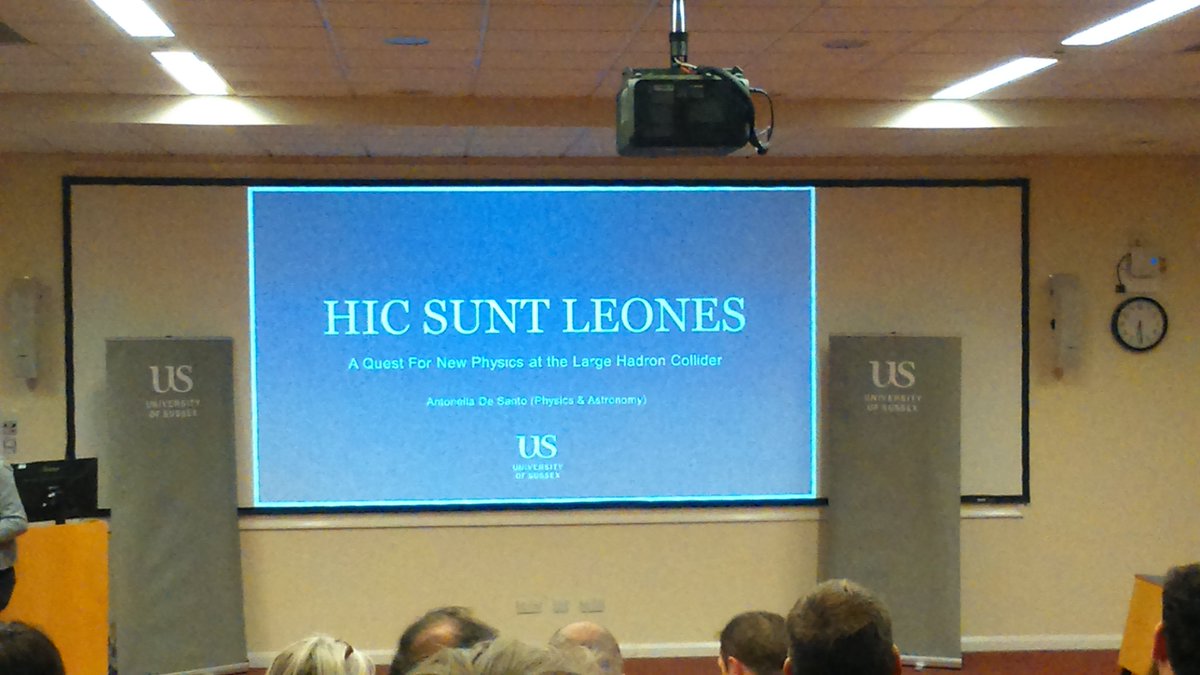
Antonella was the first female Professor of Physics at the University of Sussex and I’m glad to say she was promoted to a Chair during my watch as Head of the School of Mathematical and Physical Sciences, at Sussex. That was about four years ago, so it has taken a while to arrange her inaugural lecture, but it was worth the wait to be able to celebrate Antonella’s many achievements.
The lecture was about the search for physics beyond the standard model using the ATLAS experiment at the Large Hadron Collider, with a focus on supersymmetry and possibly candidates for dark matter. It was a very nice lecture that told a complex story through pictures and avoiding any difficult mathematics, followed by a drinks reception during which I got to have a gossip with some former colleagues.
The title, by the way, stems from the practice among mediaeval cartographers of marking terra incognita with `Here be lions’ or `Here be dragons‘. I hasten to add that no lions were harmed during the talk.
Anyway, it was nice to have an excuse to visit Brighton again. The last time I was here was over a year ago. It was nice to see some familiar faces, especially in the inestimable Miss Lemon, with whom I enjoyed a very nice curry after the talk!
Now for a sleep and the long journey back to Cardiff tomorrow morning!
Follow @telescoperI just saw this little movie circulated by the European Space Agency.
The source displayed in the video was first identified by European Space Agency’s now-defunct Herschel Space Observatory, and later imaged with much higher resolution using the ground-based Atacama Large Millimeter/submillimeter Array (ALMA) in Chile. It’s a significant discovery because it shows two large galaxies at quite high redshift (z=5.655) undergoing a major merger. According to the standard cosmological model this event occurred about a billion years after the Big Bang. The first galaxies are thought to have formed after a few hundred million years, but these objects are expected to have been be much smaller than present-day galaxies like the Milky Way. Major mergers of the type seen apparently seen here are needed if structures are to grow sufficiently rapidly, through hierarchical clustering, to produce what we see around us now, about 13.7 Gyrs after the Big Bang.
The ESA press release can be found here and for more expert readers the refereed paper (by Riechers et al.) can be found here (if you have a subscription to the Astrophysical Journal or for free on the arXiv here.
The abstract (which contains a lot of technical detail about the infra-red/millimetre/submillimetre observations involved in the study) reads:
We report the detection of ADFS-27, a dusty, starbursting major merger at a redshift of z=5.655, using the Atacama Large Millimeter/submillimeter Array (ALMA). ADFS-27 was selected from Herschel/SPIRE and APEX/LABOCA data as an extremely red “870 micron riser” (i.e., S_250<S_350<S_500<S_870), demonstrating the utility of this technique to identify some of the highest-redshift dusty galaxies. A scan of the 3mm atmospheric window with ALMA yields detections of CO(5-4) and CO(6-5) emission, and a tentative detection of H2O(211-202) emission, which provides an unambiguous redshift measurement. The strength of the CO lines implies a large molecular gas reservoir with a mass of M_gas=2.5×10^11(alpha_CO/0.8)(0.39/r_51) Msun, sufficient to maintain its ~2400 Msun/yr starburst for at least ~100 Myr. The 870 micron dust continuum emission is resolved into two components, 1.8 and 2.1 kpc in diameter, separated by 9.0 kpc, with comparable dust luminosities, suggesting an ongoing major merger. The infrared luminosity of L_IR~=2.4×10^13Lsun implies that this system represents a binary hyper-luminous infrared galaxy, the most distant of its kind presently known. This also implies star formation rate surface densities of Sigma_SFR=730 and 750Msun/yr/kpc2, consistent with a binary “maximum starburst”. The discovery of this rare system is consistent with a significantly higher space density than previously thought for the most luminous dusty starbursts within the first billion years of cosmic time, easing tensions regarding the space densities of z~6 quasars and massive quiescent galaxies at z>~3.
The word `riser’ refers to the fact that the measured flux increases with wavelength from the range of wavelengths measured by Herschel/Spire (250 to 500 microns) and up 870 microns. The follow-up observations with higher spectral resolution are based on identifications of carbon monoxide (CO) and water (H20) in the the spectra, which imply the existence of large quantities of gas capable of fuelling an extended period of star formation.
Clearly a lot was going on in this system, a long time ago and a long way away!
Follow @telescoper
The other day I noticed a story about a plane carrying 53 passengers that did an emergency landing at Belfast airport. Here is a picture from that link:

The story caught my attention for a couple of reasons. One is that the airline and type of plane (a Bombardier Dash 8 Q400) were exactly the same as the one I took from Cardiff to Dublin a few weeks ago. The other is that something very similar happened to me many years ago, on a trip to America. That event may even have involved the same type of plane, as it was a twin turbo-prop, but in my memory the one I was on was a bit smaller than the one shown above. I don’t remember the name of the airline either (though it might have been the now-defunct US Airways) but it was taking me to State College (Pennsylvania, USA), from either Pittsburgh or Philadelphia, for a meeting at Penn State University. I’m not sure of the year, either, but it must have been around 1990.. I’m not sure of the year, either, but it must have been around 1990. From all that you can infer that my memory isn’t all that good, but I do remember the details of the emergency landing extremely well!
We were approaching State College when I noticed that the plane started circling around the airport, which was visible below. Circling prior to landing owing to air traffic restrictions is not an unfamiliar experience for anyone coming into land at, e.g., London Heathrow, but State College airport is in a fairly remote location in rural Pennsylvania so a problem with the air traffic seemed unlikely. Eventually the pilot came onto the intercom and explained that there was a problem with the undercarriage under the nose of the aircraft and we would have to make an emergency landing. The circling was an attempt to use up fuel to reduce the risk of fire on landing. The dozen or so people on the plane seemed quite scared as the pilot explained the procedure, including the brace position to be assumed when was making its landing.
As it happened, I was seated in a window seat next to the emergency door on the port side near the front of the aircraft so it would be my job to open it and get out quickly to let everyone else get out. As we came into land I studied the instructions over and over again. I am not a particularly courageous individual, and I think having that to concentrate on is the best explanation for why I actually didn’t feel all that scared. I was too busy concentrating on the task at hand to let anything else into my head.
Soon we were coming into land. I could see fire engines from their lights flashing either side of the runway as we came down. The pilot shouted “BRACE! BRACE! BRACE!” as the plane touched down on the wheels under the wings, and was a sharp deceleration as the braking systems were deployed. When we were moving sufficiently slowly the pilot dropped the nose, the plane dipped forward and there was a scraping sound as the plane veered to port. It tilted again which I (correctly) assumed was because it had left the runway and was on the grass verge.
The shout came `OPEN THE DOORS’ and I followed the instructions to the letter, turning the handle, pulling the door towards me so it detached and then flinging it out of the aircraft. It worked like clockwork. I felt like a hero, but that sense of pride soon vanished. Forgetting that the plane had tipped forward, I misjudged the step onto the emergency chute that had deployed and, instead of proceeding in an orderly fashion, I tripped on the way out and fell flat on my face. Fortunately, it was not far down to the ground from the door and it had been raining so I fell onto wet grass rather than concrete. I picked myself up and followed the instructions of the firemen to get the hell away from the plane. I’m sure they were laughing as I ran past them to safety.
The plane was safely evacuated and nobody was hurt. Nobody else got covered in mud like I did either…
Later on I got to know a guy who worked on safety training for cabin crew at British Airways. He told me that one of the most important things about an emergency situation on an aircraft is to give the passengers something to do to keep them occupied. That is the best way to prevent panic. It certainly worked with me!
Follow @telescoperI’ve been away from blogging for a few days, so I thought I’d begin the process of catching up with a short review of the concert I went to on Thursday evening (9th November) at the Royal Welsh College of Music and Drama in Cardiff featuring acclaimed Welsh pianist Llŷr Williams playing music by Franz Schubert. Llŷr Williams recently completed a series of concerts in which he performed all the works for keyboard by Beethoven, and now he has embarking on another journey, this time of Schubert. The concert was recorded and will, I believe, be released commercially.
The first half of the recital consisted of the Sonata in G Major D894 (Op. 78) which was written in 1826, just two years before the composer’s death. Although Schubert was already ill when he wrote this piece it is generally optimistic in tone. The first and third movements introduce dance-like elements, and the final movement is a light and breezy Allegretto in the form of a rondo. The piece is tempestuous in places but generally resolves into a more tranquil mood. It’s a well-balanced and enjoyable piece, wonderfully played.
To close the first half we had three transcriptions for solo piano by Franz Liszt of Schubert songs: Ständchen, Auf dem Wasser zu singen, and Ave Maria. The last of these (Ellens Gesang III) is probably the most famous as a song but also the least successful as a solo piano piece. On the other hand, Auf dem Wasser zu singen, works well. I’m not a huge fan of Liszt and although it was interesting to hear these works in this form I much prefer them sung by a human voice with a piano accompaniment.
After the interval wine break we had a later Piano Sonata (in C Minor D 958), written during the last year of Schubert’s life. In four movements like the piece we heard in the first half, this piece has a much greater depth and sense of drama to it (at least to my ears), at least partly because it is clearly influenced in structure and tonality by Beethoven. Perhaps it was for that reason that this work inspired Llŷr Williams to a performance of great intensity as well as virtuosity, especially in the final Allegro movement which is extremely agitated, even frenzied. As he introduced the piece, Llŷr Williams spoke of this as being like a `dance of death’. Schubert probably knew he was dying when he wrote this piece, but it’s not as bleak as some of his other late works. It seems to me to be characterised by a sense of determination, to get as much done as possible before his life came to an end.
Schubert died before his 32nd birthday, but he was astonishingly prolific, especially towards the end of his life, and he left a huge legacy of wonderful music. I’m very much looking forward to the next concert in this series of explorations of his piano music.
Follow @telescoper
The other day I was listening to the radio and heard a demonstration of someone playing the Theremin, an early example of an electronic instrument that can be played without touching it. Here’s the inventor Leon Theremin (who patented the device in 1928) showing what it can do:
I reckon it would be fun thing to show this to a group of physics students to ask them to figure out how the Theremin works! If you want to know the answer to that question you can find it here. It’s a simple idea based on the idea that when the operator of the instrument movers his or her hands it changes the effective capacitance between them and the aerials.
Anyway, anyone who has ever watched the detective series Midsomer Murders will (perhaps unwittingly) have heard a Theremin. Here is how the theme tune is played:
Follow @telescoper
It is essential to the way that science works that published results are challenged by independent scrutiny and by confrontation with rival analysis. New facts and new theoretical explanations are often established and previously existing misapprehensions eliminated through this form of critical dialogue. More often than not this process of claim and counter-claim is carried out in a collegiate spirit because all parties are mindful that this kind of debate is part and parcel of the scientific method. To behave otherwise as a scientist is unprofessional.
Regrettably, however, sometimes scientists overstep the mark and engage in behaviour which falls short of this expectation, particularly when it is by a senior scientist directed towards a junior colleague because then unnecessarily aggressive criticism can take on the mantle of bullying.
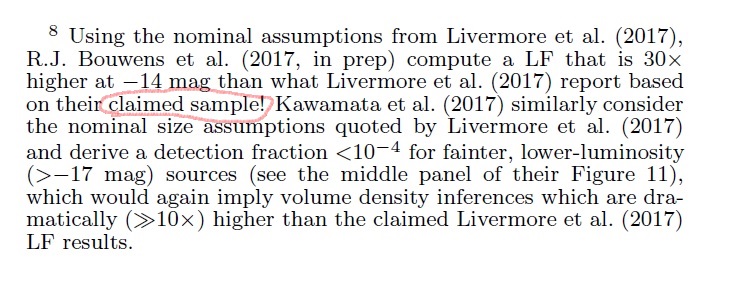
Today I saw a paper on the arXiv by Bouwens et al. that contains criticism of a previous paper by Livermore et al. (2017) (arXiv version here) which I think oversteps the mark in this way, especially because the lead author of the first paper, Rychard Bouwens, is an established (male) academic and the first author of the second, Rachael Livermore, is a (female) postdoctoral researcher.
Two footnotes from the Bouwens et al. paper suffice to give a flavour of the tone. This is footnote 8:
This is footnote 9:
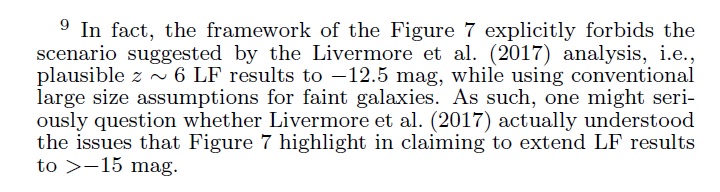
There are a number of inappropriate aspects of these comments (and others made elsewhere in the paper). I’ll mention just two.
First, note the highlighted `claimed sample’ in Footnote 8. The only way I can read this phrase is as an insinuation that the Livermore et al. sample has somehow been fabricated. In other words, it is a snide allegation of research misconduct. This may not be what Bouwens et al intended to say, but that’s certainly how it reads. And the phrase `claimed sample’ appears more than once in their paper. If they don’t mean it that way then I strongly suggest they edit the paper to clarify, as it is potentially extremely defamatory.
Second, note that the Livermore et al. results are published in the Astrophysical Journal. That means that they have therefore passed peer review and are in the public domain. That does not mean that they cannot be challenged, of course, but note that in Footnote 8, Bouwens et al. refer to an article that is not public, not refereed and not even finished. I don’t think this it is fair to include this in the current paper as the evidence to back up the criticism is simply not available. Note also the implication in Footnote 9 that the referee of this paper did not understand the issues presented in the paper, either.
Now I don’t know who (if anyone) is right about the luminosity function results in these papers. Luminosity function determinations are difficult, being prone to all kinds of selection biases and other problems. I am not going to side with either set of authors on the technicalities. I just think it’s extremely regrettable that Bouwens have adopted this tone towards another group of authors whom they should regard as colleagues. It is perfectly reasonable to criticise the work of another group in the literature, but in my experience this usually only happens after the two teams have discussed the issues in private and failed to reconcile their differences. That can and does happen, but here there does not seem to have been any attempt to sort this out amicably before going on the offensive. I find that deeply regrettable.
By the way, this is the AAS Policy on Professional and Ethical Standards for its journals (including the Astrophysical Journal, to which the Bouwens et al. paper has been submitted):

Follow @telescoper
Well, as if I didn’t have enough to do these days, yesterday I managed to lock myself out of my house. Monday not being one of my regular work days (I work part-time at the moment), I had a leisurely morning in, eventually toddling around to the corner shop (Pontcanna Stores) to buy a newspaper and use the Post Office (which is inside the store) to send some correspondence overseas.
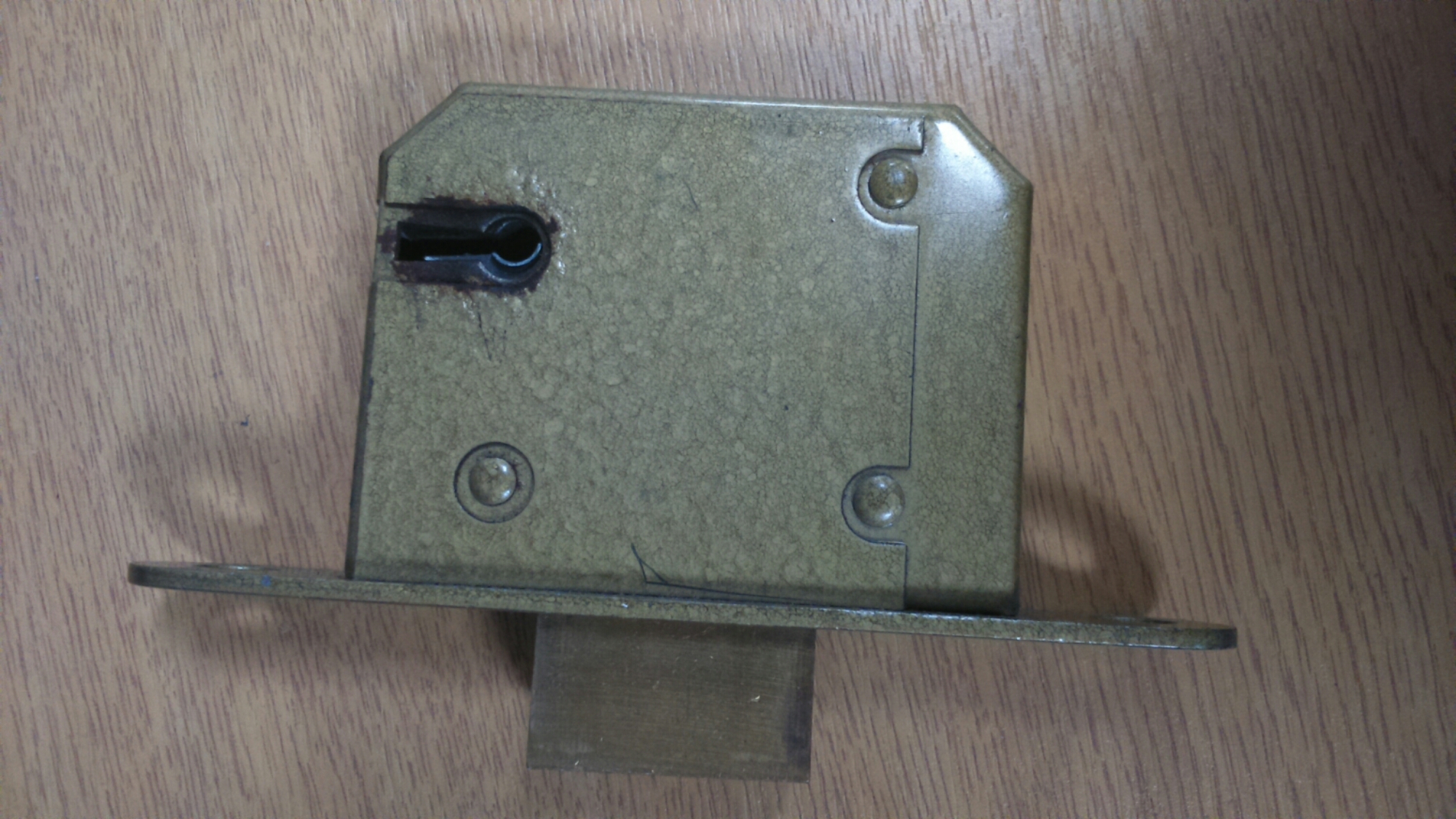
I locked the front door as I left the house, which I always do. The door is fitted with a dead lock so it can be neither locked nor unlocked without using the key. That means I can’t lock myself out by leaving the key inside the house.
However, returning back to my house, I attempted to open the lock with my key only to find, to my dismay, that, although the cylinder within the lock seemed to rotate correctly, the door didn’t unlock. I tried dozens of times to no avail. I was stuck outside with no obvious way to get into the house. I didn’t have access to any tools, and didn’t have my phone either so I was at a loss to know what to do. Eventually I decided to return to the shop to ask if I could use a phone to call a locksmith.
The shopkeeper (Mr Patel) would have none of it, arguing that a locksmith would cost me a fortune, and instead mobilised his handyman, Mike, who was working upstairs in the flat above the shop. Mike came with me to my house and, after quite a struggle, he managed to get the door open without having to damage the door or frame. I was mightily relieved. I might add that he also refused my offer of payment…
Looking at the lock it after removing it from its door it became obvious what had happened. Something had gone wrong with the mechanism inside the lock which meant that, although the key rotated the action, it didn’t engage the bolt fully which resulted in the bolt not being properly withdrawn from the rebate on the hinge. It’s an old lock so it was probably just internal wear and tear, and, the likelihood being that it would recur every time I used it, I had no choice but to remove the lock so I could try to find a replacement. There is another lock on the door, so it would be fairly secure until I fitted another dead lock, the old dead lock being dead.
Mike suggested I take it to the local hardware shop to find another lock that matched. I did so but he didn’t have an exact fit. Also I had – stupidly – omitted to take the plate from the front of the lock which had the name of the manufacturer written on it. He offered to sell me a new lock (c. £15) and fit it for £20. That seemed a pretty good deal, but he did suggest trying a specialist shop (not far from where I work). Putting a replacement lock into the space vacated by removal of the old one would be much easier than cutting a bigger hole in the door to hold a lock of different size. The man in Cardiff Lock and Safe Co Ltd managed to identify an identical lock but didn’t have one in stock. He ordered one that I can collect tomorrow, and I should be able to mend it then.
I’m posting this not so much because of the little crisis about the dead lock, but to say thanks to all those who helped me out yesterday. It makes a big difference living in a friendly community where people help each other out. Sadly, though, Mr Patel is selling up the business he has owned for over 30 years and it is being taken over by the Coop as yet another mini supermarket.
Follow @telescoper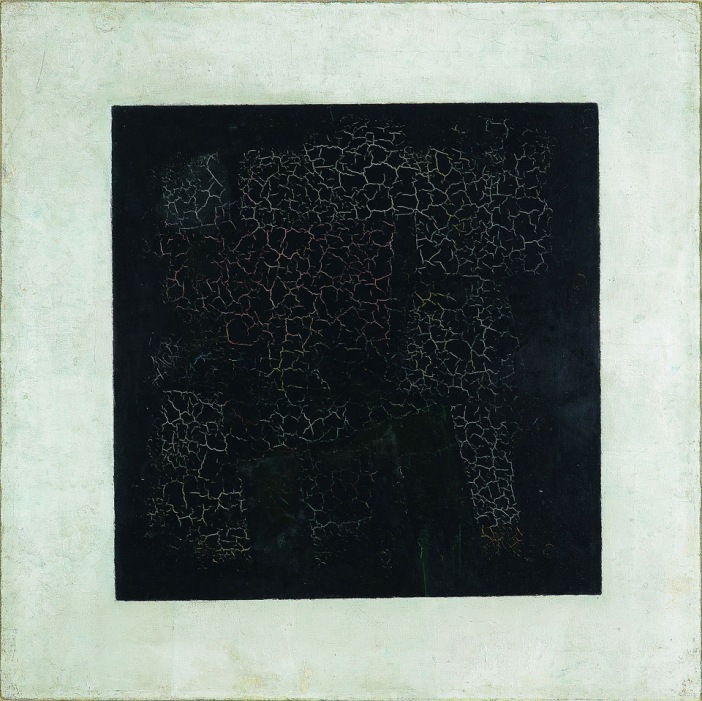
Kazimir Malevich, The Black Square, 1915, oil on linen, 79.5 x 79.5 cm, Tretyakov Gallery, Moscow.
Follow @telescoperIf you live in Cardiff, please spare a thought for the many homeless people in.the city and consider donating something this Christmas.
Over the past couple of years, the incredible Project Shoebox has gathered hundreds of boxes from you generous people to gift during the cold winter months. This year Project Shoebox isn’t running again, HOWEVER, some charities that support homeless and vulnerable people are running their own collections. So you can still donate and support.
There’s plenty to show the number of homeless people in Cardiff and across the UK is increasing. The Wallich publish figures of the number of people they support on a monthly basis, and while this isn’t an absolute figure, you can see the rough trend.

You can find out more and donate money to the Wallich here: https://thewallich.com/donate/
If you would like to donate money to Women’s Aid, you can do so here: https://www.justgiving.com/cardiffwomensaid
You can also donate directly to The Huggard Centre: http://www.huggard.org.uk/how-you-can-help/donate/
Llamau are collecting gifts and care packages. Gifts can be dropped…
View original post 183 more words


 In the Dark