Archive for December, 2017

Trees, Graphs and the Leaving Certificate

Posted in Biographical, mathematics, Maynooth, The Universe and Stuff with tags , , , , , , on December 15, 2017 by telescoper

I’m starting to get the hang of some of the differences between things here in Ireland and the United Kingdom, both domestically and in the world of work.

One of the most important points of variation that concerns academic life is the school system students go through before going to University. In the system operating in England and Wales the standard qualification for entry is the GCE A-level. Most students take A-levels in three subjects, which gives them a relatively narrow focus although the range of subjects to choose from is rather large. In Ireland the standard qualification is the Leaving Certificate, which comprises a minimum of six subjects, giving students a broader range of knowledge at the sacrifice (perhaps) of a certain amount of depth; it has been decreed for entry into this system that an Irish Leaving Certificate counts as about 2/3 of an A-level for admissions purposes, so Irish students do the equivalent of at least four A-levels, and many do more than this.

There’s a lot to be said for the increased breadth of subjects undertaken for the leaving certificate, but I have no direct experience of teaching first-year university students here yet so I can’t comment on their level of preparedness.

Coincidentally, though, one of the first emails I received this week referred to a consultation about proposed changes to the Leaving Certificate in Applied Mathematics. Not knowing much about the old syllabus, I didn’t feel there was much I could add but I had a look at the new one and was surprised to see a whole `Strand’, on Mathematical Modelling with netwworks and graphs.

The introductory blurb reads:

In this strand students learn about networks or graphs as mathematical models which can be used to investigate a wide range of real-world problems. They learn about graphs and adjacency matrices and how useful these are in solving problems. They are given further opportunity to consolidate their understanding that mathematical ideas can be represented in multiple ways. They are introduced to dynamic programming as a quantitative analysis technique used to solve large, complex problems that involve the need to make a sequence of decisions. As they progress in their understanding they will explore and appreciate the use of algorithms in problem solving as well as considering some of the wider issues involved with the use of such techniques.


Among the specific topics listed you will find:

  • Minimal Spanning trees applied to problems involving optimising networks and algorithms associated with finding these (Kruskal, Prim);  
  • Bellman’s Optimality Principal to find the shortest paths in a weighted directed network, and to be able to formulate the process algebraically;
  •  Dijkstra’s algorithm to find shortest paths in a weighted directed network; etc.


For the record I should say that I’ve actually used Minimal Spanning Trees in a research context (see, e.g., this paper) and have read (and still have) a number of books on graph theory, which I find a truly fascinating subject. It seems to me that the topics all listed above  are all interesting and they’re all useful in a range of contexts, but they do seem rather advanced topics to me for a pre-university student and will be unfamiliar to a great many potential teachers of Applied Mathematics too. It may turn out, therefore, that the students will end up getting a very superficial knowledge of this very trendy subject, when they would actually be better off getting a more solid basis in more traditional mathematical methods  so I wonder what the reaction will be to this proposal!



A Python Toolkit for Cosmology

Posted in The Universe and Stuff with tags , , , , on December 14, 2017 by telescoper

The programming language Python has established itself as the industry standard for researchers in physics and astronomy (as well as the many other fields, including most of those covered by the Data Innovation Research Institute which employs me part-time). It has also become the standard vehicle for teaching coding skills to undergraduates in many disciplines. In fact it looks like the first module I will be teaching in Maynooth next term is in Computational Physics, and that will be delivered using Python too. It’s been a while since I last did any significant hands-on programming, so this will provide me with a good refresher. The best way to learn something well is to have to teach it to others!

But I digress. This morning I noticed a paper by Benedikt Diemer on the arXiv with the title COLOSSUS: A python toolkit for cosmology, large-scale structure, and dark matter halos. Here is the abstract:

This paper introduces Colossus, a public, open-source python package for calculations related to cosmology, the large-scale structure of matter in the universe, and the properties of dark matter halos. The code is designed to be fast and easy to use, with a coherent, well-documented user interface. The cosmology module implements FLRW cosmologies including curvature, relativistic species, and different dark energy equations of state, and provides fast computations of the linear matter power spectrum, variance, and correlation function. The large-scale structure module is concerned with the properties of peaks in Gaussian random fields and halos in a statistical sense, including their peak height, peak curvature, halo bias, and mass function. The halo module deals with spherical overdensity radii and masses, density profiles, concentration, and the splashback radius. To facilitate the rapid exploration of these quantities, Colossus implements about 40 different fitting functions from the literature. I discuss the core routines in detail, with a particular emphasis on their accuracy. Colossus is available at bitbucket.org/bdiemer/colossus.

The software can be downloaded here. It looks a very useful package that includes code to calculate many of the bits and pieces used by cosmologists working on the theory of large-scale structure and galaxy evolution. It is also, I hope, an example of a trend towards greater use of open-source software, for which I congratulate the author! I think this is an important part of the campaign to create truly open science, as I blogged about here.

An important aspect of the way science works is that when a given individual or group publishes a result, it should be possible for others to reproduce it (or not, as the case may be). At present, this can’t always be done. In my own field of astrophysics/cosmology, for example, results in traditional scientific papers are often based on very complicated analyses of large data sets. This is increasingly the case in other fields too. A basic problem obviously arises when data are not made public. Fortunately in astrophysics these days researchers are pretty good at sharing their data, although this hasn’t always been the case.

However, even allowing open access to data doesn’t always solve the reproducibility problem. Often extensive numerical codes are needed to process the measurements and extract meaningful output. Without access to these pipeline codes it is impossible for a third party to check the path from input to output without writing their own version assuming that there is sufficient information to do that in the first place. That researchers should publish their software as well as their results is quite a controversial suggestion, but I think it’s the best practice for science. There isn’t a uniform policy in astrophysics and cosmology, but I sense that quite a few people out there agree with me. Cosmological numerical simulations, for example, can be performed by anyone with a sufficiently big computer using GADGET the source codes of which are freely available. Likewise, for CMB analysis, there is the excellent CAMB code, which can be downloaded at will; this is in a long tradition of openly available numerical codes, including CMBFAST and HealPix.

I suspect some researchers might be reluctant to share the codes they have written because they feel they won’t get sufficient credit for work done using them. I don’t think this is true, as researchers are generally very appreciative of such openness and publications describing the corresponding codes are generously cited. In any case I don’t think it’s appropriate to withhold such programs from the wider community, which prevents them being either scrutinized or extended as well as being used to further scientific research. In other words excessively proprietorial attitudes to data analysis software are detrimental to the spirit of open science.

Anyway, my views aren’t guaranteed to be representative of the community, so I’d like to ask for a quick show of hands via a poll…

…and you are of course welcome to comment via the usual box.

Problems with two-year degrees

Posted in Education with tags , , , , , on December 13, 2017 by telescoper

I see that the Minister responsible for UK universities, Jo Johnson, has decided that universities should offer two-year degrees, claiming that this will somehow attract more students into higher education.

The idea seems to be that students will get the same `amount’ of teaching, but concentrated in two full calendar years rather than spread over three academic years. This fast-track degree will be offered at a lower level of fee than a normal three-year Bachelors programme.

I can just about accept that this will work in some disciplines and at some universities. The (private) University of Buckingham, for example, already offers such programmes. On the other hand, the University of Buckingham did not participate in the latest Research Excellence Framework, no doubt for the reason that teaching all-year round leaves its academic staff no time to do research or even attend conferences, which (I find) these days is only possible during the summer recess.

Call me old-fashioned, but I think an institution that does not combine teaching and research – and indeed one in which the teaching is not led by research – does not merit the name of `University’. The old polytechnics offered a range of valuable opportunities that complemented the traditional honours degree, but that capacity was basically eliminated in 1992 when all such institutions became universities.

Though my main objection to two-year degrees is their impact on research, there are problems from the teaching side too. One is that keeping up the intensity of full-time study throughout a whole year will, in my opinion, exacerbate the difficulty many students have managing their workload without stress or other mental health difficulties. Moreover, many students currently use the long summer vacation either to work, either to earn money to help offset the cost of study, or to participate in placements, internships or other activities to help make them more employable after graduation.

It would be particularly difficult to manage two-year degrees in STEM disciplines, as the teaching laboratories need maintenance and installation of new equipment, for which the proposed system allows no time. And how would project work fit into the fast-track system? On top of all that there’s the fact that the current fee level does not cover the cost of teaching in STEM disciplines, so having to do it faster and for less money is not going to be possible. Incidentally, many STEM students currently pursue undergraduate programmes that last four years, not three…

These points have no doubt been made before, but there is another point that is less widely understood. The fact is that a two-year Bachelors degree may not be a recognised qualification outside the UK. This is, in fact, already a problem with the four-year undergraduate programmes we call, e.g., MPhys, and regard as Masters level in this country: these are not regarded as Masters qualifications in many European countries. Perhaps this is part of some cunning plan to stop graduates leaving the UK after Brexit?

In the light of these difficulties it is no surprise to me that not a single undergraduate I’ve spoken to thinks that a two-year degree is a sensible option. If the government wants to make studying cheaper, said one Physics student I was chatting to, why don’t they just cut the fees for normal degree programmes?

The impression one gets from all this `thinking’ is that the Government increasingly regards universities as businesses that trade in a commodity called `education’, where the word ‘education’ is narrowly construed as `training’ in the skills needed for future employment. I believe a University education is (or should be) far more about developing critical thinking, problem-solving ability, intellectual curiosity than it is about teaching them, e.g., programming skills. Skills are important, of course, but we also need to educate students in what to use them for.

The Sonny Rollins Williamsburg Bridge

Posted in Jazz with tags , , , on December 12, 2017 by telescoper

Between 1959 and 1961 the great tenor saxophonist Sonny Rollins took a break from making recordings to practice intensively, developing his technique and expanding his musical vocabulary. Living in New York City, but lacking anywhere private to play, he went every day to Williamsburg Bridge to practice. The first record he made after this `sabbatical’ was called The Bridge, released in 1962, and now regarded as a classic:

There is now a move afoot to have the Williamsburg Bridge renamed as the Sonny Rollins Williamsburg Bridge. There is a petition here.  Please consider signing it. I have!

Here’s a little video about The Sonny Rollins Bridge project:

And if you’re on Twitter can follow their account here:


Have you got a proper posterior?

Posted in Bad Statistics, The Universe and Stuff with tags , , , , on December 12, 2017 by telescoper

There’s an interesting paper on the arXiv today by Tak et al. with the title `How proper are Bayesian models in the astronomical literature?’ The title isn’t all that appropriate, because the problem is not really with `models’, but with the choice of prior (which should be implied by the model and other information known or assumed to be true). Moreover, I’m not sure whether the word `Bayesian’ applies to the model in any meaningful way.

Anyway, The abstract is as follows:

The well-known Bayes theorem assumes that a posterior distribution is a probability distribution. However, the posterior distribution may no longer be a probability distribution if an improper prior distribution (non-probability measure) such as an unbounded uniform prior is used. Improper priors are often used in the astronomical literature to reflect on a lack of prior knowledge, but checking whether the resulting posterior is a probability distribution is sometimes neglected. It turns out that 24 articles out of 75 articles (32\%) published online in two renowned astronomy journals (ApJ and MNRAS) between Jan 1, 2017 and Oct 15, 2017 make use of Bayesian analyses without rigorously establishing posterior propriety. A disturbing aspect is that a Gibbs-type Markov chain Monte Carlo (MCMC) method can produce a seemingly reasonable posterior sample even when the posterior is not a probability distribution (Hobert and Casella, 1996). In such cases, researchers may erroneously make probabilistic inferences without noticing that the MCMC sample is from a non-existent probability distribution. We review why checking posterior propriety is fundamental in Bayesian analyses when improper priors are used and discuss how we can set up scientifically motivated proper priors to avoid the pitfalls of using improper priors.

This paper makes a point that I have wondered about on a number of occasions. One of the problems, in my opinion, is that astrophysicists don’t think enough about their choice of prior. An improper prior is basically a statement of ignorance about the result one expects in advance of incoming data. However, very often we know more than we think we do. I’ve lost track of the number of papers I’ve seen in which the authors blithely assume a flat prior when that makes no sense whatsoever on the basis of what information is available and, indeed, on the structure of the model within which the data are to be interpreted. I discuss a simple example here.

In my opinion the prior is not (as some frequentists contend) some kind of aberration. It plays a clear logical role in Bayesian inference. It can build into the analysis constraints that are implied by the choice of model framework. Even if it is used as a subjective statement of prejudice, the Bayesian approach at least requires one to put that prejudice on the table where it can be seen.

There are undoubtedly situations where we don’t know enough to assign a proper prior. That’s not necessarily a problem. Improper priors can – and do – lead to proper posterior distributions if (and it’s an important if) they include, or the  likelihood subsequently imposes, a cutoff on the prior space. The onus should be on the authors of a paper to show that their likelihood is such that it does this and produces a posterior which is well-defined probability measure (specifically that it is normalisable, ie can be made to integrate to unity). It seems that astronomers don’t always do this!

Thinking of Applying for a PhD Place in Physics or Astronomy?

Posted in Education with tags , , on December 11, 2017 by telescoper

Back in Cardiff at the start of Week 11, the last week of teaching before Christmas, I realise that some final-year undergraduate and Masters students will be using the forthcoming vacation to think about applying for PhD places. As I have done for a few years now, I thought I’d use this opportunity  to pass on some, hopefully useful,  information about how to go about applying for PhDs  in Physics  and Astronomy. I’m aiming this primarily at UK students applying for places in the UK; special considerations apply for students wanting to do graduate research abroad, including the Irish Republic…

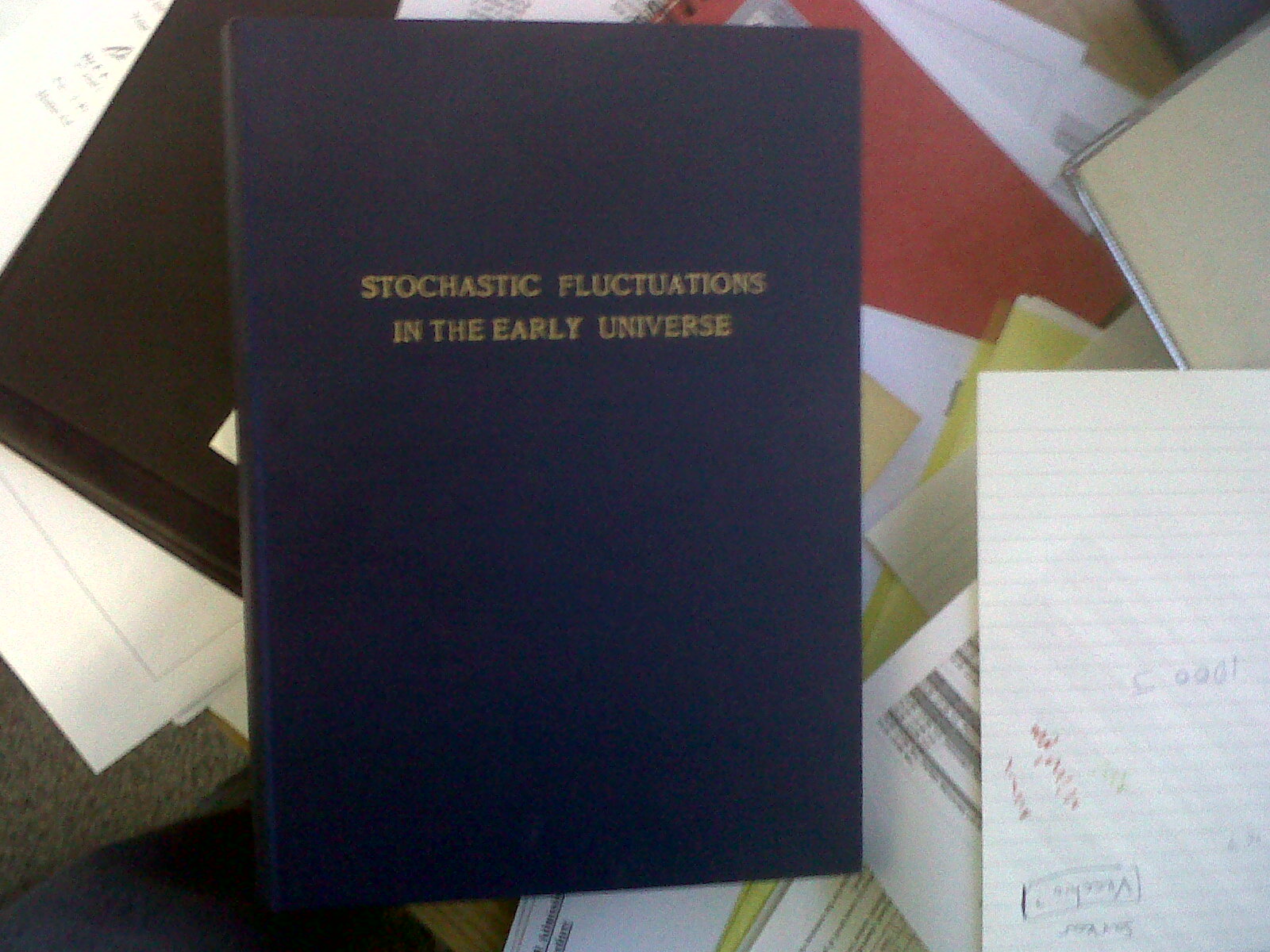
What is a PhD? The answer to that is relatively easy; it’s a postgraduate research degree. In order to obtain a PhD you have to present a thesis like that shown on the left (which happens to be mine, vintage 1988), typically in the range 100-250  pages long. A thesis has to satisfy two conditions for the award of the degree: it should contain original research, which is publishable in an academic journal; and it should present a coherent discussion of that original work within the context of ongoing work in the area of study. In Physics & Astronomy, the PhD is pretty much a prerequisite for any career in academic research, and it usually takes between 3 and 4 years to complete. After submission of the thesis you will have to undergo a viva voce examination conducted by two examiners, one internal and one external. This is quite a tough test, which  can last anywhere between about 2 and about 6 hours, during which you can be asked  detailed questions about your research and wide-ranging questions about the general area.

The Money Side. In the UK most PhDs are supported financially by the research councils, either EPSRC (most physics) or STFC (nuclear & particle physics, astronomy). These generally award quotas of studentships to departments who distribute them to students they admit. A studentship will cover your fees and pay a stipend, currently £14553 pa. That doesn’t sound like a lot, but you should at least remember that it is a stipend rather than a wage; it is therefore not taxed and there is no national insurance payable. There is a fee (currently £4284) payable for a PhD course, but that only comes into play if you are planning to fund yourself. If you receive a studentship it will normally cover the fee as an additional component. What I mean by that is you don’t need to pay it out of the stipend, it is separate. In top of that, research council funding also supplies a Research Training Grant which covers, e.g., travel and small items of equipment, so you don’t need to pay for those out of your stipend either.

How do I choose a PhD? During the course of a postgraduate degree you are expected to become an expert in the area in which you specialize. In particular you should reach the point where you know more about that specific topic than your supervisor does. You will therefore have to work quite a lot on your own, which means you need determination, stamina and enthusiasm. In my view the most important criterion in your choice of PhD is not the institution where you might study but the project. You need to be genuinely excited by the topic in order to drive yourself to keep through the frustrations (of which there will be many). So, find an area that interests you and find the departments that do active research in that area by looking on the web. Check out the recent publications by staff in each department, to ensure that they are active and to have something to talk about at interview!

Qualifications. Most universities have a formal requirement that candidates for admission to the PhD should have a “good honours degree”, which basically means at least an Upper Second Class Honours degree. Some areas are more competitive than others, however, and in many disciplines you will find you are competing with a great many applicants with First Class degrees.

How to apply successfully. The application procedure at most universities is quite simple and can be done online. You will need to say something about the area in which you wish to do research (e.g. experiment/theory, and particular field, e.g. cosmology or star formation). You’ll also need a CV and a couple of references. Given the competition, it’s essential that you prepare. Give your curriculum vitae some attention, and get other people (e.g. your personal tutor) to help you improve it. It’s worth emphasizing particular skills (e.g. computing). If you get the chance, make use of your summer vacations by taking on an internship or other opportunity to get a taste of research; things like that will undoubtedly give your CV an edge.

The Interview. Good applicants will be invited for an interview, which is primarily to assess whether you have the necessary skills and determination, but also to match applicants to projects and supervisors. Prepare for your interview! You will almost certainly be asked to talk about your final-year project, so it will come across very badly if you’re not ready when they ask you. Most importantly, mug up about your chosen field. You will look really silly if you haven’t the vaguest idea of what’s going on in the area you claimed to be interested in when you wrote your  application!

Don’t be shy! There’s nothing at all wrong with being pro-active about this process. Contact academic staff at other universities by email and ask them about research, PhD opportunities. That will make a good impression. Also, don’t be afraid to ask for advice. Although we’re all keen to recruit good PhD students for our own departments, we academics are  conscious that it is also our job to give impartial advice. Ask your tutor’s opinion.

How many places should I apply for? Some research areas are more fashionable than others so the level of competition varies with field. As a general rule I would advise applying for about half-a-dozen places, chosen because they offer research in the right area. Apply to fewer than that and you might lose out to the competition. Apply to many more and you might not have time to attend the interviews.

What’s the timetable?  Most applications come in early in the new year for entry to the PhD in the following September/October. The Christmas break is therefore a pretty good time to get your applications sorted out. Interviews are normally held in February or March, and decisions made by late March. STFC runs a deadline system whereby departments can not force students to accept or decline offers before the end of March, so there should be ample time to visit all your prospective departments before having to make any decisions.

That’s all I can think of for now. I hope at least some of these comments are useful to undergraduates anywhere in the UK thinking of applying for a PhD. If there are any further questions, please feel free to ask through the comments box. Likewise if I’ve missed anything important, please feel free to suggest additions in the same manner…

Messiah

Posted in Biographical, Cardiff, Music, Uncategorized with tags , , , on December 10, 2017 by telescoper

A performance of Handel‘s Messiah  at St David’s Hall  is always a pretty sure sign that the Christmas season is upon us, although the work itself was actually first performed at Easter and it’s by no means clear why it ended up almost universally regarded as a Christmas work . Messiah actually spans the entire biblical story of the Messiah, from Old Testament prophecy to the Nativity (Part 1) , the Passion of Christ (Part II, culminating in the Hallelujah Chorus, and the Resurrection of the Dead (Part III). The Nativity only features (briefly) in Part I, which is why it’s a little curious that Messiah is so strongly associated with Christmas.

Whatever the reason I don’t mind admitting that Messiah is a piece that’s redolent with nostalgia for me – some of the texts remind me a lot of Sunday School and singing in a church choir when I was little and then, a bit later, listening to the whole thing at Christmas time at the City Hall in Newcastle. I loved it then, and still do now, over 40 years later. I know it’s possible to take nostalgia too far – nobody can afford to spend too much time living in the past – but I think it’s good to stay in contact with your memories and the things that shaped you when you were young. I went to a performance of Messiah (in the same venue) about this time last year but I relished the chance to hear it again last night.

As it turned out, the pairing of Cardiff Polyphonic Choir with baroque orchestra Réjouissance produced a very different performance from last year. The choir, numbering about sixty members, was in fine voice and the much smaller orchestra meant that the chorus really dominated the show.

Generally speaking I’m not a fan of period instrument performances. I can see the virtue of having a lighter instrumental touch in this case, and don’t have a problem with using forces of similar scale to those Handel would have used (e.g. two oboes, two cellos, one double bass, etc). I do not however understand why musicians insist on using outdated instruments. This is particularly true for the trumpets. Nobody will ever convince me that a baroque trumpet isn’t an inferior version of the modern instrument. All credit to the players for doing the best they could, but I really don’t see the point.

Anyway, that rant aside, I very much enjoyed the performance, especially the lovely singing by all four soloists and the choir, who were outstanding.
Now, I wonder where I’ll hear Messiah  next year?

Ellington meets Tchaikovsky

Posted in Jazz with tags , , on December 9, 2017 by telescoper

Jazz and classical music don’t always provide a palatable blend, but here’s one cocktail that definitely works, especially in the festive season. It’s from the 1960 album The Nutcracker Suite by Duke Ellington, based on original music for the ballet by Pyotr Ilyich Tchaikovksy. Most of the arranging on the album was, I think, done by Duke Ellington’s regular collaborator Billy Strayhorn,  and the result is every bit as witty, elegant and charming as you’d expect. No doubt some classical music fans will hate this, but I think it’s wonderful!

This is the Overture. If you like it do check out the other tracks!

Timeless Post

Posted in Uncategorized on December 8, 2017 by telescoper

No time for a proper post today, so here’s a picture of a sleepy kitten cuddling a bemused guinea pig.

A Blast from a Past Texas Symposium 

Posted in Biographical, Brighton, The Universe and Stuff with tags , , , on December 7, 2017 by telescoper

I got into my office in Maynooth a little late this morning as I was moving some things into my new flat, the keys to which I duly received yesterday. I didn’t move in last night as I had already paid for last night’s accommodation in St Patrick’s College, as well as breakfast, so thought it was silly to waste my last night there.

It turned out to be a good decision. Breakfast is served in Putin Pugin Hall and on Thursdays the seminarians get a cooked breakfast. Normally guests are only entitled to a continental breakfast but since this was my last morning the friendly lady in charge said I could help myself to the full Irish. I have to say that the staff at St Patrick’s have been absolutely lovely – very friendly and helpful – so I was a little sad leaving, but it will be nice to settle into my own place.

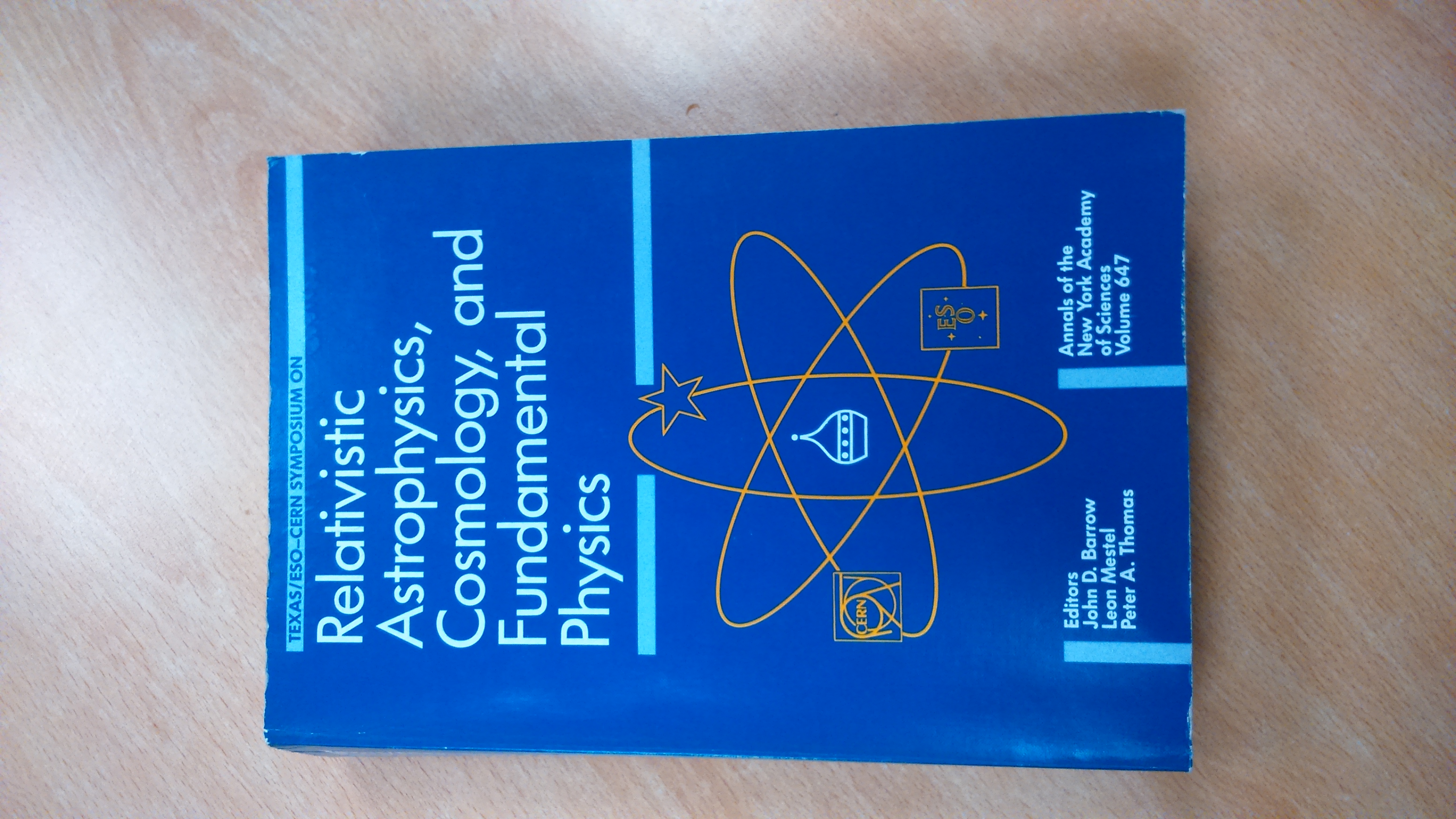
Anyway, duly checked out, I came into the Department of Theoretical Physics and made myself a cup of tea. While I was waiting for the kettle I looked in the pile of books in the staff room and found this:

This is the proceedings of the 15th Texas Symposium on Relativistic Astrophysics, which was held in Brighton in December 1990 (just after I had left Sussex University for Queen Mary, London).  I did go back to Brighton from London for this, but actually don’t remember that much about it!  Twenty seven years is a long time!

Anyway, these meetings  are held every other year, sometimes in association with other meetings, e.g. the CERN-ESO Symposium in the case above, and there’s one going on right now, the 29th Texas Symposium in Cape Town, South Africa.