Archive for September, 2019

The Radio, The Universities and The Culture in Ireland

Posted in Maynooth, Music with tags , on September 14, 2019 by telescoper

Yesterday at the end of a busy week I finally got round to booking a ticket for next Friday’s Culture Night performance at the National Concert Hall in Dublin. That will be my first concert of the new season and I’m looking forward to it. Among other things, it gives me the chance to persevere with Brahms…

However, later on in the evening yesterday I heard via one of the presenters of RTÉ lyric fm, the radio station on which next week’s concert will be broadcast, that there are plans afoot to close down the channel because of funding difficulties.

Since I first arrived in Ireland nearly two years ago, I searched through the available radio stations for one that I could listen to and it didn’t take me long to settle on RTÉ lyric fm, which has been a regular source of edification, relaxation and stress relief for me. I fear its loss tremendously. I’m not the only one. If you’re on Twitter, take a look at the hashtag #savelyricfm.

I listen to the jovial Marty Whelan in the morning before work, and when I get home in the evenings I enjoy John Kelly’s Mystery Train followed by Bernard Clarke’s The Blue of the Night on weekdays and Ellen Cranitch’s The Purple Vespertine at the weekends. All these programmes have intriguingly eclectic playlists, from classical to jazz and beyond, and presenters who clearly know and love the music. It’s not just a music channel, of course. RTÉ lyric fm covers culture and the arts generally, and is the only channel run by RTÉ – which is meant to be a public service broadcaster – that has this area as its province. It would be a crying shame as well as an abdication of its cultural responsibility if all this were lost to save the paltry amount of money required to keep the station going. I’ll do anything I can to save RTÉ lyric fm. For me it really is one of the very best things about Ireland.

I might add that I stopped watching television many years ago and don’t have a TV set. I’m even less inclined to get one now that I’m in Ireland as the schedules are dominated by the kind of crappy programmes I didn’t watch when I lived in Britain and have even less reason to watch now. The radio, on the other hand, in something I enjoy a lot.

Another item that was doing the rounds last week was the publication of the annual Times Higher Education World Rankings. I’ll save a proper rant about the stupidity and dishonesty of these league tables for another occasion, but one thing that has preoccupied the media here about the results is that Irish universities have done rather badly: Trinity College, for example, has fallen 44 places since last year. While I don’t trust these tables much, together with Ireland’s very poor showing in the recent ERC grant round, they do paint a consistent picture of a higher education system that is struggling with with the consequences of years of chronic underfunding.

(I’ll add that Maynooth University bucked the trend a bit, rising from the band covering 351st-400th place to that covering 301st to 350th place. That means that Maynooth went up by anything from 1 place to 99 places. There can be little doubt who is responsible for this…)

For me these stories are both consequences of the prevailing political culture in Ireland, which is a form of neoliberalism that deems neither culture nor public service nor education to be things of value in themselves and therefore just leaves them to dwindle through lack of care. The only think that matters is the cycle of production and consumption. Culture is irrelevant.

While the Irish economy is booming – at least in terms of GDP growth – the proceeds of this growth go to a relatively small number of rich individuals and multinational corporations while most people don’t see any benefit at all, either in their own salaries, or in investment in the public services. Austerity for everyone except the rich has been the policy for the last decade in Ireland as it has in the United Kingdom and the consequences are plain for all to see, in the arts, in the universities and in the lives of ordinary people.

The Open Journal of Astrophysics: Scholastica Webinar and Plan S

Posted in Open Access, The Universe and Stuff with tags , , on September 13, 2019 by telescoper

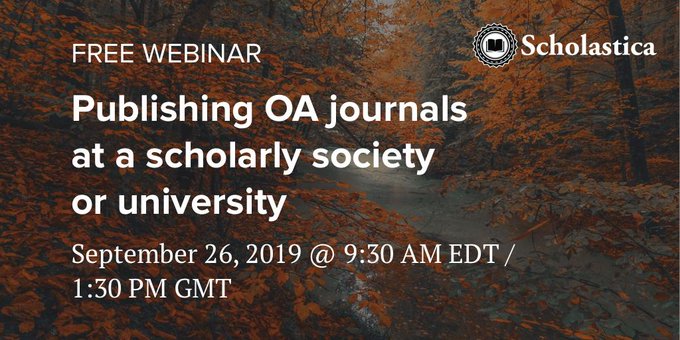
Just a quick post to advertise the fact that I’ve been invited by Scholastica to do a webinar (whatever that is) about the Open Journal of Astrophysics, which will involved a short presentation delivered over the interwebs jointly by myself and Fiona Morley (Head of Digital Programmes and Information Systems at Maynooth University Library), followed by a question and answer session. The session will be conducted via Zoom (which is the pretty neat platform we use, e.g., for Euclid teleconference meetings).

Here is the advert:

You can sign up here.

While I’m on the subject(s) of Scholastica and the Open Journal of Astrophysics, I thought I’d add a bit of news about Plan S. Scholastica has been working hard behind the scenes to develop a roadmap that will enable its journals to become compliant with Plan S. The roadmap is here. Three important landmarks on it are:

  • Core machine-readable XML metadata in the JATS standard for all articles
  • Automated Digital Object Identifier (DOI) registration through Crossref
  • Automated metadata, including funding sources, deposited into major indexes and archives including DOAJ and Portico

Currently we do some of these manually for each article, and it’s nice to see that Scholastica is intending to provide these services automatically which will save us (i.e. me) a considerable amount of fiddling about!


Conferring Ceremony

Posted in Biographical, Education, Maynooth with tags , , , on September 12, 2019 by telescoper

So far it has been a very busy but interesting day, involving both the start of a new academic year and the end of the old one. Today I did three subject information talks – to different groups of students – about our Mathematical and Theoretical Physics courses here at Maynooth University. This is part of the pre-term  Orientation Week, designed to help new arrivals at the University settle into their courses and choose their options.

In between these sessions signifying the start of the new academic cycle,  I had to don academic garb in order to attend my first ever Graduation Ceremony at Maynooth, thus marking the end of the old.

These events are not actually called Graduation Ceremonies here in Ireland but Conferring Ceremonies. I was impressed that the local suppliers of academic dress, Phelan Conan were able to find and supply the correct 1989 vintage DPhil gown from Sussex University as opposed to the less interesting modern one.

Aula Maxima, Maynooth

Conferring Ceremonies in Maynooth are held in the Aula Maxima, on South Campus, which is an excellent venue with lots of atmosphere.I somehow found myself at the front of the academic procession and almost screwed everything up by entering through the wrong door, but a sharp poke in the back from a member of the Psychology Department set me on the right track and I ended up in the right place on the stage.

The ceremony, which was rather shorter those I’ve attended in UK universities, was conducted in a mixture of English, Latin and Irish and was quite enjoyable. The President, Philip Nolan, gave a very nice and well-chosen speech at the end before we spilled out into the drizzle for handshakes and photographs, thence into Pugin Hall for a lunch reception and then, for me at least, a rush back onto North Campus to give another subject information talk.

Whatever their name, graduation ceremonies are funny things. With all their costumes and weird traditions, they even seem a bit absurd. On the other hand, even in these modern times, we live with all kinds of rituals and I don’t see why we shouldn’t celebrate academic achievement in this way.

I love graduation ceremonies, actually. As the graduands go across the stage you realize that every one of them has a unique story to tell and a whole universe of possibilities in front of them. How their lives will unfold no-one can tell, but it’s a privilege to be there for one important milestone on their journey. Getting to read their names out is quite stressful – it may not seem like it, but I do spend quite a lot of time fretting about the correct pronunciation of the names. It’s also a bit strange in some cases finally to put a name to a face that I’ve seen around the place regularly, just before they leave the University for good. I always find this a bittersweet occasion. There’s joy and celebration, of course, but tempered by the realization that many of the young people who you’ve seen around long enough to grow accustomed to their faces, will disappear into the big wide world never to be seen again. On the other hand, this year quite a few graduates of the Department of Theoretical Physics are staying in Maynooth to do Masters programmes so they won’t all be vanishing without trace.

Graduation of course isn’t just about dressing up. Nor is it only about recognizing academic achievement. It’s also a rite of passage on the way to adulthood and independence, so the presence of the parents at the ceremony adds another emotional dimension to the goings-on. Although everyone is rightly proud of the achievement – either their own in the case of the graduands or that of others in the case of the guests – there’s also a bit of sadness to go with the goodbyes. It always seems that as a lecturer you are only just getting to know students by the time they graduate, but that’s enough to miss them when they go.

Anyway, all this is a roundabout way of saying congratulations once more to everyone who graduated today, and I wish you all the very best for the future!


Chaos and Variance in (Simulations of) Galaxy Formation

Posted in The Universe and Stuff with tags , , , on September 11, 2019 by telescoper

During yesterday’s viva voce examination a paper came up that I missed when it came out last year. It’s by Keller et al. called Chaos and Variance in Galaxy Formation. The abstract reads:

The evolution of galaxies is governed by equations with chaotic solutions: gravity and compressible hydrodynamics. While this micro-scale chaos and stochasticity has been well studied, it is poorly understood how it couples to macro-scale properties examined in simulations of galaxy formation. In this paper, we show how perturbations introduced by floating-point roundoff, random number generators, and seemingly trivial differences in algorithmic behaviour can produce non-trivial differences in star formation histories, circumgalactic medium (CGM) properties, and the distribution of stellar mass. We examine the importance of stochasticity due to discreteness noise, variations in merger timings and how self-regulation moderates the effects of this stochasticity. We show that chaotic variations in stellar mass can grow until halted by feedback-driven self-regulation or gas exhaustion. We also find that galaxy mergers are critical points from which large (as much as a factor of 2) variations in quantities such as the galaxy stellar mass can grow. These variations can grow and persist for more than a Gyr before regressing towards the mean. These results show that detailed comparisons of simulations require serious consideration of the magnitude of effects compared to run-to-run chaotic variation, and may significantly complicate interpreting the impact of different physical models. Understanding the results of simulations requires us to understand that the process of simulation is not a mapping of an infinitesimal point in configuration space to another, final infinitesimal point. Instead, simulations map a point in a space of possible initial conditions points to a volume of possible final states.

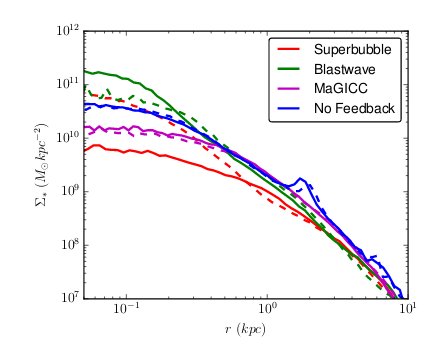
(The highlighting is mine.) I find this analysis pretty scary, actually, as it shows that numerical effects (including just running the code on different processors) can have an enormous impact on the outputs of these simulations. Here’s Figure 14 for example:

This shows the predicted stellar surface mass density in a number of simulations: the outputs vary by more than an order of magnitude!

This paper underlines an important question which I have worried about before, and could paraphrase as “Do we trust N-body simulations too much?”. The use of numerical codes in cosmology is widespread and there’s no question that they have driven the subject forward in many ways, not least because they can generate “mock” galaxy catalogues in order to help plan survey strategies. However, I’ve always been concerned that there is a tendency to trust these calculations too much. On the one hand there’s the question of small-scale resolution and on the other there’s the finite size of the computational volume. And there are other complications in between too. In other words, simulations are approximate. To some extent our ability to extract information from surveys will therefore be limited by the inaccuracy of our calculation of the theoretical predictions.

Anyway, the paper gives us quite a few things to think about and I think it might provoke a bit of discussion, which is why I mentioned it here – i.e. to encourage folk to read and give their opinions.

The use of the word “simulation” always makes me smile. Being a crossword nut I spend far too much time looking in dictionaries but one often finds quite amusing things there. This is how the Oxford English Dictionary defines SIMULATION:

1.

a. The action or practice of simulating, with intent to deceive; false pretence, deceitful profession.

b. Tendency to assume a form resembling that of something else; unconscious imitation.

2. A false assumption or display, a surface resemblance or imitation, of something.

3. The technique of imitating the behaviour of some situation or process (whether economic, military, mechanical, etc.) by means of a suitably analogous situation or apparatus, esp. for the purpose of study or personnel training.

So it’s only the third entry that gives the intended meaning. This is worth bearing in mind if you prefer old-fashioned analytical theory!

In football, of course, you can even get sent off for simulation…

To Edinburgh and Back

Posted in Uncategorized on September 10, 2019 by telescoper

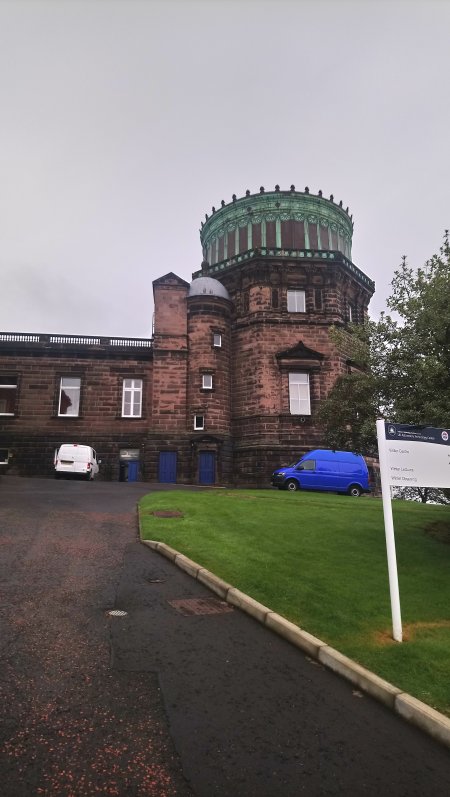
So here I am at the Royal Observatory in Edinburgh waiting for a taxi to the airport. It was just a flying visit from Dublin to do a PhD Examination (for which I had to get up at 5am to catch the plane).

The viva lasted about three and a half hours but went very well and the candidate has only some minor corrections to make. I did, however, miss lunch so now I’m going to have to find something decent to eat in the airport. I may also have a drink!

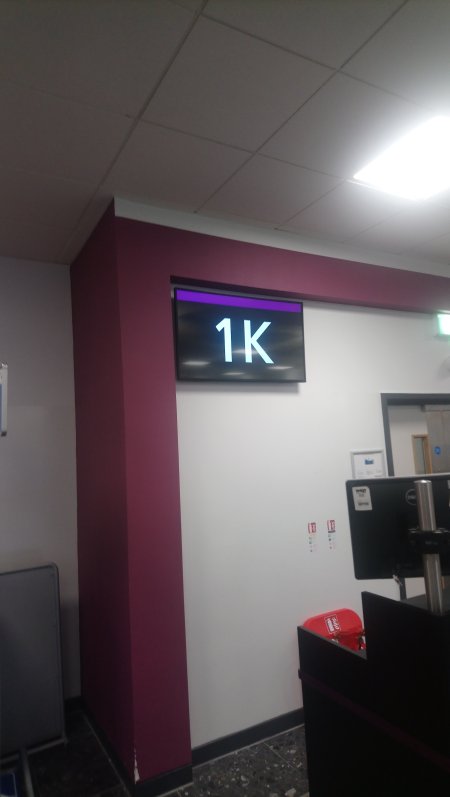
The gate for my flight back to Dublin is 1K, which is pretty cold.

Update: somewhat to my surprise I got back to Dublin in time to catch the last hopper bus back to Maynooth. Which was nice.

Heading Off

Posted in Biographical, Maynooth on September 9, 2019 by telescoper

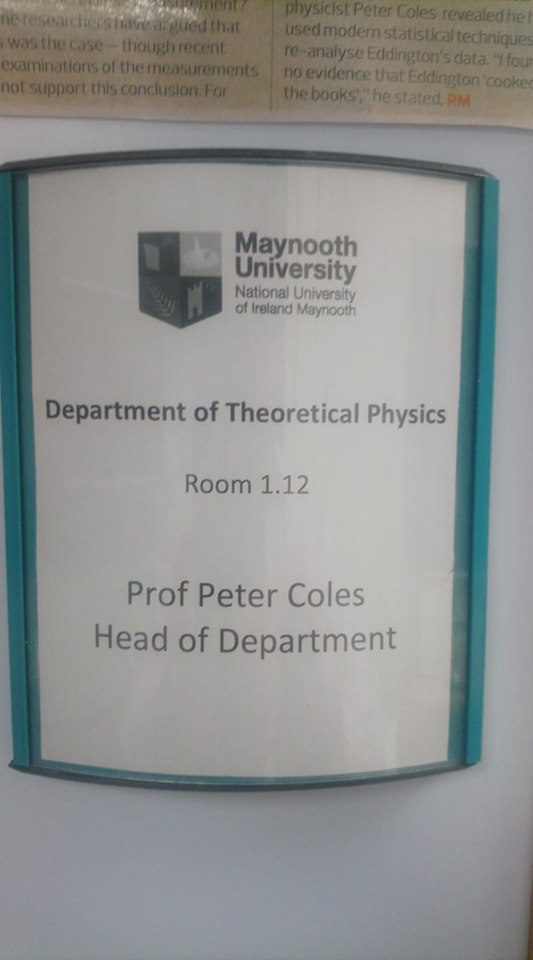
So here I am, then, Head of the Department of Theoretical Physics at Maynooth University.

I’ve even got a sign on my door to prove it!

More to the point I’ve also got a calendar full of meetings!

This morning was my first ever meeting of the Faculty Executive for Science & Engineering. The most exciting part of that was that I managed to leave my umbrella behind when I left.

After that I had a number of meetings with students to discuss the results of the recent Repeat Examinations, go through scripts, and give advice on progression. I also met with the new Head of the Department of Design Innovation to discuss the module in Physics & Mathematics we teach for them.

Coming up shortly I have a Euclid telecon (for an hour).

At the crack of dawn tomorrow I’m heading off to Edinburgh for the day to examine a PhD thesis.

Busy busy busy. And term hasn’t even started yet!

The England Cricket Team – Another Apology

Posted in Cricket with tags , , , on September 8, 2019 by telescoper

I’m sure that I wasn’t the only person who reacted to England being bowled out for a paltry 67 in the first innings of the Third Ashes Test at Headingley by concluding that the England batsmen were hopelessly inept, that they would certainly lose the match, that the team had absolutely no chance of regaining the Ashes, and that Joe Root should be sacked as England captain.

But after their subsequent one-wicket victory in that match inspired by Ben Stokes, I thought I was wrong, and apologised unreservedly to Joe Root and the England team for having doubted their ability.

Now, after being comprehensively outplayed at Old Trafford, losing by 185 runs, and allowing Australia to retain the Ashes I realise that my previous apology was incorrect, that England’s cricketers are actually inept, and that Joe Root should indeed be sacked as England captain.

I hope this clarifies the situation.

Boris Johnson is 55.

Maynooth Access Programme Launchpad Panel

Posted in Biographical, Education, Maynooth with tags , , on September 8, 2019 by telescoper

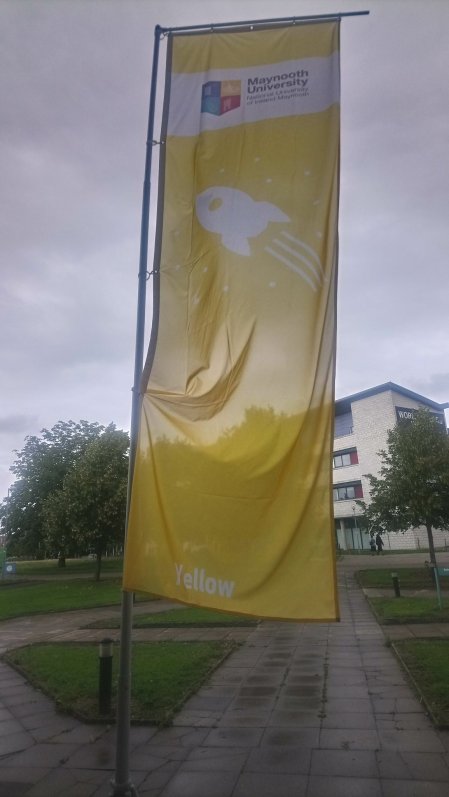
Launchpad banner outside the Science Building last week

As I mentioned a while ago, one of the reasons I had to come back from Armagh before the end of INAM2019 was an event I had to attend on Friday to do with Launchpad.

Launchpad is the Maynooth University Access Programme (MAP) orientation designed to support and ease the transition to third level for students who are coming to Maynooth University through entry routes supported by MAP. These groups include under-represented school leavers, mature students, students with disabilities and members of the Irish Traveller community. Incoming students supported by MAP can get to know fellow first years, ask questions and find out advice from existing student ambassadors on how to navigate the University before starting a new course at Maynooth.

It’s worth mentioning one specific initiative related to mature students, namely the Certificate in Science, which is a programme for mature students who wish to undertake a foundation year in preparation for degree studies in Science or Engineering. In this one year, full-time programme of study, students undertake modules on Mathematics, Engineering Science, Computer Science, Experimental Physics, Mathematical Physics, Biology and Chemistry. Students who do well can progress from this course into one of the science or engineering degree courses on offer at Maynooth.

Anyway, the event I took part in on Friday was a panel discussion involving the MAP advisors from each of the Departments in the Faculty of Science and Engineering and a lecture room full of students just about to start their courses at Maynooth. There were similar panel discussions for the other Faculties. I have assumed the responsibility as MAP advisor for Theoretical Physics this year, as I think it’s important that as Head of Department I make it clear that this programme has a high priority for the Department. Because I haven’t attended any such events before I wasn’t sure what to expect of this session. I worried the students might be very shy about asking question and that as a consequence in might not be very useful. I’m very glad to have been proved completely wrong!

We had a huge number of questions from the audience on a whole range of topics, such as subject choices (especially for the Omnibus Science course), coursework requirements, note-taking and all kinds of other issues too numerous to mention, filling up the entire 90 minute slot scheduled for the event. It was  a very interesting and enjoyable session and great to see the students so engaged and enthusiastic. Thanks to all who attended and especially to the new students for playing their part!

Teaching term doesn’t start for another couple of weeks during period which there will be further introductory sessions for the MAP students and others. My calendar is already rather full, but I don’t mind that at all if the events are as enjoyable as Friday’s.

The First Landing on the Irish

Posted in History with tags , , , , , , on September 7, 2019 by telescoper

While at the Irish National Astronomy Meeting last week I picked up a free copy of the magazine Astronomy Ireland. I chuckled when I saw this little item about the stamps issued in Ireland to commemorate the 50th Anniversary of the Apollo 11 first landing on the Moon:

If you can’t read the text it refers to a spelling error in the Irish language version of the caption on the Neil Armstrong stamp at the top image: instead of the Irish word for Moon (Gealach) the text contains the word for Irish (Gaelach). The caption thus translates as the 50th Anniversary of the First Landing on the Irish

Breakthroughs, Beermats and the Bending of Light

Posted in Biographical, The Universe and Stuff with tags , , , , on September 6, 2019 by telescoper

I found out on the way home from Armagh yesterday that this year’s Breakthrough Prize in Fundamental Physics (worth $3,000,000) has been awarded to the team behind the Event Horizon Telescope which was featured in newspaper and magazines around the world in April this year and which I blogged about here. There are 347 members of the team so it amounts to an average of less than $9000 per person, but let me offer them all my sincerest congratulations!

Coincidentally, just before my talk at INAM2019 yesterday I noticed that the Armagh Observatory and Planetarium stocks these items:

I’m not sure they are intended to be used as beer mats but that’s what they look like! Anyway, I picked one up and showed it at the end of my talk. I was talking about the 1919 eclipse expeditions, which I have done rather a lot these days, and finished up by mentioning that the events of a hundred years ago ushered in a century of developments in relativistic astrophysics, including gravitational lensing, gravitational waves and of course the Event Horizon Telescope.

If you’re interested here are the slides I used for this (short) talk: