Archive for January, 2020

LGBTQ+ STEMinar 2020

Posted in LGBTQ+, The Universe and Stuff with tags , , , on January 10, 2020 by telescoper

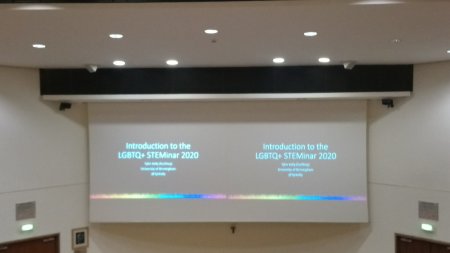
Well I made it to Birmingham (after getting up at 3.30am!) and to the Leonard Deacon Lecture Theatre in the School of Medicine at the University thereof for this year’s LGBT+ STEMinar (the 5th of a series that started in 2016).

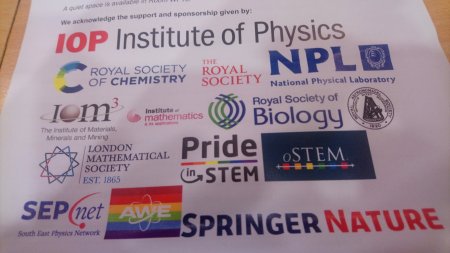
This is the largest one of these do far, with around 250 participants, and an impressive array of sponsors:

One of the great things about the LGBTSTEMeminar (apart from the feeling of being amongst ‘family’) is the opportunity to hear talks about fields other than your own, which I am enjoying very much.

Ooh. I forgot to mention that next year’s event will also be in the Midlands, at Oxford University.

Exams and Anniversaries

Posted in Biographical, Education, Maynooth with tags , , , on January 9, 2020 by telescoper

Tomorrow (10th January)  is the start of our mid-year examination period here at Maynooth University. It’s therefore a good opportunity to send a hearty “good luck” message to all students about to take examinations, especially those who are further on in their courses for whom these papers have greater importance. In particular I’d like to send my best wishes to students on my fourth-year module on Astrology Astrophysics and Cosmetics Cosmology, whose paper is tomorrow.

On the equivalent day last year I reflected on examinations and in particularly on the fact that the system of education both here in Ireland and in the United Kingdom places such a great emphasis on examination and assessment compared to learning and understanding.

Also on the equivalent day yesterday I was about to travel to London to attend my first LGBT+STEMinar at the Institute of Physics in London. Tomorrow I’ll be doing a similar thing, getting up at stupid o’clock
to travel to Birmingham for the 2020 event. The main difference this year (apart from the change of venue) is that I’m not giving a talk this time. This is good news for me (because it means I can relax a bit more) and for the attendees (because they don’t have to listen to me rambling on like they did last year).

I won’t be able to stay to the end of the LGBT+STEMinar, however, as I have to get to London. As I have mentioned previously here, 2020 marks the bicentenary of the Royal Astronomical Society:

According to the brief history published on the RAS website:

The ‘Astronomical Society of London’ was conceived on 12 January 1820 when 14 gentlemen sat down to dinner at the Freemason’s Tavern, in Lincoln’s Inn Fields, London. After an unusually short gestation the new Society was born on 10 March 1820 with the first meeting of the Council and the Society as a whole. An early setback, when Sir Joseph Banks induced the Duke of Somerset to withdraw his agreement to be the first President, was overcome when Sir William Herschel agreed to be the titular first President, though he never actually took the Chair at a meeting.

To be precise, the Society only became the `Royal Astronomical Society’ in 1831 when it was granted a Royal Charter by William IV, but its roots go back to 1820.

It’s not only the Royal Astronomical Society that has survived and prospered for two hundred years. The group of `gentlemen’ who met for dinner in January 1820 has also carried on in the form of the RAS Club which is, of course, older than the RAS itself. The Dining Club always meet on the second Friday of the month, which means that tomorrow is the closest date to that very first meeting. There will therefore be a special club dinner tomorrow night, with more guests than usual. I’m looking forward to it a lot, actually, although I’m slightly apprehensive about the fact that I’ll be relying on the train to get me there in time!

Classics in the Russell Library

Posted in History, Literature, Maynooth, Uncategorized with tags on January 9, 2020 by telescoper

Here’s a taster of the wonderful collection of books and manuscripts in the Russell Library at Maynooth University..

Special Collections's avatarMU Library Treasures

Ruth O’Hara, Collections and Content

Ruth pic 1

Study of the classical world has been a staple of this University for centuries. The Russell Library’s classic’s collection, which was amassed largely by the early professors of St. Patrick’s College, is eclectic covering all areas of the ancient world and indeed it transcends disciplines. So, besides Homer and Virgil, for example, sit the poems of Catullus, the theological tracts of Ambrose of Milan, and the philosophical musings of Aristotle. One blog can’t hope to capture the extent and range of such a collection so, instead, I just want to look at some of the ways that we in the Russell Library continue to foster interest in this diverse subject area by integrating it into the research, teaching and life of the University.

We have found our classics collection to be a really useful resource for postgraduate students, for example, who engage with primary source…

View original post 426 more words

New Publication at the Open Journal of Astrophysics!

Posted in OJAp Papers, Open Access, The Universe and Stuff with tags , , , , , , on January 8, 2020 by telescoper

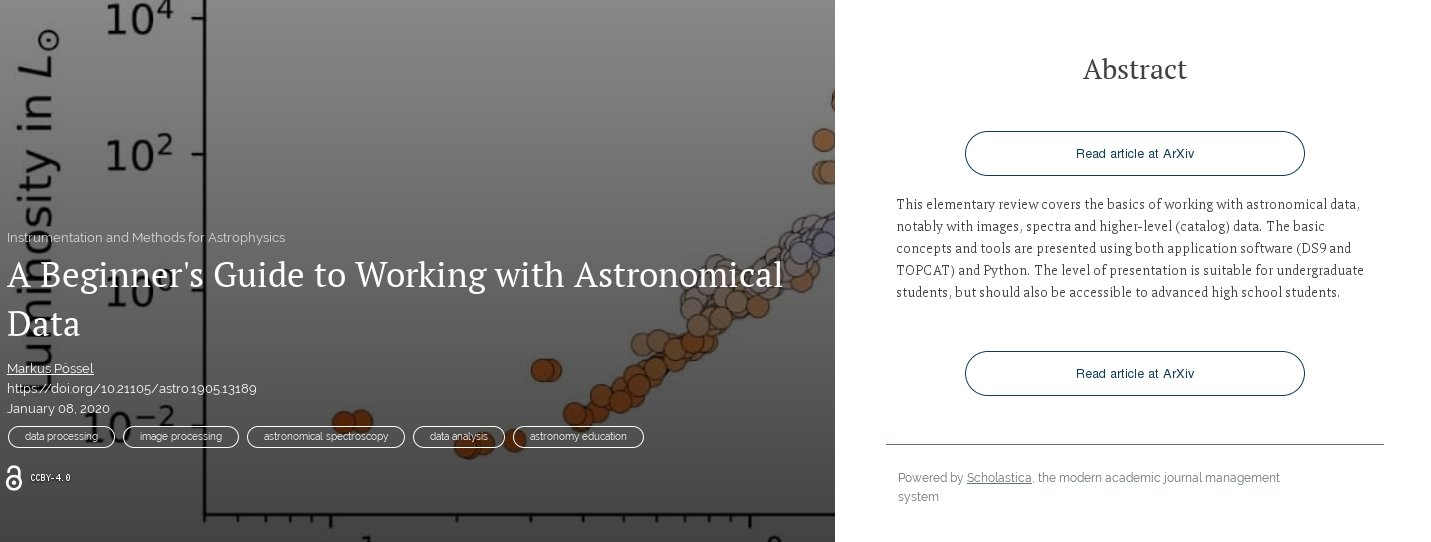
It’s two in two days because we have published another new paper at The Open Journal of Astrophysics. The title is A Beginner’s Guide to working with Astronomical Data. Here is a grab of the overlay:

You can find the arXiv version of the paper here.

The author is Markus Pössel of the Haus der Astronomie at the Max Planck Institute for Astronomy in Heidelberg (Germany). This is a long paper – 71 pages with over a hundred figures – that gives a comprehensive introduction to the various kinds of astronomical data and techniques for working with such data. I think this paper will attract a lot of interest from many different kinds of people but it will be particularly interesting to students doing undergraduate projects involving astronomical data (and their supervisors).

Another point worth noting is that there’s a small addition to the overlay for this paper, which will apply to all future papers (and retrospectively once we have worked through the back catalogue) and that is in the bottom left of the image above. It shows that the article is published with the latest form of Creative Commons License (CC-BY-4.0). It has always been our policy to publish under a CC-BY licence but Scholastica have very helpfully set up a new facility to make this explicit on each page. This is part of our efforts to ensure that we are compliant with Plan S which makes CC-BY licenses mandatory.

UPDATE: the CC-BY-4.0 license has now been applied retrospectively to all our publications.

New Publication at the Open Journal of Astrophysics!

Posted in OJAp Papers, Open Access, The Universe and Stuff with tags , , , on January 7, 2020 by telescoper

Back after the New Year break we have published another new paper at The Open Journal of Astrophysics, our first of 2020!

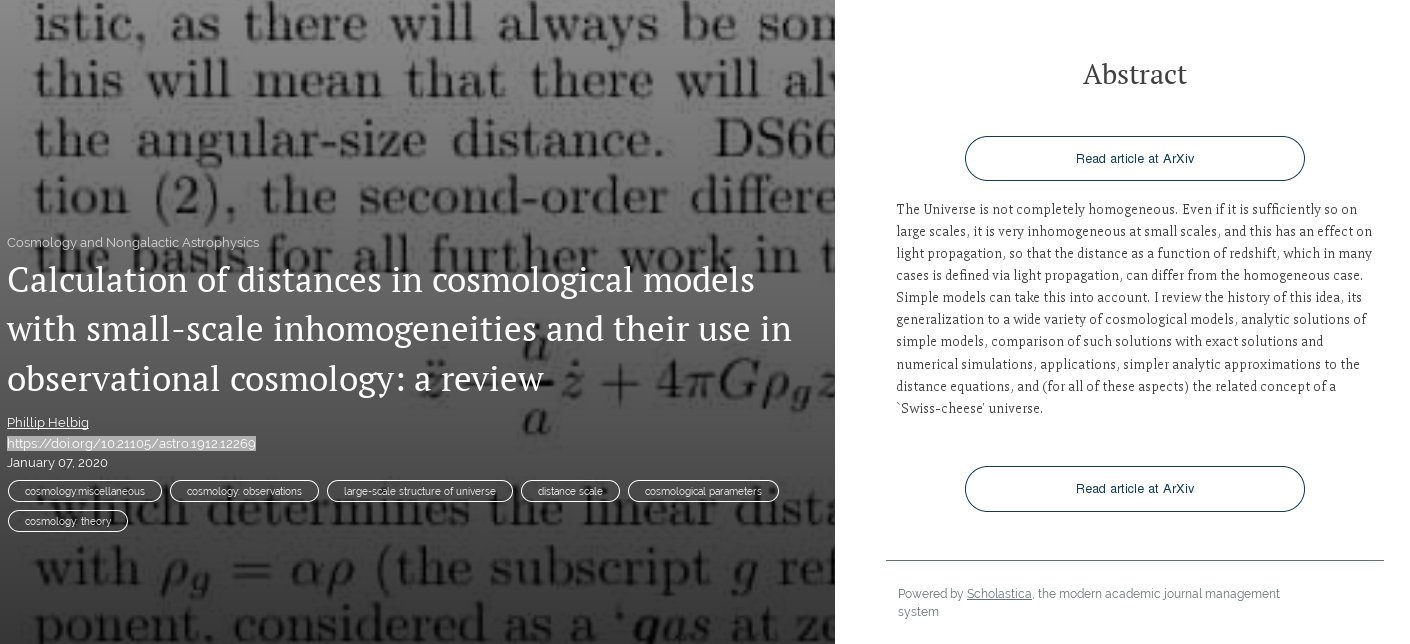
Here is a grab of the overlay:

The author is Phillip Helbig (Who? Ed). This is a review article. Our `For Authors‘ page includes the following:

We may accept review articles on appropriate subjects if the Editorial Board considers them a useful contribution to the literature.

You can find the accepted version on the arXiv here. This is another one for the `Cosmology and Nongalactic Astrophysics’ section . We would be very happy to get more submissions from other areas, especially Stellar and Planetary astrophysics. Hint! Hint!

P.S. Just another reminder that we now have an Open Journal of Astrophysics Facebook page where you can follow updates from the Journal should you so wish..

A Blog on Nollaig na mBan

Posted in Biographical, Maynooth on January 6, 2020 by telescoper

In the Liturgical Calendar today (6th January) is the date of Epiphany, the tradition arrival date of the Wise Men from the East bearing gifts. Like them I also travelled from the East today and gave arrived at my destination in Maynooth. Not sure about the gifts though.

In Ireland today is also Nollaig na mBan (Women’s Christmas), a day on which it is traditional for women to get together and enjoy their own Christmas, while the menfolk stay at home and handle the chores. Although an old tradition, emanating from the West of Ireland, the traditional Nollaig na mBan has apparently had a bit of a resurgence in recent years.

Anyway it’s been a very quiet Christmas for me, not least in terms of the weather which has been mild and largely rain-free. Except, that is, for the precise time that I walked to the bus stop to get the bus to Cardiff Airport during which I got drenched. I’ve been away from Ireland for a couple of weeks so don’t know what it has been like here but it’s a lot chillier here. My flat is particularly cold as the heating has been off all the time I’ve been away.

I was supposed to be in the office today but I only realised on Saturday that I’d booked my return flight on 6th (today) not 5th (yesterday). Not a great start to a year in which I am supposed to be improving my time management! I probably didn’t miss anything vital as there are no lectures this week; the January examination period starts on Friday and the days before that are meant for private study.

I do have quite a few things to do tomorrow though – including answering a ton of emails – so I think an early night followed by an early start tomorrow morning might be in order!

The Largest Known Spiral Galaxy – UGC 2885

Posted in The Universe and Stuff with tags , , , , , on January 6, 2020 by telescoper

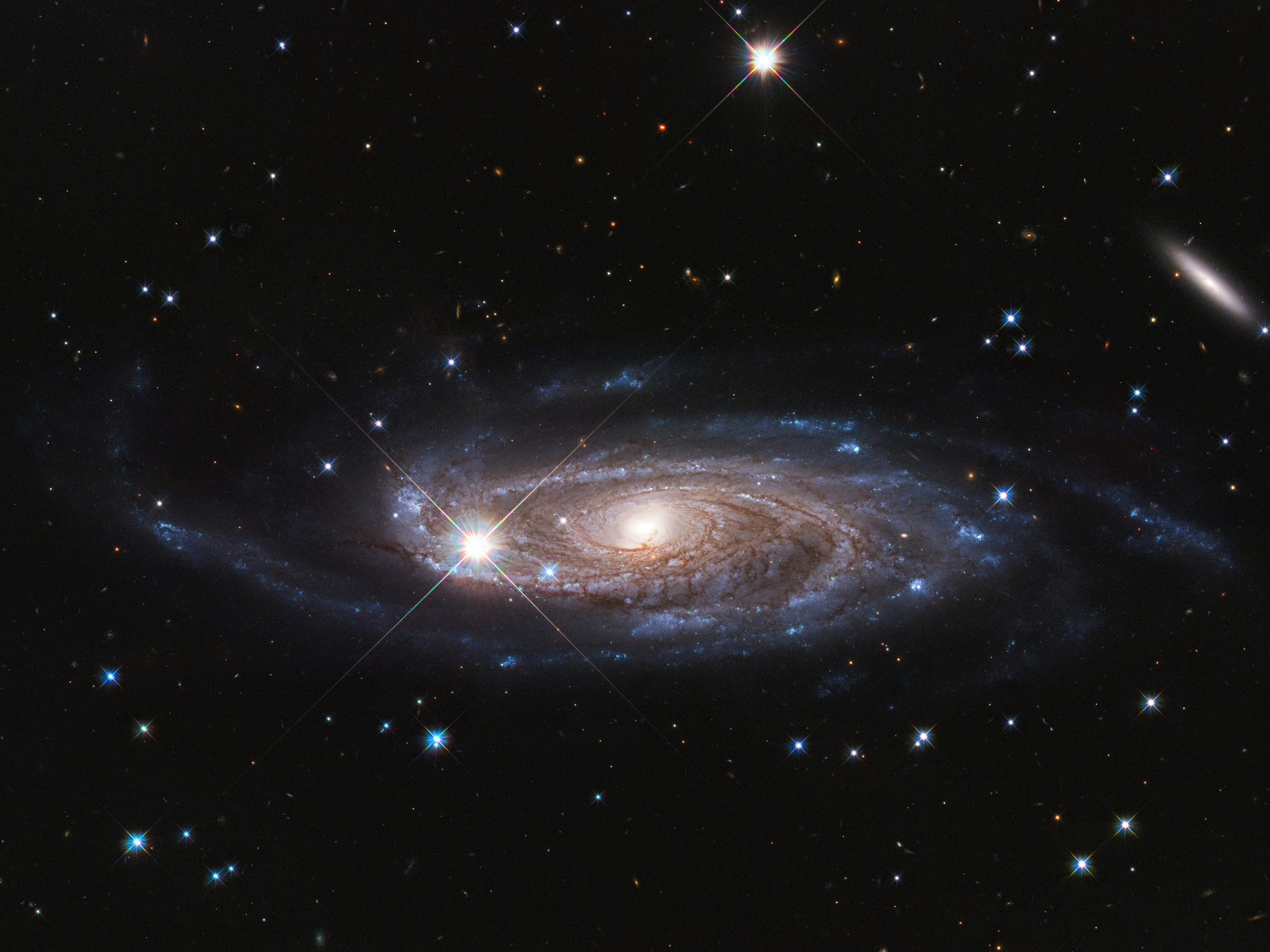
So here I am, Christmas break over, waiting in Cardiff Airport for my flight back to civilization. I thought I’d take the opportunity to share this wonderful picture, courtesy of the Hubble Space Telescope, of the galaxy UGC 2885 – the largest known spiral galaxy. You can click on the picture to make it bigger or if you really are a size queen you can download an ultra-high=resolution version here.

UGC 2885 is located about 71 Mpc (232 million light-years) from us, in the direction of the constellation Perseus. The galaxy is 2.5 times wider than our own Milky Way and contains approximately 10 times as many stars. A number of foreground stars (in our Galaxy), identified by the diffraction crosses produced by unresolved point sources, can be seen in the image, including one superimposed on the disk of the galaxy, to the left of its centre. The galaxy UGC 2885 has been nicknamed “Rubin’s galaxy” after Vera Rubin, the astronomer who studied the rotation of the galaxy and found evidence for dark matter therein.

There is a very interesting and informative thread on Twitter by Benne Holwerda covering the background to this latest image of the galaxy:

If you click on the above it will take you to Twitter where you can read the series of linked tweets on this subject by clicking on `show this thread’.

Call for support for Carrick McClean school student barred from A-Levels due to having a beard

Posted in Beards on January 5, 2020 by telescoper

Mr Carrick Mcclean has been barred from his A-level* classes at St Columb’s College in Derry because of his facial hair. Please sign the petition to have him reinstated. I’m sure such blatant pogonophobic discrimination would not be tolerated in a United Ireland.

*for readers in the Republic, the A-level is the Protestant Leaving Certificate.

kmflett's avatarKmflett's Blog


Beard Liberation Front

Press Release 4th January Contact Keith Flett 07803 167266

Call for support for Carrick McClean, school student barred from A-Levels due to having a beard

The Beard Liberation Front, the informal network of beard wearers, has called for support for a Derry Sixth Form student Carrick McClean.

Mr McClean has been banned from sitting for his A Level at St Columbs in Derry because he has a beard.

The pogonophobic rules of the school do not allow students to have a beard

BLF Organiser Keith Flett said, this is not the 1950s and we fully support Mr McClean. There is a petition that can be signed and we expect a change of mind by the school

https://www.change.org/p/principal-abolish-st-columb-s-college-clean-shaven-policy

View original post

Advance of Perihelion

Posted in The Universe and Stuff with tags , , , , , , , on January 4, 2020 by telescoper


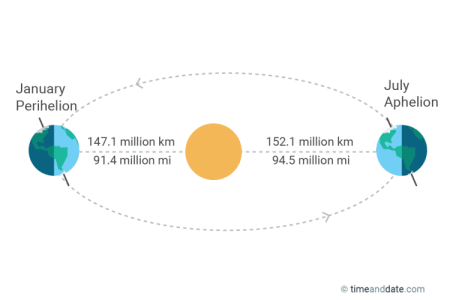
Tomorrow (Sunday 5th January 2020) at approximately 07.48 GMT the Earth reaches at the point on its orbit at which it is at its closest to the Sun, i.e. at its perihelion. At this time the distance from the Sun’s centre to Earth’s centre will be 147,091,144 km.

This year, aphelion (the furthest distance from the Sun) is  at 12.34 GMT on July 4th 2020 at which point the centre of the Earth will be 152,095,295 km from the centre of the Sun.

You can find a list of times and dates of perihelion and aphelion for future years  here.

It surprises me how many people think that the existence of the seasons has something to do with the variation of the Earth’s distance from the Sun as it moves in its orbit. The fact that perihelion occurs in the depth of winter should convince anyone living in the Northern hemisphere that this just can’t be the case, as should the fact that it’s summer in the Southern hemisphere while it is winter in the North.

The real reason for the existence of seasons is the tilt of the Earth’s axis of rotation. I used to do a little demonstration with a torch (flashlight to American readers) to illustrate this when I taught first-year astrophysics. If you shine a torch horizontally at a piece of card it will illuminate a patch of the card. Keep the torch at the same distance but tilt the card and you will see the illuminated patch increase in size. The torch is radiating the same amount of energy but in the second case that energy is spread over a larger area than in the first. This means that the energy per unit area incident on the card is decreases when the card is tilted. It is that which is responsible for  winter being  colder than summer. In the summer the sun is higher in the sky (on average) than in winter. From this argument you can infer that the winter solstice not the perihelion, is the relevant astronomical indicator of winter.

That is not to say that the shape of the Earth’s orbit has no effect on temperatures. It may, for example, contribute to the summer in the Southern hemisphere being hotter than in the North although it is not the only effect. The Earth’s surface possesses a significant North-South asymmetry: there is a much larger fraction of ocean in the Southern hemisphere, for example, which could be responsible for moderating any differences in temperature due to isolation. The climate is a non-linear system that involves circulating air and ocean currents that respond in complicated ways and on different timescales not just to insolation but to many other parameters, including atmospheric composition (especially the amount of water vapour).

The dates when Earth reaches the extreme points on its orbit (apsides) are not fixed because of the variations in its orbital eccentricity so, in the short-term, the dates can vary up to 2 days from one year to another. The perihelion distance varies from year to year too.

There is however a long-term trend for perihelion to occur later in the year. For  example, in 1246, the December Solstice (Winter Solstice for the Northern Hemisphere) was on the same day as the Earth’s perihelion. Since then, the perihelion and aphelion dates have drifted by an average of one day every 58 years and this trend will continue. This means that by  the year 6430 the timing of the perihelion and the March Equinox will coincide (although I will probably have retired by then).
 

In defence of the indefensible.

Posted in Uncategorized on January 4, 2020 by telescoper

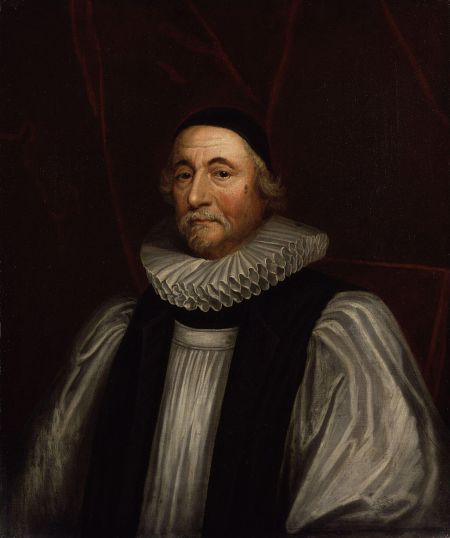
I came across this very interesting piece just now via Twitter. It’s not new but was circulated today, January 4, it is the birthday of Church of Ireland Archbishop of Armagh and Primate of All Ireland James Ussher, who was born in 1581.

thonyc's avatarThe Renaissance Mathematicus

Friday was the 23rd of October and the Internet sceptics had a field day mocking one of their favourite punching bags James Ussher (1581 – 1656) Archbishop of Armagh. Ussher is notorious for dating the creation of the world to 6 pm on the 22nd of October 4004 BCE (and not 9 am on 23rd October as Pharyngula falsely stated) a fact that the hordes of Pharyngula and other similar self appointed defenders of scientism love to brandish as a proof of the stupidity of Christians.

1024px-james_ussher_by_sir_peter_lely James Ussher Source: Wikimedia Commons

However Ussher has a right to be judged by the social and cultural standards of his own time and not those of the twenty first century. Who knows which things that we hold sacred will be ridiculed by sneering sceptics in three or four hundred years? “Can you believe it in the early 21st century…

View original post 990 more words