Archive for April, 2020

Cosmology Talks: Omar Darwish on Lensing Maps

Posted in The Universe and Stuff with tags , , , , , on April 17, 2020 by telescoper

If you are missing your regular seminar experience because of the Coronavirus lockdown, Shaun Hotchkiss has set up a YouTube channel just for you!

The channel features technical talks rather than popular expositions so it won’t be everyone’s cup of tea but for those seriously interested in cosmology at a research level they should prove interesting.

Here’s another example from that series in which Omar Darwish talks about CMB Lensing Maps and specifically about an extremely impressive example thereof which he made using data from the Atacama Cosmology Telescope.

R. I. P. Lee Konitz (1927-2020)

Posted in Jazz with tags , , , , , on April 16, 2020 by telescoper

My word this Covid-19 pandemic is having a terrible effect on the Jazz world. I heard this evening that it has now taken from us the great alto saxophonist Lee Konitz at the age of 92 after a career lasting 75 years.

I can’t possibly do justice here to the memory of such a legend but at least I can post one of my favourite tracks of his, a live performance from the 1950s of a tune called Ablution. If Lee Konitz hadn’t announced it at the start the comping of pianist Ronnie Ball would have told you straight away that this is a contrafact built on the chords of the famous Jerome Kern tune All The Things You Are, the unusual chords of which have made it a popular vehicle for jazz musicians to improvise on ever since it was written back in 1939.

In the bebop era it was typical practice to base original compositions on top of the chord sequences of standard tunes in such a way as to hide their foundations from the casual listener. A famous example of this was the Charlie Parker – Dizzy Gillespie session in which they decided to play a variation on the standard Cherokee. It went well until they absent-mindedly played the actual theme of Cherokee at which point there was a cry of anguish from the control room from a producer who had obviously hoped that if they stayed off the original melody he wouldn’t have to pay composer’s royalties. So off they went again called the next take Ko Ko and created one of the Charlie Parker classics.

Although Lee Konitz had a tone much more reminiscent of Paul Desmond than Charlie Parker he had a wonderfully agile and inventive way of playing that had echoes of Bird at the same time as being definitely his own style, as I hope you will agree after listening to this!

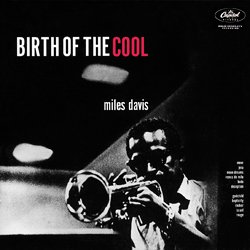
Here are just two classic albums that Lee Konitz played on relatively early in his career, if you want to check them out

R.I.P. Lee Konitz (1927-2020)

Covid-19: the next steps

Posted in Biographical, Covid-19, Education, Maynooth with tags , on April 16, 2020 by telescoper

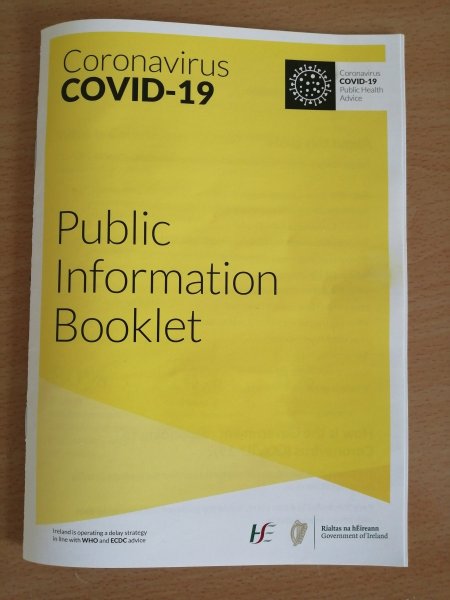
The Irish Government’s information booklet about Covid-19

Although we are currently in what is meant to be the Easter holiday the new normal continues in the form of a plethora video conferences and email exchanges punctuated by the occasional bit of rest and relaxation. We’ve even got a virtual seminar tomorrow and a virtual Open Day on Saturday 25th April to add to the fun.

One of the things making life stressful for academics these days is uncertainty about the future. Will the current lockdown actually end on May 5th? Will our plans for remote examinations work out OK? Will the Leaving Certificate actually go ahead this summer? When will the next academic year begin?

None of these issues is on the same scale as those confronting health workers and others on the front line fighting this pandemic, but that doesn’t mean they aren’t causing anxiety.

My own view is that we need to concentrate as far as possible on the next step and not get carried away by the ifs and buts about what comes after. There are too many imponderables on the horizon, so just focus on what you can control. We have three more weeks teaching here at Maynooth before the end of the Semester so let’s do that as well as we can. After that there is the exam period so let’s try to get through that with as few glitches as possible. We’ll just have to cross other bridges when we come to them.

For myself, I am sceptical that there will be any reduction of the current restrictions on May 5th and if there is, it will be slight at first. As the Taoiseach Leo Varadkar said today relaxation of the lockdown will take places gradually over a number of months. As a physicist I see the change being rather like an adiabatic process, carried out in quasi-static fashion in a series of reversible steps…

The Oldest Tree in Ireland

Posted in Biographical, History, Maynooth with tags , , , , , , on April 15, 2020 by telescoper

Regular readers of this blog – both of them – will know that I’ve developed a habit during the current lockdown of talking walks around the South Campus of Maynooth University in order to get a bit of exercise.

I’ve noticed a bit of a side effect of strolling around the environs of the old College, though, which is that I always return home sneezing. I’ve never really been susceptible to hay-fever before, but I reckon this is a reaction to tree pollen. It’s the right season for that, and there are many trees about.

Last night I was idly googling around in an attempt to identify the types of tree I would encounter on my wanderings and during the course of that I accidentally came across something fascinating.

This Yew tree stands near the main entrance to Maynooth University campus.

It’s not a particularly tall specimen and I’ve walked past it hundreds of times without paying attention to it. It is however generally believed to be the oldest tree in the Republic of Ireland (there is one tree, another Yew, possibly older, in County Fermanagh.) The tree in Maynooth germinated (or was planted) around the year 1267 ± 50, which makes it around 753 ± 50 years old.

The timing is interesting because it means that the tree is roughly the same age as Maynooth Castle and the old church. In this picture you can see the Yew tree on the left, with the church on the right and the remains of the Castle in the background:

Here’s a better picture of the Castle from another direction. Only a few bits of wall, the gatehouse and solar tower remain. The Castle was damaged and subsequently surrendered after a siege in 1535 (see below) then reoccupied only to be largely dismantled in 1647, whereafter it fell into ruin.
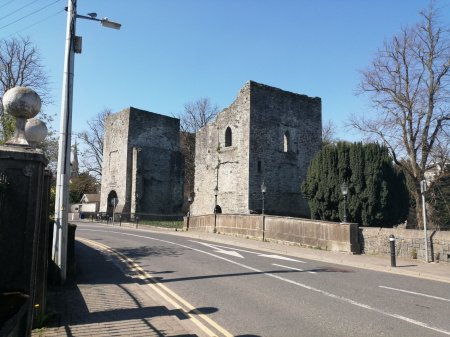
The tree is often called the “Silken Thomas Tree” after Thomas Fitzgerald, the 10th Earl of Kildare, who led a rebellion against the English authorities during the time of Henry VIII. He acquired the nickname “Silken Thomas” because of the ribbons of silk worn by his supporters. Needless to say, the rebellion failed and his family castle was destroyed. Thomas surrendered, throwing himself on the mercy of the King. That went exactly as well as you might have expected: Thomas was executed, along with several members of his family, in 1537.

The tree, of course, pre-dates Silken Thomas by three centuries, but legend has it that he played a lute under the boughs of the tree the night before he surrendered to King Henry VIII.

All that is quite interesting but doesn’t answer the question of which trees make me sneeze…

A Memorial to Reverend Professor Callan

Posted in History with tags , , , , , on April 14, 2020 by telescoper

I chose a different route for today’s post-prandial exercise around Maynooth University’s South Campus, and thus came across this attractive little tree-lined path:

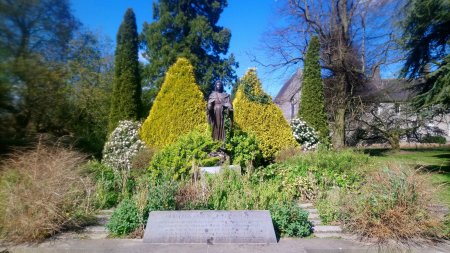
At the other end lies the historic cemetery of Maynooth College where, among many other things, I found this memorial:

This gives me an excuse to rehash an old one about the person whose memorial it is.

Father Nicholas Joseph Callan (or, more formally, The Reverend Professor Nicholas Joseph Callan) was born in County Louth in 1799 went to the seminary of St Patrick’s College, Maynooth, in 1816 on order to train as a priest. During his time as a seminarian Callan studied ‘Natural Philosophy’ and became interested in experiments involving electricity. In 1823 Callan was ordained as a priest, and went to Rome in 1826 to obtain his doctorate in Divinity. At the time Italy was a centre for research into electricity and here Callan became familiar with the work of the Italian physicist Alessandro Volta who had developed the world’s first battery. Callan returned to Maynooth where he was made chair of Natural Philosophy, a post he would hold until his death in 1864.

Callan is most famous for inventing the induction coil (in 1836). By connecting two copper wire coils to a battery and electromagnet and then interrupting the current he was able to generate much larger voltages than could be obtained from batteries alone. His 1837 version that used a clock mechanism to interrupt the current 20 times a second is estimated to have produced 60,000 volts – the largest artificially generated charge at that time. It is said that his induction coil could produce sparks 15″ long, which must have been fun to watch.

Callan’s biggest induction coil, unfinished at the time of his death, can be found in the National Science Museum of Ireland (which is in Maynooth). This was one of the largest in the world at the time. The iron core is 109 cm long. The secondary windings are 53 cm in diameter and consist of about 50 km of iron wire insulated with beeswax. They were made in three separate rings separated by air gaps, so wires carrying large voltage differences would not lie adjacent to each other, reducing the risk of the insulation breaking down. At the left end is a vibrating mercury ‘contact breaker’ in the primary circuit, actuated by the magnetic field in the primary, which interrupted the primary current to generate potentials of over 200,000 volts.

Sadly Callan’s work was forgotten for quite a period after his death – experimental electromagnetism was not a priority for St Patrick’s College at this time – for which reason the invention of the induction coil has often been attributed to Heinrich Ruhmkorff who made his first device (independently) about 15 years after Callan. More recently, however, Callan’s achievements have been more widely recognized and in 2000 the Irish government issued a stamp in his honour.

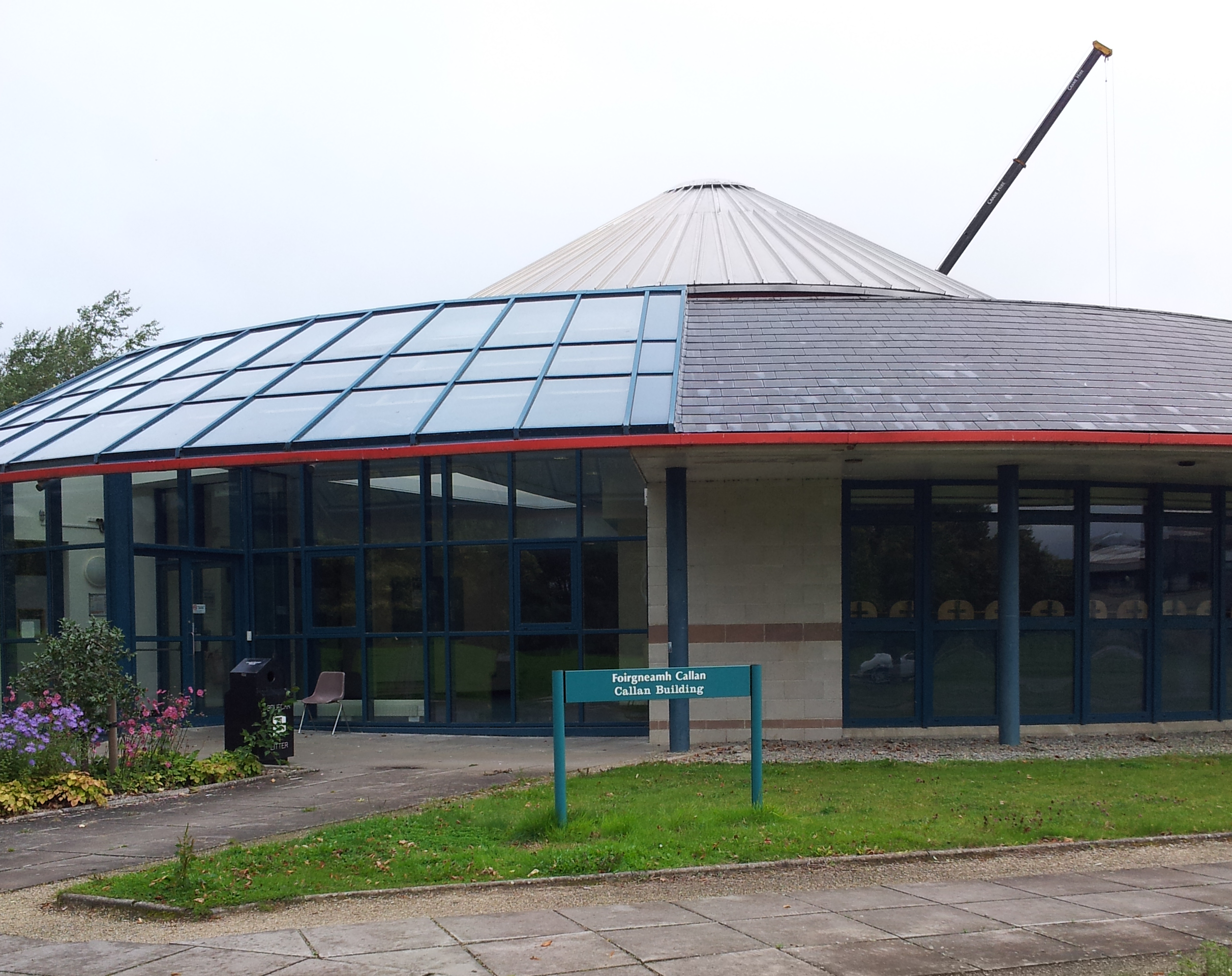
The Callan Building

Nicholas Callan was laid to rest in the College Cemetery at Maynooth in 1864. The Callan Building (above) on the North Campus of the present-day Maynooth University is named in his honour, as of course is Callan Hall, on the South Campus.

P.S. The first interment in the Cemetery took place in 1817, 200 years before I started work in Maynooth.

A Virus Testing Probability Puzzle

Posted in Cute Problems, mathematics with tags , on April 13, 2020 by telescoper

Here is a topical puzzle for you.

A test is designed to show whether or not a person is carrying a particular virus.

The test has only two possible outcomes, positive or negative.

If the person is carrying the virus the test has a 95% probability of giving a positive result.

If the person is not carrying the virus the test has a 95% probability of giving a negative result.

A given individual, selected at random, is tested and obtains a positive result. What is the probability that they are carrying the virus?

Update 1: the comments so far have correctly established that the answer is not what you might naively think (ie 95%) and that it depends on the fraction of people in the population actually carrying the virus. Suppose this is f. Now what is the answer?

Update 2: OK so we now have the probability for a fixed value of f. Suppose we know nothing about f in advance. Can we still answer the question?

Answers and/or comments through the comments box please.

R.I.P. Tim Brooke-Taylor (1940-2020)

Posted in Television with tags , , on April 13, 2020 by telescoper

More sad news arrived yesterday: comedy legend Tim Brooke-Taylor passed away with Covid-19 at the age of 79.

Together with Graeme Garden and Bill Oddie, Tim Brooke-Taylor starred an The Goodies, a TV programme I loved and watched religiously as a kid. I remember when my whole class at came down with Gibbon-Mania when the trio reached Number One in the Hit Parade with The Funky Gibbon.

Later on I discovered the radio series I’m Sorry I Haven’t A Clue and was immediately hooked. Chaired by the incomparable Humphrey Lyttelton (front left in the picture) , the original four panellists given silly things to do were Tim Brooke-Taylor (behind Humph) , Barry Cryer (centre), Willie Rushton (front right) and Graeme Garden (right) . I listened regularly to that show until Humph passed away in 2008. It never seemed the same after that. Now only two of the original team are still with us; Willie Rushton died in 1996.

It seems this cruel virus is targeting an entire generation, cutting short so many lives of so many people who meant so much to us.

Sad days.

Rest in peace, Tim Brooke-Taylor (1940-2020)

R. I. P. John Conway (1937-2020)

Posted in Biographical, mathematics with tags , , , on April 12, 2020 by telescoper

I’ve just heard the sad news that that mathematician John Horton Conway has passed away at the age of 82.

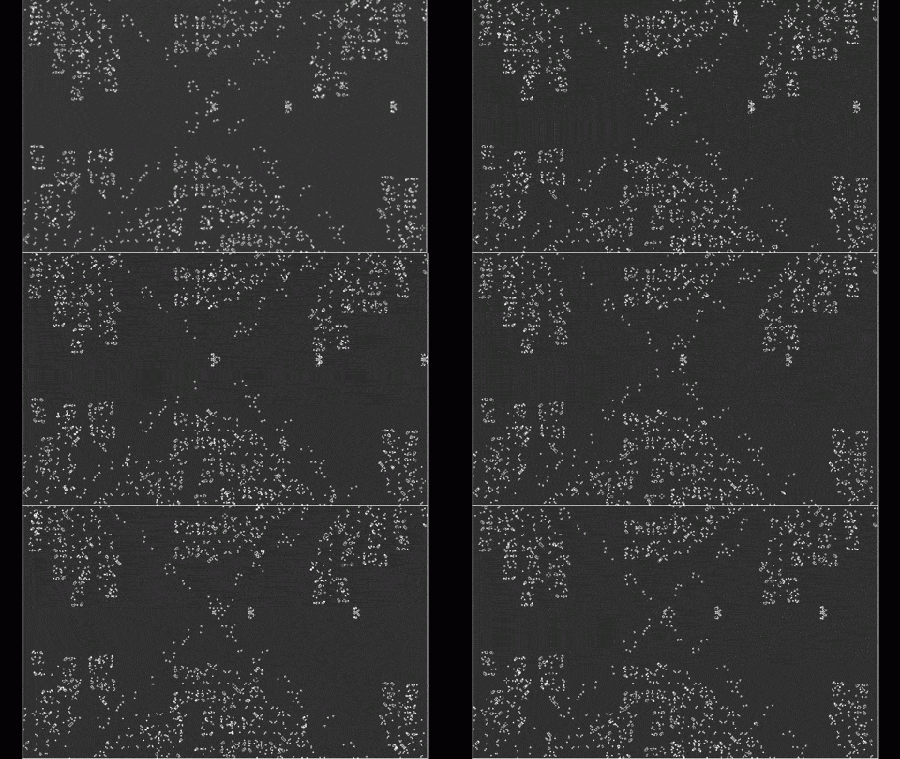
John Conway made very distinguished contributions to many areas of mathematics, especially topology and knot theory, but to many of us he’ll be remembered as the inventor of the Game Of Life. I’ll remember him for that because one of the very first computer programs I ever wrote (in BASIC) was an implementation of that game.

It’s a great illustration of how simple rules can lead to complex structures and it paved the way to a huge increase in interest in cellular automata.

I think he got a bit fed up with people just associating him with a computer game and neglecting his deeper work, but he deserves great credit for directly or indirectly inspiring future scientists.

Rest in peace John Conway (1937-2020).

Testing Times

Posted in Biographical, Covid-19 with tags , , on April 12, 2020 by telescoper

Today is April 12th which means, astonishingly, that it’s just one month since Ireland went into the first stage of its current lockdown. I say “astonishingly” because it seems much longer ago than that!

I know I’m not the only person who is finding it difficult these days to keep track of the passage of time. The lack of a regular routine seems to be the reason. The solution, I imagine, is to try to impose a timetable on yourself rather than have it imposed upon you by someone else. I’ve only been partially successful in that, probably because I lack the necessary self-discipline. Still, somewhat to my surprise, I am not having any significant problems sleeping.

Anyway talking about testing times, I wanted to make a quick comment on the Covid-19 situation in Ireland. I’ve been keeping track of the statistics on my page here, which I shall continue to update as things develop. The latest plot is as follows.

The last two points in the orange curve show a bit of a spike. That is because they include the results from a batch of about 6000 swabs sent for testing to Germany. These should be apportioned to earlier dates but lacking the information needed to do this in a sensible way I’ve just plotted them when the results were received (Friday and Saturday). This also means that the slight inflection in the blue curve is not real, but it doesn’t change the general picture significantly.

This is a manifestation of a major difficulty that the authorities in Ireland are facing, which is the capacity to do coronavirus testing in sufficient numbers and sufficiently rapidly to enable contact tracing in real time which is needed to further control the spread of this disease. At present only around two thousand tests per day are being done, which is inadequate.

Although the recent upward blip is an artefact, the fact remains that there is no evidence that the number of new cases is reducing sufficiently quickly for the relaxation of the rules to be considered feasible. There is a real danger that if the number of new cases does not stop falling soon, the number of patients needing intensive care will exceed the resources available.

Anyway, I reckon things will stay as they are until June at the earliest, so we’ll just have to get used to it!

College Walk

Posted in Maynooth on April 11, 2020 by telescoper

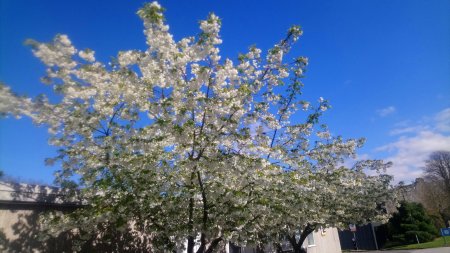
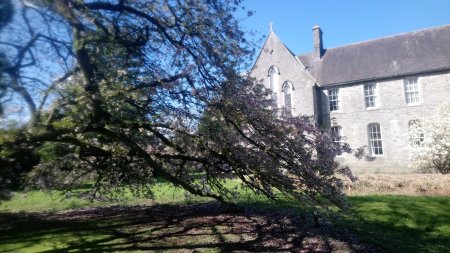
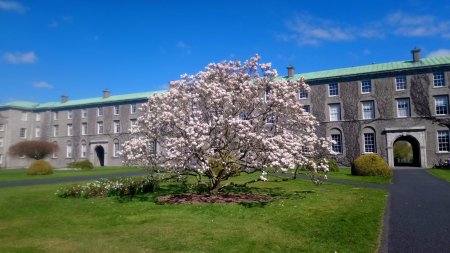
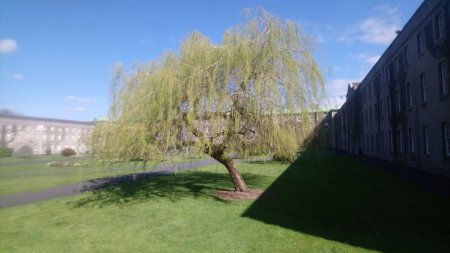
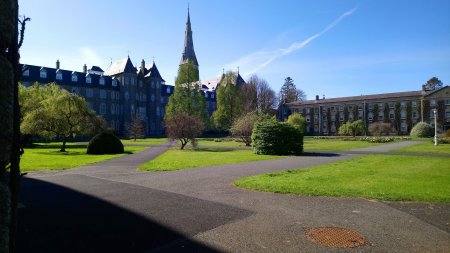
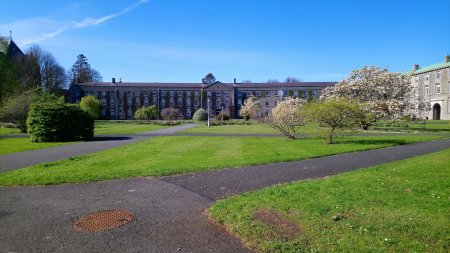
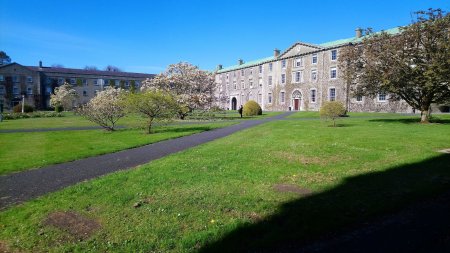
By way of a distraction from everything that’s going on in the wider world I thought I’d share a few pictures I took walking around Maynooth University’s South Campus for some exercise the other day. The Spring weather was lovely and the blossom was emerging on various trees and shrubs.

It all reminded me of those famous lines by the poet A. E. Housebound:

Loveliest of trees, the cherry now
Is hung with blossom along the bough.
I’d like to do a woodland ride,
But sadly I am stuck inside.

My favourite picture is the last one, in which the shadow of the building picks up the line of the roof to produce an interesting composition.

Here are a few more, taken today (Saturday)