Archive for August, 2020

Implementation Guidelines for Public Health Measures in Higher Education Institutions

Posted in Covid-19, Education, Maynooth with tags , , , on August 6, 2020 by telescoper

Yesterday I was speculating out loud about where we go from here in order to return to teaching in September. Today I find that there’s actually a guidance document produced by the Irish Universities Association under the auspices of the Health Service Executive. The full document (PDF, 12 pages) can be found here.

The advice focuses on principles rather than practice and a lot of work will have to be done in individual institutions to translate the guidelines into working procedures, but it is welcome nonetheless. I encourage everyone involved in higher education to read it all.

A key issue on everyone’s mind concerns on-campus teaching, so I have selected this paragraph:

This suggests that the social distancing between staff and students and between staff and other staff should be kept to 2m but the spacing between students in lecture theatres, laboratories, etc can be 1m with the proviso that students wear face masks.

Note however that there is a more general restriction that indoor gatherings should involve no more than 50 people. Unless some sort of exemption is granted for HEIs then this, rather than social distancing, may determine the maximum class size.

Allowing us to populate rooms with one metre spacing between students rather than two makes a huge difference to our ability to accommodate students in lecture halls and other teaching spaces, but even so the capacity of most teaching rooms will be much lower than normal. For example, the room I taught my first-year class of ~85 in last year has a nominal capacity of 90. With 1m social distancing that is reduced to 27; with 2m distancing it is down to 18. I don’t know how many students I’ll have next semester, but hopefully it will be more than 27! Assuming that it is, I won’t be able to teach them as a single group.

Phase Four Postponed

Posted in Covid-19, Maynooth with tags , , on August 5, 2020 by telescoper

Yesterday the Irish government decided to postpone the last phase of its (already revised) Roadmap for Reopening and also make mandatory the wearing of face masks in shops. Phase Four was supposed to start on August 10th and was to include, among other things, the opening of pubs.

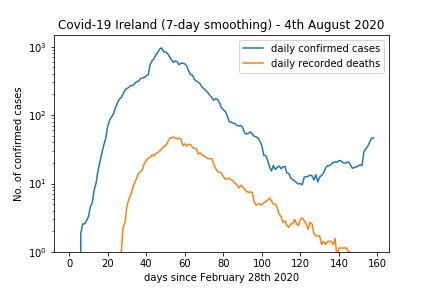
The reason for not proceeding with Phase Four is obvious when you look at yesterday’s  new cases graph:

(I keep updating the data here.

Note that the graph is logarithmic on the y-axes so the number of new cases is not large (currently averaging about 45 per day), but the trend is concerning; last week’s average was about 18. Most of the new cases are aged under 45 which perhaps accounts at least partly for the fact that the death curve is not rising: younger people are at lower risk of developing serious problems. The pattern of increasing infections but decreasing mortality figures is quite widespread across Europe, actually.

The recent cases in Ireland are occurring in clusters in particular locations. Of the 45 cases reported yesterday, for example, 33 were in County Kildare most of them at a single factory in Kildare itself (which has now been shut).

There has also been an increase in community transmission, though, which is perhaps even more dangerous than individual outbreaks.

It seems to me that pausing the planned relaxation of restrictions is a sensible thing to do at this stage. To open pubs now – which many continue to argue for – would in my view be extremely foolhardy.

I’m not sure what all this means for the new academic year which is due to start in September nor even the repeat examination period which are due to start next week but if cases continue to increase at their current rate it will severely impact our ability to return to on-campus activities.


New KiDS on the Blog!

Posted in The Universe and Stuff with tags , , , , , , , , , , on August 5, 2020 by telescoper

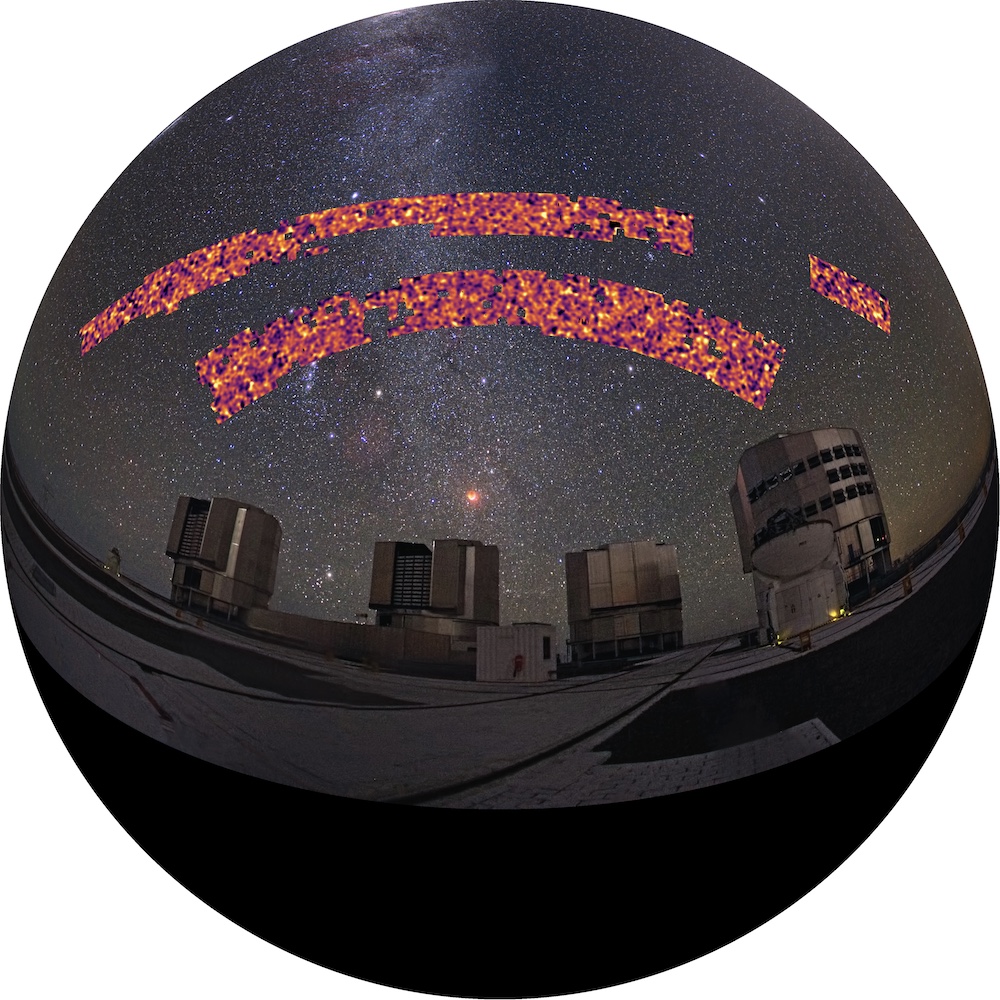
The above image is from the Kilo Degree Survey, performed using the OmegaCAM instrument on the European Southern Observatory’s VST Survey Telescope at Cerro Paranal in Northern Chile. I got it by googling `Pictures of KiDS’, which was probably unwise.

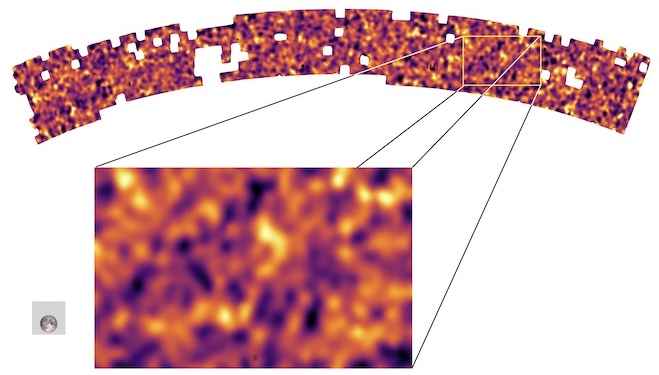
Here’s another picture, of part of the survey region.

A few people have asked me why I didn’t post about the new results from KiDs which came out last week. The answer is simply that I’ve been a bit busy, but here we go now with a post on the blog about the new KiDs papers. These appear as a bunch of five on the arXiv:

KiDS-1000 Methodology: Modelling and inference for joint weak gravitational lensing and spectroscopic galaxy clustering analysis

KiDS-1000 catalogue: weak gravitational lensing shear measurements

KiDS-1000 catalogue: Redshift distributions and their calibration

KiDS-1000 Cosmology: Cosmic shear constraints and comparison between two point statistics

KiDS-1000 Cosmology: Multi-probe weak gravitational lensing and spectroscopic galaxy clustering constraints

The result that stands out from the latest release is the suggestion that the Universe is about 8% less clumpy than the standard cosmological model suggests. The level of clumpiness is quantified by the parameter S8 which, according to Planck, has a value 0.832 ± 0.013 whereas KiDS gives 0.776 (+0.020/-0.014), a discrepancy of about 3σ. It’s not only the Hubble constant that is causing a bit of tension in cosmological circles!


But Beautiful – Tony Bennett & Bill Evans

Posted in Jazz with tags , , , on August 4, 2020 by telescoper

I’m kicking myself for having forgotten that yesterday, August 3rd, was the 94th birthday of that great jazz singer Tony Bennett so I’m correcting that omission today by posting one of my favourite recordings of his, a tune written by the famous songwriting pair of Johnny Burke and Jimmy van Heusen, recorded in 1975 with Bill Evans on piano. When one of the greatest ever jazz singers gets together with one of the greatest ever jazz pianists, what could the result be But Beautiful?

Happy Birthday, Tony Bennett!

New Publication at the Open Journal of Astrophysics!

Posted in OJAp Papers, Open Access, The Universe and Stuff with tags , , , , on August 4, 2020 by telescoper

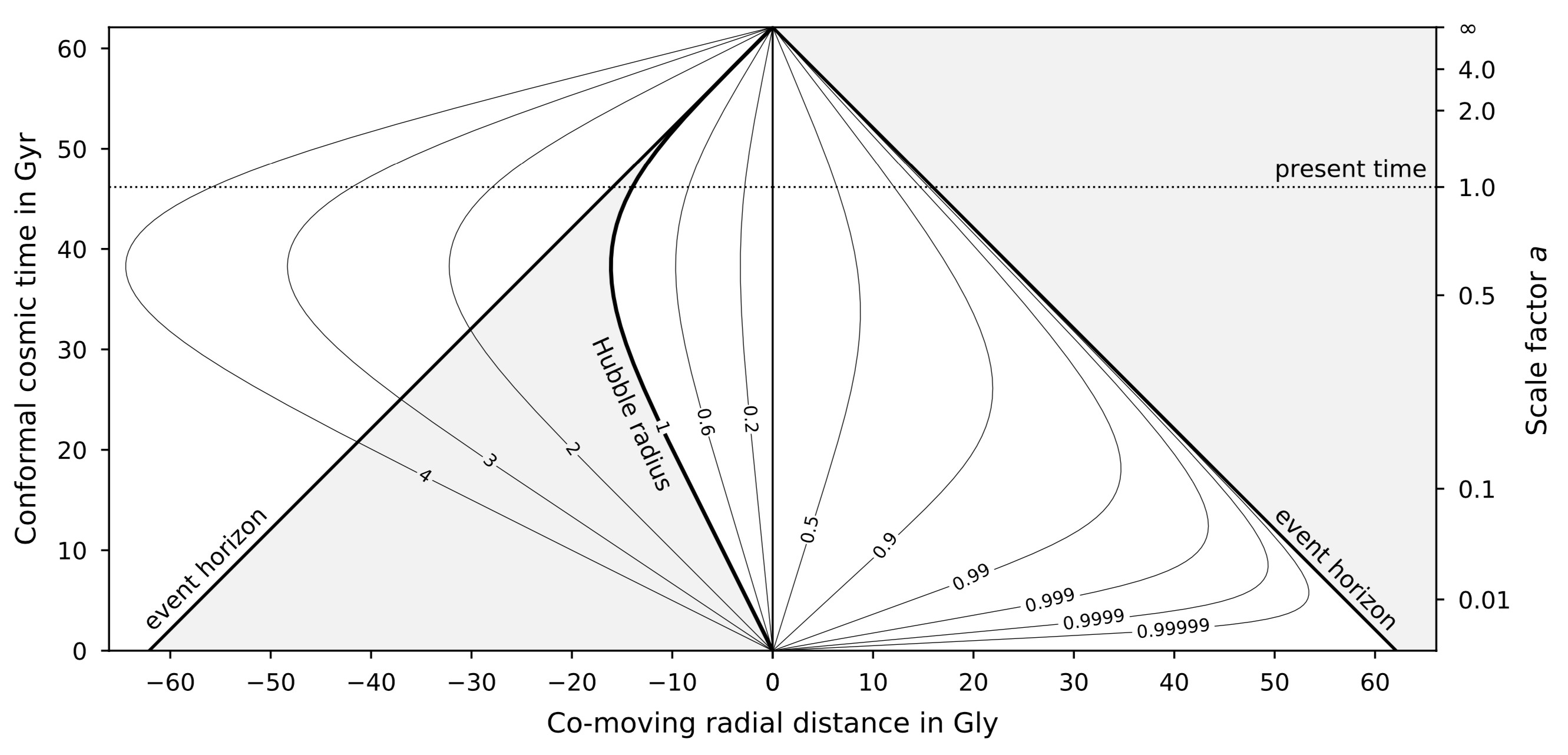
Another new paper has been published in the Open Journal of Astrophysics! This one was actually published last Friday but it being the Bank Holiday weekend I just got round to blogging about it today. This is another one for the Cosmology and NonGalactic Astrophysics section. It’s called Cosmic event horizons and the light-speed limit for relative radial motion and is a sort of pedagogical review of the subject aimed at dispelling some common misconceptions about radial velocities and horizons. The author is Markus Pössel of the Max Planck Institute for Astronomy at Heidelberg.

Here is a screen grab of the overlay:

I’ve taken the liberty of adding the background teaser image in full here, as it is rather groovy:

You can click on the image to make it larger.

You can find the arXiv version of the paper here.

Lá Saoire i mí Lúnasa

Posted in Uncategorized on August 3, 2020 by telescoper

Today being the first Monday in August it is a Bank Holiday in Ireland. This holiday was created by the Bank Holiday Act of 1871 when Ireland was under British rule. While the holiday was subsequently moved to the end of August in England and Wales it has remained at the start of August in Ireland.

I was leafing through my diary yesterday, looking at all the deadlines coming up and wondering whether I could actually take today off*, when I got to thinking more generally about matters calendrical.

In the Northern hemisphere, from an astronomical point of view, the solar year is defined by the two solstices (summer, around June 21st, and winter around December 21st) and the equinoxes (spring, around March 21st, and Autumn, around September 21st). These four events divide the year into four roughly equal parts each of about 13 weeks.

Now, if you divide each of these intervals in two you divide the year into eight pieces of six and a bit weeks each. The dates midway between the astronomical events mentioned above are (roughly) :

  • 1st February: Imbolc (Candlemas)
  • 1st May: Beltane (Mayday)
  • 1st August: Lughnasadh (Lammas)
  • 1st November: Samhain (All Saints Day)

The names I’ve added are taken from the Celtic/neo-Pagan (and Christian terms) for these cross-quarter days. These timings are rough because the dates of the equinoxes and solstices vary from year to year. Imbolc is often taken to be the 2nd of February (Groundhog Day) and Samhain is sometimes taken to be October 31st, Halloween. But hopefully you get the point.

Incidentally, the last three of these also coincide closely with Bank Holidays in Ireland, though these are always on Mondays so often happen a few days away.

Anyway, it is interesting (to me) that the academic year here in Ireland is defined by these dates.

Usually the first semester of the academic year starts on or around September 21st (Autumnal Equinox) and finishes on or Around December 21st (Winter Solstice). Half term (study week) thus includes the Halloween Bank Holiday.

After a break for Christmas and a three-week mid-year exam period Semester Two starts on or around 1st February (Imbolc). Half-term is then around March 21st (Vernal Equinox) and teaching ends around May 1st. More exams and end of year business take us to the Summer Solstice and the (hypothetical) vacation.

So we’re basically operating on a pagan calendar.

The exception is, of course, the date of Easter, which is fixed by a mixture of solar and lunar considerations: Easter is celebrated on the first Sunday following the full Moon that occurs on or just after the spring equinox. This date moves about between March and April, which is very messy and inconvenient and should, in my opinion, be reconsidered.

*I decided on “yes”.

R. I. P. John Hume (1937-2020)

Posted in Maynooth, Politics with tags , , , on August 3, 2020 by telescoper

Very sad news arrived this morning of the death at the age of 83 of civil rights campaigner and politician John Hume. He had been suffering from dementia for some time, and passed away earlier this morning in a nursing home in his native Derry. In that sense his death was not unexpected but I know from my own recent experience that won’t make it any easier for his loved ones. Condolences to John’s wife Pat and their family at what must be a difficult time for them.

John Hume, a Catholic, espoused the Irish nationalist cause but through non-violence, which often drew the ire of extremists on either side. Being moderate can be a dangerous position when you’re surrounded by armed factions. He became leader of the SDLP and was a key agent in the peace process that led to the construction of the Good Friday Agreement, a fact that was recognised in 1998 by a share of the Nobel Peace Prize (with David Trimble).

“Blessed are the peacemakers, for they shall be called the children of God” it says in the Gospel according to St Matthew. I wish more people – especially politicians – who profess to be Christian took that as seriously as John Hume.

There is a special connection between John Hume and Maynooth. He came here to St Patrick’s College initially to study for the priesthood. He didn’t pursue that aim but instead completed an MA degree in 1964 with a thesis on ‘Social and Economic Aspects of the Growth of Derry 1825 -1850’. Maynooth University recognises that connection with John & Pat Hume postgraduate scholarships and through the Hume building on campus.

John Hume was a man of great courage and integrity who dedicated his life to the cause of peace and mutual respect. He will be greatly missed.

I’ll end with a quote of his:

Ireland is not a romantic dream; it is not a flag; it is 4.5 million people divided into two powerful traditions. The solution will be found not on the basis of victory for either, but on the basis of agreement and a partnership.

And another:

All conflict is about difference, whether the difference is race, religion or nationality The European visionaries decided that difference is not a threat, difference is natural. Difference is of the essence of humanity. Difference is an accident of birth and it should therefore never be the source of hatred or conflict. The answer to difference is to respect it. Therein lies a most fundamental principle of peace – respect for diversity.

Rest in peace John Hume (1937-2020). Ar dheis Dé go raibh a h’anam dílis.

Two Hundred Years of Tyndall

Posted in Beards, History, The Universe and Stuff with tags , , on August 2, 2020 by telescoper

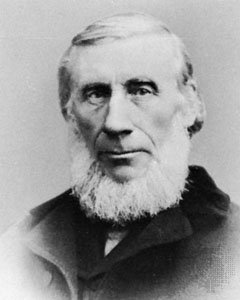
Just a short post to mark the fact that celebrated Irish physicist John Tyndall was born 200 years ago today, on 2nd August 1820.

Tyndall made his name initially for his research on diamagnetism but then worked on the scattering of light by atmospheric particles, and on the absorption of infrared radiation by gases. In the latter context he is generally credited with having discovered the Greenhouse Effect.

One should also mention his rather splendid beard.

John Tyndall was born at Leighlin Bridge, near Carlow in Ireland. After a little formal schooling, he gained a practical education by working as a surveyor and engineer. He entered the University of Marburg, Germany, in 1848 and earned his doctorate two years later. His dissertation research interested Michael Faraday, who later brought him to the Royal Institution of London. In 1867 Tyndall succeeded Faraday as superintendent there. He retired in 1887 and died in 1893.

The excellent Tyndall National Institute in Cork is named in his honour.

Spot the Deliberate Mistake

Posted in Covid-19 on August 1, 2020 by telescoper

The following graphic was recently used by a television programme to show the parts of England in which special Covid-19 restrictions are imposed:

Can any of you spot the deliberate mistake?

See below for the answer..

Continue reading

Trustan with Usolde

Posted in Literature, Opera with tags , , , , , , , , on August 1, 2020 by telescoper

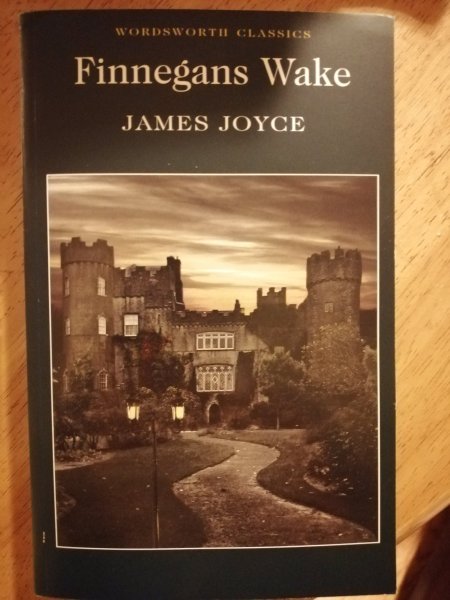
It is, I think, fairly well known that physicist Murray Gell-Mann was inspired to pick the name quark for the name of a type of subatomic particle by a passage from Finnegans Wake by James Joyce:

— Three quarks for Muster Mark!
Sure he hasn’t got much of a bark
And sure any he has it’s all beside the mark.

What is perhaps less well known is the identity of “Muster Mark” in that quote. In fact it is King Mark of Cornwall, husband of Queen Iseult in the legend of Tristan and Iseult. The Iseult in that legend is Irish. She has has an affair with Tristan, nephew of King Mark, with tragic consequences. This legend appears in many literary forms including, most famously, Richard Wagner’s Opera Tristan und Isolde. It also comes up frequently in Finnegans Wake including this passage on the same page (in the edition I have) as the Muster Mark quote above:

That song sang seaswans.
The winging ones. Seahawk, seagull, curlew and plover, kestrel
and capercallzie. All the birds of the sea they trolled out rightbold
when they smacked the big kuss of Trustan with Usolde.

See how Joyce plays with the substitution of “u” for “i” here as in “Muster”. Either that or the “I” key on his typewriter didn’t work properly. Or he had fat fingers and kept hitting the wrong key; U and I are next door on the keyboard.

Incidentally there is a small village in Dublin called Chapelizod which is where a church was built dedicated to Queen Iseult. Whether there is any real connection between this place and the historical Iseult is very doubtful.

Now, where was I. Oh yes. Back to Opera.

Years ago, when I lived in Nottingham, on a warm summer evening I decided to listen to some of the live broadcast on BBC Radio 3 of a performance of Wagner’s Tristan und Isolde from Glyndebourne. I made myself a cocktail and took the radio out into the garden with the intention of listening to a bit of it before going out for the evening. This was back in the days when I actually used to go out on the town on Saturday nights; now I’m too old for that sort of thing.

Anyway, I was hooked right from the Prelude. Act I came and went and I decided to make some dinner in the interval, opened a bottle of wine, and returned to listen to the rest of it. The glorious music washed over me in the sultry twilight. Darkness fell, a second bottle of wine was opened, and still I listened – no doubt to the consternation of my neighbours. The final Liebestod was so beautiful I almost cried. Eventually I retreated to the house having experienced my first all-out Wagner trip.

My enjoyment of that occasion was of course helped by the fact I could get up and walk around occasionally, as well as by the liberal intake of fine wine. Nevertheless I do think Tristan and Isolde works very well on the radio – nothing very much happens on stage anyway (especially in Act II) so you can just let the music work it’s magic.

The reason for all this rambling is that there is a special broadcast of Tristan und Isolde on RTÉ Lyric FM. This performance, recorded in 2012, features as Isolde the celebrated dramatic soprano Miriam Murphy who very sadly passed away suddenly a few weeks ago. Tonight’s programme is a tribute to her memory. I believe Miriam Murphy is the only Irish soprano to have sung the role of Isolde. I’ve heard a few clips from it and her voice sounds amazing.

The Opera is preceded on the radio by a documentary about the production, the first in Ireland for 50 years and the first by a brand new company based in Ireland. I think James Joyce would have approved.

So that’s my Saturday evening sorted out!

Update: I listened to the broadcast and it is an astonishingly wonderful performance by Miriam Murphy.