Archive for September, 2020

Littlewood on `the real point’ of lectures

Posted in Education, mathematics, The Universe and Stuff with tags , , , on September 3, 2020 by telescoper

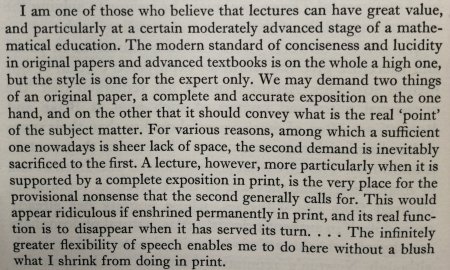
We’re often challenged these days to defend the educational value of the lecture as opposed to other forms of delivery, especially with the restrictions on large lectures imposed by Covid-19. But this is not a new debate. The mathematician J.E. Littlewood felt necessary to defend the lecture as a medium of instruction (in the context of advanced mathematics) way back in 1926 in the Introduction to his book The Elements of the Theory of Real Functions.

(as quoted by G. Temple in his Inaugural Lecture as Sedleian Professor of Natural Philosophy at the University of Oxford in 1954 “The Classic and Romantic in Natural Philosophy”.)

Temple concluded his lecture with:

Classic perfection should be reserved for the monograph: the successful lecture is almost inevitably a romantic adventure. It is at once the grandeur and misery of a scientific classic that it says the last word: it is the charm of a scientific romance that it utters the first word, and thus opens the windows on a new world.

Modern textbooks do try to be more user-friendly than perhaps they were in Littlewood’s day, and they aren’t always “complete and accurate” either, but I think Littlewood is right in pointing out that they do often hide `the real point’ so students sometimes can’t see the wood for the trees. The value of lectures is not in trying to deliver masses of detail but to point out the important bits.

It seems apt to mention that the things I remember best from my undergraduate lectures at Cambridge are not what’s in my lecture notes – most of which I still have, incidentally – but some of the asides made by the lectures. In particular I remember Peter Scheuer who taught Electrodynamics & Relativity talking about his first experience of radio astronomy. He didn’t like electronics at all and wasn’t sure radio astronomy was for him, but someone – possibly Martin Ryle – reassured him by saying “All you need to know in order to do this is Ohm’s Law. But you need to know it bloody well.”

Watch “Why the Universe is quite disappointing really – Episode 7” on YouTube

Posted in The Universe and Stuff, YouTube with tags , , , , on September 3, 2020 by telescoper

Back for Episode 7 of this series in which I explain how we can measure the strength of acoustic waves in early Universe using measurements of the cosmic microwave background, and how that leads to the conclusion that the Big Bang wasn’t as loud as you probably thought. You can read more about this here.

The Virtue of Signalling

Posted in Covid-19, Education, Maynooth, Politics with tags , , on September 3, 2020 by telescoper
I was in a supermarket in Maynooth yesterday morning when a bloke was refused entry for not wearing a mask. That’s the first time I’ve seen that happen, though I’ve heard various people mentioning similar stories elsewhere. There is a big sign near the entrance to the store saying that face masks are mandatory, which they have been for some time in Ireland, so he could not make the excuse that he didn’t know. I rather think he was trying to make a point.
The person concerned didn’t get violent, but was extremely loud and abusive to the staff, who shouldn’t have to put up with that sort of behaviour. He stood there for a while shouting expletive in between which his message was that he didn’t care whether he got Covid-19 as it was “just the flu”. I did wonder whether someone might call that Gardaí but after a few minutes, afer which he either felt he had done what he wanted to do or that he was wasting his time, he left.
I have to admit I completely fail to see why certain people find wearing a face mask such an ordeal. It’s really nothing. I understand that some people, with e.g. asthma, might have good reasons for finding it difficult but I’m talking here about people without such reasons who seem to think they’re being asked to bear some intolerable burden, rather than just wearing a piece of light material over their nose and mouth. I’ve got quite used to it and think nothing of it. As winter comes on I even think wearing a mask might help keep my face warm and, more importantly, protect my beard from inclement weather.
The only thing that bothers me slightly is that I have very boring face masks when others seem to have invested in colourful stylish affairs. It makes me feel a bit drab. Perhaps I should invest in some more glamorous masks.
But back to our friend in the supermarket. He of course may not care whether or not he gets Covid-19, but that’s not the main point of wearing a mask. Face masks are far more effective at protecting other people from your germs than protect you from other people’s germs. I suspect, however, that trying to explain this to the person concerned would simply make matters worse. To be happy wearing a face mask you have to be the sort of person who cares about what happens to other people and there are some – regrettably many these days – who just don’t. I’m sure that extreme selfishness translates into their political attitudes too.
When we return to on-campus teaching at the end of this month, students will be asked to wear face coverings in lectures. I’m not sure how that will work out. In particular I don’t know who is supposed to police it. Supermarkets have people on the door to turn away the unmasked. Are we to have that at the entrance to lecture theatres?
Lecturing with a face mask on will be difficult, but in a big theatre the lecturer is sufficiently far from the front of the audience that won’t be necessary.
I’m not sure how effective face masks will be at slowing the spread of Covid-19 – we’ll have to wait and see – but my attitude is that they are just a part of a bundle of measures, including frequent washing of hands, wiping surfaces regularly, maintaining social distancing, etc that all contribute. The great value of a face mask in all this is that it is visible. Wearing a mask is a signal to others that they should remember the danger of the situation and act accordingly. It’s a way of showing leadership.
It has become fashionable (at least among those who possess no virtues) to use the phrase virtue signalling as pejorative term for doing or saying something good in a way that is conspicuous. To the person ejected from the supermarket, the wearing of a face mask is probably an example of virtue signalling. I think it is too, literally, and I’m all in favour of it.

The Open Journal at INAM

Posted in Open Access with tags , , , on September 2, 2020 by telescoper

This afternoon I took part in a panel discussion on Academic Writing and Publishing that was held as part of this year’s Irish National Astronomy Meeting (INAM2020). For reasons related to Covid-19 this years meeting is all online so the panel was virtual. Each of the three panellists gave short (10 minute) presentations and then there was a discussion. My contribution was mainly about the Open Journal of Astrophysics but I also included some comments about academic writing generally.

Anyway, in the interest of Open Access here are the few slides I used. Many of you will have seen some or all of them before, but here they are anyway:


Thoughts on Mortality

Posted in Covid-19 with tags , , , on September 2, 2020 by telescoper

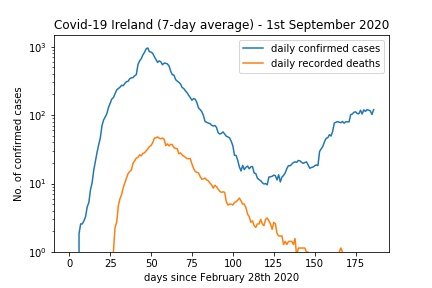
I was updating my Covid-19 statistics page yesterday after the daily announcement and I noticed that it has now been ten consecutive days since the last Covid-19 related death in Ireland. As of yesterday there were only 40 people with Covid-19 in hospitals in the Republic, six of whom were in intensive care.

These low numbers are of course very good news indeed, but it got me wondering why. As you can see from the above graph, new cases started to increase about two months ago. In the first wave the mortality figures started to grow with a much shorter lag, although it is difficult to be too precise about it because of delays in testing and reporting that shifted the blue curve to the right.

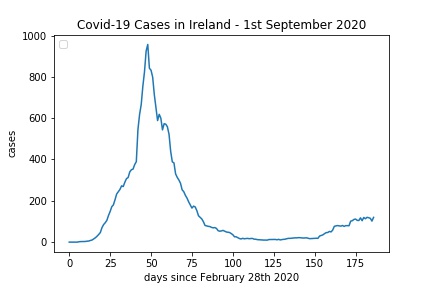
With new cases in the Republic now appearing at an average rate of around 100 per day and assuming a mortality rate of a few percent, one might have expected to see the mortality figures rising, but this has not happened. It must be said though that the current level of new cases is much lower than the initial peak, as this linear plot (also smoothed on a 7-day window) makes clear:

An even more remarkable case is that of France (data from here):

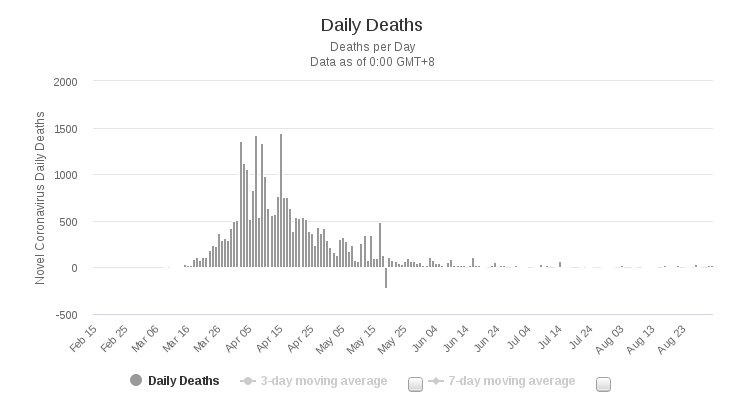
The blue curve is a 7-day moving average. You can see that the level of new cases in France is about the same as it was in late March. The daily mortality figure however looks like this:

So the mortality rate among recent cases is much lower in France than in Ireland.

I’m not going to discuss mortality data in the United Kingdom as these are being fiddled by the Government who have arbitrarily decided not to count anyone who dies more than 4 weeks after testing positive for Covid-19 in the figures. It’s a blatant con intended to make people think that the situation in the UK is better than it actually is.

I suppose the main factor for this is that the more recent cases are not happening in hospitals or care homes and they are affecting mainly younger people who have no underlying health conditions; over 70% of the recent cases in Ireland are people under the age of 45. It may also be that the treatment of patients is more effective now that it was in March and April.

Some people are arguing on social media are saying that data such as these prove that the Coronavirus has lost its potency and is no longer a threat. In order to provide evidence in support of such a claim one would have to take account of the differences in demographic and health history of new cases versus older ones, and I have not seen such a study.

Update: I had a terrible feeling that this would happen, but the same day I wrote this a further Covid-19 related death was reported. This was however a late notification of a death that occurred in June. For the latest figures see here.

Back to Returning to Campus Again

Posted in Covid-19, Education, Maynooth with tags , , , , on September 1, 2020 by telescoper

Three weeks ago I was writing about our plans for returning to campus at Maynooth University only to be rudely interrupted the very next day by new restrictions that forced us to put those plans on ice. Now we have about four weeks to get everything in place so we have to crack on.

Today the University wrote to all students outlining the general approach we are taking at Maynooth, but the details vary enormously from subject to subject. That is because the capacity of lecture theatres and laboratories and seminar rooms is reduced considerably to maintain the proper distancing between students. Classes will inevitably be smaller but we haven’t got any more rooms, so the number of face-to-face sessions will have to decrease. This affects every subject but hits very large courses much harder than smaller ones.

I will be in at the deep end on September 28th as I am teaching our first-year Mathematical Physics module, MP110. That is in Physical Hall, which has a normal capacity of 90 reduced to 27 by physical distancing requirements. Last year I had about 85 students in the class so it was full every time. This term I can fit only about one-third of that number in any session. There are three lectures per week in that module which means that if I have up to 81 students then each will be able to attend one lecture. Those unable to attend a lecture will be able to view recordings. Over the summer the University has been installing Panopto, a lecture-capture system we used to have when I was in Cardiff, so recordings of each session can be made. I also intend to record offline supplementary material for the class.

In addition to lectures each student on MP110 previously had a weekly tutorial. For the tutorials the students were split into 4 groups, but this year the reduced room capacities will probably require us to have more, smaller groups or to move to bi-weekly tutorials.

All of this is very sensitive to numbers, and we won’t know those until very close to the start of term. If we get more students than last year we will to revise the plans. The start of term is likely require quite a lot of last-minute adjustment.

For returning students on more specialist modules the classes are smaller and the impact less severe. I will also be teaching a second-year module MP201 Vector Calculus and Fourier Series next term. Not everyone who does Mathematical Physics in Year 1 continues with it to the second year so we expect roughly 50 on MP201. With that number we may be able to run lectures as normal (which means two a week) but may have to switch to bi-weekly tutorials. We expect third and fourth year classes to run quite close to normal. At least we will know the numbers of returning students fairly soon and can lock those plans in, leaving the 1st year to be dealt with last.

On top of all this we do have to have contingency plans in case the local or national Covid-19 situation deteriorates so far that we have to close the campus again. We will be in a better position to deal with that than we were back in March, as we have learned a lot very quickly and now have better equipment.

This afternoon the President of Maynooth University, Professor Philip Nolan, sent a message to all students that included the following:

Most of the large modules will use streaming of lectures so that you will receive some of the lectures on-line, and will be invited to attend less frequently than usual. Tutorials and practicals will also have reduced capacity, and in some cases the frequency will be reduced. The content of each module will remain largely unchanged, so you will be introduced to the same ideas, concepts and challenges. What will change is the format of delivery, and you will learn through a combination of live classes and on-screen material. We will publish more information, and details of the contact time in sample modules on the COVID page of the university website.

This reduced time on campus will mean that you will need to take more responsibility for your own learning, and ensure that you keep up with both the on-campus and on-line teaching.

Some of you are wondering if you need to attend at all, and whether you could complete your studies remotely. We are not a distance teaching university, and most of our courses are designed for on-campus delivery. So there will be times when you need to be on campus, and you will need to make sure that you can get to the campus when you need to.

I’ve seen some of the draft plans for other departments and it seems that the Department of Theoretical Physics is probably going to be one of the departments whose students will spend the most time on campus, with about 50% of the normal contact time. That’s primarily because we are small(ish) so can be a little more flexible. I also think that mathematical physics is a subject that needs students to take responsibility for their own learning anyway because much of it is problem-based. You can do physics problems at home or on the bus just as well as sitting in a room on campus.

I know some students are questioning the need to come on campus at all if they have so few contact hours and material is made available via recordings anyway. I can only speak for my own Department when I say that we think there is a huge value attached to in-person teaching, which is why we are trying so hard to maximize the on-campus experience for our students. It won’t quite be business as usual but will be the very best we can do under the constraints we have imposed on us. We’re doing the best we can but we do need students to play their part too!

P.S. I note that, for example, Waterford Institute of Technology is taking a quite different approach, with all lectures and tutorials going online for the whole academic year 2020/21.