Archive for October, 2020

Black ’47

Posted in Beards, Film, History with tags , , , on October 14, 2020 by telescoper

The film Black ’47 was released in Ireland in 2018 (just after I moved here) but although it got good reviews I didn’t get around to seeing it in the cinema. Last Friday however it turned up on TV so I watched it and thought it was excellent.

The film tells the story of Martin Feeney (played by James Frecheville) who returns home to Ireland having deserted from the British Army, in 1847, only to find his native Connemara in the grip of the Great Famine. Witnessing the callous treatment of his people by landlords, their agents and the British authorities he sets out on a trail of violent retribution against the oppressors. In structure the film is very like that of a classic `revenge’ Western, though set in the Wild West of Ireland rather than America. It’s very well acted by a very fine cast and superbly photographed, grimly convincing in its depiction of the extreme deprivation of the time, with gripping action sequences. Among many other things, I was impressed by the realistic portrayal of the unreliability and inaccuracy of mid 19th Century firearms. The rifles in use by the British Army at that time were muzzle loaded, using paper cartridges, so their rate of fire was very low too.

There are some splendid beards too.

I’m sure there will be people to correct me if I’m wrong but I don’t think there were any feature films made about the Great Hunger, despite its importance in Irish history, before this one.

Here’s the official trailer for the movie. I think it’s well worth watching if you can get to see it, though somehow I doubt it will be on prime time television in the UK like it was here in Ireland…

Against Hierarchies

Posted in Education, Politics, Television with tags , , , , on October 13, 2020 by telescoper

Being too tired to do anything else, last night I had a rare look at the television and found an interesting programme on RTÉ One called The Confessors which I watched to the end. The theme of the show was the tradition of the confession box in the Irish Catholic Church. As someone brought up in the Anglican tradition, the confessional has always been a bit of a mystery to me, which is one reason I found it interesting. It also touched on a number of wider issues (including the possible role of the seminary at Maynooth in establishing Ireland as an outpost of Jansenism. Some of the priests contributing to the programme also talked very frankly about the systematic sexual abuse of children by priests and the way it was covered up by the Church.

I was very interested to hear several of the contributors complaining that this problem was exacerbated by the power structure of the Catholic Church which made it easy for complaints to be stifled.

That discussion reminded me of thoughts I’ve had previously about harassment and abuse in other contexts (not of children) and the way they are suppressed by official hierarchies. This problem extends to universities, whose management structures often resemble those of church hierarchies, even down to the terminology (e.g. Deans) they have inherited from their origins as theological institutions.

This sort of structure creates a problem that is extremely deeply rooted in the culture of many science departments and research teams across the world. These tend to be very hierarchical, with power and influence concentrated in the hands of relatively few, usually male, individuals. A complaint about (especially sexual) harassment generally has to go up through the management structure and therefore risks being blocked at a number of stages for a number of reasons. This sort of structure reinforces the idea that students and postdocs are at the bottom of the heap and discourages them from even attempting to pursue a case against someone at the top.

These unhealthy power structures will not be easy to dismantle entirely, but there are simple things that can be done to make a start. “Flatter”, more democratic, structures not only mitigate this problem but are also probably more efficient by, for example, eliminating the single-point failures that plague hierarchical organisational arrangements. Having more roles filled on a rotating basis by members of academic staff rather than professional managers would help. On the other hand, the existing arrangements clearly suit those who benefit from them. If things are to change at all, however, we’ll have to start by recognizing that there is a structural problem.

Maynooth from the Air

Posted in Maynooth with tags , , , on October 12, 2020 by telescoper

I came across this video of drone footage of Maynooth and surroundings and thought I’d share it here. There are plenty of shots of the St Patrick’s College and parts of Maynooth University as well as the town itself and  Carton House. Judging by the state of progress of the new University building and the colour of the Virginia creeper I’d say this was filmed very recently. Enjoy!


Who will be the next President?

Posted in Maynooth with tags , , on October 11, 2020 by telescoper

The question on everyone’s lips here at Maynooth University is who will take over from Professor Philip Nolan when his ten-year term as President of the University comes to an end in August next year.

Over the last few months the current President has had to combine the duties of his office with those as Chair of the Epidemiological Modelling Advisory Group within the National Public Health Emergency Team (NPHET).

Whoever gets the job will face tough challenges even if the Covid-19 has improved by next summer because the University’s finances will have been seriously affected by the pandemic, as will those of many other institutions. That said, it is still a great opportunity in a lovely part of the world.

To quote from the advert

Following impressive growth over the past 10 years under the leadership of Professor Philip Nolan, the Governing Authority is now seeking to appoint a new President to lead this outstanding University and to build on its strategic role at regional, national and international levels. Coming at a time of great change and challenge, the new President will be expected to create, articulate and deliver, in a collegial manner, a shared vision for the future to drive the continued development of Maynooth University.

If you’re interested in applying you can find the details here.

Garden Variety

Posted in Biographical, Maynooth with tags , , , on October 10, 2020 by telescoper

The modest investment I made in bird feeders when I moved into my new house in Maynooth has paid a considerable dividend in terms of entertainment. As well as a number of starlings and sparrows, I have quite a variety of more exotic species. The other morning, while I was drinking my coffee while looking into the garden before leaving for work, I saw a robin, a great tit, a blue tit, a chaffinch, and (I think) a hedge warbler*. And that was all just in the space of 10 minutes or so.

The show was then brought to a sudden end by the arrival of two jackdaws who scared everything else off and then tried to wreck the nut feeder.

I went outside and chased them away. I have nothing against the jackdaws – they’re actually rather amusing – but I won’t have vandalism in my garden.

The hedge warbler (or dunnock or hedge sparrow, although it’s not a sparrow) is not particularly rare in Ireland but is extremely shy and never gives you a long time to look at it. I’m pretty sure the bird I saw was one, though it was gone in a flash.

The local robin, by contrast, is not shy. I see him very frequently. I think it’s male because of the very bright red of his chest colour; females of the species tend to have colours that look slightly washed out. Male or female this one is very well nourished. In fact it’s so plump as to be almost spherical.

Anyway, all these birds (including the jackdaws) are passerine species, defined by the shape of their feet: they all have three toes pointing forward and one pointing backwards. The order Passeriformes includes perching birds of all kinds, from sparrows and finches to crows and a lot more besides. In fact over half the known bird species belong to this order.

Thirty Years On

Posted in Biographical, LGBTQ+ with tags , on October 9, 2020 by telescoper

Every now and then I use this blog to mark a personal anniversary, but I’m a bit late with this one. It was on October 1st 1990 that I started work at what was then Queen Mary & Westfield College of the University of London on Mile End Road. Here’s my staff ID card which, for some reason, I have kept for over thirty years.

I was to work there until the end of 1998, after which I moved to Nottingham.

My position came about because I had applied unsuccessfully for a permanent lectureship at QMW, but this was a kind of consolation prize. I had strong personal reasons for wanting to move to London at that time and was very happy with the outcome. I only had two years’ postdoc experience at the time and wasn’t sufficiently experienced for a permanent job so wasn’t surprised that I didn’t get it. In fact it went to Mike Thompson, who sadly passed away a couple of years ago.

The job I moved for was a five year fixed-term position that was a mixture of a postdoctoral research fellowship and a temporary lectureship in the ratio 30:70 so I had a teaching load that was lighter than that of a lecturer but heavier than that of a postdoc. As the card indicates I was in the School of Mathematical Sciences and because my research interests including a statistical component, I mainly taught statistics. In fact, the first course I lectured was on Time Series Analysis, which was to a mixed class of mathematics and statistics students. A couple of years into this position I applied for and was awarded an Advanced Fellowship from the (then) Science & Engineering Research Council, which meant that QMW got me for nothing for 5 years and my reward for that was a permanent position at the end of the fellowship.

For some reason – probably because the terms of employment were a little complicated – I kept the correspondence about the job. In particular I note that my starting salary was a princely £14,148 per annum (including £1,767 london weighting). That’s about what a PhD student’s stipend is these days!

I look back on my time at Queen Mary with great fondness. I learnt a huge amount not only from my boss, Ian Roxburgh, who had managed to set up the job in the first place and was very clever at things like that thanks to his somewhat Machiavellian nature.

When I visited QMW to talk informally to Ian about the job, he asked me why I wanted to move to London. “Do you have a girlfriend here?” he inquired. I said “no”. “A boyfriend, then?” he responded. I wasn’t sure whether he meant it as a joke, and thought it was a bit inappropriate, but didn’t hesitate in saying “yes” in response. I wondered whether this would cause any issues but it didn’t. Being openly gay didn’t cause me any problems there at all, in fact.

P. S. Here is the staff list on the letterhead of my appointment letter. An illustrious collection, though the gender balance could have been better. All by now have either retired or moved to other institutions, though I have stayed in touch with several of them through the RAS Club.

The Evening Star – Louise Glück

Posted in Literature with tags , , , on October 9, 2020 by telescoper

The winner of the 2020 Nobel Prize for Literature is American poet Louise Glück (“for her unmistakable poetic voice that with austere beauty makes individual existence universal”). I have only one book of her poems but it is excellent and I’m sure to explore more of them. Here is a poem of hers I like very much. It is called The Evening Star.

Tonight, for the first time in many years,
there appeared to me again
a vision of the earth’s splendor:

in the evening sky
the first star seemed
to increase in brilliance
as the earth darkened

until at last it could grow no darker.
And the light, which was the light of death,
seemed to restore to earth

its power to console. There were
no other stars. Only the one
whose name I knew

as in my other life I did her
injury: Venus,
star of the early evening,

to you I dedicate
my vision, since on this blank surface

you have cast enough light
to make my thought
visible again.

A Test of the Cosmological Principle using Quasars

Posted in The Universe and Stuff with tags , , , , on October 8, 2020 by telescoper

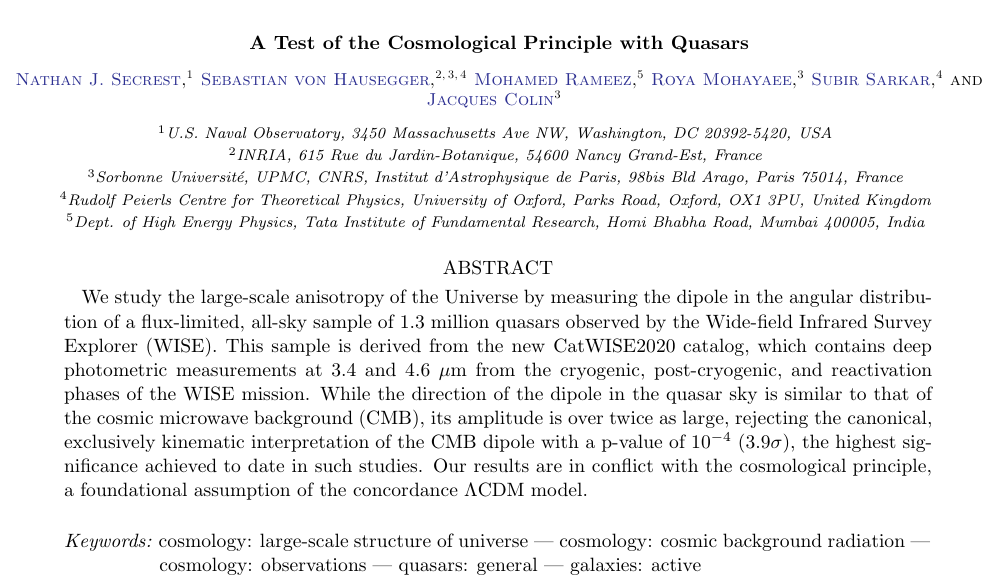
I’m not getting much time these days to even think about cosmology but Subir Sarkar drew my attention to an intriguing paper by his team so I thought I’d share it here. Here is the abstract and author list:

I find this an intriguing result because I’ve often wondered about the dipole anisotropy of the cosmic microwave background might not be exclusively kinematic in origin and whether they might also be a primordial contribution. The dipole (180°) variation corresponds to a ΔT/T of order 10-3, which a hundred times larger than the variation on any other angular scale. This is what it looks like:

This is usually interpreted as being due to the motion of the observer through a frame in which the cosmic microwave background is completely isotropic. A simple calculation then gives the speed of this motion using ΔT/T ≈ v/c. This motion is assumed to be generated by gravitational interaction with local density fluctuations rather than being due to anything truly cosmological (i.e. of primordial origin).

The features in the cosmic microwave background temperature pattern on smaller angular scales (the quadrupole, octopole, etc…) , which have ΔT/T of order 10-5 are different in that they are dominated by primordial density fluctuations. There should be a primordial dipole at some level, but the fact that these other harmonic modes have such low amplitudes and the assumption that the primordial dipole should be of the same order, combined with the fact that the CMB dipole does indeed roughly line up with the dipole expected to be generated by local inhomogeneities, has led to the widespread belief that this intrinsic dipole is negligible. This analysis suggests that it might not be.

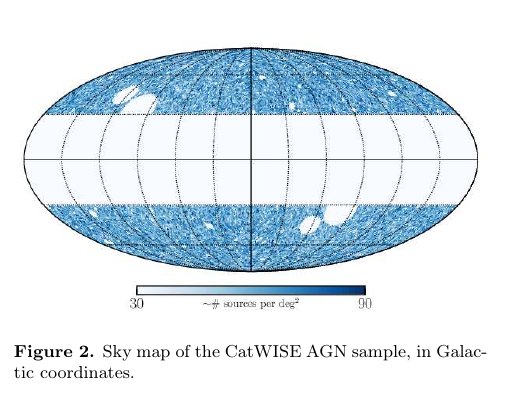
What the authors have done is study the anisotropy of a large sample of quasars (going out to redshifts of order three) finding the dipole to be larger than that of the CMB. Note however that the sample does not cover the whole sky because of a mask to remove regions wherein AGN are hard to observe:

As well as the mask there are other possible systematics that might be at play, which I am sure will be interrogated when the paper is peer-reviewed which, as far as I know, is not yet the case.

P.S. I might just quibble a little bit about the last sentence of the abstract. We know that the Universe violates the cosmological principle even in the standard model: with scale-invariant perturbations there is no scale at which the Universe is completely homogeneous. The question is really how much and in what way it is violated. We seem to be happy with 10-5 but not with 10-3

Update: On 23rd October Subir will be giving a talk about this an participating in a debate. For more details, see here.

Lecture Streaming

Posted in Education, Maynooth with tags , , , on October 7, 2020 by telescoper

When we were told, at the start of this term, to move all our teaching online my initial intention was to record most of the lectures in my office for the students to watch at their leisure rather than streaming them live.
The system we’re using, Panopto, allows for both webcast (i.e. live streaming) and pre-recorded (offline) videos. I thought that only very few students would want to watch the broadcast version. I have however changed my mind about this and am now streaming all my lectures (as well as recording them for later viewing). It also meant that I could record the lectures in advance at my without being constrained by the timetable.

Last week my office wasn’t usable for recording videos because of noise from building work so I had to find somewhere else to record the videos so I decided to go to the lecture theatre at the scheduled time primarily because I knew the room would be available at that time. When I started the first lecture I thought I might as well webcast it as well, thinking only a few students would tune in. In fact, out of my class of 45 or so second-year students, about 39 were online while I did the lecture. Since then I’ve done all the lectures live and plan to do so until further notice.

A handful of students even turn up in person to the lectures. I see no problem with this. The restrictions are designed to minimize as far as possible the number of students coming to campus, but if they are here anyway because of labs (which can’t be done virtually) then why shouldn’t they come to the lectures? (Provided, of course, that they follow the public health guidance, wear masks, wash their hands, practice social distancing, etc). I find their presence very helpful, actually. Talking to an audience is far easier than talking only to a camera. You do have to remember to look at the camera though!

It is possible to edit the webcast recording before sharing it with the students. That way you can get rid of all the mistakes, hesitations and other defective bits. Starting with a 50 minute lecture that usually means you end up with about 10 minutes of good material.

Having settled on this approach I was dismayed on Monday to find the Panopto system wasn’t working in either webcast or offline recording mode. I assumed at first that I was doing something wrong but it turns out it was a major outage affecting all of Europe that went on all day. Twitter was full of comments from academics complaining about! Panopto uses cloud storage with very little being held locally so when the connectivity fails the user is helpless. I did the lecture by Teams instead, but had lost some time faffing around trying to get Panopto to work.

Yesterday morning Panopto was back working and my office was quiet so I reran the lecture using the blackboard in my office and recorded it as an offline video. That way the students now have the lecture in the right space on the Moodle page. After that I did two more lectures as webcasts using Moodle – Tuesday is a busy teaching day this term – and everything worked fine.

I think there are two morals to be drawn from this. The first is not to assume that you know what students will find useful. The second is wherever possible to have a backup plan. Putting all your eggs in the basket marked Panopto is risky.

Astronomy Look-alikes No. 101

Posted in Astronomy Lookalikes, Television, The Universe and Stuff with tags , , , , , on October 6, 2020 by telescoper

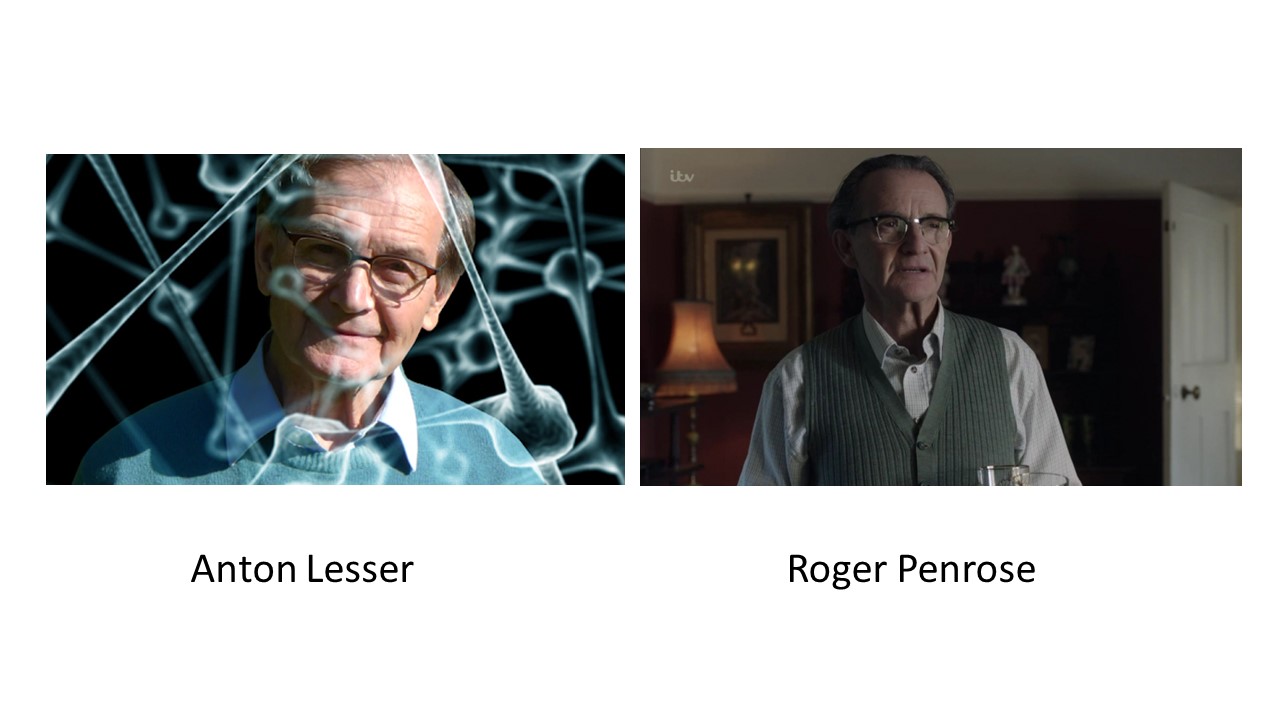
One winner of the 2020 Nobel Prize for Physics, Roger Penrose, is based in Oxford where he also plays Chief Superintendent Bright in the popular TV detective series Endeavour