Archive for September, 2021

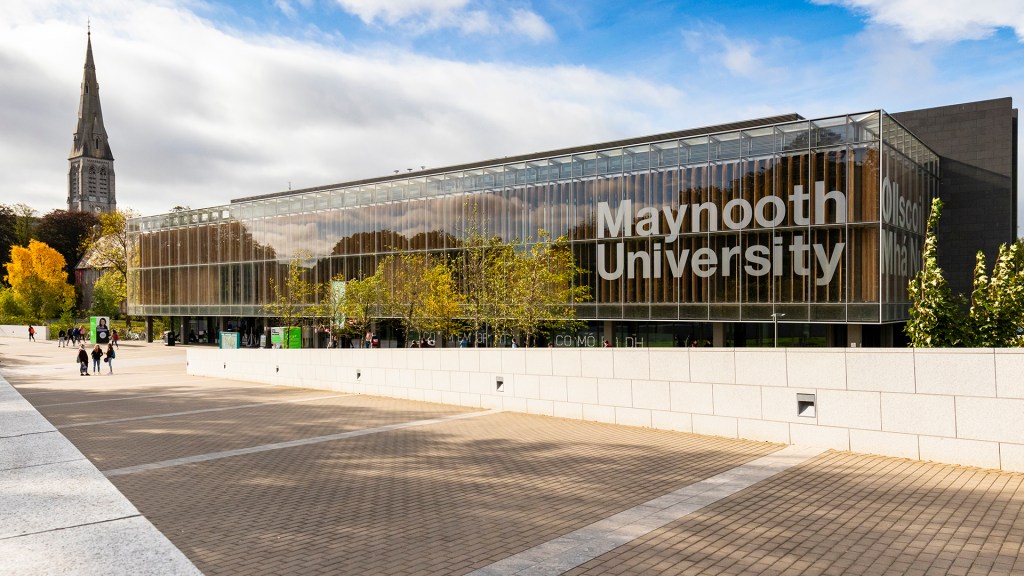
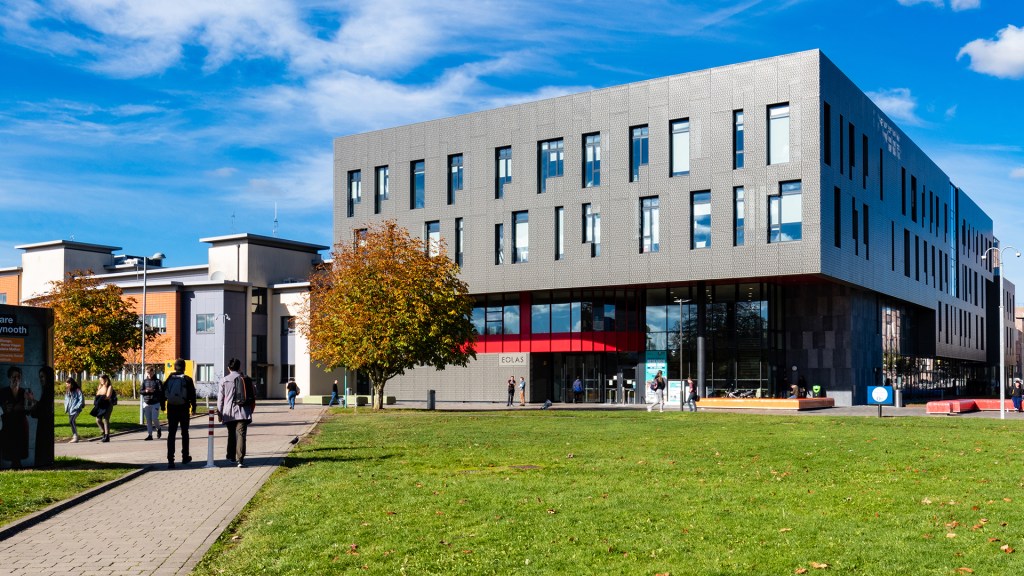
Views of Maynooth University Campus

Posted in Architecture, Education, Maynooth on September 16, 2021 by telescoper

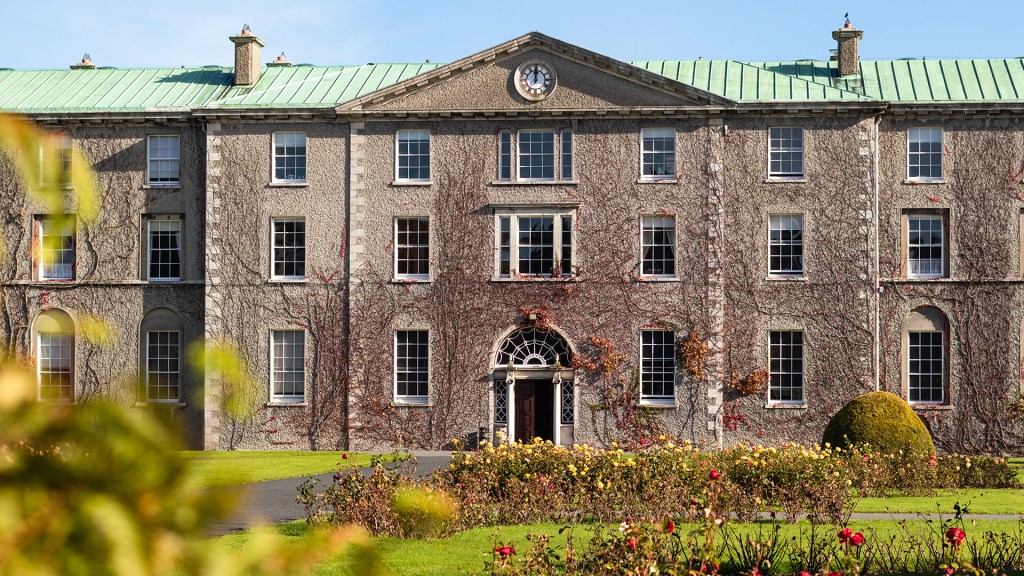
I’ve been spending a lot of time doing various webinars and the like to help welcome new students to Maynooth University for the new academic year. During the course of this I discovered we had some semi-official photographs to use as backgrounds for Zoom or Teams. I thought it might be fun to share a few of them here as they provide nice views of some of the buildings you might see while walking around campus…

New Publication at the Open Journal of Astrophysics

Posted in OJAp Papers, Open Access, The Universe and Stuff with tags , , , , , , on September 16, 2021 by telescoper

Time to announce another publication in the Open Journal of Astrophysics. This one is the ninth paper in Volume 4 (2021) and the 40th in all.

The latest publication is entitled Black Hole Shadow Drift and Photon Ring Frequency Drift. The authors are Emmanuel Frion (Helsinki), Leonardo Giani (Queensland) and  Tays Miranda (Jyväskylä).

Here is a screen grab of the overlay which includes the abstract:

You can click on the image to make it larger should you wish to do so. You can find the arXiv version of the paper here. This one is also in the folder marked Cosmology and Nongalactic Astrophysics; although primarily in general relativity and quantum cosmology (gr-qc) it is cross-listed in astro-ph so it eligible for publication with us.

The end of the summer has been heralded by the arrival at OJAp HQ of a number of revised versions so I expect to be publishing a few more papers in the next few weeks!

Thirteen Years in The Dark!

Posted in Biographical, The Universe and Stuff with tags on September 15, 2021 by telescoper

When I logged onto WordPress today I received a message that it was the 13th anniversary of my registration with them as a blogger, which is when I took my first step into the blogosphere; that was way back on 15th September 2008.

I actually wrote my first post on the day I registered but unfortunately I didn’t really know what I was doing on my first day at blogging – no change there, then – and I didn’t actually manage to figure out how to publish this earth-shattering piece. It was only after I’d written my second post that I realized that the first one wasn’t actually visible to the general public because I hadn’t pressed the right buttons, so the two appear in the wrong order in my archive.

If you’re interested in statistics then, as of 12.49 Irish Summer Time Today today, I have published 5634 blog posts posts and have received about 4.6M hits altogether. This varies in a very erratic fashion from day to day, but there has been a bit of a downward trend over the last few years, presumably because I’m getting older and more boring. The largest number of hits I have received in a single day is 8,864 (at the peak of the BICEP2 controversy).

There have been 37,465 comments published on here and 2,795,394 rejected by the spam filters. The vast majority of the rejected comments were from bots, but a small number have been removed for various violations, usually for abuse of some kind. And, yes, I do get to decide what is published: it is my blog!

While I am on the subject of comments, I’ll just repeat here the policy stated on the home page of this blog:

Feel free to comment on any of the posts on this blog but comments may be moderated; anonymous comments and any considered by me to be abusive will not be accepted. I do not necessarily endorse, support, sanction, encourage, verify or agree with the opinions or statements of any information or other content in the comments on this site and do not in any way guarantee their accuracy or reliability.

It does mean a lot to me to know that there are people who find my ramblings on this `shitty wordpress blog’ interesting enough to look at, or even read, and sometimes even to come back for more, so I’d like to take this opportunity to send my best wishes to all those who follow this blog!

The last twelve years have been eventful, to say the least, both personally and professionally. I started blogging not long after I’d moved into my house in Pontcanna, Cardiff. Since then I moved to Sussex, then back to Cardiff, and now to Ireland. More importantly we’ve seen the discovery of the Higgs Boson and gravitational waves, both of which resulted in Nobel Prizes, as did the studies of high-redshift supernovae. The Planck mission mission was launched, did its stuff, and came to a conclusion in this time too. Science has moved forward, even if there are many things in this world that still seem to be going backwards.

Reminder of talk today!

Posted in Open Access with tags , on September 14, 2021 by telescoper

Beards, Boxing and Bullshit

Posted in Beards, Sport with tags , , on September 14, 2021 by telescoper

I found out today that this year an IgNobel Prize has been awarded for a paper on Impact Protection Potential of Mammalian Hair: Testing the Pugilism Hypothesis for the Evolution of Human Facial Hair which was actually published last April in the journal Integrative Organismal Biology. This seems to be a bona fide academic journal, though apparently not one that has very high standards.

Anyway, the abstract reads:

Because facial hair is one of the most sexually dimorphic features of humans (Homo sapiens) and is often perceived as an indicator of masculinity and social dominance, human facial hair has been suggested to play a role in male contest competition. Some authors have proposed that the beard may function similar to the long hair of a lion’s mane, serving to protect vital areas like the throat and jaw from lethal attacks. This is consistent with the observation that the mandible, which is superficially covered by the beard, is one of the most commonly fractured facial bones in interpersonal violence. We hypothesized that beards protect the skin and bones of the face when human males fight by absorbing and dispersing the energy of a blunt impact. We tested this hypothesis by measuring impact force and energy absorbed by a fiber epoxy composite, which served as a bone analog, when it was covered with skin that had thick hair (referred to here as “furred”) versus skin with no hair (referred to here as “sheared” and “plucked”). We covered the epoxy composite with segments of skin dissected from domestic sheep (Ovis aries), and used a drop weight impact tester affixed with a load cell to collect force versus time data. Tissue samples were prepared in three conditions: furred (n = 20), plucked (n = 20), and sheared (n = 20). We found that fully furred samples were capable of absorbing more energy than plucked and sheared samples. For example, peak force was 16% greater and total energy absorbed was 37% greater in the furred compared to the plucked samples. These differences were due in part to a longer time frame of force delivery in the furred samples. These data support the hypothesis that human beards protect vulnerable regions of the facial skeleton from damaging strikes.

E A Beseris, S E Naleway, D R Carrier
Integrative Organismal Biology, Volume 2, Issue 1, 2020

This study has attracted a number of silly headlines such as “Big manly beards evolved so we could take punches to the head, study says” and a rebuke from the Beard Liberation Front.

My main problem with the article are (i) that the study itself is very flawed and, worse, (ii) that the claims made of a link to evolution are clearly bullshit; the latter is especially disappointing because the connection to evolution was explicitly caimed by biologists, who really ought to know better.

On point (i) I’ll just point out that the experiment didn’t involve beards or punching. The team built models – sixty of them – made of fibres and epoxy resin to represent human bone, covered in sheepskin to mimic facial hair. Those models were either ‘furred’ (‘full beard’ with 8cm-long hairs), ‘sheared’ (0.5cm length ‘trimmed beard’) or ‘plucked’ (‘hairless’ shaven face). Human hair follicles are four times as thick as those from sheep, but five times less densely packed, so a fleece roughly approximates a beard. The biologists then used a mechanical striker to repeatedly drop a 4.7kg weight onto each model to measure the impact and record the damage.

The results showed that furred models were better than both sheared and plucked models at taking the ‘punch’: a beard will absorb 37% more energy than a shaven face, for example, partly because springy hairs serve as suspension to slow down and soften the blow. As the researchers explain, “the greatest advantage offered by the hair is that it distributes the force of impact over a longer time frame”.


The problem is that this experiment isn’t at all realistic. Dropping a load onto a solid object would simulate hitting a dummy rather than a person; the latter can roll with a punch, the former cannot. In addition, many punches thrown in fights – as opposed to the boxing ring – are not straight to the chin but some variation of the hook that hits the side of the head causing it to rotate. Now allowing the models to rotate is a significant flaw in the experiment.

But the bigger problem with the study is (ii), that its results are interpreted as evidence for evolution on the grounds that facial hair represents a form of ‘sexual dimorphism’ leading to the suggestion that certain facial features evolved as a result of competitive fighting between human males .There is then the idea is that, just as a lion’s thick mane covers vital regions such as the jugular vein, beards help protect against potentially lethal punches to the throat and jaw. This is the so-called ‘pugilism hypothesis’ (from the Latin pugil, pugilis meaning a boxer) and this study says nothing at all about whether or not this is true. Even if you think the experiment is realistic, its results shed no light on the pugilism hypothesis. That is not a matter that can be settled by biomechanics but has to involve evolutionary biology, and specifically how the trait in question might have evolved through natural selection.

Charles Darwin’s 1871 book The Descent of Man discusses hair in great detail but didn’t make the mistake of equating the lion’s mane with human hair: although he argued that the thick hair of various mammals might provide protection in fights between competing males, he believed that human facial hair is a ‘secondary sexual character’ that evolved as a result of female preferences, and rightly pointed out that human populations differ in their ability to grow thick beards — not something you would expect if facial hair has a protective function. Not every biological feature is the result of natural selection either: a given characteristic could be an adaptation that evolved for a specific function, but it could also have no “purpose:

Anyway in reading this silly article I became interested in beards in boxing, given that boxers are generally clean-shaven. A ban on beards in boxing has been in place in many forms of the sport and still is in, for example, the Olympics. There has been recent discussion about a beard ban being a form of discrimination against, say, Sikh boxers and the amateur sport. I think beards are only allowed in professional boxing if both sides agree.

So why would anyone forbid a boxer to wear a beard? I don’t buy the argument about a beard cushioning a punch, for the reasons outlined above and for the fact that the gloves play the role of “distributing the force of impact” far more effectively than a beard would. Some have argued that a full beard may make it difficult for an opponent to locate the line of the jaw and hence strike the wearer’s chin. Another suggestion is that a beard would conceal cuts and bleeding and possible hinder medical attention.

I’m not sufficiently expert to say whether any of these are reasonable, but reading an article like this one by promoter Frank Warren convinces me that the major factor in the beard ban is just an irrational aversion to beards among the boxing hierarchy. In other words, pogonophobia.

One week to go…

Posted in Education, Maynooth on September 13, 2021 by telescoper

It’s Monday 13th September 2021 which means that teaching begins a week today. Gulp.

We still don’t really have any idea how many students we’ll have on our courses in the first year. The 2021 Leaving Certificate Results only came out on Friday 3rd September and the first round of CAO offers went out last week (on Tuesday 7th). Today at 3pm is the deadline for accepting these offers, so we expect to have some reasonably firm information later this week. There are two more rounds of CAO offers, though, so there may be some late arrivals.

This week we’re having some orientation and induction sessions for the new students. I recorded several videos to help students make their choices and am doing two live webinars about Mathematical and Theoretical Physics. I’m not doing one for our denominated Theoretical Physics & Mathematics programme because students on that do not have options in the first year. There’s also a live online Q&A session.

Lectures for first-year students don’t start until 27th September (two weeks from today) but there will probably be quite a few students who accept their places this week and would be able to start with the rest of the students next Monday. I think we’ll devise some optional sessions for them to keep them amused until teaching starts in proper.

Meanwhile the returning students (second, third and fourth years) have been enrolling. That seems to have gone alright and we now have a good idea how many we’ll have in those classes.

Unfortunately we still have the problem I’ve already, mentioned that for visa reasons we’re short of a member of staff, who is likely to have to start giving his lectures remotely. He has been allocated one second year and one third year module. I’ll wait a day or two to see if his visa comes through and if not inform the students that these lectures will be online. I suspect the students won’t be happy but it’s out of my hands. The visa application has been waiting for months for an answer from the Immigration Service in Ireland, which is a very poor level of performance by them.

The Self on the Shelf

Posted in Biographical, Books with tags , on September 12, 2021 by telescoper
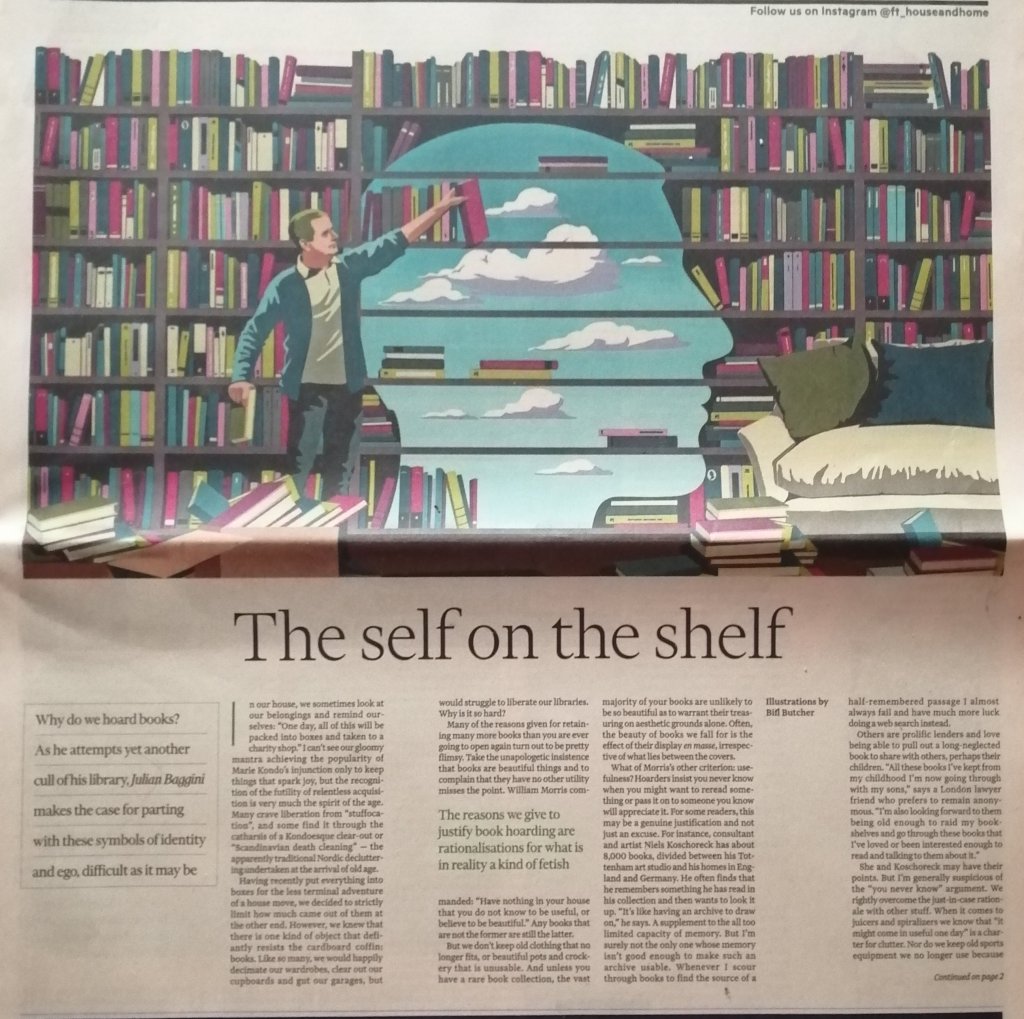
Financial Times Weekend Edition

In this Weekend’s Financial Times there is an article (above) about why some of us find it hard to throw away old books. This range home to me because the work involved in packing and shipping my possessions to Ireland recently would have been considerably reduced had I thrown away my books, all 25 boxes of them. The removers who did the packing mentioned that they dislike packing books because it takes so long. You have to use small boxes otherwise they are too heavy to shift but mainly it’s because books aren’t all the same size so it can be awkward to pack them efficiently.

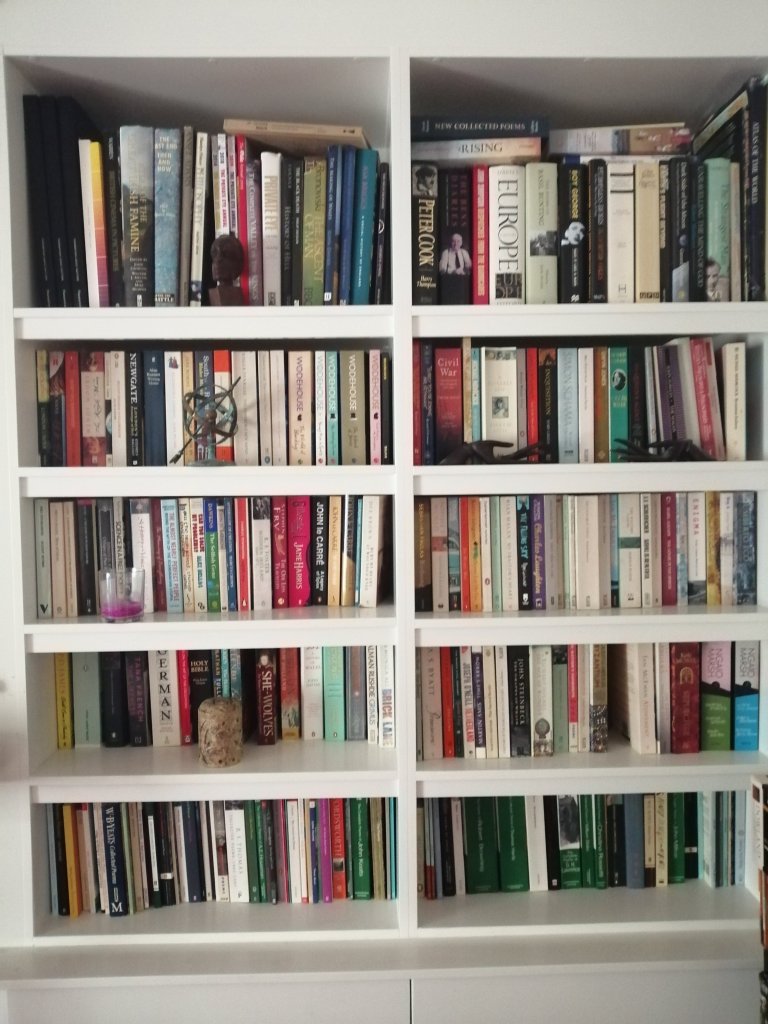
Anyway, it would have been a lot easier not to have bothered moving them and , but I just find it very difficult throw books away. So there they are on my shelves (or part of them).

They’re arranged somewhat randomly because I just put them wherever they would fit. This is the packing problem in reverse: it’s hard to organize books by theme or author when they can differ so much in dimension that they don’t fit. For this reason I tend to arrange books by height but I can usually remember the size and cover colour so I can find them quite quickly.

The various gaps are because some books are currently on loan friends while another is on my bedside cabinet (as I realized when I was unpacking that I hadn’t read it yet and am now doing so).

My house in Maynooth came equipped with a large selection of bookshelves. Above you see half the shelves in my sitting room. The hallway is also lined with built-in bookcases; the spare room has a set of similar shelves and my study has four standalone bookcases (of the ‘Billy’ variety, for those of you familiar with Ikea). I also have a small bookcase unit in the kitchen in which I keep cookery and gardening books. All of these are full (or nearly full). That amounts to well over a thousand books altogether – and no, they’re not mainly dictionaries.

So why do I have so many books?

The FT article hits on some of the reasons. There are definitely some that I consult regularly, for different reasons. Reference books such as dictionaries are obvious examples. I also have quite a few old maths and physics textbooks which I keep because they’re useful sources of homework problems and exam questions. I dip into poetry books quite regularly too as one can read a couple of poems at a time; I have a habit of putting a volume of poetry in my pocket when I travel on the bus or train. Quite a few of these and other books have scribbles in the margins, another habit of mine.

Other books I keep because they remind me of the experience of reading them. Just as you might keep a souvenir of a visit to a foreign land, a book is a memento of a journey of the mind. That doesn’t explain however why I tend to keep books I’ve read but didn’t enjoy!

Among the other ideas suggested in the FT article is that a library of books is that they are statement of identity or even a form of bragging: you display them to impress visitors to your house with your intellect and erudition. I don’t think that works for me, though, as I don’t have many visitors and didn’t even before the pandemic. In any case I think most people aren’t likely to be “impressed” by stacks of books – they’re more likely to think you’re a weirdo.

But there’s another reason missed by the analysis in the Financial Times and that is that books actually look quite nice on shelves. Covering a wall in that way saves you the bother of having to paint it!

Musée des Beaux Arts

Posted in Art, Poetry with tags , , , on September 11, 2021 by telescoper

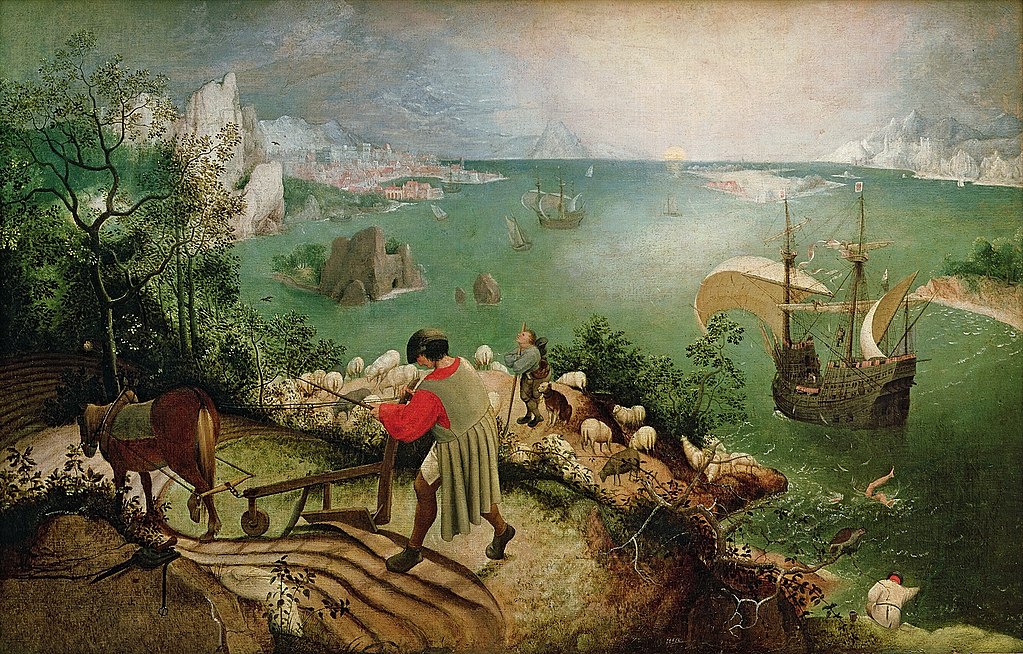
Reminiscing about the events of twenty years ago I was reminded of this poem by W.H. Auden, arguably his greatest, which for some reason I have never posted before. The painting referred to in the second part of the poem is Landscape with the Fall of Icarus by Pieter Bruegel the Elder which is in the Musée des Beaux Arts in Brussels, a visit to which inspired Auden to write this poem in 1938. I remember being quite amused when I saw it in the same gallery about 15 years ago, because it took me a while to spot Icarus! It made me think of one of those Where’s Wally cartoons…

About suffering they were never wrong,
The old Masters: how well they understood
Its human position: how it takes place
While someone else is eating or opening a window or just walking dully along;
How, when the aged are reverently, passionately waiting
For the miraculous birth, there always must be
Children who did not specially want it to happen, skating
On a pond at the edge of the wood:
They never forgot
That even the dreadful martyrdom must run its course
Anyhow in a corner, some untidy spot
Where the dogs go on with their doggy life and the torturer's horse
Scratches its innocent behind on a tree.

In Breughel's Icarus, for instance: how everything turns away
Quite leisurely from the disaster; the ploughman may
Have heard the splash, the forsaken cry,
But for him it was not an important failure; the sun shone
As it had to on the white legs disappearing into the green
Water, and the expensive delicate ship that must have seen
Something amazing, a boy falling out of the sky,
Had somewhere to get to and sailed calmly on.

Memories of 9/11

Posted in Biographical, Politics with tags , , on September 11, 2021 by telescoper

Today is 11th September 2021 which means it is exactly twenty years since the terrorist attacks on the World Trade Centre and the Pentagon which led to the loss of almost three thousand civilian lives (and many more in the longer term). At the risk of contributing to the deluge of (mainly mawkish) reminiscences about the happenings on this day a decade ago, let me just give a brief account of my recollection. The events of 9/11 are, I suspect, etched on many a memory in much the same way as people remember what they were doing when President Kennedy was assassinated.

For what it’s worth, I was actually at a conference on that day. It was called A New Era in Cosmology, and was hosted in the fine city of Durham; in fact one of the organizers was a certain Tom Shanks, an occasional commenter on this blog. Above you will see part of the conference poster which I took from a recent Facebook post by him where I also found the text below. I was also reminded that 9/11 was the first day of that meeting and that I gave a talk on the first morning, the last before lunch. Such was the effect of the events that unfolded that day that I had completely forgotten about that.

What I do remember is sitting near the back of the lecture theatre after we returned from lunch, listening to one of the afternoon talks – I can’t remember who it was by – when a dear friend of mine, Manuela, came into the auditorium and walked down the aisle, stopped by me. She tugged my arm, mumbled something about the “Twin Towers” and then ran back up the stairs and out of the lecture theatre. Thinking it was something to do with Wembley Stadium, I followed her out and she explained what had happened. We found a TV set, around which a crowd had already formed. The coverage was, not surprisingly, shambolic and it was not until late afternoon that the scale of what had happened became clearer.

There were rumours of more planes likely to be involved in attacks and discussions about whether the military might have to shoot down civilian aircraft. Fortunately that wasn’t the case. I had a friend visiting New York at the time and was unable to contact her by mobile, so was worried, but I don’t think anyone was able to contact anyone in New York by mobile phone in those hours and it turns out she was fine.

Meanwhile the other participants were informed about the events on the other side of the Atlantic. It was an international conference with many US-based attendees who were understandably worried. The preface to the conference proceedings reveals that discussions were held about whether to cancel the meeting:

I think it was the correct decision to proceed with the conference, including the conference dinner and all that. As it happened all passengers flights were grounded for several days anyway, so nobody could get home who didn’t live in the UK.

The rest of the conference was pretty much business as usual as far as possible, although as the text above explains we did stand in silence in memory of the victims on the Thursday morning. When the meeting ended on the Friday quite a few people had to stay on in Durham or elsewhere before being able to fly home. It was this event that led to the heightened security measures at airports that we have been living with since then.

The loss of human life, though awful, turned out to be much less than had been feared and was subsequently dwarfed by the hundreds of thousands killed in the “War on Terror” set in motion by the events of that day. Will the recent withdrawal of US troops from Afghanistan lead to further attacks of this sort?

Anyway, my point is not the politics but to invite a bit of audience participation. Would anyone else like to contribute their memories from that fateful day? If so, the comment box awaits your entry…

Trepidation

Posted in Biographical, Covid-19, Education, Maynooth on September 10, 2021 by telescoper

I spent most of today in various virtual meetings to do with next Semester’s teaching which is due to start on September 20th for returning students (and a week letter for first-years). I’ve also been keeping an eye on the student record system, as the returning students have started to register. We don’t expect most first-years to start enrolling until next week, although I did see a few early acceptances coming through…

One of the meetings I had today was about how to handle the first-year “Omnibus” science course in which some of the modules are taught in large classes which have to be held remotely and others in smaller groups which will be in person. One of the complications is if students have, say, two lectures online, which they can view at home, will they really travel to campus to attend another one in person? And if they have an online lecture immediately before or after an in-person one, where will they view it if they haven’t got time to get between home and campus (or vice versa)?

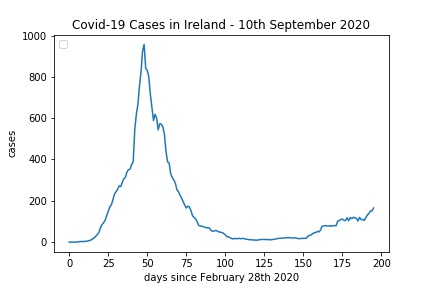
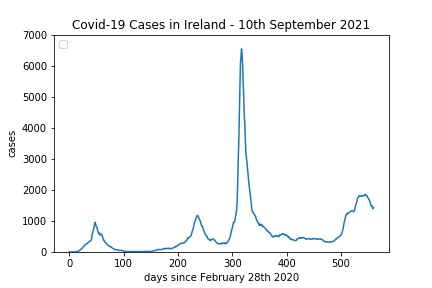
All this reminded me of similar discussions we had at this time last year. Back then all the plans came to naught anyway because everything went online anyway a few weeks into term as infections rose (see left panel below):

Today 1620 new cases of Covid-19 were reported in Ireland. On this day last year the number was 196 I keep a full record here where you will see that between 10th September 2020 and 10th September 2021 3,378 deaths were recorded, most of them resulting from the big spike that followed Christmas. There is evidence of a dip right now, which is sincerely hope continues, but to me the rate of infections is alarmingly high. If infections start to climb then they’ll be starting from a much higher level than last year.

Of course we now have vaccines and the good news is that it seems that well over 90% of those over the age of 18 in Ireland will have been vaccinated by the start of term but with the Delta variant in circulation will this be enough?

At least we have had a significant change in the wording given to students: masks are now “mandatory” in lecture theatres.

I still think there’s a significant chance we have to revert to online teaching just as we did last year. Looking on the bright side at least we know how to do that now, as we’ve done it before.

But that’s enough worrying for this week. I’m now going to have a glass of wine and cook myself some dinner. Sautéed chicken with Cavolo Nero and Parmesan, in case you were wondering.