Archive for February, 2022

Sins of Omission

Posted in The Universe and Stuff with tags , , , , , on February 20, 2022 by telescoper

There’s a paper recently published in Nature Astronomy by Moreno et al, which you can find on the arXiv here. The title is Galaxies lacking dark matter produced by close encounters in a cosmological simulation and the abstract is here:

The standard cold dark matter plus cosmological constant model predicts that galaxies form within dark-matter haloes, and that low-mass galaxies are more dark-matter dominated than massive ones. The unexpected discovery of two low-mass galaxies lacking dark matter immediately provoked concerns about the standard cosmology and ignited explorations of alternatives, including self-interacting dark matter and modified gravity. Apprehension grew after several cosmological simulations using the conventional model failed to form adequate numerical analogues with comparable internal characteristics (stellar masses, sizes, velocity dispersions and morphologies). Here we show that the standard paradigm naturally produces galaxies lacking dark matter with internal characteristics in agreement with observations. Using a state-of-the-art cosmological simulation and a meticulous galaxy-identification technique, we find that extreme close encounters with massive neighbours can be responsible for this. We predict that approximately 30 percent of massive central galaxies (with at least 1011 solar masses in stars) harbour at least one dark-matter-deficient satellite (with 108 – 109 solar masses in stars). This distinctive class of galaxies provides an additional layer in our understanding of the role of interactions in shaping galactic properties. Future observations surveying galaxies in the aforementioned regime will provide a crucial test of this scenario.

It’s quite an interesting result.

I’m reminded of this very well known paper from way back in 1998, available on arXiv here, by Priya Natarajan, Steinn Sigurdsson and Joe Silk, with the abstract:

We propose a scenario for the formation of a population of baryon-rich, dark matter-deficient dwarf galaxies at high redshift that form from the mass swept out in the Intergalactic Medium (IGM) by energetic outflows from luminous quasars. We predict the intrinsic properties of these galaxies, and examine the prospects for their observational detection in the optical, X-ray and radio wavebands. Detectable thermal Sunyaev-Zeldovich decrements (cold spots) on arc-minute scales in the cosmic microwave background radiation maps are expected during the shock-heated expanding phase from these hot bubbles. We conclude that the optimal detection strategy for these dwarfs is via narrow-band Lyman-α imaging of regions around high redshift quasars. An energetically scaled-down version of the same model is speculated upon as a possible mechanism for forming pre-galactic globular clusters.

It’s true that the detailed mechanism for forming dwarf galaxies with low dark matter densities is different in the two papers, but it does show that the issue being addressed by Moreno et al. had been addressed before. It seems to me therefore that the Natarajan et al. paper is clearly relevant background to the Moreno et al. one. I always tell junior colleagues to cite all relevant literature. I wonder why Moreno et al. decided not to do that with this paper?

Had Moreno et al. preprinted their paper before acceptance by Nature Astronomy I’m sure someone would have told them of this omission. This is yet another reason for submitting your papers to arXiv at the same time as you submit them to a journal rather than waiting for them to be published.
Personal and Postdoctoral Choices

Posted in Biographical, Brighton on February 19, 2022 by telescoper

Over the past week or so I’ve noticed quite a lot of discussion on social media about postdoctoral fellowship positions. These positions are scarce compared to the number of eligible applicants so competition is quite intense. Applications are usually required around November for a start the following year: those lucky enough to have been offered such a position to start in September or October usually have to accept or decline around this time of year; those lucky enough to receive more than one offer have to pick which one they want to accept so that those on a waiting list can be contacted. It’s a nervous time for early career researchers, particularly in the USA where there are few opportunities outside this cycle.

Seeing all these exchanges on Twitter reminded of this time of year in 1988. I was in the last the last year of my PhD DPhil at Sussex – there was only three years’ funding in those days – and had applied before Christmas 1987 for postdoc positions to start in September or October1988. I was fortunate to receive several offers, including one to stay at Sussex.

There was a big complication in my case. I have never written about this on the blog but during the last year of my PhD I was helping to care for a friend who was terminally ill. The medical people couldn’t say how long he would live but said it would be months rather than years. When it came to February 1988 and I had to make a choice, I felt I had no alternative but to make a decision that would allow me to continue to help as long as was necessary if my friend lived past September, rather than abandon him. Accordingly I accepted the position at Sussex and decline the others.

As it happened my friend passed away (peacefully) about six weeks later, but by then I’d made the decision and there was no going back.

I do generally advise younger researchers that moving away from the institute in which they did their graduate studies is generally a good idea in order to broaden your experience. Given that, people have sometimes asked me in person why I decided to stay at Sussex and I usually tell them what I’ve written above.

I have absolutely no regrets about the decision. Sussex was a very good place to be a postdoctoral researcher anyway and things worked out very well for me in the end, career-wise. I also felt I’d done the right thing based on how the situation stood at the time I made the decision.

The point of this post is that you shouldn’t be afraid of including personal considerations in your career choices. We’re all people, not robots. And if you’re that others might think your decision is strange then remind yourself that it’s your life, not theirs. In the end the only person you need to justify yourself to is yourself.

Wind, by Ted Hughes

Posted in Poetry on February 18, 2022 by telescoper

This house has been far out at sea all night,
The woods crashing through darkness, the booming hills,
Winds stampeding the fields under the window
Floundering black astride and blinding wet

Till day rose; then under an orange sky
The hills had new places, and wind wielded
Blade-light, luminous black and emerald,
Flexing like the lens of a mad eye.

At noon I scaled along the house-side as far as
The coal-house door. Once I looked up –
Through the brunt wind that dented the balls of my eyes
The tent of the hills drummed and strained its guyrope,

The fields quivering, the skyline a grimace,
At any second to bang and vanish with a flap;
The wind flung a magpie away and a black-
Back gull bent like an iron bar slowly. The house

Rang like some fine green goblet in the note
That any second would shatter it. Now deep
In chairs, in front of the great fire, we grip
Our hearts and cannot entertain book, thought,

Or each other. We watch the fire blazing,
And feel the roots of the house move, but sit on,
Seeing the window tremble to come in,
Hearing the stones cry out under the horizons.

by Ted Hughes (1930-98)


They think it’s all over…

Posted in Biographical, Covid-19, Education, Maynooth on February 18, 2022 by telescoper

This afternoon it was announced that the Government of Ireland would be accepting the latest advice from the National Public Health Emergency Team (NPHET) to wind down most of the remaining Covid-19 restrictions from 28th February 2002. The first officially recognized Covid-19 case in Ireland was reported on March 1st 2020, so that will be two years after the arrival of the pandemic here.

The decision means that face masks will no longer be required on public transport or in shops or in schools, though they will be mandatory in hospitals and other health-care settings. I assume this extends to universities too. Likewise limits on social distancing. The Chief Medical Officer has also announced that PCR testing will no longer be performed for anyone under the age of 55. It seems that even NPHET itself is to be phased out.

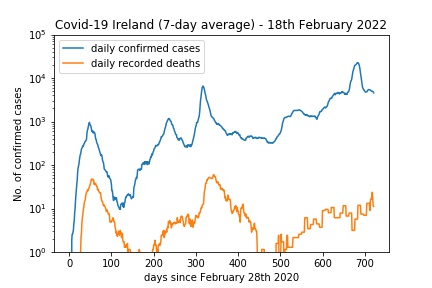
I know many people will be celebrating the end of these restrictions, but in case you need reminding here are the latest figures for Covid-19 in Ireland:

PCR-confirmed new cases are still running at 4500+ per day (almost double that if you include self-reported antigen tests). That means medically vulnerable people would be at risk of infection if those around them are not wearing masks. Masks protect others more than they protect the wearer so allowing the wearing of face masks to be discretionary puts such people in danger. For this reason I for one will be continuing to wear a face covering in shops, on buses, etc for the foreseeable future.

I don’t mind this – it was widespread practice in Asia long before the Coronavirus pandemic – and just can’t understand the extreme anti-maskers who liken the wearing of a face covering to being put in a concentration camp. I just hope we don’t get situations in which those who choose to wear a mask on, say, a bus get picked on by those who don’t.

At the moment in the Department of Theoretical Physics at Maynooth the situation is that a significant fraction of our students are staying away from lectures because of illness or self-isolation and one lecturer is having to do his teaching remotely. That’s not too bad; I feared much worse. I think other Departments have worse problems, missing demonstrators and tutors who are unable to come on campus.

The logic behind scrapping these restrictions is that despite the high case numbers the vaccination programme (helped, perhaps by the ‘milder’ omicron variant) does seem to have succeeded in keeping hospitalizations and deaths at a much lower level than in previous waves. Implicitly the strategy is to let Covid-19 wash over the population without worrying that the Health Service will be overwhelmed. My main worry now is what if another variant emerges after we have let our guard down?

A Topical Nursery Rhyme

Posted in Poetry on February 17, 2022 by telescoper

I’ve always been fascinated by Nursery Rhymes. Some people think these are little more than nonsense but in fact they are full of interesting historical insights and offer important advice for the time in which they were written. One such poem, for example, delivers a stern warning against the consequences of placing sleeping babies in the upper branches of trees during windy weather.

In the light of recent events I thought I would continue this old tradition by posting a nursery rhyme of topical relevance. Here it is:

Verse:

The Grand Old Duke of York
He gave twelve million quid
To a girl he never met
For a thing he never did.

Chorus:

And when he was up he **censored**

Say hello to ar5iv!

Posted in Open Access with tags , , , on February 16, 2022 by telescoper

Yesterday I stumbled across a new thing which I think is very cool.

Usually if you want to read a paper posted on arXiv you have to view, e.g. a PDF file. Now someone has set up a facility to view every article as a modern HTML5 page. To use this function you just need to change the “X” in the link to an arXiv paper to a “5” and you can view the whole paper, equations and all, in your browser as a web page.

You can check this out using a recent paper from the Open Journal of Astrophysics:

Here is the standard arXiv link to the paper:

https://arxiv.org/abs/2107.05639v2

Now try looking at

https://ar5iv.org/abs/2107.05639v2

I have found a few conversion errors using this facility but I assume these can be ironed out in due course. Now I have to persuade Scholastica to let us link to the ar5iv versions of OJAp papers (although I think the plan is to integrate ar5iv with arXiv at some point).

Attack of the Rooks

Posted in Biographical, Maynooth on February 15, 2022 by telescoper

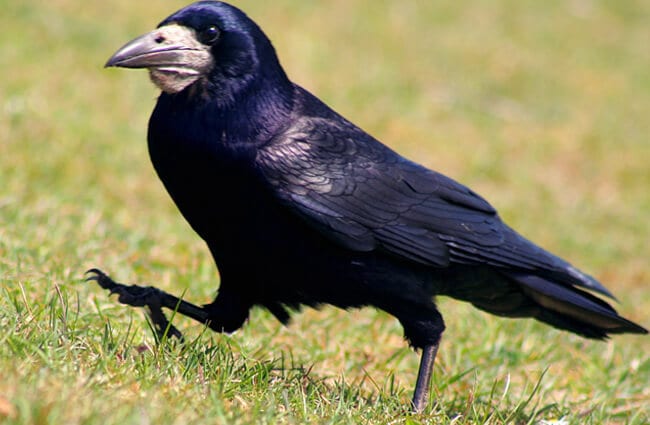
In this recent spell of rather cold weather I’ve been especially careful to keep the garden birds well nourished by deploying various feeders around the place. My fat balls are proving particular popular with the birds, but I won’t dwell on that here.

A few weeks ago a solitary rook started visiting my garden. I felt a bit sorry for this bird as it seemed to be on its own and was too big and clumsy to feed off the seed and peanut dispensers. Rooks always look a big glum to me. Eventually this figured one out how to dislodge one of the feeders from its usual place so it crashed to the floor and spilled seed all over the lawn, some of which it ate.

There then followed a sort of arms race. First I attached the feeder more securely to its existing site. The rook again managed after some time to knock it down. Then I moved it somewhere else, only for it to appear on the ground once more. Then I found a place where I could hang it between two branches of a tree in such a way it would be impossible to dislodge. This clearly frustrated the rook and again I felt sorry for it, but only for a short time.

A few days later I looked out in the garden and saw not just one rook but a whole crowd of them five or six in number, no doubt the local gang had been pressed into service. They proceeded to jump up and down on the branches of the tree until both snapped off completely, again dislodging the feeder.

I know I should admire the quality of the teamwork – a characteristic of the Corvid family – but at this rate the trees in my garden are going to be reduced to stumps. I’m not sure what I can do next.

There’s no doubt that rooks are hooligans, but at least they’re not taking all the food. I have two other dispensers that are positioned in such a way that only the little critters can get at them. So far. I’ve had all kinds of tits and finches as well as sparrows and starlings and pigeons as well as the rooks’ slightly less troublesome cousins, jackdaws and magpies.

A Peer Review Poll

Posted in Open Access on February 14, 2022 by telescoper

A long time ago I posted a poll to see what people think about the issue of peer review. Now seems a good time to circulate it again.

In previous posts (e.g. this one) I had advanced the view that, at least in the subject I work in (astrophysics), while in its usual form peer review does achieve some degree of quality control, it is by no means perfect. Some good papers get rejected and some poor papers get accepted. Moreover, the refereeing is usually done for free by members of the academic community while journal publishers use peer review as a justification for levying publication charges in that it provides added value to the publication process – a view I disputed here.

Any system operated by humans is bound to be flawed to some extent, but the question is whether there might be a way to improve the system so that it is fairer and more transparent.

I suggested that it could be replaced by a kind of crowd-sourcing, in which papers are put on an open-access archive or repository of some sort, and can then be commented upon by the community and from which they can be cited by other researchers. This would, if you like, be a sort of “arXiv plus” – good papers would attract attention and poor ones would disappear.

We did consider having open peer review of the sort mentioned above for the Open Journal of Astrophysics but this option was not available for the no-frills off-the-shelf Scholastica platform we went for so we now operate a version of the traditional peer review system. This achieves some level of gate-keeping but also (and much more importantly, in my view) makes constructive criticism to allow authors to improve their papers. We also discussed publishing referee reports alongside the papers, but that is also beyond the scope of our current system (and would of course require the consent of referees).

I have no idea really how strongly others rate the current system of peer review. The following poll is not very scientific, but ‘ve tried to include a reasonably representative range of views from “everything’s OK – let’s keep the current system” to the radical suggestion I make above.

A Message of Solidarity

Posted in Education, Politics with tags , , , on February 14, 2022 by telescoper

Today members of the Universities and Colleges Union (UCU), which represents academic staff in UK universities, begin ten days of strike action over cuts to pensions, pay and working conditions.

I know it doesn’t help very much, but I’d like to take this opportunity to wish all the strikers well and express solidarity and support for their wholly justified action.

Universities affected by the strike include three that I’ve actually worked in: Sussex, Nottingham and Queen Mary, University of London. I understand that a large majority of those voting in the ballot at Cardiff were in favour of industrial action but there were insufficient responses to meet the legal threshold for a strike to be lawful.

Third Level Ireland – The Core Problem

Posted in Biographical, Education, Maynooth, Politics with tags , on February 13, 2022 by telescoper

One of the things I noticed straight away when I moved from the UK to my current job in Ireland is how under-resourced the Irish higher education system is. That realization was driven home still further by the Covid-19 pandemic during which those of us working in Irish universities had to switch to online teaching with precious little support.

Academic staff worked very hard to keep going during the various lockdown periods, but I’m sure I’m not the only person to feel deep regret that we were unable to do things better and that many students have a right to feel they have been let down by the system.

Now that we’re back teaching on campus the problems have not gone away. With a significant number of students prevented from attending lectures by the need to self-isolate we should be making recordings or live streams available, but we lack the equipment to do so properly. I have to carry a webcam and a tripod around campus to record my classes in improvised and not very satisfactory fashion. Contrast with the UK, where proper lecture capture facilities were commonplace in universities long before the pandemic. We are at least a decade behind.

This is one example of a deep crisis in the Irish third level system. Sadly it is by no means clear that the current Government is interested in solving it. There is talk of reducing the “student contribution” (currently €3000, the highest in the EU) because of the cost-of-living crisis but cutting this tuition fee (which is effectively what it is) would reduce the money coming into higher education unless offset by an increase in Government funding. According to this report (from November 2019), core state funding per student in third level institutions fell from about €9K in 2009 to under €5K in 2019.

A sizeable fraction of the income of a university is spent on its staff. In Ireland academic staff are treated as public sector employees which means that salary levels are set centrally. After being cut after the financial crisis they are now fairly generous and increase in line with overall pay settlements. Academic staff get annual increments and can get promoted, which adds to costs on top of the cost-of-living increases.

And that’s the crunch.

If the resource per student is decreasing but the salary bill is increasing, universities have to find other ways of generating income (which has been particularly difficult during the pandemic) or to increase the number of students. Keeping staff and student numbers constant means sliding into deficit. The way out of this many have found is to freeze permanent academic hires and instead take on casual teaching staff that can be paid lower wages than full-time staff. With no disrespect at all to people employed on such contracts, who generally do an excellent job, I feel we are short-changing students if they are not taught by academics who are active in research.

Take my current Department of Theoretical Physics at Maynooth University as an example. This has a student-staff ratio of about 15. That would be considered quite high for a physics department in the United Kingdom, but lower ratios are financially viable there because the fee income per student is much higher and physics departments bring in significant research income that makes a contribution to both direct and indirect costs. The latter is very difficult in Ireland because of the lack of research funding, especially in basic sciences; fortunately we have been relatively successful in generating research income and have recently increased student numbers, so we’re keeping our head above water. For now.

The price is that all academic staff in the Department have very heavy teaching loads – about five modules a year. That is way higher than physics departments in the UK, where most staff teach at most a couple. That makes it very difficult to stay competitive in research.

The problem is that science subjects are (a) more expensive to teach and (b) have limited capacity to grow because of constraints on, e.g., laboratory space (and the fact that there is a limited pool of suitably qualified school-leavers). As a consequence there is a strong incentive for universities to expand in subjects that are cheaper to teach. Something has to be done to ensure that Ireland’s universities can continue to provide education in a broad range of subjects.

Given the funding situation and the charges currently levied on students, it amazes me that more don’t seek their tertiary education elsewhere in the EU where fees are much lower (and in some places non-existent) especially since there is such a terrible shortage of student housing In Ireland. Does the Government really want to continue giving its young people such strong incentives to emigrate?

I was going to end this post there, having stated that the mismatch between between income and salary costs is the core problem facing Irish universities. As I went along though I came to think that the really basic problem is at a deeper level than that. Irish universities are public institutions but the political parties that have dominated Irish government for decades are of a neoliberal hue and are at best ambivalent towards the public sector. There are many in the current Government who would privatize everything if they could get away with it. They are pragmatic, though, and realize that these institutions are actually popular, just like the NHS in England. It is however very difficult for public institutions to function when the Government in charge doesn’t really believe in them.