Archive for February, 2022

Irreversible Changes

Posted in Biographical, Cardiff, Mental Health on February 12, 2022 by telescoper

There’s a feature on Facebook that reminds you of things you posted there on the same day in previous years. It’s often a pleasant thing to be reminded of past events involving your friends but occasionally the memories are not so nice.

Over the past few weeks Facebook has been bringing back posts that I put up a decade ago, when I was experiencing serious mental health issues that had gone on for months. I ended up in a terrible state in summer 2012, resulting in me spending some time in a psychiatric institution near Cardiff.

Some time after that I wrote a piece for Time to Change Wales from which I’ve taken the following excerpt:

I realize how stupid it was for me not to have sought professional help before. It’s only now, looking back, that I realize how ill I actually was. I had almost left it too late. I know I’m not “cured”. I’ll no doubt have to confront this problem again. But next time I know what to do.

So why did I leave it so long? Fear of the stigma, perhaps. But I suppose also pride. It can be difficult to ask for help, to admit to yourself, your friends and your colleagues that you can’t cope, especially when you’re in a job in which you feel that people “expect more” of you. Difficult, yes, but not impossible, and certainly necessary. Don’t do what I did. Life’s too short.

Although I did not enjoy at all the experience of being in a high-dependency psychiatric unit, I was lucky that I got professional help in time back then. Even more happily, in recent years I haven’t had any problems of the same severity.

I have only just come to understand, however, how far I was irreversibly diminished as a person by that episode, not only in social settings but also intellectually. My ability to concentrate has greatly deteriorated, for example, and I have far less energy. The fact that I’m also getting old – another irreversible change – hasn’t helped!

On top of all this, bridges that you burned when you were not in your right mind can’t be rebuilt, no matter how much you wish they could. You can’t hope to go back to things exactly as they were. It’s taken me a decade to realize that it this is a positive: there’s no point in being haunted by the past and dreaming about undoing things that can’t be undone. Moving on is the only way to move forward.

I don’t know if these thoughts will help anyone else who might happen to read this blog, but I hope they do.

Jazz Quiz – Spot the Link

Posted in History, Jazz with tags , , , , on February 11, 2022 by telescoper

Time, I think, for a quick lunchtime jazz quiz. Here are two great old records from the classical period of Jazz. Can you spot the link between them?

The first is a slow blues recorded in 1928 called Superstitious Blues featuring a formidable singer by the name of Hattie Burleson in the company of Don Albert (trumpet), Siki Collins (soprano saxophone), Allen Van (piano), John Henry Bragg (banjo) and Charlie Dixon (brass bass):

The second, an up-tempo stomp recorded a year earlier in 1927, is one of the hottest jazz records ever made – the way it catches fire for the last 45 seconds or so is absolutely sensational no matter how many times you listen to it. It is performed by the Johnny Dodds (on clarinet) and his Black Bottom Stompers, consisting of George Mitchell and Natty Dominique on cornets, John Thomas on trombone, Charlie Alexander piano, Bud Scott banjo and Johnny Dodds’s younger brother, Warren ‘Baby’ Dodds, drums.

So, what’s the connection?

Well, nobody tried to answer so I will: real name of Don Albert, the trumpet player in the first track, was Albert Dominique and he was the nephew of the more famous Natty Dominique who played on the second track. Not a lot of people know that.

Scientific Computing Then and Now

Posted in Biographical, mathematics with tags , , , on February 10, 2022 by telescoper

This afternoon I was in charge of another Computational Physics laboratory session. This one went better than last week, when we had a lot of teething problems, and I’m glad to say that the students are already writing bits of Python code and getting output – some of it was even correct!

After this afternoon’s session I came back to my office and noticed this little book on my shelf:

Despite the exorbitant cost, I bought it when I was an undergraduate back in the 1980s, though it was first published in 1966. It’s an interesting little book, notable for the fact that it doesn’t cover any computer programming at all. It focusses instead on the analysis of accuracy and stability of various methods of doing various things.

This is the jacket blurb:

This short book sets out the principles of the methods commonly employed in obtaining numerical solutions to mathematical equations and shows how they are applied in solving particular types of equations. Now that computing facilities are available to most universities, scientific and engineering laboratories and design shops, an introduction to numerical method is an essential part of the training of scientists and engineers. A course on the lines of Professor Wilkes’s book is given to graduate or undergraduate students of mathematics, the physical sciences and engineering at many universities and the number will increase. By concentrating on the essentials of his subject and giving it a modern slant, Professor Wilkes has written a book that is both concise and that covers the needs of a great many users of digital computers; it will serve also as a sound introduction for those who need to consult more detailed works.

Like any book that describes itself as having “a modern slant” is almost bound to date very quickly, and so this did, but its virtue is that it does complement current “modern” books which don’t include as much about the issues covered by Wilkes because one is nowadays far less constrained by memory and speed than was the case decades ago (and which circumstances I recall very well).

The Course Module I’m teaching covers numerical differentiation, numerical integration, root-finding and the solution of ordinary differential equations. All these topics are covered by Wilkes but I was intrigued to discover when I looked that he does numerical integration before numerical differentiation, whereas I do it the other way round. I put it first because I think it’s easier, and I wanted the students do do actually coding as quickly as possible, but I seem to remember doing e.g. Simpson’s Rule at school but don’t recall ever being taught about derivatives as finite differences.

Looking up the start of numerical differentiation in Wilkes I found:

This is a far less satisfactory method than numerical integration, as the following considerations show.

The following considerations indeed talk about the effect of rounding errors on calculations of finite differences (e.g. the forward difference Δf = [f(x+δ)-f(x)]/δ or backward difference Δf = [f(x)-f(x-δ)]/δ) with relatively large step size δ. Even with a modest modern machine one can use step sizes small enough to make the errors negligible for many purposes. Nevertheless I think it is important to see how the errors behave for those cases where it might be difficult to choose a very small δ. Indeed it seemed to surprise the students that using a symmetric difference Δf=[f(x+δ)-f(x-δ)]/2δ is significantly better than a forward or backward difference. Do a Taylor series expansion and you’ll understand why!

This example with δ=0.1 shows how the symmetric difference recovers the correct derivative of sin(x) far more accurately than the forward or backward derivative:

Particle Physics Masterclass at Maynooth

Posted in Covid-19, Maynooth, The Universe and Stuff on February 9, 2022 by telescoper

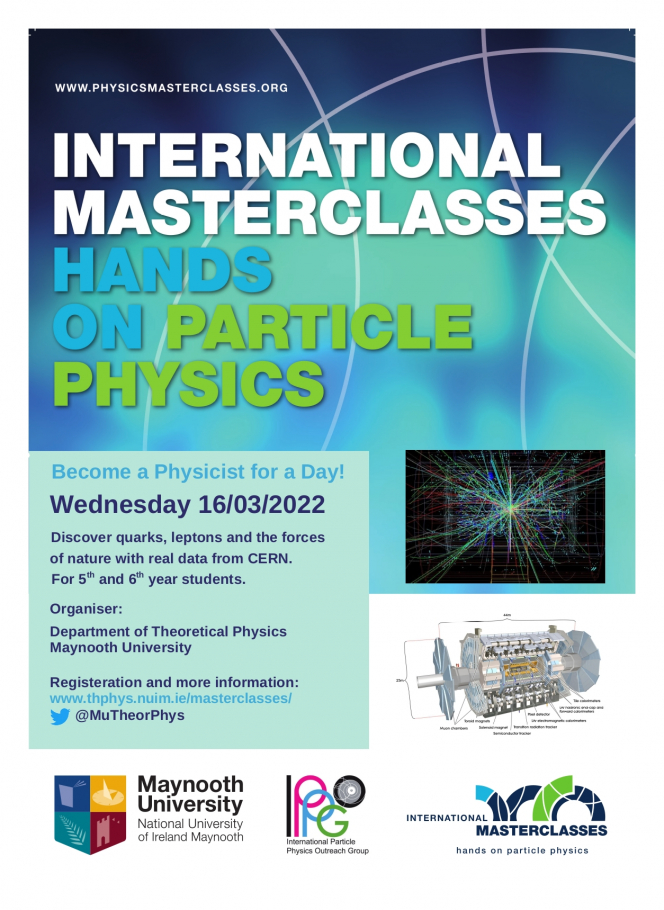
You may remember that we ran a very successful virtual Astrophysics & Cosmology Masterclass at Maynooth University last November. Now it’s time to announce the forthcoming International Masterclass on Particle Physics. This will take place on campus at Maynooth during the half-term break:


You can find more information, including instructions on how to book a place, here. The first such Masterclass at Maynooth took place in March 2012, so this year we will be celebrating the 10th anniversary.

These Masterclasses give secondary school students the opportunity to discover the world of quarks and leptons for themselves, by performing measurements on real data from CERN, meeting active particle physics researchers and linking up with like-minded students from other countries.  We will join thousands of other secondary school students at more than 100 universities and laboratories around Europe and worldwide in a programme stretching over four weeks.

Physics at the most fundamental level – the smallest and most basic building blocks of matter – is an exotic world.  But a few introductory talks and working with data from CERN will give the students insight into the fundamental particles of matter and the forces between them, as well as what went on during the Big Bang.

On Sunday afternoon, the students are introduced to particle physics, experiments and detectors in lectures given by active particle physics researchers.  On Monday, after a virtual visit to the ALICE detector at CERN, they work on their own with data from ALICE Afterwards they participate in a video conference with students from other countries and moderators at CERN, where they discuss and compare their results.

For more information on the Particle Physics Masterclasses, see the International Masterclasses web site.

R.I.P. Bamber Gascoigne

Posted in Biographical, Television with tags , , , on February 8, 2022 by telescoper

I was saddened this morning to hear of the death at the age of 87 of Bamber Gascoigne who was best known as the original presenter of University Challenge. He was an excellent quizmaster, not least because he actually seemed to know the answers to the questions (rather than just reading them from the cards like his successor Jeremy Paxman did) and often supplied extra pieces of information off his own bat.

Though he cut a stern figure whenever anybody transgressed e.g. the “no conferring” rule, he always seem to be generous in his praise and people who took part in the show say he was very gentle with the contestants who were often very nervous.

I never met Bamber Gascoigne in the flesh, although I attended the same college (Magdalene College, Cambridge) as he did when he was an undergraduate (though not at the same time) and I’m sure he was around at some dinners and other events while I was there.

I used to watch University Challenge a lot when I was at school. It’s sad to have to say goodbye to yet another figure from the era.

Rest in Peace Bamber Gascoigne (1935-2022)

Is the Hubble crisis connected with the extinction of dinosaurs?

Posted in Open Access with tags , , on February 7, 2022 by telescoper

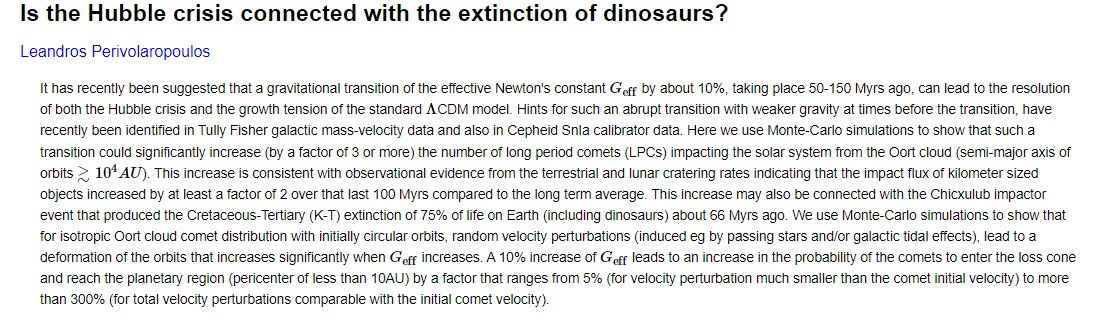
There is a paper on the arXiv (in the astro-ph section) with the title Is the Hubble crisis connected with the extinction of dinosaurs?

The abstract is here:

You can read the paper and make your own mind up, but I’m going to stick my neck out and go for “no” as the answer to the question posed…

And while I’m here I’ll give anyone who is yet to do so the chance to vote on whether there really is a Hubble constant crisis in the first place:

Facebook Folly

Posted in Biographical, Film with tags , , on February 7, 2022 by telescoper

Yesterday I found myself in the Facebook punishment block. My crime? To share a piece from the main RTÉ website about the film In Bruges.

I couldn’t understand the decision to ban me for sharing an innocuous article about a comedy film (though it’s admittedly a very dark comedy) especially when material that is so much worse is allowed. A few hours later, however, I was unbanned. I clicked on the ‘learn more’ link to be taken to a blank page. I assume the whole thing was just a mistake.

Of course this ban/unban episode is of no consequence. What worries me though is that the ban was imposed immediately, suggesting that somebody (or some AI bot) must be watching everything that gets posted by users; the same entity is presumably also checking the constant stream of bigoted bile, anti-vax misinformation, far-right propaganda, and other hateful lunacies one sees on Fashbook every day and deciding that it’s all perfectly acceptable.

Carte Blanche

Posted in Biographical, Crosswords on February 6, 2022 by telescoper

After spending this afternoon going through lots of papers in an attempt to work out how soon I’ll be able to retire – answer: not soon enough – I’ve only just realized that today there is an Azed Competition Prize Puzzle (usually the first Sunday of every month). I haven’t got the energy to do it now, but will have a go later in the week if I get the time.

Some years ago at a lunch event I had the opportunity to chat with some professional crossword compilers. It seems one gets paid around £150 (give or take) for setting a crossword in a national newspaper, which isn’t a lot considering how difficult it is. It has crossed my mind a number of times that I might try to supplement my retirement income that way.

However, when I saw today’s Azed puzzle (which is ofa special Carte Blanche form) I suddenly hit on a potentially lucrative idea.
I’ve decided to start a crossword competition of my own. Here  is Telescoper Prize Crossword No. 1.

Instructions for solvers. To enter the competition, devise a set of clues and solutions that fill the above grid in the manner of a typical Azed puzzle. Mail completed grids, together with clues to me at:  Telescoper Prize Crossword No. 1, PO Box 16  (across), Maynooth, Ireland. The best entries, as judged by me, will win 27p in (used) postage stamps plus the chance to see their crossword in a national newspaper with my name as setter.

As a business plan, this simply can’t fail. It’s nearly as good as running an academic journal!

First Light at L2 for JWST

Posted in History, The Universe and Stuff with tags , , , on February 5, 2022 by telescoper

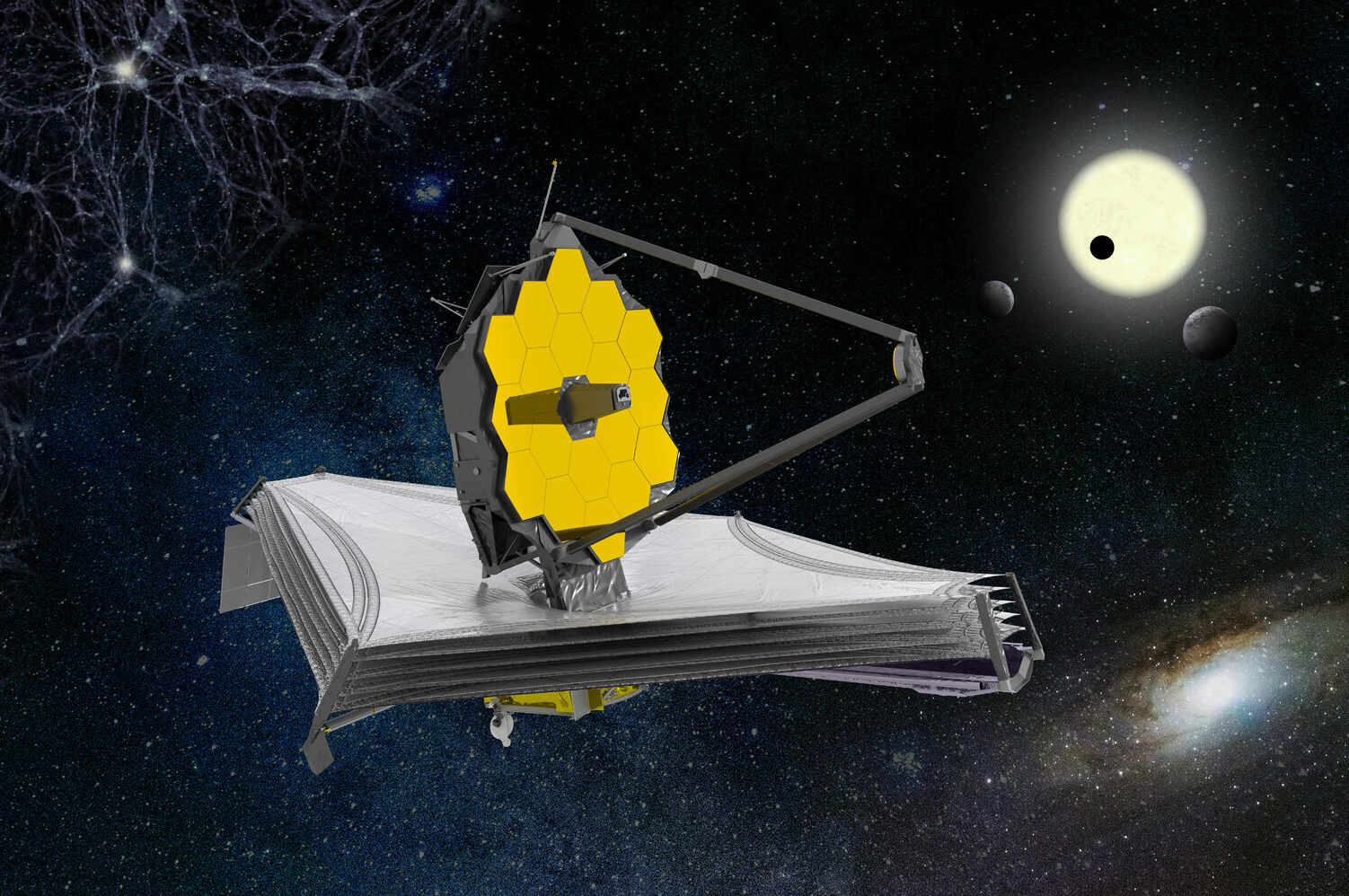
After a successful launch, subsequent deployment of its sunshield and mirrors, and arrival at its orbit around the Second Lagrange Point, the goal now for the James Webb Space Telescope is to align the optical components of the telescope to the required accuracy. This is not a simple task – each of the segments of the main mirror has to be aligned to within a fraction of a wavelength of the light it will observe (in the near-infrared part of the electromagnetic spectrum) – and it will take several months to complete. However, we did hear yesterday that the telescope has now seen “first light”, in the sense that the first photons have landed on its detectors. The first images to be formed will be blurry and distorted, but these will be used to adjust the components until they reach the required sharpness.

For more details of this process see here.

Incidentally, it is worth saying a little bit about L2, the second Lagrange point of the Earth-Sun system. As the diagram below shows, this orbits the Sun at a greater distance from the Sun than the Earth. According to Kepler’s Laws, and ignoring the Earth’s gravitation, a test particle placed in a circular orbit at this radius would move more slowly than the Earth and would not therefore hold a fixed position relative to the Earth and Sun as it went around. The effect of the Earth’s gravity however is to supply an extra force to speed it up a bit, so it can keep up and thus remain in a fixed configuration relative to both Earth and Sun.

The opposite applies to L1: an object placed here would, in the absence of Earth’s gravity, move more quickly and thus pull ahead of the Earth. Having the Earth there holds it back by just the right amount to maintain a fixed position in the rotating frame.

The interesting thing about L1 & L2 is that while they are both equilibrium points, they are both unstable to radial perturbations. An object placed at either of these points would move away if disturbed slightly. JWST does not therefore just sit passively at L2 – it moves in a so-called halo orbit around L2 a process which requires some fuel. It’s not that there’s an actual mass at L2 for it to orbit around, but that its motion produces a Coriolis Force that keeps it from moving away. It’s very clever, but does require a bit of energy to keep it in this orbit.

Unlike L1 & L2, the Lagrange Points L4 & L5 are stable and therefore attract all kinds of space junk, such as asteroids, cometary debris, and preprints by Avi Loeb.

Another interesting Lagrange Point is that Joseph-Louis Lagrange was born in 1736 in Turin, but that does not mean that he was Italian. At that time Italy did not exist as a political entity; in 1736 Turin was part of the Kingdom of Sardinia. Although born in the part of the world now known as Italy, he was never an Italian citizen. In fact he lived most of his life in Berlin and Paris and died in 1813, long before the Kingdom of Italy was founded (in 1861).

Leaving Certificate Matters

Posted in Covid-19, Education, Maynooth with tags on February 4, 2022 by telescoper

On the last day of a very busy first week of the new term I’ve finally cleared a backlog of things and thought I’d take a break for a quick comment about the arrangements for this year’s Leaving Certificate which has implications for this year’s University admissions (amongst many other things).

It has been decided that this year’s Leaving Certificate will revert to the pre-pandemic style of written examinations, but with the important proviso that the overall distribution of marks will be scaled to be no lower than the results last year (when accredited grades were taken into account). In addition the examinations will offer students more choice, so that they have to answer a smaller subset of the questions than in the good old days before Covid.

Last year’s Leaving Certificate results revealed a big increase in scores and consequent changes in offers for many courses. For example, the points required for our Theoretical Physics and Mathematics course (MH206) at Maynooth University went up by about 50 to around 550. Perhaps surprisingly this resulted in the admissions to this course going up by about a factor three. I won’t speculate on the reasons for this here.

The reason for scaling this year’s results is to ensure that students entering third-level education this year are not disadvantaged relative to those who left school last year and took a year out. Also, there is much less information on which to base accredited grades, because of pandemic interruptions.

My concern about the announcement is not so much about the return to formal examinations but on the matter of choice. Take Mathematics for instance. Instead of answering questions in each of 10 sections, students this year will only have to answer questions from six. That means that students can get very high grades despite knowing nothing about 40% of the syllabus. That matters most for subjects that require students to have certain skills and knowledge for entry into University.

In my own discipline (physics) we already have to get new students rapidly up to speed in, e.g., calculus – a difficulty exacerbated this year by the fact that the first Semester was shortened as a knock-on effect of delays in Leaving Certificate process – this is likely also to be a problem for next year’s entry. I can see we’re going to have to do a lot of thinking over the summer about how to deal with this.

Overall I prefer the Leaving Certificate over the UK system of A-levels, as the former gives the students a broader range of subjects than the latter (as does the International Baccalaureate), but I still have doubts about using a simple points count for determining entry into third-level education. Changing a system so deeply embedded is likely to prove difficult, though, so we for the foreseeable future we just have to make the best of what we’ve got.