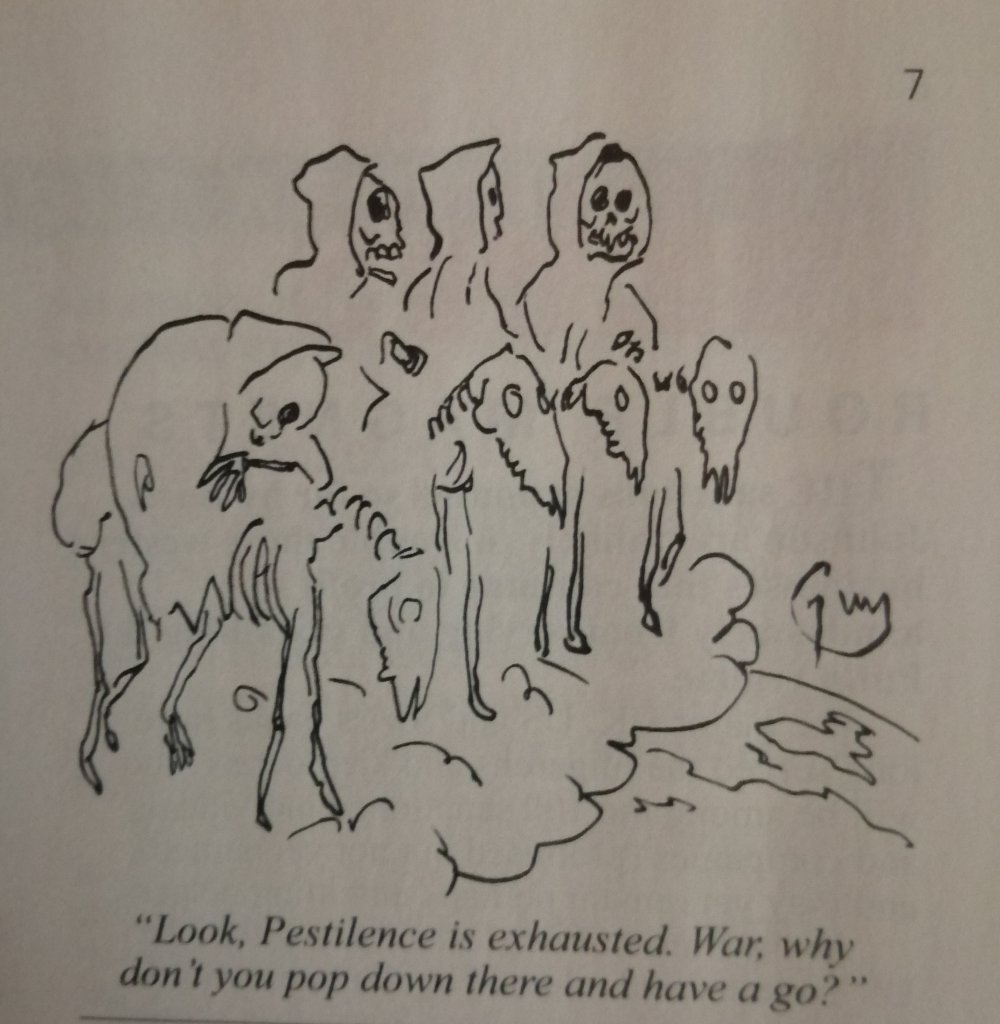
From last week’s Private Eye.
So we arrive at the start of the mid-Semester study break at Maynooth University. There are no lectures next week, and there are two bank holidays (17th March, St Patrick’s Day, and 18th March, the new holiday announced earlier this year).
I was talking to some students on Thursday and I think they’re all as tired as the staff are. Many have long commutes to and from college because they weren’t able to find local accommodation, some have to work to provide income, and some have been ill with Covid-19 and are still recovering. Some staff are also having to work from home being close contacts of people with Covid-19.
Although the Minister responsible for Higher Education declared that students would return to campus, the reality is not really like that. For the above reasons (and, no doubt, others), attendance at in-person lectures has fallen to very low levels, and from what I’ve heard this is not only in the Department of Theoretical Physics. I don’t know whether it is the case at other universities in Ireland. At least I’m recording my lectures – except when there’s a power cut! – so students who can’t come in can have something to study from.
Ironically, the one module I am teaching that is quite easy to deliver online – Computational Physics – still has good attendance for the laboratory sessions, with only one or two students tuning in remotely.
At the end of this Semester, in May 2022, we have examinations on campus for the first time in two years. For students in the first and second year these will be the first university examinations they have ever taken. I for one am a bit nervous about how things will go given the difficulties facing students up to this point.
But that’s for later. For now we have a break from teaching. I have an assignment ready for my Advanced Electromagnetism students but I decided not to put it up until after Study Week as I think it’s better for them to take a bit of a break before the final six weeks of the Semester. For many in my class this will be the final six weeks of their course so it’s important to approach this period with as much energy as possible.
For myself although I have no teaching next week there are a number of things going on between Monday and Wednesday – including some conferring ceremonies – and I’m behind with quite a lot of things, so I’ll be in the office more-or-less as usual. I’ll be looking forward to a glass of wine or several on Wednesday evening though, ahead of Thursday morning’s St Patrick’s Day parade in Maynooth (weather permitting).
In the summer of 2021 we published a paper in the Open Journal of Astrophysics entitled A Differentiable Model of the Assembly of Individual and Populations of Dark Matter Halos. The authors are Andrew P. Hearin, Jonás Chaves-Montero, Matthew R. Becker and Alex Alarcon, all of the Argonne National Laboratory.
Here is a screen grab of the overlay which includes the abstract:
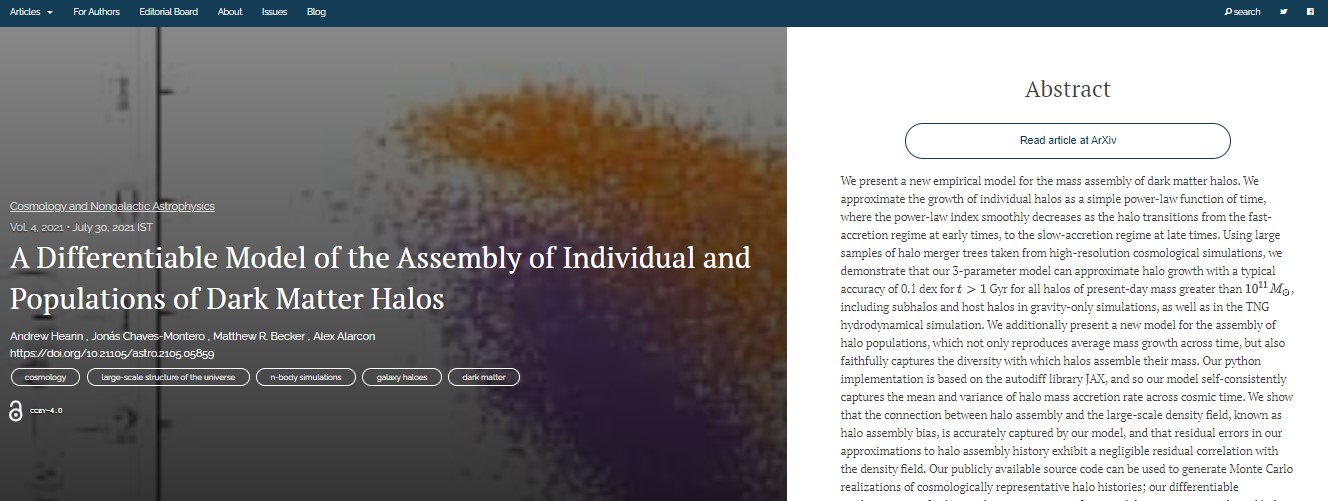
One of the authors contacted me recently to ask if it would be possible to make some minor textual modifications to the version we already published. After discussing this with the Editorial Board we agreed on the following steps:
The way we are set up no further action was necessary. I think this is a nice demonstration of the flexibility of an overlay journal!
We’ve had several power cuts on Maynooth University campus today.
I had a lecture during one of them. The lecture went ahead with the usual chalk-and-talk, although the room was a bit on the dark side without any electric lights. More seriously I could neither record nor webcast the lecture because there was no internet so I couldn’t connect to Panopto. Ironically, the topic of the lecture was electromagnetism.
After a couple of false starts we finally got power back this afternoon, but the power failure seems to have had a number of fairly drastic consequences. Our office machines which are currently unable to access the internet. Also the data projector in our computer lab seems to be completely bust, but that is less important than the fact that the none of lab computers is working. Fortunately we don’t have a lab session on Wednesday afternoons, but I hope we can get this fixed before tomorrow when we do have a lab session!
By the way this is what our computer lab looks like:

Fortunately, next week is study week (the week containing the St Patrick’s Day holiday) which will give us time to regroup. It can’t come soon enough!
With an energy crisis looming as a result of Russia’s invasion of Ukraine I wouldn’t bet against much worse problems with electricity supply in the near future. I’m old enough to remember the Oil Crisis of 1974, with petrol rationing, regular power cuts and the Three Day Week. I wonder if we will soon be experiencing something similar again?
Update: after yet another power cut I decided to go home earlier than usual. When I got back to my house in Maynooth at 6pm I saw no sign that the power had been off at all!

When a speaker at yesterday’s vigil mentioned that his family were from Kharkiv, the scene of great destruction and heavily civilian casualties as a result of Russia’s invasion of Ukraine, I was reminded that this location was the scene of no fewer than four huge and bloody battles during the Second World War.
Kharkiv fell to German forces after the First Battle of Kharkiv took place in October 1941. The first attempt by the Soviets to take it back led to the Second Battle of Kharkiv, which took place in May 1942, and was a catastrophic defeat for the Red Army. Among other things this fiasco revealed Stalin to be a military leader of legendary incompetence. He had a huge numerical advantage in men, tanks, artillery and but most of his troops were poorly trained conscripts who were sent into a position from which they were easily outflanked, then encircled and finally destroyed. The losses were appalling: almost 300,000 casualties and the destruction of over a thousand tanks. This defeat left the way open for German forces to advance on Stalingrad (now Volgograd), where they were finally halted in 1943.
The Third Battle of Kharkiv of January 1943 was another German victory but resulted in a salient which was successfully attacked during the Battle of Kursk leading to a massive German defeat. Kharkiv was finally recaptured by the Soviets in August 1943 after a fourth major battle.
It seems in the Fifth Battle of Kharkiv, Putin is following Stalin’s policy of sacrificing the resource he values least – the lives of his young conscripts – but the big difference between then and now is that it is the Russian army is attacking a predominantly Russian-speaking part of Ukraine; Kharkiv is only 25km from the Russian border. If Putin’s army is prepared to behave so abominably to people he claims are his own, one can barely imagine the horrors he will inflict on the Ukrainian-speakers elsewhere in Ukraine. This isn’t just a war, it’s a genocide.
This lunchtime I attended a public vigil for Ukraine on Maynooth University campus. It was a moving experience, not least because of the presence of a Ukrainian PhD student, Oleg Chupryna, who addressed the gathering. Although he has lived in Ireland for over 20 years many members of his family are still in Ukraine. They were in Kharkiv when the invasion happened, having refused to leave because they didn’t think the Russians would actually invade, but then found themselves under relentless shelling by Russian artillery. His family managed to flee Kharkiv for the countryside a couple of days ago, but are still trapped in Ukraine, apart from one family member who has arrived safely in Dublin and who read the following poem (in Ukrainian) by Taras Shevchenko, followed by the English translation. you see below.
Shevchenko (who was a painter and illustrator as well as a poet) was born a serf, so the use of the word slavery is not metaphorical. Sales of artwork enabled him to be bought out of his serfdom in 1838, but he spent a great deal of time imprisoned by the Russian authorities. He died in St Petersburg in 1861 at the age of 47.

The poem Calamity Again was written in 1854, in the middle of the Crimean War, at which time Ukraine was part of the Russian Empire. The poem was written at Novopetrovsk Fortress, depicted in the above painting by Shevchenko himself.
Dear God, calamity again! …
It was so peaceful, so serene;
We but began to break the chains
That bind our folk in slavery …
When halt! … Again the people’s blood
Is streaming! Like rapacious dogs
About a bone, the royal thugs
Are at each other’s throat again.
Just a very quick post to mark the fact that it was on Sunday 5th March 1972 that the first Azed Crossword set by Jonathan Crowther was published in the Observer. Today’s special 50th anniversary competition puzzle “Looking Back” is No. 2595. I have been too busy recently to spend much time on competition entries – I didn’t have time to look at last month’s puzzle at all – but I did buy the Observer today because it’s a special occasion and hope to have a bash at the puzzle sometime in the week.
There’s a piece about the 50 years of Azed dated a few days ago here.
Incidentally, I noticed that the Everyman Crossword competition in the Observer is now accepting postal entries again so I may send in an entry for the first time in over two years.
Another thing I noticed is that there is a lunch to commemorate Azed’s 50th anniversary at Wolfson College, Oxford on 28th May. The timing is a bit tricky because of University examinations here in Maynooth but I’ll see if I can manage to go. The Azed 2500 lunch planned for 2020 was cancelled owing to Covid-19 restrictions, but I attended the Azed 2000 lunch in 2010 and enjoyed it enormously. On that occasion, though, I only had to travel to Oxford from Cardiff!
As the humanitarian consequences of Russia’s invasion of Ukraine unfold, Ireland expects something like 20,000 refugees to arrive many of whom will require accommodation. Around 1300 have arrived in Ireland so far, but these have mainly been taken in by Ukrainian family members and friends already in Ireland.
(The number of Ukrainian refugees so far accepted into the UK is just 50.)
We had a Department Meeting on Friday which began with a minute’s silence for the dead, the bereaved and all those suffering in ways we can’t even begin to imagine as a result of Russia’s heinous crimes in Ukraine. As I stood in silence I felt frustration at the smallness of the gesture; that feeling wasn’t at all assuaged by making a donation to the Irish Red Cross appeal later that evening.
When I learnt that the Irish Red Cross has launched an appeal for emergency accommodation I saw the chance to do something practical. I have a spare room, which I decided to register as potential accommodation for a refugee. It’s quite a small bedroom but can be made available very quickly once I’ve moved a few things out and given it a clean. At least the bed is quite comfortable: I know because I slept in it for several weeks before my new bed arrived. Of course if anyone comes they can have the run of the rest of the house.
Pledging accommodation in this way is not a trivial process. The property and the host have to be vetted to check that nothing nefarious is going on. I expect I’ll be contacted next week for this purpose and if my pledge is accepted and an appropriate individual found, a case officer will be assigned to ensure everything is going OK. There’s no guarantee my offer will be accepted, though. I’ll just have to wait and see.
As a single adult it would obviously be more appropriate to host another single adult. It crossed my mind that an offer of accommodation in a university town such as Maynooth might enable a student or academic from Ukraine to continue their studies in some way, but I’m not going to limit the range of possible people to that. I can offer an LGBT+ friendly environment too if that is important to anyone.
I’ve lived alone for quite a long time now so it is not without apprehension that I registered this pledge. I can see that there may be many difficulties, but they would be as nothing compared to the difficulties facing the Ukrainian people right now. I feel it’s the least I could do.
I am glad that, within the European Union, Ireland is playing its part in the response to the Ukraine crisis. When I look across the Irish Sea at the United Kingdom’s callous indifference to refugees alongside its half-hearted implementation of sanctions on Putin’s evil regime, I am once more glad I no longer live in a country with such a corrupt and mean-spirited Government.
Yes, I know there are far more important things to think about these days but if you want to take a break from doom scrolling then you might want to cast your vote in the St Patrick’s Day Beard of Ireland 2022 poll.
Owing no doubt to some form of administrative error, I actually won this in 2020 but sank without trace last year. I’m in the first round group this year and will no doubt be eliminated but I’d be happy if I could cling on to the fourth place (out of four) that I managed last year.

Beard Liberation Front
Press release 5th March
Contact Keith Flett 07803 167266
BEARD OF IRELAND 2022 POLL SEES COMPETITION BRISTLING
The Beard Liberation Front, the informal network of beard wearers, has said that competition for the Irish Beard of the Year 2022 is officially open
The 2017 winner was politician Colum Eastwood who bearded broadcaster William Crawley for the annual Award.
In 2018 the DUP’s Lee Reynolds shaved writer Dominic O’Reilly for the honour with Colum Eastwood in a steady third place.
In 2019 Lee Reynolds retained the title
The 2020 winner was Maynooth academic Peter Coles
In 2021 Aodhan Connolly shaved opponents to win the coveted title
The BLF says that while traditionally a land of predominantly clean-shaven cultures, Ireland has in recent times become something of a centre for stylish and trendy beards.
Contenders for the title in 2022 include a diverse range of the hirsute- a golfer…
View original post 161 more words
I was shocked to see just now the news that legendary Australian legspinner Shane Warne has passed away suddenly at the age of just 52. I always admired his bowling hugely no doubt partly because having tried to bowl leg-breaks myself I have some idea how difficult it is to do well! I thought as a tribute I would rehash a piece I posted about 12 years ago about the prodigious amount of spin Shane Warne was able to generate.
For those of you not so familiar with cricket here’s a clip of another prodigious spinner of the ball, Australia’s legend of legspin Shane Warne:
For beginners, the game of cricket is a bit similar to baseball (insofar as it’s a game involving a bat and a ball), but the “strike zone” in cricket is a physical object ( a “wicket” made of wooden stumps with bails balanced on the top) unlike the baseball equivalent, which exists only in the mind of the umpire. The batsman must prevent the ball hitting the wicket and also try to score runs if he can. In contrast to baseball, however, he doesn’t have to score; he can elect to play a purely defensive shot or even not play any short at all if he judges the ball is going to miss, which is what happened to the hapless batsman in the clip.
You will see that Warne imparts considerable spin on the ball, which has the effect of making it change direction when it bounces. The fact that the ball hits the playing surface before the batsman has a chance to play it introduces extra variables that you don’t see in baseball, such as the state of the pitch (which generally deteriorates over the five days of a Test match, especially in the “rough” where bowlers have been running in).
A spin bowler who causes the ball to deviate from right to left is called a legspin bowler, while one who makes it turn the other way is an offspin bowler. An orthodox legspinner generates most of the spin from a flick of the wrist while an offspinner mainly lets his fingers do the torquing.
Another difference that’s worth mentioning with respect to baseball is that the ball is bowled, i.e. the bowler’s arm is not supposed to bend during the delivery (although apparently that doesn’t apply if he’s from Sri Lanka). However, the bowler is allowed to take a run up, which will be quite short for a spin bowler, but long like a javelin thrower if it’s a fast bowler. Fast bowlers – who can bowl up to 95 mph (150 km/h) – don’t spin the ball to any degree but have other tricks up their sleeve I haven’t got time to go into here. A typical spin bowler delivers the ball at speeds ranging from 45 mph to 60 mph (70 km/hour to 100 km/hour).
The physical properties of a cricket ball are specified in the Laws of Cricket. It must be between 22.4 and 22.9 cm in circumference, i.e. 3.57 to 3.64 cm in radius and must weigh between 155.9g and 163g. It’s round, made of cork, and surrounded by a leather case with a stitched seam.
So now, after all that, I can give a back-of-the-envelope answer to the question I was wondering about on the way home. Looking at the video clip my initial impression was that the ball is deflected by an angle as large as a radian, but in fact the foreshortening effect of the camera is quite deceptive. In fact the ball deviates by less than a metre between pitching and hitting the stumps. There is a gap of about 1 metre between the popping crease (where the batsman stands) and the stumps – it looks much less from the camera angle shown – and the ball probably pitches at least 2 metres in front of the crease. I would guess therefore that it actually deflects by an angle less than twenty degrees or so.
What happens physically is that some of the rotational kinetic energy of the ball is converted into translational kinetic energy associated with a component of the velocity at right angles to the original direction of travel. In order for the deflection to be so large, the available rotational kinetic energy must be non-negligible compared to the original kinetic energy of the ball. Suppose the mass of the ball is 


Approximating the ball as a uniform sphere of mass 


or 


This estimate is obviously very rough because it ignores the direction of spin and the efficiency with the ball grips on the pitch – friction is obviously involved in the change of direction – but it gives a reasonable ballpark (or at least cricketground) estimate.
Of course if the bowler does the same thing every time it’s relatively easy for the batsman to allow for the spin. The best bowlers therefore vary the amount and angle of spin they impart on each ball. Most, in fact, have at least two qualitatively different types of ball but they disguise the differences in the act of delivery. Offspinners typically have an “arm ball” which doesn’t really spin but holds its line without appearing to be any different to their spinning delivery. Legspinners usually have a variety of alternative balls, including a topspinner and/or a flipper and/or a googly. The latter is a ball that comes out of the back of the hand and actually spins the opposite way to a legspinner while being produced with apparently the same action. It’s very hard to bowl a googly accurately, but it’s a deadly thing when done right.
Another thing also worth mentioning is that the rotation of the cricket ball also causes a deviation of its flightpath through the air, by virtue of the Magnus effect. This causes the ball to curve in the air in the opposite direction to which it is going to deviate on bouncing, i.e. it would drift into a right-handed batsman before breaking away from him off the pitch. You can see a considerable amount of such movement in the video clip, away from the left-hander in the air and then back into him off the pitch. Nature clearly likes to make things tough for batsmen!
With a number of secret weapons in his armoury the spin bowler can be a formidable opponent, a fact that has apparently been known to poets, philosophers and astronomers for the best part of a thousand years:
The Ball no Question makes of Ayes and Noes,
But Right or Left, as strikes the Player goes;
And he that toss’d Thee down into the Field,
He knows about it all — He knows — HE knows!
The Rubaiyat of Omar Khayyam [50]


 In the Dark