Archive for May, 2022

New Publication at the Open Journal of Astrophysics

Posted in Open Access, The Universe and Stuff on May 14, 2022 by telescoper

The last couple of days have been very busy but at last I’ve got time to announce a new publication in the Open Journal of Astrophysics! This one is the 5th paper in Volume 5 (2022) and the 53rd in all. It was published on Thursday in fact but I’ve only just found time to mention it here.

The latest publication is entitled “Statistical Uncertainties of the NDW=1 QCD Axion Mass Window from Topological Defects” and is written by Sebastian Hoof & Jana Riess of the Georg-August-Universität Göttingen in Germany and David Marsh of King’s College London.

This paper is in the Cosmology and Nongalactic Astrophysics folder (cross-listed on arXiv from High-Energy Physics).

Here is a screen grab of the overlay which includes the abstract:


You can click on the image to make it larger should you wish to do so. You can find the arXiv version of the paper here.

P.S. We have quite a number of papers out there waiting for revised versions to be submitted. I get the feeling that everyone is very busy these days. Hopefully as we emerge from the pandemic things will improve.

M87: Ring or Artefact?

Posted in The Universe and Stuff with tags , , on May 13, 2022 by telescoper

Following on from yesterday’s post here is an arXiv preprint that I’ve only just seen, though it was submitted on Tuesday 10th May, ahead of yesterday’s announcement about Sagittarius A*. It says inside the manuscript (though not in the arXiv entry) that it was accepted for publication in ApJ on 5th May, though it has not yet appeared there.

The abstract is:

We report our independent image reconstruction of the M 87 from the public data of the Event Horizon Telescope Collaborators (EHTC). Our result is different from the image published by the EHTC. Our analysis shows that (a) the structure at 230 GHz is consistent with those of lower frequency VLBI observations, (b) the jet structure is evident at 230 GHz extending from the core to a few mas, though the intensity rapidly decreases along the axis, and (c) the unresolved core is resolved into bright three features presumably showing an initial jet with a wide opening angle of about 70 deg. The ring-like structures of the EHTC can be created not only from the public data, but also from the simulated data of a point image. Also, the rings are very sensitive to the FOV size. The u-v coverage of EHT lack about 40 micro-asec fringe spacings. Combining with a very narrow FOV, it created the 40 micro-asec ring structure. We conclude that the absence of the jet and the presence of the ring in the EHTC result are both artifacts owing to the narrow FOV setting and the u-v data sampling bias effect of the EHT array. Because the EHTC’s simulations only take into account the reproduction of the input image models, and not those of the input noise models, their optimal parameters can enhance the effects of sampling bias and produce artifacts such as the 40 micro-asec ring structure, rather than reproducing the correct image.

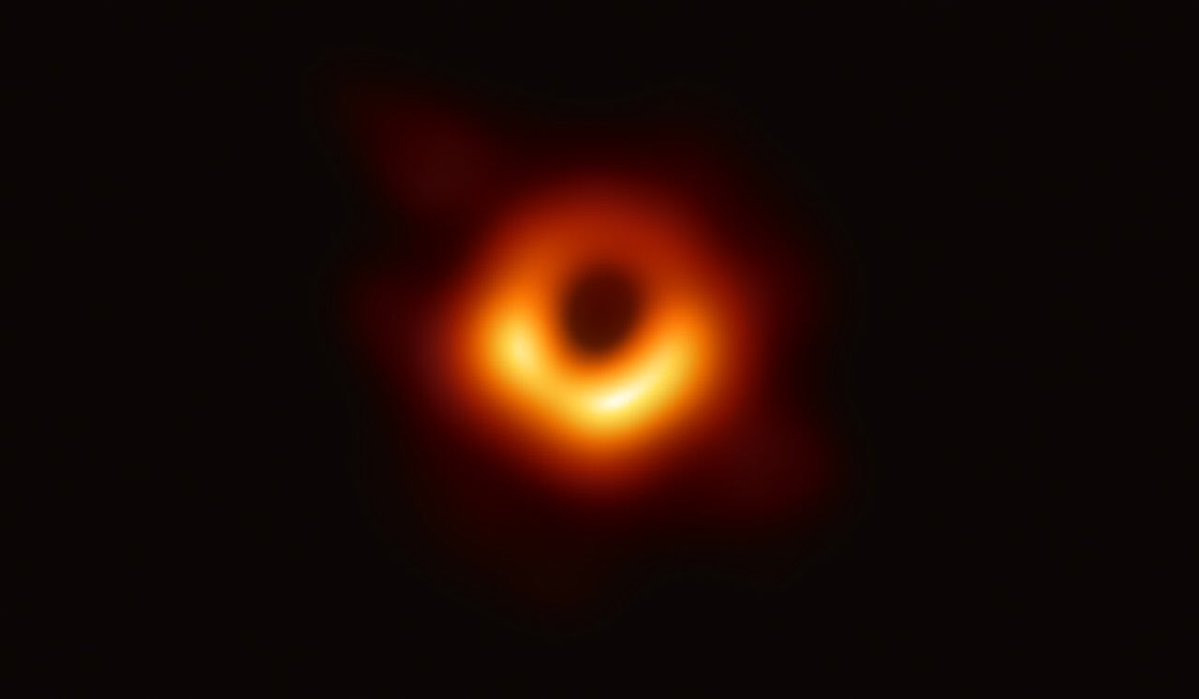
I draw your attention to the sentence “The ring-like structures of the EHTC can be created not only from the public data, but also from the simulated data of a point image”. In other words the authors (Miyoshi, Kato and Makino) are saying that the ring-like structure in the now-iconic image could be an artefact of the image reconstruction process as they can apparently be produced by a point source.

From the manuscript itself:

The EHTC conducted various surveys, but their methods were not objective and biased towards their desires from the very beginning of their analysis. They also failed to perform the basic data checking that VLBI experts always do.

That’s very blunt. The plot thickens!

It’s a lengthy paper and I haven’t gone through it in detail. Comments from experts are welcome through the box below.

Our own Galactic Black Hole

Posted in The Universe and Stuff with tags , , , , on May 12, 2022 by telescoper

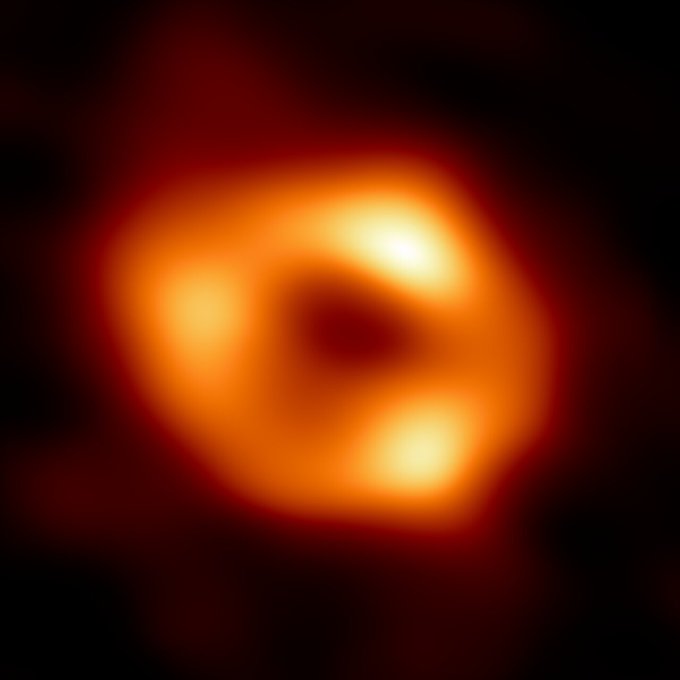
As I mentioned a while ago the Event Horizon Telescope team held a press conference this afternoon and to nobody’s surprise they used it announce an image of the (shadow of the event horizon around the) black hole at the centre of the Milky Way.

Here it is:

You can read the full press release here.

You may recall a great deal of excitement about three years ago concerning the imaging of the “shadow” of the event horizon of the black hole in the centre of the galaxy M87. The question I was asked most frequently back then is that there’s a much closer black hole in the centre of our own Galaxy, the Milky Way, so why wasn’t that imaged first?

It it true is that the black hole in the centre of M87 is ~103 times further away from us than the black hole in the centre of the Milky Way – known to its friends as Sagittarius A* or SgrA* for short – but is also ~103 times more massive, so its Schwarzschild radius is ~103 times larger. In terms of angular resolution, therefore, the observational challenge of imaging the event horizon is similar in the two cases. However, in the the case of the Milky Way’s black hole the timescales involved are much shorter than in M87 and there is a greater level of obscuration along the line of sight. That’s why it took longer to produce the image.

It’s a very difficult observation of course and I’m not sure of the significance of the “lumps” you can see, but the dark region in the centre is what the image is really about and that seems to be exactly the predicted size. The resolution is about 20 microarcseconds. Congratulations to the Event Horizon Telescope team!

If you’re interested in learning more about how this image was made I recommend this short video:

REF 2021 Results and Ranking

Posted in Biographical, Cardiff with tags , , , on May 12, 2022 by telescoper

The results of the UK’s Research Excellence Framework (REF) 2021 have now been published. You can find them all here at the REF’s own website because they are presented there in a much more informative way than the half-baked “rankings” favoured by, e.g., The Times Higher.

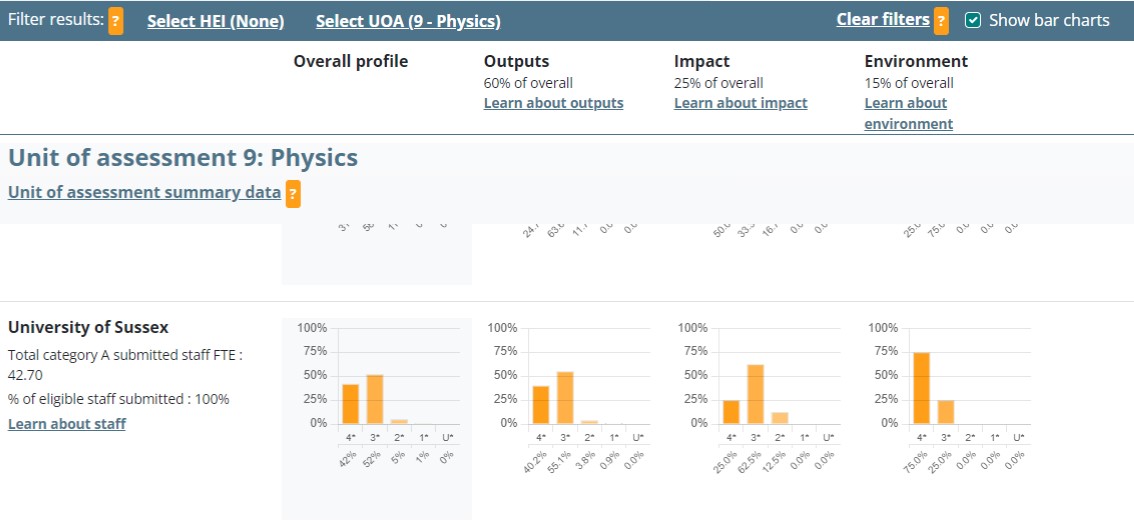
To give some background: the overall REF score for a Unit of Assessment (UoA; usually a Department or School) is obtained by adding three different components: outputs (quality of research papers); impact (referring to the impact beyond academia); and environment (which measures such things as grant income, numbers of PhD students and general infrastructure). Scores are assigned to these categories, e.g. for submitted outputs on a scale of 4* (world-leading), 3* (internationally excellent), 2* (internationally recognized), 1* (nationally recognized) and unclassified. Similar star ratings are applied to the impact and environment. These are weighted at 60%, 25% and 15% respectively in the current incarnation of REF.

You can find further discussion of the REF submission rules, especially concerning changes with respect to 2014, here.

The way the star ratings are often reported is via a Grade Point Average reflecting the percentage of in each band. A hypothetical UoA that scored 100% in the top category would have a GPA of 4.0, for example. One that had 50% 4* and 50* 3* would be 3.5, and so on.

In the 2014 REF institutions were allowed to be selective in the number of staff submitted so the GPA wasn’t really a very appropriate measure: some institutions chose to submit only their very best research in order to get a high GPA. The funding allocated as a result of REF turned out to be highly weighted towards 4* so this was a sensible strategy for them, but it made the simple GPA-based rankings even more meaningless than usual. That didn’t stop e.g. The Times Higher making such rankings though.

This time the rules on selection are stricter so the GPA is arguably more relevant, though many institutions have achieved selectivity anyway by moving certain staff onto teaching-only contracts. Staff on such contracts do not have to be submitted. I note that the main REF website does not use the GPA at all but instead gives profiles like this:

I show the example of Sussex because of my bad memories of the last REF (the 2014 exercise). I had moved to Sussex in 2013 at which point preparations were not well advanced and although everyone concerned worked very hard to put together the best submission for Physics & Astronomy we had to face the problem that our staff numbers had grown significantly in 2013 response to an increase in student numbers. While new staff could bring publications with them they couldn’t bring impact or environment, and while the outputs scored well the latter two categories didn’t so the Department of Physics & Astronomy did poorly in the ensuing rankings.

It must be said however that the primary purpose of the REF (allegedly) is to allocate blocks of funding- the so-called QR funding – to support research in the UoA concerned and while the GPA at Sussex was disappointing the fact that the money depends on the number of staff submitted meant that we got a substantial increase in QR dosh. Note further that the formula for allocation of funds to 4*, 3*, etc is not even specified in advance of the exercise: it is likely to be highly concentrated on research graded 4* and that the funding formula will probably different in England, Wales, Scotland and Northern Ireland. A ranking in terms of money earned is likely to look rather different from one based on GPA.

Another, even more fundamental, problem with the GPA is that the scores are so close together that the differences are of doubtful significance. In the Physics UoA, for example, the gap between top GPA (Sheffield) and 5th place (Bristol) is just 0.05 (3.65 versus 3.60) respectively. I see also that Cardiff is ranked equal 18th (with Imperial College) on a GPA of 3.45.

I say these things just to illustrate how much more subtle the criteria for success are compared to a simple GPA. It’s even hard to tell on an objective basis who to congratulate and who to commiserate.

Anyway, back to Sussex I see that Physics & Astronomy has done far better on environment and impact than last time round and the outputs (95% of which are either 4* or 3*) are comparable to last time (96%) so by those measures they have done well although this might not be reflected in a GPA-based ranking. Sussex is 26th in the rankings with a GPA of 3.35, if you’re interested, which is better than last time, though they will probably be disappointed at the presence of 2* elements in their profile.

Indeed, looking through the Physics list I can’t see any UoA that has a lower GPA this time than last time. The pot of money to be allocated for QR funding is fixed so if every UoA does better that doesn’t mean every UoA gets more money; some institutions will no doubt find that their improved GPA is accompanied by a cut in QR funding.

I’ll end by re-iterating that, having moved to Ireland in 2017, I’m very glad to be out of the path of the bureaucratic juggernaut that is the REF. In its first incarnations (as the Research Assessment Exercise) it did fulfil a useful purpose and did, I believe, improve the quality of UK research. Since then, however, it has become an industry that is largely self-serving. I quote from an article in the Times Higher itself:

The allocation of QR funding could be done in a much simpler and fairer way but the REF is now such a huge edifice it will resist being replaced by something smaller. No doubt before long the staff who spent so much time preparing for REF 2021 will start work on the next exercise. And so it goes on.

The changes in ranking that now occur from exercise to exercise are generally small in magnitude and in number. In other words, huge effort and cost are being invested to discover less and less information.

P.S. For completeness I should say that I am glad we don’t have an equivalent of the REF here in Ireland, we don’t have an equivalent of the QR funding either. This latter is a serious problem for the sustainability of research in third-level institutions, and it is not addressed at all in the recent proposals for reform.

The Time of the Pandemic

Posted in Biographical, Books, Talks and Reviews, Covid-19, Science Politics, Talks and Reviews with tags , , , , on May 11, 2022 by telescoper

I’ve posted before about the way the Covid-19 pandemic has played havoc with my perception of the passage of time and today I’ve experienced another example because I was reminded that it was on this day (11th May) last year that I received my first shot of Covid-19 vaccine.

It’s very hard for me to accept that it was just one year ago that I was waiting in City West to get my injection as it seems in my memory further back than that in my memory. It’s not only how long ago things happened, but also even the sequence of events that has become muddled. I wonder how long it will take to restore any normal sense of these things?

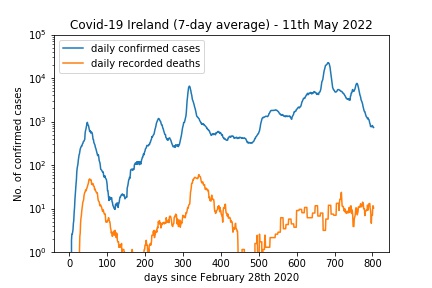
Anyway, I’ve just updated the daily statistics on this blog and although case numbers remain relatively high they do seem to be falling steadily and things do seem to be under control in terms of hospital admissions and deaths. Only 254 people are in hospital with Covid-19 today and the trend is downward.

Maybe the time of the pandemic is drawing to a close?

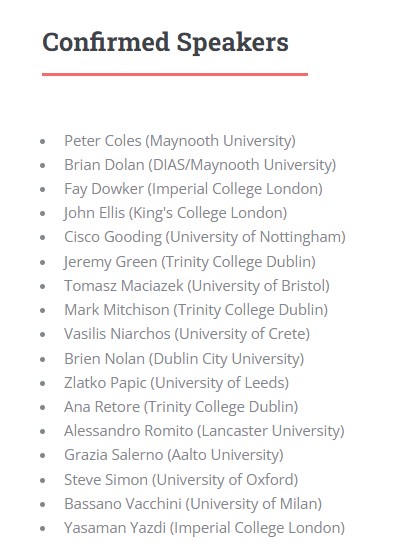
Further evidence that things may be getting back to normal is that I’m giving the first in-person research talk I’ve done since before the pandemic started at the Irish Theoretical Physics Meeting (ITP22) at the end of this month in Dublin (at the Dublin Institute for Advanced Studies, to be precise). I’m looking forward to giving a talk in the same room as real people. I’m even top of the bill (though only thanks to alphabetical order):

I’ve only got a 30-minute slot so I hope my sense of the passage of time returns at least to the extent that I keep to schedule. My PhD student is travelling to Newcastle next week to give her first ever conference talk at the UK Cosmology Meeting. Hers is a 5-minute talk, which is quite a difficult thing to do well, but I have every confidence it will be excellent.

And talking of research, I see that tomorrow sees the public announcement of the results of the 2021 Research Excellence Framework. Universities have had their results since the start of the week but they are embargoed until tomorrow, no doubt to allow PR people to do their work. I’ll probably post a reaction tomorrow, but for now I’ll just send best wishes to colleagues in the UK – especially in Cardiff and Sussex – who are waiting anxiously hoping for a successful outcome and say that I’m very happy to be here in Ireland, out of the path of that particular bureaucratic juggernaut.

A Chara

Posted in Irish Language, Uncategorized on May 11, 2022 by telescoper

Having spent a great deal of time recently writing reference letters I thought about how at least to start a letter in the Irish language (though I’m nowhere near fluent enough to continue).

It turns out the correct formal way to begin a letter in Irish to someone you don’t know is “A chara” which means literally “O friend” to be compared with the opening you might write in English “Dear Sir/Madam”. The plural version is A chairde.

The Irish form is interesting for a number of reasons. For one thing it is ungendered so there’s no need for the clumsy “Sir/Madam”. For another it presupposes that the person you are writing to is a friend, which is far less frosty than the English alternative.

The Irish word cara is related to many similar words in other European languages, especially the Italian caro and the French cher and like them can be used as an adjective meaning “dear”. If you want to address a letter to someone you know you can write, for example, A Phádraig, a chara which would mean “Dear Patrick”.

A chara is also interesting from a grammatical point of view because the nominative case of the word for friend is cara but in the vocative case (introduced by the particle “a”) it is modified in a manner called a séimhiú which involves lenition of the initial consonant, hence a chara. The plural form of cara is cairde, which also attracts a séimhiú in the same way as the singular form, becoming chairde. In older forms of written Irish this would have been denoted by a dot over the consonant, but in modern script the modification is indicated by inserting an h.

One of the pronunciational things I struggled with when I was attempting to learn Irish last year was the difference between the c in cara and the ch in chara. The c in Irish is usually pronounced like a k in English but in its weakened form ch it only changes slightly: it’s not like the c in census nor the ch in cheese.

If you try saying the letter k out loud as a child would – “kuh” – you will find it involves contact between your tongue and the roof of your mouth. Move the point of contact back to the rear of your mouth and it becomes deeper and thicker; move it towards your front teeth and it becomes narrower and slightly higher in pitch. That’s the difference between the broad and narrow “c”. It’s very hard to spot in spoken Irish, particularly for a beginner!

There is a vocative case in other European languages ancient and modern, e.g. Latin, but that involves changes at the end of a noun rather than the beginning. The particle “a” which introduces it in Irish plays the same role as “o” in archaic and/or poetic English usage but is part of everyday usage in Irish. It is not a preposition because it doesn’t have any particular meaning other than to introduce the vocative case.

Mental Health and the Reasons for Burnout

Posted in Biographical, Education, Maynooth, Mental Health with tags , , , on May 10, 2022 by telescoper

It is now European Health Week as well as “Employee Wellbeing Month” here at Maynooth University. I’m reminded that ten years ago that I was heading for a breakdown and a subsequent spell in a psychiatric institution so I always try to use this opportunity to encourage friends colleagues and students to do what I didn’t back then, and ask for help sooner rather than later.

Today my colleague from, and former Head of, the Psychology Department at Maynooth shared a piece on twitter that provided me with a new theme, burnout, which is usually described in these terms:

Burnout is a state of emotional, physical, and mental exhaustion caused by excessive and prolonged stress. It occurs when you feel overwhelmed, emotionally drained, and unable to meet constant demands. As the stress continues, you begin to lose the interest and motivation that led you to take on a certain role in the first place.

Burnout reduces productivity and saps your energy, leaving you feeling increasingly helpless, hopeless, cynical, and resentful. Eventually, you may feel like you have nothing more to give.

I’d be surprised if any of my friends and colleagues in the University have not felt at least some of the signs of burnout at some point over the last two years during the which the pandemic drastically exacerbated existing conditions of overwork. I know there’s a tendency among staff to blame themselves for struggling and I know that there’s a even stronger tendency for Management to want staff to blame themselves: “you need to be more resilient” is the catchphrase.

As a counter to this attitude I suggest you read this piece which explains that burnout is not the fault of employees but of the environment created by management. In particular, here are the five main causes of burnout:

  1. Unfair treatment at work
  2. Unmanageable workload
  3. Lack of role clarity
  4. Lack of communication and support from their manager
  5. Unreasonable time pressure

Do any of these look familiar to you? They certainly do to me! I would add a sixth: “6. management determination to make 1-5 even worse in future”. Academic staff on proper contracts are much more expensive than low-paid temporary lecturers on insecure contracts. If you care more about making a profit than providing a quality third level education, why not let the former burn out and replace them with the latter?

My biggest fear is that having seen the lengths to which staff have been prepared to go voluntarily to keep things going during the pandemic, all that has been achieved is to establish in the minds of Management an expectation that this is the way things will be for the indefinite future.

It’s not so bad for me. I’ll be 60 next year and I can see the prospect of retirement on the horizon, but I do worry about what this means for the careers of younger staff.

How to do Physics Exam Questions

Posted in Education on May 9, 2022 by telescoper


It’s now Study Week in Maynooth, with the summer examination period starting on Friday. For many of our students this will be the first exam they have ever taken on campus and for others there will have been a gap of two years since their last one.

Bearing this in mind I thought I would share again this video from my YouTube channel (which has several subscribers) which related to a post I did a few years ago about how to solve Physics problems.

These are intended for the type of problems students might encounter at high school or undergraduate level in examinations. I’ve tried to keep the advice as general as possible though so hopefully students in other fields might find this useful too.


The Stormont Elections

Posted in Politics with tags , , , , on May 8, 2022 by telescoper

Yesterday proved to be an historic day in the politics of Northern Ireland, as the counting of votes from elections to the Northern Ireland Assembly at Stormont on Thursday made Sinn Féin the party with the largest number of seats. This is the first time a republican party has topped the poll, and thus the first time that Sinn Féin has the right to nominate the First Minister under the provisions of the Good Friday Agreement. Whether the leading unionist party (the Democratic Unionist Party) will play its part in forming a new administration remains to be seen. The DUP seem to be keener at manufacturing a crisis over the Northern Ireland Protocol than doing anything positive for the people of Northern Ireland as a whole.

For what it’s worth I think that if the DUP had any sense they would actually support the Protocol. Norther Ireland as a whole voted against Brexit, but the DUP helped deliver it anyway. In any case parties in favour of the Protocol are now in the majority in Stormont now.

I’m in no position to provide an expert political commentary on what these results mean for the future, but I will add a couple of observations to counter some silly comments flying around the, especially UK, media.

I saw countless statements that the electoral system used in these elections is “complex” and went on to make misleading statements by misunderstanding or misrepresenting how it works. I don’t think it is at all. The Single Transferable Vote in multi-member constituencies is actually very straightforward and is indeed the same system as used here in the Republic. Much attention was focussed on the share of first-round preferences (of which SF got 29% and the DUP 21%). The reason why the final total of seats is much more even than this is that the DUP lost a number of first-preferences to the Traditional Unionist Voice (TUV) which picked up about 7.7% of the first preferences, but most TUV voters probably put the DUP as second preference and the DUP would have picked up votes when TUV candidates were eliminated: adding TUV+DUP gives about 29%, roughly the same as SF.

The behaviour of voters in selecting parties below their first choice is more complicated than that and can be very interesting. Some will just vote for their favourite party and not list any alternatives at all. Others will carefully rank all the candidates. This is one of the things that makes STV elections something of a spectator sport, as each round of counting gradually reveals the pattern of transfers. I checked the results regularly on Friday and Saturday as the counts progressed, as I did during the election here in 2020.

Overall I wasn’t surprised that the results came out the way they did between SF and DUP but the surprise is how well the Alliance Party did, more than doubling its seats. When I was a lad the Alliance Party was a moderate Unionist outfit but is now basically neutral on the unionist/nationalist issue and is on other issues a pretty conventional centrist party analogous to the Liberal Democrats in the UK.

The other issue that people have been speculating about is whether these results will lead rapidly to a Border Poll and the prospect of a United Ireland. While it is true that a nationalist leadership of the NI Assembly is a necessary condition for that to happen, it is by no means sufficient. A huge amount of groundwork will have to be done before a fully-developed plan, encompassing difficult issues as healthcare provision and taxation, can be presented to voters. Having seen the fiasco of Brexit, no responsible leader would put anything less than concrete proposals to a public vote. It will take time to develop a proper strategy. A United Ireland would be a very big and difficult fish to land, so patience is definitely required: try to reel it in too quickly and you will lose it.

What is interesting is the emergence of a sizeable block of voters that is agnostic on this issue: whether or not there will be a United Ireland will depend on how these people see things. If the UK economy continues to slide and Westminster is further engulfed by corruption then opinion might shift rapidly towards NI unshackling itself from the corpse. But it’s not there yet. It’s not even clear whether a majority of voters in the Republic would want a United Ireland either. The recent rise of Sinn Féin in the Republic has at least as much to do with issues internal to the Republic – especially the chronic housing shortage – as the goal of a United Ireland.

When Northern Ireland it was set up a century ago, it was prepared in such a way that the electorate was polarized along a Catholic-Protestant religious axis (the boundaries of NI chosen to ensure a Protestant majority). Mostly (but not exclusively) this axis coincided with the Republican-Loyalist one, as well as the usual Right and Left of politics. Over time it seems these alignments have shifted and the overall level of polarization has decreased: the system is losing memory of its initial conditions. The rise of a centrist party such as the Alliance is a manifestation of this.

The Brief Span of Life…

Posted in Art, Literature, The Universe and Stuff with tags , , on May 7, 2022 by telescoper

I found this rather poignant cartoon on Facebook because a friend shared it. Some people have told me they find it depressing. I don’t. I think the finiteness of life is one of the things that makes it bearable.

I don’t know the name of the artist. If anyone does please let me know.

Halley’s Comet last visited us in 1986 when I was 23 and living in Brighton. It will next be visible in 2061, when I shall be 98!

The comet’s orbital period of 75 years or so is brief by astronomical standards, as is the duration of a human life. As Quintus Horatius Flaccus (Horace to you and me) put it in one of his Odes (Book I, Ode 4, line 15):

Vitae summa brevis spem nos vetat incohare longam