Archive for June, 2022

Old School, Old Home

Posted in Biographical, History, Television with tags , , , , , on June 14, 2022 by telescoper

I’ve posted a few times posted about Benwell,  the part of Newcastle in which I grew up. For example I’ve posted about the little house where my first memories live here, and there’s an old photograph of it here:
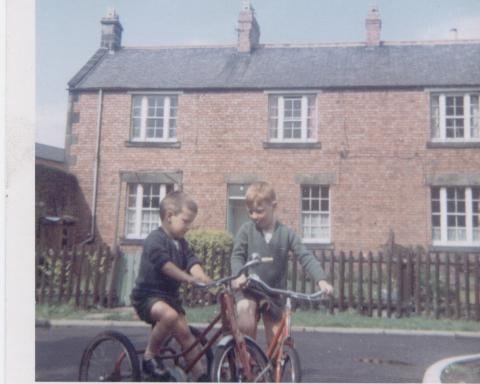
The house itself (ours was the one on the left on this picture) was built of brick but to the left hand side you can just see a stone wall. The two cottages were demolished some time ago, along with Pendower School which was behind them as viewed from the picture.

I recently came across a picture of Pendower School taken sometime in the early 1990s when it was all boarded up and being sold for redevelopment.
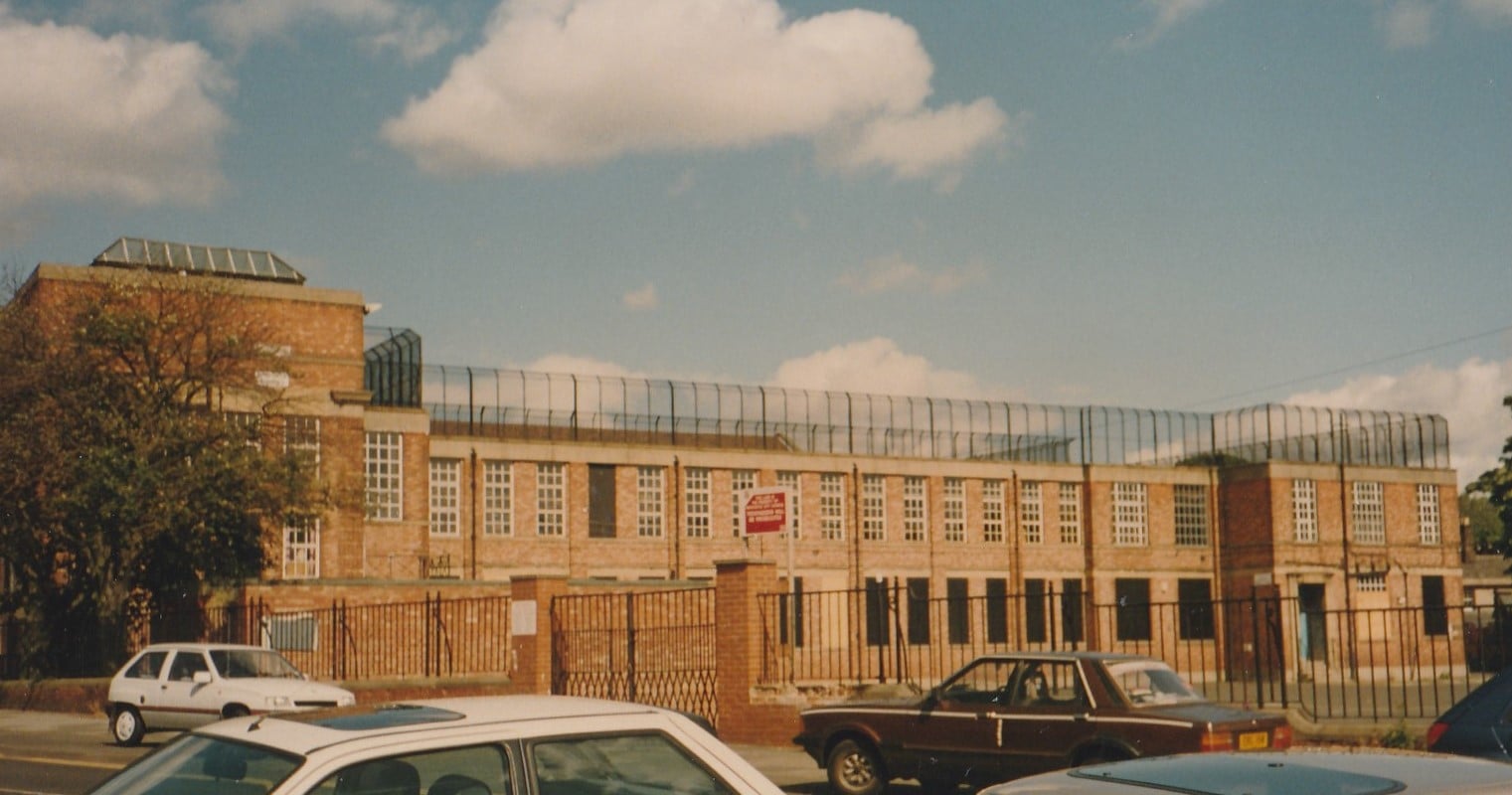
The roof area with the fence around actually had a playground on it, used by Pendower Girls’ High school which occupied most of the building. The Infants and Junior schools which I attended were contained in the wing on the far right of the picture, the Infants downstairs and the Juniors upstairs. The school was built in 1929 and closed in 1992. It was used as a store for some time and then demolished.

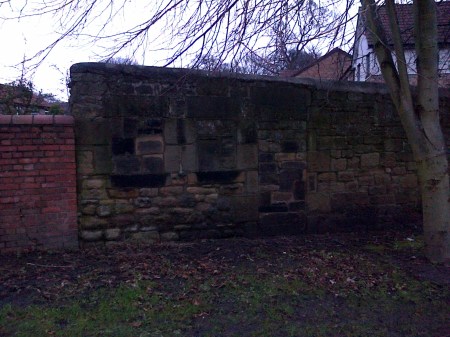
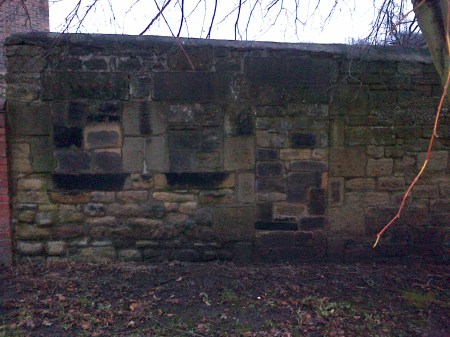
The whole area including the school and the old cottages has now been covered with new houses, but for some reason they left the stone wall, part of which you can see to the left of the two cottages of the first picture. These were both taken from Ferguson’s Lane, which is immediately behind the stone wall to the left of the old photograph.
IMG-20121226-00026

IMG-20121226-00027

In the second picture you can see the filled in outlines of the door which led to our backyard (on the right) and (on the left) the holes through which the coalman used to deliver the coal that was the only form of heating in the house. There was no central heating and no heating at all upstairs, incidentally, so we had very cold bedrooms in winter!

Anyway, my excuse for reposting this trip down Ferguson’s Memory Lane is that I recently came across this fascinating picture taken from the West in 1897 of the old Benwell Village:
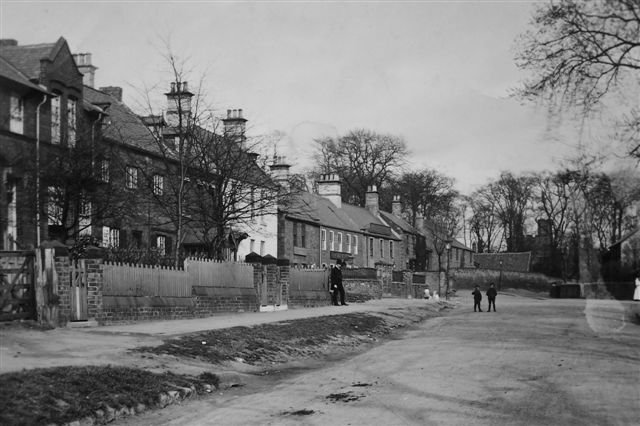
 

I had never seen this picture before but I am now quite sure from looking at street maps of the time that the houses you can see at the far left are in fact the cottages shown in the very first picture of this blog, including the one I lived in! I had never thought about it before, but notice how close the roofline is to the top of the first floor windows. Note also the wall separating them from the rest of the row as they were originally on a private estate.  In the background you can see Benwell Towers which, many years later, is where the TV series Byker Grove was filmed.

The row of houses you can see includes two pubs: The Hawthorn and The Green Tree. Both pubs survived in name though the newer premises were on opposite sides of the road when I lived there. These houses and pubs were all demolished long before I was born to make way for a road (Fox & Hounds Lane) which is basically continuation of Ferguson’s Lane but curving to the left.

A slightly better view from the early 1900s again shows the cottages on the far right. If you click to expand it you can see the drainpipe coming down the front of the house beside the first set of windows, exactly as in the first image on this blog.

Here’s a slightly different view of the same area, taken in 1920 and showing both sides of Ferguson’s Lane, again with Benwell Towers in the distance.
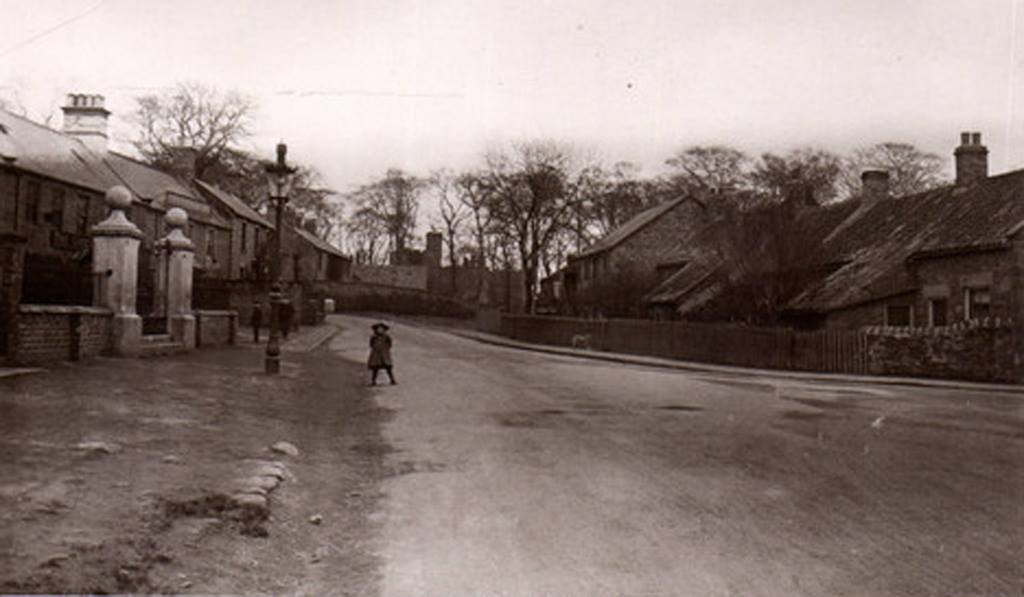
The lamppost is very useful for orienting these three images!

The cottages on the right no longer existed by the time I lived in Benwell: the new Hawthorn Inn stood at their location. At the far end of that row of houses was the old Smithy part of which became a dodgy garage called HQ Motors, which when I lived in the area was guarded by a very scary dog called Patch.

I never really knew what the old Benwell Village looked like. Now I have a much better idea, despite the fact the School the cottages and the pubs have now all vanished!

Gaia’s Third Data Release!

Posted in The Universe and Stuff with tags , , on June 13, 2022 by telescoper

It seems like only yesterday that I blogged about the second release of data from the European Space Agency’s Gaia mission but today sees the release of the third data set, known to its friends as DR3. This completes the set after some initial data were released early as EDR3 back in 2020.

Gaia on the Launchpad at Kourou, French Guyana, on 13th December 2013

In case you weren’t aware, Gaia, launched way back in 2013, is an ambitious space mission to chart a three-dimensional map of our Galaxy, the Milky Way, in the process revealing the composition, formation and evolution of the Galaxy. Gaia will provide unprecedented positional and radial velocity measurements with the accuracy needed to produce a stereoscopic and kinematic census of about one billion stars in our Galaxy and throughout the Local Group. This amounts to about 1 per cent of the Galactic stellar population.

Gaia is likely to operate until round about November 2024, so there’s a lot of data yet to come.

You can find a complete list of what is in DR3 here and if you want to go straight into the papers based on this dataset, go here. There is a nice promotional video here:

R.I.P. Phil Bennett (1948-2022)

Posted in Biographical, Rugby with tags , , , on June 13, 2022 by telescoper

With the passing of Phil Bennett at the age of 73, one of the true greats of Rugby Union has left us. Known to many as “Benny”, Phil Bennett was one of the best players ever to play at fly half for any team at any time. While the role of outside half in the modern game involves a much greater emphasis on kicking ability, Bennett just loved to run with the ball and had an amazing box of tricks with which to bamboozle the opposition, including but not limited to his famous sidestep.

Watch him here in the classic Barbarians versus New Zealand match in Cardiff 1973. The coach of a mere mortal would tear his hair out seeing a player what Bennett did under the shadow of his own posts, but he didn’t just get away with it – he started the move that created a part of Rugby history.

Phil Bennett took over as outside half for Wales from Barry John, who retired early from Rugby, and soon established himself as a permanent member of the phenomenal Welsh team of the early 1970s, joining the ranks of such legends as JPR Williams, Gerald Davies, and Gareth Edwards.

I was born in England but had family connections to Scotland, Wales and Ireland too. Partly because the English team of that period was not strong we always cheered for Wales when we watched the Five Nations games at home. Years later I managed to meet a few of the players of that time. I was flabbergasted to bump into JPR Williams once just outside my house; met Gerald Davies at an event in Cardiff Bay; and encountered Phil Bennett in a bookshop in Cardiff city centre. On all occasions I was completely tongue-tied, struck by the awe of being in the company of such people. All of them were modest and gracious. Remember that Rugby Union in those days was an amateur sport and none of these extraordinary men became rich like modern players do.

Anyway, here is another sensational try featuring Phil Bennett who both starts and finishes the move – with a fantastic contribution from Gerald Davies in between. In the words of the great Bill McLaren “That was absolute magic, and the whole crowd here knows it”.

Rest in Peace, Phil Bennett (1948-2022)

John McLaughlin

Posted in Jazz with tags , , on June 12, 2022 by telescoper

It’s Sunday and I’ve just finished work for the day. Too tired to write anything substantial I thought I’d share a track featuring and named after the guitarist I went to see at the National Concert Hall a few weeks ago. John McLaughlin is the 4th track on the Miles Davis (double) album Bitches Brew. It doesn’t feature Miles Davis on trumpet nor Wayne Shorter on saxophone but does involve the electric pianos of Chick Corea and Joe Zawinul, the bass of Dave Holland, the drums of Lenny White and Jack de Johnette, other percussion by Don Alias and Juma Santos and Bennie Maupin on bass clarinet; the latter addition to the ensemble being a stroke of genius by Miles Davis. I know quite a lot of fans of Miles Davis don’t like this album at all, finding it all a bit perplexing but I don’t mind music that’s a bit perplexing and I think it’s great. Most of the tracks are very long but this one is only four and a half minutes or so in duration, built around a simple riff laid over a loose and very dynamic rhythmic accompaniment. Like the other numbers, it’s almost entirely improvised.

A Leaving Certificate Applied Maths Problem

Posted in Cute Problems, Education, mathematics with tags , on June 11, 2022 by telescoper

The 2022 cycle of Leaving Certificate examinations is under way and the first Mathematics (Ordinary and Higher) were yesterday there’s been the usual discussion about whether they are easier or harder than in the past. I won’t get involved in this except to point you to this interesting discussion based on an archive of mathematics questions, that this year the papers have more choice for students and that, apparently, the first Higher Mathematics paper had very little calculus on it.

Anyway, I was looking through some old Applied Mathematics Leaving Certificate papers, as these cover some similar ground to our first year Mathematical Physics at Maynooth, and my eye was drawn to this question from 2010 about two balls jammed in a cylinder…

I’d add another: does it matter whether or not the cylinder is smooth (as this is not specified in the question)?

Your answers are welcome through the comments box!

Concerning Covid Immunity

Posted in Biographical, Covid-19, Maynooth with tags , , , on June 10, 2022 by telescoper

Over the past few weeks I’ve attended a number of events at which most people were not wearing face coverings, including a recent Open Day at which I took my mask off in order to be heard in a very crowded space. Although I still wear a mask on public transport and in shops, most people now do not.

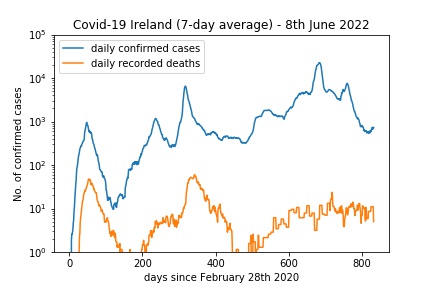
The first thing I’d note is that that there has been a clear upturn in reported Covid-19 cases, with figures now running at about 700 per day:

(Official figures for Ireland are only issued weekly these days…)

It’s not an alarming increase but hospitalizations and testing positivity are also increasing, though the mortality rate remains low because of the protection afforded by vaccines. Incidentally, it was a year ago on Wednesday (8th June) that I received my second Pfizer dose. One wonders how long vaccine protection will last, though, until further boosters are needed. If cases continue to rise I wonder if any measures will be put in place before the start of next academic year?

A number of my colleagues at home and abroad have attended scientific conferences recently, a number of which have led to mini-outbreaks and some instances of quite serious illness. Although most people seem to think Covid has gone away, it clearly hasn’t. A resurgence is all we need right now.

Anyway, one of my colleagues at work expressed surprise that I didn’t catch Covid during the largely unmasked Open Day at the end of April. Of course I might have done but I certainly didn’t display any symptoms. I’ve actually been quite surprised that I have never shown any sign of SARS-Cov2 at all during the entire period of the pandemic, while many of my colleagues and students in the Department have come down with it.

Coincidentally, a comment appeared yesterday on a blog post I wrote a while ago in which I revealed that I have the  CCR5-Δ32 genetic mutation which confers protection against HIV infection. As a matter of fact I have it twice (i.e. homozygotic). For one thing the commenter pointed out that this mutation may have protected against smallpox, which means some evolutionary selection may have been involved in its propagation. The commenter also drew attention to the evidence – by no means conclusive at this stage – that this mutation may also protect against Covid-19. If you’re interested here are links to some papers:

The last of these is a preprint but the other two are peer-reviewed publications.

Could it be that I’ve yet again been a jammy bastard and inherited immunity to Covid-19 too?

R.I.P. David Hughes (1941-2022)

Posted in The Universe and Stuff with tags , , on June 9, 2022 by telescoper
David W Hughes (1941-2022)

I am once again very sorry to have to pass on some sad news. Astronomer David Hughes (formerly of Sheffield University) passed away suddenly on Monday 6th June at the age of 80.

Born in Nottinghamshire, David did his first degree at Birmingham University and his DPhil in Oxford. He moved to Sheffield in 1965 and worked there until he retired in 2007.

David was an expert on the Solar System, especially its minor bodies, such as asteroids and comets; the Mars-crossing asteroid 4205 David Hughes is named in honour of his many achievements. He was also very knowledgeable about the history of astronomy and the threat to Earth from meteors and other impact phenomena. An ebullient public speaker, he was much in demand as a guest on TV programmes, as well as giving lectures on cruise ships and talks to amateur astronomical societies and lay audiences. Through these activities he did a huge amount for the popularization of astronomy especially in the UK.

I send my condolences to his family, friends and colleagues both in Sheffield and around the world.

R.I.P. David W Hughes (1941-2022)

Writing, Publishing and Blogging

Posted in Biographical, Maynooth on June 8, 2022 by telescoper

This morning I saw this bit of guidance about writing a blog produced by a colleague from Maynooth:

I’m not sure how well I’ve followed this guidance over the last 14 years or so but was struck by the assertion that “a blogpost is a publication”. It reminded me of a webinar I did a while ago about Open Access publication which led to a discussion of whether or not a preprint is a publication. Taking the definition of “publish” to be “to issue to the public”, I think it is. In the digital era methods of publication are much simpler and more diverse than in the days when everything was circulated on paper and although I haven’t thought much about it before, I agree on this basis that a blog post is indeed a publication.

That means I have 5942 publications! Or actually 5943 after I’ve published this one. Not counting a couple of hundred “proper” ones, of course…

Anyway I have never really seen a good reason why this blog should be entirely about my professional life. It is true that the most popular posts have proved to be about my research interests but people seem to read the other stuff too so I see no reason to be restrictive.

A dozen years ago I wrote a post about how and why I started blogging, and what follows is an edited version of that.

Lots of people have asked me over the years why I have a blog and why I apparently spend so much time writing it. Well, for me, there are two answers. The first is just that I enjoy writing. I think because of that I’ve always been able to write stuff fairly quickly and developed a little bit of a knack for it. I also sometimes find it easiest to figure out what I actually think about something by trying to write about it. Publishing a post written for this reason is almost irrelevant and there have been a few occasions when I’ve regretted posting items in which I’ve been “thinking out loud” in this way. Sometimes it’s good to remember that people may actually read what you write…

When I started blogging I realized that it gave me the chance to write about things quite different from the usual themes I had previously tackled in publications. I’d written scientific papers, textbooks, lecture notes, popular books and newspaper articles before but most had  been quite strictly controlled by editors and were always related to my scientific work.

It was only after I’d been blogging quite a while that I started doing music and poetry items, entirely for my own amusement, like keeping a scrapbook, but if people actually enjoy things that I’ve put up that they’d never seen before then all the better. I know a lot of people think I’m a pretentious twat for posting about poetry or Opera or modern jazz – some have said as much to my face, in fact – but that’s what I like. There’s enough blogs about pop music, TV celebrities and computer games already, not that I’d be able to write about them. I’m flattered too by the fact that some of my music and other posts have been linked to Wikipedia articles – and, no, I didn’t put them there!

The other reason I had for starting to blog is much more personal. I moved job from Nottingham to Cardiff in 2007, but I got caught up in the credit crunch and was unable to sell my old house for quite a while. I spent far too much time commuting from Nottingham to Cardiff and back for the weekends and got thoroughly depressed, a state of mind not helped by some other issues which I won’t go into. In the middle of this my father died. Though not entirely unexpected, I did have to take some time out to deal with it. He hadn’t left a will, and I had to sort out the legal side of things as well as dispose of his belongings and arrange the funeral. In the aftermath of all that I had pangs of nostalgia for my childhood in Newcastle and an urge to connect with all that through writing down some thoughts and memories. Many of my early posts on here were quite morbidly introspective and probably not much fun for anyone to read, but I found writing them quite cathartic, as indeed I’ve found other posts for different reasons.

Anyway, knowing my tendency to write bits and bobs and then forget about them, quite a few people had encouraged me to start writing a blog but I hadn’t done it because I didn’t know how to go about setting one up. Fortunately, after a public talk I’d given, Phil Brown of the British Association for the Advancement of Science gave me a few pointers to getting started writing a blog. After finally managing to sell off the Nottingham house and after relocating fully to Cardiff, I started blogging in 2008.

So there you are.  That’s some of why and most of how I came to start writing this blog. I wish I could say I had a mission to change the world, but it’s really just partly a big exercise in self-indulgence and partly a piece of occupational therapy.

I would add two things in my defence. One is that I think that among all the other stuff, I do a bit of public service on here. Any bits of news about funding, exciting or controversial science results and things I think my colleagues might find interesting tend to go on here and I do think that’s a useful thing to do. People in my own Department sometimes find things first from reading here, which I think adds a healthy bit of transparency to the otherwise closed world of academic life. The other thing to say is that, contrary to popular opinion, I don’t actually spend a huge amount of time writing the blog. Much of it is recycled and the rest thrown together quite quickly. I know it’s rubbish, but at least its fast…

Some time ago I came across the idea of a “commonplace book“. To paraphrase Wikipedia

Such books came into use in the middle ages and were essentially scrapbooks, filled with items of every kind: medical recipes, quotes, letters, poems, tables of weights and measures, proverbs, prayers, legal formulas. Commonplaces were used by readers, writers, students, and humanists as aids for remembering or developing useful concepts ideas or facts they had learned. Each commonplace book was unique to its creator’s particular interests.

Dare I say, just like a blog?

R.I.P. Richard Hills (1945-2022)

Posted in Biographical, The Universe and Stuff with tags , , on June 7, 2022 by telescoper

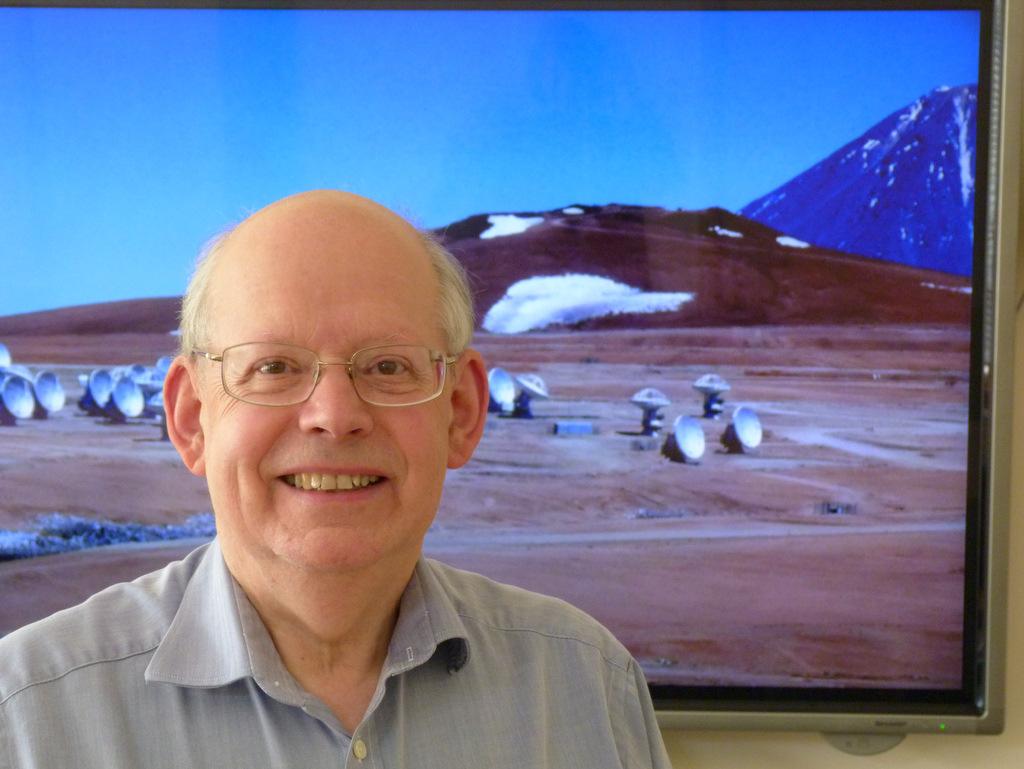
Yet again I find myself having to pass on some sad news. I heard yesterday that Professor Richard Hills FRS lately at the Mullard Radio Astronomy Observatory of the Cavendish Laboratory in Cambridge, passed away on 5th June at the age of 76. Richard was a specialist in radio and sub-mm astronomy, being heavily involved in the James Clerk Maxwell Telescope (JCMT) and more recently the Atacama Large Millimetre Array (ALMA; shown in the background above).

I remember two encounters with Richard particularly well.

The first was when I was an undergraduate student at Cambridge. I did a final-year theory project that involved making a computer simulation of a laser. I had to attend a viva voce examination with two members of staff after submitting my project report. Richard was the one of the pair and, although it was not his specialist subject, he seemed genuinely interested in what I’d done. He managed to ask some very searching questions at the same time as being very friendly and encouraging. I must have answered quite well because they gave me a very good mark!

The other was much more recent occasion when I gave a seminar at the Cavendish about phase correlations in cosmological fields. As an expert in interferometry he knew a lot about this from a different perspective and again he asked some very interesting questions, ending up with a discussion of the closure phase.

Richard Hills was a very eminent scientist who made a huge range of contributions to astronomy, for which he was elected a Fellow of the Royal Society in 2014. He will be greatly missed by his friends, family and colleagues in Cambridge and around the world to whom I send my condolences.

R.I.P. Richard Edwin Hills (1945-2022)

Exploitation and Surplus Value in Academia

Posted in Education, Maynooth with tags , , on June 7, 2022 by telescoper

After two years of Covid-19 pandemic requiring academic staff to undertake countless hours of unpaid overtime, I’m sure all my colleagues at Maynooth University, especially those whose workloads went through the roof during this time, will be as delighted as I am to learn that the University made a surplus of €13.2 million last year.

I’m reminded of a post I did a while ago about why academic publishing is so profitable. The argument I presented based on Marx’s theory of exploitation which holds not only for capitalist societies but for all class-based societies (including, e.g., feudal societies). In Das Kapital Marx argued that

…living labour at an adequate level of productivity is able to create and conserve more value than it costs the employer to buy; which is exactly the economic reason why the employer buys it, i.e. to preserve and augment the value of the capital at his command. Thus, the surplus-labour is unpaid labour appropriated by employers in the form of work-time and outputs.

The current situation certainly seems like exploitation to me, though it’s not only the staff but also the students who are being taken for a ride.

In a couple of weeks I am supposed to spend yet another Saturday (unpaid) delivering an open-day talk at which I attempt to persuade students to come to Maynooth to study Theoretical Physics. I probably won’t mention that we haven’t got enough staff to teach them effectively, we haven’t had sufficient investment to offer decent levels of teaching infrastructure (e.g. no lecture capture facilities), and they probably won’t be able to find anywhere to live near campus so won’t be able to attend lectures without lengthy commutes. I don’t suppose prospective students care about those things anyway. But I’m sure they’ll be delighted to hear about the size of the University’s surplus….

…I bet that will make them feel really good about coming to Maynooth!