Archive for January, 2023

New Publication at the Open Journal of Astrophysics

Posted in OJAp Papers, Open Access, The Universe and Stuff with tags , , on January 5, 2023 by telescoper

I’ve been catching up on publishing matters over the past day or so, including dealing with a bit of a backlog generated by the Christmas break. The Open Journal is run entirely by volunteers and we all need some time off at some point.

To start with I’m delighted to be able to announce the last paper of 2022 at the Open Journal of Astrophysics.  The latest paper is the 17th paper in Volume 5 (2022) as well as the 65th in all. It’s yet another in the Cosmology and Non-Galactic Astrophysics folder.

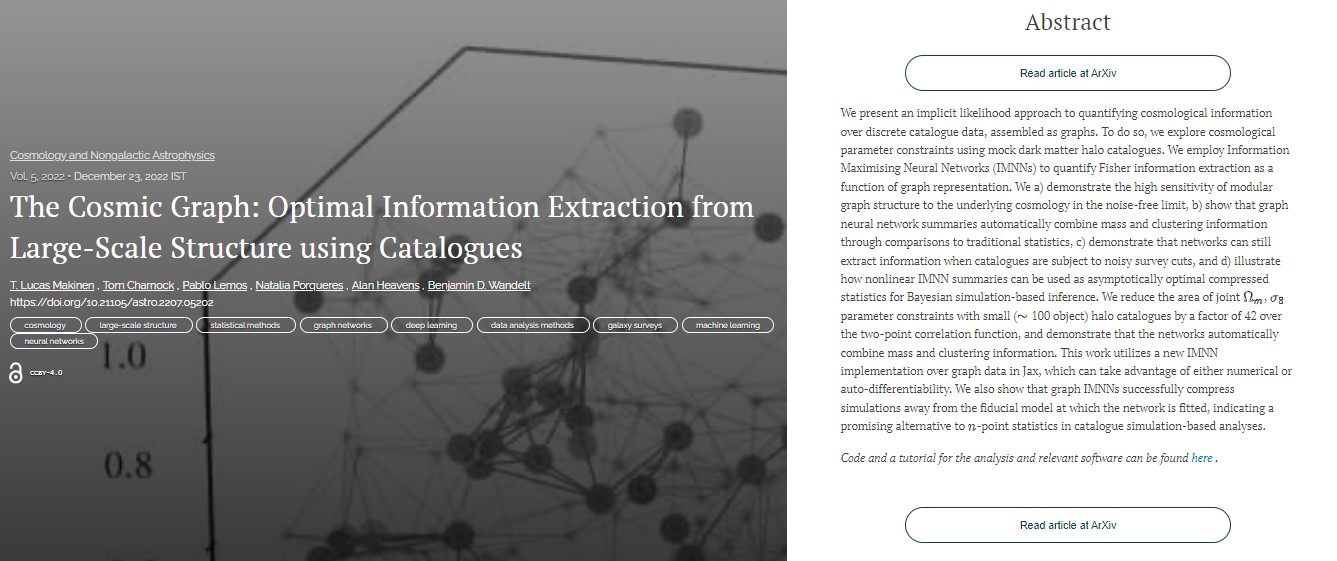
The latest publication is entitled “The Cosmic Graph: Optimal Information Extraction from Large-Scale Structure using Catalogues“. It is written by a distinguished collection of cosmologists from around the world (and Alan Heavens).

Anyway, here is a screen grab of the overlay which includes the  abstract:


You can click on the image to make it larger should you wish to do so. You can find the officially accepted version of the paper on the arXiv here.

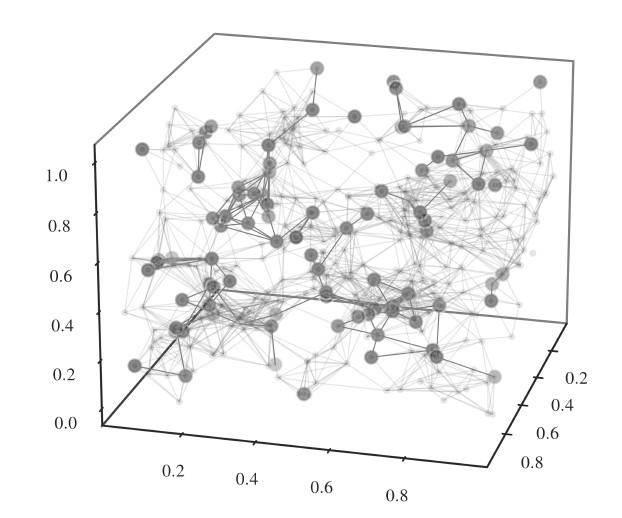
Here is a bigger version of the image from the paper used on the overlay:


Code and a tutorial for the analysis and relevant software can be found here .

Perihelion Again

Posted in The Universe and Stuff with tags on January 4, 2023 by telescoper

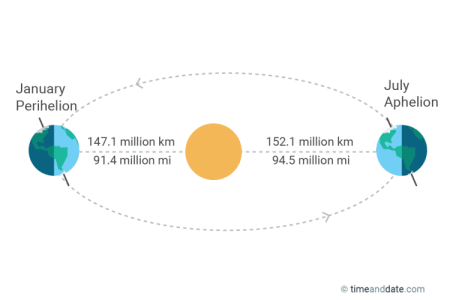
Earth’s elliptical orbit viewed at an angle (which makes it look more eccentric than it is – in reality is very nearly circular).

According to my new RAS Diary,  today (Wednesday 4th January 2023) at approximately 16.17 GMT the Earth reaches at the point on its orbit which which it is at its closest to the Sun, i.e. its perihelion. At this time the distance from the Sun’s centre to Earth’s centre will be  147,098,925 km. This year, aphelion (the furthest distance from the Sun) is at 21.06 GMT on July 6th 2023 at which point the centre of the Earth will be 152,093,251 km from the centre of the Sun. You can find a list of times and dates of perihelion and aphelion for future years here.

At perihelion the speed of the Earth in its orbit around the Sun is greater than at aphelion (about 30.287 km/s versus 29.291 km/s). This difference, caused by the Earth’s orbital eccentricity, contributes to the difference between mean time and solar time I blogged about when discussing the Winter Solstice a couple of weeks ago.

It surprises me how many people think that the existence of the seasons has something to do with the variation of the Earth’s distance from the Sun as it moves in its orbit in that the closer to the Sun we get the warmer the weather will be. The fact that perihelion occurs in the depth of winter should convince anyone living in the Northern hemisphere that this just can’t be the case, as should the fact that it’s summer in the Southern hemisphere while it is winter in the North.

The real reason for the existence of seasons is the tilt of the Earth’s axis of rotation. I used to do a little demonstration with a torch (flashlight to American readers) to illustrate this when I taught first-year astrophysics. If you shine a torch horizontally at a piece of card it will illuminate a patch of the card. Keep the torch at the same distance but tilt the card and you will see the illuminated patch increase in size. The torch is radiating the same amount of energy but in the second case that energy is spread over a larger area than in the first. This means that the energy per unit area incident on the card is decreases when the card is tilted. It is that which is responsible for winter being colder than summer. In the summer the sun is higher in the sky (on average) than in winter. From this argument you can infer that the winter solstice not the perihelion, is the relevant astronomical indicator of winter.

That is not to say that the shape of the Earth’s orbit has no effect on temperatures. It may, for example, contribute to the summer in the Southern hemisphere being hotter than in the North, although it is not the only effect. The Earth’s surface possesses a significant North-South asymmetry: there is a much larger fraction of ocean in the Southern hemisphere, for example, which could be responsible for moderating any differences in temperature due to insolation. The climate is a non-linear system that involves circulating air and ocean currents that respond in complicated ways and on different timescales not just to insolation but to many other parameters, including atmospheric composition (especially the amount of water vapour).

The dates when Earth reaches the extreme points on its orbit (apsides) are not fixed because of the variations in its orbital eccentricity so, in the short-term, the dates can vary up to 2 days from one year to another. The perihelion distance varies slightly from year to year too; it’s slightly smaller this year than last year, for example.

There is however a long-term trend for perihelion to occur later in the year. For example, in 1246, the December Solstice (Winter Solstice for the Northern Hemisphere) was on the same day as the Earth’s perihelion. Since then, the perihelion and aphelion dates have drifted by an average of one day every 58 years and this trend will continue. This means that by the year 6430 the timing of the perihelion and the March Equinox will coincide, although I will probably have retired by then…
 

First Day Back

Posted in Biographical, Education, Maynooth with tags , on January 3, 2023 by telescoper

So here we are, then, 3rd January 2023 and my first day back after the Christmas break. Maynooth University Campus has been largely deserted, though a few of my colleagues have been in today.

Quite a few people seem to have been down with various bugs over the holiday, including a few that have tested positive for Covid-19. We haven’t had information about actual case numbers since before Christmas but I expect a big increase when the figures are announced later this week. Hospitals are already under pressure here in Ireland so things could be quite difficult during the next few weeks.

My plans to do an in-person revision lecture were foiled by the fact that the teaching room I planned to use was locked so I adopted plan B which was to put up some lecture recordings to help the students with their revision ahead of the examination period which starts on Friday. That’s a bit early, really, as 6th January (being Epiphany) is still very much a part of the Christmas season for many people. I remember trying to arrange a meeting on January 6th years ago with a European collaboration only to be met with complete disbelief. At least the first examination for which I am responsible isn’t until Saturday.

For many of the students taking examinations in subjects I have been teaching, these will be the first University examinations and I’m sure many of them are a bit apprehensive, so I thought I’d pass on some advice.

  1. Try to get a good night’s sleep before the examination and arrive in plenty of time before the start. Spending all night cramming is unlikely to help you do well. Prepare well in advance so you’re relaxed when the time comes.
  2. Read the entire paper before starting to answer any questions. In particular, make sure you are aware of any supplementary information, formulae, etc, given in the rubric or at the end.
  3. Start off by tackling the question you are most confident about answering, even if it’s not Question 1. This will help settle any nerves. You’re under no obligation to answer the questions in the order they are asked.
  4. Don’t rush! Students often lose marks by making careless errors. Check all your numerical results on your calculator at least twice and – PLEASE – remember to put the units!
  5. Don’t panic! You’re not expected to answer everything perfectly. A first-class mark is anything over 70%, so don’t worry if there are bits you can’t do. If you get stuck on a part of a question, don’t waste too much time on it (especially if it’s just a few marks). Just leave it and move on. You can always come back to it later.

Nolan, Moran and Schwa…

Posted in Biographical, Irish Language with tags , , on January 2, 2023 by telescoper

This Bank Holiday afternoon I’ve been pottering about at home and listening to The Full Score on RTÉ Lyric FM, which is presented by Liz Nolan. I like this programme because it consists of performances of full works rather than bits and pieces extracted from longer compositions (“bleeding chunks” as my music teacher at school used to call them). Unfortunately this programme is broadcast on weekday afternoons so I can’t listen to it often except when I’m off work.

The presenter’s surname Nolan made me reflect on how many Irish surnames end with –an. Other examples aside from Nolan include Regan, Keegan, Dolan, Coogan, Behan, Whelan and Moran. In Ireland these are all pronounced with a stress on the first syllable, as they are in English pronunciation, but curiously English people usually pronounce the last with a stress on the second syllable, i.e. Mor-AN. I’ve been pulled up for doing this on more than one occasion. Here in Ireland it’s not Mor-AN but MOR-an. A little googling suggests that the English version is influenced by the French name Morant rather than the original Gaelic Ó Móráin.

Anyway this line of thought took me to the realization that the vowel in an unstressed final syllable such as in Nolan is a very indistinct sound. You could almost put any vowel in there and get the same sound: “Nolan” could easily be transcribed as “Nolon” or “Nolun” etc if the second syllable is not stressed.

Then I realized that linguists, specifically those who study phonetics and phonology, have been there long before me. There is a name for the indistinct vowel sound in such cases: it is called schwa and is denoted by the character ə. Schwa sits right in the middle of the vowel chart. Produced when the lips and tongue are completely relaxed, it’s neither an open nor a closed vowel but something in between. It’s actually quite a common sound in English, though it’s taken me almost 60 years to discover its name! – and exists in many other languages too.

New Year, Old Resolutions

Posted in Biographical on January 1, 2023 by telescoper

For last year’s words belong to last year’s language
And next year’s words await another voice.
And to make an end is to make a beginning.

from Four Quartets, ‘Little Gidding’ by T. S. Eliot.

For the last three years I have been sharing a list of things I plan, to do in the New Year. Unfortunately it seems to have been pretty much the same list each time. Here it is again for completeness.

  1. Go to more live concerts. Although I enjoy the radio and recordings, I far prefer to listen to live music at concerts. Attending such events helps also support the venues and musicians as without an audience both would die.
  2. See more of Ireland. I moved to Maynooth five years ago but, apart from one visit to Galway and one to Armagh, I still haven’t travelled much beyond the Dublin area. I must get around more, especially to the South.
  3. No more working weekends. I’ve been in the office for at least one day every weekend since I started at Maynooth. I did the same when I was at Sussex too, and seem to have relapsed. I have always had problems managing my own work/life balance but I realize it’s not setting a good example to younger folk to be getting it so obviously wrong. I’ll add not reading work emails at weekends to this.
  4. Be a better colleague. This is something I think one should always strive to be, but I have particular need to improve. I know that over the last five years or so things weighed very heavily on me behind the scenes and I ended up letting people down on too many occasions. I apologize for that and will try to do better in future.
  5. Read more books. I used to be a voracious reader of all kinds of books, both fiction and non-fiction, but I somehow got out of the habit. I now have a stack of unread works that I must try to read before the year is out!
  6. Finish more things! Not unrelated to No. 4 above, I have been very poor over the last few years at completing projects and writing papers. I need to clear the backlog and get on with some new things.
  7. Do more to promote Open Access publishing. I’m not surprised that the status quo in academic publishing is proving hard to dislodge, but I believe that change can be achieved if researchers take the initiative. I’m proud of what we have achieved so far at the Open Journal of Astrophysics but there’s much more to be done.

I achieved very few of these in 2020, 2021 or 2022. The pandemic made the first two impossible but at least I managed to get out to a few concerts in 2022 and plan to see more this year. The Irish National Astronomy Meeting in 2023 is in the fine city of Cork, and I’m looking forward to going there. Number 3 changed when we had to start working from home, which made it difficult to get away from work at all but since I moved into my house in August 2020 I at least have a study on which I can close the door. I haven’t improved much on the 4th one either, although the reasons for the past two years are different. Likewise with 5 and 6. I have done as much as I possibly can on 7 but it’s been a bit of a struggle getting papers turned around promptly. I think there are a lot of busy and/or tired people out there!

I didn’t cope with the stress and isolation of being a Head of Department during the Covid-19 era as well as I might have done. I don’t know whether it was the high levels of anxiety that sapped my energy or whether I’m just feeling the effects of age. Anyway I’m glad I completed my term in September last year, and have at least managed to complete a couple of papers since then. I hope to finish another in the following week or so.

Finally I should mention that the traffic to this blog was up a massive 4.5% in 2022 compared with 2021. Interestingly the most popular post of the year wasn’t either of the two about Chorizogate (here or here) but an old one I wrote in 2012 about the Shell House Raid which came back to life because of a film on Netflix.