Archive for February, 2023

Institutional Affiliations and the Open Journal of Astrophysics

Posted in Open Access with tags , on February 13, 2023 by telescoper

This is a copy of a blog post I put up in the Open Journal of Astrophysics website at the weekend.

The Research Organization Registry (ROR) is a community-led database that aims to provide a persistent identifier for every research organization in the world. In other words, it aims to do for institutions what ORCID does for individual researchers.

Scholastica has recently introduced a facility to allow authors to include an ROR tag for authors when they submit a paper. We encourage authors of papers submitted to the Open Journal of Astrophysics to do this. Institutions and organizations may require this in due course, as some do with ORCID, so it would be good to get into practice!

For example the ROR entry for NUI Maynooth is:

https://ror.org/048nfjm95

You can find your institutions ROR identifier here.

Not all corresponding authors of papers to OJAp supply details of institutional affiliations when they submit papers to us., presumably because it takes a while enter the relevant data. We can only supply the metadata to Crossref that authors supply to us. The more authors include the better, of course, but the ROR tag supplies a unique persistent identifier that is sufficient to pinpoint the relevant organization, so it is undoubtedly useful. Obviously, however, we can only pass this information on if authors supply it to us.

What should it mean to be an author of a scientific paper?

Posted in Open Access, The Universe and Stuff with tags , , , on February 12, 2023 by telescoper

The implementation of artificial intelligence techniques in tools for generating text (such as ChatGPT) has caused a lot of head-scratching recently as organizations try to cope with the implications. For instance, I noticed that the arXiv recently adopted a new policy on the use of generative AI in submissions. One obvious question is whether ChatGPT can be listed as an author. This has an equally obvious answer: “no”. Authors are required to acknowledge the use of such tools when they have used them in writing a paper.

One particular piece of the new policy statement caught my eye:

…by signing their name as an author of a paper, they each individually take full responsibility for all its contents, irrespective of how the contents were generated. If generative AI language tools generate inappropriate language, plagiarized content, biased content, errors, mistakes, incorrect references, or misleading content, and that output is included in scientific works, it is the responsibility of the author(s).

The first sentence of this quote states an obvious principle, but there are situations in which I don’t think it is applied in practice. One example relates to papers emanating from large collaborations or consortia, where the author lists are often very long indeed, sometimes numbering in the thousands. Not all the “authors” of such papers will have even read the paper, so do they “each individually take full responsibility”? I don’t think so. And how can this principle be enforced as policy?

All large consortia have methods for assigning authorship rights as a way of assigning credit for contributions made. But why does “credit” have to mean “authorship”? Papers just don’t have thousands of authors, in the meaningful sense of the term. It’s only ever a handful of people who actually do any writing. That doesn’t mean that the others didn’t do any work. The project would probably not have been possible without them. It does mean, however, that pretending that they participated in writing the article that describes the work isn’t be the right way to acknowledge their contribution. How are young scientists supposed to carve out a reputation if their name is always buried in immensely long author lists? The very system that attempts to give them credit at the same renders that credit worthless.

As science evolves it is extremely important that the methods for disseminating scientific results evolve too. The trouble is that they aren’t. We remain obsessed with archaic modes of publication, partly because of innate conservatism and partly because the lucrative publishing industry benefits from the status quo. The system is clearly broken, but the scientific community carries on regardless. When there are so many brilliant minds engaged in this sort of research, why are so few willing to challenge an orthodoxy that has long outlived its usefulness.

In my view the real problem is not so much the question of authorship but the very idea of the paper. It seems quite clear to me that the academic journal is an anachronism. Digital technology enables us to communicate ideas far more rapidly than in the past and allows much greater levels of interaction between researchers. The future for many fields will be defined not in terms of “papers” which purport to represent “final” research outcomes, but by living documents continuously updated in response to open scrutiny by the community of researchers. I’ve long argued that the modern academic publishing industry is not facilitating but hindering the communication of research. The arXiv has already made academic journals redundant in many of branches of  physics and astronomy; other disciplines will inevitably follow. The age of the academic journal is drawing to a close. Now to rethink the concept of “the paper”.

In the meantime I urge all scientists to remember that by signing their name as an author of a paper, they individually take full responsibility for all its contents. That means to me that at the very least you should have read the paper you’re claiming to have written.

Ireland v France in Dublin

Posted in Rugby with tags , , , on February 11, 2023 by telescoper

I forgot to mention in this morning’s post that I walked past the above bus on the way to last night’s concert. It is evidently the official transport of the French rugby team who played Ireland today in the Six Nations this afternoon. I didn’t spot any of the French players at the concert, although I did help a couple of friendly France supporters with directions en route.

As expected, it was a cracking match between two excellent teams, a real heavyweight contest, with no quarter asked and non given. But, in the end, Ireland ran out convincing winners by 32-19 despite the absence of a number of first choice players. It was a very impressive performance from Ireland and the best game of rugby I’ve seen for a very long time.

Ives, Beethoven and Sibelius at the National Concert Hall

Posted in Biographical, Music with tags , , , , , , , on February 11, 2023 by telescoper

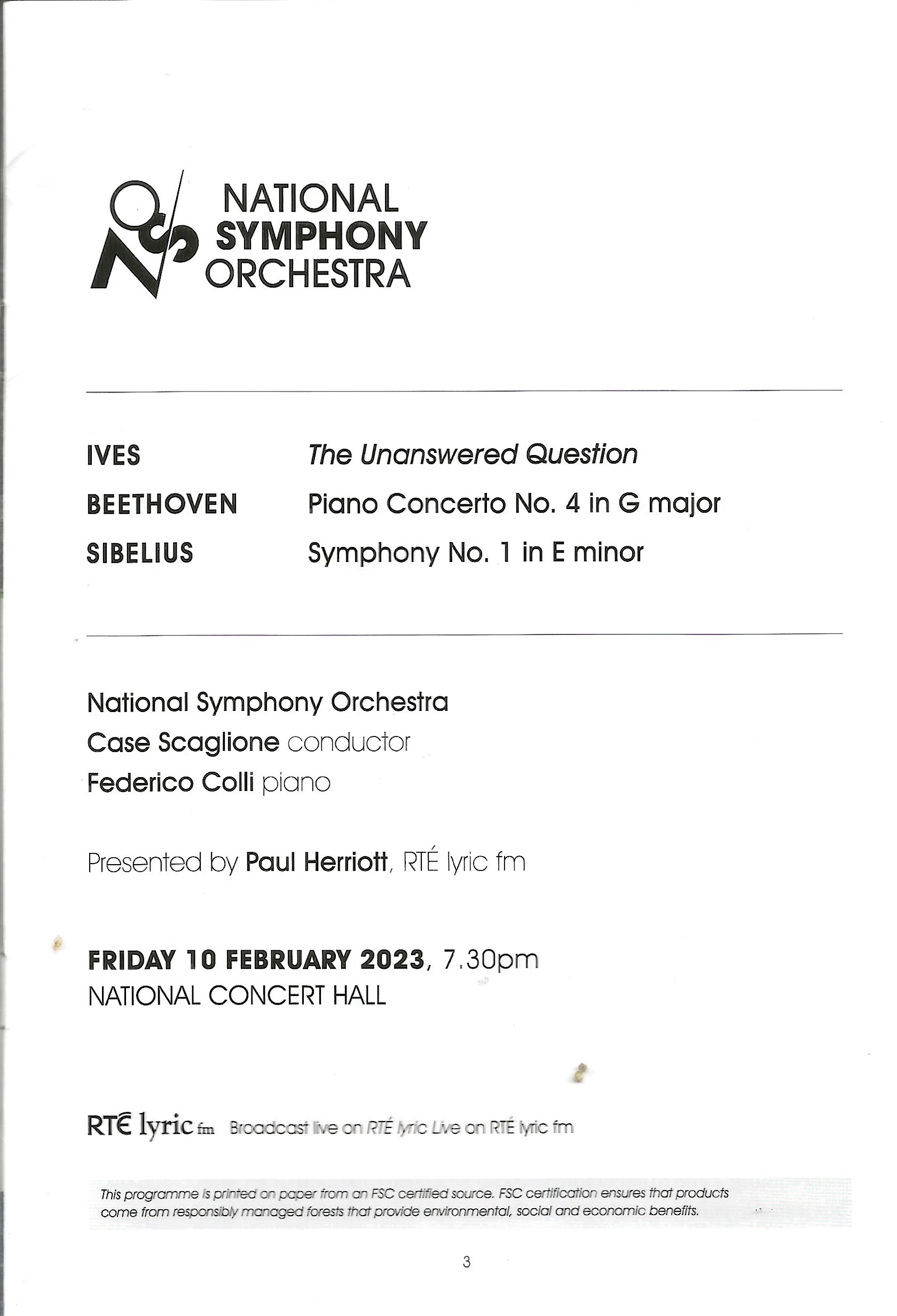
Last night’s concert by the National Symphony Orchestra at the National Concert Hall in Dublin was one that I’d been looking forward to for a long time. It didn’t disappoint! Congratulations to the National Symphony for yet another excellent concert, this time under the direction of guest conductor Case Scaglione.

The first half of the programme consisted of The Unanswered Question by Charles Ives and Beethoven’s Piano Concerto No. 4 with soloist Federico Colli. That’s an interesting juxtaposition, made even more interesting by the Beethoven piece was played directly after the Ives without a break for applause. I wondered what was up when Case Scaglione walked on stage with Federico Colli who took his seat at the piano at the start of the concert. There is no piano part in The Unanswered Question, so Colli sat quietly until the end of that piece and then went straight into the opening piano statement of the Beethoven. I wasn’t expecting this before the performance but it worked very well. The only problem is that I didn’t get the chance to applaud at the end of The Unanswered Question.

The Unanswered Question is one of my favourite works by Charles Ives (along with Three Places in New England), a composer whom I admire greatly. I wrote a piece about him some years ago, actually.  The Unanswered Question, was completed in 1908 (although it was revised later) and is subtitled “A Cosmic Landscape”. It’s a sort of meditation on the philosophical problem of existence. It comprises three different voices: muted strings playing notes from a G-Major triad (a rather “churchy” key, giving the flavour of a simple hymn). Then, played (in this performance) from the balcony behind the conductor, a solo trumpet poses the Question: a five note figure that is repeated with almost imperceptible variations several times during the work. The reply to the Question comes from the woodwinds, whose dissonant response is at first plaintive but then increasingly agitated and frustrated. Then the Question comes again without an answer, but the strings carry on quietly in G Major until everything goes quiet.

The Piano Concerto No. 4 by Ludwig van Beethoven is in G Major, so there is a continuity between the two pieces in terms of tonality, although of course the musical language is very different. It was composed in 1805/6, a hundred years before the Ives. It’s an audacious piece right from the start as it opens with unaccompanied piano. The second movement is a kind of dialogue between the orchestra and the piano, which at times sounds more like an argument as the orchestra makes a series of rather harsh statements with somewhat conciliatory responses from the piano. The last movement is a more conventional and jovial Rondo, by which time the solo trumpeter from the Ives piece had found her way back to the stage from the balcony. I’ve heard this movement several times played on its own on the radio.

Federico Colli cut a dashing figure in a grey suit and waistcoat with a high collar and a voluminous white cravat. He was well up to the demands of the piece, playing very expressively, tenderly at times and with virtuosic brilliance when called for.

After the wine break we returned for the majestic Symphony No. 1 by Jean Sibelius. This is one of the great symphonies and another favourite of mine – I have several different recordings of it and have heard it on the radio many times – but I had never heard it performed live in person before last night. The First Movement (initially Andante) opens with a theme played by solo clarinet. It then moves into allegro energico which was played very briskly in this performance (in contrast to some famous recordings which slow it down). The motif played by the clarinet at the start permeates the whole work, returning in different guises and endowing the composition with a strong sense of unity. It’s all shot through with great romantic tunes and has wonderful dynamics. In short, it’s a masterpiece. Not bad for a First Symphony!

Action Plan for Diamond Open Access

Posted in Open Access with tags on February 10, 2023 by telescoper

I came across an interesting document concerning Diamond Open Access journals and thought I’d share it here. These are journals of the good sort that charge neither authors nor readers. In particular they do not charge exorbitant Article Processing Charges, like Open Access journals of the bad sort do. The Open Journal of Astrophysics is a “diamond journal“.

The document describes an initiative (“Action Plan”) that aims for a scholarly publishing infrastructure that is equitable, community-driven, academic-led and -owned. This will enable the global research community to take charge of a scholarly communication system by and for research communities. It therefore welcomes all researchers, organisations, disciplines, and journals who share its vision and ethos to endorse it.

You can download the document as a PDF file here.

You might also want to endorse the plan, or persuade your organization/university/research lab to do so. You can do that here.

Endorsing the Action Plan does not entail any financial commitment, but makes you part of the Diamond Open Access community and engages you in the creation of conditions that will strengthen the sector. An overview of endorsing persons and organisations will be publicly available.

Perusing the list of endorsing institutes, I see Cardiff University is in there, but sadly not Maynooth (yet…)

What The World Needs Now

Posted in Music with tags on February 9, 2023 by telescoper

Very sad to hear today of the death at the age of 94 of the great songwriter Burt Bacharach. By way of a little tribute I thought I’d reblog this post from a few years ago. R.I.P. Burt Bacharach (1928-2023).

telescoper's avatarIn the Dark

I’ve always been a not-so-secret admirer of American songwriter and record producer Burt Bacharach, but when someone told me the other day that there’s an album called Blue Note Plays Burt Bacharach I assumed it was a wind up because Blue Note Records has for many years been an uncompromising voice at the cutting edge of modern jazz rather than the lighter and more popular form of music exemplified my Mr B.

There’s no reason why two forms of excellence can’t exist together, however, and the album is definitely real and is a very nice compilation of Bacharach numbers from Blue Note albums featuring various musicians over the years. Here’s an example featuring Stanley Turrentine on tenor sax, with McCoy Tyner on piano, Bob Cranshaw on bass and Micky Roker on drums. The tune is What The World Needs Now Is Love. Doesn’t it just?

View original post

Solidarity to the UCU Strikers #UCURising

Posted in Education with tags , , , on February 9, 2023 by telescoper

Today is Thursday 9th February so it sees the first of another two consecutive days of strike action by members of the University and College UCU across the UK. Although I no longer work in the UK I’d like to send this message of support to my former colleagues there who will be out on the picket lines tomorrow and on subsequent days. There will be further escalation of strike action next week, with three days of strikes.

This industrial action arises from a dispute over pensions, pay, and working conditions. The strikes will affect 2.5 million students but are necessary to safeguard not only the livelihoods of academic staff against increased casualisation and salary cuts but the UK university system itself, which is being ruined by incompetent management. Regrettably, the strikes will cause considerable disruption but, frankly, there is no point in a strike that doesn’t do that.

An Interview with Georges Lemaître

Posted in History, The Universe and Stuff with tags , , , , on February 8, 2023 by telescoper

This fascinating video surfaced recently after having been lost for decades. It’s an interview with Georges Lemaître who, along with Alexander Friedmann, is regarded as one of the originators of the Big Bang theory. Lemaître first derived the “Hubble’s law”, now officially called the Hubble–Lemaître law after a vote by members of the International Astronomical Union in 2018, by the IAU and published the first estimation of the Hubble constant in 1927, two years before Hubble’s article on the subject.

Lemaître is such an important figure in the development of modern cosmology that he was given his own Google Doodle in 2018:

The interview was recorded in 1964, just a couple of years before Lemaître’s death in 1966. It was broadcast by Belgische Radio- en Televisieomroep (BRT), the then name of the national public-service broadcaster for the Flemish Community of Belgium (now VRT). Lemaître speaks in French, with Flemish subtitles (which I didn’t find helpful), but I found I could get most of what he is saying using my schoolboy French. Anyway, it’s a fascinating document as it is I think the only existing recording of a long interview with this undoubtedly important figure in the history of cosmology.

As you can see, if you want to watch the video you have to click through to YouTube:

UPDATE: A transcript of this interview in French along with a translation into English can be found here.

New Publication at the Open Journal of Astrophysics

Posted in OJAp Papers, Open Access, The Universe and Stuff with tags , , , , , on February 8, 2023 by telescoper

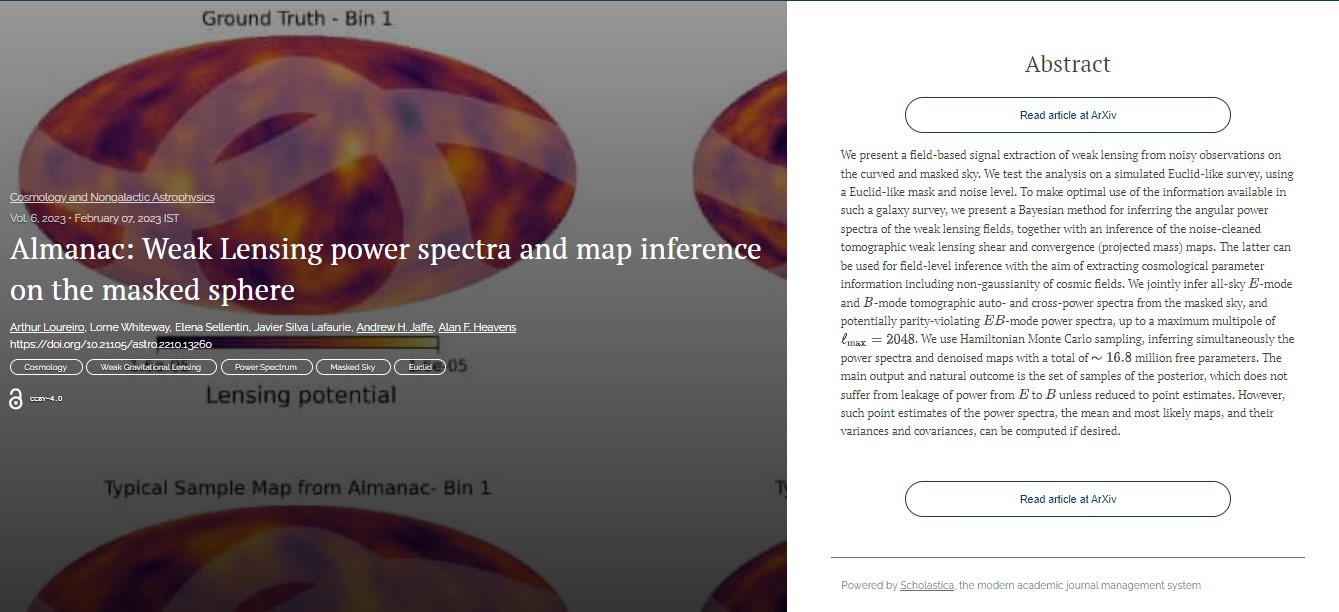
We’re on a bit of a roll at the Open Journal of Astrophysics and it’s time to announce yet another paper. We actually published this one yesterday (7th February 2023), which makes it two in two days. I don’t think we’ll keep up that rate but we have seen a big increase in submissions recently and these are working their way through the system very nicely. We aim to publish accepted papers within a day of the revised version appearing on arXiv.

The latest paper is the 6th paper in Volume 6 (2023) as well as the 71st in all. This one is another one for the folder marked Cosmology and Nongalactic Astrophysics. The title is “Almanac: Weak Lensing power spectra and map inference on the masked sphere”. The nub of the problem addressed by this paper is that the usual statistical analysis of data presented in projection on the sky involves spherical harmonics, which are orthogonal functions on the celestial sphere, but when the sky is not completely covered (i.e. part of it is masked), these functions are not orthogonal on what remains.

The authors of this paper are Arthur Loureiro (University of Edinburgh, UK), Lorne Whiteway (University College London, UK), Elena Selentin (Leiden University, NL), Javier Silva Lafaurie (Leiden University, NL), Andrew Jaffe (Imperial College London, UK) and Alan Heavens (Imperial College London, UK)

Here is a screen grab of the overlay which includes the  abstract:


You can click on the image of the overlay to make it larger should you wish to do so. You can find the officially accepted version of the paper on the arXiv here.

How Euclid will scan the sky

Posted in The Universe and Stuff with tags , , , , , on February 7, 2023 by telescoper

A missive from Euclid High Command arrived yesterday confirming that ESA’s Euclid mission would be launched by SpaceX on a Falcon 9 rocket on a date between July 1st and July 30 (2023). It will soon be time to start getting nervous!

I also noticed that another video has appeared on the Euclid public website showing how the satellite will work. It’s not a traditional general-purpose observatory on which different users bid for time to observe different objects (as is the case for JWST, for example) but a dedicated mission that will compile a systematic survey with very specific science goals.

Euclid scans across the sky using a ‘step-and-stare’ method, combining separate measurements to form the largest cosmological survey ever conducted in the visible and near-infrared. Each time Euclid ‘stares’, its telescope points to a position in the sky, performing imaging and spectroscopic measurements on an area of approximately 0.5 deg² around this position. After each stare, the telescope steps to a new position.

This way the instruments will scan over a total of around 35% of the sky. This is the largest area over which one can guarantee a a complete detection of the galaxies necessary for Euclid’s cosmological studies. The rest of the sky is dominated by the high density of bright stars in our galaxy, and by the dust in the plane of our Solar System, both of which get in the way of the cosmology observations.

I hope this clarifies the situation.