I just remembered that today is May 17th which means that it is International Day Against Homophobia Transphobia and Biphobia, This is a worldwide celebration of sexual and gender diversities and a chance to show solidarity against bigotry and intolerance.
A video circulating today on social media in Ireland showing a teenager being beaten up because he is gay reminds us that we need this now more than ever; there’s a news report here. I hope the culprits are brought to justice. The rising tide of violence and discrimination against LGBTQI+ individuals is encouraged by those who spread poisonous rhetoric in the media and online.
As the launch of the European Space Agency’s Euclid mission approaches, though we don’t know official launch date yet, the associated publicity machines are ramping up for the big occasion. The latest bit of merch is the Euclid Launch Kit.
Sadly, this does not allow you to build your own Falcon 9 launcher which is what I inferred from the name. What it is is an interactive PDF file that allows you to navigate around and learn things about the satellite, its orbit, its instruments and the science case. I think it’s pretty good. You can download it here. It’s over 100 MB though, so beware if you have a very slow connection.
To whet your appetite, here some graphics extracted from the launch kit. You can click on the tiles to make them bigger.
In my capacity as managing editor of the Open Journal of Astrophysics I’ve received a few emails recently disagreeing with our policy of asking authors to submit their papers to the arXiv before submitting them to OJAp. Before reflecting on the wider issue, let me just point out that we don’t actually require papers to on the arXiv first. It is possible to submit a PDF directly to the Scholastica platform. We do however say in our For Authors page:
We strongly encourage authors to submit in the manner described above (i.e. on the arXiv first). We can receive and review papers submitted directly to this platform but since the final version must be on the arXiv in order to be published we feel it is far better to submit it there first in order to establish that it is on an appropriate topic for this journal.
Looking back over the 81 papers we have published, only a handful were submitted directly to the platform; the vast majority were put on the arXiv first.
This behaviour is in some sense a continuation of a very old practice in astrophysics. I can’t resist sharing this, one of the interesting astronomical curiosities I’ve acquired over the years, which is a preprint of the classic work of Burbidge, Burbidge, Fowler and Hoyle in 1957 (a paper usually referred to as B2FH after the initials of its authors), which is such an important contribution to the literature that it has its own wikipedia page.
Younger readers will probably not realize that preprints were not always produced in the electronic form they are today. We all used to make large numbers of these and post them at great expense to (potentially) interested colleagues before publication in order to get comments. That was extremely useful because a paper could take over a year to be published after being refereed for a journal: that’s too long a timescale when a PhD or PDRA position is only a few years in duration. The first papers I was given to read as a new graduate student in 1985 were all preprints that were not published until well into the following year. In some cases I had more or less figured out what they were about by the time they appeared in a journal!
The B2FH paper was published in 1957 but the practice of circulating preprints persisted well into the 1990s. Usually these were produced by institutions with a distinctive design, logo, etc which gave them a professional look, which made it easier to distinguish `serious’ papers from crank material (which was also in circulation). This also suggested that some internal refereeing inside an institution had taken place before an “official” preprint was produced and this lending it an air of trustworthiness. Smaller institutions couldn’t afford all this, so were somewhat excluded from the preprint business.
With the arrival of the arXiv the practice of circulating hard copies of preprints in astrophysics gradually died out, to be replaced by ever-increasing numbers of electronic articles. The arXiv does have some gatekeeping – in the sense there are some controls on who can deposit a preprint there – but it is far easier to circulate a preprint now than it was.
It is still the case that big institutions and collaborations insist on quite strict internal refereeing before publishing a preprint – and some even insist on waiting for a paper to be accepted by a journal before adding it to the arXiv – but there’s no denying that among the wheat there is quite a lot of chaff, some of which attracts media coverage that it does not deserve. It must be admitted, however, that the same can be said of some papers that have passed peer review and appeared in high-profile journals! No system that is operated by human beings will ever be flawless, and peer review is no exception.
Nowadays, in astrophysics, the single most important point of access to scientific literature is through the arXiv, which is why the Open Journal of Astrophysics was set up as an overlay journal to provide a level of rigorous peer review for preprints, not only to provide quality control but also to improve papers through the editorial process. In fact, I think the latter is more important than the former.
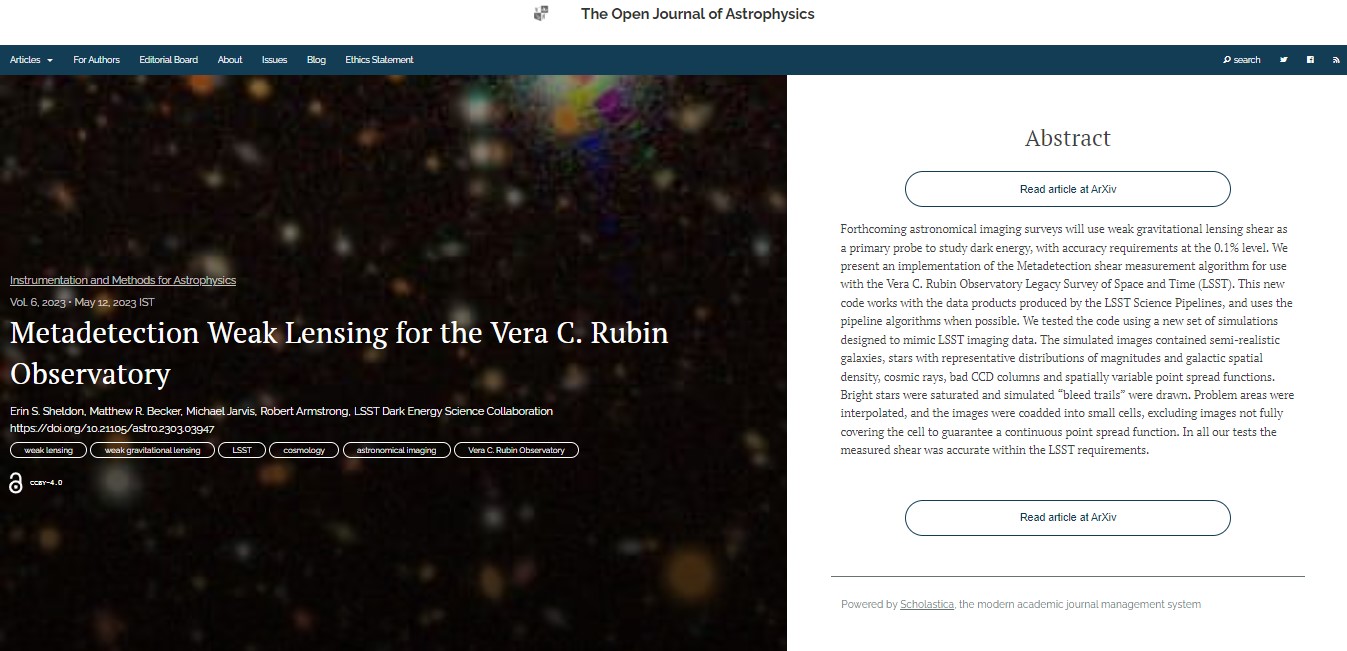
It’s time to announce yet another new paper at the Open Journal of Astrophysics. In fact it’s a little overdue, because we published this one on Friday 12th May, but I just got round to posting it on here.
The authors are Erin Sheldon (Brookhaven National Laboratory, NY, USA), Matthew Becker (Argonne National Laborary, IL, USA), Michael Jarvis (University of Pennsylvania, PA) and Robert Armstrong (Lawrence Livermore National Laboratory, CA) – all in the USA – and the LSST Dark Energy Science Collaboration, who have published a significant number of publications with OJAp. In fact, we’ll have another one in a day or two.
Here is a screen grab of the overlay which includes the abstract:
You can click on the image of the overlay to make it larger should you wish to do so. You can find the officially accepted version of the paper, along with all other astrophysics and cosmology research papers worth reading, on the arXiv here
It’s been too long since I last posted one of the cosmology talks curated on YouTube by Sean Hotchkiss so I will endeavour to put that right by posting one today.
In this video, Jeongin Moon, David Valcin and Christoph Saulder talk about the first cosmologically relevant results from DESI (the Dark Energy Spectroscopic Instrument), including the first detection of the BAOs (Baryon Acoustic Oscillations) therefrom. It’s pretty impressive for a first detection with only two months worth of data, so the final result with the full data set should be spectacular!
You can of course read the paper related to these results (by Moon et al.) on the arXiv here.
After last night’s Eurovision 2023 extravaganza I thought I’d work off my hangover by summarizing the voting. The vote is split into 50% jury votes and 50% televotes from audiences sitting at home, drunk. It’s perhaps worth mentioning that the juries do their scores based on the dress rehearsals on Friday so they are not based on the performances the viewers see.
Each country/jury has 58 points to award, shared among 10 countries: 1-8, 10 and 12 for the top score. Countries that didn’t make it to the final (e.g. Ireland) also get to vote. For the televotes only there is also a “rest-of-the-world” vote for non-Eurovision countries.
This system can deliver very harsh results because only 10 songs can get points from a given source. It’s possible to be judged the 11th best across the board and score nil!
Here are the final scores in a table:
Rank
Country
Overall
Televotes
Jury
Diff
Rank Diff
1
Sweden
583
243
340
+97
+1
2
Finland
526
376
150
-226
-1
3
Israel
362
185
177
-8
+3
4
Italy
350
174
176
+2
+3
5
Norway
268
216
52
-168
-14
6
Ukraine
243
189
54
-145
-11
7
Belgium
182
55
127
+72
+5
8.
Estonia
168
22
146
+124
+14
9.
Australia
151
21
130
+109
+14
10.
Czechia
129
35
94
+59
+7
11.
Lithuania
127
46
81
+35
+4
12.
Cyprus
126
58
68
+10
-2
13.
Croatia
123
112
11
-101
-18
14.
Armenia
122
53
69
+16
+1
15.
Austria
120
16
104
+88
+13
16.
France
104
50
54
+4
-2
17.
Spain
100
5
95
+90
+17
18.
Moldova
96
76
20
-56
-11
19.
Poland
93
81
12
-69
-16
20.
Switzerland
92
31
61
+30
+4
21.
Slovenia
78
45
33
-12
-3
22.
Albania
76
59
17
-42
-11
23.
Portugal
59
16
43
+27
+4
24.
Serbia
30
16
14
+2
0
25.
United Kingdom
24
9
22
+13
0
26.
Germany
18
15
3
-12
-2
Final Scores by country in Eurovision 2023 showing the breakdown into televotes and jury votes, together with the difference in numerical scores awarded and difference in ranking based on jury votes rather than televotes, e.g. Albania scored 42 fewer points on the jury votes and would have been 11 places higher based just on televotes than just on jury votes.
Going into the last allocation of televotes, Finland were in in the lead thanks to their own huge televote, but Sweden managed to win despite a lower televote allocation because of their huge score on the jury votes. Had the scores been based on the jury votes alone, Sweden would have won by a mile, and if only on the televotes Finland would have won. Anyway, rules is rules…
There are some interestingly odd features in the above dataset. For example, Switzerland ranked 20th overall, but were ranked 18th and 14th by televotes and jury votes respectively. There are also cases in which a higher score in one set of votes leads to a lower rank, and vice-versa. Croatia were hammered by the jury votes, ranking 25th out of 26 on that basis but would have been 7th based on televotes alone; hence their -18 in the last column. A similar fate befell Norway. By contrast, Spain were last (26th) on the televotes but placed 9th in the pecking order by the juries; they ended up in 17th place.
Anyway, you can see that there are considerable differences between the scores and ranks based on the public vote and the jury votes. I have therefore deployed my vast knowledge of statistics to calculate the Spearman Rank Correlation Coefficient between the ranks based on televotes only and based on jury votes only. The result is 0.26. Using my trusty statistical tables, noting that n=26, and wearing a frequentist hat for simplicity, I find that there is no significant evidence for correlation between the two sets of ranks. I can’t say I’m surprised.
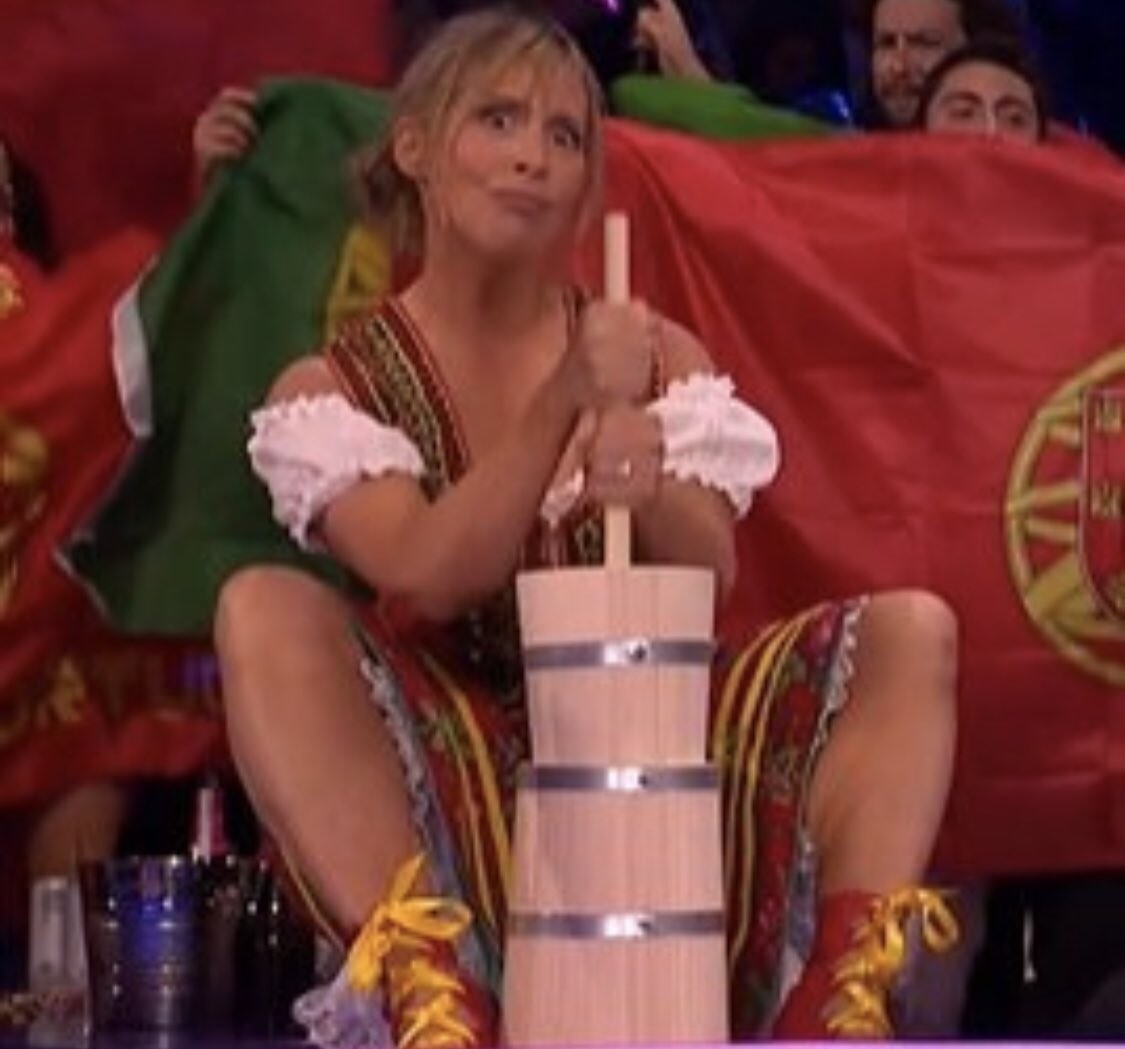
The apparent randomness of the scoring process introduces a considerable amount of churn into the system, as demonstrated by Mel Giedroyc in this, the iconic image of last night’s events.
At least I think that’s what she’s doing…
Anyway, for the record, I should say that my favourite three songs were Albania (22nd), Portugal (23rd) and Austria (15th). Maybe one day I’ll pick a song that makes it onto the left-hand half of the screen!
P.S. Eurovision 2024 will be in Sweden, which is nice because it will be the 50th anniversary of ABBA winning with Waterloo. I’ll never tire of boring people with the fact that a mere 15 years after ABBA won, I walked across the very same stage at the Brighton Centre to collect my doctorate from Sussex University…
I haven’t had time to write much about astrophysics and cosmology recently, so this morning I back a few days through the arXiv – where every research paper worth reading in these fields can be found – and found a fascinating paper by Kelly et al. about the gravitational lensing of a supernova known as SN Refsdal after the pioneer of gravitational lensing, Sfur Refsdal. When first observed in 2014 this supernova was observed as four images produced by the gravitational lensing of light from the supernova through a massive cluster of galaxies, a phenomenon known as an Einstein Cross.
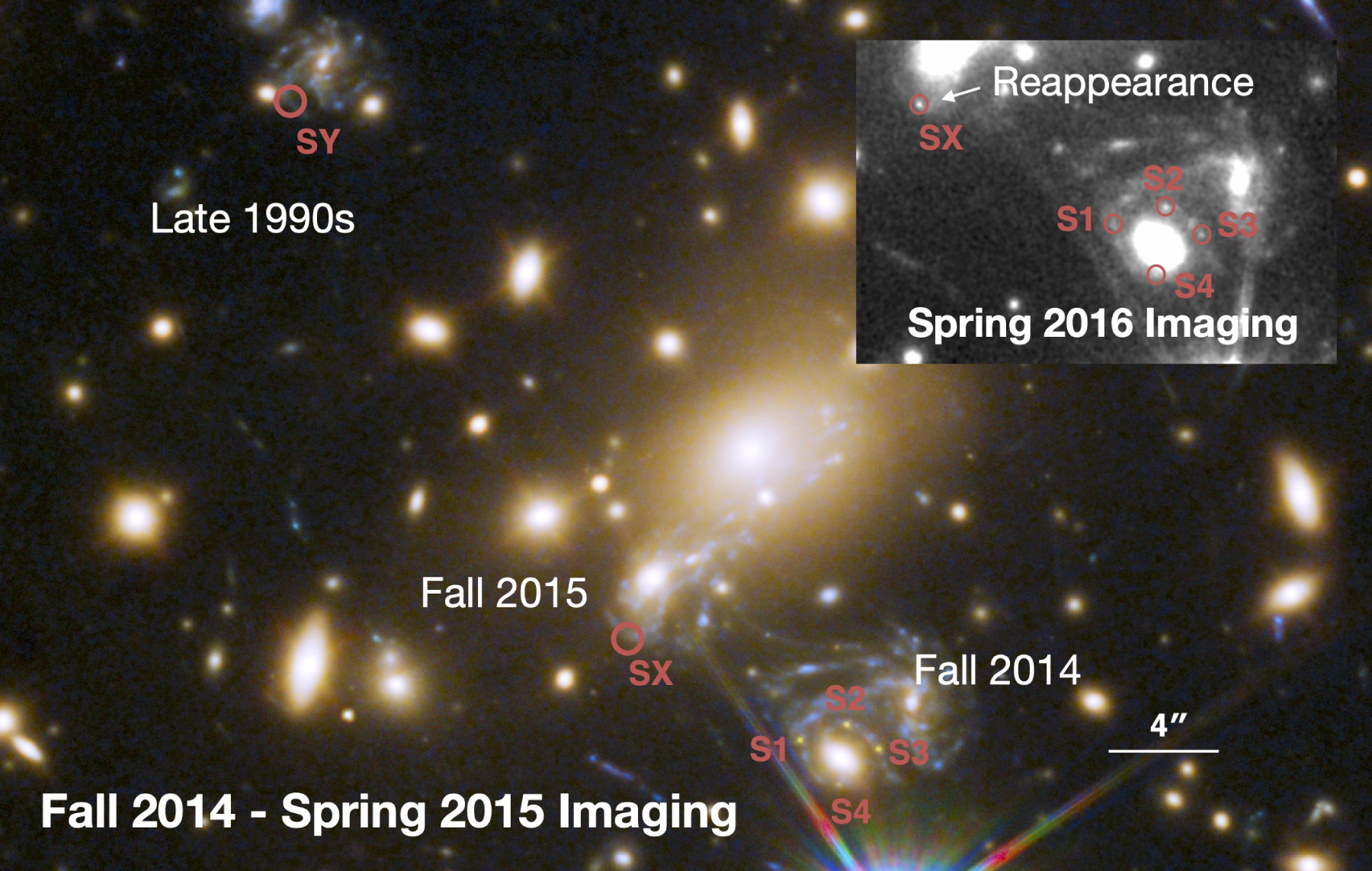
Lens modellers quickly got to work on this system and concluded that two further images should exist. Given the difference in light travel times for lensed paths and the relatively short lifetime of a supernova, neither would occur at the same time as the four original ones. One image would have been observed at some point in the 1990s, had anyone been looking, but that wasn’t the case. However, another was predicted to occur in 2015 and that was observed. I call it Refsdal’s Ghost because of the French word revenant, which means a ghost but also someone who returns after a long absence. Anyway, the revenant is marked SX in the image below (obtained from here). The unobserved image is SY and the four originals S1-S4.
Multiple images of a point source a in a system such as this, with measured time delays, provide theorists with a great deal of information they can use to model the distribution of mass inside the cluster, including its physical size. That in turn allows one to measure its distance. With a measurement of redshift, this allows one to determine the Hubble Constant.
The gravitationally lensed Supernova Refsdal appeared in multiple images, produced through gravitational lensing by a massive foreground galaxy cluster. After the supernova appeared in 2014, lens models of the galaxy cluster predicted an additional image of the supernova would appear in 2015, which was subsequently observed. We use the time delays between the images to perform a blinded measurement of the expansion rate of the Universe, quantified by the Hubble constant (H0). Using eight cluster lens models, we infer H0 = 64.8 +4.4-4.3 km / s / Mpc, where Mpc is the megaparsec. Using the two models most consistent with the observations, we find H0 = 66.6 +4.1-3.3 km / s / Mpc. The observations are best reproduced by models that assign dark-matter halos to individual galaxies and the overall cluster.
Anyone who has been following developments in cosmology knows that there is currently some “tension” over different measurements of the Hubble constant, as illustrated in this figure (which is slightly dated but which makes the point):
There is some uncertainty of course, but it is interesting that the Kelly et al. measurement aligns with most of what are called the “early” measurements in this plot. As I have mentioned before, though, there is another common factor in the “early” measurements, which is that they are based on geometrical distances obtained from angular distances whereas most of the others are based on luminosity. If the Hubble tension were to resolve into a differences between these two types of measure then it would be of fundamental importance to cosmology. At present, however, there is nowhere near enough evidence to be sure one way or the other.
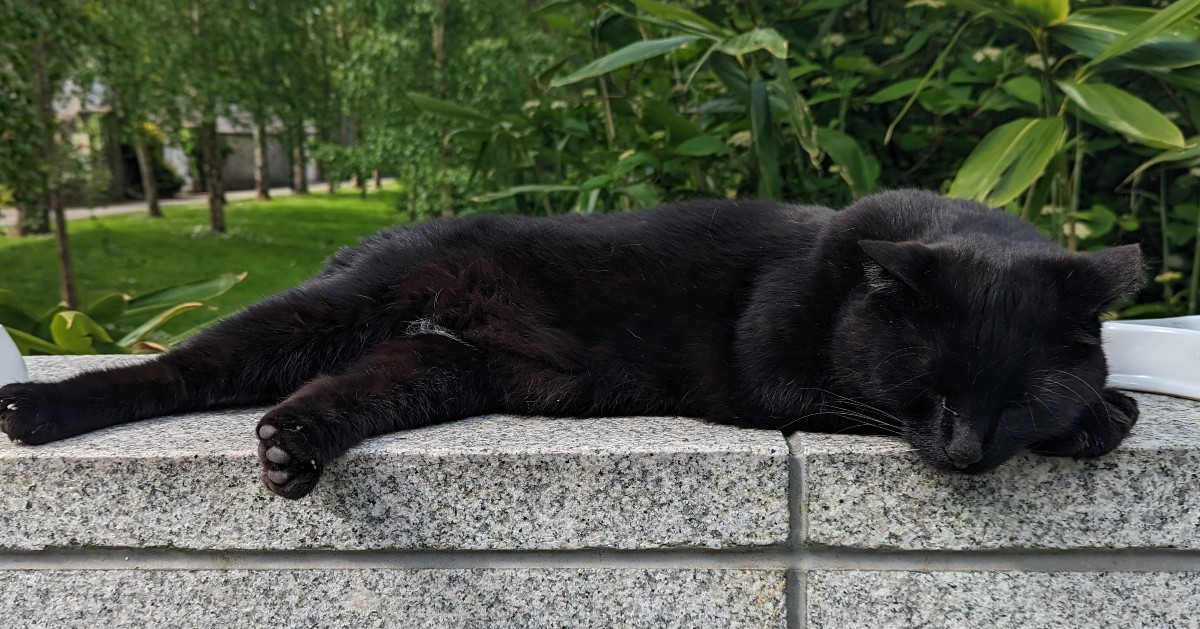
So, teaching is over at Maynooth University and the Examination Period starts today. I just checked the timetable and found that the first theoretical physics paper is not until tomorrow. Yes, we have examinations on Saturdays here! Campus is notably quieter than usual, with the only undergraduate students about being those either going to or coming from an Exam Hall. Meanwhile, Maynooth University Library Cat is strategically positioned on his wall for petting and feeding purposes, although the excitement of it all seems to have got to him and he’s fast been asleep every time I have seen him during the past week, e.g.
This morning I did my last teaching session of the Academic Year 2022-3, a revision lecture/tutorial on Computational Physics. It was optional, as this is officially a study break, and was at 9am, but I had about 40% attendance which wasn’t bad in the circumstances. As is often the case with optional sessions, I think the students who came were the keenest and probably therefore those who least needed last-minute tips for the examination, but that’s always the way.
The Examination Period starts tomorrow, but most of the students who turned up this morning have their first examination on Monday. My paper is on Saturday next, 20th May.
Anyway, now that my teaching is over I thought I’d take the opportunity to wish all students the best for their examinations:
You shouldn’t really be relying on luck of course, so here are some tips (especially for physics students, but applicable elsewhere).
Try to get a good night’s sleep before the examination and arrive in plenty of time before the start. Spending all night cramming is unlikely to help you do well.
Prepare well in advance so you’re relaxed when the time comes.
Read the entire paper before starting to answer any questions. In particular, make sure you are aware of any supplementary information, formulae, etc, given in the rubric or at the end.
Start off by tackling the question you are most confident about answering, even if it’s not Question 1. This will help settle any nerves. You’re under no obligation to answer the questions in the order they are asked.
Don’t rush! Students often lose marks by making careless errors. In particular, check all your numerical results on your calculator at least twice
Please remember the units!
Don’t panic! You’re not expected to answer everything perfectly. A first-class mark is anything over 70%, so don’t worry if there are bits you can’t do. If you get stuck on a part of a question, don’t waste too much time on it (especially if it’s just a few marks). Just leave it and move on. You can always come back to it later.
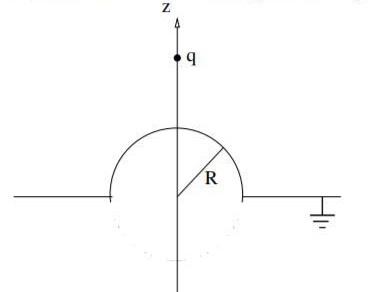
Today I gave a revision lecture/tutorial for my module Advanced Electromagnetism. With the Examination Period starting on Friday, that was the last class I will do for that. One of the topics I’ve been asked to cover in revision was the Method of Images for electrostatics. Preparing for the class I came across this cute problem which I thought I’d share here:
The question concerns a charge +q placed at a distance d as shown above an infinite earthed conducting plane distorted by the presence of a hemispherical bulge with radius R.
Using the method of images, or otherwise, calculate the potential at an arbitrary point above the conducting surface. (HINT: you need three image charges)
Find the magnitude and direction of the electrostatic force on the charge.
If you’re feeling keen you might also find what fraction of the total induced on the conductor is on the hemispherical part.
Answers through the comments box please!
Well, nobody posted an answer so here’s an outline solution.
To solve this problem you need three image charges: one is of charge – q at z=-d to make the plane an equipotential. For an isolated sphere you need a charge of -qR/d at z=-R^2/d (the inverse point of the sphere). But this charge also has an effect on the plane, which you need to correct by placing another image charge of +qR/d at z=-R^2/d. That is, the solution for the potential is due to the original charge plus three image charges. Then the potential is just the sum of four point charges.
You can differentiate the answer to the first bit to get the force, or you could work out the force on the original charge directly by adding the forces in the z-direction from the three image charges, it being obvious by symmetry that there is no other component of the force. For d>R this results in a force which is downward, so the charge is pulled towards the conductor. I’ll leave that as an exercise!
The views presented here are personal and not necessarily those of my employer (or anyone else for that matter).
Feel free to comment on any of the posts on this blog but comments may be moderated; anonymous comments and any considered by me to be vexatious and/or abusive and/or defamatory will not be accepted. I do not necessarily endorse, support, sanction, encourage, verify or agree with the opinions or statements of any information or other content in the comments on this site and do not in any way guarantee their accuracy or reliability.






 In the Dark